ScholarWorks @ Georgia State University
ScholarWorks @ Georgia State University
Business Administration Dissertations Programs in Business Administration
Summer 8-3-2014
The Impact of Psychological Contract Fulfillment on Employee
The Impact of Psychological Contract Fulfillment on Employee
Engagement in the Millennial Generation: The Moderating Effects
Engagement in the Millennial Generation: The Moderating Effects
of Generational Affiliation
of Generational Affiliation
Traron Moore
Follow this and additional works at: https://scholarworks.gsu.edu/bus_admin_diss
Recommended Citation Recommended Citation
Moore, Traron, "The Impact of Psychological Contract Fulfillment on Employee Engagement in the Millennial Generation: The Moderating Effects of Generational Affiliation." Dissertation, Georgia State University, 2014.
https://scholarworks.gsu.edu/bus_admin_diss/42
1
PERMISSION TO BORROW
In presenting this dissertation as a partial fulfillment of the requirements for an advanced degree
from Georgia State University, I agree that the Library of the University shall make it available
for inspection and circulation in accordance with its regulations governing materials of this type.
I agree that permission to quote from, to copy from, or publish this dissertation may be granted
by the author or, in his/her absence, the professor under whose direction it was written or, in his
absence, by the Dean of the Robinson College of Business. Such quoting, copying, or publishing
must be solely for the scholarly purposes and does not involve potential financial gain. It is
understood that any copying from or publication of this dissertation which involves potential
gain will not be allowed without written permission of the author.
2
NOTICE TO BORROWERS
All dissertations deposited in the Georgia State University Library must be used only in accordance with the stipulations prescribed by the author in the preceding statement.
The author of this dissertation is:
TRARON MOORE 989 FERN AVENUE SE ATLANTA, GEORGIA 30315
The director of this dissertation is:
SUBHASHISH SAMADDAR
DEPARTMENT OF MANAGERIAL SCIENCES
ROBINSON COLLEGE OF BUSINESS ADMINISTRATION GEORGIA STATE UNIVERSITY
i
The Impact of Psychological Contract Fulfillment on Employee Engagement in the Millennial Generation: The Moderating Effects of Generational Affiliation:
BY
TRARON NEAL MOORE
A Dissertation Submitted in Partial Fulfillment of the Requirements for the Degree
Of
Executive Doctorate in Business
In the Robinson College of Business
Of
Georgia State University
GEORGIA STATE UNIVERSITY ROBINSON COLLEGE OF BUSINESS
ii Copyright by Traron Neal Moore
iii
ACCEPTANCE
This dissertation was prepared under the direction of the TRARON NEAL MOORE’s Dissertation Committee. It has been approved and accepted by all members of that committee, and it has been accepted in partial fulfillment of the requirements for the degree of Doctoral of Philosophy in Business Administration in the J. Mack Robinson College of Business of Georgia State University.
H. Fenwick Huss, Dean
DISSERTATION COMMITTEE Dr. Subhashish Samaddar (Advisor) Dr. Kay Bunch
iv
TABLEOFCONTENTS ... IV
LISTOFTABLES ... VI
LISTOFFIGURES ... VII
ABSTRACT ... VIII
CHAPTERI–RESEARCHOBJECTIVE ... 1
Introduction ... 1
Motivation of the Study ... 2
Theoretical and Conceptual Framework ... 3
Research Question ... 4
Significance of the Study ... 4
CHAPTERII–LITERATUREREVIEW ... 5
What are psychological contracts?... 5
What are the major ways psychological contracts operate? ... 6
Have psychological contracts been shown to be impacted by age or generational affiliation? .. 7
What is employee engagement?... 9
Why does employee engagement matter?... 11
CHAPTERIII-METHODS ... 12
Model ... 12
Variance Model ... 13
Hypothesis... 14
Psychological Contracts and Employee Engagement ... 14
Moderating Influence of Generational Affiliation ... 16
Controls – Supervisory Status, Gender, and Tenure ... 18
Secondary Data Source ... 19
Participants ... 19
Measures ... 20
Dependent Variable - Employee Engagement ... 20
Independent Variable - Psychological Contracts ... 21
Moderator ... 22
Data Cleaning and Diagnostics ... 22
CHAPTERIV-RESULTS ... 24
Confirmatory Tests ... 26
Additional Data Analysis ... 28
Additional Data Analysis ... 28
CHAPTERV–DISCUSSION ... 32
Overview of Study ... 32
Implications... 34
v
Future Research ... 37
Conclusions ... 38
APPENDIXA–DEMOGRAPHICDATA ... 39
APPENDIXB–SURVEYITEMS ... 40
APPENDIXC–MODELASSUMPTIONSTESTING ... 45
APPENDIXD–SUPPORTINGSPSSOUTPUT ... 49
APPENDIXE–FULLFACTORANALYSIS ... 52
BIBLIOGRAPHY ... 57
vi
LIST OF TABLES
TABLE 1.GENERATIONAL GROUPINGS ... 7
TABLE 2.GENERATIONAL DIFFERENCES (STEELCASE,2008) ... 9
TABLE 3.REPRESENTATIVE DEFINITIONS OF EMPLOYEE ENGAGEMENT ... 10
TABLE 4.DESCRIPTIVE STATISTICS AND CORRELATIONS FOR STUDY VARIABLES ... 24
TABLE 5.RESULTS OF HIERARCHICAL REGRESSION ANALYSES FOR EMPLOYEE ENGAGEMENT .... 25
TABLE 6.FACTOR ANALYSIS PSYCHOLOGICAL CONTRACTS ... 30
vii
LIST OF FIGURES
FIGURE 1.PSYCHOLOGICAL CONTRACT/EMPLOYEE ENGAGEMENT CO-VARIATION MODEL ... 12
FIGURE 2.HYPOTHESIZED DIRECTION OF CO-VARIATION ... 13
FIGURE 3.REGRESSION MODEL FOR MILLENNIALS ONLY ... 26
FIGURE 4.REGRESSION MODEL FOR NON-MILLENNIALS ... 27
viii ABSTRACT
The Impact of Psychological Contract Fulfillment on Employee Engagement in the Millennial
Generation: The Moderating Effects of Generational Affiliation:
BY
TRARON NEAL MOORE
April 28, 2014
Committee Chair: Dr. Subhashish Samaddar
Major Academic Unit: Managerial Sciences
Prior empirical and theoretical research suggests that engaged employees are more
productive and, in turn, those companies are more successful. The present study empirically
examines the relationship between psychological contract fulfillment and employee engagement.
It also examines whether Millennial generational affiliation moderates this relationship. The
study uses archived secondary data of a major U.S. retail chain where the employees rated
themselves on various items including psychological contract fulfillment items and employee
engagement items. Two hypotheses were developed and tested while controlling for employee
tenure, supervisory status and gender. Hierarchical regression was used to determine the extent
of the relationship between psychological contract fulfillment in predicting employee
engagement and to assess whether Millennial generational affiliation moderated the relationship.
ix
and can predict 49.9% (p<.001) of the variance in employee engagement. Results also suggest
that Millennial generational affiliation, when compared with other generational cohorts, does not
in a statistically significant amount, moderate the relationship between psychological contract
1 Introduction
Employee engagement has been empirically linked to organizational commitment (Saks,
2006), role performance (Rich, LePine, & Crawford, 2010) and theoretically to productivity
(Irvine, 2009; Masson, Royal, Agnew & Fine, 2008). In 2013 empirical research emerged
indicating that employee engagement is associated with psychological contracts (Bal, Kooij, &
DeJong, 2013; Chang, Hsu, Liou, & Tsai, 2013). Rousseau (1989) defined psychological
contracts as the beliefs that are held by an individual regarding what they owe the organization,
and what the organization owes them. Thus, fulfillment of employer promises, obligations, and
commitments increases employee engagement (Coffman & Gonzalez-Molina, 2002; Bal et al.,
2013; Chang et al., 2013). Chang et al. (2013) and Bal et al. (2013) empirically demonstrated
that an increase in psychological contract fulfillment is related to an increase increase in
employee engagement. Current research on the relationship between psychological contracts and
employee engagement is silent as to whether generational affiliation is a factor in this
relationship (Bal et al. 2013; Chang et al. 2013).
Researchers propose that associated positive behaviors (Bal et al., 2013; Chang et al.,
2013) resulting from a positive “affective –motivational” state of mind (p.2122) are of great
importance to the business. As the greying workforce retires, organizations will have to rely on
younger employees to fill the void left by older retiring employees. Researchers propose that
Millennial employees have less employor centric attitudes towards work (Shaw & Fairhurst,
2008). As such, there is value in understanding the relationship of psychological contracts to
employee engagement (Maxham, Netemeyer, Lichtenstein, 2008; Saks, 2006; Witemeyer, 2013).
fulfillment empirically as it relates to employee engagement in an American retail setting and,
(2) to extend the understanding of this relationship by examining whether generational affiliation
has a statistically significant moderating effect; specifically,with regard to the Millennial
generation versus all other generational cohorts.
Motivation of the Study
Employee engagement has received much popular press in the past few years (Britt,
2003; Irvine, 2009; Kruse, 2012; Macey & Schneider, 2008a; Mastrangelo, 2009). In Follow
This Path, Gallop consultants Coffman and Gonzales-Molina (2002) estimate that more than
$253 billion worldwide are lost annually because low or inadequate employee engagement.
Although this is an estimate, even if it is over-estimated by $200 billion, this is not a trivial
concern. Another phenomenon occurring simultaneously to the low levels of employee
engagement in the workforce is that the composition of the workforce is changing. Millennials
are quickly entering the workforce at a time when the Baby Boomer generation (i.e., those
individuals born between 1946 and 1964) is beginning to exit the workforce (Meister & Willyerd,
2010). By 2020 Millennials are projected to constitute more than 50% of the workforce (Meister
& Willyerd, 2010). In 2020 Baby Boomers (then age 56-74) continue their exit from the
workforce, the employee engagement levels of Millennials (then age 26- 41) will become
increasingly important as they become the majority of the workforce. Evaluating and better
understanding the relationship between Millennial employees and their employer could provide
valuable insight into Millennial work behaviors (Rousseau, 1989; Kahn, 1990; Rousseau, 1994;
Sels, Janssens &van den Brande, 2004). Understanding to what extent psychological contract
employee engagement may be critical in garnering the positive behaviors associated with
employee engagement.
Theoretical and Conceptual Framework
This is an exploratory study that examines the extent to which generational affiliation
(GA) is related to psychological contract fulfillment (PCF) and employee engagement (EE).
Three distinct strains of literature will be used as a theoretical foundation. Employee engagement
serves as the first stream of literature for the current project, as an understanding of the
antecedents and consequences of employee engagement is of essential. The second theoretical
element is psychological contracts. While psychological contracts have been studied extensively
(Aggarwal, Datta, & Bhargava, 2007; Rousseau, 1989; Sels et al., 2004), research with respect to
how they impact employee engagement is limited (Chang et al., 2013; Bal, et al., 2013).
Literature on generational cohorts represents the third and final theoretical element. This study
seeks to have a better understanding of the relationship generational affiliation has with the
psychological contract – employee engagement relationship.
Lyons and Kuron (2014) describe generational affiliation as a group of people born
within the same “historical and socio-cultural contexts who experienced the same formative
experiences and develop unifying commonalities (p. 141).” The statement “unifying
commonalities” states that there are similarities but also suggest differences among generational
cohorts. Millennials (those born about 1979 -1994) matured during the birth of the Internet and
the globalization of society (Debevec, Schewe, Madden, & Diamond, 2013). The psychological
contract fulfillment and employee engagement relationship is expected to vary, in a statistically
streams helps to identify a gap in the literature that this study seeks to address in the research
question posed below.
Research Question
To what extent is psychological contract fulfillment related to employee engagement in
the Millennial generation compared to other generations in a retail environment?
Significance of the Study
The significance of this study is twofold. From an academic standpoint there are no
published papers exploring the empirical relationship between psychological contract fulfillment
and employee engagement as moderated by generational affiliation. As recently as December
2013, Festing and Schafer call for an empirical study of the moderating effect of generational
affiliation on psychological contract fulfillment as it relates to “engaged TM [talent
management] practices” (p. 268). This is noteworthy as it implies that generational affiliation
may function as a moderator, separate and apart from any direct effects that generational
affiliation might explain. From a practical standpoint, understanding the relationship between
employee engagement, psychological contract fulfillment and generational affiliation will assist
5
To aid in the exploration of psychological contract, generational affiliation and employee
engagement, a subset of literature has been selected based on its relevance to the following
questions:
1. What are psychological contracts?
2. What are the major ways psychological contracts operate?
3. Have psychological contracts been shown to be impacted by age or generational
affiliation?
4. What is employee engagement?
5. Why does employee engagement matter?
To answer these questions, a review of relevant peer reviewed journal articles,
government reports, and articles from popular press were completed. This review focuses on
major advances and connections made within them.
What are psychological contracts?
Menninger (1958) first coined the term psychological contract to describe the reciprocal
relationship between a treating therapist and his or her patient. Argyris (1960) extended the term
to employee expectations in the workplace. Levinson, Price, Munden, Mandl, and Solley (1962)
expanded the idea of the psychological contract to include “unwritten contracts” and all
“unwritten” expectations between the employer and the employee (p. 22). Schalk and Roe (2007),
noted that psychological contracts are, largely, “implicit and unspoken”, (p. 167). Levinson et al.
(1962) and Schein (1965) expand the concept of psychological contracts by adding that
psychological contracts could contain both tangible and mental expectations regarding resources.
between the individual and the organization regarding what each is to give and receive. Schein
(1980) posits that there is an inseparable and complex interaction between the employee and
organization and that the interaction can be managed. This is the first indication that
psychological contracts have strategic value. These assertions set the foundation for Rousseau
and her research on psychological contracts.
Rousseau’s (1989) seminal work defined psychological contracts as the beliefs that are
held by an individual regarding employee and employer reciprocity. The author renewed interest
in the study of psychological contracts by slightly adjusting the definition from expectation to
owe. This definition implies that each party understands and accepts that the relationship is based
on contributions to the other. Rousseau highlights the construct as individually subjective (1989).
This means that there may be differences between what the employee expects and what the
company or manager believes has been promised. The difference of understanding ignited
research regarding employee reactions based on fulfillment and breach of psychological contract.
What are the major ways psychological contracts operate?
When promises are kept or expectations met, individuals consider psychological
contracts fulfilled (Rousseau, 1989; Kickul & Lester, 2001). Using Rousseau’s (1989) definition,
a psychological contract violation, or breach, is denoted by a failure to meet the expectations of
one of the parties. When an employee receives what they expect, it creates a potential reaction in
attitude and/or behavior (Kickul & Lester, 2001). Hess and Jepsen (2009) demonstrated that
there is a relationship between psychological contract fulfillment and three cognitive responses:
satisfaction, commitment, and turnover intention. Levels of fulfillment at work have also been
shown to impact emotional attachment, affect and the desire to remain with the organization
restore balance (Ng & Feldman, 2009). Ng and Feldman (2009) note that “employees may
reduce loyalty and trust, withdraw their efforts and contributions (p. 1056).”
Have psychological contracts been shown to be impacted by age or generational affiliation?
Generational affiliation speaks to the generation or year grouping in which people are
born. It is well accepted that there have been six generational designations over the past 100
years. These generational designations are as follows: G.I. Generation; Silent Generation (also
known as Matures); Baby Boomers; Generation X; Millennials (also known as Gen Y), and New
Silent Generation (sometimes referred to as Generation Z). These groupings are shown in Table
1. The generational groupings serve as a model for understanding how group members may
behave, think, or feel as a function of their generational affiliation, especially when one
considers how technological advances, economics, politics, and social conventions can guide the
norms, behaviors, and expectations of the various generations (DelCampo, Haggerty, Haney &
[image:19.612.165.447.448.558.2]Knippel, 2010).
Table 1. Generational Groupings
Previous generations have clearly defined beginning and end years. However, the
literature concerning the beginning and end-points of Generation X, Millennials, and the New
Silent Generation tends to use about terms and approximations with regard to birth years and
ranges (Deal, Stawiski, Gentry, Graves, Weber & Ruderman, 2013; Smola & Sutton, 2002).
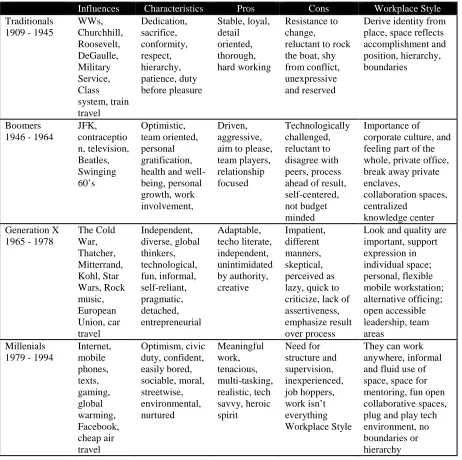
Table 2 is adapted from Steelcase (2008) and summarizes the various traits of the six different
Generation Associated Birth Years
G.I. Generation 1900 - 1924
Silent Generation 1925 - 1945
Baby Boom 1946 - 1964
Generation X 1965 - ~1978
Millenial ~1979 - ~ 1994
generations in question. Table 2 also incorporates the work of Twenge (2010) and Smola and
Sutton (2002) regarding work attitudes, values and expectations.
As can be seen in Table 2, Millennials (those born between 1979 and 1994) are different
from their predecessors. The Millennials use different idioms, have different beliefs and values,
and have a higher technology requirement (Deal, 2007; Shaw & Fairhurst, 2008) as compared to
previous generations. Millennials are tech-savvy and quickly integrate technological advances
into their daily lives. Research has demonstrated that in general, Millennials see the world
differently than other generations, especially since Millennials believe that only your parents
love you unconditionally and that you should find passion in your work (Hill, 2002). Millennials
have a higher external locus of attribution and narcissism than previous generations (Twenge,
Konrath, Foster, Campbell, & Bushman, 2008); believing that if, they work within the guidelines
that success will follow.
The research of Ng and Feldman (2009) posits that age may play a role in moderating
response to psychological contract breach. In their research, they divide workers into two
categories: older (more than 40) and younger (less than 40). They propose that age has an impact
on the flexibility of employees to change their expectation with regard to psychological contracts.
In 2009, Hess and Jepsen empirically demonstrated that, with regard to relational and
transactional psychological contracts, Baby Boomers were substantially statistically higher than
Generation X. There were no statistically significant differences found between Millennials and
Baby Boomers. They also demonstrated that transactional psychological contract affinity was
higher for baby boomers than for Millennials. Hess and Jepson concluded that Millennials “may
275). This is noteworthy, and corroborative to Hill’s (2002) work, as it implies that Millennial
[image:21.612.75.537.153.613.2]employees may expect less from organizations than other generations to begin with.
Table 2. Generational Differences (Steelcase, 2008)
What is employee engagement?
Employee engagement has been criticized as being nothing more than consultant speak,
or a poorly defined construct (Little & Little, 2006). However, employee engagement can be
defined as a construct that consists of cognitive, emotional, and behavioral components that are
Influences Characteristics Pros Cons Workplace Style Traditionals
1909 - 1945
WWs, Churchhill, Roosevelt, DeGaulle, Military Service, Class system, train travel Dedication, sacrifice, conformity, respect, hierarchy, patience, duty before pleasure Stable, loyal, detail oriented, thorough, hard working Resistance to change,
reluctant to rock the boat, shy from conflict, unexpressive and reserved
Derive identity from place, space reflects accomplishment and position, hierarchy, boundaries
Boomers 1946 - 1964
JFK, contraceptio n, television, Beatles, Swinging 60’s Optimistic, team oriented, personal gratification, health and well-being, personal growth, work involvement,
Driven, aggressive, aim to please, team players, relationship focused Technologically challenged, reluctant to disagree with peers, process ahead of result, self-centered, not budget minded
Importance of corporate culture, and feeling part of the whole, private office, break away private enclaves,
collaboration spaces, centralized
knowledge center Generation X
1965 - 1978
The Cold War, Thatcher, Mitterrand, Kohl, Star Wars, Rock music, European Union, car travel Independent, diverse, global thinkers, technological, fun, informal, self-reliant, pragmatic, detached, entrepreneurial Adaptable, techo literate, independent, unintimidated by authority, creative Impatient, different manners, skeptical, perceived as lazy, quick to criticize, lack of assertiveness, emphasize result over process
Look and quality are important, support expression in individual space; personal, flexible mobile workstation; alternative officing; open accessible leadership, team areas Millenials 1979 - 1994
Internet, mobile phones, texts, gaming, global warming, Facebook, cheap air travel Optimism, civic duty, confident, easily bored, sociable, moral, streetwise, environmental, nurtured Meaningful work, tenacious, multi-tasking, realistic, tech savvy, heroic spirit Need for structure and supervision, inexperienced, job hoppers, work isn’t everything Workplace Style
associated with individual role performance and subsequent commitment (Rich et al., 2010; Saks,
2006). In general, employee engagement centers on employee behavior and its action towards
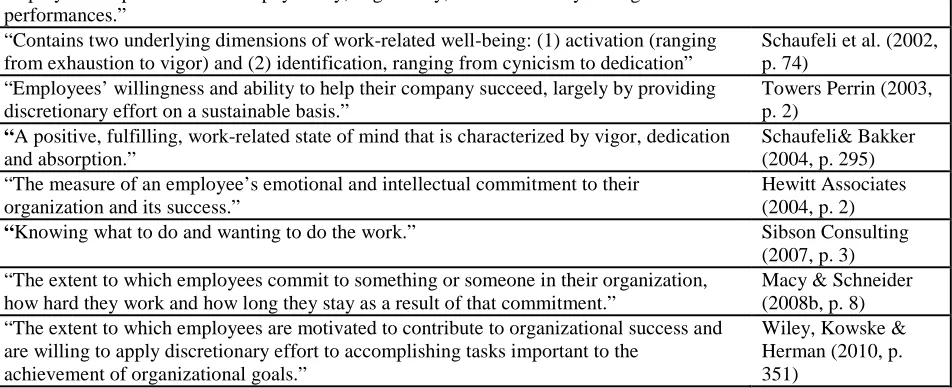
meeting organizational goals (Shuck & Wollard, 2010). Table 3 below details representative
[image:22.612.70.546.241.435.2]selection of employee engagement definitions.
Table 3. Representative Definitions of Employee Engagement
Definition Source
“The harnessing of organization members’ selves to their work roles; in engagement people employ and express themselves physically, cognitively, and emotionally during role performances.”
Kahn (1990, p. 694)
“Contains two underlying dimensions of work-related well-being: (1) activation (ranging from exhaustion to vigor) and (2) identification, ranging from cynicism to dedication”
Schaufeli et al. (2002, p. 74)
“Employees’ willingness and ability to help their company succeed, largely by providing discretionary effort on a sustainable basis.”
Towers Perrin (2003, p. 2)
“A positive, fulfilling, work-related state of mind that is characterized by vigor, dedication and absorption.”
Schaufeli& Bakker (2004, p. 295) “The measure of an employee’s emotional and intellectual commitment to their
organization and its success.”
Hewitt Associates (2004, p. 2) “Knowing what to do and wanting to do the work.” Sibson Consulting
(2007, p. 3) “The extent to which employees commit to something or someone in their organization,
how hard they work and how long they stay as a result of that commitment.”
Macy & Schneider (2008b, p. 8) “The extent to which employees are motivated to contribute to organizational success and
are willing to apply discretionary effort to accomplishing tasks important to the achievement of organizational goals.”
Wiley, Kowske & Herman (2010, p. 351)
Despite the popularity of the term, there is no agreement on the meaning of employee
engagement. Definitions range from “wanting to do the work” (Sibson Consulting, 2007) to
specific degrees of “work related well-being.” In the latter, “work related well-being,” words like
like “vigor” and “cynicism” are used to describe it (Schaufeli, Salanova, Gonzalez-Roma, &
Bakker, 2002). Consistent among these definitions, however, is the idea is that the way
employees feel (emotional state) is related to their desire to act (cognitive state). More
specifically, engaged employees will put effort towards meeting what they understand the
organizational goals to be. For the purpose of this project, employee engagement will be defined
contribute to organizational success and are willing to apply discretionary effort to
accomplishing tasks important to the achievement of organizational goals” (p. 351). Thinking of
employee engagement as motivation to do more than the minimum captures the core of this
construct and calls attention to the emotional/cognitive link. By operationally defining employee
engagement in this way, it becomes clear that there is value to organizations in monitoring levels
of employee engagement and learning how to influence levels of employee engagement.
Why does employee engagement matter?
Findings suggest The consequences of high levels of employee engagement are higher
job satisfaction, higher organizational commitment, lower intention to quit and higher
organizational citizenship behaviors as empirically demonstrated.(Saks, 2006). Shuck, Reico,
and Rocco (2011) condense these consequences of employee engagement into two succinct
categories: intentional turnover and discretionary effort. Intention to turnover is viewed as the
desire to either leave the organization or stay with the organization, whereas discretionary effort
is defined as an employee’s behavior in completing a task that goes beyond the minimum
requirements to complete the task (Lloyd, 2008). Coffman and Gonzalez-Molina (2002) estimate
that a lack of employee engagement accounts for more than $253 billion of world-wide loss,
12 Model
In order to investigate the primary research question as to what extent does psychological
contract fulfillment positively or negatively impact the level of employee engagement in the
Millennial generation as compared to other generations in a retail environment, a variance model
will be used. A variance model approach will be taken as the interest is in understanding how a
change in one variable (psychological contracts) is related to a change in another variable
(employee engagement), allowing for the moderating effect of generational affiliation.
In this model, it is expected that a covariation between the constructs of psychological
contracts and employee engagement will be moderated by generational affiliation. By using
psychological contracts as the independent variable and employee engagement as the dependent
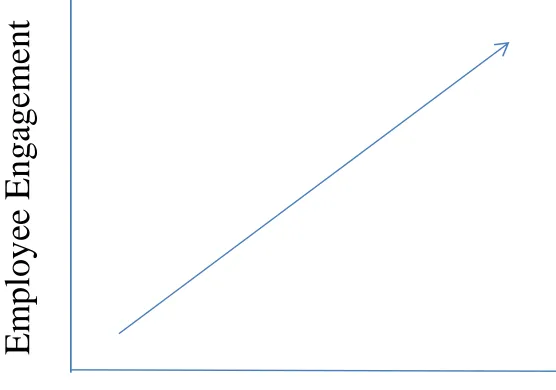
[image:24.612.123.492.290.555.2]psychological contracts, an increase in employee engagement will occur. Figure 2 below
provides a graphical representation of this hypothesized relationship.
Variance Model
Key Elements
There are six key elements in the variance model according to Van De Ven (2007):
• Fixed entities with varying attributes;
• Explanations based on efficient causality;
• Generality depends on uniformity across contexts;
• Time ordering among independent variables is immaterial;
• Emphasis on immediate causation;
• Attributes have a single meaning over time.
In determining whether the variance model is the appropriate model to use, the six
[image:25.612.124.402.138.333.2]preceding criteria were reviewed. In reviewing the first criteria, fixed entity with varying Figure 2. Hypothesized Direction of Co-Variation
E
m
pl
o
y
ee
E
nga
ge
m
ent
attributes - it is acknowledged that the construct of employee engagement is related to, not only,
the construct under review (psychological contracts), but also to others not under consideration.
Although other variables impact employee engagement, it is posited that there exists efficient
causality between psychological contracts and employee engagement to support the model.
Relationships between variables exist when a predictor variable relates directly to a
dependent variable and is associated with a change in the dependent variable. This study will
investigate whether psychological contracts and employee engagement function in that way, with
the boundary conditions being the generation under consideration (i.e. Millennials), a retail
setting, given the that geographic/cultural condition is confined to the USA. The boundary
conditions are set as such, as it is posited that this model is only generalizable to the greater
population of the United States.
Lastly, the model’s variables will have fixed definitions and will continue to use the
definitions provided at the beginning of the study. Upon reviewing the attributes of a process
model, it becomes apparent that a variance model is the most logical choice for the empirical
investigation of the proposed research question.
Hypothesis
Psychological Contracts and Employee Engagement
Kahn (1990) empirically connects role performance to the employees’ emotional and
psychological state. He described his study as having the premise that “people can use varying
degrees of their selves, physically, cognitively, and emotionally, in work role performances…”
(p. 692). Kahn’s statement foretells a later connection between psychological contracts and the
Although Argyris (1960) was first to use the term psychological contract in the context of
work, Rousseau (1989, 1994, and 2000) is credited with developing the seminal empirical work
on the topic. From Rousseau’s work, we understand that psychological contracts speak to the
informal expectations held by both the employee and the employer – terming them fulfilled when
kept and violated or breached when broken. Later, Rousseau and Wade-Benzoni (1994) would
introduce four forms of contracts: transactional, transitional, balanced, and relational. These
types of psychological contracts underpin the way employees and employers understand the
work relationship. Interestingly, Rousseau and Tijoriwala (1998) in their discussion on the
quantitative assessment of psychological contracts note that an employee may report a violation
and still report a degree of fulfillment (p. 690- 691). This suggests that employees evaluate the
psychological contracts in a cumulative fashion. This variable treatment of the psychological
contract construct extended to the creation of global measures of the construct (Rousseau &
Tijoriwala, 1999), which Rousseau (2000) included in her Psychological Contract Inventory
(PCI).
The indication that psychological contracts have a cognitive and/or emotional aspect
which can then be globally measured is noteworthy. This is important to the present research
since employee engagement has also been defined as having emotional/cognitive aspects (Table
Table 3 reveals a common theme among employee engagement writers; that there is an
emotional, cognitive, and behavioral component to the construct. Of particular interest are the
emotional and cognitive components. Words like affect, feel, cognitive and emotional have been
used to describe psychological contracts and employee engagement. It is the
emotional-cognitive aspect that connects employee engagement and psychological contracts. It is through
the relatedness of the constructs that this study seeks to find an empirical relationship.
This study posits that employee engagement and psychological contracts, being impacted
by aspects of the same core components (emotion and cognition), may thereby have an impact on
each other. As such, the following in hypothesized.
H1: An employee’s perceived psychological contract fulfillment is positively related to the employee’s level of employee engagement.
Moderating Influence of Generational Affiliation
Having reviewed the relationship between psychological contracts and employee
engagement it becomes apparent that these constructs are created through the subjective
reflection/reaction of the individual, being based on what the employee thinks and feels.
Contained within the notion that the relationship is subjective is the suggestion that it is also
contextual. This implies that other factors, such as contextual factors, may related to the
psychological contract- employee engagement relationship.
Within this contextual operation of psychological contracts and employee engagement,
this study seeks to investigate whether generational affiliation, as a contextual factor, has an
impact on that relationship. In examining the potential for generational affiliation, as a contextual
factor, to moderate the psychological contract-employee engagement relationship, it is necessary
employee engagement and (b) are subject to moderation based on generational affiliation.
Cognitive and emotional components are present in both psychological contracts and employee
engagement. The question then becomes as to whether these components are moderated by
generational affiliation?
In reviewing the literature, researchers are studying psychological contracts, their
components and attempting to understand the impact of age (Ng & Feldman, 2009). Ng and
Feldman (2009) refer to the work of cognitive emotional neuroscience researchers. The
neuroscience research of Isaacowitz and Riediger (2011) state that it should not be taken for
granted that age will moderate all cognition/emotion links. However, this work suggests that
there are differences in older versus younger workers based on how they perceive and process
information. Other research (Costanza, Badger, Fraser, Severt, & Gade, 2012) suggests no
statistically significant differences between generations regarding work-related outcome.
Recalling that between psychological contracts and employee engagement are relational contexts
which assists in explicating the inconsistencies among studies.
According to available research on Millennials, there is the suggestion that this
generational cohort should respond differently to psychological contract failures. This statement
is based on a documented need for fairness and civic duty (Holt, Marques & Way, 2012). It is
proposed, that because of the need for fairness and civic duty, Millennials will generate
statistically significant differences with regard to the emotional and cognitive links associated
with employee engagement scores among the generational cohorts - specifically showing a
stronger reaction in Millennials to psychological contract fulfillment - than in other generational
cohorts.
contract fulfillment will relate more strongly on employee engagement among Millennials than other generations.
Controls – Supervisory Status, Gender, and Tenure
The literature suggests (Aggarwal et al., 2007; Bal et al., 2013; Deal et al., 2013) that
there are may be several variables which impact the relationship between psychological contracts
and employee engagement. In particular, it is expected that generational affiliation, tenure,
gender, and supervisory status will effect employee engagement. This study focuses on the
impact of generational affiliation in the relationship between psychological contract fulfillment
and employee engagement. As such, employee engagement has been identified as the dependent
variable, with psychological contracts being the independent variable. Supervisory status, gender
and tenure have been identified as control variables. Work by Deal et al. (2013) that focused on
Baby Boomers and Generation X, and work by James, McKechnie, and Swanberg (2011), who
focused on older versus younger workers, confirmed that levels of employee engagement may be
impacted by age. Specifically, research has shown that age and tenure will co-vary (Costanza et
al., 2012). This potential covariation could create a potential issue of multicollinearity. To avoid
this, tenure will be controlled for. Although the literature is not in agreement as to why
supervisory status matters; the literature is clear that it does (Deal, et al., 2013). Deal (2013) does
go on to say that some effects that are attributed to age could potentially have been done so
incorrectly. The author states that supervisory status through tenure being ultimately reflected in
generational affiliation may be the culprit. The research demonstrates that supervisory status
with the organization and therefore increased age could account for some of the differences in
work attitudes. To isolate generational affiliation - tenure and supervisory status will also be
Secondary Data Source
The retail industry was selected for this study. The US Census Bureau (2013) reports US
retail sales to have been more than $4.5 trillion in 2013, making it a substantial portion of the US
economy and therefore important to understand better. In cooperation with a major US retailer,
data from the organization’s Employer of Choice (EOC) survey was obtained. The organization
collected the data from May 2013 through August 2013. Their survey included items relevant to
the current study. These items included employee engagement measures, global psychological
contract measures, and age groups. Given the retailer’s strong desire to maintain the
confidentiality of participants, the identity of the participants and the identity of the company are
not shared as part of this project. The retailer that distributed the questionnaire to its employees
is a large organization, with more than 280,000 employees nationwide. In order to manage such a
massive operation, the organization is divided into regions. Those regions are then divided into
divisions and districts, respectively. To achieve successful administration of the annual
Employer of Choice survey, the organization surveys approximately 10-15 districts per month.
Participants
According to the United States Department of Labor (2014), there were 4,668,300 retail
sales workers in the United States in 2012. Given a .80 power and α=.05, a sample size of at
least 385 participants is required to produce statistically significant results.
The data set consisted of 101,884 participants out of the organization’s 281,054
employees. This represents a crude response rate of 36.3 percent. The sample of employees who
participated in the survey is representative of the organization with respect to a number of key
demographic characteristics such as status, age, tenure, race, and gender. The sample consisted
18- to 24-year-old category (17.9%) or the 45- to 54-year-old category (16.3 %) and were male
(60.3%). There were no survey participants younger than 18. Located in Appendix A is a more
detailed description of survey demographic data and organization demographic data.
The organization collected information from current employees on basic demographic
information, workplace attributes, managerial efficiency, peer relationships, and overall
satisfaction with their job. Included in the survey were questions about psychological contract
fulfillment from both the employee and employer perspective (see Appendix B for the complete
survey). Although there were 96 items on the entire questionnaire, it is important to note that
none of the questions required an answer. In other words, if the employee wished to skip a
question, they were able to do so with no penalty. The survey was administered in an employee
only section of the retail outlet and was computer-based. Surveys were administered in English,
with an option of taking it in Spanish. The organization gave employees approximately one hour
to complete the computer-based survey.
Measures
Dependent Variable - Employee Engagement
There is no universally accepted measurement for employee engagement. Moreover,
there is still much disagreement about what employee engagement actually is. There are
questions regarding whether it is personal or organizational (Macey & Schneider, 2008a; Saks,
2006), whether it has core components (Dalal, Brummel, Wee, & Thomas, 2008; Schaufeli,
Salanova, Gonzalez-Roma, & Bakker, 2002; Shuck et al., 2011) and whether it is permanent or
temporary (Dalal et al., 2008). Employee engagement measures, at best, estimate antecedent
levels of constructs theorized to contribute to employee engagement. Pride, job satisfaction,
engagement. Those factors are sometimes used to create subcategories of measurement to
achieve complex employee engagement measures. This project does not seek to investigate
employee engagement measures, but rather to understand if employee engagement, in the
broadest sense, is related to the interaction of generational affiliation on the dependent variable
of psychological contracts. The Kenexa Employee Engagement Index (Wiley et al., 2010) was
used to measure the four facets of employee engagement. This index contains the four facets core
to employee engagement, which includes: (1) pride, (2) satisfaction, (3) commitment, and (4)
advocacy. Each item was rated on a 5-point Likert scale (1= Strongly Disagree/Very
Dissatisfied; 5= Strongly Agree/Very Satisfied). The relevant items included from the survey
were the question that measured pride (I am proud to work for “Organization”), satisfaction
(Considering everything, how would you rate your overall satisfaction with “Organization” at the
present time?), commitment (I rarely think about looking for a new job with another company),
and advocacy (I would recommend “Organization” as a great place to work). Wiley et al. (2010)
reported an internal reliability alpha of .91 as part of their study. In the current study, alpha
reliability for the index was .86. An aggregate variable was computed by taking the average of
the four facets: pride, satisfaction, commitment and advocacy. The new aggregate variable was
labeled employee engagement (EE).
Independent Variable - Psychological Contracts
The Psychological Contract Inventory (PCI) (Rousseau, 2000) is a psychometric
instrument used to assess an individual’s belief between that person and another party; in this
case, an employer (Rousseau, 1989). The items used to measure global Psychological Contract
fulfillment included questions on employer fulfillment (Overall, how well does your employer
In the current study, an adaptation of the aforementioned employer fulfillment items were used
to assay psychological contract fulfillment as understood by the employee’s evaluation of the
employer. Specifically, employer fulfillment was measured via three items: In thinking about
the commitment Organization has made to me, Organization has kept these commitments; In
general, Organization lives up to the promises it makes to me; Most times Organization keeps
the obligations it has made to me. Each item was rated on a 5-point Likert scale (1= Strongly
Disagree/Very Dissatisfied; 5= Strongly Agree/Very Satisfied). The items, which were labeled
PC4, PC5, and PC6 respectively, were the sole measures of psychological contract fulfillment.
The alpha reliability coefficient for the index was .96. The correlations for the items PC4, PC5
and PC6 were above .85. They were collapsed into a single item (Global PC) to avoid any
problems with multicollinearity.
Moderator
Age, PC4, PC5 and PC6 were self-reported by respondents. PC4, PC5 and PC6 were
measured as continuous variables using a Likert scale. Although age was initially captured as a
continuous variable, it was dummy-coded for the purposes of producing the dummy-coded
variable Generational Affiliation (GA) for analyses. Millennials, those ages 18-34, were the
youngest group and were coded 0, with all other older age groups being coded 1. The moderator
variable, “Generational Affiliation x Global PC” was then calculated as the product of the
centered Global PC variable and Generational Affiliation (Miles & Shelvin, 2001).
Data Cleaning and Diagnostics
Assumptions for the multiple regression were tested (Field, 2009). Correlations between
all variables did not exceed .90, indicating singularity and the absence of multicollinearity.
the absence of multicollinearity. Evaluation of the scatterplot supports a homoscedastic and
linear relationship. In the Normal P-P Plot, the points lie in a nearly straight line. This suggests
no major deviation from normality. The Mahalanobis distances that were produced as a part of
the regression calculation did contain values slightly above the critical value assigned to the
number of variables in this study. However, given the size of the dataset, it would not be unusual
for it to contain outliers (Pallant, 2007). Moreover, Cook’s Distance suggests that these outliers
do not have an inordinate influence on the results of the model as a whole. The last assumption
of multiple regression is sample size. The sample size used in this study is sufficient for the
purposes of regression (Field, 2009; Pallant, 2007). During analysis, cases with missing values
were excluded listwise, resulting in a sample of 62,046. Supporting SPSS output is presented in
24
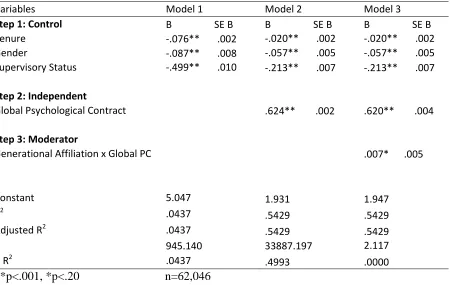
The data were analyzed using Pearson Correlation and hierarchical multiple regression.
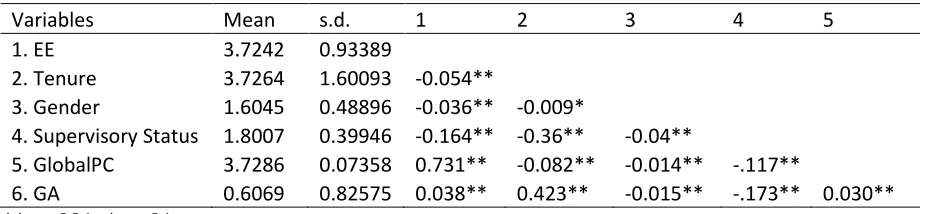
Descriptive statistics and correlations for the study variables are presented in Table 4. Table 5
presents the results of the hierarchical regression analyses for employee engagement. The
variables and moderator were entered into the hierarchical regression in three steps. The control
variables of tenure, gender and supervisory status were entered first. The variable which
measured Global Psychological Contract was added in the second step. The moderator,
Generational Affiliation x Global PC, was added in the last step. The control variables did not
explain a large portion of variance in the dependent variable of employee engagement. All
controls (tenure, gender and supervisory status) accounted for approximately 4.4% (p<.001) of
the variance in employee engagement (Table 5, Model 1).
Hypothesis 1 posited that an employee’s perceived psychological contract fulfillment is
positively related to the employee’s level of employee engagement. This hypothesis was
supported (Table 4; Table 5, Model 2). The bivariate correlation coefficient revealed that
employee engagement and GlobalPC were statistically significantly and positively related (r=.73,
p<.001). Follow-up analysis using hierarchical multiple regression indicates that GlobalPC
(β=.624, p<.001) was related to the dependent variable, further supporting the hypothesized
[image:36.612.71.534.591.698.2]relationship.
Table 4. Descriptive statistics and correlations for study variables
Variables Mean s.d. 1 2 3 4 5
1. EE 3.7242 0.93389
2. Tenure 3.7264 1.60093 -0.054**
3. Gender 1.6045 0.48896 -0.036** -0.009*
4. Supervisory Status 1.8007 0.39946 -0.164** -0.36** -0.04**
5. GlobalPC 3.7286 0.07358 0.731** -0.082** -0.014** -.117**
6. GA 0.6069 0.82575 0.038** 0.423** -0.015** -.173** 0.030**
The result of step 2 indicated that the variance accounted for with the controls (tenure,
gender and supervisory status) and the independent variable of Global PC equaled 54 percent of
[image:37.612.78.528.205.490.2]the variation in the dependent variable (adjusted R2=.54, p<.001).
Table 5. Results of Hierarchical Regression Analyses for Employee Engagement
Variables Model 1 Model 2 Model 3
Step 1: Control B SE B B SE B B SE B
Tenure -.076** .002 -.020** .002 -.020** .002
Gender -.087** .008 -.057** .005 -.057** .005
Supervisory Status -.499** .010 -.213** .007 -.213** .007
Step 2: Independent
Global Psychological Contract .624** .002 .620** .004
Step 3: Moderator
Generational Affiliation x Global PC .007* .005
Constant 5.047 1.931 1.947
R2 .0437 .5429 .5429
Adjusted R2 .0437 .5429 .5429
F 945.140 33887.197 2.117
Δ R2 .0437 .4993 .0000
**p<.001, *p<.20 n=62,046
Hypothesis 2 states that generational affiliation will moderate the relationship between
psychological contract fulfillment and employee engagement. Specifically, this hypothesis
proposed that the effects of psychological contract fulfillment among Millennials will be stronger
on employee engagement than other generations. As can be seen in Model 3 of Table 5, this
hypothesis appears to be initially supported by the data, as the coefficient for the variable is
statistically significant (β=.007, p<.01). However, the addition of the moderator in step 3 had no
statistically significant impact on the overall predictive efficacy of the regression model. The
to .0000 and was not statistically significant. As such, it must be concluded that there is no
support for the second hypothesis.
Confirmatory Tests
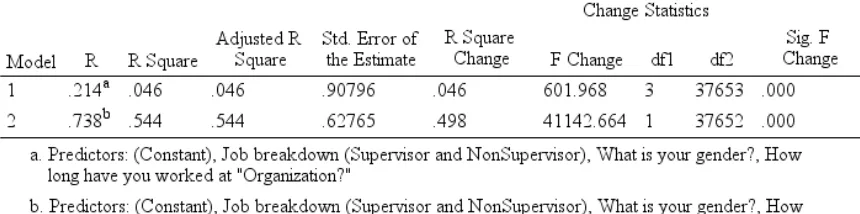
Initial analysis yielded strong results for H1 and statistically insignificant results for H2.
A battery of confirmatory tests was completed to ensure accurate reporting. The first, in the
battery of confirmatory tests, was to split the sample based on Millennial and non-Millennial
status. Then, test the relationship between psychological contract and employee engagement in
the Millennial group through multiple hierarchical regression, holding the controls constant.
Figure 3 shows the result for that regression model.
Figure 3. Regression Model for Millennials only
The results indicate a statistically significant relationship between Global PC and
employee engagement (adjusted R2Δ = .455, p<.001). The next step was to test the relationship
between psychological contracts and employee engagement in non-Millennials through multiple
hierarchical regression, holding controls constant. Figure 4 shows the results for that regression
Figure 4. Regression Model for non-Millennials
The results indicate a statistically significant relationship between Global PC and
employee engagement (adjusted R2 Δ = .498, p<.001). Although both instances of the split
sample show strong and statistically significant relationship between psychological contracts and
employee engagement, it cannot be concluded that the two results are statistically significantly
different. To determine whether the split sample regressions differ statistically an F-statistic will
be calculated using the formula F=SS1/SS2. As such, F=.656411, df=1,62035, yielding a p-value
of 0.4178, which by conventional criteria is not statistically significant.
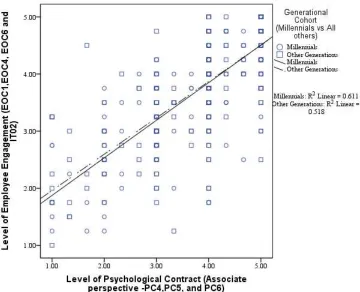
Figure 5 is a scatterplot of a simple random sample of 500 (SRS500) cases from the
complete dataset. The scatterplot suggest that when levels of global PC are low (i.e., the
psychological contract fulfillment is low), the scores for employee engagement are also low.
Creating the scatterplot from SRS500 clearly depicts the relationship between GlobalPC and
employee engagement. Presenting it in this way enables it to be seen without indicating all data
Additional Data Analysis
Additional Data Analysis
Having completed the hypothesis testing with only partial success, efforts focused on the
evaluation of the selected instruments. Factor analysis revealed that the measures for Global PC
(PC4, PC5, and PC6) all loaded onto the same component; although with other items. Global PC
loaded with items belonging to a category with leadership related themes. The employee
engagement measures (EOC4, EOC1, IT02, and EOC6) all loaded onto the same component as
well. Factor analysis follows in Tables 6 and 7. The employee engagement items loaded with
other items related to satisfaction. The measures loaded as expected and into separate
components. With regard to Global PC, noting that the leadership is held responsible for
fulfilling the employee’s psychological contract, it is reasonable that the construct would load
[image:40.612.127.487.72.364.2]and affect, it is reasonable that the employee engagement measure would load with other
30
39. Management at my store is sincere in its attempt to understand the associate's point of view. .682 .303 38. Management at my store creates an environment of openness and trust. .678 .305
42. Management at my store really cares about my well being. .660 .304
43. I feel valued as an employee of "Organization." .634 .391
23. Management at my store gives recognition to associates who provide superior customer service.
.628
37. Management at my store effectively demonstrates "Organization" Core Values. .625
40. I am kept informed about matters affecting me. .620 .320
47. How satisfied are you with the recognition you get for the work you do? .620 .318 35. From what I have seen, the most qualified people are selected when job openings are filled. .618 36. Associates who want to build a career at "Organization" can make it happen through
dedication and hard work.
.598
45. How satisfied are you with the information you receive from management on what's going on in "Organization?"
.596
46. How satisfied are you with your involvement in decisions that affect your work? .592 41. I am encouraged to come up with new and better ways of doing things. .584
31. How satisfied are you with your opportunity to get a better job in "Organization?" .563 .414 25. Management at my store does a good job of ensuring all associates create a legendary
experience with each customer engagement.
.549 .456
26. Management at my store does a good job of ensuring that all associates strive to exceed customer expectations.
.547 .470
28. "Organization" associates have equal opportunities for advancement regardless of gender, age, sexual orientation, race, religion, or cultural background.
.545
32. I am given a real opportunity to improve my skills at "Organization." .544 .345 .302
In general, the "Organization" lives up to the promises it makes to me. .511 .379 .302
34. My most recent performance review included a helpful discussion of my career opportunities .
.510 .322
24. Management at my store does a good job of executing customer clinics and workshops. .503 .332 In thinking about the commitments the "Organization" has made to me; the "Organization" has kept
these commitments.
.501 .371
Most times the "Organization" keeps the obligations it has made to me. .496 .367 7. At "Organization", the dignity of the individual is never compromised. .476 .341
33. I know how to find out about job openings at "Organization" for which I might be qualified. .396 .383
44. I feel like my work makes an important contribution to the success of "Organiztion." .372 .340
[image:42.612.150.718.67.480.2]3
1
If you have your own way, will you be working for "Organization" 12 months from now? .668 1. How do you like your job, the kind of work you do? .633 Considering everything, how satisfied are you with your job? .336 .603
I rarely think about looking for a new job with another company. .315 .594 .326
2. I am proud to work for the "Organization." .592 .363 I would recommend "Organization" as a great place to work. .372 .561
If I were offered a comparable position with similar pay and benefits at another company, I would stay at "Organization"
.334 .555 3. My work gives me a sense of accomplishment. .546 How would you rate the "Organization" to work for compared to other companies? .323 .529 Considering everything, how would you rate your overall satisfaction with the "Organization" at
the present time?
.389 .514
How likely are you to recommend shopping at "Organization" to your friends and family? .468 .306 .342 How do you rate "Organization" in providing job security for people like yourself? .367 .371 .315
15. I'm committed to making "Organization" the #1 customer service retailer in the world. .363 .308 .356 .313
[image:43.612.70.724.73.384.2]CHAPTER V – DISCUSSION
Overview of Study
Festing and Schafer (2014) call for “research that systematically addresses
generation-specific issues in TM [talent management], including an exploratory dimension that considers
the individual perspectives of talent belonging to various generations” (p. 262). The primary
purpose of this study was to examine the relationship of generational affiliation to the
psychological contract fulfillment and employee engagement relationship. Another role of this
study was to qualify empirically the relationship between psychological contract fulfillment and
employee engagement. This research was completed using secondary data, from a major US
retailer’s annual Employee of Choice (EOC) survey. Results of the study highlight the
relationship between psychological contract fulfillment and employee engagement and reveal
interesting information about generational moderation of that relationship. This final chapter of
the dissertation offers a summary of major findings, discusses practical and theoretical
implications, the limitation s of the study and potential direction for future research.
Based on the employees’ self-rating of psychological contract fulfillment and
engagement, the research findings associated with this study support the notion that
psychological contract fulfillment will relate positively to employee engagement. There is
strong support for the direct effect hypothesized; thus, strengthening the empirical foundation
regarding the relationship.
To test whether the relationship between psychological contract fulfillment and employee
engagement is moderated by generational affiliation, specifically Millennialism, multiple
hierarchical regression was used. Although there was an extremely large dataset, n= 62,046,
Empirically testing of the relationship between psychological contract fulfillment and
employee engagement furthers understanding with regard to how the relationship functions.
Research results suggest that 49% of the variance in employee engagement is explained by
psychological contracts. The potential issue with a high R2 is that it may raise cause concern with
regard to multicollinearity. There is additional sensitivity to this, as the correlation factor for the
two constructs, employee engagement and psychological contracts, was .731. Although, the two
constructs are highly correlated, factor analysis suggests that they are separate constructs. Noting
that both constructs are connected via cognitive-emotional linkages – the importance of how
employees feel about the work environment is underscored, especially when the financial impact
of lost employee engagement is considered.
The results obtained in this study, as well as its departure from what has been suggested
in the literature regarding the expected effect of generational affiliation, is noteworthy.
Generational research would suggest that attitudinal differences between the generations should
be sufficient to affect work outcomes (Smola & Sutton, 2002; Twenge, 2010). However this
research suggests that, at least as it relates to psychological contract fulfillment and employee
engagement, it does not. Deal (2007) and Deal et al. (2013) suggest that, generationally, people
are more similar that dissimilar. The results of this research support Deal’s notion. Perhaps this
is has more to do with human psysiology than psychology. The emotional-cognitive linkage,
likely responsible for the high R2 between psychological contract fulfillment and employee
engagement, may create reactions that are similar in people and function without regard to
demographic features. Researchers Isaacowitz and Riediger (2011 p.962) state that,
“Demonstrations of age invariance in cognition-emotion links would be developmentally
that there seems to be invariance in the emotional-cognitive responses between generations and
thus an absence of generational differentiation as it relates to the psychological contract
fulfillment and employee engagement.
“Systematic differences in jobs or organizations” (Lyons & Kuron, 2014, p. 146) may be
worth considering as an alteration on the potential for the emotional-cognitive links in the way
they relate to psychological contract fulfillment. This would suggest that organization processes
may predispose organizations to retain certain types of employees that may respond similarly –
supporting the suggestion that process may mitigate generational affliation effects or that
predispositon to affect towards process may support emotional-cognitive link similarity across
generations. In light of research having previously demonstrated that within person variance can
occur based on the situation (Fleeson, 2001; Lyons & Kuran 2014) the pursuit of contexual
dilineation may prove difficult, yet valuable in helping to better understand emotional cognitive
links in context.
This study provides incremental learning at the intersection of psychological contracts,
employee engagement and generational affiliation. This is especially true when one considers
that these three topics have not been previously reviewed together. Additionally, this study
provides this information in the context of a retail setting. This is of significance as the retail
sector of business garnered more than $4.5 trillion worth of trade in 2013 (US Department of
Labor, 2014), making it a very important business sector in the United States.
Implications
A theoretical contribution of this research is that it unites three areas of research not
affiliation. The results indicate that while there is a strong relationship between psychological
contract fulfillment and employee engagement, the relationship does not appears to be moderated
by generational affiliation. This finding adds to a growing body of literature regarding how
employee engagement functions. The results presented here also add to existing literature
regarding generational differentiation. Results suggest that generational affiliation does not
always function to change the relationship between other variables.
Additionally, this study illuminates the failure of generational affiliation to moderate a
relationship that is very strong; the relationship between psychological contract fulfillment and
employee engagement. Failure of generational affiliation to moderate strong direct effects could
have serious implications for understanding, what to expect as Millennials mature and continue
to enter the workforce.
From a practical perspective, there is a growing interest in understanding Millennials, as
it is project that by the year 2020 that they will comprise more than 50% of the US workforce.
Should the supposition hold true that variables with a strong direct will not be impacted by
generational affiliation then a pattern of systematic verification could be averted, unless there is
support for the understanding that the relationship between two variables is special. This would
make Festing and Shaefer’s (2013) call for systematic investigation of generational issues
unnecessary.
Psychological contracts, like the written documents after which they are named, can be
altered, satisfied or violated. It is suggested that psychological contracts become part of a
company’s overall business strategy and be managed in alignment with the company’s overall
corporate strategy (Ployhart, Van Iddekinge & MacKenzie, 2011; Rousseau, 1994; Rousseau &
leave room for ambiguity and violation. This ambiguity eventually causes the employee to
reconcile that ambiguity with what they need or want on the basis of what they have, as well as
what they think they have, think they want, or think they should have. This research adds support
for the idea that there should be management of psychological contracts, given its relationship
with organizational profitability vis-à-vis employee engagement. In an immediate and very
practical sense, this study suggests that leaders and organizations should take special care in the
making and keeping of promises, obligations and commitments.
Limitations
This study was completed using secondary data from a major US retailer. Using
secondary data has inherent limitations, regarding the design and capture of respondents’
answers. These limitations can be especially pronounced when the survey results are used for
purposes not originally intended. One such limitation encountered in the completion of this
research was the categories used to capture age. The age data did not readily lend itself to
generational comparison. The only generational category that could be clearly separated out
amongst the response choices for the variable age was the Millennial category. As a result, the
study is unable to clearly describe how all of the different generations relate to psychological
contract fulfillment and employee engagement. Two distinct groups were created: Millennials
and all others. A greater depth of insight could have been achieved were it possible analyze the
other generations separately.
The data set, while robust in number, is cross sectional in nature. Data collected in this
way lends itself most readily to understand only the current status of the respondents and the