https://doi.org/10.5194/hess-23-2261-2019 © Author(s) 2019. This work is distributed under the Creative Commons Attribution 4.0 License.
Using a coupled agent-based modeling approach to analyze the role
of risk perception in water management decisions
Jin-Young Hyun1, Shih-Yu Huang1, Yi-Chen Ethan Yang1, Vincent Tidwell2, and Jordan Macknick3 1Department of Civil and Environmental Engineering, Lehigh University, Bethlehem, Pennsylvania, USA 2Sandia National Laboratories, Albuquerque, New Mexico, USA
3National Renewable Energy Laboratory, Golden, Colorado, USA Correspondence:Yi-Chen Ethan Yang ([email protected]) Received: 2 November 2018 – Discussion started: 2 January 2019
Revised: 15 April 2019 – Accepted: 19 April 2019 – Published: 10 May 2019
Abstract. Managing water resources in a complex adap-tive natural–human system is a challenge due to the dif-ficulty of modeling human behavior under uncertain risk perception. The interaction between human-engineered sys-tems and natural processes needs to be modeled explicitly with an approach that can quantify the influence of incom-plete/ambiguous information on decision-making processes. In this study, we two-way coupled an agent-based model (ABM) with a river-routing and reservoir management model (RiverWare) to address this challenge. The human decision-making processes is described in the ABM using Bayesian inference (BI) mapping joined with a cost–loss (CL) model (BC-ABM). Incorporating BI mapping into an ABM allows an agent’s psychological thinking process to be specified by a cognitive map between decisions and relevant preceding factors that could affect decision-making. A risk perception parameter is used in the BI mapping to represent an agent’s belief on the preceding factors. Integration of the CL model addresses an agent’s behavior caused by changing socioe-conomic conditions. We use the San Juan River basin in New Mexico, USA, to demonstrate the utility of this method. The calibrated BC-ABM–RiverWare model is shown to cap-ture the dynamics of historical irrigated area and streamflow changes. The results suggest that the proposed BC-ABM framework provides an improved representation of human decision-making processes compared to conventional rule-based ABMs that do not take risk perception into account. Future studies will focus on modifying the BI mapping to consider direct agents’ interactions, up-front cost of agent’s decision, and upscaling the watershed ABM to the regional scale.
1 Introduction
Managing water resources for growing demands of energy and food while sustaining the environment is a grand chal-lenge of our time, especially when we are dealing with a complex adaptive natural–human system that is subject to various sources of uncertainty. Nowadays, almost every ma-jor basin in the world can be considered as a coupled natural– human system (CNHS) where heterogeneous human activi-ties are affecting the natural hydrologic cycle and vice versa (Liu et al., 2007). The interaction between human activity and the natural environment needs to be explicitly addressed and the uncertainty within this complex system characterized according to a formal approach if benefits toward improved water resource management (Brown et al., 2015) are to be realized.
However, one major challenge of applying the ABM ap-proach to water management decisions is the difficulty of characterizing human decision-making processes and meet-ing the real-world management intuition. The traditional ap-proach through, for example, survey or interview with lo-cal decision makers, is extremely limited (e.g., Manson and Evans, 2007) in space and time. This study introduces the theory of planned behavior (TPB), a well-known theory in psychology used to predict human behavioral intention and actual behavior (Ajzen, 1991), into the ABM framework to quantify human decision-making processes. The TPB states that an individual’s beliefs and behaviors can be expressed in terms of a combination of attitude toward behavior, sub-jective norms, and perceived behavioral control. Attitude to-ward behavior and subjective norms specify an individual’s perceptions of performing a behavior affected by their in-ternal thinking processes and social normative pressures, while perceived behavioral control describes the effects from external uncontrollable factors (e.g., socioeconomic condi-tions). If an individual has high belief about making a spe-cific decision, then it has an increased confidence that she/he can perform the specific behavior successfully. On the other hand, the tendency of a person for making a specific cision increases/decreases if social normative pressures de-crease/increase.
Implementing the TPB into ABM requires that all the three components be modeled explicitly. In this study, we adapt the Bayesian inference (BI) mapping (Pope and Gim-blett, 2015; Kocabas and Dragicevic, 2012) and the cost–loss model (CL) (Thompson, 1952) for this task. The BI mapping (also called Bayesian networks, belief networks, Bayesian belief networks, causal probabilistic networks, or causal net-works), built on the Bayesian probability theory and cogni-tive mapping, calculates the likelihood that a specific deci-sion will be made (Sedki and de Beaufort, 2012 via Pope and Gimblett, 2015) while sequentially updating beliefs of specific preceding factors (model parameters) as new infor-mation is acquired (Dorazio and Johnson, 2003). By apply-ing the BI mappapply-ing, an individual’s beliefs affected by their internal thinking processes and perceptions of social norma-tive pressures can be described as a cogninorma-tive map between decisions and relevant preceding factors. Ng et al. (2011) de-veloped an ABM using BI to model the farmer’s adaptation of their expectations (or belief) and uncertainties of future crop yield, cost, and weather. Yet the preceding factors were assumed to be independent of each other, which is not al-ways true, especially if two preceding factors are spatially related (e.g., downstream reservoir elevation, and upstream precipitation). More importantly, the internal thinking pro-cesses of all farmers were assumed to be the same (i.e., no spatial heterogeneity is modeled). As a result, a more realistic framework of applying BI to ABM is still needed to improve representation of human decision-making processes.
While BI mapping specifies the human psychological decision-making process, the CL model addresses the
ef-fect of external socioeconomic conditions on an individ-ual’s decision-making (i.e., perceived behavioral control in the TPB). The CL model is frequently used as a sim-ple decision-making model in economic analysis to quan-tify human decision-making according to economic theory (Thompson, 1952). CL modeling has been widely used in estimating the economic value of weather forecasts (Keeney, 1982; Lee and Lee, 2007; Murphy, 1976; Murphy et al., 1985). Tena and Gómez (2008) and Matte et al. (2017) in-corporated the constant absolute risk aversion theory in CL modeling to evaluate risk perception of decision makers since the original CL model assumes a risk-neutral decision maker. They used a parameter, the Arrow–Pratt coefficient, to repre-sent risk-averse and risk-seeking decision makers but did not specify how this parameter could be determined. They also did not clarify what will happen if different decision mak-ers in the system have different perceptions of risk (again, no spatial heterogeneity).
To address these aforementioned research gaps, we devel-oped an ABM based on the BI mapping and the CL model as an implementation of the TPB (referred to as the “BC-ABM” hereafter). The BC-ABM is two-way coupled with a river-routing and reservoir management model: RiverWare (details in Sect. 2.1). The four objectives of this study are listed as follows: (1) use the BC-ABM to quantify human decisions considering uncertain risk perception, (2) demon-strate the improvement of BC-ABM compared to conven-tional agent behavior rules, (3) use the coupled BC-ABM– RiverWare model to explicitly model the feedback loop be-tween human and nature systems, and (4) test the BC-ABM– RiverWare for different scenarios. The San Juan River basin in New Mexico, USA, is used as the demonstration basin for this effort. The calibrated BC-ABM–RiverWare model is used to evaluate the impacts of changing risk perception from all agents to the water management in this basin. In this study, multiple comparative experiments of a conven-tional rule-based ABM (i.e., without using the BI and CL) are conducted to demonstrate the advantages of the proposed BC-ABM framework in modeling human decision-making processes. We also evaluate the effect of changing external economic conditions on an agent’s decisions.
2 Methodology
2.1 Develop a two-way coupled ABM–RiverWare model
River-routing and reservoir management modeling is de-signed to simulate the deliveries of water within a regulated river system (Johnson, 2014). Many river-reservoir manage-ment models have been developed to address different objec-tives within a geographic region such as MODSIM, River-Ware, CALSIM (Draper et al., 2004), IQQM (Hameed and O’Neill, 2005), and WEAP (Yates et al., 2005). These mod-els use a node–link structure to represent the entire river net-work where “nodes” are important natural (sources, lakes, and confluences) or human (water infrastructures and water withdrawals) components and “links” represent river channel elements.
RiverWare, developed in 1986 by the University of Col-orado Boulder, is a model of water resource engineering systems for operational scheduling and forecasting, plan-ning, policy evaluation, and other operational analysis and decision processes (Zagona et al., 2001). It couples water-shed and reach models that describe the physical hydrologic processes with routing and reservoir management models that account for water use for water resources assessment. RiverWare has a graphic user interface and uses an object-oriented framework to define every node in the model as an “object.” Each object is assigned a unique set of attributes. These attributes are captured as “slots” in RiverWare. There are two basic types of slots: time series and table slots for each object to store either time series or characteristic data. Details of the RiverWare structure and algorithm can be found at Zagona et al. (2001) and the following website: http://www.riverware.org/ (last access: 7 May 2019).
There is an emerging research topic in Earth system mod-eling (Di Baldassarre et al., 2015; Troy et al., 2015) and water resources system analysis (Denaro et al., 2017; Giu-liani et al., 2016; Khan et al., 2017; Li et al., 2017; Mul-ligan et al., 2014) to couple models together. Coupling an ABM with a process-based model has been done before but mostly focused on groundwater models such as Hu et al. (2017) and Mulligan et al. (2014). One of the few exam-ples that involve coupling with a surface water model, Khan et al. (2017) developed a simple ABM that coupled with a physically based hydrologic model, the Soil and Water As-sessment Tool. In this paper, we perform a two-way cou-pling (or sometimes called “tight” coucou-pling) of models which means data/information will be transferred back and forth be-tween the ABM and RiverWare, where selected objects in RiverWare are defined as agents. To facilitate the two-way coupling, we utilize a convenient built-in tool within River-Ware: the data management interface (DMI) utility which al-lows automatic data imports and exports from/to any external data source (RiverWare Technical Documentation, 2017; see also Fig. S1 in the Supplement).
2.2 Quantify planned behavior with BI mapping and CL model
The ABM developed in this paper, as an implementation of the TPB, consists of two components: the Bayesian infer-ence mapping and the cost–loss modeling. This unique setup allows us to explicitly describe human decision-making pro-cesses and associated uncertainty caused by information am-biguity in water management decisions. We describe the de-tails in this section.
2.2.1 The Bayesian inference (BI) mapping
In this study, the Bayesian inference (BI) mapping is ap-plied to specify a decision maker’s (or agent’s) internal thinking processes by building a cognitive map (also called a causal structure) between decisions (or specific manage-ment behaviors) and relevant preceding factors that could af-fect decision-making (Dorazio and Johnson, 2003; Pope and Gimblett, 2015; Schlüter et al., 2017). In this setting, the goal of an agent is to develop a decision rule (or management strategy) that prescribes management behaviors for each time step that are optimal with respect to its objective function. The uncertainty associated with these management behav-iors is specified by a risk perception parameter (Baggett et al., 2006; Pahl-Wostl et al., 2008) representing the extent to which decision makers explicitly consider limited knowledge or belief about (future) information in their decision-making process (Müller et al., 2013; Groeneveld et al., 2017). This is the definition of Knightian uncertainty which comes from the economics literature where risk is immeasurable or the probabilities are not known (Knight, 1921).
In the field of water resource management, a decision is often made based on whether the preceding factor is larger (or smaller) than a prescribed threshold (i.e., exceedance). A simple example is that a farmer’s belief of changing the ir-rigation area will be affected by the forecast of snowpack in the coming water year or water availability in an upstream reservoir at the beginning of the growing season. The prob-ability of a preceding factorf (a random variable) exceed-ing its threshold given a specific management behavior (or making a decision) θ:P (f|θ ) can be expressed using the conditional probability equation shown in Eq. (1):
P (f|θ )=P (f∩θ )
P (θ ) . (1)
The probability ofθbeing made when the preceding fac-tor exceeds the given threshold:P (θ|f) can be derived using Eq. (1) and the equations of marginal probability (see Sup-plement S1 for the derivation details).
P (θ|f )= P (f|θ )×P (θ )
is coming from RiverWare to ABM, andθ is the result the ABM sends back to RiverWare. Similarly, θ being made when the preceding factor does not exceed the threshold (fc) may be expressed as
P θ|fc= P (f
c|θ )×P (θ )
P ( fc|θ ) P (θ )+P (fc|θc) P (θc). (3) The overall probability of taking a management behavior
P (θ )relying on the preceding factorf can be expressed by the law of total probability:
P (θ )=P (θ|f )×P (f )+P θ|fc×P (fc). (4) A solution ofP (θ) can be obtained by substituting Eqs. (2) and (3) into Eq. (4):
P (θ )= P (f|θ )×P (θ )
P (f|θ ) P (θ )+P (f|θc) P (θc)×P (f )
+ P (f
c|θ )×P (θ )
P (fc|θ ) P (θ )+P (fc|θc) P (θc)×P (f
c). (5)
In this study, we rename the variables in Eq. (5) as follows (Shafiee-Jood et al., 2017):
0pr=P (θ )
0pd=P (f )
λ=P (f|θ )
, (6)
where0prrepresents the decision maker or agent’s prior be-lief of θ,0pd the probabilistic forecast of preceding factor
f, andλ the rate of acceptance of new information which represents a decision maker’s belief about the received in-formation fromf (belief of the forecast/measurement accu-racy representing the degree of ambiguity off). By applying the BI theory to Eq. (5) with the expressions in Eq. (6), the agent’s prior belief ofθ,0prt at timetcan be expressed as
0prt = λ0
t−1 pr
λ0prt−1+(1−λ)
1−0tpr−1 0
t pd
+ (1
−λ) 0tpr−1 (1−λ) 0tpr−1+λ
1−0prt−1
1−0pdt . (7)
In Eq. (7), the agent’s prior belief ofθat timestept,0tpr, is updated based on the prior belief at a previous timestept−1,
0prt−1, and new incoming information or forecast at time t,
0pdt .0tprlies in between0tpr−1and0pd. Two extreme cases are described here. When λ=1, Eq. (7) reduces to0prt =0pdt , which indicates that the agent’s belief of taking management behavior is purely based on the new incoming information, which corresponds to a risk-seeking decision maker. In con-trast, whenλ=0.5, Eq. (7) becomes0tpr=0tpr−1, suggesting that a decision is made based on an agent’s previous expe-riences alone (i.e., the decision maker’s most recent experi-ence). This means that we have a risk-averse decision maker
who does not trust the new incoming information because it could be uncertain and rather sticks with her/his own expe-rience. In other words, these agents are not taking any risk by changing their behavior. In this study, the0prt in Eq. (7) at each time step is updated by applying the Bayesian prob-ability theory to0pr between two consecutive time steps to take the temporal causality between the two decisions into account.
In most water resources management cases, multiple pre-ceding factors affect the probability of a single management decision. In this paper, we assume that agents will make a decision based on the most highly recognized preceding fac-tor following the suggestion from Sharma et al. (2013). The fundamental assumption is that a decision maker will pay the closest attention to the most abnormal of any preceding factors, such as the severity of droughts or floods, historic low or high water levels of an upstream reservoir, or an ex-treme upstream water diversion. The way we represent this tendency is by calculating the “extremity” factors (V) of pre-ceding factors:
Vi= fi fmax
−0.5
, (8)
wherefi is theith preceding factor andfmax is the maxi-mal value offi. After the extremities of all preceding factors have been calculated, the agent will select the preceding fac-tor with the highestVi to update the prior belief of manage-ment actions based on Eq. (7). In this study, the extremity of each preceding factor is examined independently assuming each preceding factor is independent of each other (consider one not-joint probability of multiple factors in the BI map-ping). Taking winter precipitation, a common preceding fac-tor used by farmers as well as in this study to determine the irrigated water demand for the coming year, as an example,
firepresents the winter precipitation of yeari, whilefmaxis the maximum historical winter precipitation until the current year in Eq. (8).
2.2.2 The cost–loss (CL) model
The BI mapping method described in Sect. 2.2.1 character-izes an agent’s behavioral intentions related to their internal (psychological) decision-making processes. According to the TPB, a real-world management decision or action also de-pends on external uncontrollable factors such as socioeco-nomic conditions. The CL model is applied in this study to address this concern. The CL model measures the probability of an adverse event affecting the decision of whether to take costly precautionary action to protect oneself against losses from that event. Based on the theory of cost–benefit analysis, the probability of taking an actionpis related to the expected cost of taking actionCand opportunity loss of not taking the actionL:
p≥C
wherezis defined as the cost–loss ratio, and the precaution-ary action will be taken only when this value is less than the probability of the event occurring.
To fit the CL model into the proposed ABM framework, we modify the above CL model following the concept of Tena and Gómez (2008) and Matte et al. (2017) which added the perception of risk into the decision-making process. We define “C” as the expected cost of taking management action that will potentially increase the gross economic profit and “L” as the expected opportunity loss of not taking such man-agement action. The CL ratio (z), as a measure of probability, can be compared with the prior belief of an agent for taking a management decision (0prt in Eq. 7). When0prt is greater thanz, this decision will become real-world management ac-tion since it makes economic sense.
0prt ≥z=C
L
= the expected cost of taking management action
opportunity loss of not taking management action (10)
Whenzincreases, it means the cost of taking management action goes up or the opportunity loss of not taking manage-ment action goes down. In either case, agents are less likely to take action due to reduced profits. Whenzdecreases, fol-lowing the same logic, agents are more likely to take action.
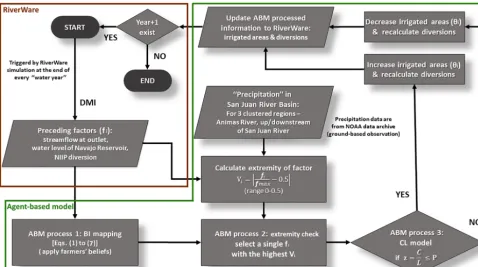
Figure 1 summarizes the methodology in Sect. 2.2 applied to this study. An agent’s decision-making and action process will start when receiving information (0tpd) from RiverWare, and the conditional probability of the agent’s decision 0tpr
will be computed after the most highly recognized preced-ing factor is decided by theVi values. This probability of an agent’s decision will be compared with the CL ratio (z) to ac-count for the external economic conditions where the agent is located. The final management action from the agent will depend on whether the probability of making a decision for an agent is greater (take the action) or smaller (do not take the action) than the CL ratio. This process is repeated annually throughout the entire simulation period. We will use the case study to demonstrate the capability of this proposed method and diagnose the model with the historical data.
3 Case study
3.1 Background of the study area
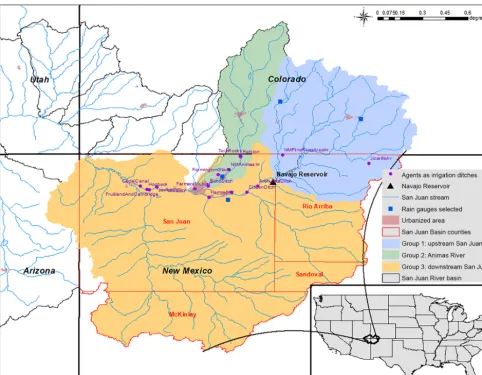
The San Juan River basin (Fig. 2) is the largest tributary of the Colorado River basin with a drainage area of 64 570 km2. Originating as snowmelt in the San Juan Mountains (part of the Rocky Mountains) of Colorado, the San Juan River flows 616 km through the deserts of northern New Mexico and southeastern Utah to join the Colorado River at Glen Canyon. Most water use activities are located in the upper part of the San Juan River basin in the states of New Mex-ico and Colorado. There are 16 major irrigation ditches, four
cities, and two power plants (Fig. 2) located in this basin, for which the San Juan River is the primary water source. Major crops grown in the basin include hay, corn, and veg-etables, and the main planting season runs from May to Oc-tober (Census of Agriculture – San Juan County, New Mex-ico, 2012). The Navajo Reservoir, located 70 km upstream of the City of Farmington, NM, is the main water infrastructure in the basin (Fig. 2) which is used for flood control, irriga-tion, domestic and industrial water supply, and environmen-tal flows. The reservoir is designed and operated by the US Bureau of Reclamation (USBR) following the rules in the Colorado River Storage Project (Annual Operating Plan for Colorado River Reservoirs, 2017). The active storage of the reservoir is 1.3 million acre-feet (1.6 billion cubic meters). The maximum release rate is limited to 5000 cubic feet per second (ft3s−1) or 141.58 cubic meters per second (m3s−1). The Navajo Indian Irrigation Project (NIIP) is another ma-jor water consumer within the basin beside the 16 mama-jor irri-gation ditches. The NIIP supplies water to Native American tribes in the region. San Juan-Chama Project manages trans-basin water transfers into the Rio Grande Basin, augmenting supply for Albuquerque, NM, irrigation and instream flow needs. Finally, the San Juan River Basin Recovery Imple-mentation Program (SJRIP) implemented by the Fish and Wildlife Service manages environmental flows within the basin, dictating timing and magnitude of releases from the Navajo Reservoir and maintenance of a daily 500 ft3s−1 (14.15 m3s−1) minimum streamflow requirement (Behery, 2017).
To improve water planning and management in the basin, several state and federal agencies established a steering com-mittee with the main responsibility of overseeing the insti-tutional complexity for the water plans operated under the 1922 Colorado River Compact and 1948 Upper Colorado River Basin Compact. Although a regional water plan report (RWP) was updated in 2016 (State of New Mexico Inter-state Stream Commission, 2016) by interested stakeholders, issues still exist under the terms of the 1948 Upper Colorado River Basin Compact. For example, New Mexico’s entitled 642 380 ac-ft (0.793 billion cubic meters) consumptive use is substantially greater than the corresponding consumptive use.
irri-Figure 1.The flow chart of agent decision-making process inside the two-way coupled ABM–RiverWare model (ABM.exe in Fig. S1). Agents make their decisions with uncertainty based on the method developed in this paper (joint BI mapping and CL model), and RiverWare runs the simulation based on these decisions.
gation area, while a reduction of future water supply is pos-sible due to climate change (State of New Mexico Interstate Stream Commission, 2016). Since irrigation activities are the most consumptive components of water demand among oth-ers (74.8 % of total water demand, State of New Mexico In-terstate Stream Commission, 2016), collective adaptive ac-tions of farmers will significantly affect the water planning and management in the San Juan Basin and become a suit-able test bed for our methodology.
3.2 The BC-ABM–RiverWare model setup
USBR developed a RiverWare model for the San Juan River basin to support water management and resource planning efforts. RiverWare includes 19 irrigation ditch objects, 21 do-mestic and industrial use objects, 2 power plant objects, and 3 reservoir objects. Input data for the RiverWare model in-clude historical tributary inflows, evapotranspiration rates for each irrigation ditch limited by the crop water requirement, historic water diversion for NIIP and the San Juan-Chama Project, and reservoir operation rules. Ungauged local in-flows were determined by the simple closure of the local water budget. The model operates on a daily time step from 1 October 1928 to 30 September 2013 (85 years) with four cycles of simulation. Each cycle is a complete model run for the entire modeling period to fulfill part of the necessary in-formation (e.g., some downstream water requirements need
to be precalculated for the Navajo Reservoir to set up the release pattern). In this study, farmers that can make man-agement decisions are quantified as 16 major irrigation ditch objects in RiverWare. They are defined as agents in the study and will decide whether to expand or reduce their irrigated area (e.g., management behavior,θ in Sect. 2) for the com-ing year at the end of every water year. We categorized the 16 agents into three groups based on their location (colored in Fig. 2). Agents in group 1 (light blue) were located upstream of the Navajo Reservoir, agents in group 2 (light green) were located on the Animas River (a major tributary of the San Juan River), and agents in group 3 (orange) were located downstream of the Navajo Reservoir.
[image:6.612.59.537.66.333.2]Figure 2.The upper San Juan River basin. Different colors of the basin represent the geographical regions that this paper used to group major irrigation districts (agents, marked as dots). The location of the Navajo Reservoir is marked as a triangle.
different. This is an advantage of using ABM to incorporate spatial heterogeneity in the model.
In this study, the information of winter precipitation was taken from NOAA ground-based rainfall monitoring gauges where we used the coming year’s winter precipitation as a proxy for the snowpack forecast in the causal structure. Win-ter precipitation has a positive effect on snowpack but there is an uncertainty about how much snow will be accumulated. Therefore, when agents expect more winter precipitation, if they believe it will lead to a lot more snowpack, they will be more aggressive in the irrigated area expansion. Flow viola-tion at the basin outlet and water level of the Navajo Reser-voir are two system-wide preceding factors that are consid-ered by all the three groups. When flow violation is too fre-quent or water level is too low, agents tend to be more con-servative in the irrigated area expansion. If a shortage were declared, the RiverWare model would reduce the targeted streamflow at the basin outlet to 250 ft3s−1 (7.08 m3s−1) and the participating six agents would adjust their water
di-version to achieve this newly targeted streamflow. Under the current model setting, agents follow the backward-looking, forward-acting mode, which means that agents make de-cisions based on their own past/current experiences (water level in the Navajo Reservoir, stream flow violations at the basin outlet, NIIP water diversion, and the previous decision on the irrigated area) and their belief of the winter precipita-tion forecast in the coming year. The detailed causal structure of BI mapping for each type of agent is given in the Supple-ment, where a standard Overview, Design concepts, and De-tails+Decision (ODD+D) protocol for ABM development is followed (Grimm et al., 2010).
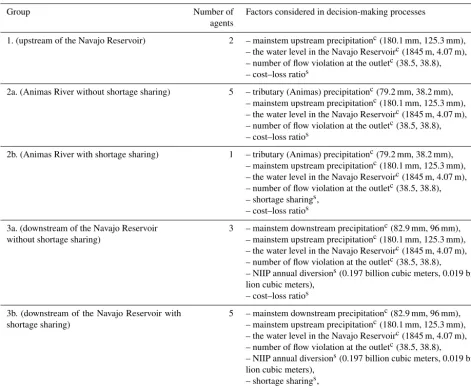
Table 1.Name of agent groups, number of agents in each group, and the proceeding factors considered in decision-making processes. Superscript “c” means climatic factors and superscript “s” means social factors. Numbers in the bracket are mean and standard deviation if applicable.
Group Number of Factors considered in decision-making processes agents
1. (upstream of the Navajo Reservoir) 2 – mainstem upstream precipitationc(180.1 mm, 125.3 mm), – the water level in the Navajo Reservoirc(1845 m, 4.07 m), – number of flow violation at the outletc(38.5, 38.8), – cost–loss ratios
2a. (Animas River without shortage sharing) 5 – tributary (Animas) precipitationc(79.2 mm, 38.2 mm), – mainstem upstream precipitationc(180.1 mm, 125.3 mm), – the water level in the Navajo Reservoirc(1845 m, 4.07 m), – number of flow violation at the outletc(38.5, 38.8), – cost–loss ratios
2b. (Animas River with shortage sharing) 1 – tributary (Animas) precipitationc(79.2 mm, 38.2 mm), – mainstem upstream precipitationc(180.1 mm, 125.3 mm), – the water level in the Navajo Reservoirc(1845 m, 4.07 m), – number of flow violation at the outletc(38.5, 38.8), – shortage sharings,
– cost–loss ratios
3a. (downstream of the Navajo Reservoir without shortage sharing)
3 – mainstem downstream precipitationc(82.9 mm, 96 mm), – mainstem upstream precipitationc(180.1 mm, 125.3 mm), – the water level in the Navajo Reservoirc(1845 m, 4.07 m), – number of flow violation at the outletc(38.5, 38.8),
– NIIP annual diversions(0.197 billion cubic meters, 0.019 bil-lion cubic meters),
– cost–loss ratios
3b. (downstream of the Navajo Reservoir with shortage sharing)
5 – mainstem downstream precipitationc(82.9 mm, 96 mm), – mainstem upstream precipitationc(180.1 mm, 125.3 mm), – the water level in the Navajo Reservoirc(1845 m, 4.07 m), – number of flow violation at the outletc(38.5, 38.8),
– NIIP annual diversions(0.197 billion cubic meters, 0.019 bil-lion cubic meters),
– shortage sharings, – cost–loss ratios
next section will demonstrate the capability of the proposed model to recreate historical patterns in the San Juan Basin. 3.3 The BC-ABM–RiverWare model diagnostics One of the major criticisms of ABM development is that ABM results are difficult to verify or validate (Parker et al., 2003; An et al., 2005, 2014; National Research Council, 2014). In this study, we address this concern by calibrating the coupled BC-ABM–RiverWare model to recreate the his-torical trend of (1) an individual agent’s irrigated area and (2) San Juan River discharge. USBR provides the observed irrigated acreage for all 16 ditches and the flow measure-ments at two different locations along the San Juan River (at the outlet of the San Juan River basin and directly down-stream of the Navajo Reservoir) for the calibration purpose. The calibrated parameters are the risk perception parameters
extremi-ties. A total of 102 parameters are manually calibrated (trial and error) with details explained in the Supplement (Supple-ment S2). In general, we calibrated the parameters sequen-tially from upstream and tributary agents (i.e., groups 1 and 2) to downstream (i.e., group 3). Within a group, we cali-brated agents with the largest irrigated areas first to capture a better system-wide result.
The calibration results of irrigated areas are given in Fig. 3 and arranged by group (region). The blue curves are the historical irrigated area. The red curves are the best-fit re-sult among multiple (30) modeling runs (shown by the gray curves, which represents the stochasticity) of each agent. In general, BC-ABM captures the pattern and trend of irrigated area for all agents, and we particularly focus on agents with the largest irrigated areas since their decision can dominate the basin. A figure showing the time variations of extremity values for each group of agents is given in the Supplement (see Fig. S2) to illustrate the preceding factors adopted by different groups of agents for making decisions at each time step.
The overall (area) weighted Nash–Sutcliffe efficiency (NSE, Nash and Sutcliffe, 1970) of the best-fit result is 0.55, which represents a reasonable calibration result. There are a few cases where structural changes occurred with some of the ditches that the model does not capture. Specifically, con-struction of the Navajo Reservoir in the 1960s inundated the New Mexico Pine River Ditch, while construction of the dam made it possible to expand the Hammond Irrigation Ditch (located directly downstream of the Navajo Reservoir). Sim-ilar structural changes are evident with the Echo, New Mex-ico, Animas, and Fruitland-Cambridge ditches. The model limitation associated with the use of BI mapping in ABM is discussed in the Discussion section.
To demonstrate the enhanced performance of the pro-posed BC-ABM framework in representing human decision-making processes, we conducted comparative experiments with conventional rule-based, deterministic ABMs (such as our previous work in Khan et al., 2017), referred to as the non-BC-ABMs. In the non-BC-ABMs, agents make deci-sions based on either past experience (e.g., flow violation or NIIP diversion) or future forecast (winter precipitation) alone, implying that agents have perfect foresight in terms of received information. Using precipitation as an example, an agent will expand irrigation area if the precipitation fore-cast is greater than the given threshold, and vice versa. Ex-cluding BI mapping implies that the agents make decisions purely based on the forecast or new incoming information and fully ignore the information from past experience, while excluding the CL model means that the agents do not take socioeconomic factors into account when making decisions. Two non-BC-ABMs were tested and results are also shown in Fig. 3. The black solid curve represents the non-BC-ABM simulation still utilizing extremity for selecting the refer-ence preceding factor, while the black dashed curve is the non-BC-ABM using only the precipitation in the
decision-making processes. The better performance of the proposed BC-ABM framework, compared to the non-BC-ABMs, is ev-idenced by the closer agreements between the simulated and historical patterns of irrigated area from BC-ABM as well as weighted NSE (0.55 for BC-ABM vs.−1.25 for the non-BC-ABM with extremity and−1.39 for the non-BC-ABM with precipitation alone). Different non-BC-ABM simulations are also compared with the BC-ABM simulations as shown in Fig. S3.
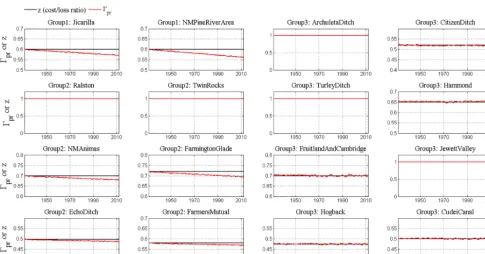
The time variations of0tprand calibratedzfor each agent are shown in Fig. 4 to illustrate the characteristics of dif-ferent agents, in terms of risk perception. The results show that the agents in group 1 and 2 have a consistently lower willingness to adjust irrigation area (0prshown in red) com-pared to the corresponding CL ratio (zshown in black). In contrast, group-3 agents adjust irrigation area more often as evidenced by the frequent crossover between red and black curves, which suggest that agents in group 3 are relatively risk-neutral compared to those in group 1 and 2. The calibra-tion results of basin outflow and the Navajo Reservoir inflow are given in Fig. 5. The results show that the simulated val-ues agree closely with the historical observations evidenced by the NSEs of 0.60 and 0.54, respectively. We do notice that our coupled BC-ABM–RiverWare model misses peaks of streamflow possibly due to the lower input streamflow data of RiverWare. However, since our focus is the water-scarce situation in this case study, this underestimation does not sig-nificantly affect our following analysis.
4 Scenario results
Figure 3.The calibration results of the ABM–RiverWare model: individual agents’ irrigated area changes from 1928 to 2013 organized by irrigation ditch and region (see groups in Fig. 3). Each figure includes the simulated irrigated area change from the best-fit BC-ABM (solid red) and the corresponding Nash–Sutcliffe efficiency (NSE), multiple runs of BC-ABM (solid gray) to visualize the stochasticity (30 runs) of agents’ random behavior, non-BC-ABM with extremity (dashed black), and non-BC-ABM using precipitation only (solid black) against historical record (solid blue). 1 ac=4046 m2.
[image:10.612.58.543.436.690.2]Figure 5.The calibration results of the ABM–RiverWare model:(a)the basin outflow to the Colorado River; (b)inflow to the Navajo Reservoir. Blue lines are historical data and red lines are modeling results. 1 ac-ft=1234 m3.
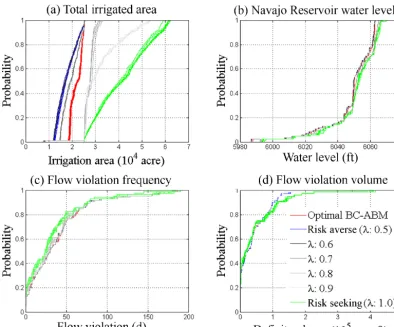
corresponding to differentλvalues. The total irrigation area generally increases with an increasingλ, indicating that the agents become more risk-seeking if they are more confident about new incoming information.
There are two interesting observations. First, it is clear that when all agents become risk-seeking, their emerging actions will result in a larger irrigated area in the basin (Fig. 6a). Since all agents want to expand their irrigated area, the Navajo Reservoir will reserve more water at the end of each year, resulting in slightly higher water levels (Fig. 6b). Streamflow violations show a somewhat counterintuitive re-sult. The volume of violation under risk-seeking scenarios increases as expected (green curve shifts to right in Fig. 6d), but the frequency of violation decreases (green curve shifts to left in Fig. 6c). This is due to the fact that the Navajo Reservoir holds more water for irrigation season to satisfy downstream increasing water demand, which results in much fewer streamflow violation days during the irrigation season. Although this operation slightly increases streamflow tion days in the following season, the total number of viola-tion days still decreases (Fig. S4). Second, the baseline re-sults (red curves) are closer to the “all agents risk-averse” scenario results (blue curves). This is consistent with the findings from previous studies (e.g., Tena and Gómez, 2008), which suggest that farmers are commonly risk-averse when the stakes are high (Matte et al., 2017).
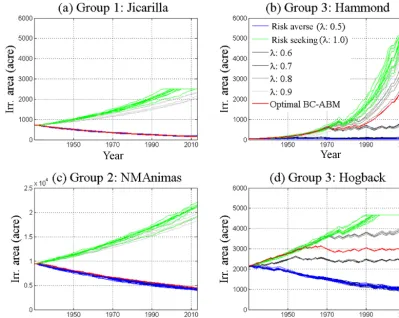
We also look at the time variations of individual irrigated area changes for characterizing risk perceptions of different agents. Figure 7 shows the simulated irrigation area changes for four selected large irrigation ditched since they are the major players in the basin. The results clearly show that Ji-carilla (group 1) and NMAnimas (group 2) are historically risk-averse agents (red curves overlap with blue curves). In contrast, Hammond and Hogback (group 3) are relatively risk-neutral, compared to agents in group 1 and 2, as the red curves lie in between the green and blue curves. Group-3 agents are located downstream of the Navajo Reservoir and most of them consider the Navajo Reservoir as a steady water source, so they can have relatively more aggressive attitudes toward risk compared to their upstream counterparts. Also, note that Jicarilla, Hammond, and Hogback under the risk-seeking scenario eventually reach their maximum available irrigated area. Therefore, their irrigated area flattens out at the end of the simulation. The gray curves in Fig. 7 represent the simulated irrigation area changes for agents correspond-ing to different agents’ risk perceptions. It shows that the ir-rigation area generally increases with an increasingλfor all the four agents.
Figure 6.The cumulative density frequency throughout the entire simulation period of(a)the basin-wide irrigated area,(b) the Navajo Reservoir end-of-year water level,(c)basin outlet annual streamflow violation days, and(d)basin outlet annual streamflow violation volume. Results are given for the calibrated (green curves), risk-averse (blue curves), and risk-seeking (red curves) cases. The simulation results with different values of agents’ risk perceptions (λ) between 0.5 and 1 are shown in gray.
decision-making processes by adjusting the CL ratio. In this study, we conducted a sensitivity analysis on the cost–loss ratio to test what happens if economic conditions change and it becomes more expensive or cheaper to expand the irri-gated area by systematically increasing (+10 % and+20 %) or decreasing (−10 % and −20 %)z values for all agents. When thezvalue goes up, it means that the cost of increas-ing irrigated area goes up, or the opportunity loss of not in-creasing irrigated area goes down. In either case, the situ-ation should become harder for agents to expand their irri-gated area. When thezvalue goes down, following the same logic, the economic conditions become easier for agents to expand their irrigated area. The modeling results shown in Fig. 8 fit with this intuition quite well. All blue and cyan curves (increasing z values) are located below, and purple and magenta curves (decreasingzvalues) are located above red curves (baseline). Modeling results also show that, in the basin, groups 1 and 2 are less sensitive to the changes in eco-nomic conditions but agents in group 3 are more sensitive to the economic conditions. Of course, individual differences exist inside each group.
Figure 7.Individual agents’ irrigated area changes under calibrated (green curves), risk-averse (blue curves), and risk-seeking (red curves) scenarios. The simulation results with different values of agents’ risk perceptions (λ) between 0.5 and 1 are shown in gray. 1 ac=4046 m2.
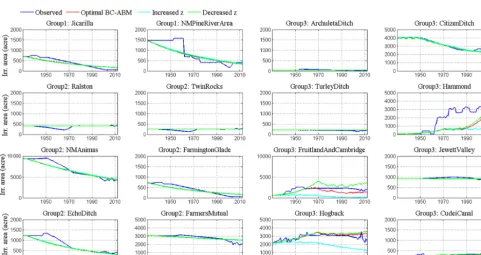
time are tested in the study. For each agent, a time variedz
is generated by adding a positive/negative trend with a small random fluctuation to the calibrated zto mimic the spatial and temporal heterogeneity of up-front costs. Note that we did not include up-front costs into the current BI mapping as real-world stakeholders’ inputs are needed to recalibrate all the model parameters.
The time variation of irrigated area for all 16 agents under different up-front cost trends is shown in Fig. 9. The cyan and green curves are the irrigated area change under an increasing and decreasingz, respectively, while red curves are the base-line which uses calibratedzvalues. The results show that the influence of changingzon group-3 agents is relatively signif-icant compared to group 1 and group 2. A consistently higher (lower) green (cyan) curve as compared to the baseline is ob-served. These preliminary results are expected as they fit the economic intuition. In this specific case, farmers tend to ex-pand their irrigation area earlier (by comparing cyan and red curves) if they expect a corresponding increased cost in the future. In contrast, if the cost of expanding irrigation area in the future is expected to go down, farmers will defer the ac-tions to pursue a lower cost.
5 Discussion
5.1 Generalized modeling framework and policy implementation for other basins
Figure 8. The sensitivity analysis of changing economic conditions on an agent’s decision on irrigated areas. Blue (+20 %) and cyan (+10 %) curves represent increasingz values which make area expansion more expensive. Purple (−20 %) and magenta (−10 %) lines represent decreasingzvalues which make area expansion cheaper. 1 ac=4046 m2.
[image:14.612.59.540.418.673.2]for the model diagnostic and calibration, such as long-term historical irrigated area time series, might not be available in every basin. In this situation, if one intends to duplicate the proposed method in other basins, some alternative data source, such as land use and land cover change data from USGS, can be used as a proxy of calibration targets.
The modeling results can be used to inform water manage-ment policy. For example, the sensitivity analysis (see Fig. 8) suggests that the collective action of farmers has the poten-tial to influence the irrigation of 4.5×10⁴ to 6.1×10⁴ac (182.1 to 246.9 km2) of cropland with 9000 to 12 000 ac-ft (11.1 to 14.8 million cubic meters) of water demand, which is about 30 % to 39 % of the average annual water usage un-der changing economic conditions (i.e., 20 % increase or de-crease in up-front cost). A potential inde-crease/dede-crease in fu-ture irrigation cost could also influence farmers’ decisions. Understanding such behavior is also critical to future water resource planning and management in the San Juan River basin as (1) threat of climate change will lead to a shift in timing of flows associated with a mean decrease in future water supply resulting from an anticipated reduced precipi-tation and/or increased evaporation, and (2) there are several settlement agreements with the tribal communities along the San Juan River basin where their committed allotment of wa-ter has yet to be put to full use (e.g., Navajo-Gallup pipeline and Navajo Indian Irrigation Project that both require con-struction and/or expansion of existing water delivery infras-tructure to make full use of water rights).
5.2 Model limitations
Here we discuss two areas of limitation of the current study: data availability and model structure. The lack of historical data to serve as the calibration target is mentioned in the above section. Another data limitation is the CL ratio calcu-lation and the up-front cost. Currently, the CL ratio is treated as a calibrated parameter in BC-ABM framework. The value of the CL ratio can be estimated directly by acquiring rele-vant data, if available. For example, the farm production ex-pense data provided by the US Department of Agriculture could be used as an approximation of the expected cost of changing irrigation area (C in Eq. 10), while the farm in-come and wealth statistics estimated from crop production may be considered as a major part of opportunity loss (Lin Eq. 10). The third data limitation is the necessary data to cre-ate the precise causal structure of BI mapping (Cheng et al., 2002; Premchaiswadi et al., 2010). In general, an accurate causal structure of BI mapping can be obtained by detailed interviews with decision makers (O’Keeffe et al., 2016) or learned from a dataset (Sutheebanjard and Premchaiswadi, 2010).
Regarding the model structure limitation, the farmer’s belief is currently calculated using one single preceding factor in the cognitive map that has the most extremity. The use of extremity from a single preceding factor in the
decision-making processes assumes that the joint probabil-ity of decision-making from multiple preceding factors is not taken into account (the agent may not respond to the cumu-lative effects of environmental conditions). Finally, the cur-rent method does not explicitly consider direct interaction among agents in the BI mapping. We do model agents as in-teracting indirectly through irrigated water withdrawal (i.e., upstream agents’ water uses will affect downstream agents’ water availability). However, effects like peer pressure, word of mouth, and potential water markets are not currently con-sidered in the model.
6 Conclusions
Making water resources management decisions in a complex adaptive natural–human system subject to uncertain informa-tion is a challenging issue. The interacinforma-tion between human and natural systems needs to be modeled explicitly with asso-ciated uncertainties quantified and managed in a formal man-ner. This study applies a two-way coupled agent-based model (ABM) with a river-reservoir management model (River-Ware) to address the interaction between human and natural systems. The proposed ABM framework characterizes hu-man decision-making processes by adopting a perspective of the theory of planned behavior implemented using Bayesian inference (BI) mapping joined with cost–loss (CL). The ad-vantage of ABM is that, by defining different agents, vari-ous human activities can be represented explicitly while the coupled water system provides a solid basis to simulate the feedback between the environment and agents.
Combining BI mapping and CL modeling allows us to (1) explicitly describe human decision-making processes, (2) quantify the associated decision uncertainty caused by in-complete/ambiguous information, and (3) examine the adap-tive water management in response to a changing natural environment as well as socioeconomic conditions. Calibra-tion results for this coupled BC-ABM–RiverWare model, as demonstrated in the San Juan River basin, show that this methodology can capture the historical pattern of both hu-man activities (irrigated area changes) and natural dynamics (streamflow changes) while quantifying the risk perception of each agent via risk perception parameters (λ). The sce-nario results also show that the majority of agents in the basin are risk-averse, which confirms the conclusion of Tena and Gómez (2008). The improved representation of the proposed BC-ABM is evidenced by the closer agreement of BC-ABM simulations against observations, compared to those from an ABM without using BI mapping and CL ratio. Chang-ing economic conditions also yield intuitive agent behavior; that is, when crop area expansion is more expensive/cheaper, fewer/more agents will do it.
their neighbors’ actions, and this information will always be treated with λ=1. This means agents will always believe their own observations (i.e., to see is to believe). In addition, we only defined groups of farmers as agents in this study. Fu-ture work can seek to add power plants, cities/municipalities, and reservoirs as agents. The direct and indirect interaction among these different types of agents (such as farmers and power plants, who may or may not have to compete for wa-ter from the reservoir) will provide a more comprehensive picture in the entire food–energy–water–environment nexus.
Data availability. The input data and modeling results of the ABM-RiverWare model are available at https://dx.doi.org/10.25584/data. 2019-05.722/1510802 (Hyun et al., 2019).
Supplement. The supplement related to this article is available online at: https://doi.org/10.5194/hess-23-2261-2019-supplement.
Author contributions. YCEY led the entire project. JYH, SYH, and YCEY developed the ABM. VT prepared RiverWare. JM reviewed the model coupling. SYH and YCEY prepared the manuscript with contributions from all co-authors.
Competing interests. The authors declare that they have no conflict of interest.
Acknowledgements. This research was supported by the Office of Science of the US Department of Energy as part of research in the Multi-Sector Dynamics, Earth and Environmental System Model-ing Program. We want to thank the editor and anonymous review-ers, who helped us improve the quality of this paper. Special thanks are given to Susan Behery in USBR for providing historical data on the San Juan Basin and Majid Shafiee-Jood in the University of Illinois, who discussed the methods of BI mapping and CL model-ing with us in the earlier version of the manuscript. All data used for both the RiverWare model (inflow, crop ET, and water diver-sion, etc.) and the agent-based model (winter precipitation, histor-ical basin outflow, and historhistor-ical irrigated area, etc.) are explicitly cited in the reference list.
Review statement. This paper was edited by Pieter van der Zaag and reviewed by Andres Baeza and one anonymous referee.
References
Ajzen, I.: The theory of planned behavior, Organ. Behav. Hum. Decis. Process., 50, 179–211, https://doi.org/10.1016/0749-5978(91)90020-T, 1991.
An, L., Linderman, M., Qi, J., Shortridge, A., and Liu, J.: Exploring complexity in a human environment system: an agent-based
spa-tial model for multidisciplinary and multi-scale Integration, Ann. Assoc. Am. Geogr., 95, 54–79, https://doi.org/10.1111/j.1467-8306.2005.00450.x, 2005.
An, L., Zvoleff, A., Liu, J., and Axinn, W.: Agent-based modeling in coupled human and natural systems (CHANS): Lessons from a comparative analysis, Ann. Assoc. Am. Geogr, 104, 723–745, https://doi.org/10.1080/00045608.2014.910085, 2014.
Annual Operating Plan for Colorado River Reservoirs: US De-partment of the Interior Bureau of Reclamation, available at: https://www.usbr.gov/uc/water/rsvrs/ops/aop/ (last access: 7 May 2019), 2017.
Baggett, S., Jeffrey, P., and Jefferson, B.: Risk perception in par-ticipatory planning for water reuse, Desalination, 187, 149–158, https://doi.org/10.1016/j.desal.2005.04.075, 2006.
Behery, S.: Current status of Navajo Reservoir, available at: https://www.usbr.gov/uc/water/crsp/cs/nvd.html (last access: 7 May 2019), 2017.
Berglund, E. Z.: Using agent-based modeling for water re-sources planning and management, J. Water Res. Plan. Man., 141, 04015025, https://doi.org/10.1061/(ASCE)WR.1943-5452.0000544, 2015.
Brown, C. M., Ghile, Y., Laverty, M., and Li, K.: Decision scal-ing: Linking bottom-up vulnerability analysis with climate pro-jections in the water sector, Water Resour. Res., 48, W09537, https://doi.org/10.1029/2011WR011212, 2012.
Brown, C. M., Lund, J. R., Cai, X., Reed, P. M., Zagona, E. A., Os-tfeld, A., Hall, J., Characklis, G. W., Yu, W., and Brekke, L.: The future of water resources systems analysis: toward a scientific framework for sustainable water management, Water Resour. Res., 51, 6110–6124, https://doi.org/10.1002/2015WR017114, 2015.
Census of Agriculture (county profile) – San Juan County, New Mexico: National Agricultural Statistics Service, US Department of Agriculture, New Mexico Field Office, Las Cruces, NM, USA, 70 pp., 2012.
Cheng, J., Greiner, R., Kelly, J., Bell, D., and Liu, W.: Learning Bayesian Networks from Data: An Information-Theory Based Approach, Artif. Intell., 137, 43–90, https://doi.org/10.1016/S0004-3702(02)00191-1, 2002. Denaro, S., Castelletti, A., Giuliani, M., and Characklis, G.
W.: Fostering cooperation in power asymmetrical water sys-tems by the use of direct release rules and index-based insurance schemes, Adv. Water Resour., 115, 301–314, https://doi.org/10.1016/j.advwatres.2017.09.021, 2017. Di Baldassarre, G., Viglione, A., Carr, G., Kuil, L., Yan,
L., Brandimarte, K., and Blöschl, G.: Debates–Perspectives on socio-hydrology: Capturing feedbacks between physical and social processes, Water Resour. Res., 51, 4770–4781, https://doi.org/10.1002/2014WR016416, 2015.
Dorazio, R. M. and Johnson, F. A.: Bayesian inference and decision theory – a framework for decision making in natural resource management, Ecol. Appl., 13, 556–563, 2003.
Draper, A. J., Munévar, A., Arora, S., Reyes, E., Parker, N., Chung, F., and Peterson, L.: CalSim: A general-ized model for reservoir system analysis, J. Water Res. Plan. Man., 130, 480–489, https://doi.org/10.1061/(ASCE)0733-9496(2004)130:6(480), 2004.
agent-based optimization, Water Resour. Res., 49, 3912–3926, https://doi.org/10.1002/wrcr.20287, 2013.
Giuliani, M., Castelletti, A., Amigoni, F., and Cai, X.: Multia-gent systems and distributed constraint reasoning for regula-tory mechanism design in water management, Water Res. Plan. Man., 141, 04014068, https://doi.org/10.1061/(ASCE)WR.1943-5452.0000463, 2015.
Giuliani, M., Li, Y., Castelletti, A., and Gandolfi, C.: A cou-pled human-natural systems analysis of irrigated agriculture under changing climate, Water Resour. Res., 52, 6928–6947, https://doi.org/10.1002/2016WR019363, 2016.
Grimm, V., Berger, U., DeAngelis, D. L., Polhill, J. G., Giske, J., and Railsback, S. F.: The ODD protocol: A review and first update, Ecol. Model., 221, 2760–2768, https://doi.org/10.1016/j.ecolmodel.2010.08.019, 2010. Groeneveld, J., Müller, B., Buchmann, C., Dressler, G., Guo, C.,
Hase, N., Homann, F., John, F., Klassert, C., Lauf, T., Liebelt, V., Nolzen, H., Pannicke, N., Schulze, J., and Weise, H.: The-oretical foundations of human decision-making in agent-based land use models – A review, Environ. Model. Softw., 87, 39–48, https://doi.org/10.1016/j.envsoft.2016.10.008, 2017.
Hameed, T. and O’Neill, R.: River Management Decision Model-ing in IQQM, Melbourne, Australia, available at: https://www. mssanz.org.au/modsim05/papers/hameed.pd (last access: 7 May 2019), 2005.
Hu, Y., Quinn, C. J., Cai, X., and Garfinkle, N. W.: Combining human and machine intelligence to derive agents’ behavioral rules for groundwater irrigation, Adv. Water Resour., 109, 29– 40, https://doi.org/10.1016/j.advwatres.2017.08.009, 2017. Hyun, J. Y., Huang, S. Y., Yang, Y. C. E., Tidwell, V., and Macknick
J.: San Juan ABM-RiverWare Input and Result Data, IM3 Data Repository, https://doi.org/10.25584/data.2019-05.722/1510802, last access: 8 May 2019.
Johnson, J.: MODSIM versus RiverWare: A comparative analysis of two river reservoir modeling tools, Report 2014.3669, US De-partment of the Interior-Bureau of Reclamation, Pacific North-west Region, Boise, Idaho, 2014.
Keeney, R. L.: Decision analysis: an overview, Oper. Res., 30, 803– 838, https://doi.org/10.1287/opre.30.5.803, 1982.
Khan, H. F., Yang, Y. C. E., Xie, H., and Ringer, C.: A coupled modeling framework for sustainable watershed management in transboundary river basins, Hydrol. Earth Syst. Sci., 21, 6275– 6288, https://doi.org/10.5194/hess-21-6275-2017, 2017. Knight, F. H.: Risk, Uncertainty, and Profit. Houghton Miffin, New
York, 1921.
Kocabas, V. and Dragicevic, S.: Bayesian networks and agent-based modeling approach for urban land-use and population density change: A BNAS model, J. Geogr. Syst., 36, 1–24, https://doi.org/10.1007/s10109-012-0171-2, 2012.
Lee, K.-K. and Lee, J.-W.: The economic value of weather forecasts for decision-making problems in the profit/loss situation, Met. Apps., 14, 455–463, https://doi.org/10.1002/met.44, 2007. Li, Y., Giuliani, M., and Castelletti, A.: A coupled human–natural
system to assess the operational value of weather and climate services for agriculture, Hydrol. Earth Syst. Sci., 21, 4693–4709, https://doi.org/10.5194/hess-21-4693-2017, 2017.
Liu, J., Dietz, T., Carpenter, S. R., Alberti, M., Folke, C., Moran, E., Pell, A. N., Deadman, P., Kratz, T., Lubchenco, J., Ostrom, E., Ouyang, Z., Provencher, W., Redman, C. L.,
Schneider, S. H., and Taylor, W. W.: Complexity of cou-pled human and natural systems, Science, 317, 1513–1516, https://doi.org/10.1126/science.1144004, 2007.
Manson, S. M. and Evans, T.: Agent-based modeling of deforesta-tion in southern Yucatán, Mexico, and reforestadeforesta-tion in the Mid-west United States, P. Natl. Acad. Sci. USA, 104, 20678–20683, https://doi.org/10.1073/pnas.0705802104, 2007.
Matte, S., Boucher, M.-A., Boucher, V., and Filion, T.-C. F.: Moving beyond the cost-loss ratio: economic assessment of streamflow forecasts for a risk-averse decision maker, Hydrol. Earth Syst. Sci., 21, 2967–2986, https://doi.org/10.5194/hess-21-2967-2017, 2017.
Müller, B., Bohn, F., Dreßler, G., Groeneveld, J., Klassert, C., Mar-tin, R., Schlüter, M., Schulze, J., Weise, H., and Schwarz, N.: Describing human decisions in agent-based models – ODD+D, an extension of the ODD protocol, Environ. Model. Softw., 48, 37–48, https://doi.org/10.1016/j.envsoft.2013.06.003, 2013. Mulligan, K., Brown, C. M., Yang, Y. C. E., and Ahlfeld, D.:
As-sessing groundwater policy with coupled economic-groundwater hydrologic modeling, Water Resour. Res., 50, 2257–2275, https://doi.org/10.1002/2013WR013666, 2014.
Murphy, A. H.: Decision-making models in the cost-loss ratio situ-ation and measures of the value of probability forecasts, Mon. Weather Rev., 104, 1058–1065, https://doi.org/10.1175/1520-0493(1976)104<1058:DMMITC>2.0.CO;2, 1976.
Murphy, A. H., Katz, R. W., Winkler, R. L., and Hsu, W.-R.: Repetitive decision making and the value of forecasts in the cost-loss ratio situation: a dynamic model, Mon. Weather Rev., 113, 801–813, https://doi.org/10.1175/1520-0493(1985)113<0801:RDMATV>2.0.CO;2, 1985.
Nash, J. E. and Sutcliffe, J. V.: River flow forecasting through con-ceptual models part I – A discussion of principles, J. Hydrol., 10, 282–290, 1970.
National Research Council: Advancing Land Change Modeling: Opportunities and Research Requirements, National Academies Press, Washington, DC, 2014.
Ng, T. L., Eheart, J. W., Cai, X., and Braden, J. B.: An agent-based model of farmer decision making and water quality im-pacts at the watershed scale under markets for carbon allowances and a second-generation biofuel crop, Water Resour. Res., 47, W09519, https://doi.org/10.1029/2011WR010399, 2011. O’Keeffe, J., Buytaert, W., Mijic, A., Brozovi´c, N., and Sinha, R.:
The use of semi-structured interviews for the characterization of farmer irrigation practices, Hydrol. Earth Syst. Sci., 20, 1911– 1924, https://doi.org/10.5194/hess-20-1911-2016, 2016. Pahl-Wostl, C., Távara, D., Bouwen, R., Craps, M., Dewulf,
A., Mostert, E., Ridder, D., and Taillieu, T.: The im-portance of social learning and culture for sustain-able water management, Ecol. Econ., 64, 484–495, https://doi.org/10.1016/j.ecolecon.2007.08.007, 2008.
Parker, D. C., Manson, S. M., Janssen, M. A., Hoffmann, M. J., and Deadman, P.: Multi agent systems for the simulation of land-use and land-cover change: A review, Ann. Assoc. Am. Geogr., 93, 314–337, https://doi.org/10.1111/1467-8306.9302004, 2003. Pope, A. J. and Gimblett, R.: Linking Bayesian and
Premchaiswadi, W., Jongsawat, N., and Romsaiyud, W.: Bayesian Network Inference with Qualitative Expert Knowledge for Group Decision Making. In: 5th IEEE International Conference on In-telligent Systems (IS), IEEE Press, New York, 126–131, 2010. RiverWare Technical Documentation – Data Management
Inter-face: Center for Advanced Decision Support for Water and Envi-ronmental Systems, University of Colorado, Boulder, CO, 2017. Scalco, A., Ceschi, A., and Sartori, R.: Application of Psychological Theories in Agent-Based Modeling: The Case of the Theory of Planned Behavior, Nonlin. Dynam. Psychol., 22, 15–33, 2018 Schlüter, M., Leslie, H., and Levin, S.: Managing water-use
trade-offs in a semi-arid river delta to sustain multiple ecosys-tem services: a modeling approach, Ecol. Res., 24, 491–503, https://doi.org/10.1007/s11284-008-0576-z, 2009.
Schlüter, M., Baeza, A., Dressler, G., Frank, K., Groeneveld, J., Jager, W., Janssen, M. A., McAllister, R. R. J., Müller, B., Orach, K., Schwarz, N., and Wijermans, N.: A frame-work for mapping and comparing behavioural theories in mod-els of social-ecological systems, Ecol. Econ., 131, 21–35, https://doi.org/10.1016/j.ecolecon.2016.08.008, 2017.
Sedki, K. and de Beaufort, L. B.: Cognitive maps for knowl-edge representation and reasoning, Tools with Artifi-cial Intelligence (ICTAI), in: 24th International Con-ference, Athens, Greece, November 2012, 1035–1040, https://doi.org/10.1109/ICTAI.2012.175, 2012.
Shafiee-Jood, M., Cai, X., and Deryugina, T.: A theoretical method to investigate the role of farmers’ behavior in adopting climate forecasts, World Environmental and Water Resources Congress 2017 – Creative Solution for a Changing Environment, Sacra-mento, CA, 2017.
Sharma, L. K., Kohl, K., Margan, T. A., and Clark, L. A.: Impulsiv-ity: relations between self-report and behavior, J. Pers. Soc. Psy-chol., 104, 559–575, https://doi.org/10.1037/a0031181, 2013. State of New Mexico Interstate Stream Commission: San Juan
Basin Regional Water Plan, available at: http://www.ose.state. nm.us/Planning/RWP/region_02.php (last access: 7 May 2019), 2016.
Sutheebanjard, P. and Premchaiswadi, W.: Analysis of calendar ef-fects: Day-of-the-week effect on the stock exchange of Thailand (SET). International Journal of Trade, Int. P. Econ. Dev. Res., 1, 57–62, https://doi.org/10.7763/IJTEF.2010.V1.11, 2010.
Tena, E. C. and Gómez, S. Q.: Cost-Loss decision models with Risk Aversion, Working paper 01/08, Universidad Complutense de Madrid, 2008.
Thompson, J. C.: On the operational deficiencies in categorical weather forecasts, B. Am. Meleorol. Soc., 33, 223–226, 1952. Troy, T. J., Pavao-Zuckerman, M., and Evans, T. P.: Debates
n– Perspectives on socio-hydrology: Socio-hydrologic model-ing: Tradeoffs, hypothesis testing, and validation, Water Resour. Res., 51, 4806–4814, https://doi.org/10.1002/2015WR017046, 2015.
Yang, Y. C. E., Cai, X., and Stipanovi´c, D. M.: A decen-tralized optimization algorithm for multi-agent system based watershed management, Water Resour. Res., 45, W08430, https://doi.org/10.1029/2008WR007634, 2009.
Yang, Y. C. E., Zhao, J., and Cai, X.: A decentralized method for water allocation management in the Yellow River Basin, J. Water Res. Plan. Man., 138, 313–325, https://doi.org/10.1061/(ASCE)WR.1943-5452.0000199, 2012. Yates, D., Purkey, D., Sieber, J., Huber-Lee, A., and
Gal-braith, H.: WEAP21: A demand, priority, and preference driven water planning model: part 2, aiding freshwa-ter ecosystem service evaluation, Wafreshwa-ter Int., 30, 501–512, https://doi.org/10.1080/02508060508691894, 2005.
Zagona, E. A., Fulp, T. J., Shane, R., Magee, T., and Goran-flo, H. M.: RiverWare: A generalized tool for complex reser-voir system modeling, J. Am. Water. Resour. As., 37, 913–929, https://doi.org/10.1111/j.1752-1688.2001.tb05522.x, 2001. Zechman, E. M.: Agent-based modeling to simulate