2019 International Conference on Artificial Intelligence, Control and Automation Engineering (AICAE 2019) ISBN: 978-1-60595-643-5
Location Problem Based on Immune Optimization
Ying-zi JIANG, Rong-qing ZHU and Peng-fei ZHANG
XuZhou University of Technology, Xuzhou, Jiangsu, 221018, China
Keywords: Cloud cover location allocation model, Immune optimization algorithm.
Abstract. This paper presents the site selection of disaster response and rescue system, uses cloud logistics coverage model to construct multi-objective programming, uses immune optimization algorithm to simulate biological immune system to reach the optimal two-dimensional coordinates of address are (130.73, 80.43) and so on. It shortens a lot of rescue time and has a positive impact. cloud logistics coverage model reduces service radius and increases transportation flexibility. Immune optimization algorithm has stronger global search ability than genetic algorithm.
Introduction
With the rapid development of new technology and new energy technology, drone technology is becoming more and more mature and plays an important role in emergency rescue work. The special uav for rescue work has transport, monitoring and other functions, and can carry out inspection, detection, rescue command and prevention and control of unexpected accidents. The following is the optimization of uav rescue site selection.
Cloud Cover Location Allocation Model
[image:1.595.67.526.479.579.2]We need to select several best disaster response and rescue platforms in Puerto Rico. It can ensure that the disaster response system platform[1,2] can reach the disaster point in time when a disaster alarm occurs in Puerto Rico and drones can deliver medical supplies and provide road data images.
Table 1. Drone Flight Parameter Table.
Drone Load-free maximum flight time Load-free maximum flight distance
A 35 min 23.3 km
B 40 min 52.7 km
C 35 min 37.3 km
D 18 min 18 km
E 15 min 15 km
F 24 min 31.6 km
G 16 min 17.1 km
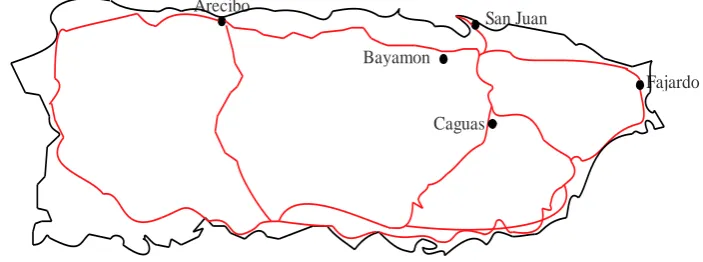
As is shown in the table 1, since disasters are concentrated in the eastern and southeastern coastal areas of Puerto Rico, we only consider the location selection of drone support and response to five hospitals in Puerto Rico. The following is a map of Puerto Rico's main road network. The red Pentagon is located in five hospitals that need drones to transport medical parcels.
Figure 1. Major Highway Network Map of Puerto Rico.
Fajardo San Juan
Bayamon Arecibo
[image:1.595.120.472.643.774.2]As can be seen from the Figure 1, five hospitals are concentrated in the north-central part of Puerto Rico, four of which are concentrated in the north-eastern part of Puerto Rico. These five hospitals are all on the main road. If the disaster happens and the road is paralyzed, it will be difficult for the ground ambulance vehicles to reach the corresponding hospital, which will cause serious consequences. Therefore, reasonable response platform location and road investigation are particularly important.
In this paper, the location allocation model of cloud logistics collective coverage [3] is adopted. In the actual location process, the radiation radius of disaster response rescue center and the coverage status of hospital are very important considerations. We consider several selected response and rescue platforms as their respective drone transfer stations. When drones can not guarantee the return of the original route, they can go to the nearby response platforms to charge and carry out the next transport mission or return.
Compared with the traditional model, the cloud logistics ensemble coverage model can distribute the drug demand of a hospital to multiple disaster response and rescue platforms, which can appropriately reduce the radiation radius of the disaster response center and allow the disaster response and rescue center to cover the demand hospital incompletely. The original coverage ratio can be reduced from 1 to 0-1, and ultimately reach flexibility of disaster response, on the other hand, also reduces the error value of load to flight time.
In the location allocation model of cloud logistics ensemble coverage, we determine the goal of maximizing demand coverage and minimizing relative total cost. The first objective function is used to solve the location problem of disaster response and rescue platform, and the second objective function is used to solve the allocation problem of hospitals.
Maximum demand coverage:
z i iz z z
maxC =
N K X (1)Among them, Ni is the demand for medical packages from hospital i. Kizis the proportion of service allocation from disaster response platform Z to hospital i.
Z
X is a 0-1 variable, representing:
0 1
Z
Do not set up the disaster response platform at place z X =
Set up the disaster response platform at place z
(2)
Relative total cost is the smallest:
A m iz z iz z m iz z v
z z z
minC =
nM t +
Q K X +
D K X +C(3) Among them, zZ, the first formula indicates the relative transportation cost of drones. n is the quantity of drugs. Mm is quality of drugs carried by drones. tzi is the time for drones to transport drugs from disaster response platform Z to hospital i. The second formula represents the replenishment cost of drugs when drugs are out of stock. Qz is the demand for drugs by hospitals. The third formula represents the flight energy consumption of drones. Dm is the relative flight distance which is equal to the ratio of the actual flight distance of the drone to the maximum flight distance of the drone. The fourth formula represents the cost of video surveillance of the drone.
Constraints[4]:
(1) Restriction on the number of disaster response and rescue centers Z: 0 Xz 3, and the total number of disaster response centers is not more than three.
(2) The constraints of the degree of demand: 0Kiz 1. (3) Restriction of response coverage: iz z 1
z
K X
(4) Restriction of response distance: 0Dm 1 the actual flight distance of the UAV can not exceed the maximum flight distance of the UAV.
(5) Non-zero constraints: j z i, , 0
Immune Optimization Algorithm for Locating Location
This paper uses immune optimization[5,6,7] algorithm to solve the location allocation model of logistics set coverage, and finally select the appropriate location. Immune optimization algorithm[4] can solve the optimal location problem more accurately.
The basic principle of immune optimization algorithm is to simulate biological immune system. We can regard the optimization problem of disaster response and rescue system location to be solved as the antigen of immune system and the solution of the problem as the antibody. In the biological immune system, the recognition, secretion and evolution of antibodies have the same principle as the solution of optimization problems. Immune optimization algorithm can solve the difficult problem of location optimization.
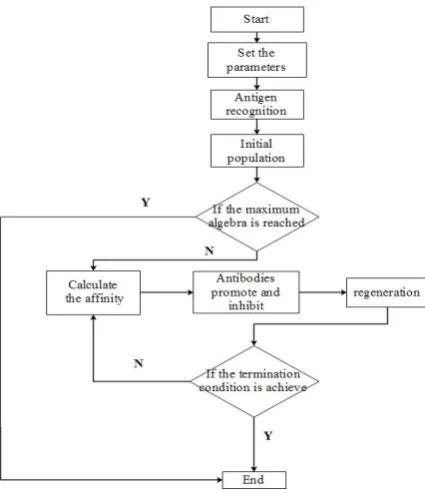
The basic flow of immune optimization algorithm is shown in Figure 2:
Figure 2. Flow chart of immune optimization algorithm.
When we use immune optimization algorithm [8,9] to solve the location problem of disaster response rescue platform, we first need to set a series of parameters such as population size, iteration times, crossover, mutation parameters, affinity, evaluation operator and so on. After that, the feasibility of the optimization of location is analyzed, the affinity function is constructed and the corresponding constraints are formulated. Then it judges whether the maximum algebraic condition is satisfied. If the condition is satisfied, the middle finger algorithm can output directly. If the algorithm[10,11] is not satisfied, it needs to undergo the process of immune processing, mutation, cloning, population renewal, and finally output the results.
[image:3.595.192.405.286.533.2]Firstly, according to the location of longitude and latitude of five hospitals, standard points are set and converted into rectangular coordinates. The coordinates of five places are as follows:
Table 2. Coordinate table of disaster-stricken hospitals.
Hospital Fajardo San Pablo San Juan Baymon Arecibo
Coord (224.6,70.4) (186.1,66.9) (182.7,85.9) (173.6,82.4) (116.7,88.5)
The coordinate data of the hospital and the parameters of drone are substituted into the location allocation model of cloud logistics ensemble coverage. The model is solved by immune optimization algorithm using MATLAB, The version of which is 2014-a.
[image:4.595.181.399.125.298.2]Immune optimization algorithm is used to solve the optimal location map:
Figure 3. Location Map of Disaster Response and Rescue Platform.
[image:4.595.53.536.421.471.2]From the figure 3, we can see that three disaster response and rescue platforms need to be set up. The hospitals in Arecibo area are under the jurisdiction of A disaster response and rescue platform, the hospitals in Bayamon and San Juan area are under the jurisdiction of B disaster response and rescue platform, the hospitals in Fajardo area are under the jurisdiction of C platform, and the hospitals in San Pablo area are under the joint jurisdiction of B and C rescue platforms. The position coordinate table is shown in Table 3:
Table 3. Disaster relief platform position coordinate table.
Location \ Name A B C
Coordinate (130.73,80.43) (167.3,74.71) (200.4,71.27)
Longitude -66.59 -66.23 -65.89
Latitude 18.38 18.32 18.27
Test of the Model
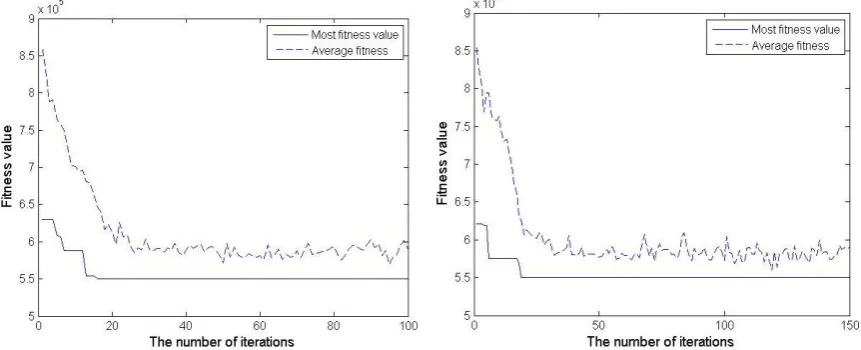
For our cloud logistics set coverage location model[12], in order to further detect the stability of the model, we consider the accuracy of the detection immune algorithm to verify the stability of the model. When solving the problem, we set the initial iteration number K to 100 and change the initial iteration number K to 150. We compare the fluctuation of the convergence curve under the two iterations, and get the convergence curve of K=100 and K=150 by Matlab:
[image:4.595.81.512.572.747.2]Through the figure 4, we can see that the optimal fitness fluctuation tends to be stable when K = 100 and K = 150, and the average fitness remains unchanged. It shows that the convergence curve is stable fluctuation under different iterations. It can be considered that the solution of immune optimization algorithm passes the test, and the stability of the optimized location model is verified.
Extension of Model
For the previous coverage location models, transportation centers and demand points are independent of each other, lack of resource sharing, and the mapping relationship is a single "point-to-point" relationship. There are only two coverage states: coverage and non-coverage. In this mode, the transportation center lacks flexibility and wastes certain resources. This paper improves the location model in the past, adds the concept of cloud logistics, integrates resources to a certain extent, and distributes the same demand point by different transport centers. This reduces the service radius of the transport center, reduces some errors, increases the flexibility of transport, reduces the waste of resources, and also reduces the cost for enterprises. The model has been widely used in logistics transportation in real life.
References
[1] Cao YanmingJing Dequan, Liu Chungao. Application of Artificial Immune Algorithms to Optimizing Double Support Vector Machines in Arch Dam Deformation Prediction [J/OL]. Journal of Yangtze Academy of Sciences:1-6[2019-05-08].
[2] Yan Lei, Li Lei, Cai Shengshuo, Lu Zhiyong. Weighted and efficient clustering method for UAV based on path planning [J]. Computer Engineering, 2018, 44 (11): 276-281.
[3] Zhang Haifeng, Han Fanglin. UAV multi-reconnaissance payload use based on task coordination[J]. Journal of Naval Aviation Engineering College, 2018, 33 (03): 333-338.
[4] Bi Ya. Research on Location-Assignment Problem Based on Collaborative Inventory and Coverage in Cloud Logistics [D]. Wuhan University of Technology, 2012.
[5] Zhao Jing. Research on location-allocation of cloud logistics coverage based on immune optimization algorithm [D]. Zhejiang University of Technology, 2018.
[6] Sun Zhen, Jiang Tianci. Reactive Power Optimization of Distribution Network with Distributed Generation Improved Immune Algorithms [J]. Journal of National Network Institute of Technology, 2019, 22(01):7-11.
[7] Tang Wei, Wang Shuai, WangLing Li Optimization of Proportional-Integral-Differential Parameter Tuning Based on Genetic Fuzzy Immune Algorithms. [J]. Science and Technology and Engineering, 2018, 18(31):152-159.
[8] Wang Guijin, Hu Jianfeng. Optimization of Multi-Population Artificial Immune Algorithms on Multimodal Functions [J]. journal of nanchang university ,2018,40(03).
[9] Cheng Qiuyun, Liu Ning. Classification of Remote Sensing Image Based on Neural Network Optimized by Immune Genetic Algorithms[J]. Digital Technology and Application, 2018.
[10] Gu Yuanli, Zhang Yuan, Rui Xiaoping. Research on Short-term Traffic Flow Prediction Based on LSSVM Optimized by Immune Algorithms[J/OL]. Journal of Jilin University, 1-7[2019-01-09].
[11] Wang Dong, Qian Shuqu, Wu Yating. Constrained Dynamic Multi-objective Immune Optimization Algorithms and Performance Comparison[J]. Journal of Anshun University, 2018, 20(03).