2019 International Conference on Computer Science, Communications and Multimedia Engineering (CSCME 2019) ISBN: 978-1-60595-650-3
Non Deterministic Bidding Procurement Decision System and Method
Yi-lin XUE
1, Kun-ling WU
2,*and Jiang-wei XUE
31
No. 48 Xinxi Road, Haidian District, Beijing Sport University, 100084 Beijing, P.R. China
ORCID: 0000-0003-2278-4582
2
No. 99 Longkun South Road, Library, Hainan Normal University, Haikou City, Hainan Province, P.R. China
3
Zhuodian Design (Hainan) Co., Ltd., & Xiamen Wankun Construction Co., Ltd., P.R. China
*Corresponding author
Keywords: Non deterministic bidding, Procurement decision system, Library purchase database.
Abstract. In this paper, The non deterministic bidding procurement decision system is introduced, which is an improved method to solve the bottleneck of deterministic procurement decision system and its disconnection from the procurement bidding process, that makes the deterministic project bidding changed into non-deterministic project bidding, and makes the non-deterministic price decision changed into deterministic price decision, in a word, the deterministic procurement decision can be realized by way of the bidding of uncertain procurement projects, as a result, the status and state of the supply and demand sides in the procurement game will be changed, and the fairness and justice of the whole process of government procurement will be realized, and the corresponding embodiment, case of library purchase database is introduced.
Introduction
Decision-making problems are usually classified into three types: deterministic, uncertain and risky. Determining procurement projects, that is also a kind of decision-making, can also be classified as deterministic, uncertain and risky. For example, kids buying a McDonald's Big Mac hamburger is basically a deterministic decision-making, women shopping for clothes is an uncertain decision-making, men buying stocks is a risky decision-making.
The price of procurement is uncertain, so the decision of procurement in essence must also belong to uncertain decision-making. However, under the existing technical conditions, it can only be set by means of tendering control price, budget price, cost price and so on, controlling the uncertain factors of procurement price within a relatively definite range, which has little effect on the results of procurement decision-making if the purchasing projects are mature and stable technology, monopoly or limiting competition, transparent and stable market price. But in some cases, the prices and the purchasing projects are quite uncertain, and relevant technology and research about uncertain procurement decision-making.
Current Situation: Disconnection between Deterministic Procurement Decision-making and Decision-making Execution
Bidding procurement belongs to the execution step of government procurement. Obviously, the decision and the execution step of government procurement are on different routs, which are embodied as following aspects:
involved in the procurement decision phase are derived from budget estimates, revised estimates, market inquiries and etc. It lead to a difference between these estimated prices and the prices determined in the final bidding, and this difference may affect the results of the procurement decision.
For example, the feasibility study of the procurement decision phase estimates prices of Project-A and Project-B as Price-A and Price-B respectively for two alternative procurement projects, assuming that Price-A is smaller than B, and determines the procurement Project-A due to the rejection of Project-B due to the same other procurement decision factors; Only after the purchase project has been determined to they enter the bidding execution phase of the purchase, and the final bid price is Price-A'; If Project-B also enters the bidding execution phase of procurement, the final bid price of Project-B may be Price-B', and Price-B' is less than Price-A'. Based on the result of the operation of the bidding execution phase of procurement, Project-A should be rejected and Project-B should be adopted, however, such result is unforeseeable by the definite procurement decision.
Secondly, because the execution phase of procurement lags behind the decision phase of procurement, the execution phase of procurement not only cannot influence the procurement decision, but also needs to passively accept and serve the procurement decision, even if this path dependence leads to the loss of better choice, even at the cost of reducing the procurement demand.
For example, procurement decisions establish clear and specific requirements. In essence, this requirement clearly points to the suppliers of very specific products or services, which leads to the single-source procurement. Because of the loss of competitiveness, the purchaser is at a distinct disadvantage in the price game between the supplier and the purchaser, and can only be forced to accept pricing of the suppliers of products or services.
Thirdly, in the current procurement decision and implementation process, tendering shall abide by the principles of fairness, openness and impartiality with strict and complete rules. However, in the decision process of determining the procurement project, it mainly relies on the personal experience and business ability of the decision managers to screen various alternative project resources. It mainly relies on the way of subjective judgment to manage and make decisions on the relevant issues of the procurement project. When there are many kinds, quantities and influencing factors of alternative projects, without rules of fair and quantitative decision for each alternative project, it is inevitable that improper procurement decision will occur due to improper consideration, resulting in procurement decision errors, tendentious choice, inefficient use of funds, repeated procurement and other adverse effects, affecting production, operation, use and increasing costs.
Determining procurement projects is the core content and key step of procurement, quality and cost of the procurement as a whole. The fundamental reason why the purchasing decisions of a certain kind of project (such as library database resources purchasing, the purchasing of specific advertising channels) frequently lead to the single-source purchasing mode lies in the defects of the purchasing decisions. Therefore, how to improve the scientificalness and rationality of procurement decision, improve the level of procurement decision and management efficiency, and integrate the elements of fairness, openness and impartiality into the procurement bidding execution stage in the procurement decision stage will become the breakthrough point of innovation.
Innovation: Procurement Decision-making System and Method for Uncertain Bidding
This paper presents a procurement decision system and method by Non-deterministic Bidding[1]
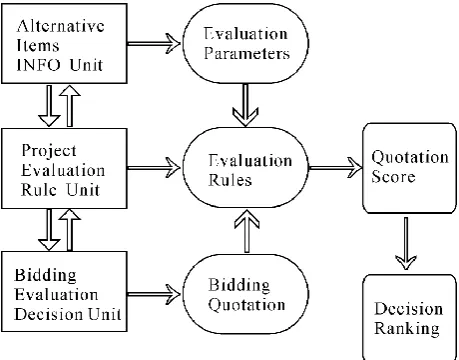
evaluation rules of relevant projects and specific scoring rules thereof. The formulation of evaluation rules is based on the requirements of laws, regulations, industry standards and technical specifications. The evaluation rules expressed in formal language include the rule of maximum satisfaction of demand, the rule of maximum relative value, one of the lowest rules of unit weighted cost and its weighted combination. The bidding evaluation decision unit is used for simultaneously organizing bidding, bidding and bid evaluation for an alternative project which can be evaluated by the same evaluation rule, obtain the bidder's bidding information of commercial, economic and technical parameters of each candidate project, infer and simulate the thinking process of evaluation experts, and calculate and infer the ranking of procurement decisions of each candidate project on the basis of project evaluation rules, evaluation parameters of each candidate project and bidding quotation; The method of decision includes the following steps.
Collect Alternative Project Information with Potential Purchase Requirements
Step 1, Collect alternative project information with potential purchase requirements including technical information, economic information, quality information, service information, establishing an alternative project information base of a certain set classification, wherein the set classification means that the alternative projects of the classification can be compared and evaluated by the same evaluation rule, the projects in the alternative project information base are represented by Project-i, the Project-i represents the i-th alternative project, and the total number of alternative projects with potential procurement requirements is n.
Preliminarily Determining an Evaluation Rule Expressed in a Formalized Language
Step 2, preliminarily determining an evaluation rule expressed in a formalized language of the set classification item, including one of a maximum meeting demand rule, a maximum relative value rule, and a minimum unit weighted cost rule and a weighted combination thereof.
Demonstrate and Evaluate Alternative Projects
Step 3. Demonstrate and evaluate alternative projects. The above argumentation method comprise that following step of soliciting the opinions of the users, counting the past use situation, investigating and predicting the use intention, collecting expert experience, external evaluation of other users, entrusting a third party to carry out one of the professional evaluations and combinations thereof, and obtaining evaluation parameters capable of being digitally calculated. The evaluation parameters include at least one of a relative demand weight coefficient, a relative function coefficient, and a weighted usage amount. Wherein the relative demand weighting coefficient is set such that the demand weighting coefficient Demand-weight-coeffective of one alternative item is equal to 1, and the remaining alternative items are compared with the alternative items having the demand weighting coefficient equal to 1 to obtain the relative demand weighting coefficient of the i-th item, expressed as Relative-Demand-weight-coeffective-i. Wherein the relative function coefficient is set such that the function coefficient of one alternative item is equal to 1, and the remaining alternative items are compared with the alternative items having the function coefficient equal to 1 to obtain the relative function coefficient of the i-th item, expressed as Relative-Function-coefficient-i. The calculation of the weighted usage quantity comprises setting different weights for the used quantity and the proposed usage quantity respectively, setting different weights for different users of the same alternative item and their usage, setting different weights for users of different alternative items and their usage, or setting different weights for one of three cases or a combination thereof, calculate the weighted usage number of i, expressed in Weighted-use-quantity-i.
Determining the Final Evaluation Rules and the Evaluation Parameter
Compiling and Publishing a Tender Notice
Step 5, compiling and publishing a tender notice to include all the candidate projects with potential procurement requirements in the candidate item information base of a certain set classification in the requirement item of one tender purchase.
Obtain the Bid Quotation of Each Alternative Project
Step 6, receiving the bid documents, opening the bid to obtain the bid quotation of each alternative project, wherein the bid quotation of the i-th project is expressed by bid-price-i, and a plurality of bidders compete for the same alternative project to select one of the bidders according to the best and obtain the bid quotation.
Calculating the Quotation Score of Each Alternative Project according to the Evaluation Rules
Step 7, calculating the quotation score of each alternative project according to the evaluation rules, and the calculation methods of the corresponding quotation score are as follows.
Maximum Demand Fulfillment Rule. The degree of demand fulfillment is calculated by the ratio of relative demand weight coefficient to bid quotation (relative demand weight coefficient/bid quotation). The demand fulfillment score of item i expressed in formal language is:
Demand-weight-i=Relative-Demand-weight-coefficient-i/bid-price-I;
Maximum Relative Value Rule. The relative value is calculated by the ratio of relative function coefficient to bid quotation (relative function coefficient/bid quotation). The relative value score of item i expressed in formal language is:
Relative-Value-i=Relative-Function-coefficient-i/bid-price-I;
Minimum Rule of Unit Weighted Cost. The amount of unit weighted cost is calculated by the ratio of weighted used quantity to bid quotation (weighted used quantity/bid quotation). The unit weighted cost score of item i expressed in formal language is:
Unit-weighted-cost-i=Weighted-usage-quantity-i/bid-price-i.
Ranking Each Alternative Project
Step8, according to the quotation score of each alternative project and other non-quotation factors, bidding evaluation ranking of each alternative project is obtained, which is the ranking of procurement decisions for which the procurement price has been determined.
[image:4.595.183.413.556.736.2]The overall framework of procurement decision-making systems and methods for uncertain bidding is shown in Figure 1.
Figure 1. The overall framework of procurement decision-making systems and methods for uncertain bidding.
bidding quotation of the first m projects according to the order of purchase decision ranking, m is the natural number from 1, and the bidding quotation of the first m projects is less than or equal to the total purchase budget, while the bidding quotation of the first m+1 item is greater than the total purchase budget, then the purchase decision is determined to be the first m projects, and the quantity of m is probably far less than n.
Embodiment: Library Procurement Literature Database
On December 31, 2018, the President and scientific council members of the Max Planck Society (MPS), one of the world’s largest research performing organizations, counting 14,000 scientists who publish 12K new research articles a year—around 1500 of which in Elsevier journals, have mandated the Max Planck Digital Library to discontinue their Elsevier subscription when the current agreement
expires[2].On February 28, 2019, as a leader in the global movement toward open access to publicly
funded research, the University of California is taking a firm stand by deciding not to renew its
subscriptions with Elsevier[3]. Despite months of contract negotiations, Elsevier was unwilling to
meet UC’s key goal: securing universal open access to UC research while containing the rapidly escalating costs associated with for-profit journals.
The method of the invention integrates the procurement decision with the bidding implement, and gives full play to their respective advantages, and the rule of lowest unit weighted cost can be used for evaluating the comparison of thousands of alternative literature databases. Firstly, the library collects the basic information of various literature databases, and makes use of the alternative databases in terms of content, quality, convenience, function, usage rate, usage effect and usage. Then, the weights of use intention, human gender, time and degree of use are compared through the weights of use and intention. For example, the usage degree can be divided into five levels: visiting website, general search, advanced search, browsing and/or downloading abstract, browsing and/or downloading full text, etc. The evaluation parameters of each literature database, i.e. weighted usage quantity can be obtained by demonstration and evaluation, and the weighted usage-quantity-i table is used. The bidding quotation bid-price-i of each literature database is determined by means of tendering, and the unit weighted cost score of the second alternative literature database is calculated as follows:Unit-weighted-cost-i=Weighted-usage-quantity-i/bid-price-I, and then get the ranking of purchasing decision of library purchasing literature database:
Unit-weighted-cost-I=Weighted-usage-quantity-i/bid-price-i.
Acknowledgement
This research was financially supported by The Hainan Province Philosophical and Social Sciences Planning Research Subject: Research on the Price Formation Mechanism of Digital Resources and the Purchasing Decision of University Libraries under the New Knowledge Payment Mode. No. HNSK (ZC)18-11.
References
[1] Yi-lin Xue, Shu-hao Xue, Chen-lu Li, Chen-xin Li, Chen-ye Zhang, Jiang-wei Xue, Xiao-dan Li, Lei Li, Others ask for anonymity. Procurement decision system and method by Non Deterministic Bidding. [P].CN107622352A, 2018-01-23.
[2] Max Planck Society discontinues agreement with Elsevier; stands firm with Projekt DEAL negotiations [OL]. [2018-12-18]. Information on https://www.mpdl.mpg.de/en/505