Citation:
Holliday, A (2016) Exercise training comprising of single 20-s cycle sprints does not provide a suffi-cient stimulus for improving maximal aerobic capacity in sedentary individuals. European Journal of Applied Physiology, 116 (8). pp. 1511-1517. ISSN 1439-6327 DOI: https://doi.org/10.1007/s00421-016-3409-8
Link to Leeds Beckett Repository record:
http://eprints.leedsbeckett.ac.uk/3078/
Document Version: Article
Creative Commons: Attribution 4.0
The aim of the Leeds Beckett Repository is to provide open access to our research, as required by funder policies and permitted by publishers and copyright law.
The Leeds Beckett repository holds a wide range of publications, each of which has been checked for copyright and the relevant embargo period has been applied by the Research Services team.
We operate on a standard take-down policy. If you are the author or publisher of an output and you would like it removed from the repository, please contact us and we will investigate on a case-by-case basis.
DOI 10.1007/s00421-016-3409-8
ORIGINAL ARTICLE
Exercise training comprising of single 20‑s cycle sprints does
not provide a sufficient stimulus for improving maximal aerobic
capacity in sedentary individuals
P. Songsorn1 · A. Lambeth‑Mansell2 · J. L. Mair3 · M. Haggett1 · B. L. Fitzpatrick3 ·
J. Ruffino1 · A. Holliday2 · R. S. Metcalfe3 · N. B. J. Vollaard1
Received: 2 February 2016 / Accepted: 1 June 2016
© The Author(s) 2016. This article is published with open access at Springerlink.com
Results Mean VO˙ 2max did not significantly change in the training group (2.15 ± 0.62 vs. 2.22 ± 0.64 L min−1) or the control group (2.07 ± 0.69 vs. 2.08 ± 0.68 L min−1; effect of time: P = 0.17; group × time interaction effect: P= 0.26).
Conclusion Although we have previously demonstrated that regularly performing two repeated 20-s ‘all-out’ cycle sprints provides a sufficient training stimulus for a robust increase in VO˙ 2max, our present study suggests that this is not the case when training sessions are limited to a single sprint.
Keywords VO˙ 2max · High-intensity interval training · SIT · Wingate sprint · Sprint interval
Abbreviations
AMPK Adenosine monophosphate-activated protein kinase
ANOVA Analysis of variance
BMI Body mass index
CVD Cardiovascular disease
EPO End power output
Hb Haemoglobin
Hct Haematocrit
HR Heart rate
IPAQ International physical activity questionnaire
MPO Mean power output
PA Physical activity
PAR-Q Physical activity readiness questionnaire
PPO Peak power output
RCT Randomised controlled trial
REHIT Reduced-exertion high-intensity interval training
RER Respiratory exchange ratio
Abstract
Purpose Sprint interval training (SIT) provides a potent stimulus for improving maximal aerobic capac-ity (VO˙ 2max ), which is among the strongest markers for future cardiovascular health and premature mortality. Cycling-based SIT protocols involving six or more ‘all-out’ 30-s Wingate sprints per training session improve VO˙ 2max , but we have recently demonstrated that similar improve-ments in VO˙ 2max can be achieved with as few as two 20-s sprints. This suggests that the volume of sprint exercise has limited influence on subsequent training adaptations. Therefore, the aim of the present study was to examine whether a single 20-s cycle sprint per training session can provide a sufficient stimulus for improving VO˙ 2max. Methods Thirty sedentary or recreationally active partici-pants (10 men/20 women; mean ± SD age: 24 ± 6 years, BMI: 22.6 ± 4.0 kg m−2, VO˙
2max: 33 ± 7 mL kg−1 min−1) were randomised to a training group or a no-intervention control group. Training involved three exercise sessions per week for 4 weeks, consisting of a single 20-s Wingate sprint (no warm-up or cool-down). VO˙ 2max was deter-mined prior to training and 3 days following the final train-ing session.
Communicated by Nicolas Place.
* N. B. J. Vollaard
1 Department for Health, University of Bath, Bath BA2 7AY,
UK
2 Institute of Sport and Exercise Science, University
of Worcester, Worcester WR2 6AJ, UK
3 School of Sport, Ulster University, Derry, Londonderry BT48
Eur J Appl Physiol
RPE Rating of perceived exertion SIT Sprint interval training
˙
VO2max Maximal aerobic capacity Wmax Maximal power output
Introduction
In cross-sectional studies, maximal aerobic capacity (VO˙ 2max) is one of the strongest prognostic markers for future cardiovascular health and premature death (Myers et al. 2002; Keteyian et al. 2008). Moreover, improving
˙
VO2max is associated with substantial reductions in the risk for mortality during follow-up in longitudinal studies (Blair et al. 1995; Lee et al. 2011). Regular physical activ-ity (PA) is the only feasible means of improving absolute
˙
VO2max, but the association between PA levels and mor-tality disappears after adjustment for VO˙ 2max (Lee et al.
2011), suggesting that a high VO˙ 2max is more important than high PA levels. Thus, it has been recommended that besides encouraging reductions in sedentary time and increases in overall PA, improving VO˙ 2max should also be a key public health message (Lee et al. 2011; Bouchard et al. 2015).
PA guidelines based on moderate-intensity aerobic exer-cise have been consistently promoted for over two decades (Pate et al. 1995; Garber et al. 2011), but the adherence to these recommendations remains poor in the general popula-tion (Hallal et al. 2012). To address the commonly reported barrier of lack of time (Korkiakangas et al. 2009), submaxi-mal high-intensity interval training (HIIT) and supramaxi-mal sprint interval training (SIT) have been proposed as time-efficient alternative/adjunct exercise strategies (Gillen and Gibala 2014). A common type of SIT protocol consists of 4–10 repeated 30-s ‘all-out’ Wingate sprints, thus result-ing in just 2–5 min of high-intensity exercise per session (Weston et al. 2014). Such protocols have been shown to provide a robust increase in VO˙ 2max, superior to that fol-lowing aerobic exercise training (Burgomaster et al. 2008; Bailey et al. 2009; Macpherson et al. 2011; Sandvei et al.
2012; Nalcakan 2014; Milanovic et al. 2015). However, the low volume of high-intensity exercise does not neces-sarily result in a time-efficient exercise intervention per se, as the need for recovery periods in between sprints gener-ally results in a total training time commitment in excess of 30 min per session (Gillen and Gibala 2014).
Because the mechanisms by which SIT improves
˙
VO2max are poorly understood, it also remains unknown how the training stimulus can be optimised in order to achieve either the largest increases in VO˙ 2max, or a set increase using the smallest amount of time and effort. However, recent evidence suggests that Wingate-based SIT protocols can be made shorter and less strenuous while
retaining the positive effect on VO˙ 2max. Two studies have directly compared the effects of reducing sprint duration from 30 s to either 10 s (Hazell et al. 2010) or 15 s (Zelt et al. 2014), and neither study observed a lower increase in
˙
VO2max with the shorter sprint duration. Furthermore, four training studies have examined the effect on VO˙ 2max of SIT protocols incorporating fewer than four supramaximal sprints per session. SIT protocols consisting of three 20-s sprints (Gillen et al. 2014) or three 30-s sprints (Allemeier et al. 1994; Ijichi et al. 2015) were reported to increase
˙
VO2max by 12–14 %. Moreover, in our lab we observed a mean increase of 14 % (Metcalfe et al. 2012) following a SIT protocol with just two 20-s all-out sprints. Changes of such magnitude favourably compare with more strenuous SIT protocols: recent meta-analyses have reported a range of improvements in VO˙ 2max of 3–14 % for SIT studies involving 4–10 repeated Wingate sprints per session (Sloth et al. 2013; Gist et al. 2014; Weston et al. 2014).
The fact that performing fewer and/or shorter supramax-imal sprints is sufficient for improving VO˙ 2max suggests that the total volume of high-intensity exercise is not a key determinant of the training stimulus. Conversely, it is plausible to hypothesise that the training stimulus resides predominantly within the first of repeated sprints. If this is indeed the case, then an exercise training protocol consist-ing of a sconsist-ingle supramaximal sprint per session should be sufficient to increase VO˙ 2max. There is some mechanistic support for this hypothesis: the signalling molecule AMPK, which is deemed important for aerobic adaptations (Gibala et al. 2012), is regulated by glycogen availability (McBride et al. 2009). It has been shown that glycogen depletion dur-ing repeated supramaximal sprints is limited to the first sprint (Parolin et al. 1999), and AMPK activation has been observed in response to a single Wingate sprint (Guerra et al. 2010; Fuentes et al. 2012).
Considering the strong association between VO˙ 2max and health, and the fact that lack of time is consistently reported as an important barrier to performing sufficient exercise, there is a need to identify the lowest volume of exercise effective at modifying VO˙ 2max. Thus, the aim of the present randomised controlled trial was to determine whether regularly performing a single 20-s ‘all-out’ cycle sprint provides a sufficient training stimulus for improving
˙
VO2max in sedentary or recreationally active individuals.
Methods
Compliance with ethical standards
the Declaration of Helsinki. The study protocol was fully explained to all participants in written and verbal form before they were asked to provide written consent.
Participants
Thirty apparently healthy, sedentary or recreation-ally active participants (10 men/20 women; mean ± SD age 24 ± 6 years, BMI 22.6 ± 4.0 kg m−2, VO˙
2max 33 ± 7 mL kg−1 min−1) were recruited at three sites in the UK (Bath, Worcester, Derry/Londonderry) and randomised into a training group (n= 15; 5 men) and a control group (n= 15; 5 men). Exclusion criteria were classification as highly physically active according to the International physical activity questionnaire [IPAQ (Craig et al. 2003)], contraindications to exercise as determined using a stand-ard physical activity readiness questionnaire [PAR-Q (Thomas et al. 1992)], clinically significant hypertension (>140/90 mm Hg), or resting heart rate ≥100 bpm. Using the IPAQ, the activity level of 16 participants was catego-rised as ‘low’, and the activity level of the remaining 14 participants as ‘moderate’.
Experimental procedures
An incremental cycling test to exhaustion was performed on an electronically braked ergometer to determine
˙
VO2max (Excalibur Sport/Corival, Lode, Groningen, The Netherlands). Participants were asked not to perform strenuous exercise or consume caffeine or alcohol the day before and prior to the test, and to drink half a litre of water the morning of the testing day. Participants com-pleted a 2-min warm-up at 50 W after which the intensity was increased by 1 W every 3 s until volitional exhaustion despite verbal encouragement. Oxygen uptake (V̇O2) was determined throughout the test using an online gas analyser (TrueOne 2400, Parvo Medics, Sandy, UT, US; COSMED Quark CPET, Rome, Italy; Oxycon Pro, Jaeger, Wurz-burg, Germany) to determine VO˙ 2max as the highest value for a 15-breath rolling average. Values for VO˙ 2max were accepted if two or more of the following criteria were met: (1) volitional exhaustion, (2) RER > 1.15, and (3) maximal heart rate within 10 beats of the age-predicted maximum (i.e., 220 age). This was the case for all participants, except for one control participant who was excluded from the data analysis (inclusion of this participant did not alter the sta-tistical results).
Following the VO˙ 2max test, participants in the training group started a 4-week training programme consisting of three training sessions per week. Training sessions involved a single 20-s ‘all-out’ adapted Wingate sprint against a resist-ance equivalent to 7.5 % of the participant’s pre-training body mass. Participants were asked to achieve the highest
pedal frequency possible during a ~1–2 s unloaded lead-in prior to applylead-ing the full resistance. Participants then received strong verbal encouragement to maintain the high-est pedal frequency throughout the remaining 18–19 s. To allow us to specifically investigate the effects of the 20-s sprints, no warm-up or cool-down were performed. To be included in the final data analyses, participants could not miss more than two training sessions, two training sessions within the final week, or the final training session. No partic-ipants failed to meet these criteria. Particpartic-ipants allocated to the control group were asked to maintain their usual physical activity patterns for the duration of the study. All participants were asked not to change their current eating behaviour.
Acute exercise-induced changes in plasma volume were determined during the first and last training sessions. After at least 15 min of seated rest, a finger-prick blood sample was taken and directly analysed for haemoglobin (Hb) levels (HemoCue, Crawley, UK). A sample for determi-nation of haematocrit (Hct) was stored for analysis after all subsequent samples had been collected (Haematospin 1300; Hawksley & Son Ltd, Lancing, UK). A second sam-ple was taken directly after comsam-pletion of the sprint, with further samples taken at rest in a seated position at 3, 10 and 30 min following the end of the sprint. Plasma volume changes were calculated as described by Dill and Costill (1974). Peak (PPO), end (EPO), and mean power output (MPO), as well as peak heart rate, were recorded during the 3rd and 12th training sessions. rating of perceived exertion [RPE (Borg 1970)] was determined directly after the 3rd, 6, 9 and 12th training sessions.
A second VO˙ 2max test was performed 3 days after the final training session, at a similar time as the baseline test and following identical procedures. Participants in the con-trol group performed their second VO˙ 2max test after a sim-ilar duration compared to participants in the training group. For the day before testing and on the testing day itself, par-ticipants were asked to follow a diet similar to that for the baseline test.
Statistical analysis
Data are presented as mean ± SD. Based on a coefficient of variation of the VO˙ 2max test protocol of 4 %, it was calculated that 14 participants were needed in each group in order to be able to detect a difference in the change in
˙
Eur J Appl Physiol
peak HR, PPO, MPO and EPO between the 3rd and 12th training sessions were determined using paired-sample t tests. Alpha was set at 0.05.
Results
There were no significant differences in mean baseline characteristics between participants in the control group and the training group (Control—age: 23 ± 5 years, BMI: 22.4 ± 3.5 kg m−2, VO˙
2max: 32 ± 6 mL kg min−1; Train-ing—age: 24 ± 6 years, BMI: 22.9 ± 4.5 kg m−2, VO˙
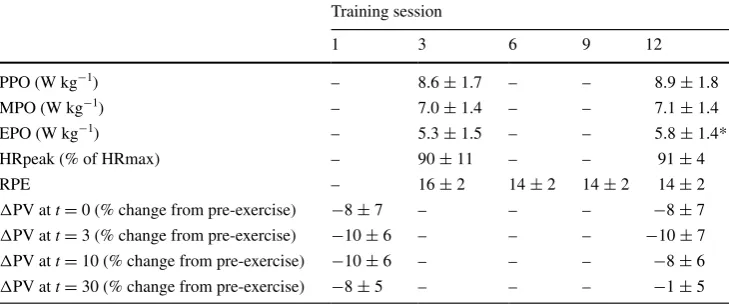
2max : 34 ± 8 mL kg min−1). Body mass did not change from baseline to reassessment in the training group (63.6 ± 15.6 vs. 63.9 ± 14.9 kg) or in the control group (64.4 ± 12.8 vs. 64.4 ± 12.8 kg). Of the fifteen participants in the train-ing group, twelve completed all 12 traintrain-ing sessions, two completed 11 sessions, and one completed 10 sessions, resulting in an overall mean adherence of 98 %. Charac-teristics of the training sessions are provided in Table 1. Peak and mean power output were not significantly differ-ent between the third and twelfth training sessions, but end power output was increased by 9 % in the 12th compared to the 3rd session (P= 0.03). Peak heart rate reached 90 ± 11 and 91 ± 4 % of HRmax during the 3rd and 12th train-ing sessions, respectively. Plasma volume was significantly reduced throughout the post-exercise period (P = 0.02), with no difference between the post-exercise time-points or between sessions 1 and 12 (Table 1).
Maximal power output (Wmax) was increased in the training group (185 ± 50 vs. 195 ± 50 W) compared to the control group (180 ± 48 vs. 174 ± 43 W; group × time interaction effect: P = 0.001). However, mean VO˙ 2max did not significantly change from baseline in the training group (2.15 ± 0.62 vs. 2.22 ± 0.64 L min−1) or the control
group (2.07 ± 0.69 vs. 2.08 ± 0.68 L min−1; effect of time: P= 0.17; group × time interaction effect: P= 0.26). There were no significant correlations between the change in VO˙ 2max and either physical activity levels as meas-ured using the International physical activity questionnaire (R2
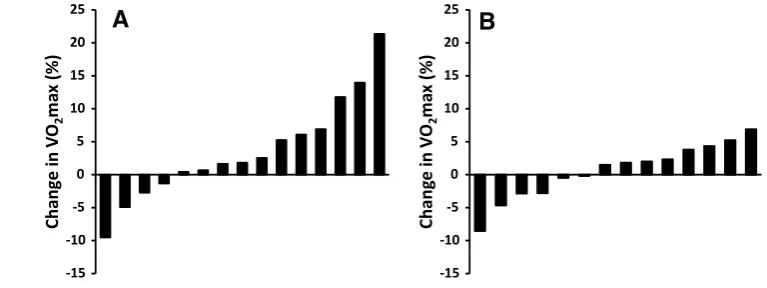
= 0.06), or baseline VO˙ 2max (R2 = 0.00). Interindi-vidual variability in the change in VO˙ 2max was larger in the training group (range −10 to +21 %) compared to the control group (−9 to +7 %; Fig. 1).
Discussion
Considering the strong association between improved
˙
VO2max and reduced all-cause/CVD mortality, it is impor-tant for studies to identify the most effective training modalities for improving VO˙ 2max (Weston et al. 2014). While strategies aimed at offering the greatest improve-ments should be a priority, considering the commonly reported barrier of lack of time (Korkiakangas et al. 2009) there is also a need for studies examining protocols that enable improved VO˙ 2max with a minimal time commit-ment. Although our previous studies have demonstrated that regularly performing just two repeated 20-s all-out cycle sprints causes a robust increase in VO˙ 2max (Metcalfe et al. 2012), in the present study we have established that a single sprint does not provide a sufficient training stimulus.
Considering the proclaimed aim for SIT to be a time-efficient alternative exercise intervention, it is surprising that little attention has been given to identifying the low-est volume of high-intensity exercise associated with ben-eficial adaptations. The design of commonly studied SIT protocols has not been evidence based, but instead appears to have utilised an arbitrary number of sprint repetitions, perhaps at most guided by finding a balance between the
Table 1 Training characteristics (n= 15)
Values shown are mean ± SD
PPO peak power output, MPO mean power output, EPO end power output, RPE rating of perceived exer-tion, ΔPV plasma volume change
* P < 0.05 for the difference between the 3rd and 12th training session Training session
1 3 6 9 12
PPO (W kg−1) – 8.6 ± 1.7 – – 8.9 ± 1.8
MPO (W kg−1) – 7.0 ± 1.4 – – 7.1 ± 1.4
EPO (W kg−1) – 5.3 ± 1.5 – – 5.8 ± 1.4*
HRpeak (% of HRmax) – 90 ± 11 – – 91 ± 4 RPE – 16 ± 2 14 ± 2 14 ± 2 14 ± 2
ΔPV at t= 0 (% change from pre-exercise) −8 ± 7 – – – −8 ± 7
ΔPV at t= 3 (% change from pre-exercise) −10 ± 6 – – – −10 ± 7
ΔPV at t= 10 (% change from pre-exercise) −10 ± 6 – – – −8 ± 6
[image:5.595.179.544.60.212.2]largest total volume of high-intensity exercise and a man-ageable total exercise session duration. There is, however, no evidence that a larger number of sprint repetitions or a greater total volume of sprint exercise will lead to supe-rior cardiovascular or metabolic adaptations. In our lab we have shown that very low volumes of supramaximal exercise [40 s per exercise session; REHIT (Metcalfe et al.
2012)] are associated with improvements in VO˙ 2max typi-cally seen with much higher volumes [≥180 s per session (Weston et al. 2014; Milanovic et al. 2015)]. In this light, the difference in effectiveness between the present protocol (1 × 20-s sprint, ~3 % mean increase in VO˙ 2max) and our REHIT protocol [2 × 20-s sprints; 14 % mean increase in
˙
VO2max (Metcalfe et al. 2012)] is striking.
One potential explanation is that the present study used an intervention period of 4 weeks, whereas in our previous study the intervention lasted 6 weeks. However, adapta-tions to SIT protocols tend to occur very rapidly, and other studies have demonstrated significant increases in VO˙ 2max after as little as two weeks of training (Hazell et al. 2010; Whyte et al. 2010). Furthermore, Ijichi et al. (2015) observed a 14 % improvement in VO˙ 2max following a 4-week SIT intervention with three 30-s sprints per training session, suggesting that large improvements in VO˙ 2max are feasible with a small volume of high-intensity exercise within a short period of time. Moreover, data reported by Burgomaster et al. (2008) suggest no further increase in
˙
VO2max after 3 out of 6 weeks of SIT, and the meta-anal-ysis by Weston et al. (2014) suggests that training duration is not a significant modifier of the increase in VO˙ 2max with SIT: a threefold increase in the number of sessions has an unclear effect on the change in VO˙ 2max of −0.3 %.
It could also be argued that doubling the volume of sprint exercise per session from 20 to 40 s may provide a substantial additional training stimulus, thus explaining the superior increase in VO˙ 2max with repeated sprints. How-ever, there are currently no indications that further increas-ing the number of sprint repetitions to more than two fur-ther enhances the increase in VO˙ 2max, with the majority of studies examining 6–10 repeated Wingate sprints reporting
increases in VO˙ 2max similar to—or lower than—those with two repeated sprints (McKenna et al. 1997; Mac-Dougall et al. 1998; Burgomaster et al. 2008; Hazell et al.
2010; Whyte et al. 2010). If the low total sprint volume was to explain the lack of effect in the present study, then it remains unclear why there is no evidence for an associa-tion between larger sprint volumes and enhanced improve-ments in VO˙ 2max. An alternative explanation could be that the initial sprint of a SIT session provides a ‘priming’ effect which then allows subsequent sprints to be effective, but this remains speculation at this point.
While a training programme incorporating single 20-s sprints may not be of use to improve aerobic capacity in the general population, the divergent responses to training protocols consisting of one vs. two sprints may provide an opportunity to help elucidate the molecular mechanisms through which SIT improves VO˙ 2max. One problem in studying mechanisms is that cause–effect relations cannot be established by correlating acute effects of exercise to chronic adaptations following training. However, by con-trasting the acute effects of exercise protocols that are simi-lar, but with divergent training effects, it may be possible to provide evidence against specific proposed mechanisms. It is clear that if a specific acute response is observed fol-lowing both a single 20-s sprint (insufficient stimulus for improving VO˙ 2max) and two repeated 20-s sprints (suf-ficient stimulus), then this response by itself cannot be responsible for causing the training adaptation(s). Future studies are needed to assess the potential use of this approach. Furthermore, future large studies should further examine the impact of technical error (measurement error and day-to-day biological variability) on the occurrence of low response to training protocols. The impact of this issue on the results in the current study are unclear, and only studies with a large sample size can sufficiently address this issue (Ross et al. 2015).
Some limitations of the present study mean that the results should be treated with caution. Firstly, we did not include a third arm to the RCT to directly compare the single-sprint protocol to a repeated-sprint protocol or to a protocol
Fig. 1 Individual changes in
˙
VO2max for the training group
(a) and the control group (b)
-15 -10 -5 0 5 10 15 20 25
Change in
VO
2
ma
x (%
)
A
-15 -10 -5 0 5 10 15 20 25
Chan
ge
in VO
2
ma
x (%
)
[image:6.595.163.547.57.201.2]Eur J Appl Physiol
incorporating 30-s Wingate sprints. Future studies should determine whether performing single sprints of a longer duration may improve VO˙ 2max. Secondly, the interindivid-ual variability in response shown in Fig. 1 suggests that the single-sprint training protocol may have been effective for some participants, with 20 % of the participants in the train-ing group showtrain-ing an increase in VO˙ 2max of >10 %. Thus, it may be that the mean increase in VO˙ 2max in response to single-sprint training in a larger sample would reach sig-nificance. However, the power of our study was sufficient to be able to detect a difference in the change in VO˙ 2max of 5 % between the control group and the training group, and smaller changes would not justify using a single-sprint train-ing protocol instead of the more effective REHIT protocol or other more strenuous SIT protocols.
In conclusion, our present study suggests that regularly performing a single 20-s ‘all-out’ cycle sprint does not pro-vide a sufficient training stimulus for increasing VO˙ 2max in low- to moderately active men and women. Thus, the REHIT protocol, consisting of two 20-s cycle sprints within a 10-min exercise session, remains the lowest volume of exercise shown to improve robustly VO˙ 2max. Further stud-ies investigating the optimal way to modulate important cardiometabolic risk factors in a time-efficient manner may help improve the health and quality of life in the predomi-nantly insufficiently active general population.
Acknowledgments We would like to thank Aaron Hengist, Matt Hol-land, Ben Taisler, Noel Brick, Gary McDermott and Diane Gillon for assistance with testing and the training sessions. PS is supported by a PhD studentship provided by Thammasat University.
Compliance with ethical standards
Conflict of interest The authors declare that they have no conflict of interest.
Open Access This article is distributed under the terms of the Crea-tive Commons Attribution 4.0 International License (http://crea-tivecommons.org/licenses/by/4.0/), which permits unrestricted use, distribution, and reproduction in any medium, provided you give appropriate credit to the original author(s) and the source, provide a link to the Creative Commons license, and indicate if changes were made.
References
Allemeier CA, Fry AC, Johnson P, Hikida RS et al (1994) Effects of sprint cycle training on human skeletal muscle. J Appl Physiol (1985) 77:2385–2390
Bailey SJ, Wilkerson DP, Dimenna FJ, Jones AM (2009) Influence of repeated sprint training on pulmonary O2 uptake and mus-cle deoxygenation kinetics in humans. J Appl Physiol (1985) 106:1875–1887
Blair SN, Kohl HW 3rd, Barlow CE, Paffenbarger RS Jr et al (1995) Changes in physical fitness and all-cause mortality. A prospec-tive study of healthy and unhealthy men. JAMA 273:1093–1098
Borg G (1970) Perceived exertion as an indicator of somatic stress. Scand J Rehabil Med 2:92–98
Bouchard C, Blair SN, Katzmarzyk PT (2015) Less sitting, more physical activity, or higher fitness? Mayo Clin Proc 90:1533–1540
Burgomaster KA, Howarth KR, Phillips SM, Rakobowchuk M et al (2008) Similar metabolic adaptations during exercise after low volume sprint interval and traditional endurance training in humans. J Physiol 586:151–160
Craig CL, Marshall AL, Sjostrom M, Bauman AE et al (2003) Inter-national physical activity questionnaire: 12-country reliability and validity. Med Sci Sports Exerc 35:1381–1395
Dill DB, Costill DL (1974) Calculation of percentage changes in volumes of blood, plasma, and red cells in dehydration. J Appl Physiol 37:247–248
Fuentes T, Guerra B, Ponce-Gonzalez JG, Morales-Alamo D et al (2012) Skeletal muscle signaling response to sprint exercise in men and women. Eur J Appl Physiol 112:1917–1927
Garber CE, Blissmer B, Deschenes MR, Franklin BA et al (2011) American College of Sports Medicine position stand. Quantity and quality of exercise for developing and maintaining cardiores-piratory, musculoskeletal, and neuromotor fitness in apparently healthy adults: guidance for prescribing exercise. Med Sci Sports Exerc 43:1334–1359
Gibala MJ, Little JP, Macdonald MJ, Hawley JA (2012) Physiologi-cal adaptations to low-volume, high-intensity interval training in health and disease. J Physiol 590:1077–1084
Gillen JB, Gibala MJ (2014) Is high-intensity interval training a time-efficient exercise strategy to improve health and fitness? Appl Physiol Nutr Metab 39:409–412
Gillen JB, Percival ME, Skelly LE, Martin BJ et al (2014) Three min-utes of all-out intermittent exercise per week increases skeletal muscle oxidative capacity and improves cardiometabolic health. PLoS One 9:e111489
Gist NH, Fedewa MV, Dishman RK, Cureton KJ (2014) Sprint inter-val training effects on aerobic capacity: a systematic review and meta-analysis. Sports Med 44:269–279
Guerra B, Guadalupe-Grau A, Fuentes T, Ponce-Gonzalez JG et al (2010) SIRT1, AMP-activated protein kinase phosphorylation and downstream kinases in response to a single bout of sprint exercise: influence of glucose ingestion. Eur J Appl Physiol 109:731–743
Hallal PC, Andersen LB, Bull FC, Guthold R et al (2012) Global physical activity levels: surveillance progress, pitfalls, and pros-pects. Lancet 380:247–257
Hazell TJ, Macpherson RE, Gravelle BM, Lemon PW (2010) 10 or 30-s sprint interval training bouts enhance both aerobic and anaerobic performance. Eur J Appl Physiol 110:153–160 Ijichi T, Hasegawa Y, Morishima T, Kurihara T et al (2015) Effect of
sprint training: training once daily versus twice every second day. Eur J Sport Sci 15:143–150
Keteyian SJ, Brawner CA, Savage PD, Ehrman JK et al (2008) Peak aerobic capacity predicts prognosis in patients with coronary heart disease. Am Heart J 156:292–300
Korkiakangas EE, Alahuhta MA, Laitinen JH (2009) Barriers to regu-lar exercise among adults at high risk or diagnosed with type 2 diabetes: a systematic review. Health Promot Int 24:416–427 Lee DC, Sui X, Artero EG, Lee IM et al (2011) Long-term effects of
changes in cardiorespiratory fitness and body mass index on all-cause and cardiovascular disease mortality in men: the Aerobics Center Longitudinal Study. Circulation 124:2483–2490
MacDougall JD, Hicks AL, MacDonald JR, McKelvie RS et al (1998) Muscle performance and enzymatic adaptations to sprint interval training. J Appl Physiol (1985) 84:2138–2142
performance but not maximal cardiac output. Med Sci Sports Exerc 43:115–122
McBride A, Ghilagaber S, Nikolaev A, Hardie DG (2009) The glyco-gen-binding domain on the AMPK beta subunit allows the kinase to act as a glycogen sensor. Cell Metab 9:23–34
McKenna MJ, Heigenhauser GJ, McKelvie RS, Obminski G et al (1997) Enhanced pulmonary and active skeletal muscle gas exchange during intense exercise after sprint training in men. J Physiol 501(Pt 3):703–716
Metcalfe RS, Babraj JA, Fawkner SG, Vollaard NB (2012) Towards the minimal amount of exercise for improving metabolic health: beneficial effects of reduced-exertion high-intensity interval training. Eur J Appl Physiol 112:2767–2775
Milanovic Z, Sporis G, Weston M (2015) Effectiveness of High-Inten-sity Interval Training (HIT) and continuous endurance training for VO2max Improvements: a systematic review and meta-analy-sis of controlled trials. Sports Med 45:1469–1481
Myers J, Prakash M, Froelicher V, Do D et al (2002) Exercise capac-ity and mortalcapac-ity among men referred for exercise testing. N Engl J Med 346:793–801
Nalcakan GR (2014) The effects of sprint interval vs. continuous endurance training on physiological and metabolic adaptations in young healthy adults. J Hum Kinet 44:97–109
Parolin ML, Chesley A, Matsos MP, Spriet LL et al (1999) Regula-tion of skeletal muscle glycogen phosphorylase and PDH during maximal intermittent exercise. Am J Physiol 277:E890–E900 Pate RR, Pratt M, Blair SN, Haskell WL et al (1995) Physical
activ-ity and public health. A recommendation from the Centers for
Disease Control and Prevention and the American College of Sports Medicine. JAMA 273:402–407
Ross R, de Lannoy L, Stotz PJ (2015) Separate effects of intensity and amount of exercise on interindividual cardiorespiratory fit-ness response. Mayo Clin Proc 90:1506–1514
Sandvei M, Jeppesen PB, Stoen L, Litleskare S et al (2012) Sprint interval running increases insulin sensitivity in young healthy subjects. Arch Physiol Biochem 118:139–147
Sloth M, Sloth D, Overgaard K, Dalgas U (2013) Effects of sprint interval training on VO2max and aerobic exercise performance: a systematic review and meta-analysis. Scand J Med Sci Sports 23:e341–e352
Thomas S, Reading J, Shephard RJ (1992) Revision of the Physi-cal Activity Readiness Questionnaire (PAR-Q). Can J Sport Sci 17:338–345
Weston M, Taylor KL, Batterham AM, Hopkins WG (2014) Effects of low-volume high-intensity interval training (HIT) on fitness in adults: a meta-analysis of controlled and non-controlled trials. Sports Med 44:1005–1017
Whyte LJ, Gill JM, Cathcart AJ (2010) Effect of 2 weeks of sprint interval training on health-related outcomes in sedentary over-weight/obese men. Metabolism 59:1421–1428