STORAGE IN CLOUD COMPUTING BY SECURE ERASURE CODE
Rinu Sam S
Sivaji College of Engineering and Technology, Manivila, Tamil Nadu, India.
ABSTRACT
A cloud storage system consisting of a collection of storage servers provides long term
services over the Internet. Storing data in a third party's cloud causes serious concern over data
confidentiality. General encryption scheme has some limitations. Constructing a secure storage
system that supports multiple functions is challenging when the storage system is distributed and
has no central authority. We propose a threshold proxy re-encryption scheme and integrate it
with a decentralized erasure code such that a secure distributed storage system is formulated.
The distributed storage system not only supports secure and robust data storage and retrieval,
but also lets a user forward his data in the storage servers to another user without retrieving the
data back. The main technical contribution is that the proxy re-encryption scheme supports
encoding operations over encrypted messages as well as forwarding operations over encoded
and encrypted messages. Our method fully integrates encrypting, encoding, and forwarding. We
analyze and suggest suitable parameters for the number of copies of a message dispatched to
storage servers and the number of storage servers queried by a key server. These parameters
allow more flexible adjustment between the number of storage servers and robustness
Keywords: Decentralized erasure code, proxy re-encryption, secure storage system
International Research Journal of Mathematics, Engineering and IT Vol. 4, Issue 6, June 2017 Impact Factor- 5.489
ISSN: (2349-0322)
© Associated Asia Research Foundation (AARF)
1. Introduction
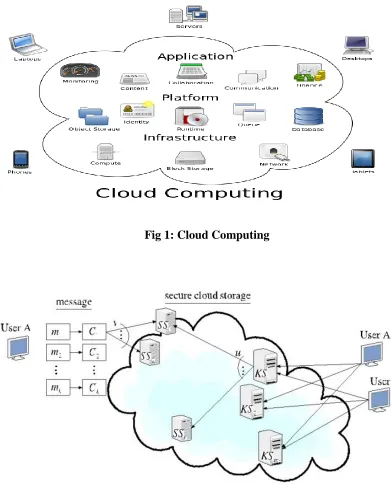
Cloud Computing is a technology that uses the internet and central remote servers to
maintain data and applications. Cloud computing allows consumers and businesses to use
applications without installation and access their personal files at any computer with internet
access (fig.1). This technology allows for much more efficient computing by centralizing data
storage, processing and bandwidth. That is Cloud Computing is the method of delivering
resources (hardware or software resources) as a service over the internet. And Cloud is a
collection of servers that is capable of providing different services to users [1-3]. A simple
example of cloud computing is Yahoo email, Gmail, or Hotmail etc. All you need is just an
internet connection and you can start sending emails. The server and email management software
is all on the cloud (internet) and is totally managed by the cloud service provider Yahoo, Google
etc. The consumer gets to use the software alone and enjoy the benefits.
1.1. Cloud Storage
There are many types of services provided by the cloud. They are
Infrastructure as a service (IaaS)
Platform as a service (PaaS)
Software as a service (SaaS)
Storage as a service (STaaS)
Security as a service (SECaaS)
Data as a service (DaaS)
Database as a service (DBaaS)
Test environment as a service (TEaaS)
Desktop virtualization
Cloud Providers who provide Storage as a Service provides online storage of data in the
database of the cloud. These hosting companies operate large data centers, and people who
require their data to be hosted buy or lease storage capacity from them. Thedatacenter operators,
in background, virtualizes the resources according to the requirements of the customer and
expose them as storage pools, which the customers can themselves use to store files or data
benefits, but it also is vulnerable to threats. As the uses of cloud computing increase, it is highly
likely that more criminals will try to find new ways to exploit vulnerabilities in the system [4].
There are many underlying challenges and risks in cloud computing that increase the threat of
data being compromised [5]. To help mitigate the threat, cloud computing stakeholders should
invest heavily in risk assessment to ensure that the system encrypts to protect data; establishes
trusted foundation to secure the platform and infrastructure; and builds higher assurance into
auditing to strengthen compliance. Security concerns must be addressed in order to establish trust
in cloud computing technology.
Storing data in a third party’s cloud system causes serious concern on data
confidentiality. In order to provide strong confidentiality for messages in storage servers, a user
can encrypt messages by a cryptographic method before applying an erasure code method to
encode and store messages [6]. When he wants to use a message, he needs to retrieve the
codeword symbols from storage servers, decode them, and then decrypt them by using
cryptographic keys. There are three problems in the above straightforward integration of
encryption and encoding. First, the user has to do most computation and the communication
traffic between the user and storage servers is high. Second, the user has to manage his
cryptographic keys. If the user’s device of storing the keys is lost or compromised, the security is
broken. Finally, besides data storing and retrieving, it is hard for storage servers to directly
support other functions. For example, storage servers cannot directly forward a user’s messages
to another one. The owner of messages has to retrieve, decode, decrypt and then forward them to
another user.
In this paper, we address the problem of forwarding data to another user by storage
servers directly under the command of the data owner. We consider the system model that
consists of distributed storage servers and key servers (fig.2). Since storing cryptographic keys in
a single device is risky, a user distributes his cryptographic key to key servers that shall perform
cryptographic functions on behalf of the user. These key servers are highly protected by security
mechan-isms. To well fit the distributed structure of systems, we require that servers
independently perform all operations. With this consideration, we propose a new threshold proxy
re-encryption scheme and integrate it with a secure decentralized code to form a secure
distributed storage system. The encryption scheme supports encoding opera-tions over encrypted
messages and forwarding operations over encrypted and encoded messages. The tight
requirements of data robustness, data confidentiality, and data forwarding. Accomplishing the
integration with consideration of a distributed structure is challenging. Our system meets the
requirements that storage servers independently perform encoding and re-encryption and key
servers independently perform partial decryption. Moreover, we consider the system in a more
general setting than previous works. This setting allows more flexible adjustment between the
number of storage servers and robustness. 1.2. Erasure code for storage applications
In this work it deals with storage systems, which includes researchers, programmers, and
managers of disk array systems, distributed storage systems, wide-area storage systems, and
peer-to-peer storage systems. No hard-core math or programming knowledge is required. The
goal is for the participants to come away with a basic understanding of how erasure codes may
be used in storage systems, including all the available techniques and technologies, plus their
performance tradeoffs and their complexity [7]. Erasure Code is a FEC (forward error correction)
which transforms a message of k symbols into a longer message with n symbols or transforms a
message of k symbols into n blocks of size m and original message can be recovered from a
subset of n symbols.
2. Background and Related Work
We briefly review distributed storage systems, proxy re-encryption schemes, and integrity
checking mechanisms.
2.1. Distributed Storage Systems
At the early years, the Network-Attached Storage (NAS) and the Network File System
(NFS) provide extra storage devices over the network such that a user can access the storage
devices via network connection. Afterward, many improvements on scalability, robustness,
efficiency, and security were proposed.
A decentralized architecture for storage systems offers good scalability, because a storage
server can join or leave without control of a central authority. To provide robust-ness against
server failures, a simple method is to make replicas of each message and store them in different
servers. However, this method is expensive as z replicas result in z times of expansion.
One way to reduce the expansion rate is to use erasure codes to encode messages. A
codeword symbol. A storage server failure is modeled as an erasure error of the stored codeword
symbol. Random linear codes support distributed encoding, that is, each codeword symbol is
independently computed. To store a message of k blocks, each storage server linearly combines
the blocks with randomly chosen coeffi-cients and stores the codeword symbol and coefficients.
To retrieve the message, a user queries k storage servers for the stored codeword symbols and
coefficients and solves the linear system.
We addressed robustness and confidentiality issues by presenting a secure decentralized
erasure code for the networked storage system. In addition to storage servers, their system
consists of key servers, which hold cryptographic key shares and work in a distributed way. In
their system, stored messages are encrypted and then encoded. To retrieve a message, key
servers query storage servers for the user. As long as the number of available key servers is over
a threshold t, the message can be successfully retrieved with an overwhelming probability.
2.2. Proxy Re-Encryption Schemes
Proxy encryption schemes are proposed by Mambo and Okamoto In a proxy
re-encryption scheme, a proxy server can transfer a ciphertext under a public key PKA to a new one
under another public key PKB by using the re-encryption key RKA!B. The server does not know
the plaintext during transformation. Ateniese et al. proposed some proxy re-encryption schemes
and applied them to the sharing function of secure storage systems. In their work, messages are
first encrypted by the owner and then stored in a storage server. When a user wants to share his
messages, he sends a re-encryption key to the storage server. The storage server re-encrypts the
encrypted messages for the authorized user. Thus, their system has data confidentiality and
supports the data forwarding function. Our work further integrates encryption, re-encryption, and
encoding such that storage robustness is strengthened.
Type-based proxy re-encryption schemes proposed by Tang provide a better granularity
on the granted right of a re-encryption key. A user can decide which type of messages and with
whom he wants to share in this kind of proxy encryption schemes. Key-private proxy
re-encryption schemes are proposed by Ateniese et al. In a key-private proxy re-re-encryption scheme,
given a re-encryption key, a proxy server cannot determine the identity of the recipient. This
kind of proxy re-encryption schemes provides higher privacy guarantee against proxy servers.
Although most proxy encryption schemes use pairing operations, there exist proxy
2.3 Integrity Checking Functionality
Another important functionality about cloud storage is the function of integrity checking.
After a user stores data into the storage system, he no longer possesses the data at hand. The user
may want to check whether the data are properly stored in storage servers. The concept of
provable data possession and the notion of proof of storage are proposed. Nevertheless all of
them consider the messages in the clear text form.
3. System Architecture Design
The system Architecture defines the operational flow of the entire system (fig.3).
In this paper, we first present our Storage structure in cloud, which uses the secure code, based
scheme and distributed storage for effective storage mechanism.
3.1 Distributed Storage in Cloud
Cloud storage system has a distributed storage mechanism (fig.4). The message of a user
A can be split and then encrypted and stored in multiple server. In normal case only encryption is
done. Erasure code base mechanism provides distributed storage of the message in the cloud
system making the data of the user more secure. Similarly it can be retrieved by merging data
distributed across the cloud.
Here data is encrypted twice for more security. After first encryption data is split
according to the choice of the data owner. Then each of the split block is re-encrypted and
zipped. Then again it is the data owner who decides where he wants to store each block. Then
storing of the data blocks can be done in a distributed fashion among all the servers of the cloud.
Anyone who is authorized to get the data can be retrieved from these distributed storage system
with appropriate secret key and thus data is forwarded from the distributed storage system to the
requested user.
4. Modules
This project has mainly divided in to six major modules. Each module has well designed
to accomplish different tasks, those are listed and designed as part of system development and
the different authorization based on the designated level. Each module has different sub-modules
too to make the system a power full one. All the major tasks makes an effective approach for
The different modules available in this system are
Process Encryption
File Rifting
Proxy Re-encryption
Data Storage on Cloud
Data Retrieval from cloud
Data Forwarding
4.1. Process Encryption
In this module, we have to define the process we use for encryption. The process can be
encrypted by using cryptographic keys. Since client files are stored in the cloud server, they have
lesser security options. To overcome these securities we have implemented the crypto process.
Each user A is assigned a public-secret key pair (PKA, SKA). User A distributes his
secret key SKA to key servers such that each key server KSi holds a key share SKA,i, 1 ≤ i ≤ m.
The key is shared with a threshold t.
4.2. File Rifting
To achieve an effective data exchange for cloud computing the prevention of file from
intruders takes a vital role. After the process can be encrypted, it can be Spitted as different
process. Splitting process is decided by the data owner. He decides the number of output files
after splitting.
The fragmentation makes a bit higher complexity to gain complete information of a file.
Thus an intruder does not get any idea by getting only any of the output file. File rifting process
strengthen the process of sending and storing data in the cloud.
4.3. Proxy Re-encryption
Each of the split output is again encrypted separately. All the k subparts of the message m
User A RE encrypts his message M and dispatches it to storage servers. A message M is
decomposed into k blocks m1,m2, . . . , mk and has an identifier ID. User A encrypts each block
mi into a cipher text Ci and sends it to v randomly chosen storage servers.
4.4. Data Storage On Cloud
The re-encrypted k message blocks can be saved anywhere on the cloud. The cloud
consists of n number of servers and it is the data owner /client who decides where his
re-encrypted message blocks be saved.
A single message block or a group of message blocks can be stored in a server in the
cloud. The data stored in the cloud is very secure as it is split and saved in different locations of
the cloud.
4.5. Data Retrieval
This is the process of retrieving data which is stored in the cloud. When the user needs
back the file which is in cloud server the user can retrieve the re-encrypted files from multiple
servers.
It consists of the following processes.
• Decrypt the files individually by referring the keys in key servers
• Decrypted individual files are then merged to get the whole file
• Again decrypted to get the original file.
4.6. Data Forwarding
Data forwarding lets a user forward his data in the storage servers to another user without
retrieving the data back. User A forwards his encrypted message with an identifier ID stored in
storage servers to user B such that B can decrypt the forwarded message by his secret key .Data
forwarding process forwards the data to the requested user.
5. Algorithm
It operates on blocks of 64 bits using a secret key that is 56 bits long (fig.5). The original
proposal used a secret key that was 64 bits long. It is widely believed that the removal of these 8
bits from the key was done to make it possible for U.S. government agencies to secretly crack
messages
DES is a block cipher--meaning it operates on plaintext blocks of a given size (64-bits)
and returns cipher text blocks of the same size. Thus DES results in a permutation among the
2^64 (read this as: "2 to the 64th power") possible arrangements of 64 bits, each of which may be
either 0 or 1. Each block of 64 bits is divided into two blocks of 32 bits each, a left half
block L and a right half R. (This division is only used in certain operations.)
The DES algorithm uses the following steps:
Step 1: Create 16 sub keys, each of which is 48-bits long.
Step 2: Encode each 64-bit block of data.
6 Conclusion & Future Work
We integrate a newly proposed threshold proxy re-encryption scheme and erasure codes
over exponents. The threshold proxy re-encryption scheme supports encoding, forwarding, and
partial decryption operations in a distributed way. To decrypt a message of k blocks that are
encrypted and encoded to n codeword symbols, each key server only has to partially decrypt to
codeword symbols in our system. By using the threshold proxy re-encryption scheme, we present
a secure cloud storage system that provides secure data storage and secure data forwarding
functionality in a decentralized structure.
6.1. Future Works
Constructing a secure storage system that supports multiple functions is challenging
when the storage system is distributed and has no central authority. So maintain a Central
authority for all the cloud storage activities.
General encryption schemes protect data confidentiality, but also limit the functionality
of the storage system because few operations are supported over encrypted data. So we
Checking the correctness of the data after retrieving from the cloud database.
[image:10.612.107.476.94.308.2]
Fig 1: Cloud Computing
[image:10.612.99.490.102.593.2]Fig: 3. System Architecture
REFERENCES
1. A. Haeberlen, A. Mislove, and P. Druschel, “Glacier: Highly durable, decentralized storage despite massive correlated failures,” in Proceedings of the 2nd Symposium on Networked
Systems Design and Implementation .
2. H.-Y. Lin and W.-G. Tzeng, “A secure decentralized erasure code for distributed network storage,” IEEE Transactions on Parallel and Distributed Systems,
3. A. G. Demakis, V. Prabhakaran, and K. Ramchandran, “Decentralized erasure codes for distributed networked storage,” IEEE Transactions on Information Theory, vol. 14, pp.
2809–2816, 2006.
4. Q. Tang, “Type-based proxy re-encryption and its construction,” in Proceedings of the 9th International Conference on Cryptology in India:Progress in Cryptology - INDOCRYPT, pp.
130–144, Springer, 2008.
5. C. Ungureanu, B. Atkin, A. Aranya, S. Gokhale, S. Rago, G. Calkowski,C. Dubnicki, and A. Bohra, “Hydrafs: a high-throughput file system for the hydrastor content-addressable storage system,” in Proceedings of the 8th USENIX Conference on File and Storage Technologies -
FAST, p. 17,USENIX, 2010.
6. W. Dong, F. Douglis, K. Li, H. Patterson, S. Reddy, and P. Shilane, “Tradeoffs in scalable data routing for deduplication clusters,” in Proceedings of the 9th USENIX Conference on
File and Storage Technologies - FAST, p. 2, USENIX, 2011.
7. Z. Wilcox-O’Hearn and B. Warner, “Tahoe: the least-authority filesystem,” in Proceedings of the 4th ACM International Workshop on Storage Security and Survivability - StorageSS,
pp. 21–26, ACM, 2008.
P. Druschel and A. Rowstron, “PAST: A large-scale, persistent peer-topeer storage utility,” in Proceedings of the 8th Workshop on Hot Topics in Operating System - HotOS