A HYBRID MULTI-ATTRIBUTE DECISION MAKING FOR
ELECTRICIAN SELECTION BASED ON AHP, SAW AND
TOPSIS
1
WIWIEN HADIKURNIAWATI, 2RETANTYO WARDOYO
1Faculty of Information Technology, Universitas Stikubank, Semarang
2Department of Computer Science and Electronics, Universitas Gadjah Mada Yogyakarta E-mail: [email protected] [email protected]
ABSTRACT
Human resources is one of the important elements that affects the continuity of infrastructure development in Indonesia. Human resources competence is a prerequisite which can not be ignored. Quality competence results in an ability (competency) of an electrical expert. This study discusses the AHP (Analytic Hierarchy Process), SAW (Simple Additive Weighting) and TOPSIS (Technique for Order Preference by Similarity to Ideal Solution) in order to make the selection of experts decision on electrician through a competency test. These three methods are used to determine the highest priority of alternative electrical expert who has knowledge and ability in the field of medium voltage network that best fits the given parameters. The use of this hybrid method is expected to help and to provide the best decision in the selection of electrician
Keywords: Multi-Attribute Decision Making, AHP, SAW, TOPSIS, Electrician
1. INTRODUCTION
Infrastructure development in Indonesia is experiencing a rapid growth. The developments affect the increased needs of the elements associated with infrastructure development, one of which is the human resources in the form of labor. Human resources is one of the important elements that affect the continual implementation of construction projects. Improving the quality of human resources is very important for experts in
construction industry. Human resources
competency is very important and is the quality of competence which results in ability (competency), as expected. Labor skills are important part in the implementation of a construction project. Suitability in job skills possessed by workers with job skills required by the labor service user is required to increase employment opportunities [1
].
Competency of human resources in the electricity sector is very important. The government was aware of this and made the Law No. 15 on Electricity. The government has drawn up Government Regulation No. 3 of 2005 as an amendment to Government Regulation No. 10 of 1989 About the Provision and Use of Electric Power, which in Article 21 paragraph 9 states that "Every technician who worked in the electricity business is required to have a certificate of
competence". This regulation is an implementation of the Law on Electricity. To obtain a certificate of competency, experts of construction services in electrical field follow a series of competency tests. Competency test includes three components, they are knowledge, skills and attitude. Components of knowledge, skill, and attitude are obtained from several tests, both written test, practice, and interview. Each component has the criteria that have been defined.
several alternatives and attributes. MADM
technique is a popular technique and widely used in many fields of science, namely engineering, economics, management, transportation planning, and so on [3].
The rest of the papers are organized as follows, section 2 describes related work of our research. In the section 3 Analytic Hierarchy Process (AHP), Simple Additive Weighting (SAW), and TOPSIS (Technique for Order Preference by Similarity to Ideal Solution) are summarized. In this section methodology for each technique are also given. Section 4 discusses a case study, analysis, and result our research. Our conclusions are presented in Section 5.
2. RELATED WORK
Decision problem occurs in many organizations. Most of these problems aim to select a set of alternatives by considering several parameters. The decision making process can be completed by using the Multi Attribute decision making (MADM). Multi-attribute decision making aims to reach a decision in order to choose the best alternative from several potential candidates, putting subject into some criteria or attributes. They are beneficial or unfavorable [4]. In addition MADM also aims to help the decision maker in choosing the most suitable alternative from a number of alternatives that meet the requirements using several different parameters. [5].
Multi Attribute Decision Making
(MADM) is effective to solve the problems and make priorities with many variations of alternative multi-criteria. MADM problems are expressed by the matrix format. [6].
Decision-making is a growing research over the past twenty years, while research on the theory and methods of decision-making has always received attention from researchers in the world [7][8]. Hopfe [9] proposes the design of uncertainty assesment on decision-making using the approach of Analytical Hierarchy Process (AHP). The case study focused on discrete decision. Preferences in this case use key performance indicators. This process can solve the problem of consensus-based decision-making group to choose one of two choices.
Kursunoglu and Onder [5] use AHP method for the selection of the main fan. Main fan is used at coal mines in Turkey. Hierarchical structure on this issue consists of three levels with three alternatives to be chosen. Additionally, Kaoutsar [10] also uses AHP in the selection of fertile land.
Parimala and Lopez[11] apply AHP to evaluate the influence the factors of productivity.
In a complex system, we often faced the decision problems which include many attributes or many criteria and require judgment or decision-making by experts. It required the consideration of experts’s judgments to resolve uncertainties. Multi-attribute methods of decision making is the right method to solve the complex problem of decision making, because (a).The existence of various opinions of decision makers, (b). The uncertainty and imprecision, and (c). The decision making process is based on the concept of natural desire. There are uncertainty and imprecision group of decision making problems as specific alternative should be selected from several alternatives available, frequent conflicts repeated in criteria involving decision makers [12].
In this paper, the selection of the best alternative is obtained using several MADM methods. The proposed methods use hybrid AHP (Analytic Hierarchy Process), SAW (Simple Additive Weighting) and TOPSIS (Technique for Order Preference by Similarity to Ideal Solution).
3. METHODS
3.1.Analytic Hierarchy Process (AHP)
This method was developed by Thomas L. Saaty mathematician from the University of Pittsburgh United States and was first published in his book The Analytical Hierarchy Process 1980. AHP is a functional hierarchy model with the main
input of human perception. Complex or
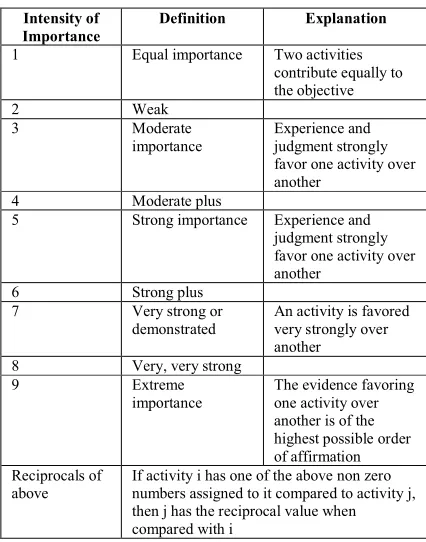
Table 1: Scale of Relative Importances (according Saaty)
Intensity of Importance
Definition Explanation
1 Equal importance Two activities
contribute equally to the objective
2 Weak
3 Moderate
importance
Experience and judgment strongly favor one activity over another
4 Moderate plus
5 Strong importance Experience and
judgment strongly favor one activity over another
6 Strong plus
7 Very strong or
demonstrated
An activity is favored very strongly over another
8 Very, very strong
9 Extreme
importance
The evidence favoring one activity over another is of the highest possible order of affirmation Reciprocals of
above
If activity i has one of the above non zero numbers assigned to it compared to activity j, then j has the reciprocal value when compared with i
Saaty [13] advised the utilization of the Concistency Index (CI) and the Consistency Ratio (CR) to verify the consistency of the comparison matrix. CI and CR are defined as follows :
CI λn 1 … … … . . … . 1 n
with CI = consistency index λmax = maximum eigenvalue n = size of matrix
Consistency Ratio (Consistency Ratio = CR) can be calculated using equation 2
CR … … … 2
In AHP, the pairwise comparison in a judgment matrix are considered to be adequately consistent if the corresponding consistency ratio (CR) is less than 10 %. If CR value is less than or equal to 0.10, the comparisons made by decision maker are considered acceptable. Larger values of CR require correction of the judgments by the decision maker.
RI (Random Index) is the average index for the consistency of the numerical numbers randomly from scale 1/9, 1/8, ..., 1, 2, ..., 9 based on the
[image:3.595.322.479.143.295.2]research conducted by Saaty with 500 samples. RI value can be seen from Table 2 [13]:
Table 2: Relationship RI and size of the matrix
Size of Matrix RI
1 0
2 0
3 0,58
4 0,9
5 1,12
6 1.24
7 1,32
8 1,41
9 1,45
10 1,49
3.2.Simple Additive Weighting (SAW)
The SAW (Simple Additive Weighting) method is probably the best known and widely used method for Multi Attribute Decision Making (MADM). SAW method is a weighted sum method. SAW is a popular method because of its simplicity. SAW method is also known as the term: often weighted. The basic principle of the SAW is to look for a weighted summation of the performance ratings of each alternative on all parameters [14].
3.3.Technique for Order Preference by Similarity to Ideal Solution (TOPSIS)
The Technique for Order Preference by Similarity to Ideal Solution (TOPSIS) is one of Multi Attribute Decision Making (MADM) classic method developed by Hwang and Yoon. TOPSIS helps decision makers in formulating the problem to be analyzed, compared, and sorted according to rank alternative [5].
TOPSIS is based on the concept of selecting the closest alternative of positive ideal solution (PIS) and the most distant alternative from the negative ideal solution (NIS) [4]. The sum of the highest value of each attribute is referred to as a positive ideal solution (PIS). Instead, the sum of all the lowest value of each attribute is negative ideal solution (NIS). TOPSIS method uses both the PIS and NIS. Alternative priorities can be achieved by comparison of the relative distance of the PIS and NIS.
Steps of TOPSIS procedure
1.
Decision matrix normalization2.
Creating a weighted and normalized decision matrix.4.
Determining the distance value of each alternative with positive ideal solution matrix and the negative ideal solution matrix.5.
Determining the preferences for each alternative.6.
Rank alternative4. CASE STUDY
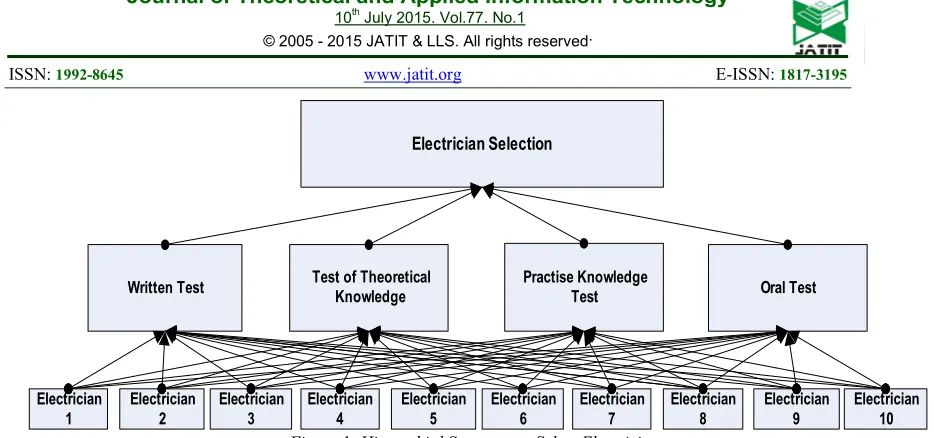
The problems in the selection of electrical experts or electrician aim to get experts who have parameters as per the requirements of the Agency for Construction Services. Construction of Services Agency is implemented by a competency test for experts in electrical construction. The electricians who have qualification will receive a certificate of competence after they have passed a competency test. The electricians fulfill administrative requirements before taking the competency test. The competency test consists of 4 exam materials. The test material is a parameter of decision-making. These parameters include of P1 (written test), P2 (test of theoretical knowledge), P3 (practice knowledge test), and P4 (oral test). The problems in the selectionof electrician can be represented in Figure 1. There are three steps of electrician selection.
4.1.Weighting Parameters
[image:4.595.299.515.382.516.2]The parameters used in the process of electrician selection are determined by the weight using a model of Analytic Hierarchy Process (AHP). These four parameters are compared to the level of importance using pairwise comparison matrix. The scale used in the pairwise comparison matrix is the scale of Saaty as shown in Table 1. Normalization matrix is required during the process of weighting.
Table 3: Pairwise Comparison Matrix
P1 P2 P3 P4
P1 1 0,2 0,142857 0,333333
P2 5 1 0,333333 3
P3 7 3 1 5
P4 3 0,333333 0,2 1
Table 3 shows the pairwise comparison matrix. Following normalization, the weights are averaged across the rows to give an average weight for parameter. Calculation of CR and CI was
performed with reference to the theoretical explanation, equation1 and 2.
λ max 4,1187389
CI 0,0395796
CR 0,0439774
Scoring pairwise comparison matrix elements are consistent, as shown by the calculation of CR values less than 0.1. CR value of pairwise comparison matrix is 0.0439774. It could be concluded that all comparison were consistent. Weighting parameters resulted from the process of calculation are as follows
P1 (written test) 0,055022
P2 (test of theoretical knowledge) 0,263378 P3 (practice knowledge test) 0,563813
P4 (oral test) 0,117786
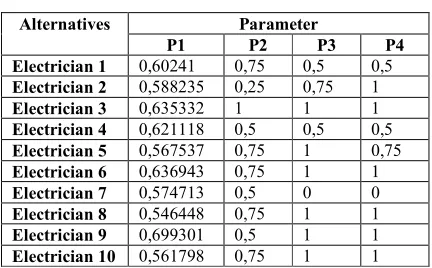
The test data is data crisp used as a parameter in the selection of an electrician. It is shown in Table 4
Tabel 4:Test Data
Alternatives Parameter
P1 P2 P3 P4
Electrician 1 0,60241 0,75 0,5 0,5
Electrician 2 0,588235 0,25 0,75 1
Electrician 3 0,635332 1 1 1
Electrician 4 0,621118 0,5 0,5 0,5
Electrician 5 0,567537 0,75 1 0,75
Electrician 6 0,636943 0,75 1 1
Electrician 7 0,574713 0,5 0 0
Electrician 8 0,546448 0,75 1 1
Electrician 9 0,699301 0,5 1 1
Electrician 10 0,561798 0,75 1 1
4.2.Decision Matrix Normalization
The next step is to normalize the test data in Table 4 in the form of a matrix using SAW (Simple Additive Weighting). The process of normalization matrix is calculated using equation below :
if j is benefit attribute
+
if j is cost attribute 3
[image:4.595.85.293.595.676.2]
Electrician Selection
Written Test Test of Theoretical Knowledge Practise Knowledge Test Oral Test
Electrician 1
Electrician 2
Electrician 3
Electrician 4
Electrician 5
Electrician 6
Electrician 7
Electrician 8
Electrician 9
[image:5.595.84.551.78.297.2]Electrician 10 Figure 1: Hierarchial Structure to Select Electrician
Table 5: Normalized Matrix
Alternatives Parameter
P1 P2 P3 P4 Electrician 1 0,861446 0,75 0,5 0,5
Electrician 2 0,841176 0,25 0,75 1
Electrician 3 0,765525 1 1 1
Electrician 4 0,888199 0,5 0,5 0,5
Electrician 5 0,811578 0,75 1 0,75
Electrician 6 0,910828 0,75 1 1
Electrician 7 0,821839 0,5 0 0
Electrician 8 0,781421 0,75 1 1
Electrician 9 1 0,75 1 1
Electrician 10 0,803371 0,75 1 1
4.3.Ranking of Alternatives
The next step is to rank the alternatives. The TOPSIS (Technique for Order Preference by Similarity to Ideal Solution) method is used to calculate the priority of alternatives. The next normalized decision matrix is weighted normalized matrix process. The weighted normalized matrix is obtained by multiplying the weight matrix normalized parameters obtained from pairwise comparison matrices. Normalized weighted matrix is calculated using the following equation:
/ 0 . …... (4)
with i = 1,2,...,m; and j = 1,2,...,n.
[image:5.595.93.281.340.456.2]The resulting normalized weighted matrix can be seen in Table 6.
Table 6:Weighted normalized matrix (Normalized Weighted Matrix)
Alternatives Parameter
P1 P2 P3 P4
Electrician 1 0,047399 0,197534 0,281906 0,058893
Electrician 2 0,046284 0,065845 0,42286 0,117786
Electrician 3 0,042121 0,263378 0,563813 0,117786
Electrician 4 0,048871 0,131689 0,281906 0,058893
Electrician 5 0,044655 0,197534 0,563813 0,08834
Electrician 6 0,050116 0,197534 0,563813 0,117786
Electrician 7 0,04522 0,131689 0 0
Electrician 8 0,042996 0,197534 0,563813 0,117786
Electrician 9 0,055022 0,131689 0,563813 0,117786
Electrician 10 0,044203 0,197534 0,563813 0,117786
The next step is to determine the positive ideal solution (PIS) and negative ideal solution (NIS), then to determine the distance of each alternative with positive ideal solution and negative ideal solution. Normalized weights in the decision matrix (yij) is used to determine the positive ideal solution A + and negative ideal solution A-
A+ = (y1+, y2+, ..., yn+) ;...(5)
A- = (y1-, y2-, ..., yn-) ; ...(6)
with
/1 2 3
4 ; jif j is benefit attribute
46 3
4 ; if j is cost attribute
...(7)
/7 2 46 34 ; if j is benefit attribute 3
4 ; if j is cost attribute
...(8)
j = 1, 2, ..., n.
Vj and Vj- value for each parameter are as follows:
P3 (Vj+ = 0,563813 and Vj- = 0)
P4 (Vj+ = 0,117786 and Vj- = 0)
Positive ideal solution and negative ideal solution of each alternative are shown in Table 7
Table 7:Positive Ideal Solution (PIS) and Negative Ideal Solution (NIS)
Alternatives PIS NIS
Electrician 1 0,087333 0,10031
Electrician 2 0,058964 0,192701
Electrician 3 0,000166 0,370778
Electrician 4 0,100319 0,087321
Electrician 5 0,00436 0,343037
Electrician 6 0,00436 0,349164
Electrician 7 0,349197 0,004345
Electrician 8 0,00448 0,349101
Electrician 9 0,017342 0,33626
Electrician 10 0,04453 0,349105
The next step is to determine the distance between the value of each alternative with positive ideal solution matrix (Di+) and the distance between the value of each alternative with negative ideal solution matrix (Di-). The distance between the alternative Ai with positive and negative ideal solution can be formulated by the equation [7],[8]:
81 9∑< /1 / ;
= ; i = 1, 2, ..., m. ...(9)
87 9∑< / /7 ;
= ; i = 1, 2, ..., m. ...(10)
Distance weighted value of each alternative to the positive ideal solution and negative ideal solution can be seen in Table 8.
Table 8: Distance alternative to PIS and NIS
Alternatives D+ D-
Electrician 1 0,295522 0,316717
Electrician 2 0,242825 0,438977
Electrician 3 0,012901 0,608915
Electrician 4 0,316733 0,295501
Electrician 5 0,066027 0,585694
Electrician 6 0,066027 0,590901
Electrician 7 0,590929 0,065917
Electrician 8 0,066934 0,590848
Electrician 9 0,131689 0,57988
Electrician 10 0,066728 0,590851
Give preference value for each alternative. Preference value for each alternative (Vi) is given as
> ?@
A
?@ A 1 ?@B ; i = 1, 2, ..., m...(11)
From the calculation Vi, Vi alternative with the largest value of the best solution and the first priority.
Table 10:Value Preferences Alternative and Alternative Rating
Alternatives Vi Rank
Electrician 1 0,517309 8
Electrician 2 0,643849 7
Electrician 3 0,979252 1
Electrician 4 0,48266 9
Electrician 5 0,898688 3
Electrician 6 0,899491 2
Electrician 7 0,100354 10
Electrician 8 0,898243 5
Electrician 9 0,814931 6
Electrician 10 0,898525 4
Based on the results from the calculation of the relative strength of the ideal solution, it is obtained that an electrician 3 has the highest value and has top rank.
5. CONCLUSION
The process of evaluating and
determining an electrician in the competency test involves many parameters. This study uses AHP (Analytic Hierarchy Process), SAW (Simple Additive Weighting), and TOPSIS (Technique for Order Preference by Similarity to Ideal Solution) for decision-making to solve the problem of determining an electrician in the competency test. The selection results are obtained in the form of ranking the final value of the electician.
REFERENCES:
[1] H.P. Adi dan M.A. Wibowo, “Evaluasi Kinerja Stakeholders Dalam Pembinaan Keterampilan Tenaga Kerja Konstruksi Dengan Metode Performance Prism”, Media Teknik Sipil, Volume X, ISSN 1412-0976, 2010, pp. 106-112.
[2] X. Zhang and Z. Xu, “Soft Computing based on Maximizing Consensus and Fuzzy TOPSIS Approach to interval-valued Intuitionistic Fuzzy Group Decision Making”, Elsevier B.V, 2014, pp. 42-56, doi:10.1016/j.asoc.2014.08.073 1568-4946. [3] L. Fan and F. Zuo, “Research on
Multi-Attribute Decision Making Method Based on AHP and Outranking Relation”, Workshop on Power Electronics and Intelligent Transportation System, IEEE, 2008, pp. 227-232, doi:10.1109/PEITS.2008.42.
[4] K.T. Cho, “Multicriteria Decision Methods : An Attempt to Evaluate and Unify”,
Mathematical and Computer Modelling, Elsevier, 2003, pp.1099-1119.
[5] N. Kursunaglo and M. Onder, “Selection of An Appropriate Fan for An Underground Coal Mine Using the Analytic Hierarchy Process”, Elsevier, 2015, pp. 101-109, doi: 10.1016 /j.tust.2015.02.005.
[6] M. Anisseh and Rosnah, “Developing a Fuzzy TOPSIS Model in Multiple Attribute Group Decision Making”, Scientific Research and Essays, Vol. 6(5), 2011
,
pp. 1046-1052.[7] X. Chen and L. Ma, “An Analytic Method
far Consensus Analyisis in Group
Experts’Judgments Based on Numerical Decision Matrix Preference Information”,
Fifth International Conference on Fuzzy Systems and Knowledge Discovery, IEEE,
2008, pp. 176-180,
doi:10.1109/FSKD.2008.502.
[8] P. Dongjing, “A New Method for Fuzzy Multiple Attribute Decision Making based on Interval Numbers”, International Forum
on Information Technology and
Applications, IEEE Computer Society, 2009, pp. 408-411, doi:10.1109/IFITA.2009.141. [9] C.J. Hopfe, G.L.M. Augenbroe, J.L.M
Hensen, “Multi-Criteria Decision Making Uncertainty in Building Performance Assesment”, Building and Environment,
Elsevier, vol.69, pp. 81-90, 2013,
doi:
10.1016/j.buildenv.2013.07.019.
[10] B. Kaoutsar and B. Lahcen, “A Fuzzy AHP Process in GIS Environment for Landfill Site Selection”, Journal of Theoretical and Applied Information Technology (JATIT), Vol.65, No.3, 2014, pp. 871-880.
[11] M. Parimala and D. Lopez, “Decision Making in Agriculture based on Land
Suitability-Spatial Data Analysis
Approach”, Journal of Theoretical and Applied Information Technology (JATIT),
Vol.46, No.1, 2012, pp. 17-42.
[12] X. Zhai and R. Xu, “A Multiple Criteria Decision Method Based on Uncertain Judgment”, Sixth International Conference
on Fuzzy Systems and Knowledge
Discovery, 2009, pp. 218-222,
doi:10.1109/FSKD.2009.682.
[13] T.L. Saaty, “Decision Making – The
Analytic and Network Process
(AHP/ANP)”, Journal of Systems Science Engineering, Vol 13, 2004, pp. 1-34. [14] W. Deni, O. Sudana, A. Sasmito,