January 25, 1998
SRC
Research
Report
149
A Calculus for Cryptographic Protocols
The Spi Calculus
Mart´ın Abadi and Andrew D. Gordon
d i g i t a l
Systems Research Center 130 Lytton Avenue
Palo Alto, California 94301
Systems Research Center
The charter of SRC is to advance both the state of knowledge and the state of the art in computer systems. From our establishment in 1984, we have performed basic and applied research to support Digital’s business objec-tives. Our current work includes exploring distributed personal computing on multiple platforms, networking, programming technology, system mod-elling and management techniques, and selected applications.
Our strategy is to test the technical and practical value of our ideas by building hardware and software prototypes and using them as daily tools. Interesting systems are too complex to be evaluated solely in the abstract; extended use allows us to investigate their properties in depth. This ex-perience is useful in the short term in refining our designs, and invaluable in the long term in advancing our knowledge. Most of the major advances in information systems have come through this strategy, including personal computing, distributed systems, and the Internet.
We also perform complementary work of a more mathematical flavor. Some of it is in established fields of theoretical computer science, such as the analysis of algorithms, computational geometry, and logics of programming. Other work explores new ground motivated by problems that arise in our systems research.
A Calculus for Cryptographic Protocols
The Spi Calculus
Mart´ın Abadi and Andrew D. Gordon
A preliminary version of this paper appeared as a Technical Report of the University of Cambridge Computer Laboratory [AG97a].
During most of this work, Andrew D. Gordon was with the University of Cambridge Computer Laboratory, holding a University Research Fellowship awarded by the Royal Society; he is now with Microsoft Research, Cam-bridge. He can be reached by email [email protected].
c
Digital Equipment Corporation 1998
Abstract
Contents
1 Security and the Pi Calculus 1
2 Protocols using Restricted Channels 3
2.1 Basics . . . 3
2.2 Outline of the Pi Calculus . . . 4
2.3 Examples using Restricted Channels . . . 6
2.3.1 A first example . . . 6
2.3.2 An example with channel establishment . . . 8
2.3.3 Discussion . . . 10
3 Protocols using Cryptography 11 3.1 The Spi Calculus with Shared-Key Cryptography . . . 11
3.2 Examples using Shared-Key Cryptography . . . 12
3.2.1 A first cryptographic example . . . 13
3.2.2 An example with key establishment . . . 14
3.2.3 A complete authentication example (with a flaw) . . . 16
3.2.4 A complete authentication example (repaired) . . . 20
3.2.5 Discussion . . . 22
4 Formal Semantics of the Spi Calculus 23 4.1 The Reaction Relation . . . 23
4.2 Testing Equivalence . . . 25
5 Semantic Notions Useful in Proofs 27 5.1 The Commitment Relation . . . 28
5.2 Some Auxiliary Equivalences . . . 30
5.2.1 Strong bisimilarity . . . 30
5.2.2 Barbed equivalence . . . 30
5.2.3 Barbed congruence . . . 32
5.3 The Underpinning Relation . . . 33
6 Proofs for the Examples 35 6.1 Proofs for the Example of Section 2.3.1 . . . 35
6.2 Proofs for the Example of Section 3.2.1 . . . 37
6.3 Proofs for the Example of Section 3.2.2 . . . 43
6.4 Formalization of the Attack of Section 3.2.3 . . . 53
7 Further Cryptographic Primitives 76 7.1 Hashing . . . 76 7.2 Public-Key Encryption and Digital Signatures . . . 76
8 Conclusions 78
Acknowledgements 79
Appendices 81
A Encoding Encryption in the Pi Calculus 81
B Proofs about Commitment 82
C Proofs about Replication 87
D Proofs about Equivalences 91
D.1 Testing Equivalence . . . 91 D.2 Barbed Equivalence . . . 98 D.3 Barbed Congruence . . . 100
E Proofs about Underpinning 103
1
Security and the Pi Calculus
The spi calculus is an extension of the pi calculus [MPW92] with crypto-graphic primitives. It is designed for describing and analyzing security pro-tocols, such as those for authentication and for electronic commerce. These protocols rely on cryptography and on communication channels with prop-erties like authenticity and privacy. Accordingly, cryptographic operations and communication through channels are the main ingredients of the spi calculus.
We use the pi calculus (without extension) for describing protocols at an abstract level. The pi calculus primitives for channels are simple but powerful. Channels can be created and passed, for example from authen-tication servers to clients. The scoping rules of the pi calculus guarantee that the environment of a protocol (the attacker) cannot access a channel that it is not explicitly given; scoping is thus the basis of security. In sum, the pi calculus appears as a fairly convenient calculus of protocols for secure communication.
However, the pi calculus does not express the cryptographic operations that are commonly used for implementing channels in distributed systems: it does not include any constructs for encryption and decryption, and these do not seem easy to represent. Since the use of cryptography is notoriously error-prone, we prefer not to abstract it away. We define the spi calculus in order to permit an explicit representation of the use of cryptography in protocols.
There are by now many other notations for describing security protocols. Some, which have long been used in the authentication literature, have a fairly clear connection to the intended implementations of those protocols (see, e.g., [NS78, Lie93]). Their main shortcoming is that they do not provide a precise and solid basis for reasoning about protocols. Other notations (e.g., [BAN89]) are more formal, but their relation to implementations may be more tenuous or subtle. The spi calculus is a middle ground: it is directly executable and it has a precise semantics.
Because the semantics of the spi calculus is not only precise but intelligi-ble, the spi calculus provides a setting for analyzing protocols. Specifically, we can express security guarantees as equivalences between spi calculus pro-cesses. For example, we can say that a protocol keeps secret a piece of data
definition of equivalence yields the desired properties for our security appli-cations. (Interestingly, we cannot take the standard bisimilarity relation as our notion of equivalence.) Moreover, equivalence is not too hard to prove; we demonstrate this by carrying out the analysis of a few small protocols.
Although the definition of equivalence makes reference to the environ-ment, we do not need to give a model of the environment explicitly. This is one of the main advantages of our approach. Writing such a model can be tedious and can lead to new arbitrariness and error. In particular, it is always difficult to express that the environment can invent random numbers but is not lucky enough to guess the random secrets on which a protocol depends. We resolve this conflict by letting the environment be an arbitrary spi calculus process.
Our approach has some similarities with other recent approaches for reasoning about protocols. Like work based on temporal logics or pro-cess algebras (e.g., [GM95, Low96, Sch96a]), our method builds on a stan-dard concurrency formalism; this has obvious advantages but it also implies that our method is less intuitive than some based on ad hoc formalisms (e.g., [BAN89]). As in some modal logics (e.g., [ABLP93, LABW92]), we em-phasize reasoning about channels and their utterances. As in state-transition models (e.g., [DY81, MCF87, Mil95a, Kem89, Mea92, Pau97]), we are in-terested in characterizing the knowledge of an environment. The unique features of our approach are its reliance on the powerful scoping constructs of the pi calculus; the radical definition of the environment as an arbitrary spi calculus process; and the representation of security properties, both in-tegrity and secrecy, as equivalences.
Our model of protocols is simpler, but poorer, than some models devel-oped for informal mathematical arguments (e.g., [BR95]) because the spi calculus does not include any notion of probability or complexity. It would be interesting to bridge the gap between the spi calculus and those models, perhaps by giving a probabilistic interpretation for our results.
Contents of this Paper
Appendices contain some proofs and several sketches of partial encodings of the spi calculus in the pi calculus.
Two conference papers contain part of the material of this paper, in preliminary form [AG97b, AG97c]. Other recent papers describe additional proof techniques [AG98] and a type system [Aba97] for the spi calculus.
Note
It has been said that Perl is a language that looks the same in clear and encrypted. The pi calculus, and a fortiori the spi calculus, are not too far behind Perl in this respect. If you get lost in the formal passages of the paper, the cleartext nearby may help—hopefully the informal explanations convey the gist of what is being accomplished.
2
Protocols using Restricted Channels
In this section, we review the definition of the pi calculus informally. (We give a more formal presentation in Section 4.) We then introduce a new application of the pi calculus, namely its use for the study of security.
2.1
Basics
The pi calculus is a small but extremely expressive programming language. It is an important result of the search for a calculus that could serve as a foundation for concurrent computation, in the same way in which the lambda calculus is a foundation for sequential computation.
Pi calculus programs are systems of independent, parallel processes that synchronize via message-passing handshakes on named channels. The chan-nels that a process knows about determine the communication possibilities of the process. Channels may be restricted, so that only certain processes may communicate on them. In this respect the pi calculus is similar to earlier process calculi such as CSP [Hoa85] and CCS [Mil89].
A central technical idea of this paper is to use the restriction operator and scope extrusion from the pi calculus as a formal model of the possession and communication of secrets, such as cryptographic keys. These features of the pi calculus are essential in our descriptions of security protocols.
2.2
Outline of the Pi Calculus
There are in fact several versions of the pi calculus. Here we present the syntax and semantics of a particular version of the pi calculus; although this version is not the standard one, our choices should be relatively uncontro-versial. The differences with other versions are mostly orthogonal to our concerns.
We assume an infinite set ofnames, to be used for communication chan-nels, and an infinite set of variables. We let m, n, p, q, and r range over names, and letx,y, and zrange over variables.
The set of terms is defined by the grammar:
L, M, N ::= terms
n name
(M, N) pair
0 zero
suc(M) successor
x variable
In the standard pi calculus, names are the only terms. For convenience we have added constructs for pairing and numbers, namely (M, N), 0, and
suc(M), and we have also distinguished variables from names. (This dis-tinction simplifies the treatment of some equivalences.)
The set of processes is defined by the grammar:
P, Q, R::= processes
MhNi.P output
M(x).P input
P |Q composition
(νn)P restriction
!P replication
[MisN]P match
0 nil
let (x, y) =M in P pair splitting
In (νn)P, the name n is bound in P. In M(x).P, the variable x is bound in P. In let (x, y) = M in P, the variables x and y are bound in P. In
case M of 0 : P suc(x) : Q, the variable x is bound in the second branch,
Q. We write P[M/x] for the outcome of replacing each free occurrence of
x in process P with the term M, and identify processes up to renaming of bound variables and names. We adopt the abbreviationMhNiforMhNi.0. Intuitively, the constructs of the pi calculus have the following meanings:
• The basic computational step and synchronization mechanism in the pi calculus isinteraction, in which a termN is communicated from an output process to an input process via a named channel,m.
– An output process mhNi.P is ready to output on channel m. If an interaction occurs, term N is communicated onm and then processP runs.
– An input process m(x).P is ready to input from channel m. If an interaction occurs in which N is communicated on m, then processP[N/x] runs.
(The general forms MhNi.P and M(x).P of output and input allow for the channel to be an arbitrary termM. The only useful cases are forM to be a name, or a variable that gets instantiated to a name.)
• Acomposition P |Qbehaves as processesP andQrunning in parallel. Each may interact with the other on channels known to both, or with the outside world, independently of the other.
• A restriction (νn)P is a process that makes a new, private name n, and then behaves asP.
• Areplication !P behaves as an infinite number of copies ofP running in parallel.
• Amatch [MisN]P behaves asP provided that termsM and N are the same; otherwise it is stuck, that is, it does nothing.
• Thenil process0 does nothing.
Since we added pairs and integers, we have two new process forms:
• An integer case process case M of 0 : P suc(x) : Q behaves as P if term M is 0, as Q[N/x] if M is suc(N). Otherwise, the process is stuck.
We write P ' Q to mean that the behaviours of the processes P and
Q are indistinguishable. In other words, the processes P and Q may have different internal structure, but a third processRcannot distinguish running in parallel withP from running in parallel withQ. As far as R can tell,P
andQhave the same properties (more precisely, the same safety properties). We define the relation'in Section 4.2 as a form of testing equivalence. For now, it suffices to understand'informally.
2.3
Examples using Restricted Channels
Next we show how to express some abstract security protocols in the pi calculus. In security protocols, it is common to find channels on which only a given set of principals is allowed to send data or to listen. The set of principals may expand in the course of a protocol run, for example as the result of channel establishment. Remarkably, it is easy to model this property of channels in the pi calculus, via the restriction operation; the expansion of the set of principals that can access a channel corresponds to scope extrusion.
We do not provide a systematic translation from another language for describing protocols into the pi calculus, but rather show some examples of protocols written directly in the pi calculus, along with informal descriptions of the kind commonly found in the security literature. We do introduce a fairly systematic approach for stating properties of protocols as pi calculus equivalences.
2.3.1 A first example
Our first example is extremely basic. In this example, there are two prin-cipals A and B that share a channel, cAB; only A and B can send data or
listen on this channel. The protocol is simply that A uses cAB for sending
a single messageM toB.
In informal notation, we may write this protocol as follows:
Message 1 A→B : M on cAB
A first pi calculus description of this protocol is:
B =∆ cAB(x).0
Inst(M) =∆ (νcAB)(A(M)|B)
The processes A(M) and B describe the two principals, and Inst(M) de-scribes (one instance of) the whole protocol. The channelcAB is restricted;
intuitively, this achieves the effect that onlyA and B have access tocAB.
In these definitions,A(M) and Inst(M) are processes parameterized by
M. More formally, we say that A and Inst are abstractions, and treat the
M’s on the left of = as bound parameters. Roughly, abstractions are func-∆ tions that map terms to processes. (Section 5.1 contains a precise definition of abstractions.) Abstractions can of course be instantiated (applied); for example, the instantiation A(0) yields cABh0i. The standard rules of
sub-stitution govern application, forbidding parameter captures; for example, expanding Inst(cAB) would require a renaming of the bound occurrence of
cAB in the definition ofInst.
The first pi calculus description of the protocol may seem a little futile because, according to it, B does nothing with its input. A more useful and general description says thatB runs a process F with its input. We revise our definitions as follows:
A(M) =∆ cABhMi
B =∆ cAB(x).F(x)
Inst(M) =∆ (νcAB)(A(M)|B)
Informally,F(x) is simply the result of applying F tox. More formally, F
is an abstraction, andF(x) is an instantiation of the abstraction. We adopt the convention that the bound parameters of the protocol (in this case,M,
cAB, and x) cannot occur free in F.
This protocol has two important properties:
• Authenticity (or integrity): B always applies F to the message M
that A sends; an attacker cannot cause B to applyF to some other message.
• Secrecy: The messageM cannot be read in transit fromA toB: if F
does not revealM, then the whole protocol does not revealM.
The secrecy property can be stated in terms of equivalences: ifF(M)'
F(M0) for all M and M0, then Inst(M) ' Inst(M0). This means that if
F(M) is indistinguishable fromF(M0), then the protocol with messageM
There are many sensible ways of formalizing the authenticity property. In particular, it may be possible to use notions of refinement or a suitable program logic. However, we choose to write authenticity as an equivalence, for economy. This equivalence compares the protocol with another protocol. Our intent is that the latter protocol serves as a specification. In this case, the specification is:
A(M) =∆ cABhMi
Bspec(M)
∆
= cAB(x).F(M)
Instspec(M)
∆
= (νcAB)(A(M)|Bspec(M))
The principal A is as usual, but the principalB is replaced with a variant
Bspec(M); this variant receives an input fromA and then acts likeB when
B receives M. We may say that Bspec(M) is a “magical” version ofB that
knows the messageMsent byA, and similarlyInstspecis a “magical” version
ofInst.
Although the specification and the protocol are similar in structure, the specification is more evidently “correct” than the protocol. Therefore, we take the following equivalence as our authenticity property: Inst(M) '
Instspec(M), for allM.
In summary, we have:
Authenticity: Inst(M)'Instspec(M), for allM.
Secrecy: Inst(M)'Inst(M0) ifF(M)'F(M0), for allM,M0.
Each of these equivalences means that two processes being equated are in-distinguishable, even when an active attacker is their environment. Neither of these equivalences would hold without the restriction of channel cAB.
We prove these equivalences in Section 6, which contains proofs for all our examples.
2.3.2 An example with channel establishment
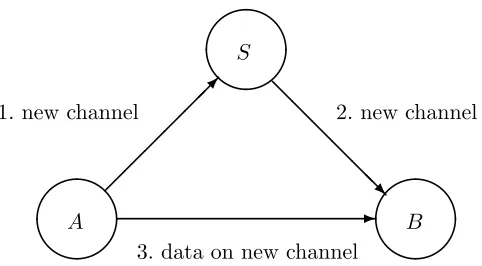
A more interesting variant of our first example is obtained by adding a chan-nel establishment phase. In this phase, before they communicate any data, the principalsAand B obtain a new channel with the help of a serverS.
&% '$
A
&% '$
B
&% '$
S
-3. data on new channel
1. new channel @@
@ @
@@R
[image:17.612.167.408.145.278.2]2. new channel
Figure 1: Structure of the Wide Mouthed Frog Protocol
We consider an abstract and simplified version of the Wide Mouthed Frog protocol. Our version is abstract in that we deal with channels instead of keys; it is simplified in that channel establishment and data communication happen only once (so there is no need for timestamps). In the next section we show how to treat keys and how to allow many instances of the protocol, with an arbitrary number of messages.
Informally, our version is:
Message 1 A→S : cAB on cAS
Message 2 S→B : cAB on cSB
Message 3 A→B : M on cAB
Here cAS is a channel that Aand S share initially,cSB is a channel that S
andB share initially, andcAB is a channel thatAcreates for communication
withB. After passing the channelcAB toB through S,A sends a message
M on cAB. Note that S does not use the channel, but only transmits it.
In the pi calculus, we formulate this protocol as follows:
A(M) = (∆ νcAB)cAShcABi.cABhMi
S =∆ cAS(x).cSBhxi
B =∆ cSB(x).x(y).F(y)
Inst(M) = (∆ νcAS)(νcSB)(A(M)|S|B)
cSB, andcAB reflect the expected privacy guarantees for these channels. The
most salient new feature of this specification is the use of scope extrusion:
A generates a fresh channel cAB, and then sends it out of scope to B via
S. We could not have written this description in formalisms such as CCS or CSP; the use of the pi calculus is important.
For discussing authenticity, we introduce the following specification:
A(M) =∆ (νcAB)cAShcABi.cABhMi
S =∆ cAS(x).cSBhxi
Bspec(M)
∆
= cSB(x).x(y).F(M)
Instspec(M)
∆
= (νcAS)(νcSB)(A(M)|S |Bspec(M))
According to this specification, the message M is communicated “magi-cally”: the process F is applied to the message M that A sends indepen-dently of whatever happens during the rest of the protocol run.
We obtain the following authenticity and secrecy properties:
Authenticity: Inst(M)'Instspec(M), for allM.
Secrecy: Inst(M)'Inst(M0) ifF(M)'F(M0), for allM,M0.
Again, these properties hold because of the scoping rules of the pi calculus.
2.3.3 Discussion
We believe that the two examples just given are rather encouraging. They indicate that the pi calculus is a natural language for describing some se-curity protocols. In particular, the restriction operator and scope extrusion allow convenient representations for the possession and communication of channels.
3
Protocols using Cryptography
Just as there are several versions of the pi calculus, there are several ver-sions of the spi calculus. These differ in particular in what cryptographic constructs they include.
In this section we introduce a relatively simple spi calculus, namely the pi calculus extended with primitives for shared-key cryptography. We then write several protocols that use shared-key cryptography in this calculus.
As in Section 2, the presentation is rather informal. Later sections con-tain further formal definitions. Throughout the paper, we often refer to the calculus presented in this section as “the” spi calculus; but we define other versions of the spi calculus in Section 7.
3.1
The Spi Calculus with Shared-Key Cryptography
The syntax of the spi calculus is an extension of that of the pi calculus. In order to represent encrypted messages, we add a clause to the syntax of terms:
L, M, N ::= terms
. . . as in Section 2.2
{M}N shared-key encryption
In order to represent decryption, we add a clause to the syntax of processes:
P, Q::= processes
. . . as in Section 2.2
case Lof {x}N in P shared-key decryption
The variablex is bound inP.
Intuitively, the meaning of the new constructs is as follows:
• The term{M}N represents the ciphertext obtained by encrypting the
term M under the key N using a shared-key cryptosystem such as DES [DES77].
• The processcase Lof {x}N in P attempts to decrypt the termLwith
the key N. If L is a ciphertext of the form {M}N, then the process
behaves asP[M/x]. Otherwise, the process is stuck.
• The only way to decrypt an encrypted packet is to know the corre-sponding key.
• An encrypted packet does not reveal the key that was used to encrypt it.
• There is sufficient redundancy in messages so that the decryption algo-rithm can detect whether a ciphertext was encrypted with the expected key.
It is not assumed that all messages contain information that allows each principal to recognize its own messages (cf. [BAN89]).
The semantics of the spi calculus can be formalized in much the same way as the semantics of the pi calculus. We carry out this formalization in Section 4. The most interesting issues in this formalization concern the notion of equivalence. Again, we writeP 'Qto mean that the behaviours of the processes P and Q are indistinguishable. However, the notion of indistinguishability is complicated by the presence of cryptography.
As an example of these complications, consider the following process:
P(M) = (∆ νK)ch{M}Ki
This process simply sends M under a new key K on a public channel c; the key K is not transmitted. Intuitively, we would like to be able to say thatP(M) andP(M0) are indistinguishable, for anyM andM0, because an observer cannot discoverK and hence cannot tell whetherM orM0 is sent underK. On the other hand, P(M) andP(M0) are clearly different, since they transmit different messages onc. A fine-grained equivalence—such as the standard strong bisimilarity—would distinguishP(M) andP(M0). Our equivalence is coarse-grained enough not to make this unwanted distinction.
3.2
Examples using Shared-Key Cryptography
The spi calculus enables more detailed descriptions of security protocols than the pi calculus. While the pi calculus enables the representation of channels, the spi calculus also enables the representation of the channel implementations in terms of cryptography. In this section we show a few example cryptographic protocols.
Security properties can still be expressed as equivalences, although the notion of equivalence is more delicate, as we have discussed.
3.2.1 A first cryptographic example
Our first example is a cryptographic version of the example of Section 2.3.1. We consider two principalsA and B that share a key KAB; in addition, we
assume there is a public channelcAB thatA andB can use for
communica-tion, but which is in no way secure. The protocol is simply thatA sends a messageM underKAB toB, on cAB.
Informally, we write this protocol as follows:
Message 1 A→B : {M}KAB on cAB
In the spi calculus, we write:
A(M) =∆ cABh{M}KABi
B =∆ cAB(x).case x of {y}KAB in F(y)
Inst(M) = (∆ νKAB)(A(M)|B)
According to this definition,Asends {M}KAB on cAB while B listens for a
message oncAB. Given such a message,Battempts to decrypt it usingKAB;
if this decryption succeeds,BappliesFto the result. The assumption thatA
andBshareKAB gives rise to the restriction onKAB, which is syntactically
legal and meaningful althoughKAB is not used as a channel. On the other
hand, cAB is not restricted, since it is a public channel. Other principals
may send messages on cAB, so B may attempt to decrypt a message not
encrypted underKAB; in that case, the protocol will get stuck. We are not
concerned about this possibility, but it would be easy enough to avoid it by writing a slightly more elaborate program forB.
We use the following specification:
A(M) =∆ cABh{M}KABi
Bspec(M)
∆
= cAB(x).case x of {y}KAB in F(M)
Instspec(M)
∆
= (νKAB)(A(M)|Bspec(M))
and we obtain the properties:
Authenticity: Inst(M)'Instspec(M), for allM.
Intuitively, authenticity holds even if the keyKAB is somehow
compro-mised after its use. Many factors can contribute to key compromise, for example incompetence on the part of protocol participants, and malice and brute force on the part of attackers. We cannot model all these factors, but we can model deliberate key publication, which is in a sense the most ex-treme of them. It suffices to make a small change in the definitions ofB and
Bspec, so that they sendKAB on a public channel after receiving {M}KAB.
This change preserves the authenticity equation, but clearly not the secrecy equation.
There is an apparent correspondence between the protocol of this section and that of Section 2.3.1, which does not use cryptography. Informally, we may say that this is a cryptographic implementation of the protocol of Section 2.3.1. More precisely, we conjecture that this protocol is an implementation of the parallel composition of the protocol of Section 2.3.1 with (νn)(cABhni). (Our notion of implementation is a testing preorder; see
Section 4.) The role of (νn)(cABhni) is to send a “decoy message” on cAB.
This decoy is needed because an environment can detect whethercAB is used
or not, and hence (in absence of the decoy) can distinguish the protocol of this section from that of Section 2.3.1.
We do not study implementation relations in this paper. However, we do believe that such relations are important and that they deserve more at-tention in the field of security. We view this example of an implementation relation as an intriguing novelty; it suggests the possibility of hierarchical development of cryptographic protocols from non-cryptographic specifica-tions.
3.2.2 An example with key establishment
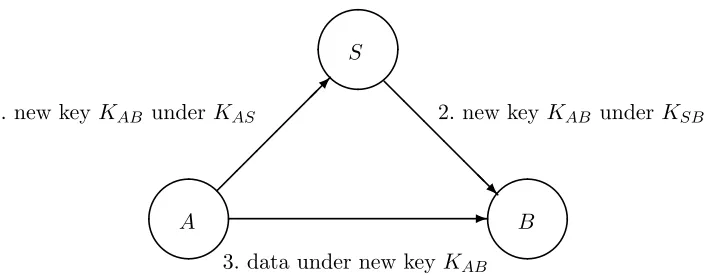
In cryptographic protocols, the establishment of new channels often means the exchange of new keys. There are many methods (most of them flawed) for key exchange. The following example is the cryptographic version of that of Section 2.3.2, and uses a simplified form of the Wide Mouthed Frog key exchange. The example is represented in Figure 2.
In the Wide Mouthed Frog protocol, the principals A andB share keys
KAS and KSB respectively with a server S. When A and B want to
com-municate securely, A creates a new key KAB, sends it to the server under
KAS, and the server forwards it to B underKSB. Since all communication
&% '$
A
&% '$
B
&% '$
S
-3. data under new keyKAB
1. new keyKAB underKAS
@ @
@ @
@@R
[image:23.612.131.484.145.284.2]2. new keyKAB underKSB
Figure 2: Sketch of the Wide Mouthed Frog Protocol
of this protocol is:
Message 1 A→S: {KAB}KAS oncAS
Message 2 S→B : {KAB}KSB oncSB
Message 3 A→B: {M}KAB oncAB
In the spi calculus, we can express this message sequence as follows:
A(M) = (∆ νKAB)(cASh{KAB}KASi.cABh{M}KABi)
S =∆ cAS(x).case xof {y}KAS in cSBh{y}KSBi
B =∆ cSB(x).case x of {y}KSB in
cAB(z).case z of {w}y in F(w)
Inst(M) = (∆ νKAS)(νKSB)(A(M)|S|B)
whereF(w) is a process representing the rest of the behaviour ofB upon re-ceiving a messagew. Notice the essential use of scope extrusion: Agenerates the keyKAB and sends it out of scope toB via S.
Following our usual pattern, we introduce a specification for discussing authenticity:
A(M) =∆ (νKAB)(cASh{KAB}KASi.cABh{M}KABi)
S =∆ cAS(x).case xof {y}KAS in cSBh{y}KSBi
Bspec(M)
∆
= cSB(x).case x of {y}KSB in
cAB(z).case z of {w}y in F(M)
Instspec(M)
∆
One may be concerned about the apparent complexity of this specifi-cation. On the other hand, despite its complexity, the specification is still more evidently “correct” than the protocol. In particular, it is still evident thatBspec(M) applies F to the data M from A, rather than to some other
message chosen as the result of error or attack.
We obtain the usual properties of authenticity and secrecy:
Authenticity: Inst(M)'Instspec(M), for allM.
Secrecy: Inst(M)'Inst(M0) ifF(M)'F(M0), for allM,M0.
3.2.3 A complete authentication example (with a flaw)
In the examples discussed so far, channel establishment and data commu-nication happen only once. As we demonstrate now, it is a simple matter of programming to remove this restriction and to represent more sophisti-cated examples with many sessions between many principals. However, as the intricacy of our examples increases, so does the opportunity for error. This should not be construed as a limitation of our approach, but rather as the sign of an intrinsic difficulty: many of the mistakes in authentication protocols arise from confusion between sessions.
We consider a system with a server S and n other principals. We use the termssuc(0),suc(suc(0)), . . . , which we abbreviate to 1, 2, . . . , as the names of these other principals. We assume that each principal has an input channel; these input channels are public and have the namesc1, c2, . . . ,cn
and cS. We also assume that the server shares a pair of keys with each
other principal, one key for each direction: principal i uses a key KiS to
send to S and a different keyKSi to receive fromS, for 1 ≤i≤n. In the
Wide Mouthed Frog protocol, as in many other small protocols, the keys
KiS and KSiare identical; our use of two different keys simplifies reasoning
by making it impossible to confuse certain messages.
We extend our standard example to this system ofn+ 1 principals, with the following message sequence:
Message 1 A→S: A,{B, KAB}KAS on cS
Message 2 S→B : {A, KAB}KSB on cB
Message 3 A→B: A,{M}KAB on cB
can be used by any pair of principals, arbitrarily often; concurrent runs are allowed.
As it stands, the protocol is seriously flawed; a correct protocol appears below, in Section 3.2.4. (The flaws and their fixes should be clear to readers knowledgeable in security.) However, we continue to discuss the protocol in order to explain our method for representing it in the spi calculus.
In our spi calculus representation, we use several convenient abbrevia-tions. First, we rely on pair splitting on input and on decryption:
c(x1, x2).P
∆
= c(y).let (x1, x2) =y in P
case Lof {x1, x2}N in P
∆
= case Lof {y}N in let (x1, x2) =y in P
where variable y does not occur free in P. Second, we need the standard notation for the composition of a finite set of processes. Given a finite family of processes P1, . . . , Pk, we letQi∈1..kPi be their k-way composition
P1 | · · · | Pk. Finally, we omit the inner brackets from an encrypted pair
of the form {(N, N0)}N00, and simply write {N, N0}N00, as is common in
informal descriptions.
Informally, an instance of the protocol is determined by a choice of par-ties (who isAand who isB) and by the message sent after key establishment. More formally, an instanceI is a triple (i, j, M) such that iand j are prin-cipals and M is a message. We say that i is the source address and j the destination address of the instance. Moreover, we assume that there is an abstraction F representing the behaviour of any principal after receipt of Message 3 of the protocol. For an instance (i, j, M) that runs as intended, the argument toF is the triple (i, j, M).
Given an instance (i, j, M), the following process corresponds to the role ofA:
Send(i, j, M) = (∆ νK)(cSh(i,{j, K}KiS)i |cjh(i,{M}K)i)
The sending process creates a keyK and sends it to the server, along with the namesiandj of the principals of the instance. The sending process also sends M under K, along with its name i. We have put the two messages in parallel, somewhat arbitrarily; but putting them in sequence would have much the same effect.
The following process corresponds to the role ofB for principalj:
Recv(j) =∆ cj(ycipher).case ycipher of {xA, xkey}KSj in
cj(zA, zcipher).[xAiszA]
The receiving process waits for a messageycipher from the server, extracts a
keyxkey from this message, then waits for a messagezcipher under this key,
and finally applies F to the name xA of the presumed sender, to its own
namej, and to the contentszplain of the message. The variablesxAand zA
are both intended as the name of the sending process, so they are expected to match.
The serverS is the same for all instances:
S =∆ cQS(xA, xcipher).
i∈1..n[xAisi]case xcipher of {xB, xkey}KiS in
Q
j∈1..n[xBisj]cjh{xA, xkey}KSji
The variable xA is intended as the name of the sending process, xB as
the name of the receiving process, xkey as the new key, and xcipher as the
encrypted part of the first message of the protocol. In the code for the server, we program an n-way branch on the name xA by using a parallel
composition of processes indexed by i ∈ 1..n. We also program an n-way branch on the name xB, similarly. (This casual use of multiple threads is
characteristic of the pi calculus; in practice the branch could be implemented more efficiently, but here we are interested only in the behaviour of the server, not in its efficient implementation.)
Finally we define a whole system, parameterized on a list of instances of the protocol:
Sys(I1, . . . , Im)
∆
= (ν ~KiS)(ν ~KSj)
(Send(I1)| · · · |Send(Im)|
!S |
!Recv(1)| · · · |!Recv(n))
where (ν ~KiS)(ν ~KSj) stands for (νK1S). . .(νKnS)(νKS1). . .(νKSn). The
expressionSys(I1, . . . , Im) represents a system withminstances of the
pro-tocol. The server is replicated; in addition, the replication of the receiving processes means that each principal is willing to play the role of receiver in any number of runs of the protocol in parallel. Thus, any two runs of the protocol can be simultaneous, even if they involve the same principals.
As before, we write a specification by modifying the protocol. The style of this specification is somewhat more complex than that used in previous examples, but it has the advantage of accommodating multiple sessions. For this specification, we revise both the sending process and the receiving process, but not the server:
Sendspec(i, j, M)
∆
Recvspec(j)
∆
= cj(ycipher).case ycipher of {xA, xkey}KSj in
cj(zA, zcipher).[xAiszA]
case zcipher of {zplain}xkey in zplainh∗i
Sysspec(I1, . . . , Im)
∆
= (ν ~KiS)(ν ~KSj)
(Sendspec(I1)| · · · |Sendspec(Im)|
!S|
!Recvspec(1)| · · · |!Recvspec(n))
In this specification, the sending process for instance (i, j, M) is as in the implementation, except that it sends a fresh channel namep instead of M, and runsF(i, j, M) when it receives any message onp. The receiving process in the specification is identical to that in the implementation, except that
F(yA, j, zplain) is replaced with zplainh∗i, where the symbol ∗ represents a
fixed but arbitrary message. The variable zplain will be bound to the fresh
name p for the corresponding instance of the protocol. Thus, the receiving process will signal onp, triggering the execution of the appropriate process
F(i, j, M).
A crucial property of this specification is that the only occurrences ofF
are bundled into the description of the sending process. There,F is applied to the desired parameters, (i, j, M). Hence it is obvious that an instance (i, j, M) will cause the execution ofF(i0, j0, M0) only ifi0 isi,j0 isj, andM0
isM. Therefore, despite its complexity, the specification is more obviously “correct” than the implementation.
Much as in previous examples, we would like the protocol to have the following authenticity property:
Sys(I1, . . . , Im)'Sysspec(I1, . . . , Im), for any instancesI1, . . . , Im.
Unfortunately, the protocol is vulnerable to a replay attack that invalidates the authenticity equation. Consider the systemSys(I, I0) whereI = (i, j, M) andI0 = (i, j, M0). An attacker can replay messages of one instance and get them mistaken for messages of the other instance, causing M to be passed twice toF. Thus,Sys(I, I0) can be made to execute two copies ofF(i, j, M). In contrast, no matter what an attacker does,Sysspec(I, I0) will run each of
F(i, j, M) andF(i, j, M0) at most once. The authenticity equation therefore does not hold. We disprove it more formally in Section 6.4.
3.2.4 A complete authentication example (repaired)
We now improve the protocol of the previous section by adding nonce hand-shakes as protection against replay attacks. The Wide Mouthed Frog pro-tocol uses timestamps instead of handshakes. The treatment of timestamps in the spi calculus is possible, but it requires additional elements, including at least a rudimentary account of clock synchronization. Protocols that use handshakes are fundamentally more self-contained than protocols that use timestamps; therefore, handshakes make for clearer examples.
Informally, our new protocol is:
Message 1 A→S : A oncS
Message 2 S →A: NS oncA
Message 3 A→S : A,{A, A, B, KAB, NS}KAS oncS
Message 4 S →B : ∗ oncB
Message 5 B →S : NB oncS
Message 6 S →B : {S, A, B, KAB, NB}KSB oncB
Message 7 A→B : A,{M}KAB oncB
Messages 1 and 2 are the request for a challenge and the challenge, respec-tively. The challenge is NS, a nonce created by S; the nonce must not
have been used previously for this purpose. Obviously the nonce is not se-cret, but it must be unpredictable (for otherwise an attacker could simulate a challenge and later replay the response [AN96]). In Message 3, A says thatA and B can communicate underKAB, sometime after receipt of NS.
All the components A, B, KAB, NS appear explicitly in the message, for
safety [AN96], butA could perhaps be elided. The presence of NS in
Mes-sage 3 proves the freshness of the mesMes-sage. In MesMes-sage 4, ∗ represents a fixed but arbitrary message;S uses ∗ to signal that it is ready for a nonce challengeNB from B. In Message 6, S says that A says thatA and B can
communicate under KAB, sometime after receipt of NB. The first field of
the encrypted portions of Messages 3 and 6 (A or S) makes explicit the senders of the messages (somewhat redundantly). Finally, Message 7 is the transmission of data underKAB.
The messages of this protocol have many components. For the spi cal-culus representation it is therefore convenient to generalize our syntax of pairs to arbitrary tuples. We use the following standard abbreviation, given inductively for anyk≥2:
(N1, . . . , Nk, Nk+1)
∆
= ((N1, . . . , Nk), Nk+1)
and similarly we write let (x1, . . . , xk) = N in P, c(x1, . . . , xk).P, and
In the spi calculus, we represent the nonces of this protocol as newly created names. We obtain the following spi calculus expressions:
Send(i, j, M) =∆ cShii |
ci(xnonce).
(νK)(cSh(i,{i, i, j, K, xnonce}KiS)i |cjh(i,{M}K)i)
S =∆ cS(xA).Qi∈1..n[xAisi] (νNS)(cihNSi |
cS(x0A, xcipher).[x0Aisi]
case xcipher of {yA, zA, xB, xkey, xnonce}KiS in
Q
j∈1..n[yAisi] [zAisi] [xBisj] [xnonceisNS]
(cjh∗i |cS(ynonce).cjh{S, i, j, xkey, ynonce}KSji))
Recv(j) =∆ cj(w).(νNB)(cShNBi |
cj(ycipher).
case ycipher of {xS, xA, xB, xkey, ynonce}KSj in
Q
i∈1..n[xSisS] [xAisi] [xBisj] [ynonce isNB]
cj(zA, zcipher).[zAisxA]
case zcipher of {zplain}xkey in F(i, j, zplain))
Sys(I1, . . . , Im)
∆
= (ν ~KiS)(ν ~KSj)
(Send(I1)| · · · |Send(Im)|
!S|
!Recv(1)| · · · |!Recv(n))
The names NS and NB represent the nonces. The variable subscripts are
hints that indicate what the corresponding variables should represent; for example,xA,x0A,yA, andzAare all expected to be the name of the sending
process, andxnonce and ynonce are expected to be the nonces generated by
S and B, respectively.
The definition of Sysspec is exactly analogous to that of the previous section, so we omit it.
We now obtain the authenticity property:
Sys(I1, . . . , Im)'Sysspec(I1, . . . , Im), for any instancesI1, . . . , Im.
This property holds because of the use of nonces. In particular, the attack described in Section 3.2.3 can no longer distinguish Sys(I1, . . . , Im) from
Sysspec(I1, . . . , Im).
assert that the protocol does not reveal any information about the contents of exchanged messages if none is revealed after the key exchange.
In order to express that no information is revealed after the key ex-change, we introduce the following definition. We say that a pair of in-stances (i, j, M) and (i0, j0, M0) is indistinguishable if the two instances have the same source and destination addresses (i = i0 and j = j0) and ifF(i, j, M)'F(i, j, M0).
Our definition of secrecy is that, if each pair (I1, J1), . . . , (Im, Jm) is
indistinguishable, thenSys(I1, . . . , Im)'Sys(J1, . . . , Jm). This means that
an observer cannot distinguish two systems parameterized by two sets of indistinguishable instances. This property holds for our protocol.
In summary, we have:
Authenticity: Sys(I1, . . . , Im)'Sysspec(I1, . . . , Im),
for any instancesI1, . . . ,Im.
Secrecy: Sys(I1, . . . , Im)'Sys(J1, . . . , Jm),
if each pair (I1, J1), . . . , (Im, Jm) is indistinguishable.
We could ask for a further property of anonymity, namely that the source and the destination addresses of instances be protected from eavesdroppers. However, anonymity holds neither for our protocol nor for most current, practical protocols. It would be easy enough to specify anonymity, should it be relevant.
As suggested in Section 3.2.1, we could also consider a variant of the pro-tocol where some keys are compromised. For this propro-tocol, the compromised keys could include both session keys and longer-term keys shared with S. Allowing the longer-term keys KiS and KSi to be compromised is basically
equivalent to considering the case where principalimay behave dishonestly and not follow the protocol. We believe that, even in the presence of dishon-est principals, the protocol guarantees security for sessions between hondishon-est principals.
3.2.5 Discussion
for example, that one of the mistakes in the CCITT X.509 protocol was to omit a timestamp check [BAN89].)
It should also be obvious that writing a protocol in the spi calculus is essentially analogous to writing it in any programming language with suitable communication and encryption libraries. The main advantage of the spi calculus is its formal precision.
We cannot say that the spi calculus will be as good a tool for finding flaws in protocols as some of the logics listed in the introduction. On the other hand, the spi calculus seems to rest on firmer ground, so it yields more convincing proofs of correctness.
4
Formal Semantics of the Spi Calculus
In this section, we start the formal treatment of the spi calculus. In Sec-tion 4.1 we introduce the reacSec-tion relaSec-tion;P →Qmeans there is a reaction between subprocesses ofP such that the whole can take a step to processQ. Reaction is the basic notion of computation in both the pi calculus and the spi calculus. In Section 4.2, we give a precise definition of the equivalence relation', which we have used for expressing security properties.
Syntactic Conventions
The grammar of the spi calculus is given in Sections 2.2 and 3.1. It has two syntactic categories, of terms, ranged over by L, M, N, and of processes, ranged over byP,Q,R. The metavariablesm,n,p,q, andr range over an infinite set ofnames. The metavariablesx, y, and z range over a disjoint, infinite set ofvariables.
We write fn(M) and fn(P) for the sets of names free in term M and processP respectively. Similarly, we writefv(M) and fv(P) for the sets of variables free in M and P respectively. We say that a term or process is
closed to mean that it has no free variables. (To be able to communicate externally, a process must have free names.) The setProc ={P |fv(P) =∅} is the set of closed processes.
4.1
The Reaction Relation
chemical solution of molecules waiting to react. A reaction step arises from the interaction of the adjacent moleculesmhNi.P and m(x).Q, as follows:
(React Inter) mhNi.P |m(x).Q → P |Q[N/x]
Just as one might stir a chemical solution to allow non-adjacent molecules to react, we define a relation, structural equivalence, that allows processes to be rearranged so that (React Inter) is applicable. We first define the
reduction relation >on closed processes:
(Red Repl) !P > P |!P
(Red Match) [M isM]P > P
(Red Let) let (x, y) = (M, N) in P > P[M/x][N/y] (Red Zero) case 0 of 0 :P suc(x) :Q > P
(Red Suc) case suc(M) of 0 :P suc(x) :Q > Q[M/x] (Red Decrypt) case {M}N of {x}N in P > P[M/x]
(The reduction relation is not found in previous accounts of the pi calculus; we introduce it here because it is useful also in the definition of commitment, given in Section 5.1.) We let structural equivalence,≡, be the least relation on closed processes that satisfies the following equations and rules:
(Struct Nil) P |0 ≡ P
(Struct Comm) P |Q ≡ Q|P
(Struct Assoc) P |(Q|R) ≡ (P |Q)|R
(Struct Switch) (νm)(νn)P ≡ (νn)(νm)P
(Struct Drop) (νn)0 ≡ 0
(Struct Extrusion) (νn)(P |Q) ≡ P |(νn)Q ifn /∈fn(P)
(Struct Red)
P > Q
P ≡Q
(Struct Refl)
P ≡P
(Struct Symm)
P ≡Q
Q≡P
(Struct Trans)
P ≡Q Q≡R
P ≡R
(Struct Par)
P ≡P0 P |Q≡P0 |Q
(Struct Res)
P ≡P0
(νm)P ≡(νm)P0
satisfies (React Inter) and the following rules:
(React Struct)
P ≡P0 P0→Q0 Q0 ≡Q
P →Q
(React Par)
P →P0 P |Q→P0 |Q
(React Res)
P →P0
(νn)P →(νn)P0
This definition of the reaction relation corresponds to the informal descrip-tion of process behaviour given in Secdescrip-tions 2.2 and 3.1.
As an example, we can use the definition of the reaction relation to show the behaviour of the protocol of Section 3.2.2:
Inst(M) ≡ (νKAS)(νKSB)(A(M)|S|B)
→ (νKAS)(νKSB)(νKAB)
(cABh{M}KABi |cSBh{KAB}KSBi |B)
→ (νKAS)(νKSB)(νKAB)
(cABh{M}KABi |cAB(z).case z of {w}KAB in F(w))
→ (νKAS)(νKSB)(νKAB)F(M)
≡ F(M)
The last step in this calculation is justified by our general convention that none of the bound parameters of the protocol (including, in this case,KAS,
KSB, and KAB) occurs free in F.
4.2
Testing Equivalence
In order to define testing equivalence, we first define a predicate that de-scribes the channels on which a process can communicate. We let a barb,
β, be an input or output channel, that is, either a name m (representing input) or a co-name m (representing output). For a closed process P, we define the predicateP exhibits barb β, writtenP ↓β, by the two axioms:
(Barb In) m(x).P ↓m (Barb Out) mhMi.P ↓m
and the three rules:
(Barb Par)
P ↓β P |Q↓β
(Barb Res)
P ↓β β /∈ {m, m}
(νm)P ↓β
(Barb Struct)
P ≡Q Q↓β
Intuitively,P ↓βholds just ifP is a closed process that may input or output immediately on barb β. The convergence predicate P ⇓ β holds if P is a closed process that exhibitsβ after some reactions:
(Conv Barb)
P ↓β
P ⇓β
(Conv React)
P →Q Q⇓β
P ⇓β
We let atest consist of any closed process R and any barb β. A closed processP passes the test if and only if (P |R) ⇓β. The notion of testing gives rise to a testing preorder vand to a testing equivalence'on the set
Proc of closed processes:
P vQ = for any test (∆ R, β), if (P |R)⇓β then (Q|R)⇓β
P 'Q =∆ P vQ andQvP
The idea of testing equivalence comes from the work of De Nicola and Hennessy [DH84]. In that work, tests are processes that contain the dis-tinguished name ω (instead of being parameterized by a barb β). This is only a superficial difference, and we can show that our relation 'is a ver-sion of De Nicola and Hennessy’s may-testing equivalence. As De Nicola and Hennessy have explained, may-testing corresponds to partial correct-ness (or safety), while must-testing corresponds to total correctcorrect-ness. Like much of the security literature, our work focuses on safety properties, hence our definitions.
One of the advantages of testing equivalence as the basis of our speci-fications of authenticity and secrecy is its simple definition in terms of the convergence predicate. A test neatly formalizes the idea of a generic ex-periment or observation that another process (such as an attacker) might perform on a process. Thus testing equivalence concisely captures the con-cept of equivalence in an arbitrary environment.
According to our definitions, two closed processes P and Q are testing equivalent if their respective parallel compositions with a third process R
Proposition 1
(1) Structural equivalence implies testing equivalence.
(2) Testing equivalence is reflexive, transitive, and symmetric.
(3) Testing equivalence is a congruence on closed processes.
This proposition is essential for equational reasoning with testing equiva-lence. Its proof is in Appendix D, where we show that testing equivalence remains a congruence when extended to open processes.
Testing equivalence is sensitive to the choice of language. Two processes that are testing equivalent in our calculus may not be testing equivalent after new constructs are added to the calculus. As Boreale and De Nicola have shown [BN95], testing equivalence becomes finer-grained in the presence of a mismatch construct ([M is not N]P). Our calculus does not include a mismatch construct because we have not found a need for it in writing protocols; however, such a construct is sensible and perhaps yields a better definition of testing equivalence. The same is true for other “negative” constructs that check whether a term is not a name, not a number, not a pair, or not encrypted under a given key. We believe that the results of this paper remain valid for a range of reasonable extensions of our calculus, but we leave the study of such extensions for future work.
5
Semantic Notions Useful in Proofs
This section develops proof techniques for the spi calculus, based on earlier work on the pi calculus. Section 5.1 defines the commitment relation, pro-viding in particular a characterization of the reaction relation. Section 5.2 reviews the notions of strong bisimulation, barbed equivalence, and barbed congruence [MS92]. Finally, Section 5.3 introduces the underpinning rela-tion and shows its use for proofs of secrecy.
5.1
The Commitment Relation
The original semantics of the pi calculus (given in [MPW92]) is not based on the notion of reaction, but rather on a labelled transition system. Here we define a labelled-transition semantics for the spi calculus, imitating Milner’s recent lecture notes [Mil95b]. Despite differences in style, this semantics is essentially equivalent to the one of Section 4, so it can be used in proofs about that semantics.
In order to define the labelled-transition semantics, we need some new syntactic forms: abstractions, concretions, and agents. Anabstraction is an expression of the form (x)P, wherexis a bound variable andP is a process. Intuitively, (x)P is like the processp(x).P minus the name p. Aconcretion
is an expression of the form (νm1, . . . , mk)hMiP, where M is a term, P
is a process, k ≥ 0, and the names m1, . . . , mk are bound in M and P.
Intuitively, (νm1, . . . , mk)hMiP is like the process (νm1). . .(νmk)phMiP
minus the name p, provided p is not one of m1, . . . , mk. We often write
concretions as (ν ~m)hMiP, where m~ = m1, . . . , mk, or simply (ν)hMiP if
k= 0. Finally, an agent is an abstraction, a process, or a concretion. We use the metavariablesA and B to stand for arbitrary agents, and letfv(A) andfn(A) be the sets of free variables and names of an agentA, respectively. We extend the restriction and composition operators to arbitrary agents, as follows. For an abstraction, (x)P, we set:
(νm)(x)P = (∆ x)(νm)P
R|(x)P = (∆ x)(R|P)
assuming thatx6∈fv(R). For a concretion, (ν~n)hMiQ, we set:
(νm)(ν~n)hMiQ =∆
(
(νm, ~n)hMiQ ifm∈fn(M) (ν~n)hMi(νm)Q otherwise
R|(ν~n)hMiQ = (∆ ν~n)hMi(R|Q)
assuming that m 6∈ {~n} and that {~n} ∩fn(R) = ∅. We define the dual compositionA|R symmetrically. IfF is the abstraction (x)P and C is the concretion (ν~n)hMiQ, and{~n}∩fn(P) =∅, we define theinteractionsF@C
andC@F to be the processes given by:
F@C = (∆ ν~n)(P[M/x]|Q)
C@F = (∆ ν~n)(Q|P[M/x])
WhenF is the abstraction (x)P, we may writeF(M) for its instantiation to
Q) andC@F = (ν~n)(Q|F(M)). Intuitively, these processes are the possible immediate results of the encounter ofF and C. Given a common name p, we have thatF is likep(x).P and C is like (ν~n)phMiP, so an interaction of
F andCis a process obtained whenp(x).P and (ν~n)phMiP, put in parallel, communicate onp.
Anactionis a namem, a co-namem, or the distinguishedsilent actionτ. That is, an action is either a barb orτ. Thecommitment relation is written
P −→α A, where P is a closed process, α is an action, and A is a closed agent. We define this relation inductively, by the following rules:
(Comm In)
m(x).P −→m (x)P
(Comm Out)
mhMi.P −→m (ν)hMiP
(Comm Inter 1)
P −→m F Q−→m C
P |Q−→τ F@C
(Comm Inter 2)
P −→m C Q−→m F
P |Q−→τ C@F
(Comm Par 1)
P −→α A P |Q−→α A|Q
(Comm Par 2)
Q−→α A P |Q−→α P |A
(Comm Res)
P −→α A α /∈ {m, m}
(νm)P −→α (νm)A
(Comm Red)
P > Q Q−→α A P −→α A
Intuitively, (Comm In) says that an abstraction is the residue of an input commitment; (Comm Out) says that a concretion is the residue of an out-put commitment; and (Comm Inter 1) and (Comm Inter 2) say that the combination of an abstraction and a concretion gives an interaction. Thus, the commitment relation has a straightforward structural definition; that is its main appeal.
Whenever P −→α A, the actionα is τ, a name, or a co-name just if the agentAis a process, an abstraction, or a concretion, respectively. Therefore, the commitment relation indexed by τ, −→τ , is a binary relation on closed processes. We write −→τ ∗ for the reflexive and transitive closure of −→τ . Moreover, we write P −→≡τ Q when there exists a process R such that
P −→τ R and R≡Q.