S T U D Y P R O T O C O L
Open Access
The effectiveness of aerobic training, cognitive
behavioural therapy, and energy conservation
management in treating MS-related fatigue: the
design of the TREFAMS-ACE programme
Heleen Beckerman
1,2,3*, Lyan JM Blikman
4, Martin Heine
5, Arjan Malekzadeh
3,6, Charlotte E Teunissen
3,6,
Johannes BJ Bussmann
4, Gert Kwakkel
5, Jetty van Meeteren
4, Vincent de Groot
1,2,3and the TREFAMS-ACE
study group
Abstract
Background:TREFAMS is an acronym for TReating FAtigue in Multiple Sclerosis, while ACE refers to the
rehabilitation treatment methods under study, that is, Aerobic training, Cognitive behavioural therapy, and Energy conservation management. The TREFAMS-ACE research programme consists of four studies and has two main objectives: (1) to assess the effectiveness of three different rehabilitation treatment strategies in reducing fatigue and improving societal participation in patients with MS; and (2) to study the neurobiological mechanisms of action that underlie treatment effects and MS-related fatigue in general.
Methods/Design:Ambulatory patients (n= 270) suffering from MS-related fatigue will be recruited to three single-blinded randomised clinical trials (RCTs). In each RCT, 90 patients will be randomly allocated to the trial-specific intervention or to a low-intensity intervention that is the same for all RCTs. This low-intensity intervention consists of three individual consultations with a specialised MS-nurse. The trial-specific interventions are Aerobic Training, Cognitive Behavioural Therapy, and Energy Conservation Management. These interventions consist of 12 individual therapist-supervised sessions with additional intervention-specific home exercises. The therapy period lasts 16 weeks. All RCTs have the same design and the same primary outcome measures: fatigue - measured with the Checklist Individual Strength, and participation - measured with the Impact on Participation and Autonomy questionnaire. Outcomes will be assessed 1 week prior to, and at 0, 8, 16, 26 and 52 weeks after randomisation. The assessors will be blinded to allocation. Pro- and anti-inflammatory cytokines in serum, salivary cortisol, physical fitness, physical activity, coping, self-efficacy, illness cognitions and other determinants will be longitudinally measured in order to study the neurobiological mechanisms of action. (Continued on next page)
* Correspondence:[email protected]
1
Department of Rehabilitation Medicine, VU University Medical Center, PO Box 7057, Amsterdam, MB 1007, The Netherlands
2
EMGO Institute for Health and Care Research, VU University Medical Center, PO Box 7057, Amsterdam, MB 1007, The Netherlands
Full list of author information is available at the end of the article
(Continued from previous page)
Discussion:The TREFAMS-ACE programme is unique in its aim to assess the effectiveness of three rehabilitation treatments. The programme will provide important insights regarding the most effective treatment for MS-related fatigue and the mechanisms that underlie treatment response. A major strength of the programme is that the design involves three almost identical RCTs, enabling a close comparison of the treatment strategies and a strong overall meta-analysis. The results will also support clinical practice guidelines for the treatment of MS-related fatigue.
Trial registrations:Current Controlled Trials ISRCTN69520623, ISRCTN58583714, and ISRCTN82353628
Keywords:Multiple sclerosis, Fatigue, Aerobic training, Energy conservation management, Cognitive behavioural therapy, Biomarkers, HPA-axis, Cortisol, Cytokines, Rehabilitation medicine, Randomised controlled trial
Background
Multiple sclerosis (MS) is a neurodegenerative disease characterised by demyelinisation, axonal loss and inflam-mation of the central nervous system (CNS). Although the first description of MS dates back to the mid-19th century, in spite of this long history the aetiology is still unknown and no curative treatment is available [1]. The disease is most probably caused by an interplay between immunological, environmental and genetic factors [2,3]. MS affects young and middle-aged people, with women twice as likely to be affected as men, and is known to cause a variety of clinical symptoms such as neurological impairments, fatigue, depression and pain [2].
Fatigue is one of the most often reported and disabling symptoms in MS and restricts societal participation and performance in daily life at home, at work and in leisure activities [4-6]. Although the importance of fatigue as a disabling symptom of MS is widely acknowledged, there is no consensus on the definition of fatigue. DeLuca [7] defines fatigue as the reduction in performance with ei-ther prolonged or unusual exertion. Furei-thermore, fatigue can be sensory, motor, cognitive or subjective. The Mul-tiple Sclerosis Council for Clinical Practice Guidelines [8] defines fatigue in MS as a subjective lack of physical and/or mental energy that is perceived by the individual (or caregiver) to interfere with usual and desired activ-ities. Chaudhuri and Behan [9] distinguish central fatigue from peripheral fatigue, and define central fatigue as the failure to initiate and/or sustain attentional tasks (mental or cognitive fatigue) and physical activities (physical fa-tigue). Peripheral fatigue is described as muscle fatigability due to disorders of muscle and neuromuscular junctions. The definitions of DeLuca [7], the MS Council for Clinical Practice Guidelines [8] and the concept of central fatigue outlined by Chaudhuri and Behan [9] concur with our view that MS-related fatigue is a multifaceted symptom. Fatigue in MS can also be subdivided into primary and secondary. Primary fatigue relates to specific pathophysio-logical mechanisms that are the direct consequence of the MS disease process. On the other hand, a number of fac-tors, while not considered primary causes of MS-related
fatigue, may be secondary contributors. These factors are not unique to MS, but are the result of symptoms of MS such as sleep problems due to spasm or urinary problems, depression or physical deconditioning. Fatigue might also be a side effect of disease modifying drugs.
Although the exact pathophysiological mechanism be-hind MS-related fatigue is unknown, it is most likely multi-factorial. A number of pathophysiological mechanisms have been proposed including dysregulation of the immune sys-tem, dysfunction of the CNS, impaired nerve conduction, neuro-endocrine/neurotransmitter dysregulation, the in-volvement of the autonomic nervous system and energy de-pletion [10,11]. Available information can be combined in a biological model in which environmental stressors such as infections, immunisation, trauma and life events influence genetically predisposed variables such as the sensitivity of the hypothalamic-pituitary-adrenal axis (HPA-axis), gluco-corticoid receptors and the noradrenaline system [9,12,13]. Consequently, fatigue is triggered in susceptible individuals. In addition to disease-related, genetic and environmental factors, psychological mechanisms may play an important role in causing and sustaining MS-related fatigue [12-14].
involved therapists. These issues have resulted in an exten-sion of the CONSORT statement for non-pharmacological trials [28]. Systematic reviews of exercise therapy and en-ergy conservation management trials are underway or re-cently published [29,30].
TREFAMS is an acronym for the TReating FAtigue in MS programme, and ACE refers to the rehabilitation treatment methods under study, that is, Aerobic training, Cognitive behavioural therapy, and Energy conservation management. The programme has two main objectives: (1) to assess the effectiveness of three different rehabilita-tion treatment strategies in reducing fatigue and in im-proving societal participation in individual MS patients; and (2) to study the biological mechanisms that underlie treatment effects and MS-related fatigue in general. The TREFAMS-ACE research programme includes three ran-domised clinical trials (RCTs), and one explanatory study on the biological mechanisms of action that underlie treat-ment effects and MS-related fatigue in general.
A significant body of evidence now implicates both HPA-axis abnormalities and immune markers in the pathophysiology of MS-related fatigue. MS patients with fatigue exhibited a higher activity of the HPA-axis than pa-tients without fatigue [13,31]. Earlier studies have exam-ined a possible relationship between cytokines and fatigue in MS [32,33]. A study of pro-inflammatory (IFN-γ, TNF-α) and anti-inflammatory (IL-10) cytokine production in MS patients showed that patients with fatigue had a signifi-cantly higher production of IFN-γand TNF-αthan patients without fatigue. IL-10 production did not significantly differ between the two groups [32]. Flachenecker and Bihler [33] found a relationship between TNF-α mRNA expression and fatigue, but not between fatigue and IFN-γor IL-10. In view of a relationship to inflammatory markers found in two independent studies and the higher HPA-axis reactivity in MS, we hypothesise that fatigue in patients with MS is stress-related and that it is caused by an inflammatory mechanism. In addition, we assume that the extent of im-balance between pro-inflammatory and anti-inflammatory cytokines is associated with the severity of fatigue.
AT is aimed at improving physical fitness and at redu-cing an inactive, deconditioning lifestyle. Improved phys-ical fitness may lead to normalisation of HPA-axis functioning [34], a reduction in pro-inflammatory cyto-kines and/or an increase in anti-inflammatory cytocyto-kines [35], leading to a reduction in MS-related fatigue. We hy-pothesise that an improved physical fitness due to AT will be accompanied by reduced fatigue and, as a consequence, improved societal participation.
CBT focuses on fatigue-maintaining cognitions and behaviour, examples of which are insufficient coping with MS or MS-related fatigue, fear of disease progres-sion, dysregulation of activity or sleep, low social support and focusing on fatigue. The general aim of CBT is to
improve daily functioning and to decrease fatigue by chan-ging fatigue-maintaining cognitions and behaviour, within the limits of the MS [36]. We hypothesise that CBT may reduce perceived stressors (for example, environmental, psychological and biological), and consequently may lead to normalisation of HPA-axis functioning and cytokine profiles.
ECM includes energy conservation strategies, ergo-nomic advice and coaching aimed at more efficient use of available energy. Energy conservation strategies have been defined as the identification and development of activity modifications to reduce fatigue through a systematic ana-lysis of daily work, home and leisure activities in all rele-vant environments [8]. Packer et al. [37] were the first to develop an ECM treatment protocol for a 6-week group course. In a clinical trial, this group course proved to be effective in patients with MS, both immediately following the course and after 1 year [24,25]. The treatment goal of ECM is to promote a positive attitude aimed at stimulat-ing active decision-makstimulat-ing and the optimal use of avail-able energy in relation to the unique needs of each individual. We hypothesise that ECM may lead to a reduc-tion in environmental and psychological stressors and consequently to the normalisation of biological stressors (HPA-axis functioning, cytokines), which may in turn lead to reduced fatigue and improved participation.
Accordingly, the following research questions have been formulated in the TREFAMS-ACE programme:
1. What is the effectiveness of Aerobic Training on fatigue and participation? Can this effect be attributed to an increase in fitness parameters? 2. What is the effectiveness of CBT on participation
and fatigue? Can this effect be explained by altered cognitions regarding fatigue?
3. What is the effectiveness of Energy Conservation Management advice on fatigue and participation? Can this effect be attributed to the implementation of ergonomic advice or adherence to altered time-schedules?
4. Which treatment strategy reduces fatigue and improves participation most effectively?
5. Does effective therapy lead to normalisation of HPA-axis function, a reduction in pro-inflammatory cytokines or an increase in anti-inflammatory cytokines?
Methods/Design
Design
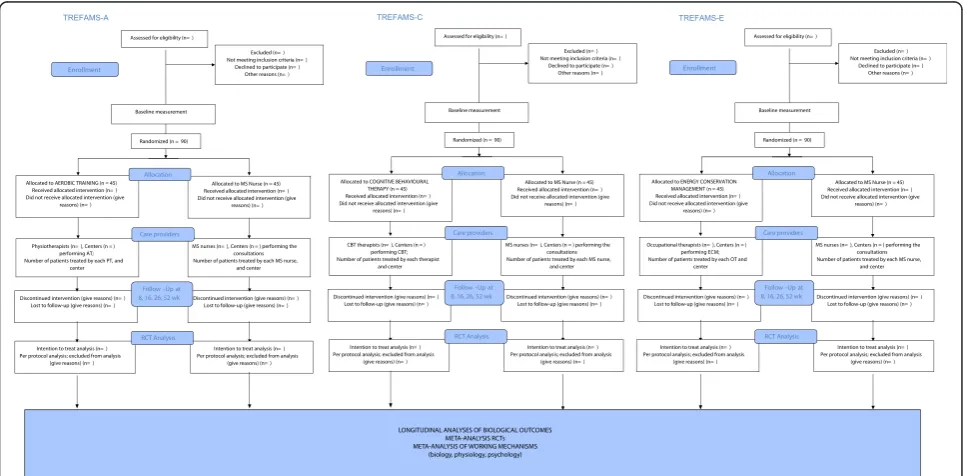
MS will be investigated. All RCTs will use the same two-parallel-arms design (Figure 1), the only difference being the specific intervention applied [28]. Patients will be randomised to receive either a high-intensity trial-specific treatment, which consists of a series of 12 therapist-led sessions in 4 months, or a low-intensity treatment by an experienced MS-nurse, which consists of three consulta-tions in 4 months. Participants will be followed for 1 year.
In addition to the three clinical trials, a fourth study has been defined that will focus on biological outcome measurement and understanding the biological mecha-nisms of action underlying MS-related fatigue [38,39]. This study should also help to improve our understand-ing of the biological mechanisms of the four interven-tions under study (see Figure 1).
The medical ethics committee of the VU University Med-ical Center approved the TREFAMS-ACE programme. Additionally, local feasibility statements were obtained from each participating medical centre.
Participants
The 270 adult patients (90 patients per RCT, and 45 per intervention group) required will have to fulfill the follow-ing inclusion criteria:(a) definitive diagnosis of MS; (b) se-verely fatigued; (c) ambulatory patients; (d) no evident signs of an exacerbation, or a corticosteroid treatment in the past 3 months; (e) no current infections; (f:) no an-aemia; (g) a normal thyroid function. The exclusion cri-teria are: (a) depression; (b) primary sleep disorders; (c) severe co-morbidity; (d) current pregnancy or having given birth in the past 3 months; (e) pharmacological
treatment for fatigue that was started in the past 3 months (for example, Amantadine, Modafinil, Ritalin, Pemoline); (f) non-pharmacological therapies for fatigue that took place in the past 3 months. See Table 1 for the operationalisation of the inclusion and exclusion criteria.
Recruitment strategy
[image:4.595.57.539.476.714.2]To avoid contamination of interventions, each RCT will be carried out at a different (university) medical centre: the AT study will be conducted in the St Antonius Hos-pital, Nieuwegein, in collaboration with the University Medical Center Utrecht, the CBT study will be conducted at the VU University Medical Center in Amsterdam and at the University Medical Centre Nijmegen (UMCN), and the ECM study will be conducted at the Erasmus MC-University Medical Center, Rotterdam, and Re-habilitation Center Leijpark in Tilburg. Patients will ini-tially be recruited through the participating main study centres. The Dutch patient organisation Multiple Scler-osis Vereniging Nederland (MSVN) has been involved since the design phase of the research programme, and has offered to help with recruitment. If the main study centres are not able to recruit sufficient participants, re-cruitment will also take place in hospitals and rehabili-tation centres in the neighbourhood of the main study centres. MS-nurses, neurologists and residents in neur-ology and rehabilitation medicine will inform poten-tially eligible patients about the TREFAMS-ACE study. A neurologist or a rehabilitation physician will check the inclusion and exclusion criteria listed in Table 1 in the case of a potentially eligible patient. Subsequently,
patients eligible for participation will be asked to complete an informed consent form before participating in the study.
Interventions
Aerobic training (AT)
AT aims to improve the participant’s fitness and consists of 12 physiotherapist-led exercise sessions on a bicycle ergometer (Table 2). Moreover, participants will be pro-vided with an identical bicycle ergometer at home on which they will be asked to perform additional training sessions, leading to the recommended three sessions per week. Each 30-min interval-type training session consists of six cycles of 5 min. Each cycle consists of 3 min of low intensity exercise, 1 min of moderate intensity exer-cise and 1 min of high intensity exerexer-cise. At the start of the treatment and after 8 weeks of training, current fit-ness levels will be assessed with a graded maximal exer-cise test to volitional exhaustion. Following the 8-week maximal exercise test, exercise intensities will be ad-justed to meet the newly obtained fitness level. After completion of the supervised training programme, pa-tients will be encouraged to continue exercising and to remain physically active. Generally, physiological adapta-tions to aerobic training occur when: (1) the training in-tensity is at least 60% VO2max, and (2) the training is
carried out at least three times a week [40]. The current treatment protocol addresses both factors.
Cognitive behavioural therapy (CBT)
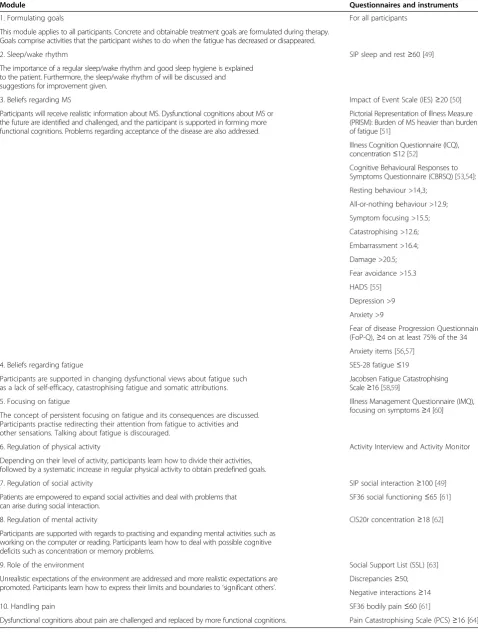
CBT is directed at behaviours or cognitions that perpetu-ate fatigue. Examples are dysfunctional cognitions with re-spect to MS, fatigue or pain, persistent focusing on symptoms, deregulation of physical and social activities and a lack of social support [41,42]. It is thought that fa-tigue will decrease if these perpetuating factors are identi-fied by the patient him/herself and changed. CBT consists of 12 sessions over a 4-month period. Ten different mod-ules have been developed to target specific fatigue maintaining factors [43] (Table 3). CBT will be customised to each individual patient using indicator criteria for each module that are based on cutoff scores on questionnaires and on a diagnostic interview (Table 3). In the final ther-apy sessions, special attention will be paid to integrating the skills obtained into daily life and how to handle behav-ioural relapses. The effectiveness of this theory-based CBT strategy has already been investigated in several other pa-tient populations and healthcare settings [44-48].
Energy conservation management (ECM)
[image:5.595.56.538.100.224.2]The ECM treatment protocol is based on a group course for energy conservation developed by Packer et al. [37].
Table 1 Inclusion and exclusion criteria TREFAMS-ACE trials
Inclusion criteria Exclusion criteria
Definitive diagnosis of MS Depression (HADS depression >11)
Severely fatigued (CIS20r-fatigue≥35) Primary sleep disorders
Aged between 18 and 70 years Severe co-morbidity (CIRS item scores≥3)
Ambulatory patients (an EDSS score≤6) Current pregnancy or having given birth in the past 3 months
No evident signs of an exacerbation or a corticosteroid treatment in the past 3 months Pharmacological treatment for fatigue in the past 3 months
No infections (normal leukocytes and C-reactive protein in blood) Non-pharmacological therapies for fatigue in the past 3 months
No anaemia (normal haemoglobin and haematocrit in blood)
No thyroid dysfunction (normal thyroid stimulating hormone (TSH) in blood)
Table 2 AT programme
45-min session of bicycle ergometer training
Details
Warming-up •5 min at 25% to 40% Wmax
Aerobic training •Six cycles of 5 min: 3 min 40% Wmax, 1 min 60% Wmax and 1 min 80% Wmax
•Cadence: 60-80 revolutions per min (rpm)
•Heart rate should not exceed 80% of the predicted maximal heart rate
•Training intensity will be updated once during the training, according to the 8-week maximal exercise test •The work rate can be adjusted, based on the clinical expertise of the supervising physiotherapist
Cooling down 10 min
•All training sessions and adjustments to the work rate are recorded in the training log
[image:5.595.56.539.573.734.2]Table 3 CBT modules
Module Questionnaires and instruments
1. Formulating goals For all participants
This module applies to all participants. Concrete and obtainable treatment goals are formulated during therapy. Goals comprise activities that the participant wishes to do when the fatigue has decreased or disappeared.
2. Sleep/wake rhythm SIP sleep and rest≥60 [49]
The importance of a regular sleep/wake rhythm and good sleep hygiene is explained to the patient. Furthermore, the sleep/wake rhythm of will be discussed and suggestions for improvement given.
3. Beliefs regarding MS Impact of Event Scale (IES)≥20 [50]
Participants will receive realistic information about MS. Dysfunctional cognitions about MS or the future are identified and challenged, and the participant is supported in forming more functional cognitions. Problems regarding acceptance of the disease are also addressed.
Pictorial Representation of Illness Measure (PRISM): Burden of MS heavier than burden of fatigue [51]
Illness Cognition Questionnaire (ICQ), concentration≤12 [52]
Cognitive Behavioural Responses to Symptoms Questionnaire (CBRSQ) [53,54]:
Resting behaviour >14,3;
All-or-nothing behaviour >12.9;
Symptom focusing >15.5;
Catastrophising >12.6;
Embarrassment >16.4;
Damage >20.5;
Fear avoidance >15.3
HADS [55]
Depression >9
Anxiety >9
Fear of disease Progression Questionnaire (FoP-Q),≥4 on at least 75% of the 34
Anxiety items [56,57]
4. Beliefs regarding fatigue SES-28 fatigue≤19
Participants are supported in changing dysfunctional views about fatigue such as a lack of self-efficacy, catastrophising fatigue and somatic attributions.
Jacobsen Fatigue Catastrophising Scale≥16 [58,59]
5. Focusing on fatigue Illness Management Questionnaire (IMQ),
focusing on symptoms≥4 [60] The concept of persistent focusing on fatigue and its consequences are discussed.
Participants practise redirecting their attention from fatigue to activities and other sensations. Talking about fatigue is discouraged.
6. Regulation of physical activity Activity Interview and Activity Monitor
Depending on their level of activity, participants learn how to divide their activities, followed by a systematic increase in regular physical activity to obtain predefined goals.
7. Regulation of social activity SIP social interaction≥100 [49]
Patients are empowered to expand social activities and deal with problems that can arise during social interaction.
SF36 social functioning≤65 [61]
8. Regulation of mental activity CIS20r concentration≥18 [62]
Participants are supported with regards to practising and expanding mental activities such as working on the computer or reading. Participants learn how to deal with possible cognitive deficits such as concentration or memory problems.
9. Role of the environment Social Support List (SSL) [63]
Unrealistic expectations of the environment are addressed and more realistic expectations are promoted. Participants learn how to express their limits and boundaries to‘significant others’.
Discrepancies≥50;
Negative interactions≥14
10. Handling pain SF36 bodily pain≤60 [61]
The TREFAMS intervention, called Individual ECM treat-ment (IECM), is individualised and consists of 12 45-min sessions over 4 months, given by a trained occupational therapist. For the IECM, the original content of the Packer et al. group programme will be divided up to fit the 4-month treatment period. Attention will also be paid to in-dividual learning and approaching styles to assimilate the programme contents. Motivational interviewing will be used as a communication technique to assist patients in exploring and resolving ambivalence to change. Table 4 shows the content of the IECM. A variety of teaching methods will be used, including providing information, discussions, long-term and short-term goal setting, prac-tice activities and homework activities, to assist the pa-tient’s integration of energy conservation principles into the performance of everyday tasks. The aim of ECM is not so much to correct the underlying mechanisms of fatigue, nor to accept that the solution is to decrease activity levels or reduce the breadth and extent of activities. Instead, the aim is to promote a positive attitude aimed at active decision-making and the optimum use of the available en-ergy to fit the unique needs of each individual. ECM is also intended to reduce the impact and severity of fatigue, to increase patients’ use of energy-conserving strategies and to improve their confidence in their ability to manage fatigue [37].
MS-nurse consultations
The low-intensity treatment by experienced MS-nurses consists of three consultations of 45 min over a 4-month period. The content of the consultations led by the MS-nurse will cover two important aspects to control for: (1) reliable information on MS-related fatigue; and (2) atten-tion from an experienced MS professional in order to re-assure the patient that his/her concerns or questions will be taken seriously [65]. In the first consultation, the pa-tient receives a booklet containing general information about MS-related fatigue and factors that may influence fatigue. This booklet was designed by the TREFAMS-ACE research team to provide patients with standardised infor-mation about fatigue, without adding details regarding specific interventions so as to avoid overlap with the trial-specific interventions. In the remaining two consultations, participants will have the opportunity to discuss their per-sonal experiences in coping with fatigue, ask questions about the booklet and discuss other fatigue-related issues. The consultations with the MS-nurses should not be con-sidered as‘usual care’because, due to the TREFAMS-ACE study design, the MS-nurses are restricted in referring pa-tients to a psychologist, physiotherapist or other healthcare professional within the hospital. In the Netherlands, timely referral is an important aspect of normal MS-nursing practice.
Therapist training
[image:7.595.302.539.91.657.2]All involved therapists were selected based on their ex-perience with the intervention and with treating MS pa-tients. Furthermore, all received training that was focused
Table 4 Individual energy conservation management
Sessions Content of the sessions
Introduction
session •
Getting to know the patient, identification of problems in daily life with help of the COPM, impact of fatigue on daily life
•Hand out workbook IECM, activity list per day/week to give insight in load and loadability of the patient, and learning style assessment
Analysis of the
problems •
Discuss activity/participation problems, outcomes of load and loadability from the activity lists •Analysis of problems, determine questions of help,
and the learning and approaching style •Formulate the problems and treatment goals
Treatment sessions
a. Information about fatigue
•types, causes and factors influencing fatigue •banking (saving) and budgeting (deciding how to
spend) energy
b. Importance of rest
•how fatigue can influence your daily life •rest as a way of relieving fatigue c. Balancing your schedule •components of a balanced lifestyle •how to balance (light and heavy) activities •planning a weekly schedule
d. Communication •expressing needs to others
•breaking down negative attitudes about fatigue and rest
e. Priorities and standards
•breaking down activities in order to simplify them as much as possible
•budgeting energy, making decisions about priorities and standards
f. How to do activities
g. Ergonomics, body positions and assistive devices •organisation of needed environments (work,
home) to promote good body mechanics •Organisation of needed environments to save
energy
•Technology and equipment that can save energy •Structure of body/biomechanics
on one of the four treatment protocols used in the TREFAMS-ACE study.
Physiotherapists experienced in cardio-respiratory train-ing were introduced to the exercise protocol, the use of the bicycle ergometer, study materials and measurements in TREFAMS-AT.
The psychologists involved in the TREFAMS-CBT study all received an additional 4-day CBT training course at the Expert Centre Chronic Fatigue of UMCN. The training course consisted of an introduction to the protocol, train-ing in the content of each treatment module and how to determine which modules are indicated for a specific par-ticipant. The skills needed to change patient cognition and behaviours were practised during role-playing, with the help of simulated patients. To ensure the quality of the CBT, weekly peer conversations between therapists, in which experiences with the TREFAMS-CBT participants will be shared, are part of the therapist training.
Occupational therapists already familiar with energy conservation strategies and the Packer group course‘ Man-aging Fatigue’ received a 1-day training course in the implementation of the individual Energy Management Course (IECM). This course was given by the researcher, together with an expert therapist in energy conservation management. Training consisted of a thorough explanation of the content of the 12 sessions and how sessions can be individually tailored. In addition, occupational therapists not yet qualified in applying Motivational Interviewing had to attend a 3-day Motivational Interviewing course.
All MS-nurses involved in one of the RCTs partici-pated in a 1-day training course. In this course the MS-nurses shared their approach to taking a fatigue-related nursing history, they were instructed as to how to pro-vide relevant information on MS-related fatigue without giving concrete therapeutic advice, and they were in-formed of the restrictions concerning the referral of pa-tients to other healthcare professionals within the hospital (MS team members). These newly-learned skills were practised using role-playing.
Outcome measures
Outcome measures consist of validated self-reported ques-tionnaires, blood and saliva, activity monitoring and phys-ical fitness tests. All primary and secondary outcomes will be assessed 1 week prior to, and at 0, 8, 16, 26 and 52 weeks after randomisation. The self-reported question-naires will be offered to patients via the internet or on paper, and will be completed at home. Within each self-reported questionnaire, the sequence of questions will be randomised between measurement occasions. The draw-ing of blood samples (accorddraw-ing to the study protocol), physical fitness tests and assessor-based interviews will take place at the outpatient clinic of the participating
centres. Saliva sampling will take place at home and in-cludes several time-points per day.
Primary outcome measures
1. Fatigue will be measured with the Checklist Individual Strength (CIS20r), domain fatigue [62,66]. This multidi-mensional questionnaire consists of 20 items, divided into four dimensions of fatigue and related behavioural aspects, including: (a) the subjective experience of fa-tigue (8 items); (b) reduction in motivation (4 items); (c) reduction of physical activity (3 items); and (d) reduction in concentration (5 items). The CIS20r focuses on fa-tigue in the past 2 weeks. Each item is answered using a 7-point scale. The CIS20r fatigue score is a sum score that can vary between 8 and 56 points. Recently, the re-producibility, distribution-based responsiveness and con-current validity of the CIS20r were investigated in patients with MS [67]. Despite good test-retest reliability, a smallest detectable change of 11.8 points was found, leading to the recommendation to monitor trial partici-pants repeatedly over time using a set of complementary fatigue scales [67]. A systematic review of the measure-ment properties of 31 fatigue questionnaires confirms this recommendation [68].
2. Societal participation will be assessed with the Im-pact on Participation and Autonomy questionnaire (IPA) [69]. The IPA questionnaire was developed to assess the severity of restrictions in participation and individual needs related to participation and autonomy. The IPA is a generic questionnaire that addresses: (a) perceived par-ticipation, reflected in 31 items in five domains, that is, autonomy indoors, autonomy outdoors, family role, so-cial relations, work and education; and (b) the experi-ence of problems related to every aspect of participation, reflected in eight problem experience scores [69]. An anchor-based responsiveness study in a heterogeneous outpatient rehabilitation population showed that the IPA was moderately able to detect within-patient improve-ment over time [69]. No studies on the responsiveness and minimal important change of the IPA in patients with MS are yet available [70].
Secondary outcome measures
Profile (RAP) and the Medical Outcome Study Short Form 36 (SF36) will be used to measure daily functioning and participation [61,73].
Determinants
These include descriptive variables, mediators (that is, intervening causal variables), confounding or effect-modifying factors that have been shown to be related to the interventions, and fatigue and participation in MS patients [53,74]. In multifactorial, complex situations such variables can act in different ways in different situa-tions or different analyses and will therefore be further specified in forthcoming articles.
Demographic and disease characteristics
Demographic information includes age, gender, ethni-city, living situation, level of education, work and in-come. The disease-related variables that will be assessed include the type of MS, neurological symptoms, the Expanded Disability Status Scale (EDSS), the number of exacerbations in the year prior to inclusion, the use of disease modifying drugs and other medication, co-morbidities and healthcare use. The EDSS and the Cu-mulative Illness Rating Scale (CIRS) will be assessed by a physician at baseline and after 52 weeks [75-77]. Cogni-tive deficits will be assessed at baseline by the Mini Mental State Examination [78].
Physical activity and physical fitness
The amount of physical activity and frequency of move-ment will be registered by means of a tri-axial activity monitor (ActiGraph GT3X+) that will be worn for 7 days. The Physical Activity Scale for Individuals with Physical Disabilities (PASIPD) is a self-reported questionnaire that assesses physical activity over the preceding 7 days. The PASIPD assesses physical activity in three domains: recre-ation, household and occupation activities [79,80].
In a subgroup of participants, cardio-respiratory fitness will be assessed by means of a maximum capacity test (VO2max test). Participants will perform this test on an electromagnetic bicycle ergometer. Work rate will be pro-gressively increased by 25 + 10 W/min (women) or 25 + 15 W/min (men) until volitional exhaustion, rpm <45 or for safety reasons. In addition, patients will walk as far as possible during a 2-min walk test (2MWT).
Cognitive and behavioural factors
Coping style is measured with the Coping Inventory for Stressful Situations (CISS-21) [81,82]. Three main cop-ing styles can be distcop-inguished: task-oriented copcop-ing, emotion-oriented coping and avoidance coping. The General Self Efficacy Scale will be used to assess opti-mistic self-beliefs for coping with a variety of difficult life demands [83]. Possible mood disorders will be assessed
with the Hospital Anxiety and Depression Scale (HADS) [55]. The HADS consists of two subscales: depression and anxiety. The tendency to fall asleep during daytime is measured with the Epsworth Sleepiness Scale [84]. Perceptions of fatigue will be measured with the Brief Illness Perception Questionnaire (B-FPQ), which as-sesses cognitive and emotional representations of fatigue [53]. The B-FPQ is an adaptation of the Brief Illness Per-ception Questionnaire (B-IPQ), which measures illness perceptions [85]. Fear of progression of MS is measured with the Fear of disease Progression Questionnaire (FoP-Q) [56,57]. Five factors are distinguished: affective reactions, partnership/family, work, loss of autonomy and coping. The Illness Cognitions Questionnaire (ICQ) measures three different generic illness cognitions: helplessness, acceptance and disease benefits [52]. The Social Support List is used to measure the level of social interactions, discrepancies and negative interactions [63].
Biological markers
An important part of the TREFAMS research
programme concerns the integration and longitudinal study of clinical parameters and biological parameters [38]. HPA-axis functioning will be assessed through the collection and analysis of salivary cortisol. To determine the Cortisol Awakening Response (CAR), saliva will be collected immediately after awakening and after respect-ively 30 min, 45 min and 60 min post-awakening. Fol-lowing the fifth sample at 22:00 the participant takes 0.5 mg dexamethasone (low dose dexamethasone suppres-sion test) and saliva is again collected the next morning, immediately after awakening.
Blood will be drawn to determine levels and activity of pro-and anti-inflammatory cytokines [39,86]. Blood and saliva will be collected at the same fixed time-points as for the other outcome measures.
Energy saving strategies
To assess which strategies the participants in all three RCTs use to influence their fatigue, we developed the Fatigue Strategies Questionnaire (FSQ). This questionnaire is based on the Energy Conservation Strategies Survey (ECSS) [87] to which we have added a number of strategies on physical activity, cognition and behaviour. Participants will be asked about the strategies they use and how effective these strat-egies are. To facilitate the meta-analysis of ECM interven-tions, the participants of the TREFAMS-ECM trial will fill in the original ECSS at 16 weeks [87].
Sample size
80%, an alpha of 0.05 and an attrition rate of 20%, 45 pa-tients per group will be needed [47,88]. This amounts to 90 patients for each trial and 270 patients for the entire TREFAMS-ACE programme. Sample size calculation was not adjusted for longitudinal data analyses with repeated measures [89], or for an eventual clustering by care pro-viders or participating centres. Balancing these two fac-tors, we expect that the power of our study will be >80%.
Randomisation
Patients eligible for participation in the study will be randomised to either the trial-specific intervention or the consultations with the MS-nurse after the baseline mea-surements have been completed. The randomisation scheme is computer-generated with random variable block sizes. An independent investigator within each main study centre will need to login to the web-based randomisation facility to carry out the randomisation, and will inform the patient and the therapist as to the therapy allocation.
Blinding
The assessors responsible for physical fitness tests and interviewer-based measures will be told in which week patients need to be measured but will not know which treatment patients receive. Patients will be instructed not to disclose which treatment they are receiving. Fur-thermore, the analyses of blood and salivary in the clin-ical chemistry laboratory, and the statistclin-ical analyses of the between-group differences, will be performed by re-search staff blinded to the treatment allocation of the participants.
Serious adverse events
Based on previous research, AT, CBT, ECM and consulting the MS-nurse are expected to be safe treatment methods in patients with MS [16-21,23-26,90,91]. However, all thera-pists and assessors involved in the studies will be instructed to report all serious adverse events (SAE) to the principal investigators, after which they will be reported to the Med-ical EthMed-ical Committee. An SAE is any untoward medMed-ical occurrence in a participant that is not necessarily associated with the treatment, but that is lethal, and/or threatens the life of the participant, and/or requires hospitalisation or prolongation of existing hospitalisation, and/or causes per-sistent or significant disability or incapacity.
Treatment fidelity and compliance
Data regarding therapy compliance will be subtracted from the administrative hospital databases and therapist notes. Participants will receive an overview of all appointments prior to the first session. If participants cancel or do not at-tend a session, this session will be rescheduled within the 16-week time frame. Because therapy consists of 12 therapist-led sessions in 16 weeks, some rescheduling is
possible. Sessions will not be rescheduled if that means that the 16-week time window will be extended by >1 week.
Statistical analyses of the RCTs and meta-analyses The primary analyses of each separate RCT will be based on the intention-to-treat principle using longitudinal data-analysis techniques, such as Generalised Estimating Equa-tions or Hierarchical Linear Mixed Models. To detect the direct effects of the interventions, longitudinal models will be constructed to analyse the differences between the inter-vention groups regarding the course of within-group changes during the 1-year follow-up period. Furthermore, a meta-analysis of all TREFAMS-ACE data will be conducted to investigate the relative effects of each treatment strategy. In addition, statistical mediation analyses will be used to examine the working mechanisms of the interventions re-lated to, among others, changes in HPA-axis functioning and changes in pro- and anti-inflammatory cytokine levels.
Discussion
The TREFAMS-ACE study will investigate the effective-ness of three different non-invasive, non-pharmacological rehabilitation treatment strategies aimed at reducing fa-tigue and improving societal participation in patients with MS. Furthermore, the mechanisms that underlie treat-ment effects will be studied. This research programme is expected to produce four related PhD-theses. By pub-lication of the design, we wish to be fully transparent as to the quality of the TREFAMS-ACE programme and thus aim to avoid most of the methodological weak-nesses reported in current Cochrane reviews in the field of rehabilitation [92-95].
the desired direction. Furthermore, the biomarker should be validly and reliably measured, and finally, the duration of the clinical trial should be sufficiently long, with an appropriate number of assessments, to allow the biological and clinical outcome parameters to change. All four criteria will be fulfilled by the TREFAMS-ACE programme [86,96]. Third, due to the follow-up period of 1 year, we will be able to investigate whether patients implement the newly-learned skills in daily life and whether the effect of therapy will be maintained over a longer period of time. Fourth, the baseline data of the three RCTs can be pooled, allowing several interesting cross-sectional analyses. Fifth, there is valuable support from the Dutch patient organisation, MSVN. The par-ticipation of patient organisations in health research is important when setting research agendas, during the de-sign phase and during the study period, but it will also enhance practical relevance during later dissemination and implementation of study results [97]. Finally, a strong network of academic rehabilitation departments and MS centres will be formed, as the four study teams work together closely. This will generate high quality knowledge on the treatment of MS-related fatigue and will also promote dissemination and sharing of expertise. Some specific issues that apply to non-pharmacological trials included in the TREFAMS-ACE programme need to be discussed [28]. Regarding the blinding procedure, everyone involved in an RCT should ideally be blinded but this is not always feasible, as is often the case in RCTs evaluating rehabilitation interventions [28,98,99]. Al-though patients are not blinded and the two primary out-come measures are both patient-reported, the assessment of the physical fitness parameters, the analyses of blood and salivary in the clinical chemistry laboratory and the statistical analyses of the between-group differences will all be performed by research staff blinded to the treatment allocation of the participants.
With respect to the complexity of the interventions, we decided to offer patients individual and mono-disciplinary interventions, and no multidisciplinary group intervention [100-102]. Two of the four active treatment intervention programmes, that is, CBT and ECM, have long been avail-able and further improved in recent years [30]. The AT programme is largely based on the general principles of exercise physiology [40]. The scientific underpinnings of the valuable work of specialised MS-nurses is probably the weakest aspect.
Contamination of treatment interventions is another specific issue that might complicate the interpretation of the study results. To avoid contamination via caregivers in the same study centres, we designed three independ-ent RCTs. Moreover, to avoid overlap between the CBT and the ECM interventions, in the developmental phase of the individual ECM protocol cognitive behavioural
aspects were further specified and should now totally focus on managing energy. To prevent contamination caused by participants, all participants are requested not to start with co-interventions for fatigue during the treatment period of the study. Because of the intensity of the treatment, we expect that simultaneous interven-tions aimed at reducing fatigue will probably only occur in a small number of patients. Other co-interventions, for example, disease modifying drugs, are monitored throughout the study at every measurement.
Finally, the inclusion of participants may be slower than anticipated. In theory, a large number of MS pa-tients are fatigued but it may be difficult to awaken the interest of every fatigued MS patient. To enhance par-ticipation, we arranged a number of patient-friendly measures, such as the setting-up of several study cen-tres, travel allowance and the scheduling of appoint-ments. In order to recruit a large group of MS patients, we enlarged our network by involving regional patient associations. In this respect, the support of and close cooperation with the Dutch patient organisation Mul-tiple Sclerosis Vereniging Nederland (MSVN) since the design phase of the research programme has been very important.
The TREFAMS-ACE study will provide insight into the effectiveness of four mono-disciplinary rehabilitation treat-ment methods for MS-related fatigue in individual patients. The primary aim of these treatment methods is to reduce fatigue and to improve societal participation. Furthermore, to enhance our understanding of how these rehabilitation interventions work, a study on biological outcome mea-sures has been added. To improve current practice, tailored and more focused rehabilitation programmes based on the most effective treatment may represent - with a clearer pic-ture of mechanisms of action - a first step in understanding which types of patients may better respond to certain ther-apies. Therefore, the TREFAMS-ACE results will also be added to systematic reviews [29,30] and used to develop and update clinical practice guidelines for the treatment of MS-related fatigue [8,103].
Trials’status
Patient recruitment commenced in October 2011. At the time of manuscript submission 104 patients have been randomised.
Abbreviations
AT:Aerobic training; B-IPQ: Brief Illness perception questionnaire; CBRSQ: Cognitive and behavioural responses to symptoms questionnaire; CBT: Cognitive behavioural therapy; CIRS: Cumulative illness rating scale; CIS20r: Checklist individual strength; CISS: Coping inventory for stressful situations; CNS: Central nervous system; COPM: Canadian occupational performance measure; ECM: Energy conservation management;
EDSS: Expanded disability status scale; FSQ: Fatigue strategies questionnaire; FSS: Fatigue severity scale; HADS: Hospital anxiety and depression scale; HPA-axis: Hypothalamic-pituitary-adrenal axis; IECM: Individual energy
questionnaire; IMQ: Illness management questionnaire; IPA: Impact on participation and autonomy; MFIS: Modified fatigue impact scale; MS: Multiple sclerosis; OT: Occupational therapist; PCS: Pain catastrophising scale; PRISM: Pictorial representation of illness measure; PT: Physiotherapist; RCT: Randomised clinical trial; SAE: Serious adverse events; SES-28: Self-efficacy scale 28; SF36: Medical outcome study short form 36 items; SIP: Sickness impact profile; SSL: Social support list; TREFAMS-ACE: Treating fatigue in multiple sclerosis - aerobic training, cognitive behavioural therapy, energy conservation management; TSH: Thyroid stimulating hormone; UMCN: University medical centre Nijmegen; VO2max: Maximum oxygen consumption; Wmax: Maximum work rate.
Competing interests
The authors declare that they have no competing interests.
Authors’contributions
HB and VG are the principal investigators and originated the idea for the study, developed the overall design and obtained funding for the TREFAMS-ACE research programme. MH will conduct the AT trial, LB will conduct the ECM trial and AM will conduct the biomarker study. All authors helped in finalising the manuscript. All authors read and approved the final manuscript. The TREFAMS-ACE study group advises the principal investigators and supervises the PhD students.
Acknowledgement
TREFAMS-ACE study group
V de Groot and H Beckerman (programme coordination), A Malekzadeh, M Looijmans, SA Sanches (until February 2012), J Dekker, EH Collette, BW van Oosten, CE Teunissen, MA Blankenstein, ICJM Eijssen, M Rietberg. VU University Medical Center, Amsterdam
M Heine, IGL van de Port (until February 2012), E Lindeman (until September 2012), G Kwakkel. Center of Excellence for Rehabilitation Medicine, University Medical Centre Utrecht and Rehabilitation Centre, De Hoogstraat, Utrecht LJM Blikman, J van Meeteren, JBJ Bussmann, HJ Stam, RQ Hintzen. Erasmus MC, University Medical Center, Rotterdam
HGA Hacking, STFM Frequin, E Hoogervorst. St Antonius Hospital, Nieuwegein
BA de Jong, JH Knoop, G Bleijenberg (until April 2012). University Medical Center St Radboud, Nijmegen
FAJ de Laat, Rehabilitation Center Leijpark, Tilburg
GJ Aarts. Dutch patient organisation, Multiple Sclerosis Vereniging Nederland (MSVN), The Hague
Funding
The study is funded by the Fonds NutsOhra (ZonMw 89000005).
Author details
1Department of Rehabilitation Medicine, VU University Medical Center, PO Box 7057, Amsterdam, MB 1007, The Netherlands.2EMGO Institute for Health and Care Research, VU University Medical Center, PO Box 7057, Amsterdam, MB 1007, The Netherlands.3MS Center Amsterdam, PO Box 7057, Amsterdam, MB 1007, The Netherlands.4Department of Rehabilitation Medicine and Physical Therapy, Erasmus MC-University Medical Center, PO Box 2040, Rotterdam, CA 3000, The Netherlands.5Rudolf Magnus Institute of Neuroscience and Center of Excellence for Rehabilitation Medicine, University Medical Center Utrecht and Rehabilitation Center, De Hoogstraat,
Rembrandtkade 10, Utrecht, TM 3583, The Netherlands.6Department of Clinical Chemistry, VU University Medical Center, PO Box 7057, Amsterdam, MB 1007, The Netherlands.
Received: 24 January 2013 Accepted: 1 August 2013 Published: 12 August 2013
References
1. Noseworthy JH, Lucchinetti C, Rodriguez M, Weinshenker BG:Multiple sclerosis.N Engl J Med2000,343:938–952.
2. Compston A, Coles A:Multiple sclerosis.Lancet2008,372:1502–1517. 3. Koch-Henriksen N, Sorensen PS:The changing demographic pattern of
multiple sclerosis epidemiology.Lancet Neurol2010,9:520–532. 4. De Groot V, Beckerman H, Twisk JW, Uitdehaag BM, Hintzen RQ, Minneboo
A, Lankhorst GJ, Polman CH, Bouter LM:Vitality, perceived social support
and disease activity determine the performance of social roles in recently diagnosed multiple sclerosis: a longitudinal analysis.J Rehabil Med2008,40:151–157.
5. Kos D, Kerckhofs E, Nagels G, D’Hooghe MB, Ilsbroukx S:Origin of fatigue in multiple sclerosis: review of the literature.Neurorehabil Neural Repair2008,
22:91–100.
6. Stuke K, Flachenecker P, Zettl UK, Elias WG, Freidel M, Haas J, Pitschnau-Michel D, Schimrigk S, Rieckmann P:Symptomatology of MS: results from the German MS registry.J Neurol2009,256:1932–1935.
7. DeLuca J:Fatigue: its definition, its study, and its future.InFatigue as a window to the brain.Edited by DeLuca J. Cambridge, MA: The MIT Press; 2005. 8. Multiple Sclerosis Council for Clinical Practice Guidelines:Fatigue and Multiple
Sclerosis: evidence-based management strategies for fatigue in multiple sclerosis. Washington, DC: Paralyzed Veterans of America; 1998.
9. Chaudhuri A, Behan PO:Fatigue in neurological disorders.Lancet2004,
363:978–988.
10. Krupp LB, Christodoulou C, Schombert H:Multiple sclerosis and fatigue.In Fatigue as a window to the brain.Edited by DeLuca J. Cambridge, MA: The MIT Press; 2005.
11. Sternberg Z:Sympathetic nervous system dysfunction in multiple sclerosis, linking neurodegeneration to a reduced response to therapy.
Curr Pharm Des2012,18:1635–1644.
12. Huitinga I, van der Cammen M, Salm L, Erkut Z, van Dam A, Tilders F, Swaab D:IL-1beta immunoreactive neurons in the human hypothalamus: reduced numbers in multiple sclerosis.J Neuroimmunol2000,107:8–20. 13. Gottschalk M, Kümpfel T, Flachenecker P, Uhr M, Trenkwalder C, Holsboer F,
Weber F:Fatigue and regulation of the hypothalamo-pituitary-adrenal axis in multiple sclerosis.Arch Neurol2005,62:277–280.
14. Induruwa I, Constantinescu CS, Gran B:Fatigue in multiple sclerosis - a brief review.J Neurol Sci2012,323:9–15.
15. Amato MP, Portaccio E:Management options in multiple sclerosis-associated fatigue.Expert Opin Pharmacother2012,13:207–216. 16. Dodd KJ, Taylor NF, Shields N, Prasad D, McDonald E, Gillon A:Progressive
resistance training did not improve walking but can improve muscle performance, quality of life and fatigue in adults with multiple sclerosis: a randomized controlled trial.Mult Scler2011,17:1362–1374.
17. Dalgas U, Stenager E, Jakobsen J, Petersen T, Hansen HJ, Knudsen C, Overgaard K, Ingemann-Hansen T:Fatigue, mood and quality of life improve in MS patients after progressive resistance training.Mult Scler 2010,16:480–490.
18. Cakt BD, Nacir B, Genç H, Saraçoğlu M, Karagöz A, Erdem HR, Ergün U:
Cycling progressive resistance training for people with multiple sclerosis: a randomized controlled study.Am J Phys Med Rehabil2010,
89:446–457.
19. Petajan JH, Gappmaier E, White AT, Spencer MK, Mino L, Hicks RW:Impact of aerobic training on fitness and quality of life in multiple sclerosis.
Ann Neurol1996,39:432–441.
20. Andreasen AK, Stenager E, Dalgas U:The effect of exercise therapy on fatigue in multiple sclerosis.Mult Scler2011,17:1041–1054. 21. Rietberg MB, Brooks D, Uitdehaag BM, Kwakkel G:Exercise therapy for
multiple sclerosis.Cochrane Database Syst Rev2005,1, CD003980. 22. Hayes HA, Gappmaier E, LaStayo PC:Effects of high-intensity resistance training
on strength, mobility, balance, and fatigue in individuals with multiple sclerosis: a randomized controlled trial.J Neurol Phys Ther2011,35:2–10. 23. Van Kessel K, Moss-Morris R, Willoughby E, Chalder T, Johnson MH,
Robinson E:A randomized controlled trial of cognitive behavior therapy for multiple sclerosis fatigue.Psychosom Med2008,70:205–213. 24. Mathiowetz VG, Finlayson ML, Matuska KM, Chen HY, Luo P:Randomized
controlled trial of an energy conservation course for persons with multiple sclerosis.Mult Scler2005,11:592–601.
25. Mathiowetz VG, Matuska KM, Finlayson ML, Luo P, Chen HY:One-year follow-up to a randomized controlled trial of an energy conservation course for persons with multiple sclerosis.Int J Rehabil Res2007,
30:305–313.
26. Finlayson M, Preissner K, Cho C, Plow M:Randomized trial of a
teleconference-delivered fatigue management program for people with multiple sclerosis.Mult Scler2011,17:1130–1140.
27. Neill J, Belan I, Ried K:Effectiveness of non-pharmacological interventions for fatigue in adults with multiple sclerosis, rheumatoid arthritis, or systemic lupus erythematosus: a systematic review.J Adv Nurs2006,
28. Boutron I, Moher D, Altman DG, Schulz KF, Ravaud P, CONSORT Group:
Extending the CONSORT statement to randomized trials of nonpharmacologic treatment: explanation and elaboration.Ann Intern Med2008,148:295–309.
29. Heine M, Rietberg MB, Van Wegen EEH, Port IGL Van D, Kwakkel G:
Exercise therapy for fatigue in multiple sclerosis.Cochrane Database Syst Rev2012,7:CD009956.
30. Blikman LJ, Huisstede BM, Kooijmans H, Stam HJ, Bussmann JBJ, Van Meeteren J:Effectiveness of energy conservation treatment in reducing fatigue in multiple sclerosis. A systematic review and meta-analysis.
Arch Phys Med Rehabil2013,94:1360–1376.
31. Gold SM, Krüger S, Ziegler KJ, Krieger T, Schulz KH, Otte C, Heesen C:
Endocrine and immune substrates of depressive symptoms and fatigue in multiple sclerosis patients with comorbid major depression.J Neurol Neurosurg Psychiatr2011,82:814–818.
32. Heesen C, Nawrath L, Reich C, Bauer N, Schulz KH, Gold SM:Fatigue in multiple sclerosis: an example of cytokine mediated sickness behaviour?
J Neurol Neurosurg Psychiatr2006,77:34–39.
33. Flachenecker P, Bihler I:Cytokine mRNA expression in patients with MS and fatigue.Mult Scler2004,10:165–169.
34. Stranahan AM, Lee K, Mattson MP:Central mechanisms of HPA axis regulation by voluntary exercise.Neuromolecular Med2008,10:118–127. 35. Castellano V, Patel DI, White LJ:Cytokine responses to acute and chronic
exercise in multiple sclerosis.J Appl Physiol2008,104:1697–1702. 36. Skerrett TN, Moss-Morris R:Fatigue and social impairment in multiple
sclerosis: the role of patients' cognitive and behavioral responses to their symptoms.J Psychosom Res2006,61:587–593.
37. Packer T, Brink N, Sauriol A:Managing fatigue: a six-week course for energy conservation.Tucson, AZ: Therapy Skill Builders; 1995.
38. Fischer A, Heesen C, Gold SM:Biological outcome measurements for behavioral interventions in multiple sclerosis.Ther Adv Neurol Disord2011,4:217–229. 39. Malekzadeh A, de Groot V, Beckerman H, van Oosten BW, Blankenstein MA,
Teunissen C:Challenges in multi-plex and mono-plex platforms for the discovery of inflammatory profiles in neurodegenerative diseases.
Methods2012,56:508–513.
40. American College of Sports Medicine:ACSM’s guidelines for exercise testing and prescription.8th edition. Philadelphia, PA: Lippincott Williams & Wilkins; 2010. 41. Voet NB, Bleijenberg G, Padberg GW, van Engelen BG, Geurts AC:Effect of
aerobic exercise training and cognitive behavioural therapy on reduction of chronic fatigue in patients with facioscapulohumeral dystrophy: protocol of the FACTS-2-FSHD trial.BMC Neurol2010,10:56. 42. Koopman FS, Beelen A, Gerrits KH, Bleijenberg G, Abma TA, de Visser M,
Nollet F:Exercise therapy and cognitive behavioural therapy to improve fatigue, daily activity performance and quality of life in postpoliomyelitis syndrome: the protocol of the FACTS-2-PPS trial.BMC Neurol2010,10:8. 43. Knoop H, Bleijenberg G:Cognitieve gedragstherapie voor chronische
vermoeidheid bij MS patiënten, Nijmeegs Kenniscentrum Chronische Vermoeidheid: Behandelprotocol. Nijmegen. ; 2011.
44. Prins JB, Bleijenberg G, Bazelmans E, Elving LD, de Boo TM, Severens JL, van der Wilt GJ, Spinhoven P, van der Meer JW:Cognitive behaviour therapy for chronic fatigue syndrome: a multicentre randomised controlled trial.
Lancet2001,357:841–847.
45. Huibers MJ, Beurskens AJ, Van Schayck CP, Bazelmans E, Metsemakers JF, Knottnerus JA, Bleijenberg G:Efficacy of cognitive-behavioural therapy by general practitioners for unexplained fatigue among employees: randomised controlled trial.Br J Psychiatr2004,184:240–246.
46. Stulemeijer M, De Jong LW, Fiselier TJ, Hoogveld SW, Bleijenberg G:Cognitive behaviour therapy for adolescents with chronic fatigue syndrome: randomised controlled trial.BMJ2005,330:14. Erratum in:BMJ2005, 330:820. 47. Gielissen MF, Verhagen S, Witjes F, Bleijenberg G:Effects of cognitive
behavior therapy in severely fatigued disease-free cancer patients compared with patients waiting for cognitive behavior therapy: a randomized controlled trial.J Clin Oncol2006,24:4882–4887.
48. Goedendorp MM, Peters ME, Gielissen MF, Witjes JA, Leer JW, Verhagen CA, Bleijenberg G:Is increasing physical activity necessary to diminish fatigue during cancer treatment? comparing cognitive behavior therapy and a brief nursing intervention with usual care in a multicenter randomized controlled trial.Oncologist2010,15:1122–1132.
49. Jacobs HM, Luttik A, Touw-Otten FW, De Melker RA:[The sickness impact profile; results of an evaluation study of the Dutch version].Ned Tijdschr Geneeskd1990,134:1950–1954.
50. Van der Ploeg E, Mooren TT, Kleber RJ, van der Velden PG, Brom D:
Construct validation of the Dutch version of the impact of event scale.
Psychol Assess2004,16:16–26.
51. Buchi S, Sensky T, Sharpe L, Timberlake N:Graphic representation of illness: a novel method of measuring patients’perceptions of the impact of illness.Psychother Psychosom1998,67:222–225.
52. Evers AW, Kraaimaat FW, van Lankveld W, Jongen PJ, Jacobs JW, Bijlsma JW:
Beyond unfavorable thinking: the illness cognition questionnaire for chronic diseases.J Consult Clin Psychol2001,69:1026–1036.
53. Knoop H, van Kessel K, Moss-Morris R:Which cognitions and behaviours mediate the positive effect of cognitive behavioural therapy on fatigue in patients with multiple sclerosis?Psychol Med2012,42:205–213. 54. Dennison L, Moss-Morris R, Silber E, Galea I, Chalder T:Cognitive and
behavioural correlates of different domains of psychological adjustment in early-stage multiple sclerosis.J Psychosom Res2010,69:353–361. 55. Zigmond AS, Snaith RP:The hospital anxiety and depression scale.
Acta Psychiatr Scand1983,67:361–370.
56. Herschbach P, Berg P, Dankert A, Duran G, Engst-Hastreiter U, Waadt S, Keller M, Ukat R, Henrich G:Fear of progression in chronic diseases: psychometric properties of the fear of progression questionnaire.
J Psychosom Res2005,58:505–511.
57. Kwakkenbos L, van den Hoogen FH, Custers J, Prins J, Vonk MC, van Lankveld WG, Becker ES, van den Ende CH:Validity of the fear of progression questionnaire-short form in patients with systemic sclerosis.
Arthritis Care Res (Hoboken)2012,64:930–934.
58. Jacobsen PB, Azzarello LM, Hann DM:Relation of catastrophizing to fatigue severity in women with breast cancer.Canc Res Ther Contr1999,
8:155–164.
59. Jacobsen PB, Andrykowski MA, Thors CL:Relationship of catastrophizing to fatigue among women receiving treatment for breast cancer.J Consult Clin Psychol2004,72:355–361.
60. Ray C, Weir W, Stewart D, Miller P, Hyde G:Ways of coping with chronic fatigue syndrome: development of an illness management questionnaire.
Soc Sci Med1993,37:385–391.
61. Aaronson NK, Muller M, Cohen PD, Essink-Bot ML, Fekkes M, Sanderman R, Sprangers MA, te Velde A, Verrips E:Translation, validation, and norming of the Dutch language version of the SF-36 health survey in community and chronic disease populations.J Clin Epidemiol1998,
51:1055–1068.
62. Vercoulen JH, Hommes OR, Swanink CM, Jongen PJ, Fennis JF, Galama JM, van der Meer JW, Bleijenberg G:The measurement of fatigue in patients with multiple sclerosis. a multidimensional comparison with patients with chronic fatigue syndrome and healthy subjects.Arch Neurol1996,
53:642–649.
63. Van Sonderen E:Sociale Steun LijstInteracties (SSLI) en Sociale Steun Lijst -Discrepanties (SSL-D).Groningen: Noordelijk Centrum voor
Gezondheidsvraagstukken; 1993.
64. Sullivan MJL, Bishop SR, Pivik J:The pain catastrophizing scale: development and validation.Psychol Assess1995,7:532.
65. Corry M, McKenna M, Duggan M:The role of the clinical nurse specialist in MS: a literature review.Br J Nurs2011,20:86–93.
66. Beurskens AJ, Bultmann U, Kant I, Vercoulen JH, Bleijenberg G, Swaen GM:
Fatigue among working people: validity of a questionnaire measure.
Occup Environ Med2000,57:353–357.
67. Rietberg MB, Van Wegen EE, Kwakkel G:Measuring fatigue in patients with multiple sclerosis: reproducibility, responsiveness and concurrent validity of three Dutch self-report questionnaires.Disabil Rehabil2010,32:1870–1876. Erratum in:Disabil Rehabil2011, 33:1298. 68. Elbers RG, Rietberg MB, van Wegen EE, Verhoef J, Kramer SF, Terwee CB,
Kwakkel G:Self-report fatigue questionnaires in multiple sclerosis, Parkinson’s disease and stroke: a systematic review of measurement properties.Qual Life Res2012,21:925–944.
69. Cardol M, Beelen A, van den Bos GA, de Jong BA, de Groot IJ, de Haan RJ:
Responsiveness of the impact on participation and autonomy questionnaire.Arch Phys Med Rehabil2002,83:1524–1529.
70. Magasi S, Post MW:A comparative review of contemporary participation measures' psychometric properties and content coverage.Arch Phys Med Rehabil2010,9:S17–S28.
72. Krupp LB, LaRocca NG, Muir-Nash J, Steinberg AD:The fatigue severity scale. application to patients with multiple sclerosis and systemic lupus erythematosus.Arch Neurol1989,46:1121–1123.
73. Van Bennekom CA, Jelles F, Lankhorst GJ, Bouter LM:The Rehabilitation activities profile: a validation study of its use as a disability index with stroke patients.Arch Phys Med Rehabil1995,76:501–507.
74. Finlayson M, Preissner K, Cho C:Outcome moderators of a fatigue management program for people with multiple sclerosis.Am J Occup Ther2012,66:187–197.
75. Kurtzke JF:Rating neurologic impairment in multiple sclerosis: an expanded disability status scale (EDSS).Neurology1983,33:1444–1452. 76. Linn BS, Linn MW, Gurel L:Cumulative illness rating scale.J Am Geriatr Soc
1968,16:622–626.
77. De Groot V, Beckerman H, Lankhorst GJ, Bouter LM:How to measure comorbidity. A critical review of available methods.J Clin Epidemiol2003,
56:221–229.
78. Beatty WW, Goodkin DE:Screening for cognitive impairment in multiple sclerosis. an evaluation of the mini-mental state examination.Arch Neurol 1990,47:297–301.
79. Van der Ploeg HP, Streppel KR, van der Beek AJ, van der Woude LH, Vollenbroek-Hutten M, van Mechelen W:The physical activity scale for individuals with physical disabilities: test-retest reliability and comparison with an accelerometer.J Phys Act Health2007,
4:96–100.
80. Washburn RA, Zhu W, McAuley E, Frogley M, Figoni SF:The physical activity scale for individuals with physical disabilities: development and evaluation.Arch Phys Med Rehabil2002,83:193–200.
81. Fournier M, De Ridder D, Bensing J:Optimism and adaptation to chronic disease: the role of optimism in relation to self-care options of type 1 diabetes mellitus, rheumatoid arthritis and multiple sclerosis.Br J Health Psychol2002,7:409–432.
82. Cohan SL, Jang KL, Stein MB:Confirmatory factor analysis of a short form of the coping inventory for stressful situations.J Clin Psychol2006,
62:273–283.
83. Schwarzer R, Jerusalem M:Generalized Self-Efficacy scale.InMeasures in health psychology: A user’s portfolio, Windsor: Causal and control beliefs. Edited by Weinman J, Wright S, Johnston M. ; 1995:35–37.
84. Johns MW:A new method for measuring daytime sleepiness: the Epworth sleepiness scale.Sleep1991,14:540–545.
85. Broadbent E, Petrie KJ, Main J, Weinman J:The brief illness perception questionnaire.J Psychosom Res2006,60:631–637.
86. Teunissen CE, Petzold A, Bennett JL, Berven FS, Brundin L, Comabella M, Franciotta D, Frederiksen JL, Fleming JO, Furlan R, Hintzen RQ, Hughes SG, Johnson MH, Krasulova E, Kuhle J, Magnone MC, Rajda C, Rejdak K, Schmidt HK, van Pesch V, Waubant E, Wolf C, Giovannoni G, Hemmer B, Tumani H, Deisenhammer F:A consensus protocol for the
standardization of cerebrospinal fluid collection and biobanking.
Neurology2009,73:1914–1922.
87. Mallik PS, Finlayson M, Mathiowetz V, Fogg L:Psychometric evaluation of the energy conservation strategies survey.Clin Rehabil2005,19:538–543. 88. Van der Werf SP, Jongen PJ, LA Nijeholt GJ, Barkhof F, Hommes OR,
Bleijenberg G:Fatigue in multiple sclerosis: interrelations between fatigue complaints, cerebral MRI abnormalities and neurological disability.
J Neurol Sci1998,160:164–170.
89. Fitzmaurice GM, Laird NM, Ware JH:Applied Longitudinal Analysis. 2nd edition. Hoboken, NJ.Wiley Series in Probability and Statistics: John Wiley & Sons; 2011.
90. Nicholas R, Rashid W:Multiple sclerosis.Clin Evid (Online)2012:1202. 91. Tallner A, Waschbisch A, Wenny I, Schwab S, Hentschke C, Pfeifer K, Mäurer
M:Multiple sclerosis relapses are not associated with exercise.Mult Scler 2012,18:232–235.
92. Sim I, Chan AW, Gülmezoglu AM, Evans T, Pang T:Clinical trial registration: transparency is the watchword.Lancet2006,367:1631–1633.
93. Milette K, Roseman M, Thombs BD:Transparency of outcome reporting and trial registration of randomized controlled trials in top psychosomatic and behavioral health journals: a systematic review.
J Psychosom Res2011,70:205–217.
94. Rosti-Otajärvi EM, Hämäläinen PI:Neuropsychological rehabilitation for multiple sclerosis.Cochrane Database Syst Rev2011,11, CD009131.
95. Khan F, Turner-Stokes L, Ng L, Kilpatrick T:Multidisciplinary rehabilitation for adults with multiple sclerosis.Cochrane Database Syst Rev2007,
2, CD006036.
96. Golden SH, Wand GS, Malhotra S, Kamel I, Horton K:Reliability of hypothalamic-pituitary-adrenal axis assessment methods for use in population-based studies.Eur J Epidemiol2011,26:511–525.
97. Abma TA, Broerse JE:Patient participation as dialogue: setting research agendas.Health Expect2010,13:160–173.
98. Siemonsma PC, Walker MF:Practical guidelines for independent assessment in randomized controlled trials (RCTs) of rehabilitation.
Clin Rehabil1997,11:273–279.
99. Boutron I, Guittet L, Estellat C, Moher D, Hróbjartsson A, Ravaud P:
Reporting methods of blinding in randomized trials assessing nonpharmacological treatments.PLoS Med2007,4:e61.
100. Kos D, Duportail M, D'hooghe M, Nagels G, Kerckhofs E:Multidisciplinary fatigue management programme in multiple sclerosis: a randomized clinical trial.Mult Scler2007,13:996–1003.
101. Hugos CL, Copperman LF, Fuller BE, Yadav V, Lovera J, Bourdette DN:
Clinical trial of a formal group fatigue program in multiple sclerosis.
Mult Scler2010,16:724–732.
102. Thomas PW, Thomas S, Kersten P, Jones R, Nock A, Slingsby V, Green C, Baker R, Galvin K, Hillier C:Multi-centre parallel arm randomised controlled trial to assess the effectiveness and cost-effectiveness of a group-based cognitive behavioural approach to managing fatigue in people with multiple sclerosis.BMC Neurol2010,10:43.
103. Anonymous:Conceptrichtlijn Diagnostiek, Behandeling en Functioneren bij Multiple Sclerose.Utrecht: CBO; 2011.
doi:10.1186/1745-6215-14-250
Cite this article as:Beckermanet al.:The effectiveness of aerobic
training, cognitive behavioural therapy, and energy conservation management in treating MS-related fatigue: the design of the TREFAMS-ACE programme.Trials201314:250.
Submit your next manuscript to BioMed Central and take full advantage of:
• Convenient online submission
• Thorough peer review
• No space constraints or color figure charges
• Immediate publication on acceptance
• Inclusion in PubMed, CAS, Scopus and Google Scholar
• Research which is freely available for redistribution