2017 2nd International Conference on Communications, Information Management and Network Security (CIMNS 2017) ISBN: 978-1-60595-498-1
A Big Data Privacy Protection Solution Based
on Compressive Sensing Theory
Deng-long LV* and Shi-bing ZHU
Aerospace Engineering University, Beijing, China
*Corresponding author
Keywords: Compressive sensing, Big data, Privacy protection, Solution.
Abstract. This paper analyzes the progress of privacy protection in big data environment, and introduces the theory of compressive sensing, and then, proposes a new big data privacy protection method based on compressed sensing anddiscusses the realization of the method. According to the analysis, this new method has a certain reference value in the realization of big data privacy preserving technology.
Introduction
The development of information technology gave birth to a big data age. Data mining, analysis and sharing is more frequent, which make the data volume swell rapidly, and further accelerate the flow of data. At the same time, data owners and data users are separated from each other, the data owners lose the absolutely controlling data, data over mining, unauthorized use, illegal transactions and other anomie behaviors are on the rise, data security and privacy is facing serious threat, how to effectively protect the data privacy and prevent sensitive data leaks becomes the urgent need to address one of the major security issues.
The main privacy protection technologies include data perturbation, data encryption, data anonymity, and so on. Data perturbation can make the original data distortion but retain some of the attributes, but the drawback is that the perturbation data query ability is weak[1]. Data encryption can better ensure data confidentiality and integrity, but that is not suitable for big data sets [2]. Data anonymity can achieve better preserving for the structured data, but it is too difficult to achieve preserving for the unstructured Data (such as stream data). The ideal privacy protection solution is to make privacy protection and data analysis to achieve a balanced.
In 2006, Candes and Tao Zhexuan, the authors of Compressed Sensing (CS) theory, argued that if the sensor matrix is used as a key, CS theory is an encryption scheme, and CS data encryption applications are beginning to be concerned. In this paper, we focus on CS theory to find the protection solution in big data privacy. The structure of this paper is as follows: In Sect.Ⅱ, we should analyze the problems of data privacy security under the background of big data and the research status of big data privacy protection; Sect.Ⅲ depicts the theory of CS and its Main algorithm; in Sect.Ⅳ we seek to present a solution of big data privacy protection based on CS theory. Finally, we end this paper with a conclusion.
The Privacy Protection of Big Data Research Contributions
Big Data and Characteristics
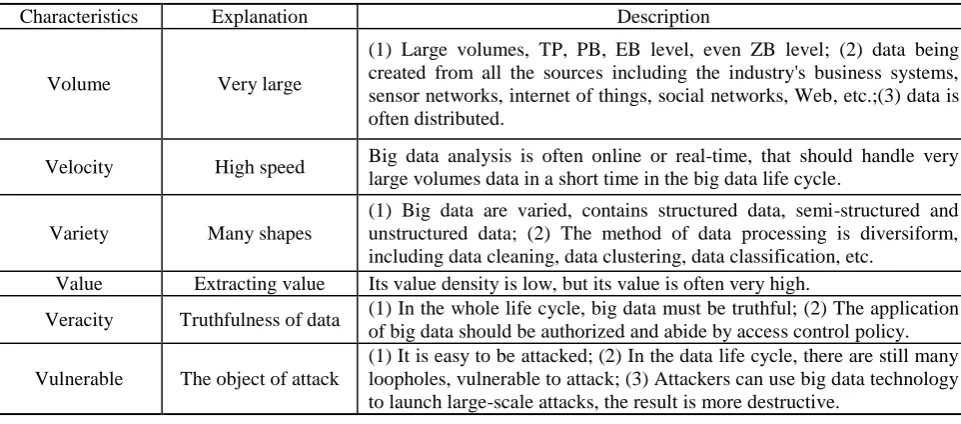
Table 1. Big data’s “6V” characteristics.
Characteristics Explanation Description
Volume Very large
(1) Large volumes, TP, PB, EB level, even ZB level; (2) data being created from all the sources including the industry's business systems, sensor networks, internet of things, social networks, Web, etc.;(3) data is often distributed.
Velocity High speed Big data analysis is often online or real-time, that should handle very large volumes data in a short time in the big data life cycle.
Variety Many shapes
(1) Big data are varied, contains structured data, semi-structured and unstructured data; (2) The method of data processing is diversiform, including data cleaning, data clustering, data classification, etc.
Value Extracting value Its value density is low, but its value is often very high.
Veracity Truthfulness of data (1) In the whole life cycle, big data must be truthful; (2) The application of big data should be authorized and abide by access control policy.
Vulnerable The object of attack
(1) It is easy to be attacked; (2) In the data life cycle, there are still many loopholes, vulnerable to attack; (3) Attackers can use big data technology to launch large-scale attacks, the result is more destructive.
The Challenge of Big Data Privacy
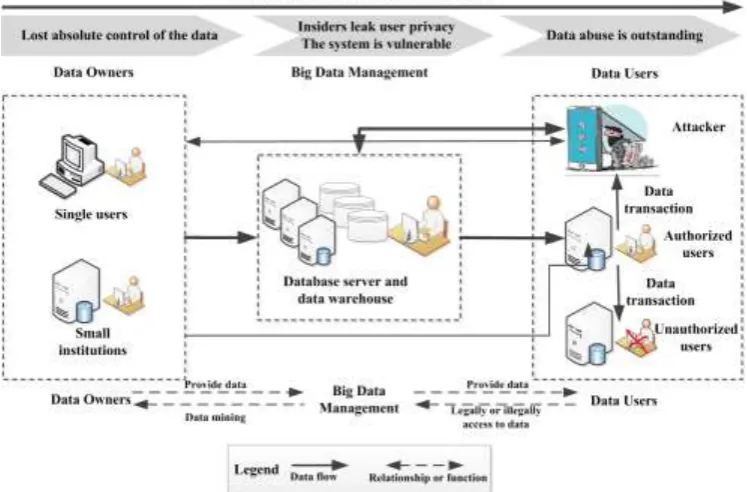
In the traditional sense, privacy refers to the individual transaction, personal information and personal domain, the data subject is a natural person. Under the background of big data, the concept of privacy become generalization, the data subject of privacy is extended to a natural person, organization, government and even countries, can contain the content of the privacy issues, activities and information related to a natural person, the sensitive information of organization, the government’s and the country's confidential information, and so on. Driven by big data, Internet of things, cloud computing and electronic trading, electronic government affairs, social media, etc. have a rapid development, which results in a high degree of data aggregation and rapid flow, and greatly increases the risk of privacy.
Figure 1. Big data subject relationship and the status of the privacy security.
Big Data Privacy Protection Contribution
In the concrete research, big data privacy protection mainly concentrated in two directions: one is the privacy data encryption [3-6] and another is the data anonymous [7-9]. Paper [3] proposes an encryption method of classification privacy in big data introducing dual-chaotic system RSA algorithm, the author verified the algorithm, but from the experimental results, we can’t understand the computational overhead of the encryption and decryption process. In the paper [4], an improved order preserving encryption algorithm is proposed to realize the privacy protection under the big data environment. Compared with traditional algorithms, the improved algorithm achieves the high efficiency of privacy protection in big data environment, but it also does not verify its encryption and decryption overhead for big data sets. In [5], the privacy protection algorithm is implemented by Bloom filter algorithm, and the time cost of algorithm performance is verified. However, the algorithm has yet to be verified for large data privacy protection. In [6], the secure multi-party computation is proposed for the two cases of constrained isomorphism and constrained heterogeneity, and the security proof is made by theoretical deduction, but there is no more information about computational efficiency. In [7], an anonymity model based on the (a, k) - anonymous model of diversity non-correlation constraints is proposed. The improved micro-aggregation algorithm is used to prove that it is applicable to the anonymous publication of privacy data. But the research [8] results show that the privacy protection based on the k-anonymous model is based on attack assumptions and background knowledge, and it is difficult to suppress attacks such as restoring privacy data by big data analysis. In [2], a hybrid algorithm based on MapReduce computing framework is proposed, the algorithm improved the scalability and processing efficiency of the original algorithm, but for the big data set the algorithm has yet to be improved. In [9], an anonymity algorithm combining differential privacy with p-link technology is proposed, its’ algorithm achieved privacy protection and user personalized retrieval function, and has made a certain breakthrough for seeking balance between privacy protection and normal calculation of data.
The Basic Theory of Compressive Sensing
Sparse Representation of Signals
Sparse is the premise of compressive sensing, the purpose is to project the signal to the orthogonal transformation base, so that most of the absolute value of the transformation coefficient is small, the resulting transformation vector is sparse. The algorithm is described as follows:
Let f be a one-dimensional discrete signal with a length of N, is a standard orthogonal basis of N N dimension, and the N 1 dimension vector x is the weighted coefficient of signal f , and then the signal f can be expressed as a linear combination of a set of orthonormal bases.
1
N
i i i
f x
OR f x . (1)If the x is only a small number of large coefficients, then the signal is compressible or sparse, if the x is only K nonzero elements, then called x is the K sparse representation of signal f .
Compressive Sensing Algorithm
Let x be a sparse representation of the signal f of lengthNon the N N dimensional orthogonal basis , that is f x , then the signal f can be successfully recovered from a
1
M -dimensional measurement vector y , and the measurement vector y expressed as
y f x Ax. (2)
is the M N-dimensional measurement matrix and A is called the perceptual matrix. In this case, ycan be regarded as the measured value of the sparse signal x with respect to the matrix A. If A satisfies the constraint equidistant condition, the sparse signal x can be reconstructed by solving an optimal 0 norm, that is
*
0
arg min
x x Ax=y (3)
If the sparse representation x* of the signal f is obtained, then the signal f * can be
reconstructed by the transform based on , that is
* *
f x . (4)
Signal Reconstruction Method
Signal reconstruction is the core content of compression perception. Its essence is to reconstruct the sparse signal x with length N(M N) from the M times of measurement vector. Since the orthogonal basis is fixed, the signal f reconstruction problem (Find the *
f in the formula
2-4) is converted to the problem of finding the solution *
x of the minimum norm of x. It is proved
that the minimum norm 0 of the formula (2-3) is a NP problem, and the stability is often not solved. Therefore, the researchers propose other methods to solve the minimum norm. The common algorithm has the minimum 1 norm method, Matching Pursuit method, minimum total variations method, iterative threshold method and so on.
The Solution of Privacy Protection Based on Compressive Sensing
Issues to Consider
of correlation analysis and background knowledge and other attacks against privacy data; third is to achieve the premise of privacy protection, how to do not affect the normal big data analysis.
The Feasibility Analysis
Big data privacy is mainly in the form of three types: one is purely privacy data and the data is stored in mass; the second type is the privacy data contained in big data sets; the third type is that the privacy data is in the form of stream data. For the first type, we can add a large amount of redundant data to fill the privacy data set, so that making the privacy data is relatively sparse; and in the second type, the privacy data compared to other data itself is sparse; the third type is the stream data, through a certain transformation can make the data becomes sparse. So the privacy of big data should meet the prerequisite of "the signal can be sparse", so you can use the compressive sensing theory to achieve the privacy protection in big data.
The Scheme Design
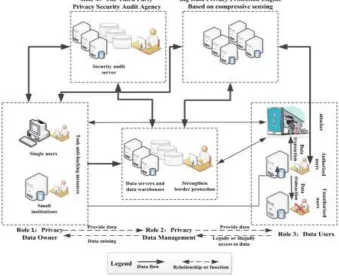
[image:5.595.127.467.311.587.2]To establish a large data privacy protection system, we should at least consider four roles in the process of big data privacy protection. The role-based big data privacy protection architecture is shown in Figure 2.
Figure 2. The architecture of big data privacy protection.
Role 1 - Privacy Data Owner is the direct subject of the privacy data. Who basically trusts the privacy data manager, have a basic grasp of the use and security of privacy data, can query the situation of privacy protection through the third party privacy security audit institution, can query and use the owned data (including privacy data) through the big data privacy protection engine, and has higher ability to prevent attacks.
Role 2 - Privacy Data Management takes a multi-party privacy data management tasks, is directly responsible for data privacy protection, is responsible for providing the feedback of privacy data security management status to the third party privacy security audit agencies, is responsible for the construction and management of big data privacy protection engine, and publish information without privacy through the engine to the trusted data users. At the same time, who can strengthen the border protection, which can effectively resist hacking.
certification according to the user behavior, once founding that users have data abuse behavior, which can directly provide feedback of evidence to the privacy data manager, the privacy data manager has the obligation to inform the privacy data owner who should be held accountable.
Role 4 – The Third Party Privacy Security Audit Agency is responsible for providing the security audit of the data privacy management.
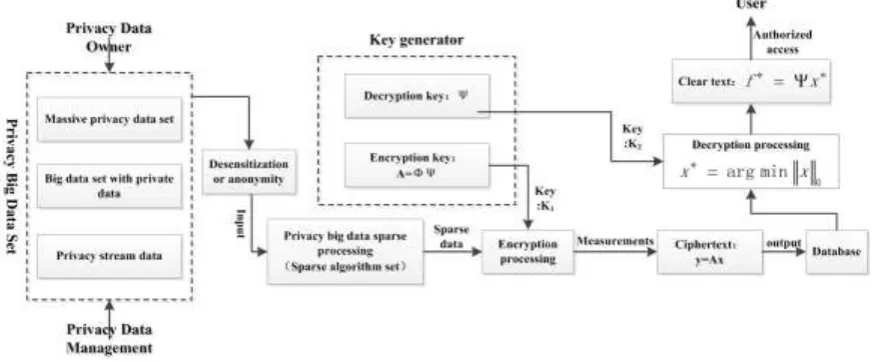
[image:6.595.81.522.184.365.2]The core of the architecture is the big data privacy protection engine, which is based on the theory of compressive sensing, and the process of encryption and decryption is shown in Figure 3.
Figure 3. Work Principle of Big Data Privacy Protection Based on Compression Sensing.
STEP1: Privacy data generates primary privacy data set as the system input after desensitization or anonymity processing. We can turn the input of the primary privacy data into sparse data by selecting the appropriate sparse algorithm, and get the sparse representation of privacy data.
STEP2: The key generator generates the encryption key, and then the system encrypts the sparse private data, generates the ciphertext, and outputs the ciphertext to the database.
STEP3: Data users can be authorized to access the primary privacy data set, first through the privacy data decryption processing calculation obtain x* , and then through the decryption
operation, get the plaintext:
* *
f x . (5)
Concluding
References
[1] Kargupta H, Datta S, Wang Q, Krishnamoorthy Sivakumar. On the Privacy Preserving Properties of Random Data Perturbation Techniques. Proceedings of the Third IEEE International Conference on Data Mining. Melbourne, FL, United states: Institute of Electrical and Electronics Engineers Inc, 2003:99-106.
[2] Wu Yingjie. Privacy protection data release: model and algorithm. Beijing:Qinghua University Press, 2015: 3-8.
[3] Zhou Hua. Classification of Large Data Privacy Encryption Simulation Research. Computer Simulation, 2016,33 (7): 414-417.
[4] Guo Liang, Big Data Encryption to Protect Privacy Data Environment Improvement and Simulation of the Algorithm. Computer Simulation, 2016,33 (8): 338-341.
[5] Wang Maohua, Hao Yunli, Chu Yawei. Data encryption method based on privacy preserving.
Computer Engineering and Applications, 2014,50 (23): 87-90.
[6] Liu Hongwei, Liu Zhihui, Zhu Hui, Lu Tao. Privacy-preserving Algorithm for Cross-organizational Collaborative Optimization Decisions Based on Big Data. Journal of Guangdong University of Technology, 2014,31 (3): 21-26.
[7] Cheng Liang, Jiang Fan. A-diversity and k-anonymity Big Data Privacy Preservation Based on Micro-aggregation. Information Network Security, 2015, (3): 19-22.
[8] Sun Jiongning. Anonymization of big data based on hybrid tree. Journal of Nanjing University of Science and Technology, 2015,39 (5): 600-613.