2017 2nd International Conference on Artificial Intelligence and Engineering Applications (AIEA 2017)
ISBN: 978-1-60595-485-1
Key Problems about Human Body Communication
on Wireless Body Area Network
ZHENGQIANG GU, HAO PENG and YUANMING WU
ABSTRACT
In our paper, basing on static model and dynamic model of human body, we present an efficient next hop selection algorithm for multi-hop Body Area Network. By calculating and analyzing every hop’s residual energy, free queue size, link reliability and so on, we can build a function about QoS and present an algorithm to select the next hop for the BAN. Via simulation software MATLB, we gain the numbers of packet forwarding and network lifetime of the network system. Last but not the end, by getting vast simulation data and analyzing it, we finally find the both advantages and disadvantages, application of scope of the algorithm. Besides, the paper also puts forward some improvement plans and prospects for the future.
KEYWORDS
Body Area Network, QoS, Routing algorithm, Simulation.
INTRODUCTION
Wireless body area sensor networks (WBAN) is a network attached to the human body, which is consisted by a series of small, communication sensors. WBAN can be not only applied in the field of telemedicine, special population monitoring and health care, but also extended to the entertainment, sports and so on.
However, in recent years, due to the serious limitation of network sensor energy supply, finding a way to prolong the network lifetime, has been the focus and hotspot in the research of the WBAN. Research shows that the energy consumption of sensor nodes module includes sensor modules, processor modules and wireless communication modules, most of the it is the wireless module. Therefore, designing an energy efficient communication protocol and routing algorithm has seemed meaningful, which can balance the network energy consumption to prolong the network lifetime.
_________________________________________
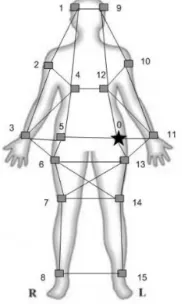
Figure 1. Human WBAN model.
ORGANIZATION OF THE TEXT
Basic model
NETWORK MODEL
As shown in the figure 1, the wireless sensor nodes that placed in the body and body surface form a WBAN network. Each sensor node is battery-powered, responsible for collecting one or more physiological data and finally will send the collected date to the gateway node SINK (0 position in the figure) through the multi-hop way.
Now we assuming that:
1. Each sensor node’s battery has the same amount of electricity, and both have the ability to receive and send information.
2. In view of the practical application, we only consider the basic node power, but do not consider the gateway node SINK power.
3. When transferring data, each node has the ability to modulate the power of the transmitted signal (we will describe later).
4. Network lifetime is the time from the beginning to a node battery exhausted. 5. When it comes to channel quality, the static algorithm fluctuates slightly at a fixed value, and the dynamic algorithm channel quality changes according to the law of human motion.
6. In order to meet the QoS index, we consider the following parameters in this paper. The node residual energy, the node residual memory (the remaining stack), and the node communication channel quality.
NODE ENERGY CONSUMPTION MODEL
[image:2.612.256.347.64.216.2]TABLE 1. CIRCUIT'S ENERGY CONSUMPTION. Energy consumption
) (k
Erx 50nJ/bit
) , (k d
Etx 100pJ/bit/m2
When it comes to WBAN, the initial power is limited, and the data transmission range of each sensor is small. We assume that the neighbor nodes of node i is expressed as
, where R is the node communication radius and is the distance between node i and node j.
In our paper, we will use an universal communication energy consumption model proposed by Heinzelman.
(1)
(2)
) (k
Erx represents the energy that needs to be consumed by the k-bit data, and )
, (k d
Etx represents the energy consumed by sending k-bit data to d (m) far distances (in actual simulations, we use d=0.5m).Eelec represents the energy consumed by a circuit when communicating or transmitting data. Eamp indicates the power consumed by the power amplifier when transmitting data. For specific values, see Table 1.
Now, we define the initial energy of node I is Einitial, the residual energy of the node I isEres. Then, the rest of the energy of the node I can be expressed as:
(3)
NODE QUEUE SPATIAL MODEL
In practical applications, the sensor’s hardware that integrated into the human body is small, and it will directly lead to its storage space is small in the process. But if the queue and the stack are almost filled, it will undoubtedly reduce the performance of the sensor processing. So, the rest of the space we must take into account.
Define the total queue size of the sensor node I is Qtotal, the remaining queue size
is a Qres.
The greater the proportion of the remaining queue, the better it is. However, we can control what the next hop to select to ensure its remaining storage space.
NODE POWER CONTROL MODEL
In the application, the channel quality of the WBAN varies with the movement of the human body and the environment. Therefore, if the channel quality changes, the transmission power should be changed to avoid transmission failure or retransmission
5 . 0 e ) (
rx E k d
E k lec ,
5 . 0 ) , ( 2
elec
E k e k d d
d k
Etx amp ,
tx rx inital
ires E E E
and so on. By improving the adaptive power control algorithm proposed by Xiao and others, we can carry out a new power control.
Xiao’s algorithm is to preset an RSSI index R0 to adjust the transmit power,
default interval boundary the best channel quality parameters ug and the worst channel quality parameters ub .In the work cycle, the algorithm will correct
R according to the actual situation and last R'to keep it between the minimum threshold and the highest threshold. When the channel quality is poor that is R<TL, the transmission power will be doubled. When the channel condition is good that is
R>TH, the transmission power will be reduced.
However, Xiao's algorithm has some flaws and can not be used directly. A significant problem is that it will frequently jump from the left to the right. Thus,we modify the algorithm to retain 1/3 of the space so that the limits will not tend to borders. The final algorithm is as follows:
Algorithm 1 modified power control algorithm
1. Compare R (current RSSI values) andR
2. If R <R, then update the valueR←ugR + (1-ug)R 3. If R>R, then update the valueR←ubR + (1-ub)R 4. If R<TL,then update:
current power = (current power +2/3 (maximum power - minimum power)) / 2 If R>TH,then update:
current power = (current power +1/3 (maximum power - minimum power)) / 2
Static human body routing algorithm
NETWORK TOPOLOGY
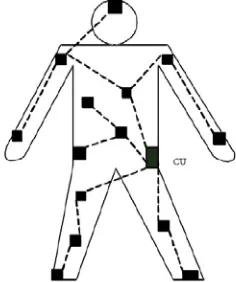
In order to maximize the network life cycle and to use resources efficiently, we finally choose the multi-hop tree topology. Next, we will try to find a better routing algorithm to control the communication between network nodes.
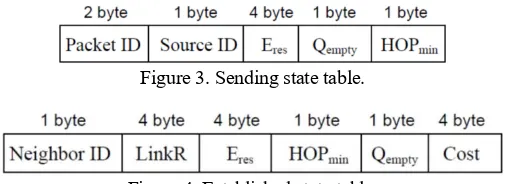
[image:4.612.240.358.564.705.2]Figure 3. Sending state table.
Figure 4. Established state table.
NEXT HOP SELECTION MECHANISM
In this paper, three factors are considered to meet the QoS requirements in the selection of the next hop of the sensor network: the residual energy of the node, the remaining queue length of the node, and the channel quality between the node and other node.
In order to balance the three parameters above, we use an next hop selection function (the maximum cost function), that we call it Cost as follows:
(4)
Among them, CE,CQ,CLare the impacting parameters, which can set according to the actual situation.
ROUTING ALGORITHM
At first, that is the beginning of each cycle, each node will send its own state table to the surrounding nodes. SourceID refers to the node label who sends the data,
min
HOP refers to the minimum number of hops required by the node to the SINK gateway node. The details are as follows.
Then, when a node receives the packets sent by the surrounding nodes, the node will establish a state table matrix according to the state of the neighboring nodes. The specific row of the matrix is shown in Figure 4.
Where NeighborID refers to the label of a neighboring node, LinkR refers to the channel quality between two nodes,Eres refers to the remaining energy of the neighbor node,HOPmin refers to the minimum hop count of the neighboring node to the SINK
node, Qempty refers to the remaining queue length of the neighboring node.Cost is calculated by the formula.
After completing the process, each node will sort the neighbor node information table according to the Cost value. Under the premise of satisfying the minimum number of neighbor nodes, the neighbor node that with the largest cost will be selected as the next hop node. Because of the overall consideration of the node residual energy, channel quality, the remaining queue length, the algorithm meet the QoS requirements.
j i L j total j empty Q
jn jres E j
i C E E C Q Q C R
Algorithm 2 routing algorithm
Define a set of neighbor nodes of I is N
Input: Ni Output (the node selected for next hop):NHi 1. Calculate the cost for all nodes;
2. Select all nodes in Ni with the minimum hop count + 1 = node i minimum hop count (which means adjacent nodes), join the set SNi;
3. Sort all nodes in SNi according to the cost;
4. Select the maximum value of the corresponding node, that isNHi, the next hop node for node I.
STATIC HUMAN BODY ROUTING ALGORITHM SIMULATION
According to the research above, we preliminary simulate the algorithm by MATLAB.
Model is operated for 100 times, set the distance of sensor within 70cm which can communicate with each other. Some of the parameter settings are shown in Table 2 below.
In the simulation, we start from the topological map with only 7 nodes and then add the topology to complete 15 sensor nodes. The initial nodes are nodes 1, 4, 5, 6, 9, 12, 13, and then add the knee nodes 7, 14, the foot nodes 8, 15, the arm nodes 2, 10, the wrist nodes 3, we mean to compare the various components of the body in overall impact of the body network.
SIMULATION RESULTS AND ANALYSIS
(1) Indicators parameters: node average energy consumption, packet forwarding, network lifetime
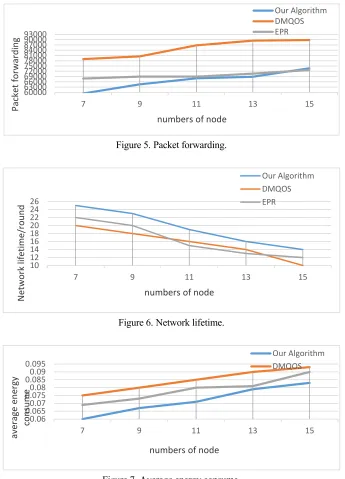
In this paper, first, we consider three parameters, that is average energy consumption, packet forwarding and network lifetime, then give the simulation results, and compare with the older generation algorithm DMQOS and EPR.
Among them, the node average energy consumption is when a node energy exhaustion, the average energy consumed from all nodes. Network lifetime refers to the number of rounds of data transmission when the network is exhausted. Packet forwarding refers to the total amount of packets transmitted by each node before a node is exhausted.
TABLE 2. SIMULATION INDEX.
Packet queue length 50
Node initial energy 2 J
Single packet size 32 Bytes
L Q
E C C
60000 63000 66000 69000 72000 75000 78000 81000 84000 87000 90000 93000
7 9 11 13 15
Packet f orw arding numbers of node Our Algorithm DMQOS EPR
Figure 5. Packet forwarding.
10 12 14 16 18 20 22 24 26
7 9 11 13 15
N etwork lifetime/rou n d numbers of node Our Algorithm DMQOS EPR
Figure 6. Network lifetime.
0.06 0.0650.07 0.0750.08 0.0850.09 0.095
7 9 11 13 15
[image:7.612.126.471.54.533.2]av era ge en ergy co ns um e numbers of node Our Algorithm DMQOS
Figure 7. Average energy consume.
It can be seen that, compared with the DMQOS and EPR algorithms, our algorithm has a great improvement in the average energy consumption, which improves the survival time of the domain network. But when considering packet forwarding, there is no obvious advantage over the EPR algorithm. The algorithm still needs to be improved in this aspect but this may probably because we have less total number of jumps.
0 10 20 30 40
0 1 2 3 4 5 6 7 8 9 10 11 12 13 14 15
First
depl
eti
on
tim
es
node number
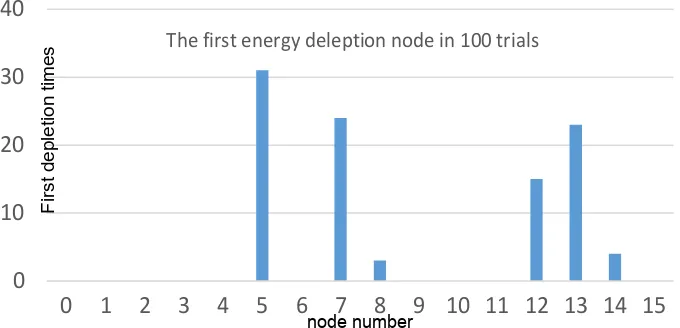
[image:8.612.129.469.61.225.2]The first energy deleption node in 100 trials
Figure 8. First depletion time.
According to Figure 8 above, the regional center nodes are most likely to be run out. And when the trunk nodes are exhausted, the whole network is almost dead, which is unavoidable by the algorithm. If so, it is necessary to perform processing such as increasing the battery power for each key node.
Dynamic human body algorithm analysis
DYNAMIC WBAN CHARACTERISTICS
Since WBAN is carried in the human body, there are some characteristics that other wireless sensor network does not have, which will mainly be reflected in:
1. According to the law of the movement of the human body, the network movement is usually relatively gentle.
2. Node around the body of the main body changes, the scope of movement relative to the human body is generally within 2 meters.
3. Some movements will cause the network topology changes. 4. Some randoms may happen.
HUMAN BODY MOVEMENT MODEL
Here we have no experience and data to build a human body movement model, and our focus is on the construction of the sensor network. So, on how the body specific movement, we found a more authoritative model of interpretation, that is, Gaussian - Markov moving model.
DYNAMIC HUMAN SIMULATION
(1) Simulation of data sources
The simulation data comes from the MSR Daily Activity 3D database. (2) Expected analysis
This is especially evident in the area of arm. Besides, the nodes that located in main transmission road will be exhausted first.
In the process of human movement, the idea in the original static algorithm, that searching for the next jump is still feasible. However, if we use old algorithm, like in the part of the arm, the current next hop selection is not reasonable. Because when people are walking and running, the arm’s node will slightly wave, that will undoubtly cause the distance between the nodes with other node changes dramatically. As the result, the misjudgment of distance will increase the average energy consumption, reduce the network lifetime. And when the channel is poor, it will lead to the loss of data retransmission. Therefore, we must put a new algorithm to take the movement of limbs into account, since it is the main change of the movement of human body.
Routing algorithm for dynamic human body
HUMAN GAIT RECOGNITION
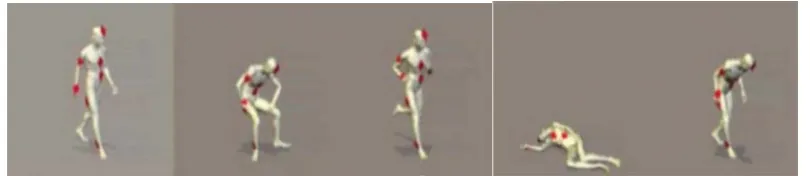
The work of ARCHASANTISU provides a possibility for us to improve the routing algorithm by identifying human motion. In this paper, the human movement is broadly divided into five categories: walking slowly, walking, running, sitting (stationary), abnormal (falling, etc.). Our paper will mainly study two kinds of human movement situation, that is walking and running.
HUMAN MOVEMENT MODEL
We have improved and compared two universal models, RGMM and Hanavan models. However, the specific models we will not present in this article. We will enter the model into our simulation database.
Algorithm 3 improved dynamic routing algorithm
1. Determine the state of human motion according to the human gait recognition method mentioned above;
2. Each node broadcasts its own information and determines the location of each node; 3. Each node will base on the human movement model and the it’s current position to predict the next location;
[image:9.612.96.501.619.707.2]4. According to the prediction results, repeat algorithm 2, step 1-4, determine the next hop selection.
5 8 11 14 17 20 23 26
7 9 11 13 15
[image:10.612.101.497.51.562.2]Ne tw ork lif etim e/round node numbers Static dynamic model1 model2
Figure 10. Network lifetime.
0.06 0.0650.07 0.0750.08 0.0850.09 0.0950.1 0.105
7 9 11 13 15
av era ge en ergy c o n su me node numbers static dynami c model 1
Figure 11. Average energy consume.
60000 62000 64000 66000 68000 70000 72000 74000 76000
7 9 11 13 15
[image:10.612.101.498.55.207.2]Packe t f orw arding node numbers static dynamic model1 model2
Figure 12. Packet forwarding.
ALGORITHM SIMULATION
We compare the survival time, average energy consumption and forwarding capacity of the network.
From the simulation we can gain that after movement model corrected, the average energy consumption of each node compared to the original algorithm has declined, the relative network lifetime extended. It is also worth noting that the arm part of the node, because no longer choose the long distance next hop, has saved it lots of energy. Compared with the two models, RGMM has a comparative advantage in terms of network lifetime and average energy consumption. Obviously, for our algorithm, RGMM model is superior to human body motion prediction model for domain network node communication. Last, after further optimization, we may also have a better performance.
SUMMARY
This paper put forward a new WBAN routing algorithm. A next hop selection algorithm is constructed by using the residual energy ratio, the channel quality between nodes, and the node memory occupancy rate. Through the recognition of human gait, we can predict the trend of human motion and adjust the algorithm to extend the network lifetime. The simulation results show that the routing algorithm proposed in this paper has more effective equalization and can save node's energy compared than the routing algorithm adopted in the past, which can prolong the network lifetime.
Here, we can see that the maximum cost function model we use, power control ideas and the routing algorithm ideas we put forward, in dealing with multi-hop network have achieved some good effects. Among them, in the static algorithm, we have more indicators and advantages compared with existing algorithm. In the dynamic algorithm, through built-in gait recognition and human movement model, the index has been significantly improved. This powerful shows that our routing algorithm in the principle of superiority.
However, although this paper has made some research on the hot spot problem of WBAN, the author's own level is limited, this paper is not perfect for the improvement of human motion, may can not use node energy more effectively. Hope in the future can put forward some more effective solutions.
REFERENCES
1. Benolit, Bart B., Ingrid M., et al. A survey on wireless body area networks [J].Wireless works, Springer, 2011, 17(1): 15-18.
2. Culler D., Estrin D. Stivastava M. Overview of sensor networks [J]. IEEE Trans on Computers, 2004, 37(8): 41-49.
3. Razzaque M.A., Hong C.S., Lee S. Data-centric multiobjective QoS-aware routing protocol for body sensor networks. Sensors, 2011, 11(1): 917–937.
4. Khan Z., Aslam N., Sivakumar S., Phillips W.Energy-aware peering routing protocol for indoor hospital body area network communication. Procedia Computer Science, 2012, 10(1): 188–196. 5. Khan Z.A., Sivakumar S., Phillips W., Robertson B.A. QoS-aware Routing Protocol for Reliability
Sensitive Data in Hospital Body Area Networks. Procedia Computer Science, 2013, 19(1): 171– 179.
7. Xiao S., Dhardhere A., Siviraman V., et al. Transmission power control in body area sensor networks for healthcare. Monitoring. IEEE Journeal on Selector Areas in Communications, 2009, 27 (1): 37-48.
8. B. Liang, Haas Z.J., “Predictive Distance-Based Mobility Management for PCS Networks [A]” Proc. IEEE Infocom [C], New York, 1999: 1377-1384.
9. Sukhumarn Archasantisuk, Nonmember, Takahiro Aoyagi, Member, Tero Uusitupa Nonmember, Minseok KIM, Member, and Jun-ichi Takada Fellow “Human Motion Classification Using Radio Signal Strength in “WBAN” IEICE Trans.Commun., VOL. E99–B, NO.3 MARCH 2016.
10. B. Anthony Kadrovach, Gary B. Lamont, “Design and analysis of swarm-based sensor systems”, Symposium on Circuits and Systems, Fairborn, OH, August, 2001.