2016 Joint International Conference on Artificial Intelligence and Computer Engineering (AICE 2016) and International Conference on Network and Communication Security (NCS 2016)
ISBN: 978-1-60595-362-5
“From-bottom-to-top” to Analyze Predicate of Traditional Mongolian
Simple Sentence Basing on the Rule
Ri-Heng WU
1,a, Monghjaya
1,b,*, MoRigen
1,c1College of Computer, Inner Mongolia University, Hohhot, Inner Mongolia, China
a[email protected], b[email protected]
*Corresponding author
Keywords: Predicate, “From-bottom-to-top”, Dictionary Library, Rule Base.
Abstract. Predicate is the core content of a sentence and also one of the main studies of syntactic parsing. We propose a method of “From-bottom-to-top” dividing sentence constituent according to the feature of Mongolian that “predicate is usually at the end of the sentence”. This thesis has summarized rules by analyzing the predicate features of Mongolian simple sentence, and has built dictionary libraries and rule bases in order to implement the division of the predicate.
Introduction
NLP is an important branch in the field of artificial intelligence. Syntactic parsing is one of the key technologies of NPL. Thus, syntactic parsing is one of issues that many scientists concern in NPL. With the implementation of the western development strategies, the importance of high-tech business developments in minority areas has been referred to the relevant departments of the national agenda, Mongolian language information processing is no exception [1], compared with English and Chinese semantic–oriented studies, Mongolian semantic research started late in many areas, thus many areas are in the early exploration stage so that they cannot form a complete and systematic theories.
Currently Mongolian syntactic analysis is in the primary stage, researchers are trying to study by all kinds of methods. Literature [2] introduces the method to construct the Mongolian verb semantic network which is compatible with Chinese WordNet based on WordNet framework and Daerhan Dictionary as the lexical basis, we propose an automatically match and manual intervention method making full use of the predecessors’ existing research results and Semantic network experience, due to the characteristics of the Mongolian language itself, we will make full of all kinds of lexical semantic knowledge to solve them when faced with the problems that cannot be matched. Literature [3] concluded a set of rules for the base verb phrase recognition and formalized with MBT (Multiple feature binary tree model) formal model. A test about potential ambiguity types of boundary determining and structure analyses was done, and the accuracy rate is over 80%. Literature [4] summarized the knowledge of Mongolian predicate structure and predicate segment assistant component, Implemented and designed the tagging system of predicate and predicate segment assistant component, and experiment, which marked the accuracy rate can reach 70%. Literature [5] constructed “Mongolian predicate information database”, and statistical analysis of the relevant information, category, morphology, phrase structure, words number and semantic features of Mongolian predicate was introduced, and preliminary statistical research on Mongolian predicate information was developed.
The Rules of Predicate
First of all, that define the simple sentence that mention in this paper. Simple sentence is a sentence that contain the object and predicate, not contain the elliptical sentence and the sentence contained only one part.
Generally, the predicate was constituted of verb, but sometimes there will be a noun, adjective, etc. Predicate is usually at the end of the sentence in Mongolian simple sentences. The position of predicate is better to determine compared with other constituents. But the forms of predicate presented are also different according to the different sentences. Thereafter may be included to indicate, mood, the tendency of the auxiliary verb. They assist predicate to express various grammatical meaning by predicate expression, time, person and mood.
Verb as Predicate (1) Verb as predicate
Verb as the predicate is a common condition. In a simple sentence, if there is a verb and the position is at the end of the sentence, the verb must be the predicate. For example, in the sentence
“ (I drink tea.)”, the word (drink) is a verb. It can be directly judged and marked as
the predicate by its part of speech.
(2) Verb + auxiliary verb/ mood as predicate.
When verb as predicate, the Thereafter verb sometimes may be shipped express, modal, auxiliary
verb like the words “ “. For
example, the sentence “ (I can't do this problem.)”, the word (do) is a
verb, and is a modal word, the privative word is .These three words are all together
constitute predicate. Noun as Predicate
Sometimes noun can be as predicate in the Mongolian simple sentences. The sentence form is generally “... is ...”.
(1) Noun as predicate
Sometimes noun can be as predicate in the Mongolian simple sentences. For example, in the
sentence “ (I am a student.), (student) is a noun. We can determine the
predicate by the key word of , the part below the word is predicate (containing the word ). (2) Noun + auxiliary verb/ mood as predicate
Sometimes, noun predicate also may contains auxiliary verbs like “ “ and mood words
like “ “. These auxiliary verbs and mood together with noun constitute
predicate. For example, in the sentence “ (He may be a student.)”, the mood
and (student) together are predicate.
Adjective as Predicate
Sometimes adjective can be as predicate in the Mongolian simple sentences. The sentence form is generally “... is ...” and “….is….to….”.
(1) Adjective as predicate
Adjective can also be as predicate in the Mongolian simple sentences. For example, in the sentence
“ (The future is bright)”, the word (bright) is an adjective. We can
determine the predicate by the key word of , the part below the word is predicate (containing the
word ). Another example is the sentence “ (You are very nice to me.)”, the word
(very nice) is an adjective as predicate. (2) Adjective + auxiliary verb/ mood as predicate
Sometimes, adjective predicate also may contains auxiliary verbs like “ “ and mood
words like “ “. These auxiliary verbs and mood together with adjective
constitute predicate. For example, in the sentence “ (He is very happy.), the adjective
Summarize Predicate Rules
Through the above analysis of Mongolian simple sentence predicate form, it can be summed up the following rules.
(1) If the auxiliary verb “ “ is
at the end of the sentence and the next word is not the “case”, then auxiliary verb together with the next noun or verb constitute predicate. If the “comitative case” is appeared with other auxiliary verbs, it may be regarded as an auxiliary verb. For example, in the sentence “
(I want to buy this hat.)” the “comitative case” and the words (want to buy) together as
predicate.
(2) If the no change word (1) is appeared at the end of the sentence, and the next word is “case”, then no change word can be as predicate.
(3) In question, we should skip the word to determine the predicate according to the rules,
the predicate section includes the word .
(4) If two words are verb and the relationship of them is linkage, then two together constitute predicate.
(5) The form “the comitative case + noun” is appeared at the end of sentence, then the form part of sentence can be as predicate.
(6) If the first word at the end of sentence is an adjective and the second word is a “case”, then it can be as predicate.
(7) If the form is “adjective + “, then the form part of
sentence can be as predicate.
Key Technology of Dividing Predicate
During analyze the Mongolian simple sentence constituent, we must tag POS of each words in the sentence firstly, then “from-bottom-to-top” analyzing the sentence constituent by each rules. POS tagging of this thesis is done by the dictionary library, selecting rules through the predicate rule base. Therefore, the key of analysis sentence constituent is to establish dictionary libraries and the rule bases.
Dictionary Library
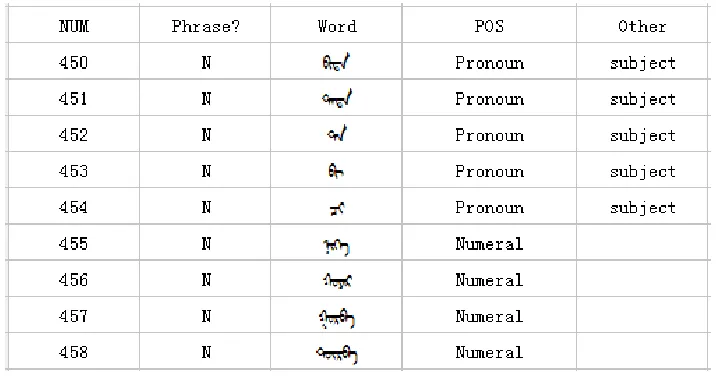
The dictionary databaseⅠis mainly composed of nouns, adjectives, no change words (1), no
[image:3.612.127.485.533.721.2]change words (2), pronouns, numerals, quantifiers, conjunctions, adjectives and phrases, noun phrases and verb phrases. The main function of dictionary library is to determine whether the phrase and parts of speech. The structure is shown in Fig.1.Dictionary library:
Rule Base
Rule base is also a key technique to analyze sentence constituent. Rule base that proposed in this thesis is based on the “ from-bottom-to-top “ analysis in order to decide POS. Determine the part of speech by affixes, then determine the specific components of the word in the sentence by the relation of word and the up and down words. Grammar judgment of traditional Mongolian is related to judgment of a new word that got by the stem of a noun, adjective, or determines access affix. The traditional Mongolian affix determination is similar to “from-bottom-to-top” determination, but not the same.
Verb Rule
[image:4.612.166.447.282.469.2]In general, the position of predicate is at the end of the sentence, and verb is generally as predicate (and sometimes also an adjective or a noun as predicate) in traditional Mongolian simple sentences. The position of predicate is better to determine compared with other constituents. But sometimes forms of predicate presented are also different according to the different sentences. Then we need to establish the rule base to help us to determine POS by affixes. The rule base that built in this paper is shown in Fig.2.Verb rule:
Figure 2. Verb rule. Noun Rule
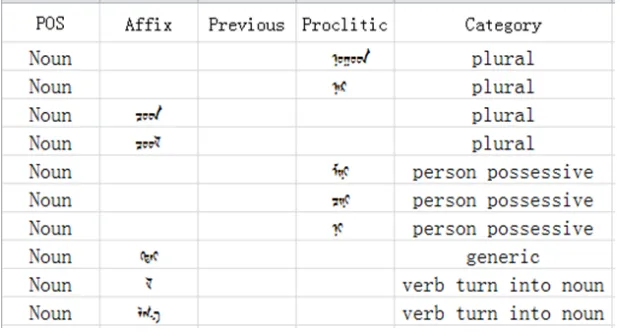
The grammar feature of noun includes singular and plural forms of noun, change of case and changes possessive beside suffix. The rule base established in this thesis is mainly based on the plural form of the followed word, person possessive and affixes to determine the noun. Noun rule that built in this thesis is shown in Fig.3.Noun rule:
[image:4.612.152.462.558.724.2]Adjective Rule
[image:5.612.118.496.143.305.2]In traditional Mongolian simple sentence, besides nouns and verbs, the frequency of adjectives appeared in sentence is also higher. From the point of view of sentence elements, adjective is usually as attributive. It can be as subject if it position is in front of a sentence, when at the end of the sentence it can be as a predicate. Adjective rule that built in this thesis is shown in Fig.4.Adjective rule:
Figure 4. Adjective rule.
The Flow of Dividing Predicate
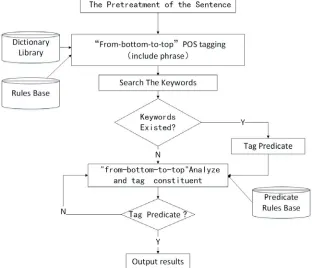
Mongolian is an adhesive language, in order to mark POS better, we must preprocess sentence firstly that is the word will be segmented through the rule base and dictionaries library. Then we use the method of tag POS based on the rule base and dictionary libraries. When POS tagging is finished,
traversing the whole sentence and identifying keywords , and marking the part of
sentence that following the keywords as predicate part. Then using the “from-bottom-to-top” method to divide and mark the predicate based on the predicate rule that we sum up. The flowchart which a whole process of analyzing predicate is shown in Fig.5.Flowchart of analyzing the predicate:
[image:5.612.150.462.453.721.2]Summary
In this thesis, we processed the test corpus (contained of the website, journals, teaching, medical, legal and other books take different simple sentence), selected objects that appear in this study. And we also established the dictionary database and rules, summarized and improved the predicate rules, the establishment of the rule base to achieve the division of predicate.
References
[1] Nasun-urt, Research on Mongolian semantic for Information Processing, Journal of Inner Mongolia University, Fifth period, 2002.
[2] Xiaoxiao Xiong, Hasi, Research on the Construction of Mongolian Verb Semantic Network, Proceeding of the IEEE International Conference on Information and Automation, Hailar, China, July 2014.
[3] H.D.G.L. Yi, The study of Mongolian basic verb phrase automatic identification. Hohhot: Inner Mongolia University. 2005.06.
[4] S.R.G.L. Wang, S.R.N. De, Nasun-urt, Design and Implementation of auto-labeling modern Mongolian predicate, National Ethnic Language Information Seminar, 2007, pp 402~427.
[5] S.Q.R.L.T. Bai, Construction Mongolian database of predicate information, Hohhot: Inner Mongolia University, 2013.06
[6] Qing Geertai, Mongolian grammar, Inner Mongolia: Inner Mongolia People's Press, 1991. [7] S.R.G.L. Wang, S.R.N. De, The systems of automatic identifying Mongolian verbal semantic, Chinese Mongolian, 2006, pp 111~113.