Robot assisted training for the upper limb after stroke
(RATULS): a multicentre randomised controlled trial
Helen Rodgers*, Helen Bosomworth*, Hermano I Krebs, Frederike van Wijck, Denise Howel, Nina Wilson, Lydia Aird, Natasha Alvarado, Sreeman Andole, David L Cohen, Jesse Dawson, Cristina Fernandez-Garcia, Tracy Finch, Gary A Ford, Richard Francis, Steven Hogg, Niall Hughes, Christopher I Price, Laura Ternent, Duncan L Turner, Luke Vale, Scott Wilkes, Lisa Shaw
Summary
Background Loss of arm function is a common problem after stroke. Robot-assisted training might improve arm function and activities of daily living. We compared the clinical effectiveness of robot-assisted training using the MIT-Manus robotic gym with an enhanced upper limb therapy (EULT) programme based on repetitive functional task practice and with usual care.
Methods RATULS was a pragmatic, multicentre, randomised controlled trial done at four UK centres. Stroke patients aged at least 18 years with moderate or severe upper limb functional limitation, between 1 week and 5 years after their first stroke, were randomly assigned (1:1:1) to receive robot-assisted training, EULT, or usual care. Robot-assisted training and EULT were provided for 45 min, three times per week for 12 weeks. Randomisation was internet-based using permuted block sequences. Treatment allocation was masked from outcome assessors but not from participants or therapists. The primary outcome was upper limb function success (defined using the Action Research Arm Test [ARAT]) at 3 months. Analyses were done on an intention-to-treat basis. This study is registered with the ISRCTN registry, number ISRCTN69371850.
Findings Between April 14, 2014, and April 30, 2018, 770 participants were enrolled and randomly assigned to either robot-assisted training (n=257), EULT (n=259), or usual care (n=254). The primary outcome of ARAT success was achieved by 103 (44%) of 232 patients in the robot-assisted training group, 118 (50%) of 234 in the EULT group, and 85 (42%) of 203 in the usual care group. Compared with usual care, robot-assisted training (adjusted odds ratio [aOR] 1·17 [98·3% CI 0·70–1·96]) and EULT (aOR 1·51 [0·90–2·51]) did not improve upper limb function; the effects of robot-assisted training did not differ from EULT (aOR 0·78 [0·48–1·27]). More participants in the robot-assisted training group (39 [15%] of 257) and EULT group (33 [13%] of 259) had serious adverse events than in the usual care group (20 [8%] of 254), but none were attributable to the intervention.
Interpretation Robot-assisted training and EULT did not improve upper limb function after stroke compared with usual care for patients with moderate or severe upper limb functional limitation. These results do not support the use of robot-assisted training as provided in this trial in routine clinical practice.
Funding National Institute for Health Research Health Technology Assessment Programme.
Copyright © 2019 The Author(s). Published by Elsevier Ltd. This is an Open Access article under the CC BY 4.0 license.
Introduction
Upper limb problems commonly occur after a stroke, comprising loss of movement, coordination, sensation, and dexterity, which lead to difficulties with activities of daily living (ADL) such as washing and dressing. About 80% of people with acute stroke have upper limb motor impairment, and of those with reduced arm function
early after stroke, 50% still have problems after 4 years.1
The strongest predictor of recovery is severity of initial neurological deficit; patients with severe initial upper limb impairment are unlikely to recover arm function, with clear impact upon their quality of life. Patients report that loss of arm function is one of the most distressing long-term consequences of stroke. Improving upper limb function has been identified as a top ten research priority by stroke survivors, carers, and
clinicians.2
How to optimise stroke patients’ upper limb recovery is unclear. Systematic reviews of therapy interventions suggest that patients benefit from therapy programmes in which they practise tasks directly rather than from
interventions that focus on impairments.3,4 Intensity
of therapy is also important; a Cochrane overview4 of
systematic reviews found moderate quality Grading of Recommendations, Assessment, Development and Evaluations evidence that arm function after a stroke can be improved by the provision of at least 20 h of additional repetitive task training.
Robot-assisted arm training has shown promise for improving ADL, arm function, and arm muscle strength
after stroke.5,6 However, studies vary in patient
charac-teristics, device used, duration and amount of training, control group, and outcome measures used. The benefits of robot-assisted arm training over conventional therapy
Lancet 2019; 394: 51–62 Published Online May 22, 2019 http://dx.doi.org/10.1016/ S0140-6736(19)31055-4
See Comment page 6
*Contributed equally
Stroke Research Group, Institute of Neuroscience, Newcastle University, Newcastle upon Tyne, UK
(Prof H Rodgers FRCP, H Bosomworth PhD, Prof G A Ford FRCP, R Francis PhD, S Hogg, C I Price MD, L Shaw MD); Stroke Northumbria, Northumbria Healthcare NHS Foundation Trust, North Tyneside, UK
(L Aird BSc, C I Price, Prof H Rodgers); Newcastle Hospitals NHS Foundation Trust, Newcastle upon Tyne, UK
(Prof H Rodgers); Massachusetts Institute of Technology, Cambridge, MA, USA
(H I Krebs PhD); School of Health and Life Sciences, Glasgow Caledonian University, Glasgow, UK
(Prof F van Wijck PhD); Institute of Health and Society, Newcastle University, Newcastle upon Tyne, UK
(D Howel MSc, N Wilson PhD, C Fernandez-Garcia PhD, L Ternent PhD, Prof L Vale PhD); School of Healthcare, University of Leeds, Leeds, UK
(N Alvarado PhD); Barking, Havering and Redbridge University Hospitals NHS Trust, Romford, UK (S Andole FRCP); London North West Healthcare NHS Trust, Northwick Park Hospital, Harrow, UK
(D L Cohen FRCP); Institute of Cardiovascular and Medical Sciences, University of Glasgow, Glasgow, UK
(Prof J Dawson MD); Nursing, Midwifery and Health, Northumbria University, Newcastle upon Tyne, UK
Trust, Oxford, UK
(Prof G A Ford); NHS Greater Glasgow and Clyde, Glasgow, UK (N Hughes FRCP); School of Health, Sport and Bioscience, University of East London, London, UK
(Prof D L Turner PhD); and School of Medicine, University of Sunderland, Sunderland, UK
(Prof S Wilkes PhD) Correspondence to: Prof Helen Rodgers, Stroke Research Group, Institute of Neuroscience, Newcastle University, Newcastle upon Tyne NE2 4AE, UK
of the same frequency and duration have not been
shown.7
This randomised controlled trial (RCT) aimed to establish whether robot-assisted training improved upper limb function after a stroke compared with an enhanced upper limb therapy (EULT) programme of the same frequency and duration and usual care alone. Robot-assisted training and EULT involved repetitive task practice and were provided in addition to usual care.
Methods
Study design
RATULS was a three-group, pragmatic, multicentre RCT done at four National Health Service (NHS) centres in the UK. Each centre comprised a stroke service in an NHS hospital with an MIT-Manus robotic gym system (InMotion commercial version, Interactive Motion Technologies, Watertown, MA, USA), plus stroke services in adjacent NHS Trusts and community services. The trial protocol was approved by National Research Ethics Committee Sunderland (reference 13/NE/0274) and has
been published.8
Participants
Study participants were adults (age ≥18 years) with moderate or severe upper limb functional limitation
(Action Research Arm Test [ARAT] score 0–39)9 as a
result of first-ever stroke that had occurred between 1 week and 5 years before randomisation. Exclusion criteria were other notable impairment in the upper limb affected by stroke; other diagnosis that might interfere with rehabilitation or outcome assessments; previous use of the robotic gym system or other arm rehabilitation robot; participation in another upper limb rehabilitation trial; and previous enrolment in this study. Participants were recruited from stroke units, outpatient clinics, day hospitals, community rehabilitation services, local stroke clubs, and primary care. All participants provided written informed consent.
Randomisation and masking
Randomisation was done through a central independent web-based service hosted by Newcastle University Clinical Trials Unit. Participants were randomly assigned 1:1:1 to receive robot-assisted training, an EULT programme, or usual care using permuted block sequences stratified according to centre, time since stroke, and severity of
upper limb functional limitation (ARAT score).9 The
sequences were prepared by an independent statistician before the start of enrolment. Outcome data were intended to be collected by a masked researcher and any unmasking was recorded. Because of the nature of the
Research in context
Evidence before this study
Robot-assisted training enables stroke patients with moderate or severe upper limb impairment to perform repetitive tasks in a highly consistent manner, tailored to their motor abilities. A 2018 Cochrane review (45 trials, 1619 participants) reported that electromechanical and robot-assisted arm training improved arm function (standardised mean difference [SMD] 0·32 [95% CI 0·18–0·46]) and activities of daily living (ADL) scores (0·31 [0·09–0·50]). The clinical importance of these differences is unclear and the results should be interpreted with caution because of study heterogeneity and variation in the quality of the included studies. Another review found no difference in any of these outcomes when robot-assisted training was compared with the same duration or intensity of conventional therapy. Theories of neuroplasticity and motor learning support an approach to rehabilitation based on repetitive practice of functional tasks. A 2016 Cochrane review (33 trials, 1853 participants) found that repetitive functional task practice for patients who had a stroke was associated with improved arm function (SMD 0·25 [95% CI 0·01–0·49]), hand function (0·25 [0·00–0·51]), and ADL (0·28 [0·10–0·45]). Again, the clinical importance of these findings is unclear.
Added value of this study
RATULS is the first multicentre trial with adequate statistical power to compare robot-assisted training with both an evidence-based therapy programme of the same frequency and duration (45 min face-to-face therapy, three times per
week, for 12 weeks) and usual care. We found no significant difference in our primary outcome of upper limb function at 3 months between stroke patients treated with robot-assisted training, an enhanced upper limb therapy programme (EULT), or usual care. Although some improvements for robot-assisted training were observed in upper limb impairment compared with usual care, these did not translate into improvement in upper limb function or ADL. EULT resulted in less upper limb impairment, better mobility, and better ADL at 3 months compared with usual care. Furthermore, EULT was superior to robot-assisted training for ADL at 3 months.
Implications of all the available evidence
The results of the RATULS trial do not support the routine use of robot-assisted training (MIT-Manus robotic gym) for patients with moderate or severe upper limb functional limitation resulting from stroke. Our findings will inform guidelines about the use of robot-assisted training and EULT in clinical practice. Further research is needed to find ways to translate the improvements in upper limb impairment seen with
intervention, patients and therapists could not be masked to the allocated treatment.
Procedures
Robot-assisted training and EULT programmes were delivered at the same frequency and duration: 45 min of face-to-face therapy, three times per week for 12 weeks. The same therapists and therapy assistants delivered both interventions at each centre. A detailed description of robot-assisted training and EULT using the Template for Intervention Description and Replication checklist
is available.8 Robot-assisted training and EULT were
delivered in addition to usual post-stroke care.
The robot-assisted training programme integrated training with all three modules of the MIT-Manus robotic gym (shoulder–elbow module, wrist module, hand module integrated on to the shoulder–elbow module). The EULT programme was designed to reflect best practice using repetitive functional task practice to work
towards participant-centred goals.10,11 Therapists recorded
data on the content of EULT sessions; the MIT-Manus robotic gym recorded data on the robot-assisted training sessions content.
Participants assigned to usual care received usual NHS care, which was provided by their local clinical service. The English national quality standard is that patients with stroke should be offered a minimum of 45 min of each appropriate therapy that is required, for a minimum of 5 days per week, at a level that enables the patient to meet their rehabilitation goals for as long as they are continuing to benefit from therapy and as long as they are able to tolerate it. Many stroke units achieve this target for physiotherapy and occupational therapy, but considerable
variation exists in service provision after discharge.12
Participants in all three groups received an arm reha-bilitation therapy log to record any upper limb rehareha-bilitation received during the trial and any self-practice arm exercises
done. The schedule of enrolment, inter ventions, and
assessments can be found in the protocol.8
Assessments included the ARAT,9,13 which assesses
upper limb function by scoring the ability to complete a range of functional tasks within four subscales (grasp, grip, pinch, and gross movement), with a total score from zero (no function) to 57 (normal function); Fugl–Meyer
assessment (FMA);13,14 Barthel ADL Index;15 Stroke Impact
Scale (SIS), version 3.0;16 and measurement of upper limb
pain on a numerical rating scale (score 0–10). For all the scores except the upper limb pain scale, a higher score denotes better performance. The total upper extremity FMA scale assesses upper limb impairment by incor-porating the motor, sensory, range of motion, and joint pain subscales (score 0–126). The FMA motor subscale is frequently used as a primary outcome in trials of robot-assisted training (score 0–66). The Barthel ADL Index consists of ten activities, together scored from 0 to 20. The SIS is a self-completion, stroke-specific questionnaire to measure quality of life. There are nine dimensions
(strength, hand function, mobility, ADL, emotion, memory, com munication, social participation, and stroke recovery). The dimension scores range from 0 to 100. All adverse events and serious adverse events were recorded in accordance with National Research Ethics Service Committee guidance for trials that are not assessing an investigational medicinal product.
Quality-adjusted life-years (QALYs) were derived from
participant responses to the EQ-5D-5L17 questionnaire,
which was completed at baseline, 3 months, and 6 months. Utility values were estimated from the responses using health state utility scores based on the UK population
tariff18,19 and mapped back to the EQ-5D-3L valuation set.20
Costs incurred by the NHS and Personal Social Services were collected via resource utilisation questionnaires, completed at baseline and 6 months.
Outcomes
The primary outcome was upper limb function success
(defined using ARAT)9,13 at 3 months after
random-isation—ie, at the end of the intervention period. The definition of success differed depending on baseline severity: baseline ARAT score 0–7 required an improve-ment of 3 points or more; baseline ARAT 8–13 required an improvement of 4 points or more; baseline ARAT 14–19 required an improvement of 5 points or more; baseline ARAT 20–39 required an improvement of 6 points or more. A stepped approach was used, because although the minimal clinically important difference (MCID) for the ARAT is 10% of its range (6 points), a smaller treatment effect might still be clinically beneficial for those with severely reduced initial upper limb function, who are likely to improve less than those with more moderate reductions in function.
Secondary outcomes were upper limb function
(ARAT)9,13 success at 6 months; ARAT score; upper limb
impairment (FMA);13,14 ADL (Barthel ADL Index);15 quality
of life (SIS, version 3.0);16 and upper limb pain (numerical
rating scale). We also did economic analysis using data from resource utilisation questionnaires at baseline and 6 months and the EQ-5D-5L at baseline, 3 months, and 6 months.
Statistical analysis
The target sample size was 762 participants (254 par tici -pants per group). Responses from 216 par tici-pants in each group were required to provide 80% power (significance level of 1·7% because of multiple comparisons) to detect a 15% difference in successful outcome between each of the three pairs of treatments (robot-assisted training, EULT, and usual care). The baseline estimate of success was
estimated as 30% from the BoTULS trial11 and a difference
The primary outcome of upper limb function success at 3 months is reported descriptively by group and overall as a proportion. Logistic regression was used to compare success between the three groups at 3 months, adjusting for time since stroke, baseline ARAT score, and centre. We considered the possibility of partial nesting due to participants sharing therapists in the robot-assisted training and EULT groups but not in the usual care group. This did not change the model estimates or improve model fit and so the simpler models without partial nesting were used. The secondary outcomes of success at 6 months and binary coding of ARAT subscales (appendix) were analysed as for the primary outcome. All analyses were done in the intention-to-treat (ITT) population of all participants, in the group to which they were assigned, who did not have missing data after simple imputation. Preplanned sensitivity analyses were done for ARAT success at 3 months and 6 months. The first sensitivity analysis excluded participants who attended their outcome assessment outside of the 3 month ± 14 days, and 6 month ± 28 days windows. The
second sensitivity analysis excluded participants with an ARAT score of zero at baseline. In a per-protocol analysis, we compared ARAT success at 3 months and 6 months for robot-assisted training versus EULT for participants who had attended at least 20 therapy sessions.
All numerical secondary outcomes were reported at baseline, 3 months, and 6 months descriptively by group as mean (SD). These secondary outcomes were analysed separately at 3 months and 6 months using linear regression adjusting for time since stroke, baseline score, and centre. The baseline score used to adjust the analysis was the same scale for that outcome—eg, baseline ARAT was used in the model for ARAT at follow-up. Bias-corrected and accelerated CIs (100 000 bootstrap intervals) have been presented for all numerical secondary outcomes because of the distribution of the data. Three preplanned subgroup analyses explored the relationship between ARAT score at 3 months and centre, time since stroke (<3 months, 3–12 months, and >12 months), and baseline ARAT scores (0, 1–7, 8–13, 14–19, and 20–39).
Simple imputation was used in the calculation of the
scales.21 Missing values contributing to a scale or subscale
total were calculated using the median value of the respondent-specific completed responses on the rest of the scale or subscale to replace missing items, if no more than 20% of items were missing. The exception was the SIS, where we used the scale developers’ rules (for a particular participant, if <50% of items are missing in a dimension then the mean of the non-missing items is used in the formula for the final score; final score=25 × [mean of non-missing items–1]). For all analyses, the best fitting transformation of time since stroke was chosen on the basis of a significant reduction in model deviance. The coverage of the CIs was adjusted to account for the three paired comparisons between the groups. Because the study was powered on a significance level of 1·7%, we report 98·3% CIs. All CIs beyond the primary outcome were exploratory because no allow-ance was made for multiplicity of outcomes. Statistical analyses were done using Stata, version 14. Independent trial steering and data monitoring committees had oversight throughout the trial and convened annually.
A cost-utility analysis was done to assess the incremental cost per QALY gained. The analysis took the perspective of the NHS and Personal Social Services. The incremental cost per gained QALY for each participant at 6 months was calculated using the seemingly unrelated regression modelling method (sureg) in the adjusted cost-utility
analysis.22 This method ensured that any imbalance
between groups at baseline was not reflected in the estimated costs and QALYs. The covariates included in the regression analysis were centre, baseline ARAT score, time since stroke, baseline costs, and baseline utility score. To account for uncertainty in the cost-effectiveness results, a non-parametric bootstrap technique (involving 1000 replications with replacement) was used as part of
[image:4.595.30.332.370.721.2]a stochastic sensitivity analysis.23 All health economics
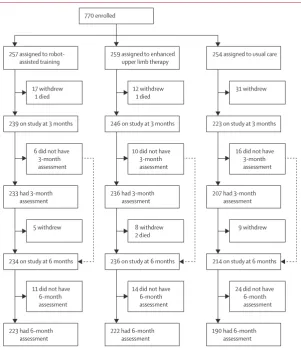
Figure 1: Trial profile
All participants assigned to intervention groups began their trial intervention. Reasons for withdrawals and missed assessments at 3 months and 6 months are in the appendix.
254 assigned to usual care
31 withdrew
223 on study at 3 months
16 did not have 3-month assessment
207 had 3-month assessment
9 withdrew
214 on study at 6 months
190 had 6-month assessment
24 did not have 6-month assessment 259 assigned to enhanced
upper limb therapy
246 on study at 3 months 770 enrolled
10 did not have 3-month assessment
8 withdrew 2 died
236 on study at 6 months
222 had 6-month assessment 257 assigned to
robot-assisted training
17 withdrew
1 died 12 withdrew1 died
239 on study at 3 months
6 did not have 3-month assessment
233 had 3-month
assessment 236 had 3-month assessment
5 withdrew
234 on study at 6 months
223 had 6-month assessment
11 did not have 6-month assessment
analyses were done using Stata, version 15. The trial is registered with the ISRCTN registry, number ISRCTN69371850.
Role of the funding source
The funder of the study had no role in study design, data collection, data analysis, data interpretation, or writing of the report. The corresponding author had full access to all the data in the study and had final responsibility for the decision to submit for publication.
Results
Between April 14, 2014, and April 30, 2018, 770 partici-pants were enrolled and randomly assigned to either robot-assisted training (n=257), EULT (n=259), or usual care (n=254; figure 1). Two participants who did not have a final diagnosis of stroke were withdrawn before the 3-month assessment (one in the robot-assisted training group and one in the usual care group; appendix). Of the 770 participants, 676 (88%) attended a 3-month asses-sment and 635 (82%) attended a 6-month assesasses-sment. Seven participants did not complete the ARAT at their 3-month assessment but were kept on study. Reasons why assessments were not done are shown in the appendix.
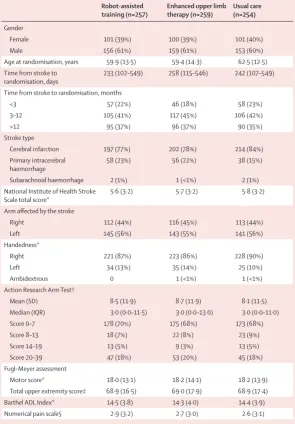
Baseline demographics and stroke characteristics were balanced between the groups at baseline (table 1). The mean age of participants was 61 (SD 14) years and 468 (61%) were men. The median time from stroke to randomisation was 240 days (IQR 109–549) and participants had a mean ARAT score of 8·4 (SD 11·8), mean FMA motor score of 18·1 (SD 13·7) and mean Barthel ADL Index of 14·4 (SD 3·9).
Robot-assisted training participants attended a median of 35 (IQR 31 to 36) of the 36 sessions and EULT participants attended a median of 34 (IQR 29 to 36) of the 36 sessions. The median duration of face-to-face therapy for each attended session was 41 min (IQR 35 to 47) for robot-assisted training and 45 min (IQR 45 to 45) for EULT. The median total duration of therapy per participant over the 12-week intervention was 23 h 28 min (IQR 18 h 53 min to 25 h 46 min) for robot-assisted training and 24 h 40 min (IQR 20 h 24 min to 26 h 15 min) for EULT. The appendix shows intervention fidelity.
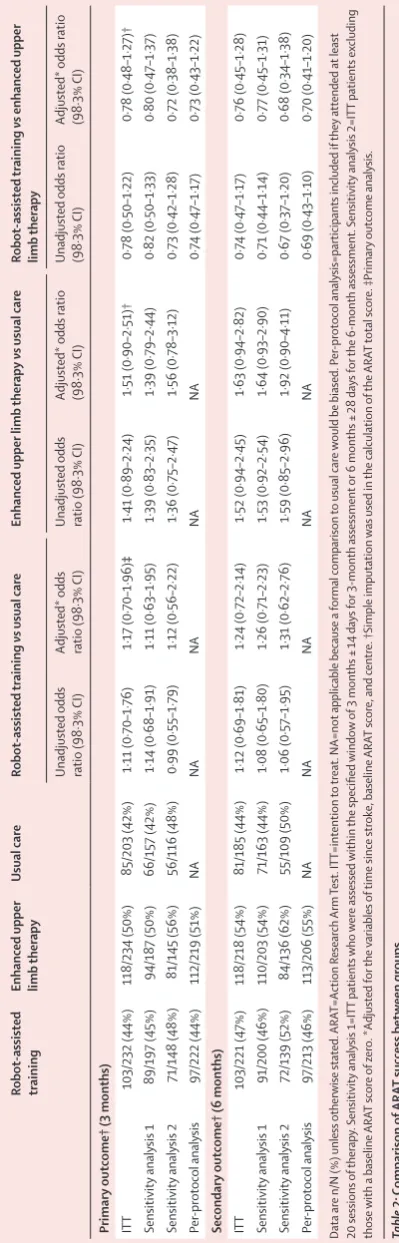
669 participants were included in the primary outcome analysis (232 in the robot-assisted training group; 234 in the EULT group; and 203 in the usual care group). At 3 months, 103 (44%) of 232 patients in the robot-assisted training group, 118 (50%) of 234 in the EULT group, and 85 (42%) of 203 in the usual care group achieved upper limb functional recovery success (table 2; figure 2A). ARAT success was not significantly different for robot-assisted training versus EULT (adjusted odds ratio [aOR] 0·78 [98·3% CI 0·48–1·27]) or usual care (aOR 1·17 [0·70–1·96]) at 3 months (figure 2B). Similarly, comparison of EULT versus usual care showed no significant dif-ference (aOR 1·51 [0·90–2·51]). At 6 months, 103 (47%) of 221 in the robot-assisted training group, 118 (54%) of
218 in the EULT group, and 81 (44%) of 185 in the usual care group achieved upper limb functional recovery success. Per-protocol and sensitivity analyses were con-sistent with the ITT analysis (table 2).
ARAT scores were similar between the robot-assisted training and usual care groups at 3 months and 6 months
(figure 2C, D). Robot-assisted training participants had
less upper limb impairment on the FMA motor subscale than usual care participants at 3 months (adjusted mean difference 2·79 [98·3% CI 0·66–5·01]) and the difference was sustained at 6 months (adjusted mean difference
Robot-assisted
training (n=257) Enhanced upper limb therapy (n=259) Usual care (n=254) Gender
Female 101 (39%) 100 (39%) 101 (40%)
Male 156 (61%) 159 (61%) 153 (60%)
Age at randomisation, years 59·9 (13·5) 59·4 (14·3) 62·5 (12·5) Time from stroke to
randomisation, days 233 (102–549) 258 (115–546) 242 (107–549) Time from stroke to randomisation, months
<3 57 (22%) 46 (18%) 58 (23%)
3–12 105 (41%) 117 (45%) 106 (42%)
>12 95 (37%) 96 (37%) 90 (35%)
Stroke type
Cerebral infarction 197 (77%) 202 (78%) 214 (84%)
Primary intracerebral
haemorrhage 58 (23%) 56 (22%) 38 (15%)
Subarachnoid haemorrhage 2 (1%) 1 (<1%) 2 (1%)
National Institute of Health Stroke
Scale total score* 5·6 (3·2) 5·7 (3·2) 5·8 (3·2)
Arm affected by the stroke
Right 112 (44%) 116 (45%) 113 (44%)
Left 145 (56%) 143 (55%) 141 (56%)
Handedness*
Right 221 (87%) 223 (86%) 228 (90%)
Left 34 (13%) 35 (14%) 25 (10%)
Ambidextrous 0 1 (<1%) 1 (<1%)
Action Research Arm Test†
Mean (SD) 8·5 (11·9) 8·7 (11·9) 8·1 (11·5)
Median (IQR) 3·0 (0·0–11·5) 3·0 (0·0–13·0) 3·0 (0·0–11·0)
Score 0–7 178 (70%) 175 (68%) 173 (68%)
Score 8–13 18 (7%) 22 (8%) 23 (9%)
Score 14–19 13 (5%) 9 (3%) 13 (5%)
Score 20–39 47 (18%) 53 (20%) 45 (18%)
Fugl–Meyer assessment
Motor score* 18·0 (13·1) 18·2 (14·1) 18·2 (13·9)
Total upper extremity score‡ 68·9 (16·5) 69·0 (17·9) 68·9 (17·4)
Barthel ADL Index* 14·5 (3·8) 14·3 (4·0) 14·4 (3·9)
Numerical pain scale§ 2·9 (3·2) 2·7 (3·0) 2·6 (3·1)
[image:5.595.267.563.134.559.2]Data are n (%), mean (SD), or median (IQR). ADL=activities of daily living. *Total number of patients was 255 in the robot-assisted training group. †Total number of patients was 256 in the robot-assisted training group. ‡Total number of patients was 254 in the robot-assisted training group. §Total number of patients was 253 in the robot-assisted training group.
2·54 [0·07–5·06]; table 3; figure 2E, F; MCID 4 points for
acute stroke patients24 and 5·25 points for chronic stroke
patients25). All other differences between robot-assisted
training and usual care were non-significant. The analysis of the ARAT subscales and the descriptive statistics for the remaining secondary outcomes (FMA [range of motion and sensory subscales] and SIS [strength, emotion, memory, communication, and stroke recovery]) are in the appendix.
Participants who had robot-assisted training performed less well in the ADL tests at 3 months than those allocated to EULT (table 2): Barthel ADL Index adjusted mean
difference –0·51 (98·3% –1·02 to –0·01; MCID 1·85)25 and
SIS ADL adjusted mean difference –4·81 (–9·48 to –0·12;
MCID 5·9).25 Other measures were not different between
the robot-assisted training and EULT groups.
[image:6.595.126.326.125.748.2]Compared with participants who received usual care, EULT patients had less upper limb impairment on the FMA total score at 3 months (adjusted mean difference 3·66 [98·3% CI 0·52–6·84]) and FMA motor subscale score (adjusted mean difference 2·96 [0·86–5·02]; table 3; MCID 4 for patients with acute stroke and 5·25 for those with chronic stroke). Participants who received EULT had better upper limb function than those who had usual care in terms of ARAT total score (adjusted mean difference 2·54 [0·02–5·14]; figure 2D; table 3; MCID 6) at 3 months. Participants who had EULT scored higher on the Barthel ADL Index than those who had usual care (adjusted mean difference 0·70 [0·16–1·25] at 3 months and 0·88 [0·29–1·48] at 6 months; MCID 1·85). Compared with usual care, patients who had EULT per-formed better on SIS hand function (7·93 [2·24–13·51]; MCID 17·8), mobility (5·81 [0·45–11·20]; MCID 4·5), and ADL (5·55 [0·87–10·21]; MCID 5·9) at 3 months. No significant differences were recorded in the pain numerical rating scale tests.
The outcome assessors reported that they were unmasked for 50 (21%) of 233 participants at 3 months and 39 (17%) of 223 at 6 months in the robot-assisted training group, 26 (11%) of 236 participants at 3 months and 25 (11%) of 220 at 6 months in the EULT group, and 25 (12%) of 207 at 3 months and 24 (13%) of 190 at 6 months in the usual care group.
43 serious adverse events were reported for 39 par-ticipants in the robot-assisted training group, 42 were reported for 33 participants in the EULT group, and 29 were reported for 20 participants in the usual care group (appendix). None of the serious adverse events were related to a trial intervention. The median number of serious adverse events was zero (IQR 0–0) across all three groups. More serious adverse events occurred in the robot-assisted training group than in the usual care group (Mann-Whitney U test p=0·013), but other groups had similar numbers (robot-assisted training vs EULT p=0·45; EULT vs usual care p=0·08). These differences are probably due to a reporting bias, because those in the intervention groups had regular contact with clinical
Robot
-assisted
training
Enhanced upper limb therap
y Usual care Robot -assisted training vs usual care Enhanced upper limb therap y vs usual care Robot -assisted training vs enhanced upper limb therap y
Unadjusted odds ratio
(98·3% CI)
Adjusted* odds ratio
(98·3% CI)
Unadjusted odds ratio
(98·3% CI) Adjusted* odds ratio (98·3% CI) Unadjusted odds ratio (98·3% CI) Adjusted* odds ratio (98·3% CI) Primary
outcome† (3 months)
ITT 103/232 (44%) 118/234 (50%) 85/203 (42%) 1·11 (0·70–1·76) 1·17 (0·70–1·96) ‡ 1·41 (0·89–2·24) 1·51 (0·90–2·51)† 0·78 (0·50–1·22) 0·78 (0·48–1·27)†
Sensitivity analysis 1
89/197 (45%) 94/187 (50%) 66/157 (42%) 1·14 (0·68–1·91) 1·11 (0·63–1·95) 1·39 (0·83–2·35) 1·39 (0·79–2·44) 0·82 (0·50–1·33) 0·80 (0·47–1·37)
Sensitivity analysis 2
71/148 (48%) 81/145 (56%) 56/116 (48%) 0·99 (0·55–1·79) 1·12 (0·56–2·22) 1·36 (0·75–2·47) 1·56 (0·78–3·12) 0·73 (0·42–1·28) 0·72 (0·38–1·38) Per -protocol analysis 97/222 (44%) 112/219 (51%) NA NA NA NA NA 0·7 4 (0·47–1·17) 0·73 (0·43–1·22) Secondary
outcome† (6 months)
ITT 103/221 (47%) 118/218 (54%) 81/185 (44%) 1·12 (0·69–1·81) 1·24 (0·72–2·14) 1·52 (0·94–2·45) 1·63 (0·94–2·82) 0·7 4 (0·47–1·17) 0·76 (0·45–1·28)
Sensitivity analysis 1
91/200 (46%) 110/203 (54%) 71/163 (44%) 1·08 (0·65–1·80) 1·26 (0·71–2·23) 1·53 (0·92–2·54) 1·64 (0·93–2·90) 0·71 (0·44–1·14) 0·77 (0·45–1·31)
Sensitivity analysis 2
72/139 (52%) 84/136 (62%) 55/109 (50%) 1·06 (0·57–1·95) 1·31 (0·62–2·76) 1·59 (0·85–2·96) 1·92 (0·90–4·11) 0·67 (0·37–1·20) 0·68 (0·34–1·38) Per -protocol analysis 97/213 (46%) 113/206 (55%) NA NA NA NA NA 0·69 (0·43–1·10) 0·70 (0·41–1·20)
Data are n/N (%)
unless otherwise stated. ARA T=Action R esearch Arm Test. ITT=intention to
treat. NA=not applicable because a formal comparison
to
usual care
would be biased. P
er
-protocol analysis=participants included if
they attended at least
20 sessions
of
therap
y. Sensitivity analysis 1=ITT patients
who w ere assessed within the specified window
of 3 months ±
14
da
ys for 3-month assessment
or 6 months ±
28
da
ys for
the 6-month assessment. Sensitivity analysis 2=ITT patients ex
cluding
those
with a baseline
ARA
T score
of zero. *Adjusted for
the variables
of
time since strok
e, baseline
ARA
T score, and centre. †Simple imputation
was used in the calculation of the ARA T
total score. ‡Primary
outcome analysis.
Table 2:
Comparison
of
ARA
T success betw
teams—eg, six serious adverse events were reported for robot-assisted training participants by the local principal investigator, which did not result in hospitalisation or death.
There was no significant difference between the groups for mean ARAT score at 3 months within the prespecified subgroups of centre, time since stroke, or baseline ARAT score, although the 98·3% CIs were wide as expected because of the reduced sample size of the subgroups (appendix).
The unadjusted results of the economic analysis suggest that, on average, usual care was the least costly option at 6 months (£3785 per participant) with robot-assisted training being the most costly (£5387 per participant; table 4). The average cost of EULT per participant was £4451; however, EULT had higher QALYs (0·229) than usual care (0·212) or robot-assisted training (0·212) at 6 months. The incremental cost per QALY at 6 months for participants in the EULT group compared with those in the usual care group was £74 100, with a 19% chance of being cost-effective at the £20 000 willingness to pay threshold. Throughout the analysis, results suggested that robot-assisted training was more costly than usual care and EULT, and was no more effective than EULT or usual care.
Discussion
We found no difference in upper limb function, defined as ARAT success, between stroke patients treated with robot-assisted training using the MIT-Manus robotic gym, a EULT programme, or usual care. All groups improved on this measure from baseline to 3 months, which was maintained at 6 months. Some differences in secondary outcomes suggest potential benefits for EULT and robot-assisted training that might have implications for clinical practice and future research. We found no safety concerns for either intervention. Neither robot-assisted training nor EULT, when delivered with a one-to-one patient-to-therapist ratio, would be considered cost-effective at the UK current level of willingness to pay per QALY (£20 000–30 000).
[image:7.595.263.565.126.749.2]Of the many preplanned comparisons of the secondary outcomes, some indicated differences that are likely to be clinically important, because the MCID is within the 98·3% CI. Robot-assisted training improved upper limb impairment as measured by the FMA motor subscale at 3 months compared with usual care and this difference
Figure 2: ARAT success, total ARAT score, and Fugl–Meyer motor score at baseline, 3 months, and 6 months (A) Proportion of patients achieving ARAT success. (B) Pair-wise comparison of
group success. (C) ARAT total score. (D) Pair-wise comparison of ARAT total score. (E) Fugl–Meyer motor score. (F) Pair-wise comparison of Fugl–Meyer motor score. In (C) and (E), the horizontal black line is the median, the box is the IQR, andwhiskers extend to the closest value within the upper or lower quartile ± 1·5 multiplied by the IQR; the black dots are any values outside of this range. ARAT=Action Research Arm Test. EULT=enhanced upper limb therapy. RT=robot-assisted training. UC=usual care.
44% 50% 42%
47% 54% 44%
1·17 (0·70 to 1·96)
1·51 (0·90 to 2·51)
0·78 (0·48 to 1·27)
1·24 (0·72 to 2·14)
1·63 (0·94 to 2·82)
0·76 (0·45 to 1·28) 0
20 40 60 80 100
RT EULT UC 0 1 2
Adjusted odds ratio (98·3% CI)3 4
Proportion achieving
success (%)
A B
6 months 0 20 40 60 80 100
RT vs EULT EULT vs UC RT vs UC RT vs EULT EULT vs UC RT vs UC
Proportion achieving
success (%)
3 months
6 months 3 months
0 20 40 60
Baseline 3
months months6 –5 Adjusted mean difference (98·3% CI)0 5 10 15
ARA
T
total score
C D
UC
0 20 40 60
ARA
T
total score
EULT
0 20 40 60
ARA
T
total score
RT
RT vs EULT EULT vs UC RT vs UC RT vs EULT EULT vs UC RT vs UC
6 months 3 months
0 20 40 80
Baseline 3
months months6 –5 Adjusted mean difference (98·3% CI)0 5 10 15
Fugl-Meyer motor subscale scor
e
E F
UC
0 20 40 80
Fugl-Meyer motor subscale score
EULT
0 20 40 80
60 60 60
Fugl-Meyer motor subscale score
RT
RT vs EULT EULT vs UC RT vs UC RT vs EULT EULT vs UC RT vs UC
6 months 3 months
1·37 (–1·05 to 3·79)
2·54 ( 0·02 to 5·14)
–1·18 (–3·62 to 1·21)
0·97 (–1·85 to 3·70)
0·26 (–2·60 to 2·98)
0·70 (–1·82 to 3·30)
2·79 ( 0·66 to 5·01)
2·96 ( 0·86 to 5·02)
–0·17 (–2·18 to 1·95)
2·54 ( 0·07 to 5·06)
2·40 (–0·16 to 4·84)
0·14 (–2·32 to 2·72)
Favours UC Favours RT
Favours UC Favours EULT
Favours EULT Favours RT
Favours UC Favours RT
Favours UC Favours EULT
Favours EULT Favours RT
Favours UC Favours RT
Favours UC Favours EULT
Favours EULT Favours RT
Favours UC Favours RT
Favours UC Favours EULT
Favours EULT Favours RT
UC better RT better
UC better EULT better
EULT better RT better
UC better RT better
UC better EULT better
Robot
-assisted
training
Enhanced upper limb therap
y Usual care Robot -assisted training vs usual care Enhanced upper limb therap y vs usual care Robot -assisted training vs enhanced upper limb therap y n Mean (SD) n Mean (SD) n Mean (SD)
Unadjusted mean difference
(98·3% CI)
Adjusted* mean difference
(98·3% CI)
Unadjusted mean difference
(98·3% CI)
Adjusted* mean difference
(98·3% CI)
Unadjusted mean difference
(98·3% CI)
Adjusted* mean difference
(98·3% CI) ARA T score† 3 months 232 15·5 (19·1) 234 17·3 (20·1) 203 14·2 (19·6) 1·24 (–3·30 to 5·69) 1·37 (–1·05 to 3·79) 3·03 (–1·59 to 7·54) 2·54 (0·02 to 5·14) –1·80 (–6·15 to 2·58) –1·18 (–3·62 to 1·21) 6 months 221 16·5 (19·7) 218 17·2 (19·9) 185 16·4 (21·3) 0·14 (–4·80 to 5·01) 0·97 (–1·85 to 3·70) 0·78 (–4·27 to 5·64) 0·26 (–2·60 to 2·98) –0·64 (–5·15 to 3·91) 0·70 (–1·82 to 3·30) FMA total score† 3 months 232 76·6 (22·1) 234 77·8 (22·8) 202 74·2 (23·6) 2·37 (–2·90 to 7·64) 3·12 (–0·03 to 6·50) 3·62 (–1·76 to 8·93) 3·66 (0·52 to 6·84) –1·25 (–6·16 to 3·71) –0·54 (–3·41 to 2·63) 6 months 221 78·2 (22·8) 218 79·4 (24·1) 186 77·9 (23·2) 0·33 (–5·20 to 5·77) 1·62 (–1·84 to 5·17) 1·46 (–4·27 to 7·03) 1·84 (–1·77 to 5·29) –1·13 (–6·46 to 4·24) –0·22 (–3·63 to 3·42)
FMA: motor subscale† 3 months
232 26·2 (17·7) 234 27·1 (18·3) 202 24·2 (18·4) 2·03 (–2·16 to 6·17) 2·79 (0·66 to 5·01) 2·91 (–1·34 to 7·10) 2·96 (0·86 to 5·02) –0·87 (–4·84 to 3·13) –0·17 (–2·18 to 1·95) 6 months 221 27·2 (18·4) 217 28·2 (19·3) 186 26·3 (18·9) 0·90 (–3·59 to 5·33) 2·54 (0·07 to 5·06) 1·90 (–2·69 to 6·40) 2·40 (–0·16 to 4·84) –0·99 (–5·32 to 3·29) 0·14 (–2·32 to 2·72) Barthel ADL Index† 3 months 233 15·5 (3·4) 236 15·9 (3·4) 207 15·3 (3·8) 0·18 (–0·65 to 1·00) 0·18 (–0·37 to 0·75) 0·65 (–0·17 to 1·47) 0·70 (0·16 to 1·25) –0·47 (–1·22 to 0·28) –0·51 (–1·02 to –0·01) 6 months 223 15·6 (3·4) 222 16·0 (3·5) 190 15·3 (3·7) 0·28 (–0·55 to 1·12) 0·45 (–0·12 to 1·05) 0·64 (–0·21 to 1·50) 0·88 (0·29 to 1·48) –0·36 (–1·15 to 0·42) –0·43 (–0·98 to 0·13)
SIS: hand function† 3 months
219 15·5 (24·4) 223 21·4 (27·9) 193 14·3 (22·9) 1·26 (–4·25 to 6·83) 2·56 (–2·62 to 7·93) 7·16 (1·11 to 13·08) 7·93 (2·24 to 13·51) –5·90 (–11·85 to 0·12) –5·37 (–10·86 to 0·18) 6 months 213 15·7 (25·2) 216 18·4 (26·2) 179 14·8 (23·5) 0·94 (–4·99 to 6·78) 1·94 (–3·56 to 7·47) 3·60 (–2·42 to 9·52) 3·91 (–1·76 to 9·59) –2·65 (–8·58 to 3·35) –1·96 (–7·40 to 3·59)
SIS: mobility† 3 months
219 61·6 (25·1) 223 66·4 (23·2) 192 61·0 (24·6) 0·64 (–5·27 to 6·45) 1·31 (–4·30 to 6·87) 5·44 (–0·13 to 11·11) 5·81 (0·45 to 11·20) –4·80 (–10·35 to 0·71) –4·50 (–9·87 to 0·88) 6 months 213 61·7 (24·8) 216 63·9 (23·7) 180 62·9 (23·8) –1·19 (–7·05 to 4·73) –0·46 (–6·00 to 5·09) 1·07 (–4·65 to 6·79) 1·44 (–4·06 to 6·83) –2·26 (–7·91 to 3·32) –1·90 (–7·28 to 3·48)
SIS: ADL† 3 months
220 50·8 (22·5) 223 55·9 (19·8) 194 50·8 (21·1) 0·004 (–5·11 to 5·20) 0·75 (–4·16 to 5·77) 5·13 (0·30 to 9·91) 5·55 (0·87 to 10·21) –5·13 (–9·97 to –0·27) –4·81 (–9·48 to –0·12) 6 months 212 50·4 (22·3) 216 52·5 (22·3) 179 51·9 (21·3) –1·42 (–6·68 to 3·88) –0·56 (–5·60 to 4·52) 0·59 (–4·65 to 5·85) 1·10 (–3·90 to 6·13) –2·01 (–7·18 to 3·14) –1·66 (–6·66 to 3·31)
SIS: social participation† 3 months
217 47·7 (24·7) 221 51·7 (23·0) 193 47·1 (23·7) 0·62 (–5·14 to 6·32) 0·54 (–5·18 to 6·19) 4·64 (–0·90 to 10·11) 4·70 (–0·75 to 10·13) –4·02 (–9·48 to 1·47) –4·16 (–9·57 to 1·34) 6 months 210 47·0 (25·9) 216 50·2 (24·4) 179 49·2 (23·8) –2·24 (–8·30 to 3·87) –2·21 (–8·23 to 3·87) 1·02 (–4·84 to 6·86) 1·22 (–4·66 to 7·03) –3·26 (–9·07 to 2·62) –3·43 (–9·16 to 2·43)
Upper limb pain (numerical rating scale) 3 months
232 2·5 (3·2) 236 2·2 (2·9) 206 2·7 (3·2) –0·19 (–0·93 to 0·54) –0·24 (–0·90 to 0·42) –0·55 (–1·26 to 0·15) –0·55 (–1·20 to 0·09) 0·36 (–0·32 to 1·03) 0·31 (–0·31 to 0·93) 6 months 223 2·5 (3·2) 221 2·5 (3·2) 190 2·0 (2·9) 0·52 (–0·22 to 1·24) 0·37 (–0·32 to 1·06) 0·48 (–0·26 to 1·20) 0·36 (–0·34 to 1·06) 0·04 (–0·69 to 0·77) 0·01 (–0·68 to 0·70)
Data are n
or mean (SD).
ARA T=Action R esearch Arm Test. FMA=F ugl–Mey er Assessment. ADL=activities of
daily living. SIS=Strok
e Impact Scale. *Adjusted for
the variables
of
time since strok
e, baseline scale score (not a
vailable for SIS), and centre.
was maintained at 6 months. However, this improvement did not translate into improvement in either upper limb function or ADL. Indeed, robot-assisted training participants did less well in ADL at 3 months than those who received EULT. EULT led to improvements in upper limb impairment, mobility, and ADL compared with usual care at 3 months. No clinically important differences were found between EULT and usual care or robot-assisted training and EULT at 6 months on any outcome measure.
Although there was no significant difference between EULT and usual care in ARAT success, the absolute difference was 8% at 3 months and 10% at 6 months in favour of EULT. This difference might be considered important by some patients and clinicians, but the trial did not have the statistical power to detect a difference of this size.
The RATULS trial has a number of strengths and weaknesses. The risk of bias was low. As the study progressed, we abandoned the screening log because this became a disincentive for clinical teams to refer potential participants. Randomisation was by an independent service with allocation concealment. The outcome measures are widely used in stroke rehabilitation trials and have been shown to be valid, reliable, and sensitive
to change.26 However, the primary outcome, derived from
the ARAT, was developed specifically for the RATULS trial and further validation is needed. All outcomes were analysed according to statistical and health economic analysis plans. There were low levels of missing data for all assessments. Overall attrition rates were acceptable but were higher in the usual care group (20%) than in the robot-assisted training and EULT groups (both 10%), and differential attrition is a potential source of bias. Most of the withdrawals before 3 months in usual care were due to disappointment with treatment allocation.
There was robust development of robot-assisted train-ing and EULT programmes, and efforts to promote fidelity. Robot-assisted training was compared to an upper limb therapy programme of the same frequency and
duration based on best evidence and best practice. Experts in both robot-assisted training and EULT were involved in designing and delivering the training programmes. Both interventions have been described according to the Template for Intervention Description and Replication, enabling them to be replicated in further research or
clinical practice.8 Robot-assisted training was provided as
it would be in clinical practice, while EULT was provided as a centralised rather than a local service for logistical reasons. Intervention delivery was monitored throughout the trial with high levels of compliance.
RATULS was a pragmatic trial and therefore usual care was chosen as a comparator. Obtaining accurate information about the usual care that patients receive is a challenge for this type of study and the assumption that usual care is uniformly provided is rarely true. Although UK guidelines suggest the amount of therapy that a stroke patient should receive, they refer to contact time with a therapist rather than specifying the focus or
intensity.27 Disappointment about group allocation might
have resulted in some usual care participants seeking or being provided with additional therapy, or increasing the amount of self-practice exercises they did, thereby introducing a competitive therapy bias. We did consider offering either robot-assisted training or EULT to usual care participants after the 6-month outcome assessment, but this was not feasible.
The 2018 Cochrane systematic review of electro-mechanical and robot-assisted arm training (45 trials, 1619 participants) reported significantly improved ADL scores (standardised mean difference [SMD] 0·31 [95% CI 0·09–0·50] and arm function (SMD 0·32
[95% CI 0·18–0·46]) at the end of the intervention period.5
Although this review described improvement in arm function, the FMA motor subscale, a measure of upper limb impairment, was reported as the most commonly used arm function outcome measure.
The robot-assisted training programme was provided at the same frequency and duration as intended in the
Unadjusted mean
cost (98·3% CI) Unadjusted mean QALYs (98·3% CI) Adjusted* incremental QALY (98·3% CI) Adjusted* incremental costs (98·3% CI)
Adjusted incremental cost-effectiveness ratio
Probability that each therapy is cost effective at different willingness to pay thresholds†
£0 £10 000 £20 000 £30 000 £50 000 Robot-assisted
training £5387 (4777 to 5996) 0·212 (0·195 to 0·229) ·· ·· More expensive and less effective than EULT in both adjusted and unadjusted analyses
0% 0% 0% 0% 0%
Enhanced upper
limb therapy £4451 (3548 to 5354) 0·229 (0·213 to 0·244) 0·010 (–0·005 to 0·025) 741 (–461 to 1943) £74 100 10% 15% 19% 26% 38%
Usual care £3785 (2801 to 4770) 0·212 (0·194 to 0·230) ·· ·· ·· 90% 85% 81% 74% 62%
Numbers of patients included in analyses were 178 in the usual care group, 259 in the EULT group, and 257 in the robot-assisted training group for the unadjusted cost calculation; 254 in the usual care group, 259 in the EULT group, and 257 in the robot-assisted training group for the unadjusted QALY calculation; and 171 in the usual care group, 254 in the EULT group, and 247 in the robot-assisted training group for the adjusted analyses. EULT=enhanced upper limb therapy. QALY=quality-adjusted life-year. *Adjusted analysis done using the seemingly unrelated regression (sureg) function on STATA, version 15; adjusted for centre, baseline ARAT score, time since stroke, baseline costs, and baseline utility score; performed for the comparison between usual care and EULT as the next best alternative. †The probabilistic sensitivity analysis includes all three therapies and was done for different threshold values of society’s willingness to pay per QALY (£0, £10 000, £20 000, £30 000, and £50 000).
VA Robotics Trial,28 which also assessed the MIT-Manus robotic gym. The VA Robotics Trial also found that robot-assisted training improved upper limb impairment (FMA motor subscale) compared with usual care, but the impairment advantage did translate into significant upper limb functional improvements (Wolf Motor
Function Test) and benefit in the SIS.28 The intensive
comparative therapy in the VA Robotics trial sought to replicate the form and intensity of upper limb movements provided by MIT-Manus, and there were no significant differences between this and the robot-assisted training group. A strength of the RATULS trial is that robot-assisted training was compared to an upper limb therapy programme, based on best evidence and best practice, of the same frequency and duration. The VA Robotics Trial reported that the average total cost of treatment over the intervention period was US$5152 for robot-assisted training and $7382 for intensive comparison therapy (p=0·001). In the VA Robotics Trial, the base-case analysis assumed that the MIT-Manus robotic gym was used by two patients simultaneously. At 36 weeks, the total
health-care costs were similar for all three groups.29 The
REM-AVC trial30 assigned participants to receive
robot-assisted training with an Armeo Spring device or self-rehabilitation of the same frequency and duration, and found no difference between groups for the FMA.
It is important to consider why the improvements in impairment seen with robot-assisted training in the RATULS trial did not translate into improved function. The RATULS trial provided integrated training with all three modules of the MIT-Manus robotic gym (shoulder–elbow module; wrist module; and hand module), which adapts to participants’ abilities (providing more or less assistance as required). The robot-assisted training programme did not include grip or pinch activities. Participants trained specific movements of their affected arm in a spatially controlled manner, but it is possible that these were not considered meaningful by participants and there might have been insufficient guidance for participants about making the best use of any reduction in impairment in day-to-day activities. Many daily activities involve both upper limbs in bilateral (eg, opening a drawer) or bimanual (eg, making a sandwich) coordinated action. This could explain why robot-assisted training resulted in less favourable out-comes in self-reported ADL compared with EULT, in which training specifically focused on daily activities and functional tasks. The improvement in mobility seen after EULT would also support this theory, because EULT included tasks involving the upper limbs in balance and sit-to-stand activities, which were not components of robot-assisted training.
The EULT programme was based on goal-orientated repetitive functional task practice, which resulted in some potentially clinically important benefits over usual care and improvements in upper limb impairments that were translated into improvement in ADL. This supports
the conclusions of the 2016 Cochrane review (33 trials, 1853 participants), which found that repetitive functional task practice improved arm function (SMD 0·25 [95% CI 0·01–0·49]), ADL (SMD 0·28, [0·10–0·45]), and hand
function (SMD 0·25 [0·00–0·51]).3 The review did not
include the Graded Repetitive Arm Supplementary
Program (GRASP) trial,31 which found significant
im-prove ments in upper limb function, grip strength, and upper limb use in daily activities. Participants in the RATULS trial had more severe upper limb impairment than those in the GRASP trial. Delivering EULT as group or classroom therapy would lead to a reduction in costs. However, the impact of this change on QALYs is unknown and should be explored.
It is likely that the pragmatic inclusion criteria led to the recruitment of some participants who had little prospect of recovery. Approaches that stratify patients into groups with differing probabilities of upper limb recovery, such as advanced neuroimaging and trans cranial magnetic stimulation, have been developed and should be considered in future trials to improve the targeting of therapies towards participants with the most potential to
respond.32 Ongoing biomarker research might help in
patient selection or treatment monitoring of future stroke
rehabilitation trials.33 Further research is needed to see
how improvements in upper limb impairment, seen with robot-assisted training, can translate into functional gain.
We recruited patients with acute, subacute, and chronic stroke in our trial because there was no evidence to exclude patients at any stage of recovery. The Cochrane systematic review on repetitive task training also found no influence of time since stroke on functional
outcomes.3 Subgroup analyses of the RATULS trial
showed no clear effect of time since stroke on the effectiveness of the interventions.
There is converging evidence that more therapy might
result in better outcomes,34 but in future, adequately
powered dose-finding studies of promising interventions, tailored to targeted subgroups, are needed, which also take into account potential cost-effectiveness. Future trials might wish to consider having a co-primary outcome measure of a patient-reported outcome measure—eg, SIS—as well as one of the standard measures of impairment and functional limitation.
Contributors
HR, HB, HIK, FvW, DH, LA, JD, TF, GAF, CIP, LT, DLT, LV, SW, and LS were involved in study design, conducting the trial, interpretation of the data, and drafting the manuscript. NW, NA, SA, DLC, CF-G, RF, and NH contributed to the conduct of the study, interpretation of the data, and drafting the manuscript. SH was a co-investigator and is a service user; he was involved in the study design and conducting the study and interpretation of data. All authors have commented on drafts of the manuscript and have given final approval to this version. Declaration of interests
The employing institutions of all authors, except SH, received funds from National Institutes of Health Research (NIHR) to enable this work to be undertaken. HIK was the founder of Interactive Motion Technologies and was chairman of the board (1998–2016); he sold Interactive Motion Technologies in April, 2016, to Bionik Laboratories, where he served as Chief Science Officer and board member until July, 2017; HIK was the founder of 4Motion Robotics (2017); HIK has patents (Interactive Robotic Therapist; US Patent 5,466,213; 1995; Massachusetts Institute of Technology issued and a patent Wrist And Upper Extremity Motion; US Patent No. 7,618,381; 2009; Massachusetts Institute of Technology licensed to Bionik Laboratories). In the past 3 years, HR has received fees from Bayer. GAF has received fees from Amgen, AstraZeneca, Bayer, Medtronic, Pfizer, Pulse Therapeutics, and Stryker; and grants from Medtronic and Pfizer. During this study HR was a member of the NIHR Health Technology Assessment (HTA) Clinical Evaluation and Trials (CET)panel, 2010–2014. DH was a member of the NIHR Programme Grants for Applied Research panel from 2017 and the NIHR Health Services and Delivery Research Commissioning Board, 2012–2015. LV was a member of the NIHR HTA CET panel, 2014–2018. SH declares no competing interests.
Data sharing
The trial protocol is published.8 De-identified participant data will be
made available to scientific researchers on approval of their study protocol and analysis plan by a committee of the RATULS team. Proposals should be directed to the corresponding author. A data sharing agreement will need to be signed by data requestors. Requests for data sharing will be considered after publication of the full trial report in the Health Technology Assessment Journal, which is anticipated in 2020.
Acknowledgments
This project was funded by the National Institutes of Health Research (NIHR) Health Technology Assessment (HTA) programme (project number 11/26/05). The views and opinions expressed here are those of the authors and do not necessarily reflect those of the HTA programme, NIHR, the UK National Health Service (NHS), or UK Department of Health. We would like to thank participants of this trial for their contribution to this research project. We thank staff at RATULS NHS study centres, including Jen Alexander,
Elizabeth Colquhoun, Ozlem Dincarslan, Wendy Jackson,
Pamela MacKenzie, and Karen Shields (Glasgow); Rebecca Davidson, Judith Murdy, Victoria Riddell, Anna Smith, Leanne Smith, Gail Storey, Marie Twentyman, Helen Walker, and Rebecca Watson (North Tyneside); Robert Ballantine, Daniel Brooks,
Aberami Chandrakumar, Angela Chamberlain, Anette David, and Mushiya Mpelembue (Northwick Park); Evelyne Burssens, Karen Dunne, Janice Hastings, Louise Hinkins, and Sam King (Romford) and staff at all adjacent sites. We would like to thank staff who left the study centre teams before the end of the study; staff at Newcastle University who assisted with conductingthe study, including Michael Adams, Clare Bowes, and Deborah Jones; Jenni Hislop for her input into the health economics analysis plan; Data Monitoring and Ethics Committee members (John Bamford [chair], Richard McManus, Rebecca Palmer, Philip Rowe, and Christopher Weir); Trial Steering Committee members (Jennifer Burr [chair], Jane Burridge, Nikola Sprigg, Sarah Tyson, and Judith Williamson); staff at Biosense Medical for their technical support; Brenda Hyland-Miller for staff training and support; the NIHR Stroke Research Network and NIHR Clinical Research Network: Stroke for their support and encouragement; and Jim Mackey for his support throughout.
References
1 Langhorne P, Coupar F, Pollock A. Motor recovery after stroke: a systematic review. Lancet Neurol 2009; 8: 741–54.
2 Pollock A, St George B, Fenton M, Firkins L. Top 10 research priorities relating to life after stroke--consensus from stroke survivors, caregivers, and health professionals. Int J Stroke 2014;
9: 313–20.
3 French B, Thomas LH, Coupe J, et al. Repetitive task training for improving functional ability after stroke. Cochrane Database Syst Rev 2016; 11: CD006073.
4 Pollock A, Farmer SE, Brady MC, et al. Interventions for improving upper limb function after stroke. Cochrane Database Syst Rev 2014;
11: CD010820.
5 Mehrholz J, Pohl M, Platz T, Kugler J, Elsner B. Electromechanical and robot-assisted arm training for improving activities of daily living, arm function, and arm muscle strength after stroke. Cochrane Database Syst Rev 2018; 9: CD006876.
6 Veerbeek JM, Langbroek-Amersfoort AC, van Wegen EE,
Meskers CG, Kwakkel G. Effects of robot-assisted therapy for the upper limb after stroke. Neurorehabil Neural Repair 2017; 31: 107–21.
7 Norouzi-Gheidari N, Archambault PS, Fung J. Effects of
robot-assisted therapy on stroke rehabilitation in upper limbs: systematic review and meta-analysis of the literature. J Rehabil Res Dev 2012; 49: 479–96.
8 Rodgers H, Shaw L, Bosomworth H, et al. Robot assisted training
for the upper limb after stroke (RATULS): study protocol for a randomised controlled trial. Trials 2017; 18: 340.
9 Lyle RC. A performance test for assessment of upper limb function in physical rehabilitation treatment and research. Int J Rehabil Res 1981; 4: 483–92.
10 Brkic L, Shaw L, van Wijck F, et al. Repetitive arm functional tasks after stroke (RAFTAS): a pilot randomised controlled trial. Pilot Feasibility Stud 2016; 2: 50.
11 Shaw LC, Price CI, van Wijck FM, et al. Botulinum Toxin for the Upper Limb after Stroke (BoTULS) trial: effect on impairment, activity limitation, and pain. Stroke 2011; 42: 1371–79.
12 Sentinel Stroke National Audit Programme: King’s College London; 2019. https://www.strokeaudit.org/results/Clinical-audit/National-Results.aspx (accessed April 17, 2019).
13 Platz T, Pinkowski C, Van Wijck F, Johnson G. ARM: Arm Rehabilitation Measurement. Manual for performance and scoring of the Fugl-Meyer test (arm section), Action Research Arm test and the Box-and-Block test. Baden-Baden: Deutscher
Wissenschafts-Verlag; 2005.
14 Fugl-Meyer AR, Jaasko L, Leyman I, Olsson S, Steglind S. The post-stroke hemiplegic patient. 1. a method for evaluation of physical performance. Scand J Rehabil Med 1975; 7: 13–31. 15 Mahoney FI, Barthel DW. Functional evaluation: the Barthel index.
Md State Med J 1965; 14: 61–65.
16 Duncan PW, Bode RK, Min Lai S, Perera S. Rasch analysis of a new stroke-specific outcome scale: the Stroke Impact Scale.
Arch Phys Med Rehabil 2003; 84: 950–63.
17 Herdman M, Gudex C, Lloyd A, et al. Development and preliminary testing of the new five-level version of EQ-5D (EQ-5D-5L). Qual Life Res 2011; 20: 1727–36.
18 Dolan P. Modeling valuations for EuroQol health states. Med Care 1997; 35: 1095–108.
19 Kind P, Hardman G, Macran S. UK population norms for EQ-5D. York: Centre for Health Economics, The University of York, 1999. 20 van Hout B, Janssen MF, Feng YS, et al. Interim scoring for the
EQ-5D-5L: mapping the EQ-5D-5L to EQ-5D-3L value sets. Value Health 2012; 15: 708–15.
21 Peyre H, Leplege A, Coste J. Missing data methods for dealing with missing items in quality of life questionnaires. A comparison by simulation of personal mean score, full information maximum likelihood, multiple imputation, and hot deck techniques applied to the SF-36 in the French 2003 decennial health survey. Qual Life Res 2011; 20: 287–300.
22 Willan AR, Briggs AH, Hoch JS. Regression methods for covariate adjustment and subgroup analysis for non-censored
cost-effectiveness data. Health Econ 2004; 13: 461–75.
24 Lundquist CB, Maribo T. The Fugl-Meyer assessment of the upper extremity: reliability, responsiveness and validity of the Danish version. Disabil Rehabil 2017; 39: 934–39.
25 Ryan S. Rehabilitation Measures Database. April, 2016. https://www.sralab.org/rehabilitation-measures (accessed April 17, 2019).
26 Kwakkel G, Lannin NA, Borschmann K, et al. Standardized measurement of sensorimotor recovery in stroke trials: consensus-based core recommendations from the Stroke Recovery and Rehabilitation Roundtable. Int J Stroke 2017; 12: 451–61. 27 Intercollegiate Stroke Working Party. National clinical guideline for
stroke. London: Royal College of Physicians; 2016. https://www. strokeaudit.org/SupportFiles/Documents/Guidelines/2016-National-Clinical-Guideline-for-Stroke-5t-(1).aspx (accessed May 16, 2019). 28 Lo AC, Guarino PD, Richards LG, Haselkorn JK, Wittenberg GF,
Federman DG, et al. Robot-assisted therapy for long-term upper-limb impairment after stroke. N Engl J Med 2010; 362: 1772–83.
29 Wagner TH, Lo AC, Peduzzi P, et al. An economic analysis of robot-assisted therapy for long-term upper-limb impairment after stroke. Stroke 2011; 42: 2630–32.
30 Remy-Neris O, Medee B, Bensmail D, et al. Rehabilitation robotics of the upper limb after stroke. The REM_AVC trial.
Ann Phys Rehab Med 2018; 61 (suppl): e21.
31 Harris JE, Eng JJ, Miller WC, Dawson AS. A self-administered Graded Repetitive Arm Supplementary Program (GRASP) improves arm function during inpatient stroke rehabilitation: a multi-site randomized controlled trial. Stroke 2009; 40: 2123–28. 32 Stinear CM, Byblow WD, Ackerley SJ, Smith MC, Borges VM,
Barber PA. PREP2: a biomarker-based algorithm for predicting upper limb function after stroke. Ann Clin Transl Neurol 2017;
4: 811–20.
33 Cramer SC, Wolf SL, Adams HP Jr, et al. Stroke recovery and rehabilitation research: issues, opportunities, and the National Institutes Of Health StrokeNet. Stroke. 2017; 48: 813–19. 34 Lohse KR, Lang CE, Boyd LA. Is more better? Using metadata to