University of Huddersfield Repository
Bennett, Elizabeth
HE practice and Web 2.0 What’s stopping us?
Original Citation
Bennett, Elizabeth HE practice and Web 2.0 What’s stopping us? In: ALTC 2010 Into something
rich and strange making sense of the seachange, 79 September, Nottingham Uk. (Unpublished)
This version is available at http://eprints.hud.ac.uk/id/eprint/10633/
The University Repository is a digital collection of the research output of the
University, available on Open Access. Copyright and Moral Rights for the items
on this site are retained by the individual author and/or other copyright owners.
Users may access full items free of charge; copies of full text items generally
can be reproduced, displayed or performed and given to third parties in any
format or medium for personal research or study, educational or notforprofit
purposes without prior permission or charge, provided:
•
The authors, title and full bibliographic details is credited in any copy;
•
A hyperlink and/or URL is included for the original metadata page; and
•
The content is not changed in any way.
For more information, including our policy and submission procedure, please
contact the Repository Team at: [email protected].
HE practice and Web 2.0 - What’s stopping us?
Liz Bennett Senior Lecturer
University of Huddersfield
This session will focus on of how web 2.0 is changing learning and teaching within HE courses. The session will provide an outline of the topic informed by literature and will move on to provide examples of practice using web 2.0 tools.
The session will follow the following format
Introduction to the topic, what is web 2.0, definitions and examples Outlining the range of ways that web 2.0 is affecting HEIs
Focus in particular on learning and teaching practices and how they can/are changing Identify key tensions for pedagogy brought about by web 2.0
Discuss ways that learning and teaching practices are adopting web 2.0 practices experiences and show case 3 examples of practice using etherpad, wikis and YouTube.
PAPER
This session focuses on how web 2.0 tools are impacting on learning and teaching practices in Higher
Education. The definition of web 2.0 is contested. The original developer of the web, Tim Berners Lee, considers it to be lacking any coherent meaning (2006). The term was coined by Tim O‟Reilly in 2004 to explain what makes some web sites more successful than others. Paul Anderson (2007) adapted O‟Reilly‟s
principles into six that particularly apply to the adoption of web 2.0 in education. These are
1. Individual production and user generated content
2. Harness the power of the crowd
3. Data on an epic scale
4. Architecture of participation
5. Network effects
6. Openness
However whilst these are feature of the web 2.0 services, other commentators have found that summarising
web 2.0 more succinctly to be helpful. The Committee of Inquiry into the Changing Learner Experience in its executive summary says „Web 2.0 or Social Web technologies, technologies that enable communication, collaboration, participation and sharing‟ (2009, p. 5). Dohn prefers to define web 2.0 as a practical activity
with a set of characteristics (including collaboration, open-access, continuous production and reproduction
and transformation of material) which are not necessarily restricted to the online environment (2008, p. 45). Crook defines “web 2.0 is a set of internet services and practices that give a voice to individual users. Such services thereby encourage internet users to participate in various communities of knowledge building and knowledge sharing” (2008 p.8). Despite this lack of any precise definition web 2.0 has entered into the
Higher Education, both at the level of an individual institutional and the sector as a whole, is coming to terms
with how these web 2.0 technologies can, will and should impact on their practices. There have been a
number of studies of student perspectives of web 2.0. For instance Spire (2007) surveyed students to find out their levels of use of web 2.0 tools, Creanor et al. (2006) examined students‟ attitudes to using
technology and Conole et al. (2006) explored students‟ expectations of using technology in their studies. In
addition a national enquiry into the impact of web 2.0 tools on the behaviour and attitudes of learners
entering higher education has been set up in 2008 (Committee of Enquiry into Changing Learning
experience). There has been some attention given to how web 2.0 tools impact on teaching, learning and
institutional practices in HE (Bridges, 2000; Cope & Kalantzis, 2008; Dohn, 2008; Jones, 2008) but little of
this is empirically derived.
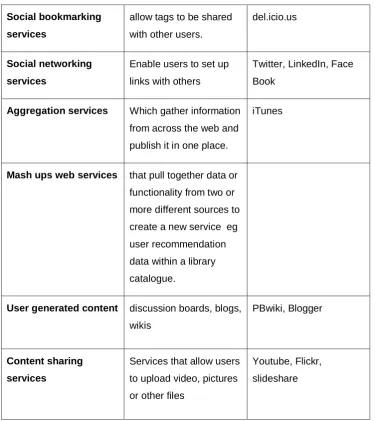
[image:3.595.50.426.364.785.2]Categorising web 2.0 tools and services
Table 1 below shows how web 2.0 tools and services can be grouped in 6 different categories. However
caution is needed with such categorisation as some of the tools fit into more than one category. For instance
Twitter, the microblogging site, is an example of user generated content, as participants send short
messages to the Twitter service which are published for others to view. However it also has features of a
social networking service, where users can build up a network of people that they follow.
Social bookmarking
services
allow tags to be shared
with other users.
del.icio.us
Social networking
services
Enable users to set up
links with others
Twitter, LinkedIn, Face
Book
Aggregation services Which gather information
from across the web and
publish it in one place.
iTunes
Mash ups web services that pull together data or
functionality from two or
more different sources to
create a new service eg
user recommendation
data within a library
catalogue.
User generated content discussion boards, blogs,
wikis
PBwiki, Blogger
Content sharing
services
Services that allow users
to upload video, pictures
or other files
Youtube, Flickr,
Syndication A service which allows
users to get files
downloaded (most
typically sound file)s to
their computer when the
user has signed up for
the feed.
iTunes,
Associated with web 2.0 is a set of new concepts which have entered into our 21st century language eg
podcasts, blogs, wiki, tag (a short usually one word, label which describes a posting), folksonomy (a system
of classification derived from the practice of collaboratively creating and managing tags to annotate and
categorize content).
Thus web 2.0 is a radically different way of generating, storing and accessing information. In addition the
information being created and shared can be radically different from traditional print based media in that it
can be rich in pictures, video and sound.
Possibilities of web 2.0 in learning and teaching
The advent of web 2.0 has presented many possibilities for learning and teaching. Crook has identified three
key motivators or enablers for this change; firstly because as young people are active users of the medium
they will be familiar with the ways the medium operates (p.28). Secondly he argues that there is a match between web 2.0 practices and dominant policies on the goverment‟s agenda in terms of the being able to
participate in the knowledge economy, being able to engage in lifelong learning in a fluid skills market, and fitting with DfES‟ Harnessing Technology Strategy 2005, including personalisation of learning and
encouragement for group work. Finally he talks of web 2.0 fitting with what is known about learning theory in
that it lends to design of activity based learning tasks based on constructivist principles (p.31).
Tensions when using web 2.0 in learning and teaching
However alongside these possibilities there are a number of tensions which teachers and learners must
navigate when adopting web 2.0 tools. The most comprehensive discussion of tensions is provided by
Crook (2008) who lists 11 different ways in which web 2.0 practices challenge HE teaching and learning. I have summarised Crook‟s list below in the order that he presents them and using some of the labels (eg
walled garden) that he uses. After outlining each tension key questions suggested by each tension are
proposed and these questions will form basis for an empirical study which is related to this paper.
1. Teaching and learning; a learner centred approach is a dominant feature of teaching and learning
practices using web 2.0 tools and this requires teachers to have skills in managing these sorts of
learner centred activity (such as orchestrating and supporting independent research (p.35)).
What are the barriers for teachers in terms of learner centred design? Are they related to
2.0 tools)? Do teachers feel that these sorts of activities undermine their authority or are
hard to control?
2. Walled garden versus open areas – A key feature of the web is that it is uncensored and open medium. For educational practices this raises issues and practical questions. Should students‟ work
be made available to the wider world? Without this the key feature of web is not present. However making students‟ work public clearly raises issues of duty of care and managing productive
exchanges and of reputation as well as debates about censorship. There is a trade off with
authenticity provided by a wider sense of audience and the potential for exchanges on open internet
compared to security and control of VLE. (p.37). This tension was also identified by Bridges (2000).
How do teachers negotiate the tension between authenticity or learning activities which
occur on the web compared to their responsibilities to protect their students and the institution‟s reputation?
3. Private learning versus individual learning. Crook discusses the focus on collaboration that web 2.0
tools afford and contrasts these with the personalisation agenda which is currently being promoted in
schools, arguing that personalisation implies that students should have the choice about working in
groups. In addition the form that assessment takes in the school sector is generally individualised so
this also shapes the adoption of group work activities.
Does use of web 2.0 tools imply increased use of group work through the web 2.0‟s
opportunities for collaboration or can web 2.0 learning activities be individually managed and
assessed?
How do teachers manage and assess group work?
What is lost as synchronous face to face aspects of learning move online? For example
intimacy, pace, rhythm, and flow. How do teachers feel about this?
4. Digital natives/digital divide issues. There are two aspects to this tension outlined by Crook, firstly the familiar discussion of students‟ access to the technological tools and skills. The second aspect to this tension is the contrast between the skills of the students with the skills of the teacher.
However this is not a focus of this study which is concerned with the experiences of teachers who
are early adopters in the take up of technology. However the extent to which teachers expect
students to have internet access at home and how this affects the way they plan activities may affect
how they design an activity..
5. Risks of antisocial behaviour on the web eg cyber bullying and requirements and importance for
safeguarding in schools.
Questions that arise include how do teachers manage their responsibilities to students‟
safety?
6. Cutting and pasting culture – Dohn (2008 p.658) identifies that the activity of cutting and pasting is part of internet web 2.0 practices . Crook extends cutting and pasting to other forms of digital
amalgamation such as mashups (for instance where a Google map is incorporated into another web
tension that arises here is teaching students about using other people‟s materials creatively and
within academic (and legal) codes of acceptability.
How do teachers manage plagiarism versus creative use of others‟ work?
Are there any new ways of working that refine academic learning practices eg stronger
emphasis on teaching about provenance, or using activities which involve creatively
bricolage?
7. Permanence of web contributions – the fact that things posted to the web can remain there in
perpetuity leds to a number or tensions. For the students there is a question about their awareness of this level of exposure and whether it is the teachers‟ responsibility to make this clear to the student? In addition it raises the question of the extent to which this level of exposure inhibits students‟ contributions and how teachers manage this reluctance? There are overlaps between the
second tension identified above in that the reputation of individuals and the institution are implicated
by the permanent nature of web postings.
How do institutions understand their role and responsibilities in relation to material published
on the internet?
8. Print literacy versus digital literacy Crook discusses the nature of the different medium results in
different constraints and affordances. Kres argues for the importance of multimodality or ability to
express ideas across a wide range of representational systems and says digital literacy is about
having confidence in reading these systems (p.43). However Crook argues that reading and writing
provide considerable cognitive impact and that these skills (of reading and writing) in traditional print
form should not be devalued by overly promoting new digital literacies.
How do teachers cultivate fluency and sensitivity in new forms of expression whist at the
same time protecting the special potency of print literacy?
How are skills for digital literacy being taught?
9. Serial or parallel processing. Crook argues that academia values linear forms of reasoning based on
language rather than the new modes of analysis based on more informal, pattern-based methods of
reading such as folksonomies and tag clouds He talks of a loss of formalisations and taxonomies in
web 2.0 world (p.45).
How do teachers relate to informal systems of data organisation characterised by personal
tagging and folksonomies?
10. Successive attention versus simultaneous attention. He argues that multitasking is a phenomena
encouraged by technological services (eg MSN) and that students appear to have higher rating on
distractibility if they spend time on MSN (p.45). However this is quite contrary to the sustained focus
on material expected of study.
Hence how do teachers negotiate the tension between the sustained way of working
Have teachers found any value in the „volatile exploration‟ that occurs when students are
multitasking with MSN, social networks etc.?
11. Authorised knowledge versus distributed knowledge; Web 2.0 presents a very different way of
producing and validating knowledge. The ease with which one can publish on the web and wide
geographic and demographic reach that the web facilitates enables a more democratic form of knowledge production and validation. Crook outlines three points based on Keen‟s arguments of the „cult of the amateur‟ (2007 in Crook 2008 p.46) against the effect that web 2.0 has had on knowledge
promotion and publication of cultural knowledge. Firstly that contributions on the web2.0 are
dominated by offerings that are trivial or narcissistic. Secondly that the knowledge discussed on web
2.0 services (eg blogosphere) are poorly evidenced so make it hard for the read to make a
judgement on the validity of the knowledge being presented. And thirdly that the quality control
mechanisms of print are missing with the web. In addition Crook identifies additional problems with
the value of knowledge available through web 2.0 services that is that they are hard to reference
precisely eg YouTube video and they do not have persistence (URLS out of date etc).
Therefore a number of questions arise surrounding students‟ digital literacy (finding and judging and
referencing web 2.0 materials).
How do students judge the authority of sources when researching in a web 2.0
environment? And how do teachers address the skills of inquiry required to make such
judgements? (p.48)
Where does the responsibility for developing the critical and confident attitude to
understanding Web 2.0 knowledge reside with students, teachers, librarians or study skills
tutors?
Conclusion
The world has changed radically with the invention of the web and that change was accelerated through the
services known as web 2.0. Whilst the paper has identified some powerful drivers for uptake, it has also
described a considerable number of tensions that arise for teachers and learners when using these tools.
This paper is part of some preliminary work undertaken to explore the how teachers in HE are negotiating
these tensions, which aims to understand the range of skills required by teachers using web 2.0 tools in their
References
Berners-Lee, T. (2006). in interview with Scott Langham. Retrieved 12 December 2008, from
http://www.ibm.com/developerworks/podcast/dwi/cm-int082206txt.html
Bridges, D. (2000). Back to the Future: the higher education curriculum in the 21st century.
Cambridge Journal of Education, 30(1), 37-55.
Committee of Inquiry into the Changing Learner Experience. (2009). Higher Education in a Web 2.0 World: Committee of Inquiry into the Changing Learner Experience.
Conole, G., Laat, M. d., Dillon, T., & Darby, J. (2006). LXP Student experiences of technologies Final report JISC.
Cope, B., & Kalantzis, M. (2008). Ubiquitous Learning: An Agenda for Educational Transformation.
Paper presented at the Proceedings of the 6th Networked Learning, Greece.
Creanor, L., Tinder, K., Gowan, D., & Howells, C. (2006). LEX Learner Experience of E-learning: Open Learning and Glasgow Caledonian University.
Crook, C. (2008). Web 2.0 technologies for learning: The current landscape – opportunities,
challenges and tensions: Becta.
Dohn, N. B. (2008). Knowledge 2.0 - tensions and challenges for education. Paper presented at the Proceedings of the 6th International Conference on Networked Learning.
Jones, C. (2008). Infrastructures, institutions and networked learning. Paper presented at the Proceedings of the 6th International Conference on Networked Learning.
Land, R., & Bayne, S. (2008). Social technologies in higher education: Authorship, subjectivity and temporality. Paper presented at the Proceedings of the 6th International Conference on Networked Learning
Spire. (2007). SPIRE Project – Results and analysis of Web 2.0 services survey. Retrieved 12 December 2008, from