Multiple-interval timing in rats: Performance on two-valued
mixed fixed-interval schedules
J.S. Whitaker, C.F. Lowe, & J.H. Wearden
University of Huddersfield, University of Wales, Bangor, and University of
Manchester, U.K.
Suggested running head: Mixed FI performance in rats
Address for editorial correspondence: J.H. Wearden, Department of
Psychology, Manchester University, Manchester, M13 9PL, U.K. email:
Abstract
Three experiments studied timing in rats on two-valued mixed-FI schedules,
with equally probable components, FI S and FI L. When the L/S ratio was
greater than 4, two distinct response peaks appeared close to FI S and L, and
data could be well-fitted by the sum of 2 Gaussian curves. When the L/S ratio
was less than 4, only one response peak was visible, but nonlinear regression
usually identified separate sources of behavioral control, by FI S and FI L,
although control by FI L dominated. The data were used to test ideas derived
from Scalar Expectancy Theory (SET), the Behavioral Theory of Timing
For more than 60 years, since its development by Skinner (1938), the
fixed-interval (FI) schedule of reinforcement has been used in the study of
temporal control in animals. On a simple FI schedule, the first response
occurring t s after the previous reinforcer delivery is itself reinforced, and this
reinforcer delivery starts the next interval of the schedule. After a period of
training, animals exhibit temporal control of responding, in the sense that their
responding varies markedly as a function of elapsed time in the interval.
Reinforcer delivery initiates a post-reinforcement pause (Lowe, Harzem, &
Spencer, 1979), and when the pause finishes, subsequent responding either
gradually accelerates to reach its maximum rate just before the next reinforcer
delivery (Dews, 1978), or proceeds at a high steady rate until reinforcer
delivery (Schneider, 1969).
When data from a number of intervals of FI are aggregated together,
average response rate increases as a function of elapsed time in the interval
in almost all animal species tested (Lejeune & Wearden, 1991), including
mice, fish, and turtles, as well as the more conventional rats and pigeons.
This response rate increase usually takes the form of the left half of a
Gaussian curve with the peak located at the FI value (Lejeune & Wearden,
1991).
Although originally developed within the behavior-analytic framework of
emphasizing relations between observed behavior and imposed
environmental constraints rather than analysis in terms of internal processes,
FI schedules and their variants like the peak-interval procedure (Roberts,
1981; Church, Meck, & Gibbon, 1994) have recently been used extensively to
test theories of timing like Scalar Expectancy Theory (SET: Gibbon, Church, &
Meck, 1984), the Behavioral Theory of Timing (BeT: Killeen & Fetterman,
1988), and an elaboration of ideas similar to those of BeT by Machado (1997),
an account subsequently called the Learning to Time model (LeT: Machado &
Guilhardi, 2000).
One example of the application of ideas derived from SET to simple FI
they analyzed data from different species on FI schedules, and fitted
Gaussian curves to the function relating response rate to elapsed time in the
interval. The spread of the curve, that is, whether response rate grew
gradually throughout the interval or was concentrated at the end of it, could be
measured by the standard deviation of the fitted Gaussian curve, and the
standard deviation can be divided by the mean (effectively the peak location)
of the curve to yield a coefficient of variation statistic. SET requires that
coefficients of variation remain constant as the interval timed varies (this is a
form of the scalar property of variance which gives the theory its name), and
Lejeune and Wearden (1991) found that there was a large duration range
over which this was true for most animal species studied. In addition, the
coefficient of variation, effectively a measure of temporal sensitivity where
lower values indicate higher sensitivity, varied systematically with species,
being lowest in cats, rats, and mice, higher in birds, and highest of all in fish
and turtles.The more complex peak interval procedure has also been used
frequently to test SET, see Church et al. (1994) for only one example among
many.
The present article is concerned with the timing behavior of rats on
single FI schedules but, more interestingly, on mixed FI schedules where the
two FI values making up the mixed schedule are equiprobable. On a mixed FI
schedule with two components, reinforcers are available either after the
shorter value in the mixture, or the longer value, for example, after 30 s or 240
s, as in the present Experiment 1. Stimulus conditions in the interval remain
constant, so at the start of the interval nothing signals to the animal which FI
value is in force, and in our experiments, and most others, the different FI
values are intermixed at random.
Why should performance on mixed FI schedules be of any particular
theoretical interest? Leak and Gibbon (1995, pp. 3-6) provide an initial answer
to this question, principally in terms of potential differences between the
predictions that SET and BeT make about mixed-FI performance. SET
explains timed behavior in terms of an interaction of clock, memory, and
simple FI schedules, the coefficient of variation should remain constant as the
interval timed varies. In the case of mixed FI schedules, the timing of the
intervals in the mixture should also have scalar properties: for example, in
mixed FI 30 s FI 240s, a condition presented in our Experiment 1, the timing
of the 30 s component and the 240 s component should be controlled by a
process with the same coefficient of variation.
In contrast, BeT derives timed behaviors which are
experimentally-observed, such as key pecks and lever presses, from a sequence of
adjunctive states, which are themselves usually unobserved. Transition from
one state to another is governed by pulses from a Poisson pacemaker, but
the scalar property normally found in behavior is reconciled with the principles
of BeT by requiring that the pacemaker rate vary with the rate of
reinforcement (effectively the FI value on simple FI schedules), such that the
number of adjunctive states underlying different intervals remains the same.
So, for example, if the animal goes traverses n states when timing 30 s, it
should also traverse, considerably more slowly, the same n states when
timing 240 s.
When a mixed-FI schedule is used (e.g. mixed FI 30 s FI 240 s), the
number of states traversed in the entire interval presumably reflects the
reinforcement rate in this condition (which is, of course, lower than that
obtaining on FI 30 s alone, but higher than that on FI 240 s alone). The critical
point is that both the shorter FI of the mixture and the longer one are timed by
the same Poisson pacemaker, so the Poisson character of the process should
manifest itself in terms of more precise timing at the longer FI than the shorter
one (e.g. a smaller coefficient of variation for the 240 s component than for
the 30 s one). In general, mixed FI schedules enable the timing of a
consistent duration (e.g. a constant component in the mixture) to be observed
while the other component, and thus the rate of reinforcement, changes. BeT
relates pacemaker rate to the "temporal context" (Beam, Killeen, Bizo, &
Fetterman, 1998) in which the animal finds itself, and it seems, at first sight,
that, in mixed FI schedules, since all stimulus conditions remain constant, the
same. However, as is usual in attempts to distinguish BeT and SET by
"critical" experimental predictions, the situation may not be as clear as it first
appears, as we will discuss later.
Leak and Gibbon (1995) used a number of mixed FI schedules,
including those with two or three component schedules, to evaluate the
relative predictions of SET and BeT, and generally found support for SET,
particularly from their Experiment 3. Our experiments, while relevant to the
SET versus BeT issue, have the broader aim of trying to understand more
generally what factors govern timing on mixed FI schedules with two
components. Some of the issues discussed are similar to those treated by
Leak and Gibbon, for example, how does timing vary when the intervals
making up the mixture are close together or far apart? Others, however, are
rather different in particular our attempts to understand how the contributions
of the components which make up the 2-valued mixed FI schedule are
combined together to produced the behavior observed.
The general problem of timing of behavior on two-valued mixed-FI
schedules is also discussed by Machado (1997), as part of the exposition of a
complex model which deals with performance on a number of timing tasks.
Machado's LeT not only predicts patterns of temporal control on FI-like
schedules, but also deals with the question of how response rates should
change as time passes in the schedule conditions. How our data relate to the
predictions of LeT will be discussed later.
In the present article, we describe data from what was originally
conceived of as a series of 5 experiments, although the studies are grouped
together as 3 separate experiments in the present article to save space. In all
experiments, rats timed either simple FI schedules, or two-valued mixed-FI
schedules where the two components were equiprobable and presented at
random within the experimental session.
Experiment 1 examined data from conditions timing FI 30s and FI 240
components, essentially a test of the principles for distinguishing between
SET and BeT outlined by Leak and Gibbon (1995) in their Figures 1 and 2,
and in an experiment similar to their Experiment 2.
Our Experiment 2 involved conditions where a single component
(either FI 60 s in Experiment 2a or FI 120 s in Experiment 2b) was kept
constant, while the other component in the mixture varied, from values below
the constant component to values above it. This enabled us to examine
performance on schedules where the two FI values were different (e.g. FI 20 s
FI 60 s) or similar (e.g. FI 60 s FI 80 s). Leak and Gibbon (1995) also
addressed the issue of what temporal control looks like from some schedules
of this type.
Finally, Experiment 3 examined performance on schedules where the
shorter component of the mixed FI was constant, while the longer value varied
(Experiment 3a), or vice versa (Experiment 3b).
Although our data have not been published previously, and were
derived from completely normal experimental procedures, they have the
rather unusual characteristic that they were collected more than 20 years ago,
as part of the doctoral work of one of the authors (Whitaker, 1980). This
means that the data predate both the information-processing version of SET
(first published in the early 1980s, e.g., by Gibbon et al., 1984, and Church &
Gibbon, 1982), BeT (Killeen & Fetterman, 1988), and LeT (Machado, 1997)
as well as other recent theories (e.g. Staddon & Higa, 1999). The only
negative consequence of the age of our data is that we do not have some
behavioral measures that might be desirable (e.g. the start-stop-spread
analysis of individual trials, proposed for the first time by Gibbon and Church,
1990, which was used extensively by Leak and Gibbon for the analysis of
their Experiment 3), nor can these more modern measures of performance
now be derived from our data set. On the positive side, what we do have, as
will be seen later, is the most extensive data set known to us on the timing of
multiple intervals by animals, a data set which is not only very orderly, but
Figure 1 about here
Finally, some terminological issues. When we discuss two-valued
mixed FI schedules, we will consistently refer to the lower FI value in the
mixture as FI S and the higher one as FI L: so, for example, we might
consider effects of L/S ratio on timing behavior, as in Experiments 2 and 3.
Leak and Gibbon (1995) refer to mixed-FI schedules as an example of
simultaneous timing. It seems to us that this description carries considerable
surplus meaning, via its implication that the animals are timing more than one
interval at the same time. Some experiments where humans participate
almost certainly involve simultaneous timing in this sense (e.g. Brown & West,
1990; Penney, Gibbon, & Meck, 2000, Experiment 1), but it is less clear that
mixed FI does, or at least always does. Consider the data in the lower panel
of Figure 1, which come from our Experiment 1 (and are similar to data
presented in Leak & Gibbon, 1995, Figure 3, p. 6). Here, FI S is 30 s, FI L 240
s. At some elapsed time in the interval considerably greater than FI S (100 s,
say), it is not necessarily the case that the animal is doing anything other than
timing FI L, as the elapsed time is presumably highly discriminable from FI S,
which has long passed. On the other hand, early in the interval, it is possible
(although not logically necessary) that the animal is timing both FI S and FI L
(e.g. at an elapsed time of 10 s), so timing may sometimes be simultaneous
and sometimes not. We will just refer to timing on mixed FI schedules as
multiple timing, without any implication of simultaneity. What the implications
of this possible non-simultaneity of timing are for predictions about behavior
will be discussed later.
Experiment 1
Experiment 1 is the simplest in our series. Rats received FI 30 s alone,
FI 240 s alone, and mixed FI 30 s FI 240 s, with both intervals equiprobable,
and randomly intermixed in the experimental session, as they were in all the
experiments we report. We were interested in a number of issues. One was
manifested in our single FI conditions. The second was what timing on the
mixed schedule would look like: in particular, would the timing of the FI S and
FI L also show scalar properties? If the scalar property was found in the mixed
condition then, as mentioned above, this result is consistent with SET but
contrary to the predictions of BeT which would require more precise timing
(i.e. a lower coefficient of variation) at FI L than FI S.
Method
Animals
Four experimentally-naïve male hooded rats were housed individually
with ad lib access to water. They were maintained at 80% of the weight
reached in the last 5 days of free feeding, and were fed supplementary food
approximately 1 hour after the experimental session to maintain the 80%
weight.
Apparatus
Standard LeHigh Valley experimental chambers (model 142-25),
enclosed in a sound-resistant housing (ambient noise level 60 dB) were used.
Only the right lever was operative. Reinforcers were 45 mg Noyes pellets. The
experiment was controlled by a Data General NOVA computer.
Procedure
In the first session the rats were trained to lever-press by successive
approximation, then allowed to obtain 60 reinforcers, with each lever-press
reinforced. Then they were exposed to FI 240 s (29 to 32 sessions for
different rats), FI 30 s (28 or 29 sessions), mixed FI 30 s FI 240 s (50 to 53
sessions), then re-exposed to FI 240 s (32 to 34 sessions), then finally FI 30 s
(23 to 26 sessions). Sessions normally lasted until 60 reinforcers were
obtained, although they were sometimes longer.
Data were recorded in the form of response rate versus elapsed time in
the interval. The total interval was always divided in 20 equal-length bins, so
the bins were 1.5-s long for FI 30 s, and 12-s long for FI 240 s. The data of
interest from the mixed FI condition come from intervals where responding
according to FI L was reinforced, and bin-length in these cases was also 12 s.
Data were averaged over rats, and over the two determinations of FI 30 s and
FI 240 s, and were taken from the last 3 sessions of exposure to the schedule
in force. Figure 1 shows the response rates versus elapsed time in the interval
for FI 30 s (upper panel), FI 240 s (center panel), and the FI 240 s intervals of
the mixed FI (bottom panel).
Inspection of the data from the single FI conditions (upper 2 panels of
Figure 1) suggests that responding increased on average throughout the
interval, from zero just after food to some maximum rate just before the time
of food delivery. In the mixed FI condition, responding rose towards a peak
located somewhere close to FI S, then declined, only to increase again to
reach a peak at FI L.
The panels of Figure 1 also show fitted curves. The curves are
Gaussian curves fitted to data by the nonlinear regression program of SPSS
10. A Gaussian curve is characterized by two parameters, its mean (or peak
location), m, and its standard deviation, sigma, so we will in general refer to
this Gaussian function as G(m, sigma). To fit what is in fact a probability
density function to response rates, G must be multiplied by some scaling
constant, K.
When fitting Gaussian curves to the kind of data we have, a number of
decisions need to be made about peak location. One possibility is to force m
to be at the FI value in single FI schedules, so the only parameter derived
from the fit to data from these schedules, apart from the scaling parameter, K,
is sigma, the standard deviation. Alternatively, the peak location, m, could
itself be a parameter. When fitting data from mixed-FI schedules (for example
data like those in the lower panel of Figure 1), the obvious solution is to sum
KS*G(mS, sigmaS) + KL*G(mL, sigmaL)
where KS and KL are scaling constants appropriate to the contribution
of FI S and FI L to the response function, mS, and mL are peak locations
appropriate to FI S and FI L, and sigmaS, sigmaL are standard deviations for
the two Gaussian curves. This is essentially the method we used, with one
proviso: for single FI schedules, we always forced m to be the FI value, and
for fits to mixed FI schedules, we always forced the peak of the upper curve to
be at FI L, although the position of the lower peak could vary as a parameter.
The main reason this was done is that time values more than a few seconds
higher than the FI value (or FI L on mixed FI schedules) were never
experienced by the animal, so if such values are found by nonlinear
regression it is impossible to interpret theoretically. In addition, the worst fit to
any data sample we analyzed had an r2 value of .96, so our decision did not
do violence to the data, as will be obvious from inspection of data points and
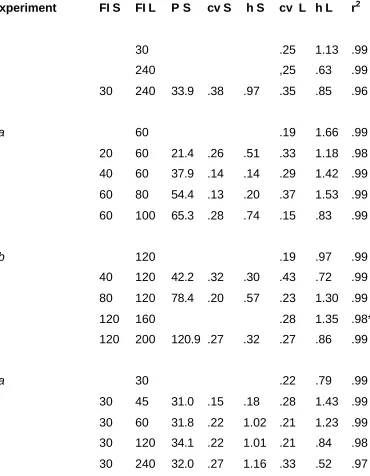
curves both in Figure 1, and presented subsequently. Table 1 shows the
parameter values from the curve fits to the data in Figure 1.
Table 1 about here
Consider first a comparison of the single FI schedules, FI 30 s and FI
240 s. The fitted Gaussian curve accounted for 99% of data variance, and the
coefficient of variation (sigma derived from the curve fit divided by the FI
value) was .25 for both schedules, supporting the scalar property in timing of
single FI schedules, even when absolute duration timed varied 8-fold. Also
shown are the peak heights derived from the curve fits, which correspond to
the predicted response rate at the peak of the Gaussian curve. Peak
response rate was nearly twice as high on FI 30 s than on FI 240 s, consistent
with the fact that the rate of reinforcement is 8 times greater in the former
case than the latter.
Consider next parameters derived from the fit to data from the mixed FI
FI was close to FI S (33.9 s compared to 30 s), and the coefficients of
variation for the two Gaussian curves were .38 (FI S) and .35 (FI L). Peak
heights from the two Gaussian curves were more similar than for the single FI
conditions, although the peak was slightly higher at FI S than at FI L. The
function produced by summing two Gaussian curves fitted data well (r2 = .96).
Our data found scalar timing of behavior (i.e. constant coefficient of
variation) in the two single FI schedules. This is consistent with both SET and
BeT, as BeT produces the result by essentially varying pacemaker rate
between the FI 30-s and FI 240-s schedules. In the mixed FI schedules, the
relative constancy of the coefficient of variation for FI S and FI L appears
more consistent with the predictions of SET than with those of BeT, which
would predict that the longer FI component in the mixed schedule would timed
markedly more precisely than the shorter one. In fact, FI L was timed slightly
more precisely than FI S, consistent with the direction of effect predicted by
BeT. Exactly what the quantitative predictions of BeT might be in these cases
will be considered in detail later.
Leak and Gibbon (1995) presented only one data set (their Figure 3, p.
3, which came from an unpublished study not fully described in their article)
which used a 2-valued mixed FI with a large L/S ratio (12:1, from mixed FI 10
s FI 120 s), and their data resemble the results we obtained from mixed FI 30
s FI 240 s in all respects. Two peaks were clearly visible in the response rate
versus time in the interval function obtained from the FI 120 s component of
the mixed FI, with a period of low-rate responding between them; the peaks
appeared to be centered approximately at FI S and FI L (although Leak and
Gibbon did not present any quantitative analysis). The peak height at FI S
was higher than that at FI L, but only about 50% higher.
Our Experiment 2 uses a more complex set of schedules, and
consisted of two sub-experiments which are reported together as they were
procedurally and conceptually almost identical. In Experiment 2a, an FI 60-s
schedule was presented alone, or as a component of mixed FI. In the mixed
100 s, producing L/S ratios of 3, 1.5, 1.33, and 1.67. In Experiment 2b, all FI
values were twice as long, and the constant component was FI 120 s,
presented either alone, or in a mixed schedule with values of 40, 80, 160, and
200 s, which produced the same L/S ratios as in Experiment 2a.
Leak and Gibbon (1995) discuss the conditions in which two distinct
response peaks (like those shown in the bottom panel of our Figure 1) will be
obtained from mixed FI schedules in terms of the L/S ratio. Catania and
Reynolds (1968) reported double peaks when the L/S ratio was 4:1 or more,
but not when it was less, and Leak and Gibbon (1995) reported double peaks
when the ratio was 8:1 but not when it was 2.5:1. However, these conclusions
seem to be based on visual inspection of the response rate versus elapsed
time in the interval functions rather than quantitative analysis. In our
Experiment 2, we allowed the nonlinear regression program to decide whether
there were separate contributions to the response function observed on the
mixed-FI schedule from FI S and FI L, rather than simple visual inspection. As
will be seen later, whenever there were two peaks obvious on visual
inspection, the nonlinear regression program identified them. In addition,
however, the program sometimes indicated contributions from both FI S and
FI L on mixed schedules with small L/S ratios.
Experiment 2
Method
Animals
8 male hooded rats were arbitrarily allocated to two groups of 4. One
group served in Experiment 2a, one in Experiment 2b. Deprivation and
housing conditions were as Experiment 1.
Apparatus
As Experiment 1.
In Experiment 2a, the constant component of the mixed FI schedules
was FI 60 s, which was also presented alone. In the first session, the rats
received lever-press training, and then obtained 60 reinforcers, with each
response reinforced. The rats were then exposed to FI 60 s (70 to 74
sessions), mixed FI 20-s FI 60-s (17 to 20 sessions), mixed FI 60-s FI 100-s
(18 or 19 sessions), mixed FI 40 s FI 60 s (16 to 20 sessions), and finally
mixed FI 60 s FI 80 s (16 to 19 sessions). Experiment 2b was almost identical,
except that all schedule values were twice as long. After initial lever-press
training, the rats received FI 120 s (72 to 75 sessions), mixed FI 120 s FI 200
s (18 to 20 sessions), mixed FI 40 s FI 120 s (23 or 24 sessions), mixed FI
120 s FI 160 s (32 to 36 sessions), and mixed FI 80 s FI 120 s (17 to 19
sessions).
Figures 2 and 3 about here
Results and Discussion
Figure 2 shows response rates versus elapsed time in the interval
from the mixed FI schedules of Experiment 2a, and Figure 3 shows the same
data from Experiment 2b. To improve the layout of the Figures, data from the
single FI schedules (FI 60 s for Experiment 2a, FI 120 s for Experiment 2b)
are not shown, but these were virtually identical in form to data from the single
FI conditions of Experiment 1 (shown in the upper 2 panels of Figure 1).
Consider first data from Experiment 2a (Figure 2). Visual inspection of
the data suggests that only the mixed FI 20-s FI 60-s schedule generated two
obvious response peaks, but in fact the nonlinear regression program found
that all the response functions could be well fitted by the sum of 2 Gaussian
curves, even that from mixed FI 60 s FI 80 s, where the L/S ratio was 1.33. All
2-Gaussian fits were well-adjusted to the data (r2 either .98 or .99 in all
cases), and parameter values are shown in Table 1. The lower peak of the
2-Gaussian fit was allowed to vary, and Table 1 shows that it was always within
contributions of FI S and FI L were combined when the L/S ratio varied will be
considered further below.
Figure 3 shows analogous data from Experiment 2b. Once again,
visual inspection identified two peaks when the L/S was large (mixed FI 40 s
FI 120 s), although the regression produced two peak fits for two of the other
three cases: only the mixed FI 120 s FI 160s condition could not be fitted by
the sum of two Gaussian curves, and here a single curve with a peak at 160 s
was used. Table 1 shows parameter values from the fits and, once again, r2
values were high (.98 or .99), and the lower peak which was allowed to vary
was within 10% of FI S.
Our data were similar to those of Leak and Gibbon (1995) in that when
the L/S ratio was small (less than 3 in our case) two response peaks were not
clearly visible on inspection of response functions. However, the fact that the
nonlinear regression procedure identified two underlying sources of temporal
control in all but one case (mixed FI 120 s FI 160 s) enables us to examine
more precisely just what does happen when the L/S ratio is low in mixed FI
schedules. The critical measure appears to be the peak height (i.e. the peak
of responding predicted by the Gaussian curves).
Consider first data from Experiment 2a. In Figure 2, all the data were
well-fitted by the 2-Gaussian function, but the peak heights reflect the relative
contributions of the curve centered around FI S and that centered on FI L. In
Experiment 1, with an 8:1 L/S ratio, peak height was higher for the FI S
component than for the FI L one, but when the L/S ratio was small, the
reverse was the case, and the peak at FI S was always lower than that at FI
L. When the L/S ratio was particularly small (1.33 and 1.5: from the mixed FI
40 s FI 60 s and mixed FI 60 s FI 80 s conditions) the peak height associated
with FI S component was also particularly small, and the peak height at FI L
was much greater (more than 10 times as great in the 40/60 case).
Data from Experiment 2b (Figure 3 and Table 1) showed an almost
as those at FI S, and even data from the mixed FI 120 s FI 160 s condition
followed this same rule trivially, as the peak at FI S disappeared altogether,
leaving that at FI L infinitely greater.
In general, then, when the L/S ratio was small on mixed FI (less than 3
in our studies), not only did the two-peak form of the response function
disappear, even though the nonlinear regression program usually identified
separate sources of control by FI S and FI L, but the balance of control of
responding shifted away from FI S towards FI L, with at a limit control by FI L
alone.
Our final study, Experiment 3, consists of 2 sub-experiments, which
differed procedurally but had the common theme of keeping one component
of the 2-valued mixed-FI schedule constant, while varying the other. In
Experiment 3a, an FI 30-s schedule was either presented alone, or as FI S,
the lower component of the mixed schedule, while FI L varied over values
from 45 s to 240 s. In Experiment 3b, FI L was fixed at FI 300 s (although this
value was never presented alone), and FI S varied over the range from 15 s
to 75 s.
Experiment 3
Method
Animals
8 male hooded rats were arbitrarily allocated to either Experiment 3a (4
rats) or Experiment 3b (4 rats).
Apparatus
Experiment 3a: Four LeHigh Valley RTC-028 operant chambers were
used, all other details were as Experiment 1. Experiment 3b: all details were
Procedure
Experiment 3a: After initial lever-press training, rats received FI 30 s
(30 sessions), mixed FI 30 s FI 120 s (25 sessions), mixed FI 30 s FI 60 s (25
sessions), mixed FI 30 s FI 240 s (25 sessions), and mixed FI 30 s FI 45 s (30
sessions). Experiment 3b: After initial lever-press training, rats received the
following mixed FI schedules: mixed FI 30 s FI 300 s (30 sessions), mixed FI
60 s FI 300 s (25 sessions), mixed FI 15 s FI 300 s (25 sessions), mixed FI 45
s FI 300 s (25 sessions), mixed FI 15 s FI 300 s (25 sessions), and mixed FI
60 s FI 300 s (25 sessions).
Results and Discussion
Figures 4 and 5 about here
Figure 4 shows response rate versus elapsed time in the trial data from
the longer intervals of the mixed FI conditions of Experiment 3a. Data from the
single FI 30-s schedule are not shown, but were almost identical in form to
those shown in the upper panel of Figure 1. Inspection of the data suggests
that two response peaks were clearly present in all conditions except mixed FI
30 s FI 45 s, and that the peak of the lower response function was located
close to FI S, 30 s. Table 1 shows results from the nonlinear regression
analysis. As for Experiment 2a, the program found 2-Gaussian fits for data
from all the mixed-FI schedules, including mixed FI 30 s FI 45 s. Inspection of
the parameter values shows that (a) data were fitted well by the Gaussian
(single FI) or 2-Gaussian (mixed FI) functions (smallest r2 = .97), (b) the
position of the lower response peak was close to FI S, 30 s, (c) peak heights
for FI S were lower than those for FI L when the L/S ratio was less than 4
(with data from the FI 30-s FI 45-s condition showing a particularly small peak
height at FI S), but higher when the L/S ratio was 4 and 8.
Figure 5 shows response rate versus elapsed time functions from the
longer components of the mixed FI schedules of Experiment 3b. Data from
the repetitions of the mixed-FI 15-s FI 300-s condition were averaged
present in all cases. Table 1 shows the parameter values from the 2-Gaussian
fits that the nonlinear regression program found. Examination of the
parameters showed that (a) all data were well-fitted by the 2-Gaussian
function (r2 either .96 or .97), (b) the position of the lower peak was close to FI
S (although consistently about 5 to 8 s above it), (c) peak heights for FI S
were higher than for FI L in all cases but one (mixed FI 15 s FI 300s), but
were often similar in spite of the considerable difference between FI S and FI
L.
Figures 6 and 7 about here
Across-Experiment Analyses
As in Leak and Gibbon (1995) some trends in our data are seen most
clearly when results from the different experiments are displayed together.
Figures 6, 7, and 8 show some of these.
Consider first peak location, and peak height. The upper panel of
Figure 6 shows the location of the lower peak of the 2-Gaussian function fitted
to data from the different mixed FI schedules, determined by the nonlinear
regression program, as a function of the FI value that was FI S. Obviously the
peaks located by the program tracked the FI value closely. The line shown
comes from linear regression of peak location against FI value. The
(significant) slope was .98, the (non-significant) intercept 3.63 s, and r2 was
.98, confirming the impression that the peak location was located almost
exactly at FI S, over the three experiments as a whole.
The lower panel of Figure 6 summarizes data on the relative peak
heights from FI S and FI L in the different mixed FI schedules. An
across-experiment analysis shows clearly that the relative peak heights at FI S and FI
L were importantly determined by L/S ratio. When this was large (i.e. >= 4,
thus the FI schedules making up the mixed FI were very different), FI S had a
was less than 4, all 8 instances produced greater peak height at FI L, and the
differences were sometimes very large, as discussed above.
The data in the lower part of Figure 6 are particularly relevant to
Machado's (1997) LeT account of timing. LeT is too complex to be anything
other than sketched here, but like BeT it derives measured behavior from the
proposed existence of a sequence of underlying behavioral states, which
occur in sequence. Different states can have different levels of activation at
any elapsed time since a "time marker" (e.g. the food delivery at the start of
an interval of FI), and each state has some degree of association with the
measured operant response, so controls its presence or absence. In LeT,
states later in the sequence on FI-like schedules have higher associative
strength (i.e. control the operant response more strongly) than earlier ones,
and a consequence of this is that the peak response rate at FI S (to use our
terminology) will always be lower than that on FI L on mixed FI schedules,
even when FI S and FI L are equiprobable. The data in Figure 6 show that this
prediction was almost always false when the L/S ratio was greater than 4, but
was true when it was less. As Machado points out himself, the principles of
LeT lead inevitably to the peak rate at FI L being greater than at FI S, and the
reverse case (normal in our data when the L/S ratio was greater than 4)
cannot be simulated by any simple manipulation of the parameters of the
model.
Figures 7 and 8 are concerned with variability of responding around the
peaks, measured by coefficient of variation. Figure 7 examines the
coefficients of variation from the curve fits in two different ways. In the upper
panel, coefficients of variation from all the conditions in the 3 experiments are
plotted against the rate of reinforcement that the schedules provided overall
(i.e. from the mixed schedules this was the rate of reinforcement on average,
not that associated with each separate FI value). Data are separated
according to whether they come from single FI conditions or mixed FI. Two
questions were of interest. Firstly, were coefficients of variation from single
and mixed FI conditions systematically different? Experiment 1 found higher
the two components when presented alone, suggesting that multiple timing
was associated with more timing variability than timing of a single interval.
The upper panel of Figure 7 shows, however, that this was not generally true.
It further suggests that the coefficient of variation was insensitive to the rate of
reinforcement for the schedule: although some variability between conditions
was evident, there was little to suggest systematic change in coefficient of
variation as the rate of reinforcement changed.
Why is rate of reinforcement important? The answer comes from BeT,
as according to this theory, the rate of adjunctive behaviors is determined by
the reinforcement rate in the experimental "context" (a position for which
Lejeune, Cornet, Ferreira, & Wearden, 1998, found some direct evidence), so
higher rates of reinforcement in the single FI or mixed FI schedule, should,
other things being equal, lead to more adjunctive states than lower rates of
reinforcement, and thus more precise timing in terms of coefficient of
variation. However, the upper panel of Figure 7 found no obvious effect of
reinforcement rate on coefficient of variation.
The effect of reinforcement rate was examined another way, as shown
in the lower panel of Figure 7 which presents selected coefficients of variation,
with all data coming from constant components of mixed FI schedules. Recall
that Experiments 2a, 2b, 3a, and 3b all involved one component of the mixed
FI remaining constant while others changed in various ways. Suppose that we
take the coefficient of variation from the constant component, and plot it
against the rate of reinforcement for the condition from which it comes. The
lower panel of Figure 7 shows the results when this is done. In some cases,
like Experiment 2a and Experiment 3a, the changes of schedule across
conditions produced marked changes in reinforcement rate: in the case of
Experiment 3a the change was nearly 5-fold. According to SET, such a
change in rate of reinforcement rate should have no effect overall, whereas
according to BeT, coefficients of variation should decrease as the rate of
reinforcement increases. Data from Experiment 3a do show declining
coefficient of variation with increases in reinforcement rate, but data from
highest reinforcement rate (Experiments 2a and 2b) or unsystematic
fluctuation (Experiment 3b, although the variation in reinforcement rate was
very small in this experiment). Overall, the results were mixed, but there was
little which clearly supports the assertion of a marked change in coefficient of
variation with changing rates of reinforcement.
Figure 8 about here
However, although examination of effects of reinforcement rate on
coefficient of variation offered little support for BeT overall, Figure 7 used data
from all the experiments, and thus aggregated results from mixed-FI
schedules with low L/S ratios, and those with longer ones, whereas a general
theme of our article is that the contributions of the two FI values to responding
on mixed FI is different in the two cases. In general, BeT requires more
precise timing at FI L than FI S, for any L/S pair making up a mixed-FI
schedule, as the constant rate of reinforcement in the situation will result in
more adjunctive states in the FI L region than in the FI S one. In general, then,
the coefficient of variation at FI L should be smaller than at FI S. SET, on the
other hand, requires the coefficients of variation to be the same, or at least to
vary unsystematically.
Figure 8 shows the ratios of the coefficients of variation for the FI L and
FI S curves, plotted against L/S ratio. Here, coefficient of variation values less
than 1.0 indicate that timing was more precise at FI L than FI S, values
greater than 1.0 the reverse. The data were divided into those coming from
mixed-FI schedules with L/S ratios greater than 4 (upper panel), and those
with L/S ratios less than 4 (lower panel). In the former case, most values were
less than 1.0 (average .80), supporting BeT's prediction of more precise
timing at FI L, although the effect of L/S ratio did not appear to be systematic.
On the other hand, when the L/S ratio was small, the reverse was generally
true, and in most mixed-FI schedules, FI S was timed more precisely (average
ratio 1.44). Once, again, the data provide another example of behavioral
differences between mixed-FI schedules with small and larger L/S ratios. If
then the average coefficient of variation ratio was 1.14, supportive of slightly
more precise timing at the shorter FI value of the mixed schedule.
General Discussion
Our results might be summarized by considering an attempt to predict
performance on the longer intervals of some mixed FI schedule mixed FI S FI
L. If the L/S ratio was greater than about 4, then two peaks in the response
function (one located at or near to FI S, the other located at FI L) would be
obvious on visual inspection. The response curves around FI S and FI L
would be of approximately Gaussian shape, with a coefficient of variation that
was slightly lower for FI L than for FI S, and peak height at FI S would be
greater (but sometimes not much greater) than that at FI L. On the other
hand, if the L/S ratio was less than 4, visual inspection would not usually
locate two distinct response peaks, although sources of control of responding
by the separate FI S and FI L components would usually be identified by
nonlinear regression. When two components were identified, the contribution
of FI S to the overall response function would be smaller, sometimes much
smaller, than that of FI L. Peak height at FI S would usually be a fraction of
that at FI L, and the coefficient of variation of the FI S peak would usually be
smaller than that from FI L.
The dependence of behavior on mixed FI schedules on L/S ratio is not
particularly surprising either logically or on the basis of previous work. As FI L
and FI S become more similar, the animals presumably find it more difficult to
maintain separate sources of temporal control, because of overlap in their
temporal representations of S and L, as discussed by Leak and Gibbon
(1995), who reported a similar effect of L/S ratio (as did Catania & Reynolds,
1968, before them). What is not so obvious a priori, although becomes clearer
in our data, is how the "conflict" between control by FI S and by FI L is
resolved when the L/S ratio is small. It is clear that, in all cases, control is
more powerfully exerted by FI L than FI S. Some evidence for this comes from
the single case we have where 2 response peaks could not be identified
control only by the longer, rather than the shorter, component of the mixed-FI
schedule. In addition, our analysis of peak heights (lower panel of Figure 6)
shows that the peak height at FI S was smaller than that at FI L, when the L/S
ratio was small, and the contribution of FI S to the response pattern on the
longer components of mixed-FI schedules was correspondingly less than that
of FI L in these cases.
In general, data from all our conditions suggest that FI L is in some
senses more "important" than FI S in the mixed-FI schedule. Not only does FI
L dominate in mixed-FI schedules with small L/S ratios, as discussed earlier,
but even in others the relative peak heights of the components also suggest
something similar. For example, in Experiment 1, the peak at FI L (240 s) was
only slightly lower than the peak at FI S (30 s), in spite of the 8-fold difference
in time to reinforcement between them. As is well-known, on aperiodic
reinforcement schedules such as variable-interval (VI) response rate is highly
sensitive to reinforcement rate, and this sensitivity can be embodied in
Herrnstein's equation (Herrnstein, 1970), and related formulations. On VI, it
would be surprising if two VI schedules with an 8-fold ratio of reinforcement
rate supported nearly the same rate of responding, whereas in our mixed-FI
schedules, with large L/S ratios, even disparate schedules produced similar
peak heights.
One way of conceptualizing this effect is to suggest that the peak
height at FI L is higher than it "should be", and the peak height at FI S lower
than it "should be", on considerations of reinforcement rate alone. Why is this?
One explanation for the general "dominance" of FI L in mixed FI schedules
might be a role played by probability, or conditional probability, of
reinforcement at FI S and FI L, rather than just time to reinforcement from the
start of the interval, or reinforcement rate on the schedule overall. On a
two-valued mixed FI schedule, reinforcer delivery at FI S is never certain until it
arrives, whereas reinforcer delivery at FI L sometimes is. For example, at the
start of the interval, the probabilities of reinforcement at FI S and FI L are
equal, but when FI S has been passed, reinforcement at FI L becomes
at FI S and FI L given a certain elapsed time in the interval changes in
different ways for FI S and FI L. Up to the time of FI S, the conditional
probability of reinforcement at both FI S and FI L is the same at 0.5, whereas
after S, the conditional probability of reinforcement at FI S drops to zero,
whereas that at FI L increases to 1.0.
The animal's time discrimination is not of course perfect, so the
conditional probabilities may be blunted to some extent by variability of
temporal representations, but on mixed FI schedules with large L/S ratios,
there will come a time in the interval which is longer than, and discriminable
from, FI S, and at this point the animal can be certain that a reinforcer will be
available at FI L. For example, it would be surprising if times greater than 100
s were not discriminable from 30 s on mixed FI 30 FI 240 s, so if the rat
arrives at such a time, reinforcement at 240 s may be subjectively certain, and
this certainty may boost response rate.
This kind of consideration is similar to ideas from Beam et al. (1998, p.
395), and may explain how BeT can be reconciled with some of the results we
obtained, and some of those obtained by Leak and Gibbon (1995), which
seem at first sight contrary to BeT. For example, if pacemaker rate is
determined by arousal linked to expectancy of reinforcement, then on a
mixed-FI schedule this arousal may change markedly as the interval elapses.
For example, put informally, the animal may begin an interval on a mixed FI
30-s FI 240-s schedule in a high state of arousal (i.e., with high pacemaker
rate), because reinforcement in a fairly short time is a 50% possibility. Later in
the interval (e.g. at 60 or 100 s after the start), arousal falls because the
animal now anticipates food for certain at 240 s into the interval, but this time
is remote from the current elapsed time. So, in general, the assumption that
the rate of the BeT pacemaker will necessarily remain constant on mixed FI
schedules because the "temporal context" remains constant, which is the
basis of Leak and Gibbon's (1995) argument that mixed FI schedules can
Such an argument may also help Machado's (1997) LeT deal with what
for it is the "impossible" situation of a higher peak rate at FI S than FI L. LeT
has a parameter which like BeT's "arousal", governs the rate of transition
between underlying behavioral states and, like BeT, LeT reasonably assumes
that this parameter is constant during an experimental trial. However, as
noted above, this may not be true when the L/S ratio is large on the long
interval of a mixed-FI schedule, at elapsed times that are discriminably above
FI S. Changes in the rate of transition between behavioral states within trials
may also change their subsequent associative strength, and some way might
be found to predict higher peak rates at FI S than FI L. When the L/S ratio is
low, on the other hand, the assumption of constancy of transition rates may
hold, thus the prediction of LeT would be that the peak rate at FI L would be
higher than that at FI S which, as the lower panel of our Figure 6 shows, was
true in all the data sets we analyzed. However, whether LeT can predict the
very large differences in peak height between FI S and FI L found in some of
our conditions remains to be seen.
As our Figure 8 shows, when the L/S ratio was large on mixed FI
schedules, FI L was usually timed slightly more precisely than FI S. BeT
predicts the direction of this effect, but the differences appear to be much
smaller than would be expected on the basis of BeT with constant pacemaker
rate. Beam et al. (1998, p. 392) show that the coefficient of variation of the
response rate function at some time value is given by the square root of 1/(n +
1), where n is the number of adjunctive states in the time period. For a
constant pacemaker rate, n would just increase with FI value, so would be n
for FI 30 s and 8n for FI 240 s. Working out the expected ratio of coefficients
of variation depends on n, but data from Beam et al. (1998) suggest that the
BeT pacemaker has inter-pulse times between 5 s and 20 s. The lower value
would predict a coefficient of variation ratio of .37, for the FI 240-s and FI 30-s
components of mixed FI 30 s FI 240 s, the higher one a value of .44, both
values much less than the value found in data (0.92), but the discrepancy
could be due, as mentioned above, to a change in pacemaker rate part-way
In general therefore, although mixed-FI schedules produce orderly
data, and are important in understanding the way that sources of temporal
control are combined when there is more than one of them, they may not be
as completely clear as tests of the different predictions of timing models as
was supposed by work published even quite recently (e.g. Leak and Gibbon,
1995). In particular if, on long intervals of mixed-FI schedules with a large L/S
ratio, "arousal" induced by expectancy of reinforcement changes within
intervals, then certain findings which seem inconsistent with BeT and LeT
might, in fact, be easily reconcilable with these theories.
SET has been criticised on the grounds that its complex structure
makes it difficult to falsify (Staddon & Higa, 1999; see also Wearden, 1999, for
a similar view from a position much more sympathetic to SET), but if
pacemaker rate (or state transition rate) and the number of adjunctive states
can change in complex ways both within and between conditions (sometimes
so that changes in one can compensate for opposite changes in another, see
Killeen, Hall, & Bizo, 1999, for an example), theories claiming a more
"behavioral" character than SET, such as BeT and LeT, may also be prone to
Table 1
Schedule and parameter values from curve fitting conducted on data from
Experiments 1, 2, and 3. FI S, FI L: upper and lower FI value in mixed-FI schedule (in s), single FI values are given as FI L only. P S: peak location, in s, of fitted Gaussian curve corresponding to FI S. cv S, cv L: coefficients of variation of fitted curves. h S, h L: peak heights (responses/s) of fitted curves.
r2: proportion of variance accounted for by the curve fit.
---Experiment FI S FI L P S cv S h S cv L h L r2
1 30 .25 1.13 .99
240 ,25 .63 .99
30 240 33.9 .38 .97 .35 .85 .96
2a 60 .19 1.66 .99
20 60 21.4 .26 .51 .33 1.18 .98
40 60 37.9 .14 .14 .29 1.42 .99
60 80 54.4 .13 .20 .37 1.53 .99
60 100 65.3 .28 .74 .15 .83 .99
2b 120 .19 .97 .99
40 120 42.2 .32 .30 .43 .72 .99
80 120 78.4 .20 .57 .23 1.30 .99
120 160 .28 1.35 .98*
120 200 120.9 .27 .32 .27 .86 .99
3a 30 .22 .79 .99
30 45 31.0 .15 .18 .28 1.43 .99
30 60 31.8 .22 1.02 .21 1.23 .99
30 120 34.1 .22 1.01 .21 .84 .98
3b 15 300 21.7 .57 .39 .21 .52 .96
30 300 34.8 .40 .43 .39 .19 .97
45 300 50.9 .33 .79 .24 .69 .97
60 300 66.2 .32 .63 .26 .42 .97
75 300 83.1 .33 .50 .32 .43 .96
References
Beam, J.J., Killeen, P.R., Bizo, L.A., & Fetterman, J.G. (1998). How temporal
context affects temporal production and categorization. Animal
Learning and Behavior, 26, 388-396.
Brown, S.W., & West, A.N. (1990). Multiple timing and the allocation of
attention. Acta Psychologia, 75, 103-121.
Catania, A.C., & Reynolds, G.S. (1968). A quantitative analysis of responding
maintained by interval schedules of reinforcement. Journal of the
Experimental Analysis of Behavior, 11, 327-383.
Church, R.M., & Gibbon, J. (1982). Temporal generalization. Journal of
Experimental Psychology: Animal Behavior Processes, 8, 165-186.
Church, R.M., Meck, W.H., & Gibbon, J. (1984). The application of scalar
timing theory to individual trials. Journal of Experimental Psychology:
Animal Behavior Processes, 20, 135-155.
Dews, P.B. (1978). Studies on responding under fixed-interval schedules of
reinforcement: II: The scalloped pattern of the cumulative record.
Journal of the Experimental Analysis of Behavior, 29, 67-75.
Gibbon, J., & Church, R.M. (1990). Representation of time. Cognition, 37,
23-54.
Gibbon, J., Church, R.M., & Meck, W. (1984). Scalar timing in memory. In
J.Gibbon and L. Allan (Eds.), Annals of the New York Academy of
Sciences, 423: Timing and time perception, (pp. 52-77). New York:
Herrnstein, R.J. (1970). On the law of effect. Journal of the Experimental
Analysis of Behavior, 13, 243-266.
Killeen, P.R. & Fetterman, G.J. (1988). A behavioral theory of timing.
Psychological Review, 95, 274-295.
Killeen, P.R., Hall, S., & Bizo, L.A. (1999). A clock not wound runs down.
Behavioural Processes, 45, 129-139.
Leak, T.M., & Gibbon, J. (1995). Simultaneous timing of multiple intervals:
Implications of the scalar property. Journal of Experimental
Psychology: Animal Behavior Processes, 21, 3-19.
Lejeune, H., & Wearden, J.H. (1991). The comparative psychology of
fixed-interval responding: Some quantitative analyses. Learning and
Motivation, 22, 84-111.
Lejeune, H., Cornet, S., Ferreira, J., & Wearden, J.H. (1998). How do
mongolian gerbils (Meriones unguiculatus) pass the time? Adjunctive
behavior during temporal differentiation in gerbils. Journal of
Experimental Psychology: Animal Behavior Processes, 24, 325-334.
Lowe, C.F., Harzem, P., & Spencer, P.T. (1979). Temporal control of behavior
and the power law. Journal of the Experimental Analysis of Behavior,
31, 333-343.
Machado, A. (1997). Learning the temporal dynamics of behavior.
Psychological Review, 104, 241-265.
Machado, A., & Guilhardi, P. (2000). Shifts in the psychometric function and
their implications for models of timing. Journal of the Experimental
Penney, T.B., Gibbon, J., & Meck, W.H. (2000). Differential effects of auditory
and visual signals on clock speed and temporal memory. Journal of
Experimental Psychology: Human Perception and Performance, 26,
1770-1787.
Roberts, S. (1981). Isolation of an internal clock. Journal of Experimental
Psychology: Animal Behavior Processes, 7, 242-268.
Schneider, B.A. (1969). A two-state analysis of fixed-interval responding in the
pigeon. Journal of the Experimental Analysis of Behavior, 12, 667-687.
Skinner, B.F. (1938). The behavior of organisms. New York:
Appleton-Century-Crofts.
Staddon, J.E.R., & Higa, J. (1999). Time and memory: Towards a
pacemaker-free theory of interval timing. Journal of the Experimental Analysis of
Behavior, 71, 215-251.
Wearden, J.H. (1999). "Beyond the fields we know...": Exploring and
developing scalar timing theory. Behavioural Processes, 45, 3-21.
Whitaker, J.S. (1980). Temporal control of animal operant performance.
Figure legends
Figure 1. Response rates versus elapsed time in the interval from FI 30 s
(upper panel), FI 240 s (center panel), and the FI 240-s intervals of
mixed FI 30 s FI 240 s (bottom panel). Data points are shown as
unconnected filled circles, and the best fitting Gaussian or
2-Gaussian function (see text for details) is shown as a line. Parameter
values for the curve fit are given in Table 1.
Figure 2. Data from the longer components of mixed-FI conditions of
Experiment 2a. Other details as Figure 1.
Figure 3. Data from mixed-FI conditions of Experiment 2b. Other details as
Figure 1.
Figure 4. Data from mixed-FI conditions of Experiment 3a. Other details as
Figure 1.
Figure 5. Data from mixed-FI conditions of Experiment 3b. Other details as
Figure 1.
Figure 6. Upper panel: Peak location (in s) of the Gaussian curve associated
with FI S in the mixed-FI schedules used in Experiments 1 to 3,
plotted against FI S value in s. Lower panel: Number of instances
where the peak height at FI S was greater than at FI L (or lower).
Data are group by L/S ratio (>= 4 or < 4).
Figure 7. Upper panel: Coefficients of variation from the Gaussian curves
fitted to data from single and mixed FI schedules used in Experiments
1 to 3, plotted against the programmed rate of reinforcement provided
by the schedules. Lower panel: Coefficients of variation of curves
fitted to the constant component of the mixed FI schedules used in
Experiments 2 and 3, plotted against reinforcement rate for the
schedule.
Figure 8. Ratio of coefficients of variation of curves fitted to FI L and FI S from
indicate that the coefficient of variation at FI L was greater than that at
FI S; values below 1.0 the reverse. Data are shown separately from
Author note
The experimental work reported in this thesis was conducted in partial
fulfilment of the requirements for a degree of Ph.D. awarded to the first author
by the then-titled University College of North Wales, Bangor, in 1980. J.S.
Whitaker is currently in the Learning Disabilities Unit University of
Huddersfield, and C.F. Lowe at the School of Psychology, University of
Wales, Bangor. Correspondence concerning this article should be sent to J.H.
Wearden, Department of Psychology, Manchester University, Manchester,
Elapsed time in interval (s)
0 5 10 15 20 25 30
Responses per second
0.00 0.25 0.50 0.75 1.00 1.25
Elapsed time in interval (s)
0 30 60 90 120 150 180 210 240
Responses per second
0.00 0.25 0.50 0.75 1.00
Elapsed time in interval (s)
0 40 80 120 160 200 240
Responses per second
0.00 0.25 0.50 0.75 1.00 1.25 1.50
FI 240 s
Elapsed time in interval (s)
0 10 20 30 40 50 60
Responses per second 0.0 0.2 0.4 0.6 0.8 1.0 1.2
Elapsed time in interval (s)
0 10 20 30 40 50 60
Responses per second 0.0 0.2 0.4 0.6 0.8 1.0 1.2
Elapsed time in interval (s)
0 15 30 45 60 75
Responses per second 0.0 0.2 0.4 0.6 0.8 1.0 1.2 1.4 1.6
Elapsed time in interval (s)
0 20 40 60 80 100
Responses per second 0.0 0.2 0.4 0.6 0.8 1.0 1.2 1.4 1.6
Elapsed time in interval (s)
0 20 40 60 80 100 120
Responses per second 0.0 0.2 0.4 0.6 0.8 1.0 1.2
Elapsed time in interval (s)
0 20 40 60 80 100 120
Responses per second 0.0 0.2 0.4 0.6 0.8 1.0 1.2
Elapsed time in interval (s) 0 20 40 60 80 100 120 140 160
Response per second 0.0
0.2 0.4 0.6 0.8 1.0 1.2 1.4 1.6
Elapsed time in interval (s)
0 50 100 150 200
Responses per second 0.0 0.2 0.4 0.6 0.8 1.0 1.2 1.4 1.6
Elapsed time in interval (s) 0 5 10 15 20 25 30 35 40 45
Responses per second 0.00 0.25 0.50 0.75 1.00
Elapsed time in interval (s)
0 10 20 30 40 50 60
Responses per second 0.00 0.25 0.50 0.75 1.00
Elapsed time in interval (s)
0 20 40 60 80 100 120
Responses per second 0.00 0.25 0.50 0.75 1.00 1.25 1.50
Elapsed time in interval (s)
0 60 120 180 240
Responses per second 0.00 0.25 0.50 0.75 1.00 1.25 1.50
Elapsed time in interval (s) 0 50 100 150 200 250 300
Responses per second 0.0 0.2 0.4 0.6
Elapsed time in interval (s) 0 50 100 150 200 250 300
Response per second 0.0
0.2 0.4 0.6
Elapsed time in interval (s) 0 50 100 150 200 250 300
Responses per second 0.0 0.2 0.4 0.6 0.8
Elapsed time in interval (s) 0 50 100 150 200 250 300
Responses per second 0.0 0.2 0.4 0.6 0.8
Elapsed time in interval (s) 0 50 100 150 200 250 300
Responses per second 0.0 0.2 0.4 0.6 0.8
Mixed FI 45 s FI 300 s
Mixed FI 60 s FI 300 s
L/S ratio
L/S >=4
L/S < 4
Number of instances
0 1 2 3 4 5 6 7 8
FI S higher FI S lower
FI value (s)
0 20 40 60 80 100 120
Peak location (s)
Programmed reinforcers per hour
0 20 40 60 80 100
Coefficient of variation
0.0 0.1 0.2 0.3 0.4
Experiment 2a Experiment 2b Experiment 3a Experiment 3b
Programmed reinforcers per hour
0 20 40 60 80 100 120
Coefficient of variation
0.0 0.1 0.2 0.3 0.4 0.5
L/S ratio
0 5 10 15 20
cv(L)/cv(S)
0.0 0.5 1.0
L/S ratio
1.0 1.5 2.0 2.5 3.0