2017 2nd International Conference on Manufacturing Science and Information Engineering (ICMSIE 2017) ISBN: 978-1-60595-516-2
Overview of the Overall Technical Research of
the Deep Space Exploration Antenna Array
Long Shen, Feng Gao, Liang Liu, Jun He and Zeilang Sun
ABSTRACT
In this paper, through the research of the deep space exploration antenna array, the array technology of the uplink and downlink of deep space exploration are respectively analyzed and discussed. It is put forward that the technical advantages of antenna array in deep space exploration and that antenna array technology is one of new measurement and control communication technologies in the deep space exploration field. It will have important research and engineering application prospects in the deep space exploration.1
INTRODUCTION
Deep space exploration refers to the exploration of the separation of gravity from the earth and into the space of the solar system and space. Our country will explore the space exploration activity of celestial bodies other than earth as deep space exploration. With the improvement of human spaceflight science and technology, the concept of deep space exploration is constantly being developed and defined. It is the man on the moon and celestial bodies beyond or space environment detection of activity, as the important direction of human space activities and an important way for space science and technology innovation. It is also one of the current and future developments in the field of space.
1Long Shen, Liang Liu, Zeliang Sun. School of Mechatronical Engineering and Automation, Shanghai University, Shanghai, P.R. China, 200072.
Deep space exploration is one of the three fields of near earth satellite, manned spaceflight and deep space exploration. Through deep space exploration, it can be further development of space technology, reasonable development and utilization of resources, explore the origin of life, extend the cognitive space, to explore the earth, the sun, the universe and human of unknown mysteries.
At present, the telemetry and communication tasks of deep space exploration are carried out by single large diameter antennas. As the antenna size increasing, its request of the mechanical structure, servo control, etc. are also to rise. The difficulty of the engineering design, processing and measuring technology is close to or reach the technical limit. In the process of antenna usage, the maintenance cost of the system will also increase exponentially. Therefore, it is very difficult to improve the antenna system performance by increasing the antenna aperture and to realize the task demand. As the bottleneck in the development of traditional large-aperture antenna technology, antenna array technology came into being as a new concept and technology, which greatly enhanced the future deep space exploration communications system through the formation of multiple small and medium-sized antennas ability. It will provide duplex communication capability and two-way ranging capabilities after the launch of the spacecraft, or at the point of intersection, and may be reconfigured to meet mission requirements during spacecraft flight to alleviate and resolve the ever-increasing antenna aperture System performance difficulties. Therefore, the antenna array technology will be a new and feasible solution to the problem of deep space exploration, which has traditionally been one of the new effective technological ways to pass the system detection capability and technical performance by continuously increasing the antenna aperture.
THE OVERALL RESEARCH OF ANTENNA ARRAY TECHNOLOGY
Figure 1. Square Kilometers Array (SKA).
The Advantages of Antenna Array
Due to the antenna design, the production difficulty and development funds have exponential growth relationship with the antenna aperture size, while the device range and antenna aperture into a linear relationship. Therefore, the cost-effectiveness of the antenna construction is obviously worsened after the single antenna diameter increases to a certain degree. In addition, the detection and control communication frequency of the deep space exploration will be higher in the future, possibly reaching 40-50GHz or even 100GHz, and the larger diameter antenna will be difficult to meet the requirements[1].
The antenna array has the following technical features:
Antenna array can increase the calibre efficiency and can exceed the existing maximum aperture antenna. It can provide support for a specific task when needed to achieve higher resource utilization.
Antenna array can provide higher system availability, maintenance flexibility and work reliability. The system can achieve full-time full-featured work by alternating the daily maintenance of different antennas. The failure of any antenna or a few antennas in the antenna array will not invalidate the antenna array, which will only reduce the performance of the array, which will only decrease the performance of the antenna array. Redundant design can fully realize the performance of the antenna array unaffected and increase the risk of the antenna array system against unexpected events such as natural disasters, terrorist attacks and future wars.
Antenna array can reduce the spare parts and cost of antennas and equipment on engineering. In general, In order to ensure the giant antenna full-time and fully functional requirements, spare parts of 100% of the work necessary to antenna array only need one order of magnitude of the mark one backup configuration, and spare parts for versatility and the price is relatively more guaranteed.
easy to manufacture, process and install, the manufacturing process is easier to batch, automation and scale, which can reduce the manufacturing cost.
Antenna array can achieve system operability and planning flexibility. In theory, the new antenna unit will not have any impact on the equipment that is carrying out the tasks, and can design different antenna array plans and work plan arrangements according to the requirements of different tasks.
It can be verified through analysis that the large array of small aperture antennas has some advantages over the small array (large number of cells) of large aperture antennas, that is, the performance margin grows more slowly or can be said that in the case of cell failure antenna array performance decline more slowly. And higher array availability is achievable in larger arrays, which can weigh cell reliability and cost while maintaining the same overall reliability, the same as the unit with high reliability of small array[2].
Downlink Antenna Array Application Analysis
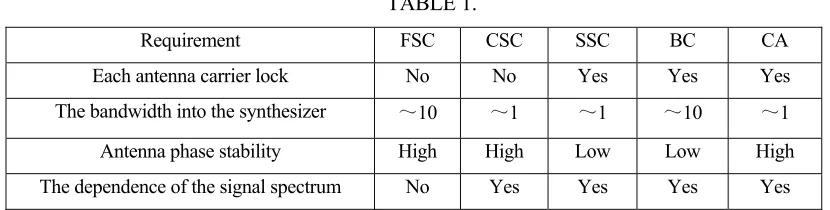
[image:4.612.90.505.400.505.2]There are mainly five kinds of array schemes to receive deep space exploration signals, including full spectrum composite (FSC), complex symbol composite (CSC), symbol composite (SSC), baseband composite (BC) and carrier array (CA). The technical performance comparison of the five downlink grouping schemes is as follows:
TABLE 1.
Requirement FSC CSC SSC BC CA
Each antenna carrier lock No No Yes Yes Yes
The bandwidth into the synthesizer ~10 ~1 ~1 ~10 ~1
Antenna phase stability High High Low Low High
The dependence of the signal spectrum No Yes Yes Yes Yes
Uplink Antenna Array Application Analysis
OVERRALL TECHNICAL ANALYSIS of THE ARRAY of DEEP SPACE EXPLORATION ANTENNAS
Antenna array technology, deep space optical communication and inter-planetary communication network technology are listed as the three main technical methods of realizing deep space detection and control communication in the future. The G / T performance of the antenna system can be improved by increasing the antenna system gain G, reducing the system noise temperature T, or by increasing the two-antenna system gain G while reducing the system noise temperature T. There are two ways to improve the gain of the antenna system G: one is to use optical communication system to improve the performance through higher frequency; the other is to achieve higher gain through a large number of small antenna array. System signal-to-noise ratio (SNR) is the objective of the overall design of the project.
According to the theory of signal theory, if there are other attenuated transmitted signal copies provided to the receiver, it is helpful to accept the correct judgment of the signal. This method is referred to as diversity, which improve the correct decision rate of the received signal by providing multiple copies of the transmitted signal. Diversity technology is used to compensate the loss of fading channel. It usually takes advantage of the irrelevant characteristics of independent samples of the same signal in the radio propagation environment and uses some signal combining techniques to improve the received signal to resist the adverse effects of fading. Spatial diversity can overcome the spatial selective fading, but the distance between the diversity receivers to meet the basic conditions of more than 3 times the wavelength. The N independent branch signals obtained by the diversity method at the receiving end can be mainly obtained using maximum ratio combining, equal gain combining and selective combining three different types of combining techniques to obtain larger diversity gain.
Spatial diversity is also known as the antenna diversity, which is the most widely used technique in wireless communication. Deep space antenna array is the spatial diversity of space exploration in the field of engineering applications. In engineering applications, the system must consider the technical parameters such as the amplitude, phase, time and damping factors. At the same time, the Ka, Q or higher frequency of high frequency work, should consider the influence of the received signal cable insertion loss, otherwise the cable insertion loss values is too much to lead to antenna array gain effective gain exhausted and could even occur on engineering application of array antenna group has no practical significance.
CONCLUSION and SIGNIFICANCE
system, the use of antenna array technology for uplink and downlink has its unique advantages and important engineering application prospects.
ACKNOWLEDGMENTS
The research project of this paper is supported by the research on the key technology of the deep space exploration antenna array (MSV201612) of the State Key Laboratory of Mechanical System and Vibration (Shanghai JiaoTong University).
REFERENCES
1. David H. Rogstad Alexander Mileant Timothy T. Pham. 2005. Antenna Array Technology in Deep Space Network. Tsinghua University Press.
2. Zhijian Yu, Haiqing Li and Xiaomei Li. 2015.“Technical Research and Experimental Verification of Extendable Deep Space Exploration”. Measurement and control remote control. 36(6).
3. Tiancahn Zhao, Guolong He, Xiaoliang Li and Min Liu. 2011. “Feasibility Study on Upstream Array Technology” presented at the 8th Academic Conference of Deep Space Exploration