http://dx.doi.org/10.4236/jamp.2014.29100
A Numerical Method for Singular
Boundary-Value Problems
Abdalkaleg Hamad
1, M. Tadi
1, Miloje Radenkovic
21Department of Mechanical Engineering, University of Colorado at Denver, Denver, USA 2Department of Electrical Engineering, University of Colorado at Denver, Denver, USA
Email: [email protected], [email protected]
Received 10 June 2014; revised 10 July 2014; accepted 23 July 2014
Copyright © 2014 by authors and Scientific Research Publishing Inc.
This work is licensed under the Creative Commons Attribution International License (CC BY). http://creativecommons.org/licenses/by/4.0/
Abstract
This note is concerned with an iterative method for the solution of singular boundary value prob-lems. It can be considered as a predictor-corrector method. Sufficient conditions for the conver-gence of the method are introduced. A number of numerical examples are used to study the appli-cability of the method.
Keywords
Singular Boundary-Value Problem, Singularly Perturbed Boundary Value Problem
1. Introduction
In this note we consider a numerical method for singular linear boundary value problems. Such problems arise very naturally in various applications including gas dynamics, chemical reactions, and structural mechanics. Traditional methods fail to produce good approximations for such equations. As a result, a number of investiga-tors have considered various non-classical methods, including Chebyshev polynomials, B-splines, and cubic splines [1]-[3]. Recent results also include methods based on reproducing kernel space [4] [5], and Sinc colloca-tion method [6].
The purpose of this note is to develop an iterative method for singular and singularly perturbed boundary val-ue problems. The method is explicit in nature, and can be considered to be an iterative predictor-corrector me-thod. Section 2 introduces the method in details. Section 3 provides sufficient conditions for the convergence of the method. Section 4 uses a number of examples to investigate the applicability of the method, and compares the results to exact solutions.
( )
( )
( )
, 0 1y′′+P x y′+Q x y=F x ≤ ≤x (1) With Dirichlet-type boundary condition
( )
0 ,( )
1y =
α
y =β
(2) where, the functions P x( )
, Q x( )
and F x( )
are analytic in x∈( )
0,1 . The functions P x( )
and Q x( )
can vanish at the boundary points. Assume that the domain is divided into ne equal intervals ∆x, which leads to n=ne+1 nodes with x1=0, xj =
(
j− ∆1)
x, for j=2,3,,n. The boundary conditions provide theval-ues for y1 and yn. Consider a finite difference approximation of the above equation given by
1 1 1 1
2 2
, 2
j j j j j
j j j j
y y y y y
P Q y F
x x
− − + + + + − − + =
∆
∆ (3)
where Pj =P x
( )
j , Qj =Q x( )
j , and Fj =F x( )
j . The boundary conditions provide the values for y1 andn
y . It is then possible to formulate a two-step iterative formulation. First, using the given boundary conditions, an initial value can be assigned to the unknown function, i.e. yj, j=1,,n. Starting from the left
(
x=0)
, and marching to the right, the first step is to solve Equation (3) for yj (here, we are naming it zj and refer to it as an intermediate variable) according to(
2)
21 1
1 1
2 1 1 0,
2 2
j j j j j j j
x Q z xP z − xPy+ x F
− + ∆ + − ∆ + + ∆ − ∆ =
(4)
for j=2,,n−1
Note that, marching from the left to right, the above equation is explicit for zj. The second step is to march from the right to the left according to
(
2)
21 1
1 1
ˆ ˆ
2 1 1 0,
2 2
j j j j j j j
x Q y xPy+ xP z − x F
− + ∆ + + ∆ + − ∆ − ∆ =
(5)
For j= −n 1,n−2,n−3,, 2.
The variable zj is an intermediate variable for which z1 =y1 =y
( )
0 =α
and yˆj =y( )
1 =β
. Marching from right to left, the above equations can be solved for yˆj explicitly. The above two steps can be repeated af-ter setting yj =yˆj, for j=2,n−1. In the next section, we provide sufficient condition for convergence of the above iteration.3. Convergence of the Method
For simplicity, consider a second-order singular differential equation given by
( )
( ), 0
1y′′ +Q x y=F x ≤ ≤x (6) The same analysis can be performed for a non-zero P x
( )
. The above two-step iterative method simplifies to(
2)
21 1
2 x Qj zj zj− yj+ x Fj 0, for j 2, ,n 1
− + ∆ + + − ∆ = = − (7)
(
2)
21 1
ˆ ˆ
2 x Qj yj yj+ zj− x Fj 0, for j 2, ,n 1
− + ∆ + + − ∆ = = − (8)
In a matrix form, the first step can be written as
2 2 2 2
3 3 3 2 3
1 1 1 1
0 0 0 1 0
1 0 0 0 0 1
. 1
0 1 n n 0 0 0 n n
z y F
z y F
x
z y F
σ α
σ
σ − − β − −
− − + = + ∆ − (9)
where
σ
j = ∆ −x2 2. Similarly, writing the second step in a matrix form leads to2 2 2 2
3 3 3 2 3
1 1 1 1
ˆ
1 0 0 0 0
ˆ
0 1 0 1 0 0
.
0 0
ˆ
0 0 n n 0 0 1 0 n n
y z F
y z F
x
y z F
σ α
σ
σ − − β − −
The above equations can be written in a more compact form according to 2
1 + =B1 + ∆x
A z b y F (11) 2
2ˆ+ =B2 + ∆x
A y b y F (12) where, the bold lower case letters indicate vectors corresponding to the above terms. After eliminating the in-termediate term z in the above equations one can arrive at the equation given by
(
)(
)
1 1 1 1 2
2 2 1 1 2 2 1
ˆ= −B −B + +I −B − ∆x −
y A A y A A F b (13) For convergence of the above iteration, it is sufficient that all eigenvalues of the coefficient matrix, i.e.,
1 1
2 B2 1 B1
− −
A A be inside the unit circle. The form of the coefficient matrices are such that it is possible to obtain explicit expressions for the inverses. For A1, we have
( )
( )
2 2
3 1
2 3 3
1 1 1 1 2 3 1 0 0
0 0 1 1
0 0
1 0
; .
0
0 1
1ne 1ne 1
n ne ne ne k k k k σ σ
σ σ σ σ
σ σ σ σ − − − = = − = = − −
∏
∏
A A (14)
Note that matrix A1 is a lower triangular matrix, and its inverse is also a lower triangular matrix. It is also possible to explicitly compute the triple product
( )
( )
2
1 2 1 1
3 2 3
1
1
1 2
0 0 0 0
1
0 0 0 0
1 1
0 0 0 .
0 0 0
1 1 0 0 ne ne ne ne k k B B σ
σ σ σ
σ σ σ − − − − = − = −
∏
A (15)
The matrix A2 is an upper triangular and its inverse which is an upper triangular is given by
2 2 3
2
3 1
3 2 4
2 2 1 1 1 1 1 0 1 1 0 0 0 1 ; . 0 0 1 0 0 n n
σ σ σ
σ σ
σ σ σ
σ σ − − − − − = =
Α Α (16)
Writing the coefficient matrix in Equation (13) as a product of two matrices according to
1 1 1 1
2 B2 1 B1 2 B2 1 B1
− − − −
=
A A A A (17) The first matrix on the right hand side is upper triangular, and the second matrix is lower triangular. The di-agonal entries are the eigenvalues and using the spectral radius, it is sufficient to have
σ
k >1, for2, ,
4. Numerical Examples
Example 1: Consider a singular boundary value problem [4] given by
( )
( )
2 3( )
( )
1
4 9 , 0 1, 0 1 0
y y y x f x x x x x y y
x
′′+ ′+ = = − + − < ≤ = = (18)
The exact solution is given by y x
( )
=x2−x3. Using a second-order accurate finite-difference approximation, the first step of the algorithm which is marching from the left(
x=0)
to the right(
x=1)
according to(
2)
2( )
1 1
1 2 1
2 j j j 2 j j j
x x
z x z y x f x
x − x +
∆ ∆
− + ∆ − + + = ∆
(19)
The second step is to march back from x=1 to x=0 using
(
2)
2( )
1 ˆ ˆ 1
1 2 1
2 j j j 2 j j j
x x
z x y y x f x
x − x +
∆ ∆
− + ∆ − + + = ∆
(20)
Both steps involve the explicit calculations only. After dividing the domain into equal intervals, Table 1
presents the results at selected points inside the domain and compares their values to the exact solution. The ite-rations are continued until the results do not change. In all the cases, the error is within the order of the approx-imation of the finite difference scheme. The relative error in the table is computed according to
computed exact
exact
r
y y
E
y −
= (21)
Example 2: Consider another singular boundary value problem [7] given by
(
1 1)
104572 2 104512 3 2091 4 191 5,( )
0( )
1 0.y y x x x x y y
x x
′′ + = − + + + = =
− (22)
The exact solution is given by
( )
1834592 917296 2 458648 3 188072 4 14131 5 32 6 1 7887331445 887331445 887331445 34571355 29252685 278597 817
y x = x+ x + x − x + x + x + x (23)
Dividing the domain into equal intervals and using the above method,Table 2 compares the computed solu-tion with the exact solusolu-tion at different points in the domain. The computed values are after 90,000 iterasolu-tions. But the calculations are explicit and pose little burden.
Example 3: Consider a singularly perturbed boundary-value problem [7] given by
( ) ( )
2(
)
( )
( )
2 2
cos π 2 π cos 2π 0, 0 1 0
y′′ y x x y y
− + + + = = = (24)
for which the exact solution is given by
( )
( )
1
2 1
e e
cos π 1 e
x x
y x x
− −
− +
= −
+
(25)
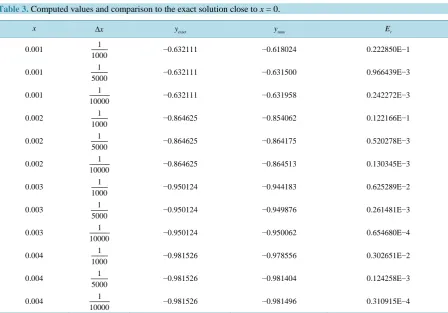
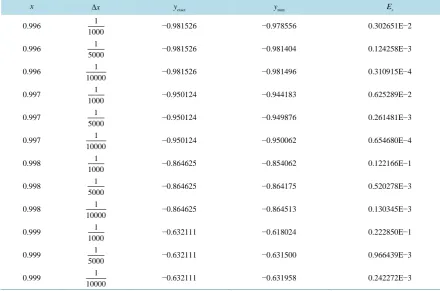
This problem is singularly perturbed, and large gradients exist close to the boundaries. The present method can still be used to obtain an accurate solution.Table 3 presents the convergence of the solution close to the left
(
x=0)
boundary as a function of the mesh size, and Table 4presents the convergence close to the right boun-dary(
x=1)
for =0.001.The above results are for finite difference approximation with equal intervals. The accuracy of the results can be improved by using a smaller mesh sizes close to the boundaries. However, the calculations are explicit and using equal intervals does not pose a computational burden.
5. Conclusions
Table 1.Computed value and the relative error at different values of x.
x
∆ x=0.2 x=0.2 x=0.4 x=0.4 x=0.6 x=0.6 x=0.8 x=0.8
num
y Er ynum Er ynum Er ynum Er
1
50 0.0317593 7.5E−3 0.0957938 2.1E−3 0.1438538 1.0E−3 0.1279245 5.8E−4
1
100 0.0319362 1.9E−3 0.0959463 5.5E−4 0.1439622 2.6E−4 0.1279805 1.6E−4
1
200 0.0319833 5.2E−4 0.0959861 1.4E−4 0.1439903 6.7E−5 0.1279950 3.8E−5 1
400 0.0319956 1.3E−5 0.0959964 3.7E−5 0.1439975 1.7E−5 0.1279987 9.8E−6 1
800 0.0319981 5.7E−6 0.0959984 1.6E−5 0.1439988 7.6E−6 0.1279994 4.3E−6
Table 2.Computed value and the relative error at different values of x for Example 2.
x
∆ x=0.2 x=0.2 x=0.4 x=0.4 x=0.6 x=0.6 x=0.8 x=0.8
num
y Er ynum Er ynum Er ynum Er
1
50 4.5047E−4 2.25E−5 8.938E−4 1.82E−4 1.0968E−3 3.46E−4 7.9756E−4 5.71E−4
1
100 4.5047E−4 5.66E−6 8.937E−4 4.56E−5 1.0966E−3 8.65E−5 7.9722E−4 1.42E−4
1
200 4.5047E−4 1.44E−6 8.937E−4 1.14E−5 1.0965E−3 2.16E−5 7.9722E−4 3.57E−5
Table 3. Computed values and comparison to the exact solution close to x = 0.
x ∆x yexact ynum Er
0.001 1
1000 −0.632111 −0.618024 0.222850E−1
0.001 1
5000 −0.632111 −0.631500 0.966439E−3
0.001 1
10000 −0.632111 −0.631958 0.242272E−3
0.002 1
1000 −0.864625 −0.854062 0.122166E−1
0.002 1
5000 −0.864625 −0.864175 0.520278E−3
0.002 1
10000 −0.864625 −0.864513 0.130345E−3
0.003 1
1000 −0.950124 −0.944183 0.625289E−2
0.003 1
5000 −0.950124 −0.949876 0.261481E−3
0.003 1
10000 −0.950124 −0.950062 0.654680E−4
0.004 1
1000 −0.981526 −0.978556 0.302651E−2
0.004 1
5000 −0.981526 −0.981404 0.124258E−3
0.004 1
[image:5.595.89.538.405.718.2]Table 4.Computed values and comparison to the exact solution close to x = 1.
x ∆x yexact ynum Er
0.996 1
1000 −0.981526 −0.978556 0.302651E−2
0.996 1
5000 −0.981526 −0.981404 0.124258E−3
0.996 1
10000 −0.981526 −0.981496 0.310915E−4
0.997 1
1000 −0.950124 −0.944183 0.625289E−2
0.997 1
5000 −0.950124 −0.949876 0.261481E−3
0.997 1
10000 −0.950124 −0.950062 0.654680E−4
0.998 1
1000 −0.864625 −0.854062 0.122166E−1
0.998 1
5000 −0.864625 −0.864175 0.520278E−3
0.998 1
10000 −0.864625 −0.864513 0.130345E−3
0.999 1
1000 −0.632111 −0.618024 0.222850E−1
0.999 1
5000 −0.632111 −0.631500 0.966439E−3
0.999 1
10000 −0.632111 −0.631958 0.242272E−3
lems. The method can be considered as an iterative predictor-corrector method. Sufficient conditions for the convergence of the iteration was also presented. The proposed method is fully explicit and requires little com-putational time. It can also be applied to singularly perturbed boundary value problems.
Three numerical examples were used to study the applicability of the method.
References
[1] Kadalbajoo, M. and Agarwal, V. (2004) Cubic Spline for Solving Singular Two-Point Boundary Value Problems. Ap-plied Mathematics and Computation, 156, 249-259. http://dx.doi.org/10.1016/j.amc.2003.07.020
[2] Ravi Kanth, A. and Reddy, Y. (2005) Cubic Spline for a Class of Singular Two Point Boundary Value Problems. Ap-plied Mathematics and Computation, 170, 733-740. http://dx.doi.org/10.1016/j.amc.2004.12.049
[3] Mohanty, R.K., Sachder, P.L. and Jha, N. (2004) An o(h4) Accurate Cubic Spline TAGE Method for Nonlinear Singu- lar Two Point Boundary Value Problem. Applied Mathematics and Computation, 158, 853-868.
http://dx.doi.org/10.1016/j.amc.2003.08.145
[4] Geng, F.Z. and Cui, M.G. (2007) Solving Singular Nonlinear Second-Order Periodic Boundary Value Problems in the Reproducing Kernel Space. Applied Mathematics and Computation, 192, 389-398.
http://dx.doi.org/10.1016/j.amc.2007.03.016
[5] Li, Z.Y., Wang, Y.L., Tan, F.G., Wan, X.H. and Nie, T.F. (2012) The Solution of a Class of Singularly Perturbed Two-Point Boundary Value Problems by the Iterative Reproducing Kernel Method. Abstract and Applied Analysis, 1-7.
[6] Mohsen, A. and El-Gamel, M. (2008) On the Galerkin and Collocation Methods for Two-Point Boundary Value Prob- lems Using Sinc Bases. Computers and Mathematics with Allications, 56, 930-941.
http://dx.doi.org/10.1016/j.camwa.2008.01.023