A Biometric Traits based Authentication System for
Indian Voting System
Saurabh Yadav
Meerut Institute of Engineering and Technology, Meerut, India
Ajay Kr. Singh,
PhD.Meerut Institute of Engineering and Technology, Meerut, India
ABSTRACT
All nations needs a democracy and nations in which democracy exists are trying for improvement in voting system. Recent Movement of Egypt and all developed nations having a democracy shows the value of voting. Developing nations like India are spending huge money to improve their whole voting system to provide a better government to their citizens. For good democracy, a voting system should be correct, transparent and fully authentic. In this text we are comparing the covenantal method of voting with new proposed voting system which is based on complete biometric traits of voter which are saved in a government database as Aadhaar (U-id) number database. These biometrics traits provide secure and feasible authentication to the voters. Biometrics prevents the fraud and illegal voting. Our efforts in this paper are directed towards reviewing existing challenges to the conventional electoral system of India with the aim of addressing fraudulent electoral prices by the use of biometric authentication based Electronic voting system.
Keywords
Aadhaar, Biometrics, Electronic voting, Democracy, Electorates, Electoral fraud.
1.
INTRODUCTION
Voting as a system has been in existence since the late 12th century. The election is a very sensitive issue in developing countries like India.
In a democracy, every citizen has right to cast his/her vote for any candidate. The word democracy means the Government
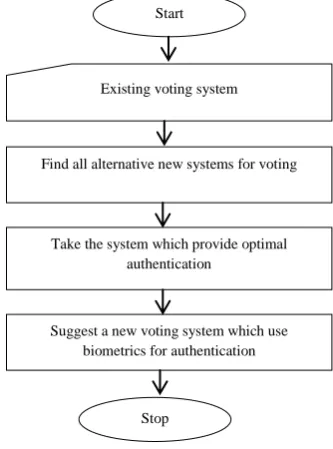
of the people, by the people and for the people. A democratic nation is a nation where voters have the freedom to elect their own dictators. Figure 1 shows the overall designing of the new suggested system.
Voting is a process in which citizens choose a leader among all candidates by casting his/her vote in favor of a candidate on the ballot paper or on electronic voting machine as shown in figure 2.
A voting system should be fair enough for both political parties and voters. There are some characteristics of voting system that are as follows-
Authentication: Only authorized voters should be able to vote.
Uniqueness: No voter should be able to vote more than once.
Accuracy: Voting systems should record the votes correctly.
Integrity: Number of casted vote must not be modified.
Verifiability: Possible to verify that votes are correctly counted in the final tally.
Auditability: Reliable and demonstrably authentic election records.
Reliability: Systems should work robustly, even in the face of numerous failures.
[image:1.595.309.552.274.458.2]Authentication is the very crucial part of the whole voting system which ensures that the voter is authenticated to vote; if there is a loophole in the authentication process then a voting system is not secure and results will not be acceptable and if a government comes in power by any illegal means like eectoral fraud that affects election then that government is not for the nation. Developing country like India which have one of the largest democracy in world are continuously trying to
Fig. 2. Different types of voting
Paper ballots
Voting
Paper voting E-voting
Precinct voting
Internet voting Polling place
voting Punch cards
Kiosk voting
Start
Existing voting system
Find all alternative new systems for voting
Suggest a new voting system which use biometrics for authentication Take the system which provide optimal
authentication
Stop
[image:1.595.75.242.487.712.2]improve its style of voting. Citizen of India gets a good government which runs the whole country by better decision making in favor of common men, businessmen and all object which are related to country. This the responsibility of the government to deal everything which may directly or indirectly affect the nation. So a good government come from good voting system. Election means a lot for nation.
Particularly in India, election[1] takes place in every five years and a citizen who are more then 17 years old has a right to cast his/her vote. This rule is implemented after getting freedom in 1947. Before 2004 voting system was based on paper. Voter had to go to polling booth on the of election day. For casting his vote he has to mark seal in front of a symbol any candidate for which he wants to cast his vote on ballot paper. For results all votes are counted and maximum vote gainer is declared as winner. India has population more than 120 crores so if ballot paper voting takes place then it is very hard to counts the vote and there are also problems like replacement of ballot paper boxes with duplicate, damage of ballot paper, marking stamp seal for more than one candidate hence it was mandatory for India to overcome this problem. In 2004, India had adopted Electronic Voting Machines (EVM) for its elections[2] (e-voting) to the Parliament with 380 million voters had casted their vote using more than a million voting machines. EVM is called Direct-recording electronic (DRE) voting system.
Votes are recorded correctly and no problem is there in counting, scalability and robustness of system. Problem lies in authentication, the person who is voting may not the right person. There are other problem like booth capturing by political parties, voting done by less age children’s and fraud voting. A person is identified by voter list provided by the Election Commission of India and voter ID card issued by Indian government There are lots of problems in voter ID card like name misprinting, missing of name, no clear photo on photo id card, etc.
So to overcome above stated problems we are proposing a new voting system in India which is more secure, time saving and provide two level of authentication by electronic means based on individual Biometric traits of voters. The new system will use biometric traits of the voter as authentication by which at the time of election if scanned biometric data of the voter matches which is saved in system then he is allowed to vote otherwise he rejected a reported as fake voter and law breaker. Biometric properties of any individual are unique universally, which cannot be matched with anybody like fingerprint, iris, gaits, voice, face etc. Fingerprints and face matching is used in the voting authentication process and all these biometric data are saved in national Aadhaar (U-id) database of Indian government so, no need to create an extra database which contains only biometric data. The need is to connect with U-id database. The proposed approach is time saving and provide much authentication from paper base authentication.
2.
INDIAN ELECTORAL SYSTEM
India is a Socialist, Secular, Democratic Republic and one of the largest democracy in the World with the union of twenty-eight states and seven union territories. As of 2011, with an estimated population of 1.21014569 billion. The modern Indian nation State came into existence on 15th of August 1947. India is a constitutional democracy[1] with a parliamentary system of government and at the heart of the system lies a commitment to hold regular, free and fair elections. These elections determine the composition of the
government, the membership of the two Houses of Parliament, the State and Union Territory Legislative Assemblies.
The Lok Sabha also called House of the People, is the lower house of the Parliament of India. The Vidhan Sabha or the Legislative Assembly is the lower house of the provincial (state) legislature in the different states of India and Members of the Lok Sabha and Vidhan Sabha are elected by direct election. Citizen of India cast their vote for both Lok Sabha and Vidhan Sabha.
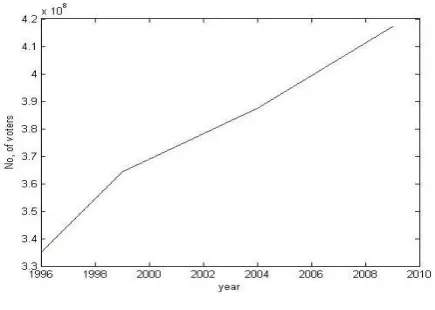
Conduct of General Elections in India for electing a new House of the People i.e Lower House of Indian Parliament, involves management of the largest event in the world. The electorate exceeds 605 million, voting in nearly 800,000 polling stations, spread across widely varying geographic and climatic zones. Increasing rate of voters in India is very high with respect to per election as shown in figure 3. Polling stations are located in the snow-clad mountains in the Himalayas, the deserts of the Rajasthan and in sparsely populated islands in the Indian Ocean.
3.
WHO CAN VOTE FOR LOK SABHA
OR VIDHAN SABHA
The democratic system in India is based on the principle of universal adult suffrage; that is to say, any citizen over the age of 18 can vote in an election to Lok Sabha or Vidhan Sabha before 1989 the age limit was 21. The right to vote is irrespective of caste, creed, religion or gender. Those who are deemed unsound of mind, and people convicted of certain criminal offenses are not allowed to vote.
3.1
VOTING DAY
[image:2.595.319.537.124.279.2]Government schools and colleges are chosen as polling stations. The Collector of each district is in charge of polling. Government employees are employed to many of the polling stations. EVM are being increasingly used instead of ballot boxes to prevent election fraud via booth capturing, which is heavily prevalent in certain parts of India. An indelible ink is applied usually on the left index finger of the voter as an indicator that the voter has casted his vote. This practice has been followed since the 1962 general elections to prevent bogus voting.
4.
HOW VOTING TAKES PLACE
CURRENTLY
Voting is done by secret EVM. Polling stations are usually set up in public institutions, such as schools and community halls. To enable as many electors as possible to vote, the officials of the Election Commission try to ensure that there is a polling station within 2 km of every voter. On entering the polling station, the elector is checked against the Electoral Roll, and allowed to cast his/her vote by EVM.
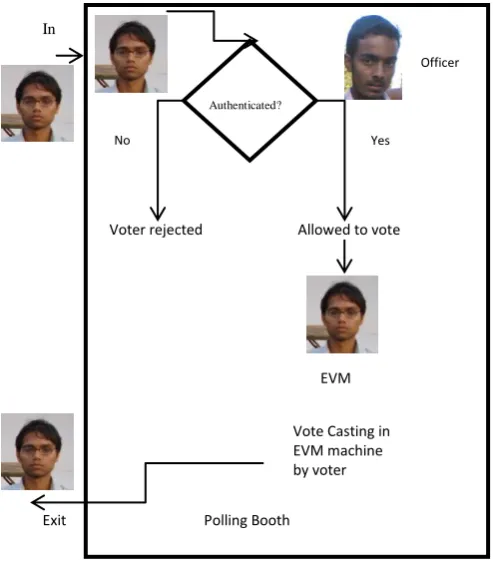
Currently voting is done by EVM in India and voter is allowed to only cast his/her after complete authentication. Authentication is done by voter list of voters at that polling station and voter id card having by voters both voter id card and voter list are issued by the election commission of India (ECI). A government and constitutional body of India is there to control and take care of the Indian election. If voter name matches with the name that is on the voter ID card and he has not casted his/her vote before then the voter is allowed to vote as shown in figure 4. This authentication is completely on paper based.
• Each voter has an photo ID card issued by the ECI.
• On the election day of election, he has to go to the polling booth for casting his vote.
• Where an electoral officer will check his /her identity with a voter list provided by ECI.
• After authentication voter is allowed to cast his vote by EVM.
5.
PROBLEMS RELATED TO
CURRENT SYSTEM
• Capture the polling booth.
• Time taking authentication process. • Fraud voting.
• Voting done by less age voters.
6.
RELETED WORK
Using biometrics[3-5] for authentication is new technique too much research is going on in this field.
Sonja Hof, University of Linz, Austria suggest in his paper[6] that use of live matching of biometric data at the time of vote casting instead of using smart card which contains biometric data which is more secure. He has done a comparative study of biometrics in the form of smart card and centralized system for voting.
Dimitris A. Gritzalis discussed[7,8] on e-voting to identify the set of generic Constitutional requirements, which should be met when designing an e-voting system for general elections and identify, using the Rational Unified Process, the requirements of an adequate secure e-voting system. He suggested the role of authentication in voting in deep.
O.M. Olaniyan, T. Mapayi and S.A. Adejumo presented a paper[9] based on Proposed a Multiple Scan Biometric-Based System for electronic voting which cover all aspects of using biometrics in voting and how to secure the election process. Writers suggested the use of multiple biometrics scanning for providing more authentication.
Shobha lokhande, Dipali Sawant, Nazneen Sayyad, Mamata Yengul presented a paper[10] have discussed the voting in terms of e-voting through biometrics and cryptography- steganography technique with GSM modem. For implementing this, cover image is used for Stenography and key is used in Cryptography. The basic concept is to merge the secret key with the cover image on the basis of key image which results a stego image, which looks quite similar to the cover image but not detectable by the human eye. The key image is a Biometric measure, such as a fingerprint image.
7.
BIOMETRICS
Biometrics[3] is the identification of an individual using a distinctive aspect of their biology or behavior. Two same types biometric property[4] (traits) of different person can’t be matched. It is divided in two characteristic (i) Physiological and (ii) behavioral. Behavioral aspect includes speach, keyboard typing, Signature and Physiological includes fingerprint, hand, eyes and face.
Fingerprint. This is very old style to authenticate any one like in forensic experts do in criminal cases. Fingerprint scanners are probably the most commonly used biometric systems. Similar systems include hand geometry or palm prints. Figure print of two humans never matched.
[image:3.595.41.288.181.465.2] Iris. Another static property of individuals are eyes. One can either use pictures of the person’s iris or use a retina scanner that scans blood vessels to create an individual data set.
Fig. 4. Current voting system
Officer
Polling Booth
Authenticated?
No Yes
Allowed to vote
EVM Voter rejected
Exit
In
Face. The human face is also a feature that can be used by biometric systems. Human face recognition by analyzing the size and position of different facial features is being pushed for use at several airports to increase security. Another possible approach is to make infrared recordings and analyze the resulting facial thermo gram.
Voice. A more behavioral individual aspect of humans are their voices. Everybody has a special mode and tone while speaking. Voice recognition tries to analyze these features and use them to identify a person.
Signature. Another behaviourial aspect of a person usable by biometrical analysis[11] is the signature. The dynamic aspects can be seen as a set of unique features of a person. Other possible movable biometric input could be the rhythm and pattern of a person’s walk.
Biometrics[5] make easier the jobs remember the all user id and passwords which are used in different web and system services used by human being for example, an identification system using biometrics would be: you approach an ATM with no card, no claimed identity, and no PIN. The ATM scans your iris and determines who you are and gives you access to your money or The ATM scans your iris and uses it as a password to authenticate you are the right owner of the card and therefore give you access to your money.
8.
AADHAAR
Aadhaar[11] is a 12 digit individual identification number issued by the Unique Identification Authority of India(UIDAI) on behalf of the Government of India. Each individual needs to enroll only once which is free of cost. Each Aadhaar number will be unique to an individual and will remain valid for life. Aadhaar number will helps to provide access to services like banking, mobile phone connections and other Government and Non-Government services. Biometric data like fingerprint, iris and palm geometry face is stored in database of Aadhaar. This number will serve as a proof of identity and address, anywhere in India. Any individual, irrespective of age and gender, who is a resident in India and satisfies the verification process laid down by the UIDAI, can enroll for Aadhaar.
9.
PROPOSED BIOMETRICS BASED
SYSTEM OF VOTING
Our proposed system makes use of biometric traits of each voter for authentication to overcome above problems. Biometrics makes easier the job to authenticate the correct voter by providing an automated electronic interface to voters. The only need is that if voter fingerprint and face is matched[13] with saved data in ECI database shared form Aadhaar database; then the voter is allowed to cast his/her vote by EVM otherwise not.
FEATURES OF PROPOSED VOTING SYSTEM
• A voting system which provides better authentication process.
• Provide physical security at the time of vote.
• Make use of biometric traits for voting. • Make use of U-id number provided by UIDAI.
• Completely automated system for voter authentication and verification.
• Full voting system is electronically based.
• Saves environment by saving paper.
• A secure[14,15] and transparent voting system.
10.
WORKING OF BIOMETRICS
BASED VOTING SYSTEM
The first requirement of the system is connect to database of U-id by Indian Government in any manner (online/small module of data related to that region)
Step 1. User has a national U-id number.
Step 2. Voter enters his U-id number at the gate in a machine and look into the camera.
Step 3. Authentication at Booth gate by face matching. Step 4. If a match occurs then gate will open for enter otherwise voter is reported as fraud voter and the gate will not open. After entering in room gate will automatcally lock no other human is allowed to enter in room as shown in figure 5 . Step 5. If finger print match occurs if the match than allowed to vote. Otherwise reject the voter.
Step 6. After casting vote, voter leaves the room from another gate.
11.
Conclusion
Although this system provides best solutions to problems related to the Indian voting system but it is vulnerable to security attacks. Confidential biometricdata may be leaked due to network connectivity or system hacking. Full implementation is not an easy task; it involves political issues, financial issues and regional issues. It need 5-7 years to get this project in working condition so it need time to go live. Illiteracy is the main hurdle in this project to come true because for an illiterate persons this not easy to work with machine interface. Lack of human believe, High cost to develop whole system.
Voter
Face matching
No Yes
Figure print matching
Yes
Allowed to vote Not a valid voter
Exit
Vote and exit No
12.
References
[1] http://eci.nic.in/eci_main1/index.aspx.
[2] http://www.bravenewballot.org/e-voting-in-india.html. [3] Koichiro Niinuma, Unsang Park and Anil K. Jain, “Soft
Biometric Traits for Continuous User Authentication,” IEEE Transactions on Information Forensics and Security, Vol. 5, No. 4, pp. 771-780, Dec. 2010. [4] Anil K. Jain, Patrick Flynn and Arun A. Ross,
“Handbook of Biometrics,” Springer Science, ISBN-13: 978-0-387-71040-2, 2008.
[5] Massimo Tistarelli, Stan Z. Li and Rama Chellappa, “Handbook of Remote Biometrics for Surveillance and Security,” Springer Science, ISBN 978-1-84882-384-6, 2009.
[6] Sonja Hof, “E-Voting and Biometric Systems,” University of Linz, Austria.
[7] Dimitris A. Gritzalis, “Principles and requirements for a secure e-voting system,” Computers & Security, Vol. 21, No 6, pp. 539-556, 2002.
[8] Dimitris Gritzalis, “Secure Electronic Voting; New trends, new threats,” 7th Computer Security Incidents Response Teams Workshop Syros, Greece, pp. 1-21 September 2002.
[9] O.M. Olaniyan, T. Mapayi and S.A. Adejumo, “A Proposed Multiple Scan Biometric-Based System for Electronic Voting,” Afr J Comp & ICT, Vol. 4, No. 2, Issue 1, pp. 9-16, 2010.
[10]Mamata Yengul, Shobha Lokhande, Dipali Sawant and Nazneen Sayyad , “E-Voting through Biometrics and Cryptography- Steganography Technique with conjunction of GSM Modem, ” Emerging Trends in Computer Science and Information Technology (ETCSIT2012), pp. 38-42, 2012.
[11]Anil K. Jain and Umut Uludag,“Hiding Biometric Data,” IEEE Transactions on Pattern Analysis and Machine Intelligence, Vol. 25, No. 11, pp. 1094-1098,Nov 2003.
[12] http://uidai.gov.in/aadhaar.html
.
[13]Ted Dunstone and Neil Yager, “Biometric System and Data Analysis Design, Evaluation, and Data Mining,” Springer Science, ISBN-13: 978-0-387-77625-5, 2009. [14]Abhishek Nagar and Karthik Nandakumar,
“Multibiometric Cryptosystems Based on Feature-Level Fusion,” IEEE Transactions on Information Forensics And Security, Vol. 7, No. 1, pp. 255-268, Feb. 2012. [15]Kirk L. Kroeker, “Graphics and Security: Exploring