Medium Access Control with Token Approach in
Wireless Sensor Network
Nor-Syahidatul
N.Ismail
UTM-MIMOS CoE Faculty of ElectricalEngineering Universiti Teknologi
Malaysia
Sharifah H. S.
Ariffin
UTM-MIMOS CoE Faculty of ElectricalEngineering Universiti Teknologi
Malaysia
N. M. Abdul Latiff
UTM-MIMOS CoE Faculty of ElectricalEngineering Universiti Teknologi
Malaysia
Farizah Yunus
UTM-MIMOS CoE Faculty of ElectricalEngineering Universiti Teknologi
Malaysia
ABSTRACT
Hybrid medium access control (MAC) design in Wireless Sensor Network (WSN) brings a new research challenge nowadays. Hybrid MAC gives significant improvement in network performance especially in terms of energy efficiency and reliability of the network. Some of the data are sensitive to loss in the medium such as video data and data for emergency application. In MAC protocol, a contention access method which is Carrier Sense Multiple Access (CSMA) encounters collision problem when the number of nodes in the network increases. Meanwhile, the issue of slotted access which is Time Division Multiple Access (TDMA) is a strict synchronization problem. To avoid the weakness of both access methods, a hybrid MAC layer is proposed with unsynchronized TDMA, which is a token approach that calls the HMAC-TA. Token approach will be used in this protocol to avoid synchronization problems that can degrade network performance in TDMA protocol. The performance analysis of HMAC-TA shows 48% significant improvement in terms of energy efficiency compared to MAC IEEE 802.15.4 standard. The packet delivery ratio of proposed protocol also shows the good performance.
General Terms
Wireless Sensor Network, Medium Access Control, Token approach
Keywords
WSN, Hybrid MAC, Token, MAC IEEE 802.15.4
1.
INTRODUCTION
Wireless sensor network (WSN) is designed based on application specific. Different application poses different quality of service (QoS) requirement. The applications in WSN that send periodic data for monitoring such as temperature, humidity and vibration can tolerate with QoS in terms of reliability of the data. However, for emergency data such as fire, enemy appearance and medical, the reliability of the data should be achieved to make sure the data arrive at the destination [1]. Besides, video application such as transmission of low bit rate video which is MPEG-4 in WSN environment requires reliable transmission medium [2]. Another critical issue in WSN design is energy efficiency. To the best of our knowledge, most of the researchers or academia take energy as a goal in designing any protocol in WSN because the nature of the wireless device that is dependent of battery power [3]. The deployment of the wireless device that scattered wirelessly in geographical structure makes it difficult for replacement and recharging the
battery. For this reason, all the protocol designs maintain low energy usage in the network.
The key layer in WSN protocol that can handle such issue is Medium Access Control (MAC) due to its ability to control the physical radio directly [4]. MAC layer has responsibility to control the node’s medium access in the network. The popular protocol in MAC layer is carrier sense multiple access (CSMA) protocol. Even though, CSMA protocol achieves high performance in scalability, but it suffered from the collision problems. A collision might reduce the throughput, increase the energy consumption because of retransmission of the loss data and will increase the delay in data delivery. To overcome a collision problem in CSMA protocol, non-collision protocol, which is time division multiple access (TDMA) is widely used in an energy efficient design protocol. However, it faces the difficulty to maintain with dynamic topology changes. Nowadays, hybrid MAC design takes part to improve network performance with a combination of both protocols (CSMA and TDMA) strength.
However hybrid MAC layer that applied traditional TDMA experiences strict synchronization. Usually for time synchronization, centralized approach is used to make sure nodes in the network have the same clock. Managing inter-cluster communication and interference is not an easy task [5]. For small topology network, clock drift may be small and does not give a big impact in network performance. But for large topology networks with multi-hop networks, it is difficult to make sure all the nodes have the same clock. Some of TDMA MAC design assume perfect synchronization in their protocols or used global positioning system for synchronization [6] - [9].
The rest of the paper is organized as follows. Section 2 describes the motivation of token approach, section 3 summarizes the related work for hybrid MAC and MAC protocol that implements the token approach, section 4 explains the system design of the HMAC-TA protocol and section 5 shows the performance analysis for the proposed protocol. Lastly, section 6 summarizes the conclusion throughout this paper and gives some insights for future works.
2.
MOTIVATION OF TOKEN
APPROACH
it senses the medium. This will reduce the probability of node collision and avoid the node to sense in the busy network. Besides, through this approach, no hidden terminal problem will occur. For example, as shown in Figure 1, node A and node C can hear communication that occurs within node B’s range, but node A and node C cannot hear each other's signaling. Without token approach, in CSMA protocol, each node sense the channel and transmit the data if found that the channel is idle. Hence, node A and node C might sense and transmit data at the same time and cause a collision. However, with token approach, only node that has the token can transmit the signal. Node A holds the token and can transmit the data without collision because node C will wait for the token before it sends the data.
Fig 1: Token work with partial connectivity
In addition, token approach can offer dynamic frame length with unfixed time holding token (THT). A node that needs less time than THT will hand over the token when data transmission is over. Through this method, throughput will be increased and delay can be decreased in the network. Lastly, the main advantage of using token approach is in terms of synchronization. The whole network must be synchronized in order to transmit the data. In a real implementation of WSN it is difficult to achieve synchronization since sensor nodes are low power devices with small coverage area. This will lead to high overhead and increase the energy consumption.
3.
RELATED WORKS
In recent years, many hybrid MAC layer for WSN design have been proposed in the literature. Most of them combine CSMA protocol with TDMA protocol either using centralized approach or distributed approach.
Zebra MAC (ZMAC) [10] is one of the well-known hybrid MAC protocols in WSN. It selects the protocol either CSMA or TDMA depends on the contention level of the channel. Each of the node already knew its own timeslot at the beginning of the ZMAC protocol using Distributed Randomized Timeslot Assignment Algorithm (DRAND) [11]. The node will remain using its own timeslot if the channel is in high contention level, but if the channel is in low contention level, it will use the CSMA protocol. This protocol achieves high adaptability with the channel condition and fairness but leak with scalability in timeslot assigning. ZMAC assigned timeslot using DRAND protocol in an offline process at the time of deployment. The problem will occur when there is a new node that joins the network in the transmission time, it would not have timeslot and only can content in low contention level. For synchronization issue, ZMAC just broadcasts a synchronization message in high contention level, but it requires high overhead to make sure that the node is synchronized (need at least 10 synchronization messages to resynchronize 30 nodes).
ER-MAC[12] which is an emergency response MAC have the same concept with ZMAC protocol. However, the different is ER-MAC allows contention in TDMA slot if there is an emergency occur. ER-MAC initiates tree construction for topology discovery and timeslot allocation starting from the leaf node towards the base station. For synchronization issue, the concept of parent-child are used, where only a child needs to have the same clock with its parent but if there is a new node joins the network, it has to listen for neighbour’s synchronization and select parent with the lowest numbers of hop. If there is no emergency response, each node uses its own timeslot for sending data, but when there is an emergency response, each node wakes up in every slot for possible contention. Through this concept, ER-MAC achieves a high delivery ratio. However, in terms of energy efficiency, it spends more energy in an emergency response situation. In [13], the authors introduced hybrid MAC for a mobility network known as mobility aware and energy efficient MAC (MEMAC). MEMAC is improved version of scalable and energy efficient hybrid-based MAC (SEHM) [14] by adding mobility prediction. To improve energy efficiency, MEMAC introduces dynamic frame length by giving the timeslot only to the node that has the data. However, MEMAC protocol uses centralized topology by implementing a centralized algorithm in the LEACH protocol [15].
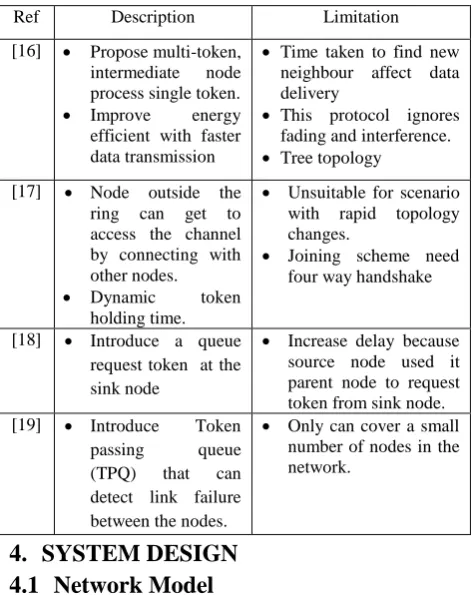
[image:2.595.311.548.435.733.2]Since all the existing MAC protocols above need an extra overhead in synchronization process that leads to higher complexity, unsynchronized TDMA such as token approach should be applied in hybrid MAC. Token approach is widely used not only in WSN [16] – [18] but also in UAWSN [19]. Description and limitation of each protocol that implement token approach are shown in Table 1.
Table 1. Summary of Token Approach Protocol
Ref Description Limitation
[16] Propose multi-token, intermediate node process single token. Improve energy efficient with faster data transmission
Time taken to find new neighbour affect data delivery
This protocol ignores fading and interference. Tree topology
[17] Node outside the ring can get to access the channel by connecting with other nodes. Dynamic token
holding time.
Unsuitable for scenario with rapid topology changes.
Joining scheme need four way handshake
[18] Introduce a queue request token at the sink node
Increase delay because source node used it parent node to request token from sink node. [19] Introduce Token
passing queue (TPQ) that can detect link failure between the nodes.
Only can cover a small number of nodes in the network.
4.
SYSTEM DESIGN
4.1
Network Model
The proposed protocol is designed based on MAC IEEE 802.15.4 standard. This protocol aims to reduce the node’s energy consumption by avoiding the unnecessary carrier sense
Without Token With Token
B A
C
A
B C
and providing a reliable path for data transmission in wireless mediums. In this paper, hybrid MAC was proposed that consists of combination the CSMA and TDMA in one protocol design. To avoid tight synchronization problem that can degrade the network performance in TDMA protocol, unsynchronized TDMA is used, which is a token approach and named it as a hybrid MAC with token approach (HMAC-TA). In the token approach, any node that has the token can transmit the data for token holding time (THT). When THT expired, they hand over the token to the next node that controls the token. Figure 2 shows the frame structure for of the proposed hybrid MAC design.
Fig 2: Proposed Frame Structure
The HMAC-TA frame structure consists of initialization phase and data transmission phase but the initialization phase is only done once at the beginning of the protocol. In the initialization phase, fully CSMA protocol is used for level implementation. In data transmission phase, CSMA protocol and token approach are used where CSMA protocol is used to transmit control message and token approach is used to transmit data message.
This proposed frame structure is the modification from beacon enable mode in MAC IEEE802.15.4 standard. In non-beacon enable mode, node that wishes to transmit the control message or data message will use unslotted CSMA. To provide secure transmission in this approach, a token requirement is added to the node that wishes to transmit the data into the medium. Besides, by using this approach, it can decrease the energy consumption of the node and increase the throughput of the network. To achieve this objective, the following assumptions take into consideration:
1) WSN is static.
2) Radio interface only function at a single frequency. 3) Wireless link between neighbouring nodes is
bidirectional. For example, if node A hears communication at node B, node B also can hear communication at node A.
4) For routing protocol, Real Time Load Distribution (RTLD) routing protocol is used.
4.2
Initialization Phase
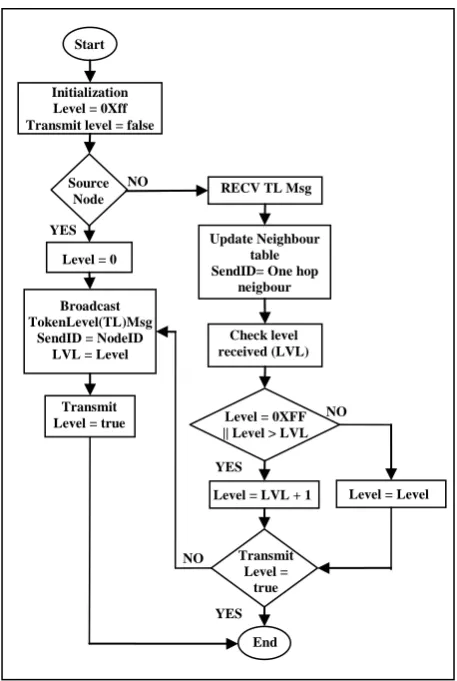
Level implementation and neighbour discovery are done during initialization phase by using CSMA protocol. At the beginning, each node in the network is set to default level (Li) value. A node that generates the event will act as source node and it is set with level 0. Source node also has the responsibility to generate the token in data transmission phase. When the event occurs, source node starts the initialization phase by broadcasting Token Level Message (TLMsg). TLMsg contains level value (Li) and address of a node. The nodes within the source node coverage which is neighbouring nodes receive the message and update their level by 1. Then, each node that has already updates the level will broadcast TLMsg that contains its new level id. Each node only broadcasts one TLMsg during the initialization phase.
[image:3.595.63.273.212.295.2]After that, the nodes in the network just update their level if it receive TLMsg that contains a level lower than its level. Figure 3 shows the algorithm in the initialization phase.
Fig 3: Level Implementation Algorithm
When a node receives a TLMsg from its neighbours, it will not only update its level but also store its one hop neighbour id. The level (Li) value at each node indicate the number of hops that node from the source node. For example, if node A has Li equal to 3, that means node A is three hops away from the source node. In HMAC-TA protocol, level id is very important and will be used in transmission phase.
4.3
Data Transmission Phase
In data transmission phase, two protocols are used depends on the type of data. CSMA protocol used to send control message such as routing message (RTLD control packet), token message and acknowledgement message. Nodes run a backoff timer and scan the network before sending the control message. For data message, token approach will be used. Any node that intends to transmit the data message should have token first. Token just like a ticket, a station that has the token can use the channel. When the node gets the token, it also has to sense the channel first before transmit the data message to make sure that the channel is free.
For token message, there are three different types of message as shown in Figure 4 which is send request to join (RTJ) message, Token Announce (TA) message and Token passing (TP) message.
Start
Initialization Level = 0Xff Transmit level = false
Source Node
Broadcast TokenLevel(TL)Msg
SendID = NodeID LVL = Level
Level = 0
RECV TL Msg
Update Neighbour table SendID= One hop
neigbour
Check level received (LVL)
Level = 0XFF || Level > LVL
Level = LVL + 1 Level = Level
Transmit Level =
true
End Transmit
Level = true
YES YES
YES NO NO
NO
Data Transmission
TF
TH Initialization
Fig 4: Frame Structure for Token Message
SendID is a node id for sending node, Li is level value, FT is flag token either 0 or 1, NCT is a node's control token at that time, and NHT is the next node that holds the token. TST is the token scheduler table. Inside TST, there is a list of neighbour nodes that joining the token. These neighbour nodes are in closed-loop ring that constructs by NCT. In data transmission phase, source node that triggers the event will generate token and assign itself as the first NCT in the network. Then NCT will broadcast TA Msg to acknowledge its neighbour about token appearance inside its coverage area. Neighbour node that receives TA Msg will send a RTJ message if there is any data to be sent. After THT expired, NCT will pass the TP Msg in a unicast way to next NCT in the network. The next NCT will check the request token table (TRT), if there is a list of neighbour nodes that request the token, NCT will construct a ring structure and broadcast TA Msg. After NCT finishes using the token, it passes the token to the next holding token (NHT) based on the list of neighbours in TST. This process continues until the token reaches back at NCT. Then NCT will choose next NCT in the network. The selection of next NCT will be explained in section 4.4. Example of token operation is shown in Figure 5. As shown in Figure 5, source node passes the token directly to node 2 (N2) after THT expired, then N2 also passes the token to node 5 (N5). When the token reaches N5, it constructs TST because there is a list of nodes inside TRT. N5 will send TP Msg to next NHT according to TST after THT expired.
Fig 5: Token operation
In this protocol, dynamic time frame (TF) and dynamic time holding token (THT) were proposed. TF and THT depend on the number of nodes joining (nJ) at that time. Each node stores the default value of time holding (THd) and time frame (TFd). The maximum number of node joining (nJ) the token in one time is limited to three nodes because to avoid increasing delay in the network. Equation 1 and 2 shows the calculation for THT and TF in the networks.
(1)
(2)
, where
THd = default time holding TFd = default time frame nJ = List of node joining
THd is set less than TFd. If there is no node that joins the token (nJ = 0), the length for THT is the same with TF which is equal to THd. THT not equal to TF if there is a node joins the token. TFd will be divided by the number of nJ.
4.4
Next Node Control Token
The selection of the next nodes that control the token in the network is based on the next hop forwarding node that is selected in the routing protocol. In our approach, the token will be passed to a node that has data. Through this approach, each node that has the data obtains the token and transmits the data towards the destination. Based on the assumption state in section 1, RTLD routing protocol is implemented in this protocol. In RTLD routing protocol, next hop forwarding node is chosen based on optimal forwarding decisions that consists of three parameters. The parameter selections are remaining battery power, max packet velocity and link quality. The equation can be found in this reference [20].
4.5
Token Generation
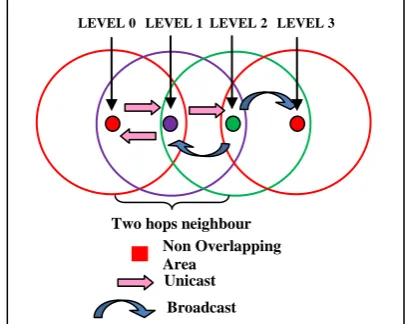
[image:4.595.325.529.512.674.2]In our protocol, the token will be generated at the source node after two hops neighbour to avoid collision. The network is assigned to a level and node that two hops from the source node is set with level 2 at initialization phase. As mentioned before, TP Msg will be sent in a unicast way to NCT after THT expired, but for a node with level 2, it will broadcast TP Msg as shown in Figure 6. Node with level 1 that receives the message will acknowledge the source node with a notification message to generate a new token into the network. The token flag will be set either 0 or 1. The generation of token after two hops neighbours is to make sure that there is no token collision inside the medium, and data can be transferred faster towards the destination.
Fig 6: Token Generation after Two Hops Neighbour
In case of notification failure occurs at node with level 1, source node can still generate the new token after time generation token (Tgt) as shown in Equation 3. Tt is a time needed to transmit the token to NCT in the medium.
(3)
Two hops neighbour Non Overlapping Area
Unicast
Broadcast
LEVEL 0 LEVEL 1 LEVEL 2 LEVEL 3
Source Node
L=0 L=1
L=1
L=2 L=3
L=4 N1
L=1
N2
N3
N4 N6
L=2
L=3
N5
N7
L=3 N8
L=3 N9
L=4 N10
N11
L=4 N12
Destination
SendID Li
FT TST Li
NCT NHT FT TST
RTJ Msg
TA Msg
5.
PERFORMANCE ANALYSIS
Simulation studies of the proposed hybrid MAC which is HMAC-TA protocol is carried out using NS-2 simulation tool. The performance of HMAC-TA is compare with MAC IEEE 802.14.5standard. There are two modes of operation in MAC IEEE 802.15.4 standard, which are beacon enable and non-beacon enable mode[21]. Even though, non-beacon enable mode offers hybrid MAC with implementation of guarantee time slot (GTS), it is only designed for star topology [22]. HMAC-TA is designed for distributed topology and should be compared with non-beacon enable mode.
5.1
Simulation Parameters
[image:5.595.326.531.73.216.2]Table 2 describes the simulation parameters that are used throughout this analysis. HMAC-TA is an improved version of non-beacon enable mode in MAC IEEE802.15.4 with token implementation. The protocol stack of IEEE 802.15.4 is already available in NS-2. The network performance for both protocols is compare in terms of energy efficiency and packet delivery ratio.
Table 2. Simulation Parameters Parameter Value
Wireless Channel MAC- IEEE802.15.4 (HMAC-TA) PHY- IEEE802.15.4 Propagation model Shadowing
Path loss : 2.00 Standard deviation = 4.00
Data Rate 250kbps
Frequency 2.4GHz
CSThresh (carrier sense Threshold)
3.16228e-12
RXThresh (reception Threshold)
3.16228e-12
Power 0.0001w
Range (meters) 10-12
No. of nodes 9
Topology Grid Topology
5.2
Energy Consumption
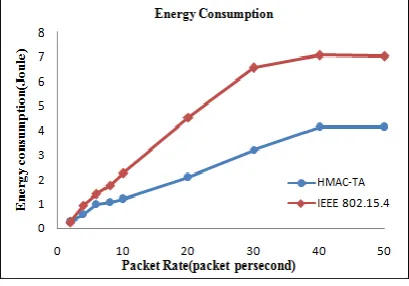
The performance of energy consumption is evaluated for both protocols by varying the traffic contention (packets per second). Traffic contentions are varied from 2 to 50 packets per second. The simulation runs for 100 second. Figure 7 shows that energy consumption of the network increases with respect to the packet rate. Energy consumption for the proposed protocol (HMAC-TA) shows average decrement at 48% for 8 to 50 packet rates and 28% for packet rates below than 6 compared to IEEE 802.15.4.
Fig 7: Energy Consumption versus Packet Rate
The energy consumption for HMAC-TA is less because only nodes that have the token are allowed to transmit the data packet and thus, reduces the possibility of data collision and retransmission. Besides, only node that has the token is allowed to sense the channel condition to avoid unnecessary channel sensing. In IEEE 802.15.4, each node always senses the channel condition if it has data to be transmitted in the medium. In fact, nodes that wake up to sense the channel also contribute to the increment of energy consumption in the network[23].
5.3
Packet Delivery Ratio
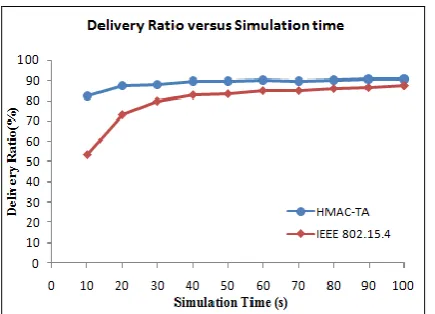
To evaluate the packet delivery ratio, the total number of packets that are received at the destination is divided with the total number of packets that are sent by the sender. As shown in Figure 8, for low traffic contention which is below 8 packets per second, IEEE 802.15.4 standard shows better performance compare d to HMAC-TA protocol. This is due to the fact that the CSMA protocol can send the data if the channel is idle. Meanwhile, in HMAC-TA, nodes have to wait for token before they can transmit the data. However, when the packet rate increases above 10 packets per second, the proposed protocol which is HMAC-TA shows good performance compared to the standard. Traffic contention is improved as the packet rate is increased in the network. Figure 9 shows the performance of packet delivery ratio in terms of time. For this analysis, packet rate is set for 10 packets per second. Packet delivery ratio increases with respect to time and from this figure, it can be seen that HMAC-TA performs better than standard.
[image:5.595.58.275.299.554.2] [image:5.595.323.534.558.702.2]Fig 9: Packet Delivery Ratio versus Simulation time
6.
CONCLUSION AND FUTURE
WORKS
In this paper, we have presented the improve version of MAC IEEE 802.15.4 standard with token approach. The main intention of the proposed protocol is to improve energy efficiency and to provide reliable communication. This protocol is suitable for priority application and emergency scenarios that require the data to arrive safely. We also introduce new idea which is token will generated after two hops neighbour. Through this approach, data can be transmitted faster compared to the transmission that only used one token that circulated inside ring structure. Besides, ring structure is only constructed upon request and token only given to the nodes with data to be transmitted. From the result, it can be seen that high energy efficiency is achieved by utilizing this method. For future work, the proposed protocol which is HMAC-TA will be simulated for the large topology network and network performance in terms of delay will be analyzed. Furthermore, to increase the scalability of the network, this protocol will be extended to support two modes of operation, which are fully CSMA and CSMA with token approach.
7.
ACKNOWLEDGMENTS
The authors would like to thank Ministry of Science, Technology and Innovation (MOSTI) Malaysia, Ministry of High Education (KPT) for the scholarship, Research Management Centre (RMC) for the sponsorship and UTM-MIMOS Center of Excellence for the support and advice. Thanks also to all anonymous reviewers for their invaluable comments and the guest editors who handled the review of this paper. Lastly, thanks to the experts who have contributed towards development of the template.
8.
REFERENCES
[1] Kim, H. and Min, S.G. 2009. Priority-based QoS MAC protocol for wireless sensor networks. IEEE International Symposium on Parallel & Distributed Processing.
[2] Ismail,N.S.N. Yunus,F. and Ariffin,S.H.S. 2011. MPEG-4 video transmission using distributed TDMA MAC protocol over IEEE 802.15. 4 wireless technology,(ICMSAO)
[3] Feeney ,L. M. and Nilsson,M. 2001. Investigating the energy consumption of a wireless network interface in an ad hoc networking environment, Proceedings IEEE INFOCOM 2001. Conference on Computer
Communications. Twentieth Annual Joint Conference of the IEEE Computer and Communications Society. [4] Roy ,A. and Sarma,N. 2010 . Energy Saving in MAC
Layer of Wireless Sensor Networks: a Survey, in National Workshop in Design and Analysis of Algorithm (NWDAA), Tezpur University, India. [5] P. Udayakumar, R. Vyas, and O. P. Vyas, “Token Bus
based MAC protocol for Wireless Sensor Networks,” International Journal of Computer Applications, vol. 43, no. 10, pp. 6-10, Apr. 2012.
[6] Ben-Othman,J. Mokdad, L. and Yahya, B. 2011. An energy efficient priority-based QoS MAC protocol for wireless sensor networks, 2011 IEEE International Conference on Communications (ICC).
[7] Watteyne,T. Augé-Blum, I. and Ubéda,S. 2006. Dual-mode real-time mac protocol for wireless sensor networks: a validation/simulation approach, Proceedings of the first international conference on Integrated internet ad hoc and sensor networks.
[8] Liu, A. Yu, H. and Li, L. 2005. An Energy-efficiency and Collision-free MAC protocol for Wireless Sensor Networks, Vehicular Technology Conference VTC . [9] Heinzelman, W.R. Chandrakasan, A. and Balakrishnan,
H. 2000. Energy Efficient Communication Protocol for Wireless Microsensor Networks, Proc. Hawaii Int. Conf. Systems Sciences.
[10] Warrier, A. Aia, M. and Sichitiu, M. L. 2008 .Z-MAC: A Hybrid MAC for Wireless Sensor Networks .IEEE/ACM Transactions on Networking.
[11] Rhee , I. and Warrier, A. 2009. DRAND: Distributed Randomized TDMA Scheduling for Wireless Ad Hoc Networks, IEEE Transactions on Mobile Computing. [12] Sitanayah, L. Sreenan, J. and Brown, N. 2010.
ER-MAC: A Hybrid MAC Protocol for Emergency Response Wireless Sensor Networks. International conference on sensor technologies and applications. [13] Yahya, B. and Ben-Othman, J. 2009. An adaptive
mobility aware and energy efficient MAC protocol for wireless sensor networks, 2009 IEEE Symposium on Computers and Communications.
[14] Yahya, B. and Ben-Othman, J. 2008. A Scalable and energy-efficient hybrid-based MAC protocol for wireless sensor network. The proceeding of the 3rd ACM workshop on performance monitoring and measurement of heterogeneous wireless and wired networks.
[15] M. F. K. Abad and M. A. J. Jamali, “Modify LEACH Algorithm for Wireless Sensor Network,” International Journal of Computer Science, vol. 8, no. 5, pp. 219-224, 2011.
[16] Dash, S. Swain, A. R. and Ajay, A. 2012. Reliable Energy Aware Multi-token Based MAC Protocol for WSN, 2012 IEEE 26th International Conference on Advanced Information Networking and Applications. [17] Wei, F. Zhang, X. Xiao, H. and Men, A. 2012. A
[18] S. Ray, S. Dash, and N. Tarasia, “Congestion-less Energy Aware Token Based MAC Protocol Integrated with Sleep Scheduling for Wireless Sensor Networks,” World Congress on Engineering 2011, vol. II, pp. 4-9, 2011.
[19] G. Fan, J. Li, W. Liu, and Y. Zhao, “An Enhanced Dynamic Token Protocol for Underwater Acoustic Sensor Networks,” International Journal on Smart Sensing and Intelligent Systems, vol. 5, no. 4, pp. 879-895, 2012.
[20] A. Ahmed and N. Fisal, “Secure real-time routing protocol with load distribution in wireless sensor networks,” Security and Communication Networks, 2010.
[21] L. Man, “Part 15.4: Wireless Medium Access Control (MAC) and Physical Layer (PHY) Specifications for Low-Rate Wireless Personal Area Networks (WPANs) IEEE Computer Society Sponsored by the LAN/MAN Standards Committee I E E E 3 Park Avenue New York, NY 10016-5997,” vol. 2006, no. September, 2006. [22] Sarvakar , K. and Patel, P. S. 2008. An Efficient Hybrid
MAC Layer Protocol Utilized for Wireless Sensor Networks. 2008 Fourth International Conference on Wireless Communication and Sensor Networks, [23] P. Kaushik, N. Patel, and J. Singhai, “Energy Efficient