OPNET based Wireless LAN Performance Improvisation
Rajan Vohra
Department of Electronics
Technology
Guru Nanak Dev University
Amritsar, Punjab, India
Ravinder Singh Sawhney
Department of Electronics
Technology
Guru Nanak Dev University
Amritsar, Punjab, India
Gurpreet Singh Saini
Department of Electronics and
Communication
ARNI University
Himachal Pradesh, India
ABSTRACT
In order to analyze the performance of Wireless Local Area Networks (WLANs) effectively, it is important to identify those network settings that can cause the networks performance to go from good to poor. Low throughput, high packet loss rate, delayed round trip time (RTT), increased retransmissions, and increased collisions are the detrimental attributes to look for, when poor network performance is encountered. In this paper, our main focus is to analyze and evaluate the role of the media access delay as well as processing delay towards the performance of WLANs. The simulation tool OPNET has been used for fine- tuning the WLAN parameters and simulation demonstrate that WLAN performance can be enhanced by tuning different metrics such as buffer size, fragmentation threshold and request to send (RTS) thresholds. In this paper, we emphasized on buffer size and its subsequent effect on service quality. By varying the buffer size to a value other than specified in the standards, will reduce WLAN delay, media access delay with minutest changes observed in throughput.
General Terms
WLAN, OPNET, Video conference
Keywords-
OPNET, Delay, Throughput, Media Access delay
1.
INTRODUCTION
The technological advances in the field of information, communication and technology have pushed the wireless networks in to a league, where these are spearheading the all other current technologies because of the ease, mobility and transmission and reception of the timely as well as secured data. Users are happy to get the timely data and that too without any hassles. The use of the biometric authentication and other improved access mechanisms have improved the security of the wireless networks many folds in recent years but still unauthorized users look for the loopholes in the system and the detection of these loop holes can lead to the exploitation of the media to gain access to sensitive and valuable data. The main objective of the wireless networks has been to establish a secure, fast and reliable communication channel, which can cater to the needs of the users without compromising their convenience and security. The above cited advantages and reasons have made the WLANs more widely recognized as a general-purpose connectivity alternative for a broad range of business customers [1]. Though many standards have been proposed and developed in the last two decades but those really survived and remained acceptable belong to the IEEE 802.11 family which includes the popular 802.11b, the 802.11a, 802.11g and 802.11n. Other standards, such as HIPERLAN and HIPERLAN/2, have been co-existent but don’t find much acceptance. [2][7
]
2.
RELATED
WORK
Many researchers have worked on simulating different WLAN parameters using various simulation tools e.g. Qualnet, OMNET, NS2 as well as OPNET. Also, there exists a wide range of techniques or methods for evaluating and proposing various enhancements in the wireless local area network metrics. The most of the work conducted, has been postulated from both analytic and simulation-based studies carried on mobile communication networks. This section describes a perspective of these methods that have been designed specifically for enhancements and performance evaluation of Wireless Local Area Networks. Previous researches (Amardeep Kaur et.al) focused on improving the performance via network layer and performance optimization has been shown performing a series of simulation tests with different parameters such as RTS/CTS threshold. To reduce the effect of throughput reduction owing to hidden stations, 802.11 specifies as an option the exchange of Request-to-Send/Clear-to-Send (RTS/CTS) frames. Before transmitting a data frame, a station may transmit a short RTS frame, which must be followed by a CTS frame transmitted by the receiving station. The RTS/CTS mechanism is very effective in terms of system performance, especially when large packets are considered, as it reduces the length of the frames involved in the contention process, can be found in [8], in details. Several modifications of the IEEE 802.11 DCF access method have been proposed recently to improve the performance of wireless LANs. (Q.NI et.al)[9] Up to now, such proposals have only been compared under ideal channel conditions (Elena Lopez-Aguilera et.al)[10]. Several investigations have been made with different methods for improving the performance of WLANs, Such as Adaptive (rather than basic) back-off algorithms in the MAC Layer, proxy approaches in the link-layer, such as snoop protocol, and TULIP , Split-connection approaches, such as I-TCP or M-TCP and Other link-layer approaches, such as AIRMAI[11-13].
Our paper focused on the buffer size parameter of wireless Local Area networks in various simulated environments using OPNETTM [3]. This Paper has been based on modeling and simulating a WLAN scenario and it has been verified that WLAN performance can be improved by fine tuning buffer size parameter. By varying the buffer size to a value other than specified in the standards gives remarkable reduction in WLAN delay and media access delay. [4-7]
3.
OUR
APPROACH
simulations because of the several benefits it offers over the other contemporary tools available. OPNET provides the set of complete tools and a complete user interface for topology design and development. Another advantage of using OPNET is because of the consensus among the network fraternity in the validity of the results produced. OPNET enables realistic analysis of performance measures and the effectiveness of wireless network design techniques.[3,15]
4.
SCENARIOS
AND
SETTINGS
[image:2.595.336.557.86.307.2]In this section, we consider the case of two scenarios in which two independent wireless LANs workstations are connected. Here, these workstations are configured for the videoconference application only as in figure 1. In scenario 1, workstations are operated at 11 Mbps data rate and in scenario 2, workstations are operated at 1 Mbps data rate. Two different scenarios and settings have been considered to optimize the network. [14]
[image:2.595.48.286.251.495.2]Figure 1. WLAN Network video application configured for 11 Mbps and 1 Mbps
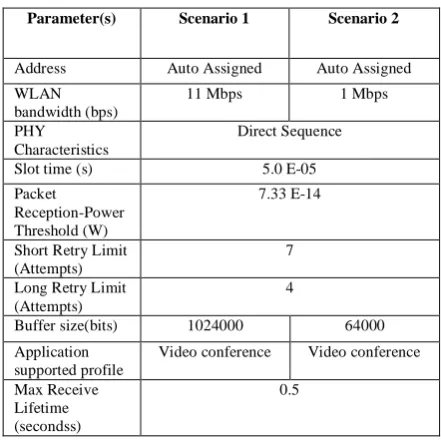
Table I shows the parameters, which are used in different scenarios for simulation. Parameters shows that we use PHY characteristics as Direct sequence, buffer size(bits) 1024 kbits and 64 kbits for scenario 1 and 2. Bandwidth used for the WLAN for scenario 1 and scenario 2 is 11Mbps and 1 Mbps.
Table II shows the wireless Lan traffic generation parameters for both the scenario. Duration used in the scenario is End of simulation , start time (seconds) are uniform (100,110) ,repetition pattern in the scenarios is serial ,numbers of repetition is constant and rest of the parameters used are listed in table below:
Table1 .Simulation Scenario Parameters
Table 2.Wireless lan traffic generation parameters
Attribute Value
Duration End of simulation
Repeatability Once at Start Time
Operation Mode Serial (ordered)
Start Time (seconds) uniform (100,110)
Inter-repetition Time (seconds) constant (300)
Number of Repetitions constant (30)
Repetition Pattern Serial
5.
SIMULATION
ANALYSIS
A simulation model was developed using OPNET IT Guru Academic Edition (2007). OPNET 802.11b PHY module was used as a standard with maximum data rate up to 11 Mbps and PHY characteristic direct sequence was used. The packet size is default. In normal case when workstations are operated at 11 Mbps and 1 Mbps with buffer size of 1024 Kbits in scenario 1 and 2
Parameter(s) Scenario 1 Scenario 2
Address Auto Assigned Auto Assigned
WLAN bandwidth (bps)
11 Mbps 1 Mbps
PHY Characteristics
Direct Sequence
Slot time (s) 5.0 E-05
Packet
Reception-Power Threshold (W)
7.33 E-14
Short Retry Limit (Attempts)
7
Long Retry Limit (Attempts)
4
Buffer size(bits) 1024000 64000
Application supported profile
Video conference Video conference
Max Receive Lifetime (secondss)
[image:2.595.329.560.344.544.2]Figure 2.WLAN throughput (bits/seconds) for normal 11 and 1 Mbps scenarios
Figure 3. WLAN media access delay(seconds) for normal 11 and 1 Mbps scenarios
[image:3.595.324.570.82.343.2]Figure 4.WLAN delay(seconds) for normal 11 Mbps and 1 Mbps scenarios
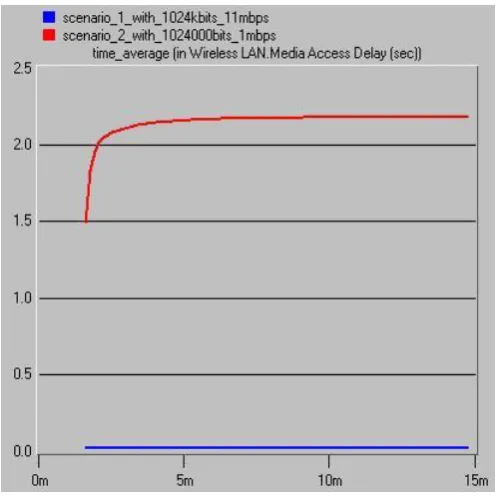
In figure (3-4) WLAN media access delay (seconds) and WLAN delay (seconds) is considered for both the scenarios.In case of figure 3 WLAN media access delay (seconds) is around 0.025 seconds in scenario 1 and around 2.1 seconds in scenario 2. For WLAN delay (seconds) we consider results at 10 minutes in case of 11 Mbps scenario delay is 0.020 seconds and 2.25 seconds for 1 Mbps scenario after that delay remain constant for rest of time.
[image:3.595.44.293.359.608.2]Figure 5.WLAN throughput (bits/seconds) for customized scenarios
Figure 6.WLAN media access delay(seconds) for customized scenarios
Figure 7. WLAN delay(seconds) for customized scenarios
In case of delay(seconds) we observe the result at 10 mins. Delay for the customized scenario as comapre to previous result is decreased as shown in figure 7 value of the delay is 0.113 seconds which is 2.137 seconds less than previous scenario result shows the remarkable improvement in delay.
6.
CONCLUSIONS
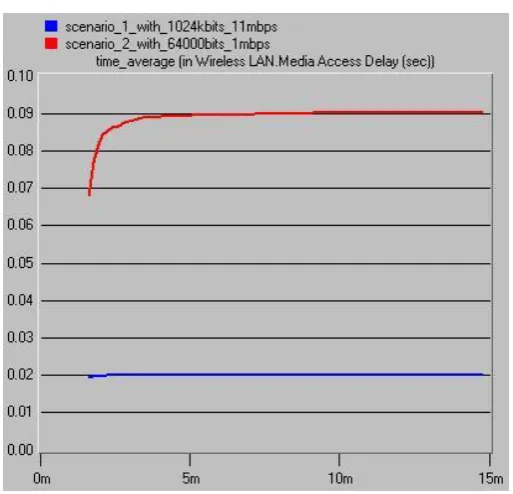
This paper investigates the delay, media access delay and throughput parameters for standard and customized WLAN networks and their comparison thereof. Minute change in throughput has been reported when results of both the scenario are compared. A delay of 2.25 seconds has been reported in scenario 1 WLAN network, while it is 0.113 seconds in case of scenario 2 exhibiting WLAN network remarkable improvement in scenario 2, when compared with scenario 1. Further, the results reveal the media access delays for both the standard & customized networks. It has been observed that in case of network with standard values, media access delay is 2.1 seconds but in case of customized network, it is 0.09 seconds less by the factor of 95% than that of standard network showing tremendous improvement in network performance. Finally, we conclude that the customized network with buffer size of 64 Kbps offer commendable reduction in delay and media access delay with minutest changes observed in throughput, that leads to overall performance of the WLAN network with customized WLAN.
[image:4.595.43.300.348.595.2][4] Wlan_lab_script_1_2 from http:// www.comnets.uni-bremen.de/~mms/wlan_lab_script_1_2.pdf
[5] Walid Hneiti(2006),―Performance Enhancement of Wireless Local Area Networks‖ Amman Arab University for Graduate Studies, Jordan.
[6] Manju Sharma and Manoj, ―Comparative Investigation on Throughput and Client Response Time for a Switched and
Routed Wireless LAN based on OPNET‖ Presented and published in the proceedings of National Conference on ―Emerging Trends in ―Computing and Communication (ETCC-07) at national institute of Technology, Hamirpur, (HP), India during July 27-28, 2007, pp 436-440.
[7] IEEE, ―IEEE standards for information technology — telecommunications and information exchange between systems — local and metropolitan area network — specific requirements — part 11: Wireless LAN medium access control (MAC) and physical layer (PHY) specifications,‖ 1999.
[8] Ms. Amardeep Kaur1, Dr. Sandip Vijay2, Dr. S.C.Gupta3 ―Performance Analysis and Enhancement of IEEE 802.11 Wireless Local Area Networks‖ Vol. 9 Issue 5 (Ver 2.0), pp.130. January 2010.
[9] Q. Ni, I. Aad, C. Barakat, and T. Turletti, ―Modeling and Analysis of Slow CW Decrease for IEEE 802.11 WLAN‖. 14th IEEE Proceedings on Personal, Indoor and Mobile Radio Communications,IEEE PIMRC 2003, vol. 2, pp. 1717-1721. Beijing, September 2003.
[10] Elena Lopez-Aguilera, Martin Heusse, Franck Rousseau, Andrezej Duda and Jordi Casademont,― Evaluating Wireless LAN Acess Mothods in Presence of Transmission Errors‖.
INFOCOM 2006.Barcelona, pp. 1-6, Spain, April 23-29, 2006.
[11] Dr. Mayyada Hammoshi, Mrs. Razan Alani, "A Proposed Model to Implement Load and Throughput of WLAN Implemented as Wi-Fi System", JCIT: Journal of Convergence Information Technology, Vol. 5, No. 7, pp. 100 ~ 111, 2010.
[12] M. Heusse, F. Rousseau, R. Guillier, and A. Duda, ―Idle sense: An optimal access method for high throughput and fairness in rate diverse wireless LANs,‖ in Proc. of ACM SIGCOMM 2005, vol 35; NUMB 4, pages 121-132, August 2005.
[13] Mrs. Razan Al-Ani, "Simulation and Performance Analysis Evaluation for Variant MANET Routing Protocols", IJACT: International Journal of Advancements in Computing Technology,Vol. 3, No. 1, pp. 1 ~ 12, 2011.- 163
.
[14] Rajan Vohra, R.S.Sawhney and Shikha, ―WLAN Metrics Enhancement Using Buffer Size Optimization‖ published in ―International Journal of P2P Network Trends and Technology‖, Volume1Issue2- 2011, pp 22-25.