The transfer of statistical equilibrium
from physics to economics
Parrinello, Sergio and Fujimoto, Takao
Università di Roma "La Sapienza", Okayama University
1995
Online at
https://mpra.ub.uni-muenchen.de/30830/
THE TRANSFER OF STATISTICAL EQUILIBRIUM
FROM PHYSICS TO ECONOMICS
Sergio Parrinello (University of Rome “La Sapienza")
and Takao Fujimoto (Okayama University)
1995
ABSTMCT
Two
applications
of
the
concept
of
statistical
equilibrium, taken
from
statisticalmechanics, are compared: a simple model
of
a pure exchange economy, constructed asan alternative to a walrasian exchange equilibrium,
and
a simple modelof
an industry,in which
statisticalequilibrium is
used asa
complementto
the
classicallong
periodequilibrium.
The postulateof
equalprobability
of
all
possible microstatesis
critically
re-examined. Equal probabilities are deduced as a steady state
of
linear and non-linear2
Introduction
The
concept
of
statistical
equilibrium
is a
fundamentalanalytical
tool
in
physics and
particularly
in
statistical mechanics.After
having borrowedthe
classicalmechanics concept
of
equilibrium,
economic
theory has
occasionally
turned
itsattention
to
the
other
concept
of
probabilistic equilibrium.
In
fact,
since
thecontributions
which
appearedin
the
50s andthe
early 60s
it
is
only
recently
thatserious
attemptshave
beenmade
to
revise
and
develop
the notion
of
statisticalequilibrium
in
economics. Past contributionsinclude
Champernown(1953),
Simon-Bonini
(1958),Newman-Wolf
(1961) and Steindl (1962) and weremainly
related toGibrat's Law
(1931)
andto
Paretodistribution.
Recentworks,
explicitly linked
to thermodynamics, areE.
Farjoun
-
M.
Machover(1983)
and, in paficular,
Foley (1991, 1994) .In
economics a statisticalequilibrium is
a most probable distributionof
certain economic entities (say firms or individuals) which cannot all be distinguished onefrom
another, rather
than a particular configuration
in
which
eachentity is
identified.
In
other words,
this
equilibrium
is
a
macrostatewith
maximum numberof
realizations(microstates) and, as such,
is
a distinct
conceptfrom
a
state obtainedby
the
simpleinclusion
of
some random
variable
in
the
relations
which
determine
a
classicalequilibrium.l
In
thiswork two
applications of the conceptof
statisticalequilibrium
toeconomic theory
will
be formulated and compared using simple models. Furthermoreit
will
be
shown
that, under sufftcient
conditions,
a
state
of
equal
probability
of
microstates - a basic postulatein
statistical mechanics-
in the long period is consistentwith
unequal transition probabilities.In
section
1 the
first
application
is
a
model
of
a
pure
exchange economy, constructed as a special caseof
Foley's (1994) modelin
which
statisticalequilibrium
appears
as an
altemative
to
the
Walrasian
equilibrium.
In
section
2
the
secondapplication
is
a
model
of
an industry
in
which
statisticalequilibrium
is
usedas
acomplement
to
the
classicallong
periodequilibrium.
It will
be
arguedthat
only
thelatter application maintains the notion
of
statisticalequilibrium
adoptedin
thefield
of
physics; whereas the former differs fromit
on an essential point and resolvesitself
intoa
concept
of
equilibrium
similar
to
that
of
temporary
equilibrium
adopted
in
economics.
In
section3
the
postulateof
equalprobability
is re-examined
and
a simple case of linear Markov chains is presented, in which equalprobability
is a steadystate
of
a
stochasticprocess.
In
section4
this
uniform probability
outcome is generalizedto
non-linearMarkov
chains, applying a theorem provedby Fujimoto
and Krause (1985).Let
us
make
a
simple
exampleof
statistical
equilibrium
for
an
exchangeeconomy, as
a
special caseof the
statisticaltheory
of
markets developedby
Foley(1991-1994). In this theory the elementary unit of analysis is the
individual offer
set :"The marlret
beginswith
agentsdefined
by offer
setsreflecting
their
information,technical pos sibilitie s, endowments and preferenc e s " (p. 3 2
4.
"In
termsof
standard production-exchange model,...., offer sets consistof
technicallyfeasible
transactions leading toJìnal
consumption bundles that arepreferred to
initial
endowments" ( Foley p.32a)
Suppose
that
there are
only
4
agentse,o2,bt,b2
and
two
goods
X,Y
thequantities
of which
are measuredby
integers. There is a totalof
4 unitsof
goodX
and4
of
goodY
which
are equally distributed at the beginning: eachindividual
therefore has an endowment of one unit of each good. V/ewill
athibute to the agents very simple preferences: agerrtsar,a.,
like
goodX,
but
areindifferent
to
goodY;
whilst
agentsbr,b, like
goodY,
but
areindifferent
to
goodX. An
agent's transactionis
a vectorof
quantitiesof
thetwo
goodswith
a plus signto
indicate a net acquisition, a minus signfor
a net cession and zeroif
theinitial
endowment is maintained.The
offer
setof
an agent is the set of transactionswhich
areweakly
preferableto and feasible for
him
in relation to hisinitial
endowment. In Foley's model theagents
that
havethe
sameoffer
set are considered indistinguishable and represent atvoe
of
asent.In the figures below the lattices represent parts
ofthe
offer sets ofagentsoftype
A
andB
as
feasible transaction
sets.The
null
transaction
(0,0)
is
included among
theType A
2
Type B
In
the
examplewe
can thereforefind two
typesof
agents:type
A
(to which
ar,a,
belong) and type
B
(to whichbr,brbelong).
These types can be identified by theiroffer
sets
which
are
distinct
asfar
astheir
preferences are concemed,but not
for
their
endowments.
Table
I
describes the feasible microstates of the exchange economy.TABLE.
I
(0 0)
(r
-1) (-1l)
ar ra, ,br rb,ar rb qr b,
Ar,b. a1 b1
a"b, al b.,
arb, ar b1
0t ,Cl, br,b,
It
isto
be noted that no exchange takes placein
thefirst
microstate and each agentin
the last one acquires one
unit
of
his preferred good against oneunit
of
his indifferent
good.
In
the otherfour
microstatestwo
agents make one preferred transaction,whilst
the other
two
remain in theirinitial
position.Let us
consider
the
feasible
statistical
aggregatesor
macrostatesof
theexchange
economy
by
treating
agentsof
the
sametype as
indistinguishable
and [image:6.604.65.523.60.290.2]we
find
three macrostates,two
of which are madeof
only one microstate (thefirst
and the last one represented in tableI)
and one made by four microstates (the others).Let us assign equal probabilities to all feasible microstates.
A
statisticalequilibrium
is
a macrostatewith
maximumprobability, that
is with
themaximum number
of
feasible equally
probablemicrostates.
In
the
example thismacrostate is the one
with
four microstates, in which, for each typeof
agent, one of thetwo
benefits from the exchange by acquiring aunit
of his preferred good andby giving
up a
unit
of the indifferent good, whilst the other agent remains at the status quo.A
market statistical equilibrium in the model developed by Foley possesses thefollowing
interesting featuresthat
contrastwith
those sharedby
a
walrasian generalequilibrium:
1.In general
it
is not Pareto-efficient;2.It
doesnot
imply
auniform
exchange ratio betweeneach
pairof
commodities overall
transactions;
3.A uniform
entropy priceis
associatedto
eachgood:
this
priceis
a shadow pricedetermined
by
solving
an entropymaximizing
problem under thetotal
endowment constraints.Property
I
is
straightforwardin
our exchange model, as the most probable macrostateis Pareto-inferior compared to that in which all the agents obtain a
unit
of the preferred goodin
exchangefor
the other good. Instead properties2
and 3 are not evidentin
this simple model andwe
shallnot
be concernedwith
themfor
the sakeof
thefollowing
argument.
It
should
be
emphasizedthat
the
statistical
equilibrium
of
the
exchangeeconomy
is
determinedby offer
setsthat
dependon the
initial
endowmentsof
eachindividual.
In
general
the
offer
sets undergo endogenous changeif
the
economy is conceivedin
real time. To make this point clear,it
is
suffrcientto
assume that thetwo
goods are
non
perishableand
that the
economyis
subjectto
two
trials
and two
corresponding observations. Let us suppose that the
following
microstate is realizedin
thefirst trial:
Then at the second
trial
the individual endowmentwill
differ
from that at the beginningof
thefirst
trial.
Therefore the typesof
agents and the numberof
each typewill
differ
macrostate
which
has beendefined
as statisticalequilibrium
at the first
trial
islonger so at the second.
At
the secondtrial
each agentwill
represent a distinct type:a, with
endowments(1,1)
and offerset
{(0
0)
(l
-l)
(2 -l)...\
a,
with
endowments (2,0) and offerset
{(0 0)}
ór
with
endowments (1,1) and offerset
{(0
0)
Cl
1)
Cl
2) ....} b2 wfth endowments (0,2) and offerset
{(0
0)};
At
the secondtrial
the agentsar,
b,
prefertheir
respectiveinitial
endowmentsto
the outcome of any feasible transaction; whilst the agents ar,b,
prefer any positive amountof the preferred good
in
exchangefor
theunit
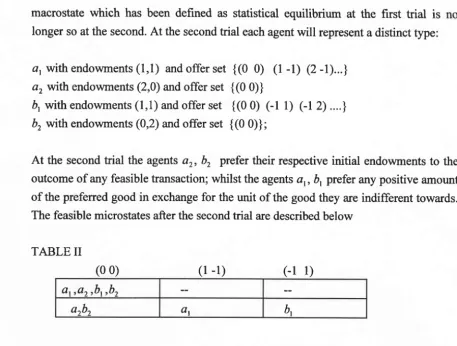
of the good they are indifferent towards. The feasible microstates after the secondtrial
are described belowTABLE
II
(0 0)
(l
-l)
(-l
1)ar ro, ,br rb,
o"bt qr bl
From the statistical
point
of
view
the sample space has changed. Thetwo
microstatesin table
II
each haveprobability
ll2
at eachtrial.
Howevef, as the trials are repeated anindefinite
numberof
times,the
second microstatewill
be
realizedwith probability I
and
when
that
happens
the
economy
will
have
reached
a
Pareto-efficient configuration.2At
that point theof[er
setof
each agentwill
be represented by thenull
vector (0,0), that is by the absence of any further transaction.
One
may
well
ask whetherthe
statisticalequilibrium
of
exchange, as defined above, preservesthe
conceptof
statisticalequilibrium
in
physics.The
answeris
no.The latter has the relative persistence
of
its determinantsin
commonwith
the classicalequilibrium
in
economics;
by
contrast,
the
statistical
exchangeequilibrium,
asillustrated
in
the
example, doesnot
possessthis
prerequisite andfrom this point
of
view
it
is similar to
the conceptof
temporaryequilibrium
in
economics. Furthennore,if
the modelof
statisticalequilibrium
of
the exchange economyis
interpretedin
realtime,
it
becomes
a
model
of
statistical disequilibrium,
with
certain
transitionprobabilities
that
imply an
absorbingmicrostate.
This
state
is a
Pareto-efficient2In a certain sense the agenl.s ar,a2,b1,b, cottld not be distinguished into type A and B right from the very first
trial if "distinguishability" also requires "observability". In fact at the beginning all agents have the same initial
[image:8.612.75.532.66.411.2]equilibrium.
The stochasticfeature
is
inherentonly
in
the adjustment(or
relaxation)process but not
in
thefinal equilibrium
of the exchange.In
a more general modelwith
many Pareto-effrcient microstates, we
would
find
a problemof
indeterminacysimilar
to
the
onefound
in
a Walrasian exchangemodel
if
we
assume that transactions canoccur at
disequilibrium
pricesin
the
adjustment process towardsequilibrium.
In
thiscase
the
convergenceof
the
stochastic process towardsa
Walrasianequilibrium
is possible,but
in
generalthis equilibrium
state isnot
a walrasianequilibrium relatively
to
the
initial
endowments.As
a
consequence,the
statistical exchangeequilibrium
is"statistical"
only
becauseit
is reachedby
a successionof
stochastic disequilibria whenit
is stable, butit
is not statisticalin
so far asit
coincideswith
a microstate which takesprobability
I
at thelimit.
2.
A
model of stotisticol eauilibrium of the industrvNow we
shift
to
a morepoúe
applicationof
statisticalequilibrium.
Let
us supposenow that an
industry
is
in
a
long period
competitive
equilibrium,
under constant retums to scale at thefirm
level. Suppose that its product can takeonly
integer numbers 1,2,3,...Let
Q be the quantity produced andN
the number of firmswhich
canproduce at
the minimum
cost perunit of
output.With
these hypotheses,if
D
is
the demandfor
the product atthe long
period prices, the theoryof
classicalequilibrium
determines Q from the equation
Q:
D, but does not determine the size of eachfirm.
Let us
considernow the
feasible microstatesof
the industy which
can
be obtainedby
distributing
in
every possibleway
theN
firms
among the possible sizes measuredby the
quantities 0,1,2,3....In
orderto
illustrate
this we
will
present an example similar to that used byothers (A.
F.Brown,
1967) to introduce the conceptof
statistical
equilibrium
with
referenceto
thedistribution
of
a given
amountof
energy amongagivennumberof
particles of aperfect gas.Letus
assume
Q:3;
N:4
andI
TABLE
III
Firm
size measured by amounts of outputt2
1l (a) (b) (c) (d)
2l (a)
(b)
(d) (c)3l
(a)
(c)
(d) (b)4l
(b)(c)
(d) (a)sl (a) (b) (c) (d) 6l (a) (b) (d) (c)
71(a)
(c) (b) (d)8l
(a)
(c) (d) (b) el(a)
(d) (b) (c)101
(a)
(d) (c)o)
l
ll
G)
(c) (a) (d)I2l
(b)
(c) (d) (a)131
(b)
(d) (a) (c)r4l
o)
(d) (c) (a)151
(c)
(d) (a) (b)161
(c)
(d) (b) (a)t7l
(a)(b)
(c)
(d)181
O)
(a) (c)
(d)lel
(c)(a)
(b)
(d)201
(d)(a)
(b)
(c)Let
us
adopt
the term
"macrostate"to
indicate
a
statistical
aggregateof
microstates (a distribution), obtained by assuming that the firms are not distinguishable
from
each other. The firms are not distinguished either because we are not interestedin
their identification
or
becausethey
cannotbe
distinguished.In
our
example three macrostates of the industry are feasible- three inactive
firms
and afirm of
size 3;J
[image:10.612.57.578.71.774.2]-
two
inactivefirms,
asize-l firm
andasize-2frmr;
- one inactive
firm
and threesize-l
firms.The
first
macrostateis
generatedby
thehrst four
microstates; the secondby
the next12 and the
third
by the last four.In the general case let us indicate
n:
(no,n1,/t2,....,ne)
a feasible macrostatein
which
nofirms
are size0, n, firms
are size|,....,no
firms
are size Q on the condition thatno+nt*nr*....nn=N
(l)
Let w(n) be the
number
of
feasible
microstates
with
distribution
n :
(no,nr rÍ12,....rflg).
Combinatorial analysis gives
rr(n)= . .t'.
,nolnrlnr!...nn1,
where by convention
0!:1.
(2)
A
macrostaten:
(n0,nr,fi2,....,flg)
is
feasibleif
it
satisfies, besides theequality
(l),
the conservation condition of the total quantity Q
Ùno
+ln,
+2n,
+'..+
Qro
=
Q
(3)The total number of feasible microstates is
z
=lw(n),
with
summation over all macrostut",whiclisatisfr
(1) and(3).We may have an idea of the order of change in
w(n)
in response to variationsin
n,
as the numberof firms
isslightly
larger than the number representedin
the table,if
we assume3
N:
20
andQ:20.
In this case, wewill
have for the macrostate made upof
8 inactivefirms, 6
size-l frrms, 4 size-2firms
and2
size-3 firms:201
w =
-
=2x10⁸.
8t6l4t2l
By
contrast for the macrostate in which all the firms are of auniform
size equalto
I
wefind
201
w- '-1.
201
It
is clear how enormous the difference is between themultiplicity
of microstates in thefirst
case,
which
representsa
decreasingdistribution
comparedwith the
single10
microstate
with a
uniform distribution. So
far we
have
followed
combinatorialanalysis.
To move onto the
conceptof
statistical
equilibrium we
have
to
assume aprobability
distribution.
In
statistical physicswe find
morethan
one assumptionof
probability on this point.
In
the so-called Maxwell-Boltznann distribution
equalprobability is
athibuted to each microstate; different assumptionsof probability
can befound, however, at the basis of the Bose-Einstein and of the Fermi-Dirac distributions.a
V/e
will
adopt the Maxwell-Boltzmann hypothesisof
equiprobabilityinitially
as an apriori;
then wewill
obtain this uniform probability from other assumptions.In
the
example illustratedin
table
III,
each microstate hasprobability
1/20;whilst
the three macrostates have respectively probabilitiesl/5, 315,ll5.
The statisticalequilibrium
of
the industryis
the second macrostatewith
probability
3l5.In
this
casethe small number
of
microstates, usedfor
the purposeof
the exposition, doesnot
yetenable
us
to
attribute a useful theoretical roleto
this equilibrium
macrostate.In
fact statisticalequilibrium
needs asufficiently
large numberN
(atypical
case is thatof
the particlesof
gas consideredin
statistical physics).In
general,in
orderto
determine!,
thefollowing
maximum problem hasto
be solvedmaxr.r,(n)
=noftt*-"ne
nolnrlnrl...nnl
subject
to
no + ntt
n2r....nn
=
N
Ùno
+ln,
+2nr+...+Qnn
:
Q.By
adopting asimilar
demonstration to that givenin
statistical physicss, thefollowing
solution,
as
shown
in
Appendix
I,
can
be
obtainedby
an
approximation
in
thecontinuum and for
N
and Q large numbers.N!
e-pt
4 = ^i o
I
s =
o,1,...,e.
S
tv--F"
L/
s=0
(4)
with
p =
l^(I
+
where
ln
is the natural logarithm.;)
>0.
(s)
4 For a comparison of Maxwell-Boltanann's, Bose-Einstein's and Fermi-Dirac's so-called statistics, see
W. Feller (1970).
Hence
the
mostprobable
macrostaten
is
a
distribution
offirms
which
decreasesaccording to a geometric progression as the size increases; as
no nl
...,....nr_,
=
",
.
(6)nt
n2 neFrom (5) we obtain
eF
-r
Having reached
this
result, theinitial
assumption that Q, the quantity producedby
theindustry,
is a
quantity
in
non-statistical classical
equilibrium,
determinddon
the demand side, becomes important. SubstitutingQ:
D in
(7), we obtain:eF
-l
Equations
(6)
and
(8)
showthat
asthe
demandD
increases,
ceterisparibus,
the coeffrcientp
decreases and, therefore,the
dispersionof firms
among classesof
everincreasing size grows.
It
is worth noting
that theratio
DA.{,
demand per numberof
ftrms, plays
a
similar role
to
that
played
by
temperatureT
in
the
correspondingphysical problem determining the most probable
distribution
of
particlesor
harmonic oscillators among a certain amount of energy.Entroplt
We can interpret the
equilibrium
of the industryin
termsof
entropy.Let
p,
be theprobability
ofmicrostate
i;
and let us measure the improbabilifyof
microstatei
by
the logarithm
010
J-XI,---LrLp..
P,
tWe can then define entropy
S(n)
of ttre macrostate n the averageimprobability of
the microstates of whichit
is composed, where the weights are the probabilitiesp,:
O_
N
(8).
D
N
(7)
w(n)
S(n)
: -I
L
1,2
If
all
microstatesin
the macrostaten
haveprobability
p,
nis
the entropy
of
S(n)
=
!^*6)
and
the
entropy
of
a
most
probable
macrostate
n is S(n) = I*
w
(n).
Therefore
s
statistical equilibrium of
the industryis
a
macrostatethat
has maximum entropy; hence, under the assumption of equal probability, a macrostatewith
maximumh/(n)
number
of
possible realizations.As
N
increases,the
ratio
;
decreases,whilst
t)
lxù
rnl(n)----n-
tendsto
1, where mis
the total numberof
microstates. Then,for
N
large,Lnm
the
entropy
of
the
industry
in
its
most
probable
state
can
be
written
n
S(w(n)
) = lnn.
Since
the
improbability
of.
a
macrostate
n
is0m0n
LrL-
- Ln m-dn
w(n),
we
canalso
saythat
for
a
largeN
a
statisticalw(n)
equilibrium belongs to a set of macrostates
with
almost zeroimprobability,
in the sensethat
w(n)turns
out
incomparably greater
than
w(n)
associatedwith
any
othermacrostate n outside the equilibrium set.
This property means that a macroscopic regularity
(equilibrium)
existsin
termsof
firm
distribution.
Suchregularity
emergesin
real
time,
if
we
supposethat
the number ofpotential
firmsN
and the quantityin
demandD
are stationary.A
statisticalequilibrium
can therefore be consideredlike
the imageof
afilm,
which is
made upof
the same perceived scene repeated on a large numberof
frames, interspersed every sooften
with
picturesof
other scenes: when thefilm
is run
at asufficiently high
speed,the viewer
is
hardly
awareof
theseodd
scenesat
all, whilst
he perceivesthe
main. scene.Leaving
this
metaphorto
one side,
it
must
be
stressedthat the notion
of
statistical
equilibrium
which has
been formulated here, does
not
substitute
theclassical
equilibrium
of
the
industry,
but
it
does
presupposeit
and
standsas
a complementto it. In
fact the stationarityof
Q is not
a physical necessity(like
energy conservation), but rather a propertyof
classicalequilibrium
in
which
Qis
determinedby
theeffective
demand at thelong run
competitive prices.It
is
to
be noted that thestationarity of the most probable distribution of firms hides an incessant movement at a
microeconomic level:
if
it
were possible to observe the trajectory of eachfirm
(a not soimpossible task compared
with
the caseof
a trajectoryof
a particlein
physics) over asuffrciently long period, a
ftrm
would be
seento
move throughthe whole
rangeof
1
sizes and the industry would pass through
all
feasible microstates. Thiswould
be truein principle.
In
economics, asin
the physicsof
gas, the numberof
units involved hasto
belarge
for
this
conceptto
beof
usefor
the analysis. Thusin
the modelof
the industrythe number
of
firmsN
has to be large enough.It must be noted, incidentally, that thereare some
diffrculties
in
observingN,
in
sofar
as manypotentially active
firms
areinactive
in
equilibrium. Also
the quantity Q,which
is measuredby
integers, hadto
be assumedto
be largefor
the pu{poseof
the
solutiongiven
in
appendixI.
Clearly
theproblem of the numerosity
of
Q differs from the one concerningN,
asit
does not seem so harmful to assume a suffrcientdivisibility
of the product.3. The choice of the sample space and the assumofioh of eaual
probability
In all main formulations of the method
of
statistical equilibrium inphysics
(theMaxwell-Boltzrnann
distribution, the Bose-Einsteindistribution
and the Fermi-Diracdistribution),
a
setof
feasible microstates(the
sample space)is
definedat a
certainlevel
of
analysisand then
equalprobability
is
assignedto
these microstates. This analytical level is chosen on the basis of thelogic
of the problem,of
a separate theory orof
anintuition,
the usefulness of this choice being tested by its predictive capability.In
applying the statisticalequilibrium
approach,two
methodologicalpitfalls
should beavoided.
With
respect to the phenomenon under investigation: a) the assumed sample spacemight
lack
persistency andb)
the
assumed microstatesmight not
have equalprobability.
Let
us
examine
now
the
applications
of
the
statistical equilibrium
approach
to
the
exchange economy (section1)
andto
the
economyof the
industry(section
2)
atthelight
of the above criterion.In
the
applicationto
the
exchange economy,the
choiceof
the
sample space and the hypothesisof
equalprobability
must be assessed on the basisof
someimplicit
assumption
of
"rational" individual
behaviour.sIn
this
caseit
is
hardto
explainwhy
the
probability
of
a
Pareto-effrcient microstateis
and remainsnot
greaterthan
theL4
probability
of
anyinefficient
microstatewhich
werenot
Pareto-inferiorto
the
initial
state.
For
example,the
microstate describedin
the
first
row
of
Table
I
does notrepresent any Pareto-improvement,
but
it
has, nevertheless, been athibutedthe
sameprobability
as anyof
the other microstates (describedin
the other rows) that doin
factimply
an
improvement. We
observethat the latter
problem preventsthe
exchangestatistical
equilibrium from
strengtheningits
theoreticalrole
in
thefollowing
case,'inwhich
the
diffrculty
arisingfrom
the non-persistenceof
theinitial
endowments doesnot arise.
In
the pure exchange economy let us assume the goods to be labour services, insteadof
durable goods, and theinitial
endowments to be made uponly of
persistentlabour capacities
of
workers to provide those services.By
this hypothesis,if
we assignall
the
feasible microstates equalprobability,
it
is
possibleto
formulatea
statisticalequilibrium
for
the
exchangeof
labour servicesin
realtime,
insteadof
a temporary statisticalequilibrium.
In
spiteof
this,
therestill
remainthe
same objectionsto
thehypothesis
of
equalprobability:
asif
on eachtrial
the agents describedby
the modelwould
lookfor
each other and acceptwith
equal chance any transaction which does notentail
an inferior position
for
them,
comparedto
the
absenceof
exchange. Therationality
of these agents seem to be minimal.It
would be more reasonable to attributeequal
probability
to
those
microstateswhich
imply
Pareto-efficient allocations
of
labour-services and lower probabilitiesto
all
the other microstates?. Unfortunately no generalcriterion
seems to be available apriori for
assigning non-uniform probabilitieswithin
exogeneously given offer sets.Also in
the application to the economyof
the industry, illustratedin
section 2,the
appropriatnessof
the
choice
of
the
sainple spaceand
of
the
equalprobability
assumption can be questioned, albeit for different reasons. .
On the one
hand,
we observe that the choiceof
the sample space, madeof
all
possible microstates of the industry, belongs to
the
general model of placing randomlya
given
number
of
balls
(firms)
in a
given
number
of
cells
(firm
sizes);
then aggregation runs by treating the balls as indistinguishable, whereas the cells are kept asdistinct
entities.I
This
modelmight not
be appropriate,if
the distribution
of
manycustomers among
many
firms
is
an essential
elementin
the
enumerationof
the microstatesof
a production systemwith
exchange.
Supposefor
simplicity
thatin
themodel
describedby
TableIII
there are three customers and each customer demandsone
unit
of
outptut,
asif he
would
represent an economic "quantum".In this
case,7 Foley himself in his working paper (Foley, l99l) assumed as feasible only those microstates which
imply Pareto-superior and efficient allocations.
many microstates
listed
in
tableIII
must be re-interpretedas
composed events:for
instance
row
1would
stiill
describe
a simple eventwith
a single realization,in
which
firm
(d)
supplies one
unit
of
output
to
each customer, whereasthe other
firms
(a),(b),(c) are
inactive;
by
contrastrow
5
would
describe a composedevent
with
3rcalizations, as
firm
(c)
can supply oneunit
of
outputto
eachof
the three customersaltematively,
whereasfirm (d)
suppliesone
unit
to
eachof
the
two
residrlalcustomers
and
firms (a),
(b)
remain
inactive.
From
this
perspective,
many microstatesin
TableIII
should be conceived as macrostates that must be decomposedin
further
microstatesby
replacing
the occupancymodel
of
balls
and cellswith
amodel
that
counts
all
possible
ways
for
assigning
three
quanta, initially
distinguishable,
to
four
particles,
initially
distinguishableas
well.
Only at
thisextended
micro-level, the
equalprobability
assumption shouldbe applied
and thedefinition
of the macrostates should be chosen.On the
other
hand,
the
equal
probability
assumptionrefers
to
absoluteprobabilities.
It
remainsto
be proved that a stateof
uniform
absoluteprobability is
a steady state outcomeof
a stochastic process and that this outcome is independentfrom
the
initial
probability
vector.In
particular,in
the
industrymodel,
gradual structural changes could be more probable than major alterationsin
the sizeof
thefirms
duringthe
sameperiod
of
time.
Thus,
in
the
example describedin
Table
III, it
can
be supposed that,if
theinitial
microstate is the one describedin line
I
(with
flrms
a,b,c,inactive and
firm
d
of
size 3),it
can be more probable that microstate 5(with
firms
aand
b
still
inactive,
f,rrmc
af
size
I
andfirm
d
at
síze2)
will
be
realizedin
thefollowing trial
than microstate2 (firms
a,b,d inactive andfirm
cof
size 3). However,under certain assumptions, these unequal conditional probabilities are compatible
with
equal
absolute
probability
of
all
possible
microstates.
In
particular
it
can
beimmediately proveds, using the theory
of Markov
chains that,if
thetransition
matrix
is
given andit
is
adoublv
stochastic andprimitive,lo
thenall
microstates take equalprobabilities
atthe
limit
of
a
seriesof
repeatedtrials
andthis uniform probability
isindependent
of
the
initial
microstate(or,
more
generally,of
the
initial
probability
vector).
A
special caseof
doubly
stochastic transitionmatrix
arisesif
we
assume thatreversibility
existsin
theprobabilistic
sense between eachpair
of
microstatesof
thee See Feller (1970), chapter XV page 399; and Seneta (1973). 10
Let
pii
be the transition probability from microstate i to microstatei
in one trial and let"
= t;l1) the mxmL6
industry at each
trial;
that is theprobability
that the microstatei
occurs,following
therealizatíonof
the microstatej,
is the same as the probability thatj
occurs,following
therealization
of
i.
This
hypothesisis
representedby
a
mxm
symmetrical transition matrix.In
thenext
sectionit
will
be proved that equal probabilities can be deduced asa
limit
property under assumptions less restrictive than that of double stochasticity.4.
Equalprobabílity through
non-línearMarkov
chainswith
lagged variables.Let us introduce time
lags
andwrite
xr*l
= f(x,
,xr-,,....rxt-^)
for
t
= 0r1r2,....The
vector
x,
=
(r,r ,xp1...exs,)'
shows the absoluteprobability x,,
of microstatei
in
period
f
.
A
prime
indicates transposition.V/ith
no
fearof
confusion,we
alsowrite
î
=(ft,fz,...,fn)'
. Let
X,
=(x,-,
,xr-m+',...,Xr)'.
When
the
given
function/
is homogeneousof
degree onein
each vector variable and continuously differentiable,the above equation is now written as
Xr*r
=AX'
O)
where
A
is(ram)by
(nxm) and010000
001000
0001
A=
,,r^,
"tt-tl
:
:
.
fO,
A
typical
elementof
F(*)
1,--òl-.
"
úr-k,i
To apply the
Propositionin
AppendixII,
the assumptions we now make are:Ass
l. f
is non decreasing in each variable.Ass2.
f,
is homogeneous of degree one.F(t)
has at least onepositive
diagonal enfry. Ass 4. e =f(e,e,...,e),
where
e =(l
In,
I I n,...,11n).
Originally,
f
is defined on a subsetof
Bl.'
because
x, is a
vector
of
probability
distribution.To
satisfi
Assl,
f
isfirst
to be extendedto
thewhole
ni*'
in anatural
way. Ass 3 is
to
assure theprimitivity of
the process, i.e. thematrix
A;
while
Ass
4
requires
that
if
the
equal probabilities have been
observedin
theconsecutive
m
past periods,then
that
situation
be
continuedas
an equilibrium.
It
should be noted that this is more general than the assumption
of
double stochasticityin
the
linear case. More
importantly, the equaldistribution
of
the presentperiod is
notenough to enswe the equilibrium state to be repeated.
Now
we can apply the Propositionin
AppendixII,
and can assert that startingfrom any
Xo
in
B1*^,
the
process(p)
,
i.e. X,*,
=AX,,
yields
a
serieswhich
converges to a unique
X*.
By the special formof A,
we can deduceX*
:
(x*,x*,
...,x*).Finally
by Ass4,
x*:
e
if
eachx*
should be normalized so thatit
belongs to theunit
simplex.
With
time
lags being introduced, a more natural interpretationof
the model isnow possible. That is, a society has a chain
of
memory, and accumulate the experienceof
shift from
one microstateto
another, and thesepiled up
"experience"or
"memory"affect the transition probabilities most plausibly
in
non-lineat
way.
Besides,in
thelinear case, the speed
of
convergence is quick and at a geometric rate.Let
us hope this nice property continuesto
hold
alsoin
the non-linear case, and establishesthe
equalprobabilities
in
ablink
as Nature may wish. Nature somehow seems tolove
"equality"or at least equal opportunities for all.
Strong ergodicity in the case of nonlinear positive mappings has been extended
to
the
transformationson
Banach spaces (seeFujimoto
and Krause
(1994).
The arguments above can hence be carried overto the
spacesof
aninfinite
dimension.It
may
serve
also
to
give
a
lower-level
foundation
to
the
equal-shareprinciple in
thermodynamics and,
in
spirit, to that in quantum theory.5.
Fìnal
consideralionsThe
two
applications developedin
sectionsI
and2 have enabled us to point out certainlimitations
on the transfer of the statistical equilibrium method from physics to18
The basic
difficulty
for
that transfer liesin
the changeover from particlesin
physics tointelligent units
with
memory and leaming
skills. The
method
seemsto
be fully
successful only in those theoretical areas of economics where the microstates cannot be
ordered
in
termsof
preferencesor
profrtability
and furthermorethe
determinantsof
statisticalequilibrium
are relativelypersistent.
These requirements have provedto
beplausible
in
the applicationto
the economicsof
the industry, but they appeared ratherproblematical in the application to a pure exchange economy.
It
should be noticed that,in
the application to the economics of the industry,rationality
is not absent, becauseit
underlies
the given
demandD for
the product,that
canbe
interpreted asa
classicalequilibrium
quantity determined by a wider model of the economy.Although the arguments presented in these notes have shown some comparative advantage
of
the transferof
statisticalequilibrium
as a complementof
classical longperiod equilibrium,
againstthe
transfer
of
the
same conceptas
a
substitutefor
awalrasian
notion
of
equilibrium,
some basic questionsremain
unanswered herefor
further applications
of
the notion of statistical equilibriumwithin
the former approach.First,
are therereally
any important
areasof
indeterminacystill left
by
the classicalequilibrium
method apart from that of the constant returns industry examined here ? We believe thisto
be so, even under the assumptionof
free competition wherethere are
no
casesof
indeterminacy dueto
strategic interactions among agents. Oneimportant
case
of
indeterminacy
can
be
found
in
classical
theory
of
value
anddistribution
if
the
labourforce
is
supposedto
be homogeneous asfar
as productiveefficiency
is
concemed,but
to
have non-homogeneous tastes.Suppose
an economicsystem
with
single product industries, constant returns to scale, free competition and afixed
interestrate. In
this
case the non substitution theorem holds: the choiceof
thecost-minimising technique and the long period prices of the commodities are uniquely determined, but the amount and the composition of employment in terms
of individual
tastes cannot
be
determined
by
the
same economic criterion, even
if
somecorrespondences are supposed
to
exist among prices,incomes
and effective demand. Hence the composition of social product remains indeterminate aswell.
Secondly,
in
the caseof
the industry,it
was assumed that the classicalmethod
of
equilibrium
first
determines thetotal
output atthe long
period prices and then the methodof
statistical equilibrium step in tofrll
the gap of indeterminacyleft by
the
first
stageof
analysis.In
the
more general cases sucha
logical
sequencein
theapplication
of
two
equilibrium
methodsmight not work. This
could
happenin
theindustry
example,if
the demandD
would
be affectedin tum by
some characteristicvalue
of
the
most probable structureof
the industry
itself,
e.g.by
the
multiplier
BThirdly,
the
conceptsof
Pareto-effrcient and Pareto-superior statesof
the economy should be re-examined,if
we adopt the methodof
statistical equilibrium.In
particular
the notion
of
exoectedutility
seemsmore
suitable comparedto
thedeterministic one
adoptedin
section
I
in
orderto
characterize some propertiesof
Foley's model.It
is
left for
future research programmesto
explore thetwo routes
throughwhich
the
concept
of
statistical equilibrium can
be
exported
from
physics
to economics.On the
side
of
the
classical approach,it
is
left
to
study whether
thatconcept is capable of
filling
other gaps of indeterminacy and to ascertain to what extentthe logical
succession betweenthe
two
stagesof
analysis mentioned above can beusefully
maintained. On the sideof
the approach proposedby
Foley,it
is
left
a moreambitious task;
in
so far as that approach aimsto
replace other notionsof
equilibrium
l
Appendix
I
Solve
41w(n)
=-
l/!
to,t b-.,t
o
nolnrlnrl...nnl
subject
to
no + nrt
nrt....nn
=
N
(a)0no
+ln,
+2nr+...+Qn,
=Q
(b).For
n
large,
the following
approximation can
be
shown
to
hold using
Stirling's fomrula:{nrt
-
n.l,rnn-
n
where
h
t"the
natr.ral logarithm.We
will
freat
t4orflr.rfrrr....fre
as
continuous
variables
and apply
Lagrangemultiplier
method. We obtain the solution:e-p"
4 = t -g- ^ |
s = 0,1,---rQ-
(c)I
"-P'
s=0
where p is an undetermined coeffrcient.
Let us consider the geometric progression:
a
Z"-'"
=
I
+
x
*
x2+....+xa,
with
r
=
e-e.s0
o1
Hence,
as
Q
I
@r
Z"-u"
+ ;--.
Substituting thelimit
in
(c), we get:s=o
I-
X4 =
Ne-p'(l
-
"-0)
.
s:0,1...Q
(d)Substituting (d) in the constraint (b):
a
N(l-e").>se-e"=Q
(e)To solve (e)
with
respectto
B, we use the equation which holds at thelimit
$ ^-u'
1?u= 1-"
Differentiating
both sides of this equation, we get:a
e-9I
t"-u"
s=o
(l-
"*)'
By
substitutionof
(f) in
(e):o-F
*.---e
(g)l-e
From (g)
p
-hQ*{l
Q,
which make solution (c) determined.Appendix
II
Suppose there exist n microstates, and
letx
be an n-column vector whose Èthelement represents the
probability
of microstatei.
The symbolR"
denotes the Euclidean spaceof dimensionn,
Ri
the non negative ortantof R,,
ands'
=
{r
e
Rile''x
=
1}, where e is an n-column vector whose elements are all unity.In
-R", an order > is induced by the coneRi.
we
writex>y
whenx
>y
andx
+y.
and also writex
>>y
whenx
-y
is in the interiorof
,R "Now
a given continuous transformation/
mapsRí
i;;o
itself, and satisfies thefollowing
assumptions.Assumptionl:
f
is monotone,i.e.,
l@)>/(y)
whenx
>y.
Assumption2:
f
isweakly
homogeneous,i.e.,for
anyx
e
Ri,
î.eR*,
we havef(),x):
h(Ì,")f(x),where
:
h:R*
J
R*
is such that h(?,')/Ì,, is non increasing andft(0):0.
Assumption3:
f
isprimitive,
i.e., there exists a natural number m such thatforxy
eRi,
x>y
impliesf'
(x)
>>f'
(y).
Assumption 4:
'Whenx
e
S,then
/(x)e
S.a
l_ l_ l_
Using the theorem and
corollary
I
in Fujimoto and Krause (1985),it
is easy to show that Assumptionsl-4
are sufficient to have a unique strictly positivex*
e
S.Since
x*
is unique, this must coincidewith
elnbecatse of Assumption 5.Summaized
fts