Journal of Chemical and Pharmaceutical Research, 2012, 4(1):686-692
Research Article
CODEN(USA) : JCPRC5
ISSN : 0975-7384
Molecular Interaction Studies on Some Binary Liquid Mixtures at 303.15,
308.15, 313.15 and 318.15 K
K. Narendra
1*, Ch. Srinivasu
2, Sk. Fakruddin
1and P. Narayana Murthy
31
Department of Physics, V.R. Siddhartha Engineering College, Vijayawada, India
2
Department of Physics, Andhra Loyola College, Vijayawada, India
3
Department of Physics, Acharya Nagarjuna University, Guntur, India
_____________________________________________________________________________________________
ABSTRACT
Density (ρ), viscosity (η) and ultrasonic velocity (u) of binary liquid mixtures of anisaldehyde with o-cresol, m- cresol and p-cresol over the entire composition range have been measured at 303.15, 308.15, 313.15 and 318.15 K. Experimental data have been used to evaluate the excess ultrasonic velocity (uE), excess enthalpy (HE) and excess free volume (
V
E
f
). The computed results were fitted to the Redlich–Kister polynomial equation. These resultssuggest that specific interactions are taking place in the components of liquid mixtures.
Key Words: Binary liquid mixture, enthalpy, internal pressure, anisaldehyde, cresol.
_____________________________________________________________________________________________
INTRODUCTION
The ultrasonic method plays an important role in understanding the physic-co-chemical behavior of liquids. The velocity gives information about the bonding between the molecule and formation of complexes at various temperatures through molecular interactions [1–3]. Properties such as densities, viscosities and ultrasonic velocities and their variation with temperature and composition of the binary mixture are useful to design engineering processes and in chemical and biological industries. The study on changes in these properties of mixtures has been found to be an excellent qualitative and quantitative way to bring out the information about molecular structure and intermolecular forces present in the liquid mixtures. In order to examine molecular interaction in the mixture of anisaldehyde with phenols through excess acoustical properties, we report here the density (ρ), viscosity (η) and ultrasonic velocity (u) of binary mixtures of anisaldehyde with o-cresol, m-cresol and p-cresol over the entire range of composition at T = 303.15, 308.15, 313.15 and 318.15 K. The experimental values of ρ, η and u were used to calculate the excess ultrasonic velocity (uE), excess enthalpy (HE) and excess free volume (
V
E
f
). These results havebeen used by several workers [4-6] to discuss the nature of interaction between unlike molecules in terms of hydrogen bonding, dipole– dipole interaction and dispersive forces. The results are explained in terms of intermolecular interactions occurring in these binary liquid mixtures.
EXPERIMENTAL SECTION
preserved in well-Stoppard conical flasks. After mixing the liquids thoroughly, the flasks were left undisturbed to allow them to attain thermal equilibrium.
The densities of pure liquids and liquid mixtures were measured by using a specific gravity bottle with an accuracy of ± 0.5%. Weights were measured with an electronic digital balance (Shimadzu AUY220, Japan) capable of measuring up to 0.1 mg. An average of 4-5 measurements was taken for each sample. Viscosities were measured at the desired temperature using Ostwald’s viscometer; the viscometer is calibrated using water and benzene. After the mixture had attained bath temperature, flow time has been measured. The flow measurements were made with an electronic stopwatch with a precision of 0.01 sec. The viscosity is determined using the relation
η=kρt … (1)
Where k, ρ and t are viscometric constant, density of liquid and time of efflux for a constant volume of liquid, respectively. The values are accurate to ± 0.001mPaS.
The ultrasonic velocities were measured by using single crystal ultrasonic pulse echo interferometer (Mittal Enterprises, New Delhi, Model: F-80X). It consists of a high frequency generator and a measuring cell. The measurements of ultrasonic velocities were made at a fixed frequency of 3MHz. The calibration of the equipment was done by measuring the velocity in carbon tetrachloride and benzene. The results are in good agreement with the literature values [8]. The ultrasonic velocity has an accuracy of ± 0.5 m/s. The temperature was controlled by circulating water around the liquid cell from thermostatically controlled constant temperature water bath (accuracy ± 0.1 K).
Theory
From the experimental data of density, viscosity and ultrasonic velocity various thermodynamic parameters are evaluated using stand equations:
Free volume Vf = [ Meff u / Kη]3/2 …(2)
Where Meff is the effective molecular weight and K is proportionality constant, which is sensitive to molecular
phenomenon.
Enthalpy H= Vmπ …(3)
Where Vm is the molar volume and π is the internal pressure.
The strength of interaction between the component molecules of binary mixtures is well reflected in the deviation of
the excess functions from ideality [9]. The excess properties such as
V
E
f
, HE
and uE have been calculated using the
equation
YE = Ymix – [x1Y1+x2Y2] …(4)
Where YE is
V
E
f
or HE or uE and x represent mole fraction of the component and subscript 1 and 2 for the
components 1 and 2.
The excess values of above parameters for each mixture have been fitted to Redlich-Kister [10] polynomial equation
YE = x1 (1-x1) Σ Ai (2x1-1)i ( i = 0, 1, 2) …(5)
The values of the coefficients Ai were calculated by method of least squares along with the standard deviation σ
(YE). The coefficient is adjustable parameters for a better fit of the excess functions. The standard deviation values were obtained from
σ (YE) = [ Σ (YEexpt – YEcal)2 / (m-n) ]1/2 …(6)
Where m is the number of experimental points, n is the number of parameters, Yexpt and Ycal are the experimental
RESULTS AND DISCUSSION
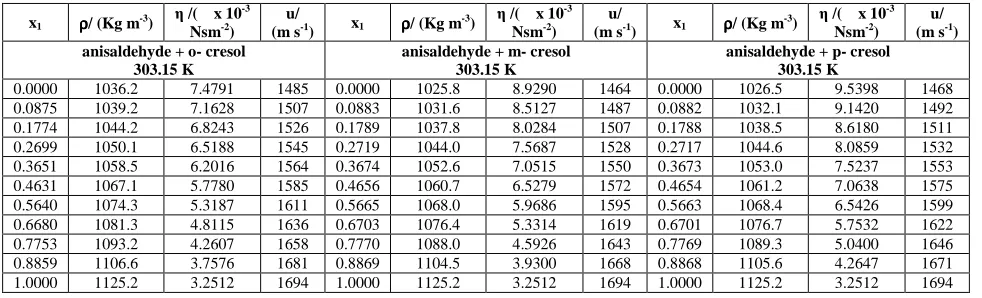
The experimental values of density (ρ), viscosity (η) and ultrasonic velocity (u) for all the mixtures over the entire range of composition are presented in Table 2 at 303.15, 308.15, 313.15 and 318.15 K. The values of the Redlich– Kister polynomial coefficient Ai evaluated by the method of least squares along with standard deviation is given in
Table 3. Plots of uE, HE and
V
E
f
against mole fraction of anisaldehyde for all the mixtures are given in Figs. 1-3,respectively.
Table-1 Comparison of experimental values of density (ρρρρ), viscosity (η) and velocity (u) of pure liquids with literature values at 303.15 K.
Liquids ρρρρ/ (Kg m
-3
) η/ (x 10-3 Nsm-2) u/ (m s-1)
Expt. Lit. Expt. Lit. Expt. Lit.
anisaldehyde 1125.2 1125.5a 3.2512 3.2753a 1694.3 1684a
o- cresol 1036.2 1036.9b 7.4791 4.243c
(313.15) K 1485.3 1487
b
m- cresol 1025.8 1026.1b 8.9290 6.252c
(313.15) K 1464.2 1465
b
p- cresol 1026.5 1026.3b 9.5398 6.661c
(313.15) K 1468.4 1471
b Expt. – Experimental; Lit. – Literature; aRef. 15; bRef. 16; cRef. 17
The values of uE, HE and
V
E
f
for the binary mixtures of anisaldehyde with o-cresol, m-cresol and p-cresol may beexplained on the basis of various types of intermolecular interactions between components. According to Parveen et.al.,[11] the excess thermodynamic properties of the mixtures are influenced by three main types of contribution, viz. (i) physical: due to non-specific Vander Walls type forces (ii) chemical: due to hydrogen bonding, dipole– dipole, and donor–acceptor interaction between unlike molecules and (iii) structural: due to the fitting of smaller molecules into the voids created by the bigger molecules. The first effect leads to contraction in volume, hence leads to positive contribution towards HE and VEf and negative contribution towards uE. However, the remaining two
effects lead to the contraction in volume, resulting in negative HE,
V
E
f
values and positive u Evalues.
[image:3.595.63.554.614.763.2]From Fig.1 it can be observed that uE values are positive for all the mixtures at all the temperatures studied. In the present investigation the magnitude of uE values follows the sequence: o-cresol > p-cresol > m-cresol. The higher positive values of uE for anisaldehyde + o-cresol mixture suggest that interaction between anisaldehyde and o-cresol is stronger as compared to that of between anisaldehyde and p-cresol or m-cresol. The effect of temperature on uE values is not very significant in the case of anisaldehyde + o- cresol or + p-cresol mixtures. However, an appreciable change is observed in uE values in anisaldehyde rich region. The plots of deviation in ultrasonic velocity uE with mole fraction at all the four temperatures for all the three mixtures exhibit positive values. The positive values of uE decrease with increase in temperature which indicates the decrease in strength of interaction with temperature in all the three mixtures. As anisaldehyde is an aprotic liquid and when it is mixed with phenols (protic liquids), it tends to break the associates present in the phenol molecules.The higher positive values of uE in anisaldehyde + o-cresol mixture indicate the presence of strong intermolecular interaction [12].
Table-2 Values of density (ρρρρ), viscosity (η) and velocity (u) of binary mixtures at different temperatures
x1 ρρρρ/ (Kg m-3) η /( x 10 -3
Nsm-2) u/
(m s-1) x1 ρρρρ/ (Kg m
-3) η /( x 10-3
Nsm-2) u/
(m s-1) x1 ρρρρ/ (Kg m
-3) η /( x 10-3
Nsm-2) u/ (m s-1) anisaldehyde + o- cresol
303.15 K
anisaldehyde + m- cresol 303.15 K
anisaldehyde + p- cresol 303.15 K
0.0000 1036.2 7.4791 1485 0.0000 1025.8 8.9290 1464 0.0000 1026.5 9.5398 1468
0.0875 1039.2 7.1628 1507 0.0883 1031.6 8.5127 1487 0.0882 1032.1 9.1420 1492
0.1774 1044.2 6.8243 1526 0.1789 1037.8 8.0284 1507 0.1788 1038.5 8.6180 1511
0.2699 1050.1 6.5188 1545 0.2719 1044.0 7.5687 1528 0.2717 1044.6 8.0859 1532
0.3651 1058.5 6.2016 1564 0.3674 1052.6 7.0515 1550 0.3673 1053.0 7.5237 1553
0.4631 1067.1 5.7780 1585 0.4656 1060.7 6.5279 1572 0.4654 1061.2 7.0638 1575
0.5640 1074.3 5.3187 1611 0.5665 1068.0 5.9686 1595 0.5663 1068.4 6.5426 1599
0.6680 1081.3 4.8115 1636 0.6703 1076.4 5.3314 1619 0.6701 1076.7 5.7532 1622
0.7753 1093.2 4.2607 1658 0.7770 1088.0 4.5926 1643 0.7769 1089.3 5.0400 1646
0.8859 1106.6 3.7576 1681 0.8869 1104.5 3.9300 1668 0.8868 1105.6 4.2647 1671
308.15 K 308.15 K 308.15 K
0.0000 1031.0 5.9629 1466 0.0000 1021.5 7.4121 1449 0.0000 1022.0 8.1190 1455
0.0875 1033.8 5.7620 1488 0.0883 1026.7 7.1076 1471 0.0882 1027.7 7.8243 1477
0.1774 1038.2 5.5404 1506 0.1789 1032.4 6.7474 1490 0.1788 1033.0 7.4188 1496
0.2699 1043.4 5.3613 1524 0.2719 1038.0 6.4210 1511 0.2717 1038.6 7.0015 1516
0.3651 1050.6 5.1677 1544 0.3674 1045.4 6.0458 1532 0.3673 1045.9 6.5680 1536
0.4631 1058.4 4.8739 1564 0.4656 1052.3 5.6585 1553 0.4654 1053.0 6.2185 1558
0.5640 1065.0 4.5597 1589 0.5665 1060.0 5.2373 1575 0.5663 1060.5 5.8261 1580
0.6680 1071.5 4.1963 1613 0.6703 1066.1 4.7414 1598 0.6701 1066.8 5.1576 1602
0.7753 1082.8 3.8152 1635 0.7770 1077.2 4.1515 1621 0.7769 1077.5 4.6038 1625
0.8859 1095.3 3.4751 1657 0.8869 1092.6 3.6476 1645 0.8868 1093.0 3.9654 1648
1.0000 1111.6 3.1306 1670 1.0000 1111.6 3.1306 1670 1.0000 1111.6 3.1306 1670
313.15 K 313.15 K 313.15 K
00.000 1026.0 4.2380 1452 0.0000 1017.0 6.1160 1436 0.0000 1018.1 6.7410 1443
0.0875 1030.2 4.1621 1470 0.0883 1022.8 5.8936 1455 0.0882 1024.2 6.5293 1462
0.1774 1034.7 4.0725 1486 0.1789 1028.4 5.6289 1473 0.1788 1029.7 6.2416 1479
0.2699 1040.9 4.0075 1502 0.2719 1034.8 5.3930 1490 0.2717 1035.9 5.9127 1496
0.3651 1047.3 3.9364 1519 0.3674 1042.8 5.1298 1509 0.3673 1044.0 5.5817 1514
0.4631 1055.4 3.8060 1536 0.4656 1049.1 4.8580 1528 0.4654 1050.3 5.3386 1533
0.5640 1062.1 3.6728 1560 0.5665 1056.8 4.5554 1547 0.5663 1057.6 5.0700 1552
0.6680 1070.0 3.4940 1580 0.6703 1064.4 4.1814 1567 0.6701 1065.6 4.5412 1572
0.7753 1082.1 3.2908 1598 0.7770 1075.1 3.7240 1588 0.7769 1076.5 4.0989 1591
0.8859 1094.9 3.1260 1617 0.8869 1090.9 3.3400 1609 0.8868 1091.7 3.6092 1612
1.0000 1109.5 2.9614 1631 1.0000 1109.5 2.9614 1631 1.0000 1109.5 2.9614 1631
318.15 K 318.15 K 318.15 K
0.0000 1021.1 2.2150 1437 0.0000 1013.5 5.0185 1424 0.0000 1013.9 5.4690 1432
0.0875 1026.3 2.2689 1449 0.0883 1019.2 4.8489 1437 0.0882 1020.0 5.3161 1445
0.1774 1031.9 2.3130 1460 0.1789 1026.5 4.6554 1449 0.1788 1027.2 5.1150 1456
0.2699 1038.3 2.3633 1470 0.2719 1033.4 4.4695 1461 0.2717 1033.9 4.8700 1467
0.3651 1044.3 2.4141 1482 0.3674 1041.6 4.2725 1474 0.3673 1042.1 4.6160 1479
0.4631 1052.8 2.4506 1493 0.4656 1048.2 4.0849 1486 0.4654 1048.9 4.4315 1492
0.5640 1059.5 2.4960 1511 0.5665 1055.2 3.8683 1500 0.5663 1055.4 4.2586 1505
0.6680 1067.7 2.5427 1524 0.6703 1062.5 3.5863 1513 0.6701 1063.0 3.8612 1518
0.7753 1078.8 2.5892 1536 0.7770 1073.3 3.2362 1527 0.7769 1073.7 3.5228 1531
0.8859 1090.1 2.6308 1549 0.8869 1088.4 2.9489 1542 0.8868 1088.9 3.1628 1544
1.0000 1104.7 2.6822 1557 1.0000 1104.7 2.6822 1557 1.0000 1104.7 2.6822 1557
uuuu
EEEE /
(m
s
/(
m
s
/(
m
s
/(
m
s
----1111))))
System-1: anisaldehyde (x1) +
o-cresol
0.00 2.00 4.00 6.00 8.00 10.00 12.00 14.00
0.00 0.20 0.40 0.60 0.80 1.00
molefraction (x1)
System-2: anisaldehyde (x1) +
m-cresol
0.00 0.50 1.00 1.50 2.00 2.50 3.00 3.50
0 0.2 0.4 0.6 0.8 1
molefraction (x1)
System-3: anisaldehyde (x1) +
p-cresol
0.00 1.00 2.00 3.00 4.00
0.00 0.20 0.40 0.60 0.80 1.00
molefraction (x1)
Fig. 1 The Variation of excess ultrasonic velocity with mole fraction of anisaldehyde (x1) for (a) anisaldehyde
[image:4.595.61.549.67.657.2]Table-3 The values of coefficient Ai from Equation (5) for u E
, HE and
V
E
f
and standard deviation σσσσ (Y E) for
binary liquids at varying temperatures.
System Temp./ (K) A0 A1 A2 σσσσ
uE/ (m s-1)
anisaldehyde + o-cresol 303.15 14.9396 41.2528 105.1554 1.4682
308.15 13.3817 37.1995 92.5946 1.4062
313.15 8.5686 22.4567 67.6270 1.7999
318.15 6.6397 25.6170 58.4664 1.6076
HE /(KJ mol-1)
303.15 29.7536 -3.6304 -25.4819 0.4929
308.15 23.9862 -5.9947 -25.0264 0.5928
313.15 16.7937 -6.0545 -19.6838 0.3432
318.15 4.5765 -4.5792 -1.4176 0.1632
E
V
f
/ (x 10-6 m3 mol-1)
303.15 -6.5197 -3.0307 -0.4890 0.0111
308.15 -5.5015 -1.7744 0.3841 0.0146
313.15 -3.6668 -0.4533 1.0215 0.0190
318.15 -0.2544 0.5973 0.3009 0.0173
uE/(m s-1)
anisaldehyde + m-cresol 303.15 2.8627 -22.0698 25.4053 1.0603
308.15 2.7539 -18.6926 21.0561 0.8826
313.15 2.8020 -15.3940 16.3799 0.6574
318.15 2.6941 -13.0999 13.0959 0.5558
HE/(KJ mol-1)
303.15 33.7097 3.9058 -9.0662 0.6700
308.15 30.354 0.3754 -13.7176 0.7002
313.15 26.3186 -1.8996 -17.8573 0.8040
318.15 21.0524 -4.8962 -18.6758 0.9687
E
V
f
/(x 10-6 m3 mol-1)303.15 -7.6181 -5.0235 -2.2831 0.0282
308.15 -6.9952 -3.8373 -1.3232 0.0212
313.15 -6.3364 -2.7532 -0.4563 0.0329
318.15 -5.8020 -1.8277 0.2973 0.0551
uE/(m s-1)
anisaldehyde + p-cresol 303.15 8.2434 -10.9640 42.1784 1.2867
308.15 8.5463 -2.4236 26.8039 0.5705
313.15 7.7196 -1.9636 21.4319 0.5362
318.15 6.7658 0.7783 16.8180 0.4129
HE/(KJ mol-1)
303.15 56.9269 39.9771 29.1427 1.3611
308.15 52.6042 33.6175 25.7772 1.4075
313.15 45.7201 26.0998 20.1988 1.4495
318.15 36.8592 19.3744 19.2301 1.3058
E
V
f
/(x 10-6 m3 mol-1)303.15 -8.4437 -8.3153 -5.5034 0.1445
308.15 -8.0517 -7.3919 -4.7787 0.1224
313.15 -7.5256 -6.2820 -3.9114 0.0954
318.15 -7.0255 -5.3492 -3.2979 0.0764
H E /( K J m o l -1 )
System-1: anisaldehyde (x1) +
o-cresol 0.00 2.00 4.00 6.00 8.00
0.00 0.20 0.40 0.60 0.80 1.00
molefraction (x1)
System-2: anisaldehyde (x1) +
m-cresol 0.00 2.00 4.00 6.00 8.00 10.00
0.00 0.20 0.40 0.60 0.80 1.00
molefraction (x1)
System-3: anisaldehyde (x1) +
p-cresol 0.00 4.00 8.00 12.00 16.00 20.00
0 0.2 0.4 0.6 0.8 1
molefraction (x1)
Fig. 2 The Variation of excess enthalpy with mole fraction of anisaldehyde (x1) for (a) anisaldehyde + o-cresol
(b) anisaldehyde + m-cresol and (c) anisaldehyde + p-cresol mixture at ♦303.15, ■308.15, ▲313.15 and ×318.15 K.
Excess free volume (
V
E
f
) is found to be negative (Fig.3) for all the binary mixtures over the entire compositionrange and absolute values of
V
E
f
increases as the temperature is raised, suggesting an increase in intermolecularinteraction between unlike molecules due to thermal energy. The negative values of
V
E
f
suggest the existence ofstrong dipole–dipole type of interaction between anisaldehyde and cresols. This observation has been supported by Rama Rao et.al.[14].
Vf E /(
x
1
0
-6 m 3 m
o
l
-1 )
System-1: anisaldehyde (x1) +
o-cresol -2.00 -1.50 -1.00 -0.50 0.00 0.50
0.00 0.20 0.40 0.60 0.80 1.00
molefraction (x1)
System-2: anisaldehyde (x1) +
m-cresol -2.50 -2.00 -1.50 -1.00 -0.50 0.00
0.00 0.20 0.40 0.60 0.80 1.00
molefraction (x1)
System-3: anisaldehyde (x1) +
p-cresol
-2.50 -1.50 -0.50
0 0.2 0.4 0.6 0.8 1
[image:6.595.74.546.74.277.2]molefraction (x1)
Fig. 3 Variation of excess free volume with mole fraction of anisaldehyde (x1) for (a) anisaldehyde + o-cresol
(b) anisaldehyde + m-cresol and (c) anisaldehyde + p-cresol mixture at ♦303.15, ■308.15, ▲313.15 and ×318.15 K.
CONCLUSION
The negative values of
V
E
f
and positive values of uE and HE in all the three binary mixtures support the existence of
[image:6.595.67.549.432.668.2]REFERENCES
[1] SC Bhatia; RBhatia; GP Dubey. J. Chem. Thermodyn., 2010, 42, 114.
[2] UB Kadam; AP Hiray; AB Sawant; M Hassan. J. Chem. Eng. Data, 2006, 51, 60.
[3] K Narendra; Ch Srinivasu; Sk Fakruddin; P Narayanamurthy. J.Chem. Thermodyn., 2005, 43, 1604. [4] R Palani; S Saravanan; R Kumar. Rasayan J. Chem., 2009, 2(3), 622.
[5] K Narendra; P Narayanamurthy; Ch Srinivasu. E-J. Chem., 2010, 7(3), 927. [6] H Iloukhani; N Zoorasna; R Soleimani. J. Phys. Chem. Liquids, 2005, 43, 391.
[7] DD Perrin, WLF Armarego. Purification of Lab. Chem., 3rd ed., Pergamon Press, Oxford, 1980. [8] DR Lide, editor. CRC Handbook of Chemistry and Physics, 76th ed., CRC Press, Florida, 1995. [9] JD Pandey; RD Rai; RK Shukla; AK Shukla; N Mishra. Indian J. Pure & Appl. Phys., 1993, 31, 84. [10] Redlich; AT Kister. Indian Eng. Chem., 1948, 40, 345.
[11] S Parveen; D Shukla; S Singh; K P Singh; M Gupta; JP Shukla. Appl. Acoust., 2009, 70, 507. [12] JM Resa; C Gonzalez; S Ortiz de Landaluce; J Lanz. J. Chem. Thermodyn., 2002, 34, 1013. [13] BS Bjola; MA Siddiqi; U Fornefeld-Schwarz; P Svejda. J. Chem. Eng. Data, 2002, 47, 250.
[14] GV Rama Rao; A Vishwanatha Sarma; D Ramachandran; C Rambabu. Indian J. Chem., 2007, 46A, 1972. [15] R Bhaskaran; TR Kubendran. J. Chem. Eng. Data, 2008, 53, 978.
[16] CS Bhatia; R Rani; R Bhatia. J. Chem. Eng. Data, 2011, 56, 1669.