Low-Complexity Iterative Receiver for Space-Time
Coded Signals over Frequency Selective Channels
Noura Sellami
France T´el´ecom R&D, 38-40 rue du G´en´eral Leclerc, 92794 Issy les Moulineaux, France ´
Equipe de Traitement des Images et du Signal, ENSEA-Universit´e de Cergy Pontoise, 6 avenue du Ponceau, 95014 Cergy-Pontoise, France
Email: [email protected]
Inbar Fijalkow
´
Equipe de Traitement des Images et du Signal, ENSEA-Universit´e de Cergy Pontoise, 6 avenue du Ponceau, 95014 Cergy-Pontoise, France
Email: [email protected]
Mohamed Siala
Sup’Com, Route de Raoued Km 3.5, 2083 Ariana, Tunisia Email: [email protected]
Received 31 May 2001 and in revised form 18 March 2002
We propose a low-complexity turbo-detector scheme for frequency selective multiple-input multiple-output channels. The detec-tion part of the receiver is based on a List-type MAP equalizer which is a state-reducdetec-tion algorithm of the MAP algorithm using per-survivor technique. This alternative achieves a good tradeoffbetween performance and complexity provided a small amount of the channel is neglected. In order to induce the good performance of this equalizer, we propose to use a whitened matched filter (WMF) which leads to a white-noise “minimum phase” channel model. Simulation results show that the use of the WMF yields significant improvement, particularly over severe channels. Thanks to the iterative turbo processing (detection and decoding are iterated several times), the performance loss due to the use of the suboptimum List-type equalizer is recovered.
Keywords and phrases: space-time coded MIMO channel equalization, per-survivor processing, multidimensional whitened matched filter, turbo detection.
1. INTRODUCTION
The growing demand for new services at high data rates indicates the need for new techniques to increase channel capacity. Foschini and Gans [1] have demonstrated the enor-mous capacity potential gain of wireless communication sys-tems with antenna arrays at both transmitter and receiver. In order to achieve the promised high data rates over frequency selective multiple-input multiple-output (MIMO) channels, an equalizer has to be applied to reduce the channel time dis-persion due to multipath propagation at high data rates.
Several solutions have been proposed among them linear and decision-feedback structures with a zero forcing or min-imum mean square error optimization [2]. These equalizers have a low-complexity but suffer from noise enhancement and error propagation. In terms of performance, it is better to use a maximum a posteriori (MAP) [3] or Viterbi equal-izer. However, the complexity of these algorithms is pro-portional to the number of states of the trellis which grows
exponentially with the product of the channel memory and the number of transmit antennas [4]. When the channel memory becomes large and high-order constellations are used, the algorithm becomes impractical. Therefore, a re-duced complexity approach is needed.
Modulator
Modulator dN
d1
C1
CN .
. .
. . .
Antenna 1
AntennaN
Π1
ΠN DeMux
Encoder Input
bits
Figure1: Transmitter structure.
propose to use a whitened matched filter (WMF) which makes the channel “minimum phase” and keeps the noise white [9, 10, 11]. Simulation results show that the use of the WMF yields significant improvement particularly over severe channels.
We propose here to enhance the performance by using a channel encoder. As shown in Figure 1, we consider a MIMO system transmitting parallel data coded streams and demulti-plexed simultaneously. The structure of this transmitter, re-ferred to as bit-interleaved coded modulation (BICM), was initially proposed for single-antenna systems [12, 13]. A sin-gle code is cyclically connected to N transmitters, each in-cluding a bit interleaverΠifollowed by a modulator and an antenna. The code and the frequency selective channel sep-arated by the interleavers constitute a serially concatenated scheme to which we can apply an iterative receiver composed of a soft-input/soft-output decoder and an equalizer follow-ing the idea of turbo-codes [14]. The basic idea behind iter-ative processing is to exchange extrinsic information among the receiver modules in order to achieve successively refined performance. Turbo processing for MIMO coded data en-hances all the more the need for a low-complexity equalizer. In [15, 16], an equalizer based on filters has been proposed. However, the gain in complexity induces a loss in perfor-mance. In [17], Bauch and Al-Dhahir used a set of shorten-ing filters [18] as prefilters to turbo equalization in order to reduce the number of states of the MAP equalizer. The dis-advantage of this method is that the noise becomes colored at the outputs of the shortened channel.
In this paper, we consider a turbo detector composed of a List-type MAP equalizer and a MAP decoder. Thanks to the WMF, the noise at the input of the turbo detector is white. This permits to have a good performance without enhancing the complexity of the equalizer. In fact, in the case of a col-ored noise, the noise autocorrelation matrix has to be taken into account by the equalizer in order to achieve good perfor-mance. Unfortunately, the complexity of the equalizer is then considerably increased. If, for simplicity, the colored noise is assumed to be white, the soft outputs of the equalizer are degraded, particularly on the first turbo iteration. This can affect significantly the performance of the iterative receiver since we know the importance of the equalization at the first iteration for the turbo processing.
The paper is organized as follows. In Section 2, we describe the system model. In Section 3, we present the whitened matched filter principle and give simulation results for the List-type MAP equalizer. In Section 4, we describe the proposed turbo detector and the corresponding simulation results.
Throughout, scalars and matrices are lower and upper
case, respectively, and vectors are underlined lower case; (·)T, (·)†, and (·)−1denote, respectively, transposition,
trans-conjugation, and inversion. Moreover, Trace(A) denotes the trace of matrixAandE(·) denotes the expected value opera-tor. Finally,xdenotes the highest integer not bigger thanx.
2. SYSTEM MODEL
2.1. General framework
We consider a frequency selective fading MIMO channel withNtransmitting antennas andMreceiving antennas. The channel between each transmit antenna and each receive an-tenna is modeled by a Rayleigh fading with a memory ofL symbols.
As shown in Figure 1, the input information bit se-quence is first encoded with a rateKconvolutional encoder. The output of the encoder is demultiplexed intoNstreams that are interleaved by different interleaversΠi, mapped to PSK/QAM symbols and transmitted simultaneously by the N transmitting antennas. The same modulation constella-tion with sizeQis used for each stream. Thus, log2(Q) coded bits are mapped into one Q-ary symbol. This scheme was first proposed in [12, 13] for single-antenna and is known as bit-interleaved coded modulation (BICM). We assume that transmissions are organized into bursts ofTsymbols. For the sake of simplicity, the channels are supposed to be invariant during a burst and to change independently from burst to burst.
The received baseband signal sampled at the symbol rate at antennajat timekis a linear combination of theN trans-mitted signals perturbed with noise
rj(k)= N
i=1
L−1
l=0
hi, j(l)di(k−l) +nj(k). (1)
In this expression, nj(k) are modeled as independent samples of a zero mean white complex Gaussian noise with varianceσ2 = N
0 andhi, j(l) is thelth tap gain from trans-mit antennaito receive antenna j. The tap gainshi, j(l) are modeled as independent complex Gaussian random vari-ables with zero mean and variance σ2
h(l). We assume that L−1
l=0 σh2(l)=1.Letd(k)=(d1(k), . . . , dN(k))Tbe theN-long vector of modulated symbols transmitted from theN trans-mitting antennas at timekandn(k) = (n1(k), . . . , nM(k))T be theM-long noise vector at the receiving antennas.
The output of the channel is theM-long vectorr(k) = (r1(k), . . . , rM(k))TwithZ-transform:
r(z)=H(z)d(z) +n(z), (2)
whereH(z)=Ll=0−1H(l)z−land (H(l))
The problem we address is then to recover the informa-tion bits from the noisy observainforma-tion.
2.2. Simulation framework
In our simulations, we concentrate on a MIMO system with 2 transmit antennas and 2 receive antennas. We use a frequency-selective fading channel with memoryL=5. The channel is considered to be time invariant during the trans-mission of a burst of 512 information bits and changes inde-pendently from burst to burst. We assume that the channel is perfectly known at the receiver. The rateK =1/2 convolu-tional code has 4 states and generator polynomials (7,5). The modulation used is BPSK. We plot the bit error rate (BER) with respect to averagedEb/N0per receive antenna.
3. EQUALIZATION
In the case of a single-input single-output (SISO) frequency selective channel, a whitened matched filter (WMF) is used to transform the received signal into a sequence with mini-mum phase channel response and additive white noise. This procedure is a first step in the implementation of some equalizers including decision-feedback detectors and delayed decision-feedback sequence estimators (DDFSE) [6]. This is achieved by factoring the channel spectrum into a product of a minimum phase filter and its time inverse. In this pa-per, we propose to use a List-type equalizer which realizes a good tradeoffbetween performance and complexity. Since this type of algorithm considers a reduced number of states corresponding to a reduced number of taps of the channel [6, 7, 8], it is desirable to design a multidimensional WMF and to use it as a prefilter for the equalizer, analogously to the scalar case. In the following, we will present a solution based on prediction theory results.
3.1. Whitened matched filter
As in the SISO case, the first step is to feed the received signal r(z) to the matched filterH†(z−1). The output signal is then,
H†z−1r(z)=x(z)=S(z)d(z) +b(z), (3)
whereS(z)=H†(z−1)H(z) andb(z)=H†(z−1)n(z) is a
col-ored noise with spectrumN0S(z).
For the multidimensional case, some results have been derived using the linear prediction theory for vector wide-sense stationary (WSS) processes [9, 10, 11]. An interesting result is stated below.
Theorem 1 (multidimensional spectral factorization [11]).
Given anN-dimensional WSS process v(z) with spectrum Sv(z),there exists a factorization
Sv(z)=B−†z−1B−(z) (4)
such thatB−(z) is causal and stable and has a causal inverse.
The filterB−1
− (z) is stable ifSv(z) is nonsingular on the unit circle. This factorization is called the minimum phase factor-ization ofSv(z).
According to this theorem, there exists an (N×N) causal and stable matrix filterB−(z) with causal and stable inverse
which verifiesB†−(z−1)B−(z)=H†(z−1)H(z) as soon asM≥N
(more receivers than transmitters). The filter (B−†(z−1))−1is
a whitening filter for a process with spectrumS(z). Assum-ing that (B−†(z−1))−1can be perfectly known, and passingx(z)
through this filter, we have the following as the output of the whitened matched filter:
y(z)=B†−z−1−1x(z)=B−(z)d(z) +n1(z), (5)
wheren1(z) is awhite Gaussian noisewith spectrumN0I,I
being the (N×N) identity matrix.
3.2. WMF implementation using linear prediction
Several algorithms have been presented in the literature to determine the spectral factorsB−(z) andB†−(z−1) [19]. In the
following, based on prediction theory results [9], we briefly explain how to compute an approximation of (B†−(z−1))−1.
As we will see, the algorithm based on the prediction the-ory provides the factorization S(z) = B−(z)B−†(z−1). Since
we want to obtain the spectral factorization given in (5), we begin by factoring S†(z) = B1(z)B1†(z−1) then we take
B−(z)=B†1(z). Denote bys(z) a WSS process with spectrum
S†(z)=H†(z)H(z−1),i(z) its innovations andL(z) its
inno-vations filter;s(n) can be written as
s(n)=
∞
k=0
L(k)i(n−k). (6)
Consider the linear predictorA(z) = ∞k=1A(k)z−k ofs(n). The estimation ˆs(n) ofs(n) in terms of its entire past is then,
ˆ s(n)=
∞
k=1
A(k)s(n−k)=
∞
k=1
L(k)i(n−k). (7)
It can be approximated by the estimation ofs(n) in terms of itsDmost recent past values,
ˆ s(n)
D
k=1
A(k)s(n−k). (8)
The estimation error is given by
e(n)=s(n)−sˆ(n)=L(0)i(n). (9)
Writing the Yule-Walker equations
Ee(n)s(n−k)†=0, 1≤k≤D,
Ee(n)s(n)†=L(0)L(0)†, (10)
we obtain
A=A(1), . . . , A(D)=RR−1
D,
R(0)−D k=1
Table1
Channel 1 Channel 2 Channel 3
Mean of gain0 0.540 0.369 0.159 Standard deviation of gain0 0.114 0.107 0.121
In this expression,RDis theDN ×DN covariance matrix of the random vectorsD(n)=[s(n)T, . . . , s(n−D+ 1)T]T,R(i)= E(s(k)s(k−i)†), andR=(R(1), . . . , R(D)). From (9), we can write
H†(z)Hz−1A
1(z)−1L(0)L(0)†
A†1
z−1−1
, (12)
whereA1(z)=(IN−Dk=1A(k)z−k).
Hence, by taking the trans-conjugate of this expression, we obtain
H†z−1H(z)A 1
z−1−1
L(0)L(0)†A†1(z)
−1
. (13)
Thus, an approximation of the matrix (B−†(z−1))−1is given by
L(0)−1A
1(z−1). The implementation of (B−†(z−1))−1is given by
solving (11). The autocorrelation matricesR(i) are obtained by identifying the terms inz−iin the equality
H†(z)Hz−1= +∞
i=−∞
R(i)z−i. (14)
We choose arbitrary L(0) as a lower triangular matrix since we do not care which minimum phase factor is con-sidered.
3.3. Energy concentration
Now, we want to verify that the prefiltered MIMO channels have the property of energy concentration as for SISO chan-nels. We start by recalling the property for the SISO case [20].
Theorem2 (energy concentration [20]). IfB−is an impulse
response of a minimum phase filter, andHa filter having the same spectrum, then for anyn0,
n0
i=0
B−(i)2≥ n0
i=0
H(i)2. (15)
It has been shown in [9] that the property of energy con-centration stated above holds for minimum phase MIMO channels obtained by spectral factorization forn0=0.
Theorem3 (see [9]). Let ybe a WSS stochastic process, let
B−(z) be a filter matrix corresponding to the Wold
decompo-sition ofyandW(z) a spectral factor of the matrix spectrum ofysuch asB−(z)B−†(z−1)=W(z)W†(z−1), then
B−(0)B−(0)†≥W(0)W(0)†. (16)
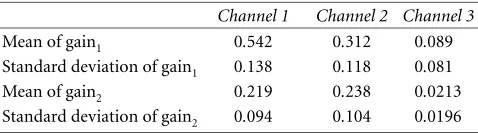
In the sequel, we will verify through simulations that this property still holds for ordersn0≥1. In order to measure the
Table2
Channel 1 Channel 2 Channel 3
Mean of gain1 0.542 0.312 0.089 Standard deviation of gain1 0.138 0.118 0.081 Mean of gain2 0.219 0.238 0.0213 Standard deviation of gain2 0.094 0.104 0.0196
gain in terms of energy on the first taps that can be obtained by using the WMF, we consider the following quantities:
gain0(H)=Trace
B−(0)†B−(0)−H(0)†H(0)
Trace Li=0−1H(i)†H(i) ,
gainn0(H)=
Trace n0 i=0
B−(i)†B−(i)−H(i)†H(i)
Trace Li=0−1H(i)†H(i) . (17)
Table 1 shows the mean and the standard deviation of the measure gain0over 1000 realizations for three types of fre-quency selective channels described by the standard devia-tion of the Rayleigh distribudevia-tion of their taps:
Channel 1:σh=(0.227; 0.460; 0.688; 0.460; 0.227),
Channel 2:σh=1/√5; 1/√5; 1/√5; 1/√5; 1/√5,
Channel 3:σh=(0.716; 0.501; 0.429; 0.214; 0.071),
(18)
whereσh=(σh(0), . . . , σh(L−1)).
These channels were chosen because they have different energy profiles.
Channel 1has the highest gain since the powers of its delayed
paths are larger than that of its direct path. Second in terms of gain,Channel 2which is quite severe because each path has the same averaged power. Third,Channel 3which is close to be minimum phase.
Table 2 shows the mean and standard deviation of gainn0(H) whenn0=1 andn0=2,for the same channels.
For the three channels, Table 2 shows that the energy con-centration property is verified whenn0 =1 andn0 =2.We
notice that forChannel 3the mean and the standard devia-tion of the different gains are very close. Hence, the gains can be very low for a few realizations. In order to achieve a good tradeoffbetween complexity and performance, a test can be performed on the calculated gains for each realization of the channel. If gainn0(H) is less than a determined threshold, the received signals are not prefiltered by the WMF before the equalization, since the improvement will be very little. Oth-erwise, the WMF is used.
3.4. Generalized List-type MAP equalizer
soft-input/soft-output algorithm to MIMO channels. As ex-plained in [6, 7, 8], the trellis hasQ(J−1)N states whereJ is the reduced memory of the channel (J < L) and Qis the constellation size. The firstJtaps are processed by the trellis transitions of the List-type equalizer and the remaining taps are processed by a per-survivor processing withSsurvivors at each state.
Our objective is to compute the a posteriori probabilities (APP)P(di(n)|y) for 1≤i≤Nand 0≤n≤T−1, given the received vector, after matched filtering and whitening, during a bursty=(y(0)T, . . . , y(T−1)T)T.
Let
µ(n)=dT(n−1), dT(n−2), . . . , dT(n−J+ 2), dT(n−J+ 1) (19) be the state at timen. As described in [3, 4], the APP are ob-tained after calculation of the forward probabilityαn(µ) and the backward probabilityβn(µ). Here, the forward probabil-ityαSi
n(µ) will also depend on the survivorsSi(i=1, . . . , S). At timen, a stateµis associated to a survivor listSi,nand a forward probability listαSi
n(µ). At timen+ 1,SQN branches converge to the following stateµ and their path metrics are defined asαSi
n(µ)γnSi(µ, µ) whereγSni(µ, µ) is the branch tran-sition probability between statesµandµfor the survivorSi. This transition can be expressed as the product of an a priori probability and the channel transition probability
γSi n
µ, µ=py(n)|µ, µPµ|µ. (20)
Since the WMF keeps the noise white and Gaussian, the channel transition probability is given by,
py(n)|µ, µ= 1 the per-survivor processing for a given survivor amongS. All symbols are assumed equally likely, soP(µ|µ)=1/QN.
TheSQNpath metrics are sorted by order and theS high-est will define, for the stateµat timen+ 1, the survivor list Si,n+1 and the forward probabilities αSni+1 (µ).Each forward
probabilityαSi
n+1(µ) is calculated as the sum of all the path
metrics leading toµwhich are inferior or equal to the path metric associated toSi[5]. The backward probabilityβn(µ)
is calculated recursively using the survivors obtained in the preceding step as
izer calculates the APP P(di(n) = mq|y) for each possible symboldi(n)=mq,q=1, . . . , Q, as
1, are the states following the
stateµif the input symbol corresponding to theith transmit-ting antenna ismq.
The probability that a coded bitci(k) is equal to 0 is then calculated as
Our equalizer encompasses the MAP algorithm obtained by lettingJ =LandS =1 and the soft DDFSE obtained by lettingJ < LandS=1.
3.5. Simulation results
Since we have been interested so far in the equalization part, we consider the performance of the receiver for a simplified system without encoding and interleaving. The receiver is composed of the WMF and the soft List-type MAP equal-izer. The equalizer uses the soft-input/soft-output algorithm presented in Section 3.4.
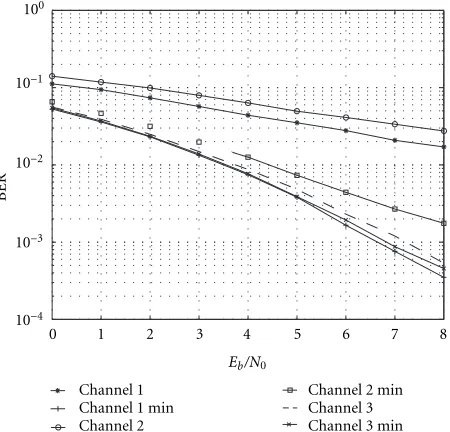
Figures 2 and 3 show the performance of the List-type equalizer for the three channels defined previously with and without the WMF. The different reduced memory sizes are J=2 andJ=3. The modulation is the BPSK. The number of survivors isS=2.
We notice that the use of the WMF yields a significant gain in performance for the three channels. As expected from Section 3.1, the channel gaining most improvement by the use of the WMF is Channel 1followed byChannel 2 then
Channel 3. As shown in Figure 3, the improvement is less
important when the reduced memory J of the channel is higher.
4. LOW-COMPLEXITY TURBO DETECTOR
0 1 2 3 4
Eb/N0
5 6 7 8
10−3 10−2 10−1 100
BER
Channel 1 Channel 1 min Channel 2
Channel 2 min Channel 3 Channel 3 min Figure 2: Performance of the List-type MAP equalizer with and without the WMF for a channel reduced memoryJ=2.
0 1 2 3 4
Eb/N0
5 6 7 8
10−4 10−2 10−1 100
10−3
BER
Channel 1 Channel 1 min Channel 2
Channel 2 min Channel 3 Channel 3 min Figure 3: Performance of the List-type MAP equalizer with and without the WMF for a channel reduced memoryJ=3.
4.1. Principle of turbo detection
Figure 4 shows the iterative receiver system. On the first it-eration, the List-type MAP equalizer generates the a pos-teriori probabilities Peq(ci(k)|y) for 1 ≤ i ≤ N, given the whole received vector during a burst. These probabilities are deinterleaved and multiplexed. The decoder uses these infor-mation to calculate the APP for the inforinfor-mation bits and for the coded bits using the MAP algorithm [3].
Extrinsic information are computed from a posteriori
coded bits probabilitiesPdec(ci(n)|y) as
Pext dec
ci(n)|y=
Pdecci(n)|y Peq
ci(n)|y
. (26)
These information are provided to the equalizer as a pri-ori information on the next iteration in order to obtain more reliable soft outputs. The equalizer computes the APP Peq(ci(k)|y) on the coded bits and provides the extrinsic information Pext
eq(ci(k)|y) to the decoder. The probabilities Pext
eq(ci(k)|y) are calculated as
Pext eq
ci(k)|y
= Peq
ci(k)|y
Pext dec
ci(k)|y.
(27)
After some iterations, hard decisions on the input informa-tion bits are taken by the decoder.
It is important that the receiver modules exchange ex-trinsic information in order to minimize the correlation be-tween the a priori information used by a module and its pre-vious decisions. To fully realize the potential of the iterative receiver, the streams of coded symbols are fed to indepen-dent random interleavers before they are transmitted. Inter-leavers help to break the correlation of the encoder output. They also guarantee that the a priori information provided to the equalizer are almost independent. The use of diff er-ent interleavers may improve the performance of the iterative receiver.
4.2. Equalizer for the iterative processing
For the first iteration, the equalizer is the List-type MAP al-gorithm described in Section 3. For the next iterations, the MAP decoder provides the equalizer with extrinsic informa-tion and only the calculainforma-tion of the transiinforma-tion probabilities γSi
n(µ, µ) is changed. More precisely, the a priori probabilities in (20) are now calculated as,
Pµ|µ= N
i=1 P ext dec
ci|y, (28)
whereci, i=1, . . . , Ncorrespond to the transition (µ, µ) and Pext
dec(ci|y) comes from (26).
4.3. Simulation results
In the following simulations, the calculation of the WMF is performed by using a predictor of degreeD =10. We focus
onChannel 2since it is a severe channel, so it is a good test
for evaluating the performance of our receiver.
r1
rM
y1
yN Whitened
matched filter
List-type MAP equalizer
Pext eq(c1|y)
Pext eq(cN|y)
Pext dec(c1|y)
Pext dec(cN|y)
Π−1 1
Π−1 N
Π1
ΠN
MUX
DeMUX P ext dec(ci|y) Decoder
Decoded bits
Figure4: Low-complexity turbo detector.
0 1 2 3 4
Eb/N0
5 6 7 8
10−4 10−3 10−2 10−1 100
BER
Ch2-iter1-S=4 Ch2-iter2-S=4 Ch2-iter3-S=4 Ch2min-iter1-S=1 Ch2min-iter2-S=1
Ch2min-iter3-S=1 Ch2min-iter1-S=2 Ch2min-iter2-S=2 Ch2min-iter3-S=2
Figure 5: BER performance of the iterative detector (J = 2) on
Channel 2versusEb/N0: Ch2-iter corresponds to a receiver with a 4-survivor detector and Ch2min-iter corresponds to the receiver with the WMF and a dfse (S=1, dotted lines) or a 2-survivor detector (S=2).
is dramatically more important than that obtained when in-creasing the number of survivors. The gain achieved via the iterative processing is also obvious. We notice that most of the improvement is achieved in the second iteration. For a BER =10−3, the iterative processing yields an improvement
of 1.8 dB, at the third iteration when the WMF is used with the 2-survivor detector.
5. CONCLUSION
In this paper, we have proposed a low-complexity turbo detector for space-time coded frequency selective channels. Our detector is a suboptimal variant of the MAP algorithm based on state-reduction and per-survivor processing. In or-der to compensate the loss due to state-reduction, we have designed a multidimensional whitened matched filter used
as a prefilter for the turbo detector. Simulation results show that this prefiltering improves significantly the receiver per-formance particularly over severe channels. Our receiver achieves a good tradeoff between complexity and perfor-mance. In fact, we have decreased exponentially the com-plexity of the optimum MAP detector. Moreover, thanks to the prefiltering and the iterative process, the performance has been dramatically improved. Thus, our turbo detector is a good candidate for multi-antenna systems mainly when the memory of the channel is large and the constellation used has a high order.
REFERENCES
[1] G. J. Foschini and M. J. Gans, “On limits of wireless commu-nications in a fading environment when using multiple an-tennas,” Wireless Personal Communications, vol. 6, no. 3, pp. 311–335, 1998.
[2] G. K. Kaleh, “Channel equalization for block transmission systems,” IEEE Journal on Selected Areas in Communications, vol. 13, no. 1, pp. 110–121, 1995.
[3] L. R. Bahl, J. Cocke, F. Jelinek, and J. Raviv, “Optimal decod-ing of linear codes for minimizdecod-ing symbol error rate,” IEEE Transactions on Information Theory, vol. 20, no. 2, pp. 284– 287, 1974.
[4] G. Bauch, A. F. Naguib, and N. Seshadri, “MAP equalization of space-time coded signals over frequency selective chan-nels,” inWireless Communications and Networking Conference, New Orleans, La, USA, September 1999.
[5] B. Penther, D. Castelain, and H. Kubo, “A modified turbo-detector for long delay spread channels,” inInternational Sym-posium on Turbo Codes, Brest, France, September 2000. [6] A. Duel-Hallen and C. Heegard, “Delayed decision-feedback
sequence estimation,” IEEE Trans. Communications, vol. 37, no. 5, pp. 428–436, 1989.
[7] T. Hashimoto, “A list-type reduced-constraint generalization of the Viterbi algorithm,” IEEE Transactions on Information Theory, vol. 33, no. 6, pp. 866–876, 1987.
[8] H. Kubo, K. Murakami, and T. Fujino, “A list-output Viterbi equalizer with two kinds of metric criteria,” inProc. IEEE In-ternational Conf. on Universal Pers. Commun., pp. 1209–1213, October 1998.
[9] P. E. Caines,Linear Stochastic Systems, Wiley, New York, USA, 1988.
[11] A. Duel-Hallen, “A family of multiuser decision-feedback de-tectors for asynchronous code-division multiple-access chan-nels,”IEEE Trans. Communications, vol. 43, no. 2–4, pp. 421– 434, 1995.
[12] G. Caire, G. Taricco, and E. Biglieri, “Bit-interleaved coded modulation,” IEEE Transactions on Information Theory, vol. 44, no. 3, pp. 927–946, 1998.
[13] E. Zehavi, “8-PSK trellis codes for a Rayleigh channel,”IEEE Trans. Communications, vol. 40, no. 5, pp. 873–884, 1992. [14] C. Berrou, A. Glavieux, and P. Thitimajshima, “Near Shannon
limit error-correcting coding and decoding: turbo codes,” in
Proc. IEEE International Conf. on Communications, pp. 1064– 1070, Geneva, Switzerland, May 1993.
[15] X. Wang and H. V. Poor, “Iterative (turbo) soft interfer-ence cancellation and decoding for coded CDMA,” IEEE Trans. Communications, vol. 47, no. 7, pp. 1046–1061, 1999. [16] A. Roumy, I. Fijalkow, and D. Pirez, “Turbo multiuser
detec-tion for coded asynchronous DS-CDMA over frequency se-lective channels,” J. on Commun. Networks, vol. 3, no. 3, pp. 202–210, 2001, special issue on multiuser detector.
[17] G. Bauch and N. Al-Dhahir, “Iterative equalization and de-coding with channel shortening filters for space-time coded modulation,” inProc. IEEE Vehicular Technology Conference, pp. 1575–1582, Boston, Mass, USA, September 2000. [18] N. Al-Dhahir, “FIR channel-shortening equalizers for MIMO
ISI channels,”IEEE Trans. Communications, vol. 49, no. 2, pp. 213–218, 2001.
[19] V. Kucera, “Factorization of rational spectral matrices: a sur-vey of methods,” inProc. IEE International Conference on Con-trol, vol. 2, pp. 1074–1078, Edinburgh, 1991.
[20] A. Papoulis, Signal Analysis, McGraw-Hill, New York, NY, USA, 1977.
Noura Sellamiwas born in Tunisia, in 1975. She received the preliminary doctorate cer-tificate in signal processing from University of Cergy-Pontoise, France, and the engineer diploma from ´Ecole Nationale Sup´erieure de l’ ´Electronique et de ses Applications (ENSEA), France, in 1999. She is currently working toward the Ph.D. degree at Univer-sity of Cergy-Pontoise, France.
Inbar Fijalkow received the Engineering M.S. and Ph.D. degrees from ´Ecole Na-tionale Sup´erieure de T´el´ecommunications (ENST), Paris, France, in 1990 and 1993, respectively. In 1993–1994, she was a Re-search Associate at Cornell University, NY, USA. During 1994–1999, she was an As-sociate Professor, since 1999 she has been a Professor. She is member of the Labora-tory ETIS (ENSEA—University of
Cergy-Pontoise), France. In 1998, she was a visiting researcher at the Aus-tralian National University (ANU), Canberra, Australia. Her cur-rent research interests are in signal processing applied to digital communications: adaptive and iterative (turbo) processing, blind deconvolution/equalization of multiple sources and sensors sys-tems. She is member of the board of the GDR ISIS, which is the CNRS research group on signal image and vision processing. She has been associate editor of the IEEE Transactions on Signal Pro-cessing since August 2000.
Mohamed Siala was born in 1965 in Tunisia. He received the “Dipl ˆome d’Ing´enieur” from “ ´Ecole Polytech-nique, Palaiseau, France,” in 1988, the “Dipl ˆome d’Ing´enieur” from “ ´Ecole Na-tionale Sup´erieure des T´el´ecommunications (ENST),” Paris, France, in 1990 and the “Doctorat de l’ENST,” Paris, France, in 1995. From 1990 to 1992, he was with Alcatel Radio-Telephones, Colombes,