Journal of Chemical and Pharmaceutical Research, 2014, 6(2):89-95
Research Article
CODEN(USA) : JCPRC5
ISSN : 0975-7384
Study on the analytic hierarchy process and fuzzy comprehensive evaluation
on the quality of teaching
Liu Lianxin, Liu Yu and Shi Guangxia
Xuzhou College of Industrial Technology, Xuzhou, Jiangsu, China
_____________________________________________________________________________________________
ABSTRACT
Higher education has become increasingly popular, along with social progress and development. The evaluation of the quality of teaching is even more important. In this paper, to establish the method of teaching quality evaluation model by the analytic hierarchy process and fuzzy comprehensive evaluation method.
Key words: the quality of teaching; analytic hierarchy process; fuzzy comprehensive evaluation
_____________________________________________________________________________________________
INTRODUCTION
The students' evaluation of teaching quality plays an important part in constructing the system of monitoring and ensuring teaching quality in universities. Through the judging of evaluation index with determining the nature of ration, the single factor and appraise matrix has been received. Secondly, Through the investigation by experts, we provided an assessment model for port security by using the fuzzy comprehensive evaluation of relevant theory.
In this paper, as shown in Table 1as an example of the quality of classroom teaching evaluation.
Table1. Index on quality evaluation of classroom teaching
Teaching Attitudes Content of courses Teaching methods Teaching effects
X1.Abide by discipline teaching, teaching style is good.
X2.Full of spirit and preparing fully, lectures skilled.
X3.Care for students' learning, timely check students' learning situation X4.Classroom discipline strictly required
X5.Knowledge right, administrative levels clear X6.Teach the concept principle clear, emphasis X7.Detailed slightly proper, suitable for deep span
X8.Appropriate
information, keep pace with The Times
X9.Dramatic language, expression organized logically
X10.Pay attention to the communication between teachers and students, students can guide the inspiration
X11.Good for example, link theory with practice
X12.Blackboard writing is clear, appropriate uses the advanced teaching means
X13.The student to study the interest thick, high participation
X14.Students understand and master the knowledge
X15.Interaction between teachers and students, teaching is beneficial to students' quality of ascension
X16.Teaching can help students master learning skills.
1 The analytic hierarchy process
The analytic hierarchy process (referred to as AHP) [1,2] is created by the United States Operations Research, University of Pittsburgh T. L. Saaty professor in the early1970s.
Application of AHP for teacher evaluation can be roughly divided into four steps:
1.1 To analyze the relationship between the factors in the problem, the establishment of a delivery-level hierarchical structure model
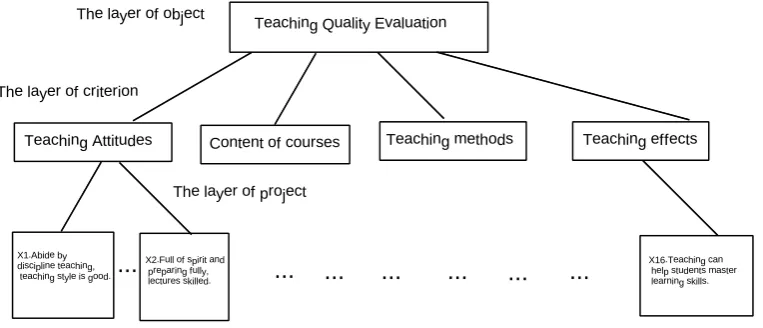
Analyze problems, should first build a delivery-level hierarchical structure model using the analytic hierarchy process [3]. The factors of each level of factors are layers of disposable, while the lower layer of the relevant factors plays a dominant role. This level can be divided into three categories: the target layer, rule layer and scheme layer. Teaching quality evaluation of the problem hierarchy model shown in Figure1.
Figure1. Level structure of teaching quality evaluation
1.2 Establishing comparison and judgment matrix
Pair wise comparisons on the same level of various factors on the importance of certain criteria in the previous level[4,5], construct pair wise comparison judgment matrix; Table 2 lists the values of pair wise comparisons of each factor score by the above method, the constructor as shown in Table described by the three pairwise judgment matrix A= [aij], where, aij, aij=1/aji, aii= 1.
Table 2.Factor score value
Scale meaning Value aij
[image:2.595.119.501.177.341.2]Ai compare with Aj, equally important 1 Ai compare with Aj, weakly important 3 Ai compare with Aj, Obviously important 5 Ai compare with Aj, Strong important 7 Ai compare with Aj, extremely important 9 Between the two adjacent judgment between scale 2、4、6、8、10
Table 3. Comparison and judgment matrix
A1 A2 …… An
A1 a11 a12 …… a1n
A2 a21 a22 …… a2n
…… …… …… …… …… An an1 an2 …… ann
1.3 Calculate the weight of the judgment matrix, sorting, and for the consistency test
First computing the weight through the pair wise comparison judgment matrix A, A1, A2, ... An, into the solution of the characteristic roots, obtained by normalized as elements of A1, A2,...An sort the right weight this method the eigenvalue method[6,7].
Namely: first calculate the geometric mean of all the elements of the judgment matrix each row,
n n
j ij
i
∏
a
=
=
ω
1
, normalized
ω
i, calculate the largest eigenvalue of the judgment matrix∑
=
ω
ω
=
λ
ni i
i
n
A
1 max
)
(
,
i
A
ω
)
(
is the ith elements of(
A
ω
)
vector, then calculate1
max−
−
λ
=
n
n
CI
(n: judgment matrix dimension),Teaching Quality Evaluation
Teaching Attitudes Content of courses Teaching methods Teaching effects
X1.Abide by discipline teaching, teaching style is good.
X2.Full of spirit and preparing fully,
lectures skilled.
...
X16.Teaching can help students master learning skills.
...
...
...
...
...
...
The layer of object
The layer of criterion
The layer of project
consistent test, by the table as follows to check the random consistency index, calculate the ratio
CI
/
RI
, then1
.
0
RI
/
CI
<
, to achieve the required consistency of judgment matrix. Otherwise the judge is to write thejudgment matrix.
Table4. RI Value
N 1 2 3 4 5 6 7 8 9 10
RI 0 0 0.58 0.90 1.12 1.24 1.32 1.41 1.45 1.49
2 Fuzzy comprehensive evaluation method
Cybernetics expert Aydin (L. A. Zadeh), the fuzzy comprehensive evaluation method was founded in 1965, it is built on fuzzy mathematics based on a comprehensive evaluation method, the method is characterized by the use of fuzzy sets, some complex and difficult to quantitative, quantitative factors and then construct the fuzzy matrix, the use of fuzzy operator composite operator, to finalize the evaluation of the object level [8].
The use of fuzzy comprehensive evaluation method, the evaluation of teaching quality steps:
2.1 Establish an evaluation factor set (first index) and the factor set (second index)
Factor set is composed of a set of evaluation factors, commonly used infinite universe U= (u1, u2,...,un), which the ui (i=1,2, ..., n) on behalf of the pending assessment of the factors, namely, a level indicators in the teaching attitudes, teaching content, teaching methods, teaching effectiveness. Factor set of second indicators in the index system, namely: X1, X2,...,X16.
2.2 To establish factors and factor weights set
With different degrees of importance because of various factors ui(an index) in the evaluation of teaching quality, various factors have been given appropriate weight coefficient ai(i= 1,2, ...,n), composed of the weight of set A.=(a1, a2, ...,an). Weights are normalized: Σai = 1 (i = 1, 2, ..., n). Analytic Hierarchy Process can also be used to identify the factors and factor weights [9, 10].
2.3 The establishment of the comments set
Judgment sets. Here, we first establish the evaluation factors set relative to the comments of the evaluation factors set, using the commonly used finite on the domain, V = (v1, v2, ..., vm) said, where vi (i = 1,2, ..., m), which represents various possible evaluation results, such as: excellent, good, moderate, qualified, unqualified and so on.
2.4 Construction of the fuzzy matrix
First factor set Ui factors ui, a single factor to judge the set of Ri, where Ri = (ri1, ri2, ... rij) rij said factors ui corresponds to the degree of membership of the jth element in the judge set V, Vj Total factor so the fuzzy relation matrix R between the factor set and evaluation set.
=
rnm
rn
rn
m
r
r
r
m
r
r
r
R
2
1
2
22
21
1
12
11
Which (ri1, ri2, ...,rin) ui factor (two indicators) distribution for the weight matrix of factors and the frequency factor in the reviews set the matrix multiplication operation.
2.5 The single factor evaluation
Full account of all factors, the weight set A and fuzzy relation matrix R, based on the fuzzy operator, can get fuzzy comprehensive evaluation decision model: B =AR= (b1, b2,...,bm), here fuzzy operator using the weighted average type of matrix operations, namely:
If bk=max (b1, b2, ..., bm), then the evaluation of teachers belonging to k classes Using the model, the single-factor evaluation rating of certain teachers.
You can calculate the evaluation value of the teacher's:
(
)
=
vm v v
bm b
b Z
2
1
2 1
2.6 Conduct a comprehensive evaluation of the multi-factor
Similar to the single factor evaluation, can be combined with the weight of the different evaluators and evaluation scores, teachers score evaluation [11, 12]. With s class evaluators and their evaluation results can be composed of the fuzzy evaluation matrix as follows:
=
S
B
B
B
B
2 1, If the weights are as follows:(T1,T2,…,Ts)
Overall conclusions as follows:
(
S
S
Ss
)
Bs
B
B
Ts
T
T
S
2 1 21
)
2
1
(
=
=
.Below draw on the experience of experts, using the analytic hierarchy process and fuzzy comprehensive evaluation method, establish a teaching quality assessment model [13].
3 Examples
3.1First step, we determined the index weights on quality evaluation of classroom teaching.
According to the indicator system of student-evaluation on theoretical courses and through the investigation by experts, we provided first index evaluation matrix, as following table5.
Table5. Evaluation matrix of first index
Target Teaching Attitudes Content of courses Teaching methods Teaching effects Teaching Attitudes 1 1/3 1 1/3
Content of courses 3 1 2 1
Teaching methods 1 1/2 1 1/2
Teaching effects 3 1 2 1
Judgment matrix
=
1 2 1 3
2 1 1 2 1 1
1 2 1 3
3 1 1 3 1 1
A , Calculate the geometric average of all the elements in each row:
, 57735 . 0 9 1
4
1 = =
ω
in a similar way:
5651
.
1
,
7071
.
0
,
5651
.
1
3 42
=
ω
=
ω
=
ω
,normalized
ω
i:,
13078
.
0
5651
.
1
7071
.
0
5651
.
1
57735
.
0
57735
.
0
1
=
+
+
+
=
ω
in a similar way:
35452
.
0
,
16017
.
0
,
35452
.
0
3 42
=
ω
=
ω
=
=
=
ω
42174
.
1
64548
.
0
42174
.
1
52730
.
0
35452
.
0
16017
.
0
35452
.
0
13078
.
0
1
2
1
3
2
1
1
2
1
1
1
2
1
3
3
1
1
3
1
1
A
Below is the largest eigenvalue of the judgment matrix:
0206
.
4
4
)
(
4 1max
ω
=
ω
=
λ
∑
= i i iA
,006865
.
0
1
4
4
0206
.
4
=
−
−
=
CI
,00763
.
0
9
.
0
006865
.
0
=
=
=
RI
CI
CR
,1
.
0
00763
.
0
<
=
CR
.The vector after normalization process as the weights of index, so we got the first index weights for:
Teaching Attitudes (0.1308), Content of courses(0.3545),Teaching methods(0.1602),Teaching effects(0.3545).
In a similar way, we got weights of second index, each index weight through the calculation of the analytic hierarchy process (AHP) to table 6.
Table6.Index weight at all levels of theoretical courses (student-evaluation)
Index level Evaluation items
First index Teaching attitudes(0.1308)
Contentof courses(0.3545)
Teaching methods(0.1602)
Teaching effects(0.3545)
Second index
X1(0.1213)
X2(0.4203)
X3(0.1899)
X4(0.2685)
X5(0.2274)
X6(0.4231)
X7(0.2274)
X8(0.1222)
X9(0.1988)
X10(0.2364)
X11(0.3976)
X12(0.1672)
X13(0.1453)
X14(0.4233)
X15(0.1608)
X16(0.2705)
3.2 Secondly, we provided an assessment model for teachers' teaching quality by using fuzzy comprehensive evaluation.
We assumed that there were 100 students had given evaluation on a teachers' teaching quality, comments set V=( excellent, good, general, eligible, unqualified), correspond to (95, 85,75, 65, 55), and the factors of teaching attitude corresponding to the four factors(Here refers to the secondary index): X1,X2,X3,X4.
In X1, the teacher is considered excellent by thirty percent, good by forty percent, general by twenty percent, eligible by ten percent, and unqualified by zero percent of students, corresponds to numerical value: 0.3, 0.4, 0.2, 0.1, 0;
In a similar way, we got numerical value corresponded to X2, X3, X4, combined with the weights of each factor by export evaluation and AHP , Structured fuzzy relation matrix,
Process is as follows:
We first calculated teaching attitude fuzzy factor:
Similar, we calculated content of courses fuzzy factor:
)
0
107
.
0
280
.
0
287
.
0
326
.
0
(
;Teaching methods fuzzy factor:
(
0
.
221
0
.
205
0
.
359
0
.
187
0
.
029
)
Teaching effects fuzzy factor:
(
0
.
337
0
.
275
0
.
138
0
.
168
0
.
082
)
From the above four fuzzy factors, sums up fuzzy relation matrix:
=
082
.
0
168
.
0
138
.
0
275
.
0
337
.
0
029
.
0
187
.
0
359
.
0
205
.
0
221
.
0
0
107
.
0
280
.
0
287
.
0
326
.
0
0
121
.
0
305
.
0
321
.
0
253
.
0
R
Four evaluation index weights of first index: teaching attitudes (0.1308); content of courses (0.3545); teaching methods (0.1602); teaching effects (0.3545).
Single element evaluation from students:
(
)
(
0
.
304
0
.
274
0
.
246
0
.
143
0
.
034
)
082
.
0
168
.
0
138
.
0
275
.
0
337
.
0
029
.
0
187
.
0
359
.
0
205
.
0
221
.
0
0
107
.
0
280
.
0
287
.
0
326
.
0
0
121
.
0
305
.
0
321
.
0
253
.
0
3545
.
0
1602
.
0
3545
.
0
1308
.
0
=
=
=
AR
B
So student evaluations of this teacher scores:
(
)
81
.
7
55
65
75
85
95
034
.
0
143
.
0
246
.
0
274
.
0
304
.
0
=
CONCLUSIONResearch shows that analytical hierarchy process (AHP) to determine the evaluation of teaching quality weight indicators, and combined Fuzzy Comprehensive Evaluation (FCE) is both feasible and scientific, which can offer the fair and objective evaluation of teachers.
REFERENCES
[1] Patrick Asubonteng, Karl J McCleary, John E. Swan. The Journal of Services Marketing, 1996, 10(6):62-81. [2] Patrick Asubonteng, Karl J McCleary, John E. Swan. The Journal of Services Marketing, 1996, 10(6):62-65. [3] A. Prasuraman, Valarie A. Zeithaml, Leonard L. Berry. Journal of Retailing,1991, 67(4):420-450.
[4] James M Carman. Journal of Retailing, 1990, 66(1):33-55.
[5] Lawson F. Congress, convention and exhibition facilities: Planning, design and management. London: Architectural Press, 2000,168.
[6] Madhukar G. Angur, Rajan Nataraajan, John S. Jahera Jr. International Journal of Bank Marketing, 1999, 17(3): 116-123.
[7] Bolton, R.N., Drew, J. H., J. Consum. Res,1 991, 17(4):875~884.
[8] James J. Jiang, Gary Klein, Christopher L. Carr. MIS Quarterly, 2002, 26(2):145-166.
[9] Philip Kotler. Marketing Management: Analysis, planning, Implementation and control (Ninth Edition). Prentice-Hall International, 1997, 467.