DEVELOPMENT OF MULTI-POSITION WELDING TABLE AS TEACHING AND
LEARNING TOOL FOR THE SUBJECT OF WELDING TECHNOLOGY
Lai Chee Sern & Jamaluddin Hashim Engineering Education Department
Faculty of Technical Education Kolej Universiti Teknologi Tun Hussein Onn,
Batu Pahat, Johor
[email protected], [email protected]
ABSTRACT
Most of the things we use in our daily life is welded or made by equipment that is welded. Welders build products from coffeepots to automobiles, from bridges to skyscrapers and millions of other products which are produced for the use of people. Because of welding technology is widely used, especially in the manufacturing and services industries, therefore most of technical institutions and higher learning institutions that offer technical and engineering courses will include welding technology as a part of the curriculums. From the educational perspective, welding technology is one of the foremost skills that have to be mastered by students who are going to involve in the area of engineering as well as technical education. But yet, learning the welding skill is not easy for students. For teachers, teaching students to master the skills is even tougher. Therefore, the main purpose of this product-based research is to design and produce a multi-position welding table which is able to help students to weld in various positions such as flat, overhead, vertical and horizontal positions. Apart from that, this product also can be used as a work piece holder for welding circular work pieces such as cylinder, rod, tube and pipe. The Crawford’s six-stage product development model will be used as a guideline in this research. The final product will be assessed in terms of user friendliness as well as the effectiveness of the product in teaching and learning process. It is expected that the use of the multi-position table will be able to smoothen the teaching and learning process, where students can use it to master the gas and arc welding skills easily and teachers can use it to demonstrate the welding technique effectively.
INTRODUCTION
Whether technology should be used in educational institutions is no longer the issue in education. Instead, the current emphasis is ensuring that technology is used effectively to create new opportunities for learning and to promote students achievement. Researcher are now beginning to meet the more complicated research task of investigating the impact of technology use in meeting these new expectation for what students should learn. According to Clement and Sarama (2003), appropriate technology use can be very beneficial in increasing students’ performance, but there are still poor uses of technology in education. The main reason teachers do not use technology in classrooms is a lack of experience with the technology (Wenglinsky, 1998). Students cannot be expected to benefit from technology if their teachers are neither familiar nor comfortable with it. The transformation of classroom technology from hardware, software and connections into tools for teaching and learning depends on knowledgeable and enthusiastic teachers who are motivated and prepared to put technology to work on behalf of their students (Guhlin, 1996). Teacher must become knowledgeable about technology and self-confident enough to integrate it effectively in the classroom. Teacher, in other word, must become “fearless in their use of technology” and empowered by many opportunity it offers. Educational technology is not, and never will be, transformative on its own, however. It requires assistance of educators who integrate technology into curriculum, align it with students learning goals, and use it for engaged project (Darling-Hammond and Falk, 1997).
The use of technology in engineering education is extremely importance as most of the educational institutions are advocating hands-on learning. When we talk about welding technology, hands-on learning is one of the most effective ways of learning because students who will involve in the area of engineering or technical field in future need hands-on skills in order to be marketable in manpower market. Emphasising the use of technology as a job skill, teachers focus on teaching students how to use various types of equipments that are likely to be encountered in business or technical work environments. This approach to technology use focuses on acquisition of practical skills and at the same time it stress on the skills of critical thinking, interpretation and synthesis as well.
According to Mathew Bacon (cited in Haury and Rillero, 1994 ), hands-on learning is the best way students can directly observe and understand. As students develop effective techniques for observing and testing everything around them, they learn the ‘what’, ‘how’, ‘when’ and ‘why’, of things with which
-they interact. These experiences are necessary if the students of today are to remain “turned-on” to engineering and become scientifically literature. There is no doubt that there is more emphasis on hands-on materials than in the recent past. However, that does not mean the hands-hands-on engineering activities ever passed away. Furthermore, good engineering program cannot exist without hands-on.
BACKGROUND OF RESEARCH
Welding is a critical technique for the joining of materials in the major manufacturing industries. No other technique is as widely used by manufacturers to join metal and alloys efficiently and to add value to their product. Most of the familiar objects in modern society, from buildings and bridges, to vehicles, computer and medical devices, could not be produced without the use of welding. Since welding technology is so importance to the manufacturing sector, it is essential to increase the skills and knowledge base of all people who will involve in welding industries, at every level, enabling them to make decisions that will result in utilisation of the best welding technology for each application. However, learning the skill of welding is not easy and learners always face problems when learning to weld.
Welding table is one of the main equipment in welding training system. By using the conventional welding table, students are difficult to learn welding in various welding positions as the conventional welding table is not equipped with work-piece holder which can be adjusted into various welding positions such as flat, vertical, horizontal and overhead positions. In most of the educational institutions, students are only given the chance to learn welding in flat position, or may be in horizontal position as well in welding workshop. Vertical and overhead welding are always neglected by most of the lecturers or teachers because welding in such positions needs extra equipment. In fact, vertical and overhead welding should be learned and practiced more by students because vertical and overhead welding are much more difficult compared to flat and horizontal welding.
Welding circular materials is more challenging because the welder has to rotate the work piece with the assistance of conventional tool and welds at the same time. Such method is tedious and sometimes it can be a tough job even for skilled welder, let alone new learner and handicap people. Welding a circular work piece is even more challenging for gas welder because both of the welder’s hands are working simultaneously, one hand for holding the injector, while the other hand is used to hold the filler rod. Since the welder has no more free hands to rotate the work piece, therefore, developing a work piece holder, which is able to rotate automatically and able to mount workpiece in various positions, is a must in order to make the welding process easier, faster and more effective.
PURPOSE OF RESEARCH
The main purposes of this research are two-fold. First, is to develop a multi-position welding table as teaching and learning tool for welding technology. Second, the welding table will be used to find out the effectiveness for teaching and learning.
OBJECTIVES OF RESEARCH
In order to achieve the purpose of the study, there are a few specific objectives that have to be achieved, namely:
i) to design a multi-position welding table for the purpose of teaching and learning.
ii) to fabricate the multi-position welding table by means of mechanical methods with suitable materials.
iii) to carry out the function test for the final product.
lives. According to UNESCO (United Nations Education, Social and Cultural Organisation), technology can be defined as:
“……. the know-how and creative processes that may assist people to ultilise tools, resources and system to solve problems and to enhance control over the natural and made environment in an endeavour to improve the human condition.” (UNESCO, 1985)
Thus technology in this statement involves the purposeful application of knowledge, experience and resources to create process and products that meet human needs. The needs and wants of people in particular communities determine the technology that is developed and how it is applied. As far as education is concerned, technology is the application of technology to any of those processes involved in operating the institutions which house the educational enterprise. It includes the application of technology to food, health, finance, scheduling, grade reporting and other processes which support education within education. According to Mark Burgin (1999), the technological approach to education is inevitable if we want to have the majority of population being integrated in modern culture and society with its sophisticated technical devices and complicated social structures. Consequently, we come to the necessity to apply scientific methods to design, evaluation, and utilization of educational technology.
Welding Process
Welding is a joining process that produces a local coalescence of materials by heating, by applying pressure, or both. In essence, the welding process fuses the surfaces of two distinct elements to form a single unit. It encompass a broad range of joining techniques that include arc welding, solid state welding, gas welding, resistance welding, brazing, and soldering.When compared with other joining methods, such as riveting and bolting, welded structures tend to be stronger, lighter-weight, and cheaper to produce. More than 100 processes and process variants comprise the family of welding technologies and include methods for welding metal, polymers, and ceramics, as well as emerging composite and engineered materials.
Welding Process
Other Welding
Resistance Welding Solid State
Welding
Arc Welding Gas Welding
Brazing
Soldering
Figure 1: Welding process
[image:3.612.82.496.415.616.2]-Figure 2: Arc welding system
Welding Positions
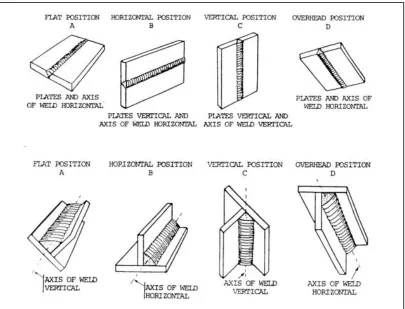
All welding can be classified according to the position of the workpiece or the position of the welded joint on the plates or sections being welded. There are four basic welding positions, namely:
(a) Flat
In flat position, the welding is performed from the upper side of the joint, and the face of the weld is approximately horizontal.
(b) Horizontal
In horizontal position, welding is performed on the upper side of an approximately horizontal surface and against an approximately vertical surface.
(c) Vertical
In vertical position, the axis of the weld is approximately vertical.
(d) Overhead
In this welding position, the welding is performed from the underside of a joint.
Hands-On Learning
Hands-on learning has become a common phrase in engineering education. Like many other highly used terms and phrases, there are various interpretations of what is meant by “hands-on learning”. Generally, hands-on learning is learning by doing. Technical and vocational education has always understood that if you want someone to learn to repair a television, you need a television to repair. If you want to teach someone to swim, you have to put them in swimming pool (Haury and Rillero, 1994).
[image:4.612.91.498.62.281.2]All welding positions are illustrated in Figure 3.
Figure 3: Welding positions
METHODOLOGY
This product-based research will be divided into two phases, namely product development and the second phase is product evaluation. In the first phase, the researcher will focus on product design, materials selection, fabrication methods selection, product assembly and product function test will be done at the final stage. While in the second phase, product evaluation will be the main focus. The researcher will evaluate the product in terms of user-friendliness and effectiveness in teaching and learning process.
[image:5.612.91.496.100.409.2]-Research Framework
Product Planning
Conceptual Design
Product Development Screening
Product Evaluation
Modification
Final Product Product Function Test
Use for Teaching Use for Learning
Figure 4: Research framework
Product Development Model
In this research, Crawford’s six stage model will used as a guideline for product development. Crawford’s six-stage model is actually originated from Cooper and Kleinschmidt’s model. Crawford (1988) simplified the Cooper and Kleinschmidt’s 13-stage model into six stages. The Crawford model is a linear model in which each stage of the process has to be completed, in order that the product should have more chance of being successful.
New Product Planning
Idea Generation
Screening
Technical Development
Market Appraisal
[image:6.612.143.435.72.322.2] [image:6.612.80.466.453.657.2]Crawford Model
1. New Product Planning
Emphasising product planning as a main element in research.
2. Idea Generation
Seeking ideas internally and externally (from management, research, competition, users and employees)
3. Screening
To analyse technical synergy and feasibility of the project.
4. Technical Development
Concepts developed transform into physical forms.
5. Market Appraisal
To assess user opinions.
6. Commercialisation Launch of the product.
Research Respondents
For determining the effectiveness of the product for teaching process, any lecturers who use the multi-position welding table for teaching Welding Technology will be targeted as respondents for this research. While for learning process, students who are taking the subject of Welding Technology will be taken as respondents in this research. The students will be divided into two groups. The first group will use conventional welding table for their projects and the second group will use the multi-position welding table. The control group and experimental group should consist of students in the same grade at the same university.
Research Instrumentation
There are three instruments will be used in this research, namely;
1. Questionnaire
Two sets of different questionnaire will be developed to find out the users’ perceptions about the product. One set of question is for teachers and the other set is for students.
2. Performance-based assessment
The individual project produced by two groups of students will be assessed and graded by the researcher or lecturer. The average score of each group will be used to determine the effectiveness of the product.
3. Observation
An observational checklist will be developed for the product evaluation. The Observation is carried out to see how students to be able to adapt to this new product.
CONCLUSION
It is expected that the use of multi-position welding table will be able to smoothen the teaching and learning process, in which students can use it to master the gas and arc welding skills easily and teachers can use it to demonstrate the welding technique effectively. Besides, the product is also able to assist students to learn and practice welding skills in various welding positions.
It is teachers’ responsibility to use the pedagogical technology for developing students’ intellects, knowledge, and skills. Development and utilisation of educational technology should not be seen as a burden for teacher. On the contrary, it is aimed at developing teacher’s creativity and enhancing teacher abilities to achieve higher level in teacher professional activities.
-REFERENCES
Bruce, M. & Cooper, R. (2000). Creative Product Design. New York: John Wiley & Sons Inc. Clements, D. H., & Sarama, J. (2003). Strip mining for gold: Research and policy in educational
technology—A response to Fool's Gold. Educational Technology Review, 11(1), 7–69. from http://www.aace.org/pubs/etr/issue4/clements2.pdf
Crawford, C.M. (1988). New Products Management. Irwin, Homewood, USA.
Darling-Hammond, L and Falk, B (1997). Using Standards and Assessments To Support Students Learning. Phil Delta Kappan.
Diana Porter (1998). How Technology Can Broaden Learning by Enabling Students to Find, Analyse, Categorise, Manipulate, and Communicate Data in Complex Task. Retrieved at http:// www.ncrel.org/sdrs/areas/issues/methods/technlgy/te800.htm
Guhlin, M. (1996). Stage a well designed saturday session and they will come! Technology Connection, 3(3), 13-14.
Haury, D.L. and Rillero, P. (1994). Perspectives of Hands-On Science Teaching. From http://www.ncrel.org/sdrs/areas/issues/content/cntareas/science/eric/eric-2.htm
Lumpe, A.T and Oliver, J.S. (1991). Dimensions of Hands-On Science. The American Biology Teacher.
53(6). 345-348.
Mark Burgin. (1999). Technology in Education. Proceedings for 1999 Frontiers in Education Conference. On 10-13 November, San Juan, Puerto Rico.
Wenglinsky, H. (1998). Does it compute? The relationship between educational technology and student achievement in mathematics. Princeton, NJ: Educational Testing Service. from