How to cite this paper: Yao, Q.K. (2015) The Spatial Relativity and Its Physical Consequences. Open Access Library Journal, 2: e1286. http://dx.doi.org/10.4236/oalib.1101286
The Spatial Relativity and Its Physical
Consequences
Qiankai Yao1,2
1School of Physics and Engineering, Zhengzhou University, Zhengzhou, China 2College of Science, Henan University of Technology, Zhengzhou, China Email: [email protected]
Received 6 January 2015; accepted 22 January 2015; published 27 January 2015
Copyright © 2015 by author and OALib.
This work is licensed under the Creative Commons Attribution International License (CC BY).
http://creativecommons.org/licenses/by/4.0/
Abstract
Through reevaluating the physical significance of Hubble law, we propose the concept of spatial relativity and make two postulates: 1) Distance is equivalent to motion; 2) Hubble radius ℜ is constant. Such an approach can help us to develop the theory of relativity into a unified form, and further construct a simple and consistent cosmological model. It shows that, our universe can be treated as an eternal 3-dimensional ball with an edge never reached served by the physical hori-zon, whose inherent geometrical property will directly lead to Hubble law, rather than Doppler mechanism. Importantly, the presented model can provide us a unified scheme to deal with the cosmological problems, but without employing more extra assumptions. This will greatly change our understanding of the cosmic spacetime.
Keywords
Hubble Law, Hubble Radius, Spatial Relativity
Subject Areas: Theoretical Physics
1. Introduction
OALibJ | DOI:10.4236/oalib.1101286 2 January 2015 | Volume 2 | e1286
as two different type involved quantities in usual kinematics, the cosmic distance r and Hubble velocity (HV, the recession velocity of celestial body) uH need to obey different additions, but indeed they are also linked by the Hubble relation uH = Hr (H Hubble constant). This means that, as long as H is constant, it would inevitably lead to the observational contradiction. Specially, if distance is doubled, the recession velocity determined by HL will be doubled (even greater than the speed of light c), uH (2r) = Hr, whereas by the Lorentz velocity addition, due to the body at position 2r moving with a velocity Hr as measured in the cosmic rest frame S' at r, and the velocity of S' relative to the earth reference S reading Hr, it seems to be equal to 2Hr
(
1+H r c2 2 2)
.To avoid the contradiction, we raise HL to the status of a postulate, and stress the equivalence of distance and motion. It shows that, for being equivalent to motion, the cosmic distance should obey the same addition as ve-locity. Starting from this, we develop the theory of relativity into a unified form, in term of which spatial geo-metry, kinematics and cosmic electrodynamics are to be understood. The modified spatial geometry can help us to construct a static cosmological model with neither a beginning nor end of time, and hence no need to define initial conditions. In our model, the universe is appearing as a finite 3-dimensional ball of radius ℜ =cT0 (with cosmological time T0 = H−1), just corresponding to the physical horizon. The properties of the model are dis-cussed and some new results are presented.
2. Unified Form of Relativity
Basic consideration. In cosmology, the cosmological principle is always regarded as a theoretical cornerstone
[11] [12], which emphasizes the universe should appear the same in every direction from every point. However, such a physical thought has not been carried out completely in BBM, since no rule is provided to determine how an event in one region is related to the same as measured in another causally disconnected region, whereas these regions were theoretically allowed to exist. This is a serious defection, we cannot accept it, just like we cannot accept an event occurring in one inertial frame is not physically allowed to be observed in the other.
To find the way out of the impasse, we extend the content of the relativistic principle: no experiment can def-initely single out one of frames of reference is “truly” stationary or at “absolute” origin, while the others are “truly” moving or in the off position. This means the physical relativity is not only reflected in motion, but in space, namely the cosmic space has the relativity too. Therefore, the difficulty that had to be resolved amounted to choosing amongst two alternatives: 1) Distance and velocity obey different additions, and something was wrong with HL; 2) There is a new principle valid for cosmological observation. The first possibility should be thrown out due to many observational evidences supporting HL. The second is our final choice: physical laws are the same in every part of our universe, or, no experiment can detect the “absolute” position of a frame. He-reby, we make two postulates:
Postulate I.Physics in a still frame at position r in relativistic space is equivalent to physics in an inertial frame moving with velocity Hr inrigid space (i.e. Euclideanspace).
Postulate II. Hubble radius ℜ isconstant.
By the two, the cosmological and relativistic principles can be stated uniformly as that: the universe does not possess any privileged positions or frames. Once the idea is included in this framework, all the frames, whether in remote distance or motion, are now on equal footing. Importantly, ℜ must go into Einstein field equations (EFE): Gµν+ Λgµν = −κTµν (κ=8πG c4) to play the role of cosmological constant Λ, and this will greatly change our understanding of the spacetime geometry. Taking the observational value [13] of H = 2.4 × 10⁻¹⁸ s−1, we get ℜ =1.3 10 m× 26 .
To illustrate the consequences of our postulates, we reassert that HV is only quantitatively equal to the veloc-ity of a particle passing though distance r in time interval T0, but indeed represents a virtual velocity for its being unable to cause any displacement. So that, if assuming there exists a kind of displacement dxˆ to be responsible for uH
(
=dxˆ dt)
, the spatial position can be defined as0
ˆ d
ˆ d
H T
t
= = x
r u , r≤ ℜ (1)
where dtˆ
(
=dt T0)
denotes the time number. Constancy of ℜ allows us to construct an invariant quantity 2ˆ ˆ
ds =ηµνdxµdxν (
(
ˆ 1 2 3)
ˆ ˆ ˆ ˆ
dxµ = ℜd , d , d , dt x x x , ηµν the Minkowski metric), and further derive a Lorentz type
transformation dxˆµ =ανµdxˆ′ν with matrix ανµ determined by Lorentz factor 2 2
1 1
r r
OALibJ | DOI:10.4236/oalib.1101286 3 January 2015 | Volume 2 | e1286
(far from S' with r) to occur at different times dtˆ=γrdx rˆ1 ℜ2, namely simultaneity is also a spatial relative concept.
Accordingly, the transformation for 4-position ξµ = ℜdxˆµ ds gives the distance additions in parallel and vertical directions respectively
/ /
/ / 2
/ /
1
r r
ξ ξ
ξ
′ + =
′
+ ℜ ,
(
2)
/ /
1
r r
ξ ξ
γ ξ
⊥ ⊥
′ =
′
+ ℜ (2)
This is a remarkable and general result, which in the case of ℜ → ∞, reduces to the usual form ξ r ξ= + ′. Meanwhile, Equation (2) also presents that, if an object has a distance less than ℜ to one observer, its distance is always less than ℜ for any other observer, provided this other observer is at distance less than ℜ. In partic-ularly, for two objects at the opposite sides of observer O with distance 0.9ℜ, BBM points that, due to laying outside of the each other’s respective horizons, one could not be observed in the other. However by Equation (2), the measured distance is only ξ =0.99ℜ < ℜ, and if ξ′ = ℜ, then ξ = ℜ, namely any celestial body at hori-zon from one observer will have the same distance in view of the other (seeFigure 1). To understand physically why this is the case, it is necessary to turn to the consequences of spatial relativity.
Effects of spatial relativity. Until now, we have only concerned the spatial relativity, but need to look at its kinematics. The reason is that, according to the usual view if given a speed, an object will move without bound
i.e. up to and then beyond the horizon range. This implies, if accepting the transformation above, it will trans-form a real position into imaginary. To avoid the problem, we must distinguish two type velocities in physics, the first is a virtual velocity, called HV uH =r T0, the second a real velocity, called displacement velocity (DV)
d d
D = t
u r , and define the full velocity (FV) by u=uH+uD=dxˆ dt.
Now, we emphasize only the frames of moving with constant FV relative to a free particle can be treated as the inertial ones, which would strongly suggest us to modify the Newton inertia law as that: the inertial nature of free moving object is no longer to keep usual velocity, but FV constant. Therefore, the spacetime geometry could be derived from the assumption that there exist rigid coordinates xˆμ with two properties: 1) Two events
1 ˆμ
x , ˆ2 μ
x can be connected by a light signal if and only if
(
xˆ2−xˆ1)
2= ℜ2(
tˆ2−tˆ1)
2; 2) Free particles obey the modified inertia law d2xˆμ dt2=0. As an example, for a free particle departing from the origin with velocity u, its DV reads uD= = −r u Hr, followed by 0(
1 e)
Ht
r=uT − − and uD ue Ht −
= . When u=c, uD ce Ht −
= ,
meaning the propagation speed of light will decay exponentially to zero, to ensure the horizon never to be crossed. Similarly, for a photon coming from the horizon, we have r= ℜ2 e−Ht− ℜ and uD 2 ec Ht
−
= − , which
gives uD t=0 =2c>c. This does not lead to contradiction, for uD representing the relative speed of photon fly-ing away from the horizon, like the separation speed of two reverse motion photons. In fact, the FV of light measured by any observer in any position, without exception, is c.
[image:3.595.191.435.561.686.2]What is the physics behind the spatial relativity? The answers are time dilation—a distant clock appears to run slow, and length contraction—a distant object appears to contract. Physically, to interpret time dilation, we con-sider a rest light clock of ticking away the time by light-pulse bouncing back and forth between proper length L0 (seeFigure 2). For a local observer, one has the duration of a round trip (proper time) ∆ =t0 2L c0 . To observ-er S with respect to whom the clock is at position r (in perpendicular), the light will traverse L0 with DV
OALibJ | DOI:10.4236/oalib.1101286 4 January 2015 | Volume 2 | e1286
( )
2 2 Dc = c − Hr in time interval ∆ =t 2L c0 D= ∆γr t0, showing time dilation.
[image:4.595.267.359.498.574.2]Correspondingly, a length will get shortened in sight line when measured by a distant observer. Shown as Figure 3, placing the light clock in parallel, the duration for local observer is still Δt0. Whereas for observer S, the pulse distance becomes L, and the total round time ∆ =t L cD1+L cD2. Due to ∆ = ∆t γr t0, and cD1= −c Hr,
1 D
c = +c Hr, the length contraction is deduced, 1 0 r
L=γ−L . This phenomenon is usually known as the Lo-rentz-Fitzgerald contraction, but here it is an observable spatial effect.
Developed relativistic principles. Now,it should berestated that, the universe appears the same in every di-rection from every point in FV space, and the statement encourages us to develop Einstein’s postulates as:
The principle of relativity Physical laws have the same form in all frames of reference moving with constant
FV with respect to one another.
Constancy of FV of light. The FV of light is independent of the motion and position of its source.
The moving behavior of material objects will be influenced by, and consistent with the FV transformation between different frames. The transformation for 4-velocity U c xdˆ ds uu
µ = µ =γ µ gives
0 / /
/ / 2
0 / /
1
u u u
u u c
′ + =
′
+ ,
(
)
0
2 0 / /
1
u u u
u u c
γ
⊥ ⊥
′ =
′
+ (3)
which in the case of u′ =0 and u0=Hr, can directly lead to Hubble relation in 4-vector form UH Hr µ = µ
. Let us examine the point O' at position r in frame S, its proper distance should be rˆ=xˆ1=α γν1
( )
r xˆ′ν =γrrfor xˆ′ = ℜν
(
, 0, 0, 0)
. If measuring ˆr in a frame with radial velocity u relative to S, we obtain rˆu=γu−1rˆ. This rigid length determines a distance in relativistic space( ) ( )
2 2 2 2
ˆ ˆ
1 1
u u
u u
r r
r
r γ ru c
= =
+ ℜ − ℜ (4)
when rℜ, it reduces to the usual length contraction ru γu1r
−
= . However, as r→ ℜ, ru→ ℜ, meaning any moving observer will observe the same horizon(notice that, such the conclusion does not hold in BBM). And thus, the universal significance of developed relativistic principles is embodied.
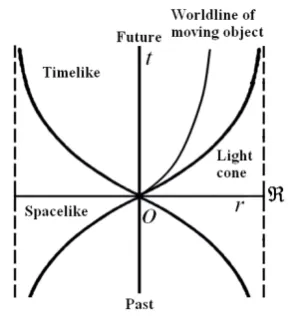
For simplicity, we rewrite the 4-coordinate interval as ds2=ηµνdxµdxν (omitting the mark above dxµ), which gives the geodesic equation dUµ ds=0, requiring free particle keep its FV constant. To interpret the properties, we plot the r-t diagram, whose world line 0
(
1 e)
Ht
r=uT − − traces out the curve rather than straight line. Therefore, suppose an event O occurs at the origin, we find the world lines of the photons passing through will lie on a convex cone with a vertex at O, called lightcone (seeFigure 4).
Figure 2. Time dilation shown by light clock at local (a) and distant (b) positions.
[image:4.595.273.355.611.693.2]OALibJ | DOI:10.4236/oalib.1101286 5 January 2015 | Volume 2 | e1286
Figure 4. Display of lightcone structure with respect to the origin of relativistic spacetime.
3. Dynamics
Relativistic Dynamics. As an extension of usual momentum, the FV 4-vector p m U0 µ = µ
must satisfy two criteria: 1) It must be conserved in all observational positions for being compatible with cosmological principle; 2) It must reduce to the usual form as r→0, requiring the relativistic laws to be correct in close enough range. The definition leads us to an idea of that the mass of particle will increase with r, until tend to infinite at the ho-rizon, i.e. m r
( )
=γrm0r→ℜ→ ∞. Such relation for galaxies implies an observational fact that the massive ga-laxies look farther (form early), whereas low-mass gaga-laxies look closer (form late) [14]. Moreover, when apply-ing the transformation to a photon of wavelength λ0 coming from the object at r, its spectral shift as measured at the origin would be0
0
1 1
r
r r
z
r
λ δλ
λ <<ℜ
+ ℜ +
+ = = ≈ +
ℜ − ℜ (5)
This is very the Hubble relation.
For free particle, we can naturally think of its FV momentum conservation, namely p=0. So that, if treating
0 D =γum D
p u as the displacement momentum, we have
d d
D eff t =
p
F , Feff = −γum H0 uD (6)
The result shows, even for a free particle, it will be subjected to an effective damping force Feff proportion-al to its DV, and finproportion-ally tend to still to ensure it never cross the horizon. That is to say, any moving particle will bear an acceleration of uD= −HuD, instead of uniform motion as the usual inertia law described. However in general, such deceleration is so small that the law is approximately valid. Moreover, for a stressed particle, its motion behavior could be described by the dynamic equation Fµ =c pd µ ds, which reduces to the usual relati-vistic form in local region.
An interesting step is to introduce the 4-momentum inertia J m r0 µ = µ
, which suggests pµ =HJµ. It indi-cates that, the momentum of moving particle eventually represents a transfer ability of delivering mass m to po-sition r=uT0. When u=c, uT0 = ℜ, namely only photon can reach the horizon. On the other hand, we also see that, the energy of a moving body E=mc2 will finally convert into its energy inertia I= ℜm 2, but in turn, it does not be allowed to happen spontaneously. Such the moving irreversibility should be not ignored in physics, it perhaps heralds a strong unidirectional arrow of time governing everything that happens [9]. Nevertheless, the truly remarkable aspect of the above conclusions is that it has its fundamental origin in the fact that there exist the universal maximum possible speed and distance, the light speed and the Hubble radius, which are both built into the structure of spacetime.
[image:5.595.239.390.82.244.2]OALibJ | DOI:10.4236/oalib.1101286 6 January 2015 | Volume 2 | e1286
properties of the electromagnetic fields E and B. Namely, under the FV Lorentz transformation, not only the space and time coordinates will change, but also the electromagnetic fields. The transform formulae for ME are somewhat simpler when written in the Heaviside-Lorentz system of units, of which the rigid coordinate form is
[15]
1
ˆ ˆ , ˆ 0
1 ˆ
ˆ 0, ˆ
c t c t σ ∂ ∇⋅ = ∇× + = ∂ ∂ ∇⋅ = ∇× − = ∂ B E E E
B B j
(7)
where
( )
ˆ ,ˆ 0U c µσ j =σ denotes the 4-current densities. Correspondingly, the Lorentz force on charge q reads
(
)
F=q E+ ×β B with β =u c. In above unit system, the transform properties of the electromagnetic fields are given by
(
)
(
)
/ / / / / / / / , , u uE E E E
B B B B
γ γ ⊥ ⊥ ⊥ ⊥ ′ ′ = = − × = ′ = ′− × B E β
β (8)
Using these rules, we can check the covariance of equations of electromagnetism. The approach can provide us all the knowledge of cosmic electrodynamics, the key point is to transform the involved quantities into relati-vistic space. For example, by Equation (7) we get the Coulomb field E
( )
rˆ =qrˆ(
4πrˆ3)
, which in relativistic space becomes( )
4π 3 4π 2 C Cq q
r
r r
= − = +
ℜ
E r r E E (9)
for rˆ=γrr. It shows that, besides the usual Coulomb field ΕC, the charge also induces a resistant field ΕC. This is different from our traditional idea.
4. Relativistic Cosmological Model
In moderncosmology, our universe is described as a surface of 4-dimensional sphere, whose contracting or ex-panding in the direction of the 4-radius would give all the dynamical properties of cosmic system [16]. But here, we model our universe as an eternal 3-dimensional sphere with a never reached edge corresponding to Hubble radius, whose spatial coordinates plusing time can just form Minkowski metric ηµν. Therefore in our model, the flatness and horizon problems would naturally disappear, but without employing the expansion hypothesis, inflationary or otherwise [2].
To introduce ℜ into EFE, we suppose a particle is placed at the origin of a small spherical space, within which the matter is removed (Tµν =0). Due to the ubiquitous fluctuation, the particle will obtain a small dis-turbed velocity u
(
=Hrc)
, whose 4-vector form reads U ruµ =γ µ
followed by ηµνU Uµ ν =g u uµν µ ν. Now, if treating gµν =ηµν+ηµνr2 ℜ2 as the metric tensor with perturbation ηµνr2 ℜ2, we can calculate Einstein tensor Gµν ≈ −ηµν ℜ2, and find the cosmological constant should be Λ = ℜ−2
. It suggests
2
1
Gµν + gµν = −κTµν
ℜ (10)
In this way, ℜ is introduced into EFE as a natural constant.
Therefore, for our universe of gµν =ηµν with the stress-energy tensor of homogeneous and isotropic static ideal fluid Tµν =Diag
(
ρ0, , ,P P P)
, we have Gµν =0, and then2
1
T µν µν
η = −κ
ℜ (11)
which requires ρ0 P 1
( )
κ 2 2.9 1010J m 3− −
= − = ℜ = × ⋅ , being 1/3 of the critical energy density given by BBM
[16]. Physically, it is sensible, as long as ρ0 constant, the system energy would be strictly proportional to its volume V, namely U=ρ0V . When the volume changes, a amounts of work will be done dW=P Vd . Ac-cording to the energy conservation dU+dW =0, there must be P= −ρ0. Not only that, if treating the horizon term in Equation (11) as a contribution to the stress-energy tensor, Tµνℜ =1
( )
κℜ2 ηµν , we can get an effectiveresult eff 0
OALibJ | DOI:10.4236/oalib.1101286 7 January 2015 | Volume 2 | e1286
0 eff
Gµν = −κTµν = ). Meanwhile, the covariant conservation of Tµν also yields ρ0=0 and ∂ ∂ =P r 0. Now, by analogy with the modified Coulomb field (9), we write the Newtonian gravity in relativistic space as
3 2 N N
Gm Gm
r r
= − + = +
ℜ
g r r g g (12)
From which we see that, accompanying with the usual gravity gN, there is always a repulsive field gN that could be responsible for the discoveries of gravitationally self-repulsive dark energy [17] [18]. And it is this re-pulsive field that maintains the balance of the Newton universe (ℜ → ∞). In particularly, we review the New-tonian gravity caused by mass within the sphere of radius r, that is
( )
20
4π 3
N
g = − Gρ r c . Correspondingly, the total repulsive effect from cosmic matter reads
π 0 2 2
0 0 2 2
3
0 0 0
2 2 2
2π sin d cos
d
2 cos
4π 4π 4π
3 15 3
N
G r r r r
g r
c r r rr
G r G r G r
c c
ρ θ θ θ
θ
ρ ρ ρ
ℜ
ℜ→∞
′ ′ − ′
′ =
ℜ + ′ − ′
= − =
ℜ
∫
∫
(13)
It shows that, for the Newton universe, the widespread existence of repulsive interaction can just resist the gra-vitational collapse, namely gN+gN =0. In the way, the dynamic balance is held.
By the transformation of volume element dV γr5dV0 −
= , we write the apparent number density of galaxies as
( )
50 r
n r =γ n , n0 is the background mean number density near us. The total number of galaxies within radius r in relativistic space reads N r
( )
=4π( )
γrr 3n0 3, just equal to that of uniform density n0 within radius γrr in ri-gid space. The analytical results of galaxy count reflect this trend, that is, the farther distance, the more galaxies[19] [20]. Similarly, the apparent energy density can be given by ρ
( )
r =γ ρr6 0. Such a distribution may provide us with some analytical clues to the dark matter [21].Finally, Equation (5) also tell us the apparent variation of temperature of cosmic blackbody radiation with redshift, Tz= +
(
1 z T)
c, Tc(
=2.726 K)
is the temperature near us. But, this does not imply the existence of a low temperature cosmic center, because any observer at any position would see the same result. In 1997, Son-gaila et al. [22] investigated the topic, their measurement yielded Tz=1.776=7.4 0.8 K± . And by the presented, we have Tz=1.776=7.57 K, in agreement with the observational result.5. Summary
As presented above, BBM maintains the existence of the causally disconnected regions in cosmic space, and this is clearly contrary to the spirit of physical unification. Here, we show that, the difficulties can be overcome by proposing the sameness of distance and motion, and adopting instead a principle of relativity for cosmic me-chanical and electromagnetic processes and by assuming the independence of the FV of light on the velocity and position of the source. Importantly, application of the developed principles can naturally lead to a detailed de-scription of relativistic phenomena, and thus it can provide a consistent theoretical expression to the spatial geometry and material motion both at cosmological distance and in local space—all in a complete agreement with observations. This expression has numerous conceptual differences with the traditional ones, and thus pos-sesses more explanatory power.
To sum up, our developments can be given as followings:
1) The starting point of this work is to propose the spatial relativity by raising the postulate status of HL, which would require the new spacetime geometry adapted to the modified inertia law.
2) A unified form of relativity theory has been derived from the FV relativistic principles: a) Physical laws have the same in all FV inertial frames; b) FV of light is constant. And the unified can give a satisfactory ac-count of the phenomena of kinematics.
3) By the definition of 4-position rµ = ℜdxˆµ ds (similar to that of 4-velocity), we have modeled our un-iverse as an eternal finite 3-dimensional ball, where the cosmological phenomena will appear as consequences of the zero stress-energy balance in the structure.
OALibJ | DOI:10.4236/oalib.1101286 8 January 2015 | Volume 2 | e1286
References
[1] Hubble, E.P. (1929)A Relation between Distance and Radial Velocity among Extra-Galactic Nebulae. Proceedings of the National Academy of Sciences, 15, 169-173. http://dx.doi.org/10.1073/pnas.15.3.168
[2] Guth, A.H. (1981)Inflationary Universe: A Possible Solution to the Horizon and Flatness Problems. Physical Review D, 23, 347. http://dx.doi.org/10.1103/PhysRevD.23.347
[3] Linde, A.D. (1982)A New Inflationary Universe Scenario: A Possible Solution of the Horizon, Flatness, Homogeneity, Isotropy and Primordial Monopole Problems. Physics Letters B, 108, 389-393.
http://dx.doi.org/10.1016/0370-2693(82)91219-9
[4] Albrecht, A. and Steinhardt, P.J. (1982)Cosmology for Grand Unified Theories with Radiatively Induced Symmetry Breaking. Physical Review Letters, 48, 1220. http://dx.doi.org/10.1103/PhysRevLett.48.1220
[5] Steinhardt, P.J. and Turok, N. (2002)A Cyclic Model of the Universe. Science, 296, 1436-1439. http://dx.doi.org/10.1126/science.1070462
[6] Ellis, G.F.R. and Rothman, T. (1993)Lost Horizons. American Journal of Physics, 61,883. http://dx.doi.org/10.1119/1.17400
[7] Misner, C.W., Thorne, K.S. and Wheeler, J.A. (1973) Gravitation. Freeman,New York.
[8] Misner, C.W. (1968)The Isotropy of the Universe. Astrophysical Journal, 151, 431. http://dx.doi.org/10.1086/149448 [9] Ellis, G.F.R. (1999)83 Years of General Relativity and Cosmology: Progress and Problems. Classical and Quantum
Gravity, 16, A37. http://dx.doi.org/10.1088/0264-9381/16/12A/303
[10] Tegmark, M. (1998)Is “the Theory of Everything” Merely the Ultimate Ensemble Theory? Annals of Physics, 270, 1-51. http://dx.doi.org/10.1006/aphy.1998.5855
[11] Bondi, H. and Gold, T. (1948) The Steady State Theory of the Expanding Universe. Proceedings of the Royal Society of London A, 338, 434.
[12] Bondi, H. (1960) Cosmology.Cambridge University Press, Cambridge.
[13] Sandage,A., et al. (1996) Cepheid Calibration of the Peak Brightness of Type Ia Supernovae: Calibration of SN 1990N in NGC 4639 Averaged with Six Earlier Type Ia Supernova Calibrations to Give H0 Directly. The Astrophysical
Jour-nal, 460, L15-L18. http://dx.doi.org/10.1086/309973
[14] Cowie, L.L., Songaila, A., Hu, E.M. and Cohen, J.G. (1996) New Insight on Galaxy Formation and Evolution from Keck Spectroscopy of the Hawaii Deep Fields. The Astronomical Journal, 112, 839. http://dx.doi.org/10.1086/118058 [15] Cheng, T.P. (2005) Relativity, Gravitation, and Cosmology. Oxford University Press, Oxford.
[16] Peebles, P.J.E. (1993) Principles of Physical Cosmology. Princeton University Press, Princeton.
[17] Garnavich, P.M., Jha, S., Challis, P., Clocchiatti, A., Diercks, A., Filippenko, A.V., et al. (1998) Supernova Limits on the Cosmic Equation of State. The Astrophysical Journal, 509, 74-79. http://dx.doi.org/10.1086/306495
[18] Bahcall1, N.A., Ostriker1, J.P., Perlmutter, S. and Steinhardt, P.J. (1999) The Cosmic Triangle: Revealing the State of the Universe. Science, 284, 1481-1488. http://dx.doi.org/10.1126/science.284.5419.1481
[19] Broadhurst, T.J., Ellis, R.S. and Shanks, T. (1988) The Durham/Anglo-Australian Telescope Faint Galaxy Redshift Survey. Monthly Notices of the Royal Astronomical Society, 235, 827-856. http://dx.doi.org/10.1093/mnras/235.3.827 [20] Broadhurst, T.J., Ellis, R.S. and Glazebrook,K. (1992) Faint Galaxies: Evolution and Cosmological Curvature. Nature,
335, 55-58. http://dx.doi.org/10.1038/355055a0
[21] Barnett, R., Carone, C., Groom, D., Trippe, T., Wohl, C., Armstrong, B., et al. (1996) Particle Physics Summary: A Digest of the 1996 Review of Particle Physics. Reviews of Modern Physics, 68, 611-732.
http://dx.doi.org/10.1103/RevModPhys.68.611