comm
en
t
re
v
ie
w
s
re
ports
de
p
o
si
te
d r
e
se
a
rch
refer
e
e
d
re
sear
ch
interacti
o
ns
inf
o
rmation
Parallel evolution of conserved non-coding elements that target a
common set of developmental regulatory genes from worms to
humans
Tanya Vavouri
*†
, Klaudia Walter
‡
, Walter R Gilks
§
, Ben Lehner
¤¶
and
Greg Elgar
¤†
Addresses: *Wellcome Trust Sanger Institute, Wellcome Trust Genome Campus, Hinxton, Cambridge CB10 1SA, UK. †School of Biological and Chemical Sciences, Queen Mary, University of London, London E1 4NS, UK. ‡MRC Biostatistics Unit, Institute of Public Health, Cambridge CB2 2SR, UK. §Department of Statistics, University of Leeds, Leeds LS2 9JT, UK. ¶EMBL/CRG Systems Biology Unit, Centre for Genomic Regulation (CRG), UPF, C/Dr. Aiguader 88, Barcelona 08003, Spain.
¤ These authors contributed equally to this work.
Correspondence: Tanya Vavouri. Email: [email protected]
© 2007 Vavouri et al.; licensee BioMed Central Ltd.
This is an open access article distributed under the terms of the Creative Commons Attribution License (http://creativecommons.org/licenses/by/2.0), which permits unrestricted use, distribution, and reproduction in any medium, provided the original work is properly cited.
Parallel evolution of conserved noncoding elements
<p>Invertebrate conserved noncoding elements (CNEs) are associated with the same core set of genes as vertebrate CNEs, and may reflect the parallel evolution of enhancers in the gene regulatory networks that define alternative animal body plans.</p>
Abstract
Background: The human genome contains thousands of non-coding sequences that are often more conserved between vertebrate species than protein-coding exons. These highly conserved non-coding elements (CNEs) are associated with genes that coordinate development, and have been proposed to act as transcriptional enhancers. Despite their extreme sequence conservation in vertebrates, sequences homologous to CNEs have not been identified in invertebrates.
Results: Here we report that nematode genomes contain an alternative set of CNEs that share sequence characteristics, but not identity, with their vertebrate counterparts. CNEs thus represent a very unusual class of sequences that are extremely conserved within specific animal lineages yet are highly divergent between lineages. Nematode CNEs are also associated with developmental regulatory genes, and include well-characterized enhancers and transcription factor binding sites, supporting the proposed function of CNEs as cis-regulatory elements. Most remarkably, 40 of 156 human CNE-associated genes with invertebrate orthologs are also associated with CNEs in both worms and flies.
Conclusion: A core set of genes that regulate development is associated with CNEs across three animal groups (worms, flies and vertebrates). We propose that these CNEs reflect the parallel evolution of alternative enhancers for a common set of developmental regulatory genes in different animal groups. This 're-wiring' of gene regulatory networks containing key developmental coordinators was probably a driving force during the evolution of animal body plans. CNEs may, therefore, represent the genomic traces of these 'hard-wired' core gene regulatory networks that specify the development of each alternative animal body plan.
Published: 2 February 2007
Genome Biology 2007, 8:R15 (doi:10.1186/gb-2007-8-2-r15)
Received: 25 July 2006 Revised: 20 October 2006 Accepted: 2 February 2007 The electronic version of this article is the complete one and can be
Background
Comparisons of the human genome against the genomes of distantly related vertebrates have revealed an abundance of highly conserved non-coding elements (CNEs) that appear to have been 'frozen' throughout vertebrate evolution [1-7]. The exact number of elements shared between any set of species varies depending on the precise definition of similarity and the divergence of the genomes used. For example, a compari-son of the human genome against the mouse and the rat genomes revealed that all three share 256 elements with no evidence of transcription that are 100% identical over at least 200 base-pairs (bp) [2]. Furthermore, the human genome
and the genome of the Japanese pufferfish (Fugu rubripes),
which diverged from a common ancestor approximately 450 million years ago (MYA), share 1,373 CNEs, with an average length of 199 bp and average identity of 84% [4].
A striking property of human CNEs is that they cluster in genomic regions that contain genes coding for transcription factors and signaling genes involved in the regulation of development ('trans-dev' genes) [2-4,6]. Therefore, CNEs
have been proposed to act as cis-regulatory sequences for
these trans-dev genes. In support of this, where tested, the majority of assayed CNEs can act as tissue-specific enhancers for a transgene in zebrafish or mice [4,7-10].
Vertebrate CNEs show extreme sequence conservation among distantly related species, often showing higher conser-vation than protein-coding exons [4,5]. However, there appear to be no traces of vertebrate CNEs in invertebrate genomes that can be identified by sequence similarity searches [2,4,11]. The evolutionary origin of most vertebrate CNEs therefore remains unknown [11]. Although CNEs have also been identified in invertebrate genomes [12-14], they have been found to be smaller and less frequent than
verte-brate CNEs. Recently, Glazov et al. [13] identified 20,301
non-coding elements that are conserved over at least 50 bp
between the very closely related genomes of Drosophila
mel-anogaster and Drosophila pseudoobscura and showed that these elements were also found preferentially near genes encoding transcription factors and developmental regulatory
genes. D. melanogaster and D. pseudoobscura diverged from
their common ancestor 25 to 55 MYA [15] and show sequence divergence similar to that between the human and mouse genomes [13]. Consequently, it is difficult to distinguish func-tionally conserved elements from background sequence con-servation by comparing these two genomes alone. In fact, only two of these elements were conserved in the more
dis-tantly related genome of Anopheles gambiae, which shared a
common ancestor with the Drosophila species approximately
250 MYA [16]. Therefore, it is still unclear how widespread highly conserved non-coding elements are among different animal genomes and whether similar genes are associated with the most conserved non-coding elements in both inver-tebrate and verinver-tebrate genomes.
To provide further insight into the function and evolution of CNEs, we have focused on the simplest animal group for which multiple genome sequences are currently available.
Two nematode genomes, Caenorhabditis elegans and
Caenorhabditis briggsae have been fully sequenced and assembled [17,18]. These two species diverged from a
com-mon ancestor approximately 80 to 110 MYA [18]. Although C.
elegans and C. briggsae diverged at a similar time as human and mouse, the neutral substitution rate estimated for these two Caenorhabditis genomes is roughly three-fold higher than for human-mouse [18], so providing a substantial period of evolutionarily divergence between these species. Whole genome shotgun sequence has also been released recently for
a third nematode genome, C. remanei. C. remanei is a sister
species of C. briggsae, and these two genomes show sequence
divergence similar to that between the human and mouse genomes [19].
The CNEs that we have identified in C. elegans have many
properties that mirror those of vertebrate CNEs. Although smaller than vertebrate CNEs, worm CNEs also reside near developmental regulatory genes. Moreover, they share both a striking base composition transition signal and a similar A+T content with vertebrate CNEs. Worm CNEs identify many previously characterized transcriptional enhancers and tran-scription factor binding sites. Most strikingly, we find that vertebrate and invertebrate CNEs are often associated with orthologous genes. Our analysis indicates that CNEs are com-monly associated with the same developmental genes in dif-ferent animal groups. Therefore, it seems likely that CNEs evolved in parallel in different animal lineages to regulate the expression of a core set of regulatory genes. The extreme sequence conservation of CNEs likely reflects the functional importance of these elements as components of the gene reg-ulatory networks that define each different evolutionarily sta-ble animal body plan.
Results
Identification of worm conserved non-coding elements To identify highly conserved non-coding elements in the
genome of C. elegans, we searched for sequences that contain
large blocks of identity with the genome of C. briggsae and
show no evidence of transcription. We used MegaBlast (with soft masking, e-value threshold of 0.001 and with the rest of the parameters set to the default values) to identify sequences that contain at least 30 (word seed size 30, W30) to 100 (word seed size 100, W100) consecutive nucleotides identical between the two nematode genomes, and removed any ele-ments overlapping protein-coding exons, non-coding RNAs or repetitive sequences (see Materials and methods for details). We identified no non-coding elements with W100, 19 elements with W75, 304 elements with W50, 746 elements with W40 and 3,061 elements with W30. All further analysis was carried out on the W30 set. Of these elements, 69% are
comm
en
t
re
v
ie
w
s
re
ports
refer
e
e
d
re
sear
ch
de
p
o
si
te
d r
e
se
a
rch
interacti
o
ns
inf
o
rmation
We refer to these non-coding sequences conserved in all three genomes as worm CNEs (wCNEs), which comprise 1,460 intergenic elements with no evidence of transcription and 624 elements located in introns covering, in total, approxi-mately 144 kb. These wCNEs have a mean length of 69 bp (minimum 30 bp, maximum 432 bp, median 59 bp) and a
mean identity of 96% between C. elegans and C. briggsae
with 990 elements being 100% identical between all three species. Using the PhastCons method [14], 93% of the total sequence contained in wCNEs is estimated to be under puri-fying selection rather than to be evolving neutrally. Moreover, this figure is probably an underestimation because the lack of sequence from other nematode species may result in an underestimation of branch lengths [14]. Therefore, the vast majority of wCNEs are likely to be functional elements under negative selection.
wCNEs cluster around genes and are enriched on the X chromosome
wCNEs are not distributed evenly along the chromosomes of
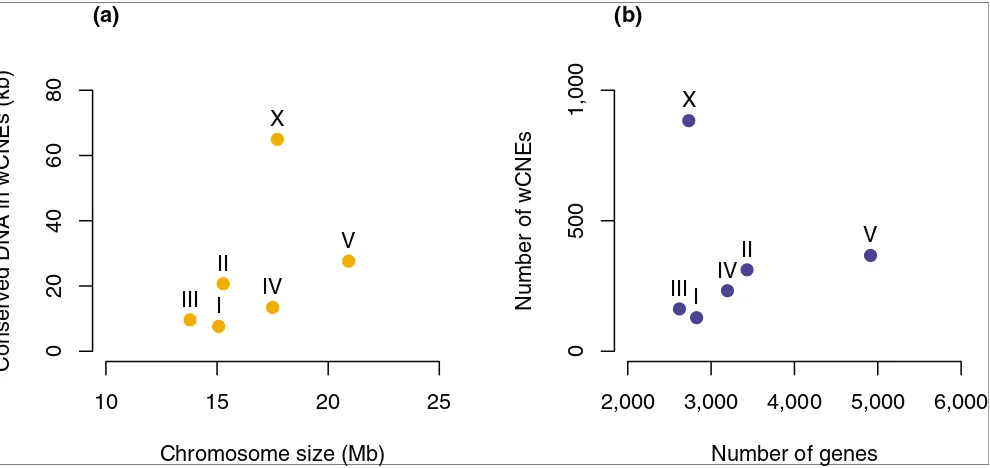
C. elegans. Rather, they tend to reside in the gene-rich centers of the autosomes (Additional data files 1 and 2) and, as with human CNEs (hCNEs) [2-4], multiple wCNEs are often clus-tered around a single gene (mean of 1.7 and maximum of 14 wCNEs per gene). Moreover, 884 out of 2,084 wCNEs
(42.4%) are found on the single C. elegans sex chromosome,
which is more than expected by chance (p value < 0.001,
based on 1,000 randomizations; Figure 1). The C. elegans sex
chromosome is almost devoid of essential genes, and is instead enriched for genes with regulatory functions [20]. The enrichment of wCNEs on the X chromosome may,
there-fore, result from more of the genes on X requiring complex
cis-regulatory architectures. This enrichment for CNEs on the
X chromosome may also explain the larger synteny blocks that are observed on the X chromosome than on the
auto-somes in C. elegans [21]. In vertebrates it has been proposed
that the requirement to maintain linkage between CNEs and their target genes places a constraint on chromosomal
rear-rangements [10] and this may also be occurring on the C.
ele-gans X chromosome.
Vertebrate and invertebrate CNEs share a striking nucleotide frequency pattern at their boundaries Vertebrate CNEs have a characteristic pattern of nucleotide composition, showing a sharp base composition change at their boundaries [22]. Fugu and human CNEs contain 59% and 62% A+T nucleotides [22], respectively, which is 6% and 3% above the genome averages [23,24]. A gradual G+C enrichment followed by a sharp AT-rich peak at the CNE boundaries marks the transition of base composition from the
flanking DNA to the CNE DNA (Figure 2). The genome of C.
elegans has increased A+T content (65%) compared to brates. Yet wCNEs have an A+T content very similar to verte-brate CNEs (58%). Moreover, we find that worm CNEs also show a similar nucleotide frequency transition at their bor-ders: there is a decrease of A+T content from the genome average (65%) down to 50% at the wCNE border followed by a sharp increase to 58% within the wCNE (Figure 2). Further-more, the same signal is present at the boundaries of CNEs
from D. melanogaster (Figure 2d) [25] (T Down, personal
communication). The significance of this signal remains unknown, although its conservation from nematodes to
[image:3.612.59.554.86.320.2]The distribution of CNEs in the C. elegans genome reveals enrichment on chromosome X
Figure 1
The distribution of CNEs in the C. elegans genome reveals enrichment on chromosome X. Chromosome X contains 884 out of 2,084 wCNEs. This enrichment for wCNEs on chromosome X cannot be explained by either (a) its size or (b) the number of genes it contains compared to the autosomes.
Chromosome size (Mb)
Conserved DNA in wCNEs (kb)
0
2
04
06
08
0
10
15
20
25
I
II
III
IV
V
X
(a)
Number of genes
Number of wCNEs
2,000
3,000
4,000
5,000
6,000
0
500
1,000
I
II
III
IV
V
X
humans indicates that it probably reflects a functional prop-erty of CNEs. For example, it might be a sign of a particular DNA conformation since AA/TT dinucleotides increase DNA rigidity, potentially making CNEs relatively rigid elements flanked by flexible DNA, or it may allow DNA unwinding and base unpairing [22]. The conservation of this signal from nematodes to humans could be useful for the discovery of functional non-coding elements less conserved than the CNEs (T Down, personal communication).
wCNEs are associated with developmental transcription factors and signaling genes
CNEs in the human genome are associated with genes involved in the regulation of development and, in particular,
with transcription factors ('trans-dev' genes) [2-4,6,7]. To assess whether CNEs are associated with certain types of
genes in C. elegans, we spatially associated each wCNE to the
protein-coding gene with the nearest transcription start site. The mean distance between a wCNE and the nearest tran-scription start site is 2,929 bp, with 1,206 (82.6%) of inter-genic wCNEs lying more than 500 bp from the nearest transcription start site (Additional data file 3).
In both the human and the C. elegans genome the most
sig-nificantly enriched functions, according to the Gene Ontology (GO) terms [26], for CNE-associated genes are related to transcription factor activity and development (Figure 3). For example, 2.82% (18/638) of genes associated with wCNEs are
CNEs share a striking nucleotide signature from C. elegans to vertebrates
Figure 2
CNEs share a striking nucleotide signature from C. elegans to vertebrates. The plot shows the percentage of A+T nucleotides for 200 bp of sequence flanking CNEs (black) and 15 bp of CNE (red) at the CNE border defined by sequence conservation (the sequence on one end of each CNE is reverse complemented) for (a) F. rubripes, (b) H. sapiens, (c) C. elegans and (d) D. melanogaster. In all four species there is a decrease of A+T content in the 200 bp of sequence flanking the CNEs followed by a sharp A+T increase at the CNE border.
F. rubripes (a)
−200 −100 0 15
0.40
0.45
0.50
0.55
0.60
0.65
0.70
H. sapiens (b)
A+T frequency
A+T frequency
−200 −100 0 15
0.40
0.45
0.50
0.55
0.60
0.65
0.70
Position
(c)
C. elegans
−200 −100 0 15
0.40
0.45
0.50
0.55
0.60
0.65
0.70
Position
D. melanogaster (d)
−200 −100 0 15
0.40
0.45
0.50
0.55
0.60
0.65
comm
en
t
re
v
ie
w
s
re
ports
refer
e
e
d
re
sear
ch
de
p
o
si
te
d r
e
se
a
rch
interacti
o
ns
inf
o
rmation
annotated with the GO term 'development', whilst only 0.63%
(52/8,301) of all annotated genes in C. elegans are annotated
with this term (p value = 6.13e-11 for log odds ratio = 1.87 and
p value < 0.001, based on 1,000 randomizations). Similarly,
10.82% (69/638) of genes associated with wCNEs are anno-tated with the term 'transcription factor activity', whilst only
6.17% (512/8,301) of all annotated genes in C. elegans are
annotated with this term (p value = 2.81e-7 for log odds ratio
= 0.68 and p value = 0.006, based on 1,000 randomizations).
The reverse association is also true: developmental genes in general are associated with wCNEs, as 34.62% (18/52) of annotated developmental genes (that is, annotated with the
GO term 'development') are associated with wCNEs while
only 7.69% (638/8,301) of all annotated genes in C. elegans
are associated with wCNEs. Glazov et al. [13] have noted a
similar trend for elements conserved between two very
closely related Drosophila species, indicating that the
associ-ation of highly conserved non-coding elements with trans-dev genes is a property conserved from worms to humans.
In addition, wCNE-associated genes are enriched for cell-sig-naling GO terms, which has also been noted for the elements in Drosophila [13], but is less striking in humans[13]. Nonetheless, several examples of major signaling genes
CNEs are associated with genes involved in transcription regulation and development in both H. sapiens and C. elegans Figure 3
CNEs are associated with genes involved in transcription regulation and development in both H. sapiens and C. elegans. The log odds ratios and the 95% confidence intervals are shown for all GOslim terms that appear in the annotation of genes spatially associated with CNEs significantly more often than in the rest of the genome for H. sapiens (black) and C. elegans (red). GOslim terms marked with three asterisks are significantly enriched in both H. sapiens and C. elegans CNE genes; those marked with two asterisks are significantly enriched only in C. elegans; and the term with one asterisk is significantly enriched only in H. sapiens. The domains are ordered according to their p value in H. sapiens (lowest p value in H. sapiens at the top). All terms related to transcription factor activity and development (that is, 'trans-dev' genes [4]) show a strong bias in the annotation of genes near CNEs in both genomes. In the C. elegans gene set, there is also a trend for genes to be involved in signal transduction and ion binding. The GO terms shown in this figure constitute all GOslim terms (excluding the term 'biological-process') with a positive log odds ratio and p value ≤ 7.19 × 10⁻³ (5% false discovery rate cut-off) in either H. sapiens or C. elegans.
Log odds ratio Gene Ontology annotation
−3 −2 −1 0 1 2 3
Plasma membrane ** Ion channel activity ** Signal transducer activity ** Actin binding **
Calcium ion binding **
Transcription regulator activity * Signal transduction **
Binding *** DNA binding *** Development *** Transcription ***
Regulation of biological process *** Transcription factor activity *** Nucleus ***
involved in development are associated with CNEs in the human genome, with a classic example being the sonic hedge-hog gene at 7q36.3 [10]. This difference is an intriguing result considering that the human genome contains more signaling genes (1,790/15,023 = 11.92% of human genes annotated with
the term 'signal transduction') than the C. elegans genome
(599/8,301 = 7.22%), whereas there are fewer signaling genes among the human CNE-associated genes (15/274 = 5.47%)
than the wCNE-associated genes in C. elegans (84/638 =
13.17%). A possible explanation for this difference is that sig-naling genes in vertebrates are associated with elements less conserved than the CNEs we previously identified. In support of this hypothesis, a set of vertebrate non-coding elements identified with less stringent criteria are significantly enriched for the GO term 'signal transduction' [27].
To further analyze the types of genes associated with CNEs, we looked at the InterPro protein domains [28] encoded by
these genes. Both Homo sapiens and C. elegans CNEs are
enriched in the neighborhoods of genes encoding DNA-bind-ing transcription factor domains (includDNA-bind-ing Homeodomain-like, Winged-helix repressor DNA-binding, Zinc finger C2H2-type and HMG1/2; Additional data file 4). We also examined the enrichment for transcription factors among the wCNE-associated genes using predicted transcription factors from two high-quality databases: DBD, a database of compu-tationally predicted transcription factors through homology to known DNA-binding domains [29]; and wTF2.0, a com-pendium of computationally and manually curated
transcrip-tion factors in C. elegans [30]. Out of 1,241 of the
wCNE-associated genes, 108 (8.7%) are annotated as transcription factors according to DBD and 137 out of 1,241 (11.0%) of the wCNE-associated genes are annotated as transcription fac-tors according to wTF2.0, both being significantly higher than the proportion in the genome (Additional data file 5).
Both H. sapiens and C. elegans CNEs are also associated with
genes encoding cell-signaling domains, although, as also
noted from the GO terms, this is more pronounced in C.
ele-gans. These domains include those found in extracellular
proteins, cell surface receptors, and intracellular signaling proteins. The lack of thoroughly annotated sets of signaling genes could potentially exaggerate differences between human and worm CNE-associated genes.
Human CNEs are not always found directly adjacent to their most likely target genes [6,7]. It is also possible that CNEs may regulate more than one gene, for example, in the case of bidirectional promoters. Therefore, these statistics probably underestimate the true association of CNEs with develop-mental regulatory genes. We conclude that CNEs are associ-ated with genes involved in transcription regulation and development and, to a certain degree, cell-signaling in both vertebrates and invertebrates, although the association with cell signaling genes appears to be stronger in invertebrates.
Vertebrate and invertebrate CNEs target a common set of core developmental genes
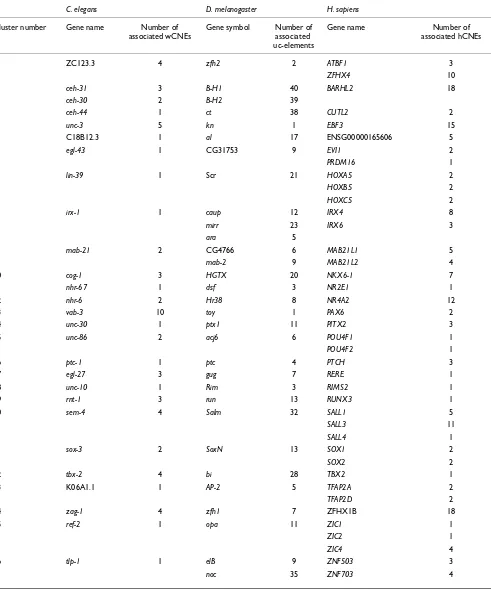
Most strikingly, we find that many of the genes associated
with CNEs in the C. elegans genome are the direct orthologs
of CNE-associated genes in the human genome. Of 397 human CNE-associated genes, 190 have identifiable
orthologs in C. elegans and, of these, 60 are also associated
with wCNEs in C. elegans. This is much greater than expected
by chance (p < 0.001, by randomization). For example, the C.
elegans gene mab-18 is associated with ten wCNEs and its human ortholog PAX6 is associated with two hCNEs. For worm CNE-associated genes that have been duplicated in the vertebrate lineage, multiple paralogs are often associated
with hCNEs. For example, the C. elegans gene sem-4 is
asso-ciated with four wCNEs, and has four human orthologs. Of these, SALL1 is associated with two hCNEs, SALL3 with eleven hCNEs and SALL4 with one hCNE.
Remarkably, of the 60 human CNE-associated genes that
have C. elegans orthologs that are associated with wCNEs, 40
also have orthologs in Drosophila that are associated with the
conserved elements identified by Glazov et al. [13]. In
sum-mary, 40 of 156 human CNE-associated genes that have
orthologs in both C. elegans and D. melanogaster, are also
associated with CNEs in these two species. These genes rep-resent a core set of developmental regulatory genes that are associated with CNEs across three different animal phyla (Table 1). Thus, despite the extensive evolutionary distance and duplication events that have occurred since the
diver-gence of C. elegans, D. melanogaster and H. sapiens, a core
set of orthologous genes are associated with highly conserved non-coding elements in all three organisms.
wCNEs identify transcriptional enhancer sequences and may function as transcription factor binding sites
Human CNEs have been proposed to act as cis-elements that
regulate the transcription of developmental genes, and of the relatively few vertebrate CNEs that have been tested, the majority can act as tissue-specific enhancers when co-injected with a reporter gene in zebrafish or in transgenic mice [4,7-10]. Therefore, we reasoned that, if worm CNEs also function as enhancers, then they should overlap multiple previously characterized enhancer sequences in the worm genome. By using literature searches, we compiled a list of 17
C. elegans genes with extensively dissected cis-regulatory sequences. We found that six of these genes are associated with wCNEs, and that, in five of these six cases, the wCNEs are contained within the defined enhancer regions
(Addi-tional data file 6). For example, the gene ser-2 is associated
with five wCNEs, and each of these wCNEs lies within a genomic region that acts as a transcriptional enhancer for a different tissue or cell type (Figure 4). This provides good
evi-dence that CNEs can act as transcriptional enhancers in vivo.
comm
en
t
re
v
ie
w
s
re
ports
refer
e
e
d
re
sear
ch
de
p
o
si
te
d r
e
se
a
rch
interacti
o
ns
inf
o
[image:7.612.61.552.122.712.2]rmation
Table 1
Orthologous genes associated with CNEs (and uc-elements) in humans, flies and worms
C. elegans D. melanogaster H. sapiens
Cluster number Gene name Number of associated wCNEs
Gene symbol Number of associated uc-elements
Gene name Number of associated hCNEs
1 ZC123.3 4 zfh2 2 ATBF1 3
ZFHX4 10
2 ceh-31 3 B-H1 40 BARHL2 18
ceh-30 2 B-H2 39
3 ceh-44 1 ct 38 CUTL2 2
4 unc-3 5 kn 1 EBF3 15
5 C18B12.3 1 al 17 ENSG00000165606 5
6 egl-43 1 CG31753 9 EVI1 2
PRDM16 1
7 lin-39 1 Scr 21 HOXA5 2
HOXB5 2
HOXC5 2
8 irx-1 1 caup 12 IRX4 8
mirr 23 IRX6 3
ara 5
9 mab-21 2 CG4766 6 MAB21L1 5
mab-2 9 MAB21L2 4
10 cog-1 3 HGTX 20 NKX6-1 7
11 nhr-67 1 dsf 3 NR2E1 1
12 nhr-6 2 Hr38 8 NR4A2 12
13 vab-3 10 toy 1 PAX6 2
14 unc-30 1 ptx1 11 PITX2 3
15 unc-86 2 acj6 6 POU4F1 1
POU4F2 1
16 ptc-1 1 ptc 4 PTCH 3
17 egl-27 3 gug 7 RERE 1
18 unc-10 1 Rim 3 RIMS2 1
19 rnt-1 3 run 13 RUNX3 1
20 sem-4 4 Salm 32 SALL1 5
SALL3 11
SALL4 1
21 sox-3 2 SoxN 13 SOX1 2
SOX2 2
22 tbx-2 4 bi 28 TBX2 1
23 K06A1.1 1 AP-2 5 TFAP2A 2
TFAP2D 2
24 zag-1 4 zfh1 7 ZFHX1B 18
25 ref-2 1 opa 11 ZIC1 1
ZIC2 1
ZIC4 4
26 tlp-1 1 elB 9 ZNF503 3
were the case, then CNEs associated with genes known to be expressed in a particular tissue type should be enriched for DNA binding sites for transcription factors regulating the co-expression of these genes in that tissue. To test this hypo-thesis, we used DNA microarray data [31] to identify 54
wCNE-associated genes that are expressed in the C. elegans
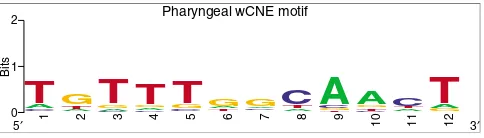
pharynx. These genes are associated with a total of 120 wCNEs (from here on referred to as 'pharyngeal wCNEs'). Our set of pharyngeal wCNEs contains 40 intronic and 80 intergenic wCNEs, ranging in size from 31 bp to 216 bp (mean = 68.2 bp; median = 60 bp). It is important to note that many of the intergenic wCNEs in this set lie further than the classi-cal 'promoter region' (often described as the first 500 bp to 1,000 bp upstream of a gene), with pharyngeal wCNEs rang-ing from 27 bp to 9,577 bp (mean = 2,970 bp; median = 2,053 bp) from the associated pharyngeal gene. To identify putative transcription factor binding sites in the pharyngeal wCNEs, we searched for overrepresented sequence motifs using the Weeder motif discovery algorithm, which searches for over-represented motifs and then carries out a post-processing step to identify similar ('redundant') motifs among the high-est scoring motifs [32]. Weeder identified a single redundant
motif that is significantly enriched in these sequences (p <
0.002). Strikingly, this motif (Figure 5) is very similar to the
consensus binding site of the pharyngeal transcription factor PHA-4. PHA-4 is the major specifier of pharyngeal cell
iden-tity in C. elegans [33,34], suggesting that occurrences of this
motif in wCNEs represent genuine PHA-4 binding sites. Indeed, inspection of the seven highest scoring occurrences of the motif in the pharyngeal CNEs (Table 2) revealed that one
of the predicted sites lies 1.2 kb upstream of the gene ceh-22,
within a 30 bp pharyngeal muscle enhancer previously shown to be bound by PHA-4 [35] (annotated in WormBase as two overlapping PHA-4 binding sites with WormBase identifiers WBsf019089 and WBsf019090). Therefore, by searching for overrepresented motifs in a set of wCNEs associated with genes expressed in the pharynx, we were able to identify the binding site for the transcription factor that acts as the major specifier of pharyngeal cell identity. Taken together with the identification of other wCNEs within previously character-ized enhancers, this suggests that wCNEs represent enhancer sequences that function (at least partially) by encoding tran-scription factor binding sites.
Intronic wCNEs likely function as enhancers for downstream alternative transcription start sites Almost a third of wCNEs (624/2,084) are located in introns. To investigate whether intronic wCNEs represent a separate
CNEs identify previously characterized enhancer sequences and when located in introns are associated with alternative transcriptional start sites
Figure 4
CNEs identify previously characterized enhancer sequences and when located in introns are associated with alternative transcriptional start sites. Five wCNEs are contained within four elements that regulate ser-2, the C. elegans ortholog of human serotonin receptor 1A. The products of ser-2 were identified as components of the AIY interneuron gene battery in C. elegans [60]. ser-2 has at least three alternative transcription start sites that produce a number of different gene products, considered to be expressed in different but overlapping regions [61]. Remarkably, each of the alternative transcription start sites is marked by a wCNE in the proximal upstream region, with additional wCNEs lying further away, highlighting the underlying cis-regulatory elements. The upstream sequences of each of the alternative transcription start sites were defined by deletion analysis [61]. One of the wCNEs lies within an approximately 280 bp element driving expression in the AIY and SIA neuronal cellular subtypes. A second wCNE lies within an approximately 520 bp element driving expression in the RME neurons and also, consistently, in other unidentified neurons. A third wCNE lies within an approximately 1,150 bp element driving expression in the head muscles. Two more wCNEs are contained within a region driving expression in PVD and lateral OLL neurons. Only the experimentally tested constructs that overlap wCNEs are shown in this diagram.
15290k 15300k
Gene models
ser-2 (C02D4.2a) ser-2 (C02D4.2b)
ser-2 (C02D4.2c) ser-2 (C02D4.2d)
ser-2 (C02D4.2e)
ser-2 (C02D4.2f)
GFP-reporter construct
PVD, lateral OLLs RMEs
AIY, SIAs
Head muscles
wCNE
Chromosome X
comm en t re v ie w s re ports refer e e d re sear ch de p o si te d r e se a rch interacti o ns inf o rmation
type of element, we examined whether they are associated with particular classes of transcripts. We found that there is a strong association between the presence of an intronic wCNE and genes that are known to produce multiple different tran-scripts (57% of genes containing intronic wCNEs have docu-mented alternative transcripts, compared to 19% of all multi-exon genes). Moreover, in 70% of the cases of alternatively spliced genes containing intronic wCNEs, the gene encodes an alternative first exon (compared to 35% of all genes with alternative transcripts). This suggests that intronic wCNEs are strongly associated with genes with alternative first exons and, therefore, that intronic wCNEs may act as enhancers for downstream alternative start sites. In support of this hypothesis, in 78% of cases the intronic wCNE is located upstream of the alternative first exon (see Figure 4 for exam-ples). Therefore, we do not believe that, in general, intronic wCNEs regulate alternative splicing. Rather, we suggest that,
at least in C. elegans, the majority of intronic wCNEs, like
intergenic wCNEs, probably function as cis-regulatory
scriptional enhancers, but for downstream alternative tran-scriptional start sites.
Discussion
Shared properties of nematode and vertebrate CNEs We have identified a set of highly conserved non-coding
sequences (wCNEs) in the genome of C. elegans. Just as with
CNEs in the human genome, these wCNEs are clustered around genes that encode regulators of development, espe-cially transcription factors and signaling genes. Both human and worm CNEs share striking nucleotide frequency patterns at their boundaries and are similarly AT-rich, despite differ-ences in the background A+T content of their genomes.
Worm CNEs overlap many independently identified cis-
regu-latory elements, and vertebrate CNEs can act as tissue-spe-cific enhancers in transient zebrafish assays. It seems likely, therefore, that human and worm CNEs function analogously
as cis-elements that regulate the transcription of a core set of
developmental regulatory genes. Consistent with this model, intronic wCNEs are very strongly associated with down-stream alternative transcriptional start sites, suggesting that
they too probably function as tissue-specific cis-regulatory
elements.
[image:9.612.57.552.119.240.2]How do CNEs regulate gene-expression? The simplest model is that CNEs encode transcription factor binding sites. In sup-port of this model, we find that wCNEs associated with genes expressed in the pharynx are significantly enriched for a DNA motif that matches the binding-site of the major pharynx specifying transcription factor PHA-4. However, it is still dif-ficult to reconcile the length and level of sequence conserva-tion of CNEs with the known sequence constraints of transcription factor binding sites, especially since conserva-tion of individual transcripconserva-tion factor binding sites has been found unnecessary for conservation of enhancer function (for example, [36]). Therefore, CNEs may represent very dense, Table 2
Occurrences of a sequence motif overrepresented in wCNEs associated with pharyngeal genes
wCNE coordinates Strand Matching sequence Position Score wCNE distance from TSS
Gene name
IV:3776258..3776298 + TATTTAGCATCT 9 85.59 9,435 vab-2
IV:8369551..8369581 - TTTTTTGCAACT 3 91.65 347 D2096.6 V:10673732..10673841 - TGTTTGTCCACT 15 87.26 1,202 ceh-22* V:13217316..13217419 + TGTTTGGCAACT 23 100 3,588 F57B1.6 X:2215856..2215898 - TGTTTTGAAATT 12 85.67 230 peb-1
X:6621897..6621968 - TTTATGGCAACT 47 88.99 826 C25B8.4 X:7457940..7457992 + TGTTTGACAATT 5 91.56 2,212 sox-2
We used the Weeder motif discovery program to search for overrepresented motifs in all wCNEs spatially associated with genes predicted to be expressed in the pharynx based on microarray data [31]. From this dataset, Weeder identified a motif very similar to the consensus binding site for PHA-4, the master specifier of pharyngeal cell identity (TRTTKRY, where R = A/G, K = T/G, and Y = T/C) [33, 34]. This table shows the coordinates (WormBase version WS140) of the wCNEs that contain matches to the overrepresented motif, the coordinates of the matches within the wCNEs, the Weeder scores of the matches to the motif, the distances (in bp) between the wCNEs and the transcription start site (TSS) of the associated genes and the names of the associated genes. The predicted site in the element 1.2 kb upstream of ceh-22 (marked with an asterisk) lies within a 30 bp pharyngeal muscle enhancer bound by PHA-4 [35].
Worm CNEs are enriched for transcription factor binding sites
Figure 5
Worm CNEs are enriched for transcription factor binding sites. Sequence logo representation of the motif significantly overrepresented in wCNEs associated with pharyngeal genes, according to the Weeder motif discovery algorithm [32]. The first six bases of this motif (with consensus TGTTTGGCAACT) agree with the first six bases of the consensus binding site of the PHA-4 transcription factor (TRTTKRY, where R = A/G, K = T/ G, and Y = T/C) [33, 34]. Note that the seventh position of the predicted motif has low information content, indicating that sites with differences in this position are still likely to represent variants of the same transcription factor binding site.
Pharyngeal wCNE motif
0 1 2
Bits
5′ 1
G
CA
T
2
CAT
G 3 CA G
T
4 C A GT
5 A C GT
6 C T A G 7 T C A G 8GAT
[image:9.612.55.297.553.622.2]potentially overlapping transcription factor binding sites. If this scenario were true, differences in the number of
overlapping constraints between different cis-elements
would manifest as differences in the degree of sequence con-servation of these elements, with CNEs representing the most extreme cases. Indeed, reducing the stringency of the conser-vation threshold (either by relaxing the similarity search cri-teria [4,27] or by comparing less divergent species [37]) often reveals additional or longer non-coding elements. Alterna-tively, CNEs may also encode some additional regulatory function. For example, it is possible to envisage mechanisms involving sequence recognition between homologous chromosomes (for example, 'transvection' [38]) that would require sequence identity to be maintained between the maternal and paternal genomes.
Remarkably, of the 190 genes that are associated with CNEs
in humans and have orthologs in C. elegans, 60 have
orthologs that are also associated with CNEs in C. elegans.
This suggests that unrelated CNEs may be associated with a core set of regulatory genes in many divergent animal species. In support of this, 40 of these 60 genes are also orthologous
to CNE-associated genes in D. melanogaster. Such an overlap
between the sets of CNE-associated genes from three animal phyla is very unlikely to have arisen by chance, and suggests that a core set of developmental regulatory genes may be associated with CNEs across all animal lineages.
Because of its genetic tractability and reduced intergenic
dis-tances, we propose that C. elegans will serve as an excellent
model organism for further understanding the mechanism by which CNEs regulate gene expression. The dissection of CNEs in parallel in different animals using both computational and experimental approaches would provide us with valuable insight into the evolution of the regulatory networks that con-trol the development of the metazoan body plan.
Since many of the genes associated with CNEs encode for transcription factors that control early development, it is pos-sible that CNEs themselves are bound by these transcription factors. Orthologous transcription factors are not only present in most metazoan lineages, but also often have highly conserved binding domains (for example, the DNA-binding domains of orthologous HOX [39], FOXA [33,34] and Brachyury T-box [40] proteins). It is tempting, therefore, to speculate that CNEs might function as enhancers even when tested in different animal lineages. A small number of reporter gene assays testing enhancers of regulatory genes from vertebrates in flies have shown positive results (for example, [41-43]), indicating that the regulators of these ver-tebrate enhancers are also present in flies. However, we would not expect alternative CNEs from different animals to drive the same expression patterns, reflecting differences in the body plans of different animal lineages.
CNEs and the evolution of animal body plans
The evolution of cis-regulatory elements is an important
driv-ing force in the evolution of gene regulatory networks (GRNs). In the case of multicellular animals, the initial
assembly and subsequent modifications of cis-elements for
key developmental control genes probably allowed the 're-wiring' of developmental GRNs and, hence, the evolution of new animal body plans [44]. In this way, regulatory genes
became associated with alternative sets of cis-elements in
dif-ferent animal lineages and these cis-elements now define the
core GRNs of each animal body plan. We propose that CNEs represent the 'hard-wired' sequence traces of these core ani-mal group-specific GRNs. The alternative core GRNs of dif-ferent animal lineages are reflected in their having alternative CNEs. However, because of their co-evolution from a com-mon metazoan ancestor, the core GRNs of different animal groups often utilize the same regulatory genes. As a result, distinct yet parallel sets of CNEs have become irreversibly associated with the same genes that coordinate core develop-mental networks in diverse animal groups. Indeed, this evolution of regulatory elements may underlie the astounding diversification of animal body plans that was seen during the Cambrian period approximately 550 million years ago.
Materials and methods
Identification of conserved non-coding elements in C. elegans
DNA sequences and annotation files for the C. elegans
genome (release WS140), the DNA sequence for the C.
briggsae genome (release cb25) and the repeat-masked
sequence of the C. remanei genome (downloaded on 30
October 2005) were retrieved from WormBase [45]. The
sequence of each C. elegans chromosome was split into 500
kb fragments overlapping by 200 bp. We searched for local
similarity between each 500 kb sequence fragment from C.
elegans against the genome of C. briggsae using MegaBlast (version 2.2.6) [46]. We performed MegaBlast searches with soft masking, e-value threshold of 0.001 and word seed size 100 bp (W100), 75 bp (W75), 50 bp (W50), 40 bp (W40) and
30 bp (W30). Where overlapping regions of the query (C.
ele-gans) sequence matched more than one location in the C.
comm
en
t
re
v
ie
w
s
re
ports
refer
e
e
d
re
sear
ch
de
p
o
si
te
d r
e
se
a
rch
interacti
o
ns
inf
o
rmation
scanned for missed repeats using RepeatMasker (version 3.0.8, slow/sensitive option, using Crossmatch) [47] using
both the C. elegans repeat library distributed with the
pro-gram and the C. briggsae library downloaded from
Worm-Base [18]. The remaining elements were scanned for missed tRNAs using tRNAscan-SE (v.1.11) [48]. In addition, 36 ele-ments with a BLAST match in Rfam [49], the microRNA reg-istry database [50] and EMBL expressed sequence tags (downloaded on 21 April 2005) were removed (e-value threshold of 0.0001). We then checked whether the
remain-ing unannotated or intronic conserved elements found in C.
elegans and C. briggsae were similarly conserved in the
genome of C. remanei using MegaBlast, with soft masking,
word seed length of 30 bp and e-value threshold 0.0001. Of
the elements conserved between C. elegans and C. briggsae,
69% were also found in C. remanei using the same similarity
search criteria. The sequences of the final set of 2,084 wCNEs are provided in Additional data file 8. Finally, we searched the set of 2,084 wCNEs for sequence similarity against the
human CNEs (1,373 sequences from Woolfe et al. [4]) using
BlastN (version 2.2.6) [51] and found no significant hits (e-value threshold = 0.0001).
We compared the final set of elements conserved between all
three Caenorhabditis species with elements identified as
con-served by WABA, a sensitive alignment method designed to
find homologous regions between the C. elegans and the C.
briggsae genome and annotate them as 'strongly conserved', 'weakly conserved' or 'coding' using information on conserva-tion and the third base 'wobble' of protein-coding sequences [12]. Of all base pairs in wCNEs, 97% are contained within alignments classified as strongly conserved, 0.6% are within alignments classified as coding and 6% are within alignments classified as weakly conserved.
We also calculated the overlap between wCNEs and elements predicted as conserved using PhastCons. PhastCons [14] is a statistical method that scores sequences in alignments according to how much more likely it is that they are con-served than that they are evolving neutrally, based on a phyl-ogenetic hidden Markov model. Elements predicted to be
conserved by PhastCons based on C. elegans-C. briggsae
BLASTZ alignments [52] were retrieved through the UCSC Genome Browser (table PhastConsElements).
Genomic distribution and sequence analysis of wCNEs
The clustering of wCNEs along the C. elegans chromosome
and the comparison of the distances between CNEs in the
human and the C. elegans genome were calculated as
described in Woolfe et al. [4]. We assessed the enrichment of
wCNEs on chromosome X using a randomization test. We generated 1,000 sets of 2,084 (that is, the same number as the
wCNEs) random locations in the C. elegans genome, making
sure that the random locations lie within non-coding and non-repetitive regions. The random sets had, on average, 487.3 wCNEs on X (minimum = 432; maximum = 550).
Therefore, the enrichment of wCNEs on chromosome X is
highly significant (p value < 0.001).
The A+T nucleotide content in the 200 bp flanking CNEs and
the first 15 bp of CNEs were calculated according to Walter et
al. [22]. In brief, 215 bp of sequence from one CNE end and
215 bp of reverse complemented sequence from the other CNE end were aligned according to the first position of each CNE. The percentage of A+T nucleotide composition was calculated and plotted for each position along this 215 bp alignment.
Analysis of CNE-associated genes in C. elegans, D.
melanogaster and H. sapiens
For each of the 2,084 wCNEs, we identified the protein-cod-ing genes with the nearest transcription start site (TSS) according to the WormBase annotation (WS140; Additional data file 9). We assigned 1,241 genes to the wCNEs. As fly CNEs we used the 20,301 intergenic and intronic
'ultracon-served' (uc) elements between D. melanogaster and D.
pseudoobscura with size ≥50 bp from Glazov et al. [13]. We associated each uc-element to the gene with the nearest tran-scription start site (according to the fly genome annotation release dm1). We assigned 3,750 genes to fly uc-elements. Similarly, we identified the nearest protein-coding genes to the 1,373 human elements conserved between human and
Fugu from Woolfe et al. [4] according to human genome
NCBI35 accessed via Ensembl [53] v35 (397 genes) (Addi-tional data file 10).
The GO annotation files for C. elegans (revision 1.55) and
human (revision 1.22) were downloaded directly from the GO website [26]. Only GO terms inferred automatically (GO evi-dence code IEA) were used in our analysis because of the heavy bias of RNAi phenotypes on the GO annotations of the
genes in C. elegans (our unpublished observation). To
increase the signal, GO terms were converted to the higher-level GOslim terms and these are the terms we have used in
this paper. GOslim term associations and counts for C.
ele-gans and human genes were calculated using the Perl script map2slim from the go-perl package and the generic GOslim
(revision 1.116) [54]. Out of 397 human genes and 1,241 C.
ele-gans genes, 274 and 638, respectively, were assigned a
GOs-lim term. We retrieved protein domains for the C. elegans and
the human genes from Ensembl. Out of 397 human genes and
1,241 C. elegans genes spatially associated with CNEs, 316
and 877, respectively, were annotated with at least one Inter-Pro domain. To increase the signal, each domain was con-verted to the top-level parent domain according to the InterPro protein domain annotation using a custom Perl script. The following analysis was carried out for all top-level InterPro domains found in at least ten genes in the human
and the C. elegans genomes. For each type of annotation (i.e.
spe-cific annotation, b is the number of annotated genes without the specific annotation and not in the CNE-associated genes set, c is the number of genes with the specific annotation but not in the CNE-associated gene set, and d is the number of remaining annotated genes without the specific annotation in the CNE-associated gene set. The log odds ratios, confidence intercals (CI) and p-values were calculated using the R
statis-tical package [55] (according to a two-tailed test). The p value
threshold at the 5% false discovery rate (FDR) cut-off was cal-culated according to the false discovery rate method by Ben-jamini and Hochberg [56]. We also carried out a randomization test to check how likely it is to get by chance the same proportion of genes annotated with the GO terms 'transcription factor activity' and 'development' as we did for the wCNE set. To do this, we generated 1,000 sets of 2,084 (that is, the same number as the wCNEs) random locations in the C. elegans genome, making sure that the random loca-tions lie within non-coding and non-repetitive regions. For each random location, we then retrieved the gene with the nearest transcription start site. Finally, for each set, we counted the proportion of genes annotated with the GO terms 'transcription factor activity' and 'development'.
Orthologous gene clusters were retrieved from Inparanoid (version 4.0) [57]. The Inparanoid dataset contains clusters of orthologous proteins between pairs of genomes. There are
4,558 Inparanoid clusters of orthologous proteins from C.
elegans and human that contain 8,846 human proteins and
5,614 C. elegans proteins. Of the human protein-coding genes
with C. elegans orthologs and the C. elegans protein-coding
genes with human orthologs, 190 and 424, respectively, are
associated with CNEs. For D. melanogaster and H. sapiens,
there are 5,497 Inparanoid clusters of orthologs that contain
8,960 human proteins and 6,170 D. melanogaster proteins.
Of the human protein-coding genes with D. melanogaster
orthologs and the D. melanogaster protein-coding genes with
human orthologs, 215 and 1,254, respectively, are associated with CNEs/uc-elements. To evaluate the significance of the
overlap between CNE-associated genes in human and C.
ele-gans, we performed 1,000 randomizations, randomly picking
424 C. elegans genes from those in the Inparanoid clusters and counting how many of them have an ortholog among the 190 human associated genes. The same overlap of CNE-associated genes in the two genomes was never seen in 1,000 randomizations. Similarly, we performed 1,000
randomiza-tions, randomly picking 1,254 D. melanogaster genes and
counting how many of them have an ortholog among the 215 human CNE-associated genes. Again, the same overlap of CNE-associated genes in the two genomes was never seen in 1,000 randomizations.
Motif discovery in pharyngeal gene-associated CNEs Genes expressed in the pharynx were identified by microarray analysis in [31]. The 120 wCNEs associated with pharyngeal genes were submitted to a local installation of Weeder (ver-sion 1.3) [32]. We performed an 'extra' mode search (that is,
looking for motifs 6 bp long with 1 mismatch, 8 bp long with 3 mismatches, 10 bp long with 4 mismatches and 12 bp long with 4 mismatches), looking for motifs in both strands and reporting back 50 motifs. Post-processing of the identified motifs carried out by Weeder returned one 'redundant' motif in the form of a position weight matrix (PWM) and seven high scoring matches of this PWM in the input set of sequences. The significance of the motif identified by Weeder was
esti-mated using the Weeder p value calculator [58]. The high
scoring matches of the PWM in the pharyngeal wCNEs are shown in Table 2. The sequence logo for this PWM was cre-ated using WebLogo [59].
Additional data files
The following additional data are available with the online version of this paper. Additional data file 1 is a figure showing the distribution of wCNEs along each chromosome. Addi-tional data file 2 is a figure showing the distribution of
dis-tances between CNEs in both the C. elegans and the H.
sapiens genomes and for randomized CNE locations. Addi-tional data file 3 is a figure showing the distribution of dis-tances between intergenic wCNEs and their nearest genes. Additional data file 4 is a table showing all the top-level Inter-Pro protein domains significantly enriched in
CNE-associ-ated genes compared to the rest of the genes in the (a) H.
sapiens and (b) C. elegans genomes. Additional data file 5 is a table showing the enrichment for transcription factors among wCNE-associated genes, using two different
collec-tions of predicted transcription factors from the C. elegans
genome. Additional data file 6 is a table showing wCNEs
over-lapping known cis-regulatory elements. Additional data file 7
is a table showing the annotation features from WormBase that were used to annotate wCNEs. Additional data file 8 con-tains the sequences of the 2,084 wCNEs. Additional data file
9 is a table with the coordinates of the wCNEs in the C.
ele-gans genome, their nearest genes and their human orthologs. Additional data file 10 is a table with the coordinates of the
human CNEs from Woolfe et al. [4] with their nearest genes
assigned using the same method as for the wCNEs. Additional data file 1
Distribution of wCNEs along each chromosome Distribution of wCNEs along each chromosome. Click here for file
Additional data file 2
Distribution of distances between CNEs in both the C. elegans and
the H. sapiens genomes and for randomized CNE locations
Distribution of distances between CNEs in both the C. elegans and
the H. sapiens genomes and for randomized CNE locations.
Click here for file Additional data file 3
Distribution of distances between intergenic wCNEs and their nearest genes
Distribution of distances between intergenic wCNEs and their nearest genes.
Click here for file Additional data file 4
Top-level InterPro protein domains significantly enriched in CNE-associated genes compared to the rest of the genes in the H. sapiens
and C. elegans genomes
Top-level InterPro protein domains significantly enriched in CNE-associated genes compared to the rest of the genes in the (a) H.
sapiens and (b) C. elegans genomes.
Click here for file Additional data file 5
Enrichment for transcription factors among wCNE-associated genes, using two different collections of predicted transcription factors from the C. elegans genome
Enrichment for transcription factors among wCNE-associated genes, using two different collections of predicted transcription factors from the C. elegans genome.
Click here for file Additional data file 6
wCNEs overlapping known cis-regulatory elements wCNEs overlapping known cis-regulatory elements. Click here for file
Additional data file 7
Annotation features from WormBase that were used to annotate wCNEs
Annotation features from WormBase that were used to annotate wCNEs.
Click here for file Additional data file 8
Sequences of the 2,084 wCNEs Sequences of the 2,084 wCNEs. Click here for file
Additional data file 9
Coordinates of the wCNEs in the C. elegans genome, their nearest genes and their human orthologs
Coordinates of the wCNEs in the C. elegans genome, their nearest genes and their human orthologs.
Click here for file Additional data file 10
Coordinates of the human CNEs from Woolfe et al. [4] with their nearest genes assigned using the same method as for the wCNEs Coordinates of the human CNEs from Woolfe et al. [4] with their nearest genes assigned using the same method as for the wCNEs. Click here for file
Acknowledgements
We acknowledge Giulio Pavesi and Chris Mungall for assistance with Weeder and GOslim terms, respectively. BL thanks Andrew Fraser for sup-port and many interesting discussions. TV is supsup-ported by a MRC Predoc-toral Fellowship.
References
1. Boffelli D, Nobrega MA, Rubin EM: Comparative genomics at the vertebrate extremes. Nat Rev Genet 2004, 5:456-465.
2. Bejerano G, Pheasant M, Makunin I, Stephen S, Kent WJ, Mattick JS, Haussler D: Ultraconserved elements in the human genome. Science 2004, 304:1321-1325.
3. Sandelin A, Bailey P, Bruce S, Engstrom PG, Klos JM, Wasserman WW, Ericson J, Lenhard B: Arrays of ultraconserved non-coding regions span the loci of key developmental genes in verte-brate genomes. BMC Genomics 2004, 5:99.
comm en t re v ie w s re ports refer e e d re sear ch de p o si te d r e se a rch interacti o ns inf o rmation
Smith SF, North P, Callaway H, Kelly K, et al.: Highly conserved non-coding sequences are associated with vertebrate development. PLoS Biol 2005, 3:e7.
5. Dermitzakis ET, Reymond A, Antonarakis SE: Conserved non-genic sequences - an unexpected feature of mammalian genomes. Nat Rev Genet 2005, 6:151-157.
6. Vavouri T, McEwen GK, Woolfe A, Gilks WR, Elgar G: Defining a genomic radius for long-range enhancer action: duplicated conserved non-coding elements hold the key. Trends Genet 2006, 22:5-10.
7. McEwen GK, Woolfe A, Goode D, Vavouri T, Callaway H, Elgar G: Ancient duplicated conserved noncoding elements in verte-brates: a genomic and functional analysis. Genome Res 2006, 16:451-465.
8. Nobrega MA, Ovcharenko I, Afzal V, Rubin EM: Scanning human gene deserts for long-range enhancers. Science 2003, 302:413. 9. de la Calle-Mustienes E, Feijoo CG, Manzanares M, Tena JJ, Rod-riguez-Seguel E, Letizia A, Allende ML, Gomez-Skarmeta JL: A func-tional survey of the enhancer activity of conserved non-coding sequences from vertebrate Iroquois cluster gene deserts. Genome Res 2005, 15:1061-1072.
10. Goode DK, Snell P, Smith SF, Cooke JE, Elgar G: Highly conserved regulatory elements around the SHH gene may contribute to the maintenance of conserved synteny across human chromosome 7q36.3. Genomics 2005, 86:172-181.
11. Bejerano G, Lowe CB, Ahituv N, King B, Siepel A, Salama SR, Rubin EM, Kent WJ, Haussler D: A distal enhancer and an ultracon-served exon are derived from a novel retroposon. Nature 2006, 441:87-90.
12. Kent WJ, Zahler AM: Conservation, regulation, synteny, and introns in a large-scale C. briggsae-C. elegans genomic alignment. Genome Res 2000, 10:1115-1125.
13. Glazov EA, Pheasant M, McGraw EA, Bejerano G, Mattick JS: Ultra-conserved elements in insect genomes: a highly Ultra-conserved intronic sequence implicated in the control of homothorax mRNA splicing. Genome Res 2005, 15:800-808.
14. Siepel A, Bejerano G, Pedersen JS, Hinrichs AS, Hou M, Rosenbloom K, Clawson H, Spieth J, Hillier LW, Richards S, et al.: Evolutionarily conserved elements in vertebrate, insect, worm, and yeast genomes. Genome Res 2005, 15:1034-1050.
15. Richards S, Liu Y, Bettencourt BR, Hradecky P, Letovsky S, Nielsen R, Thornton K, Hubisz MJ, Chen R, Meisel RP, et al.: Comparative genome sequencing of Drosophila pseudoobscura: chromo-somal, gene, and cis-element evolution. Genome Res 2005, 15:1-18.
16. Gaunt MW, Miles MA: An insect molecular clock dates the ori-gin of the insects and accords with palaeontological and bio-geographic landmarks. Mol Biol Evol 2002, 19:748-761. 17. C. elegans Sequencing Consortium: Genome sequence of the
nematode C. elegans: a platform for investigating biology. Science 1998, 282:2012-2018.
18. Stein LD, Bao Z, Blasiar D, Blumenthal T, Brent MR, Chen N, Chin-walla A, Clarke L, Clee C, Coghlan A, et al.: The genome sequence of Caenorhabditis briggsae: a platform for comparative genomics. PLoS Biol 2003, 1:E45.
19. Kiontke K, Gavin NP, Raynes Y, Roehrig C, Piano F, Fitch DH: Caenorhabditis phylogeny predicts convergence of hermaph-roditism and extensive intron loss. Proc Natl Acad Sci USA 2004, 101:9003-9008.
20. Kamath RS, Fraser AG, Dong Y, Poulin G, Durbin R, Gotta M, Kana-pin A, Le Bot N, Moreno S, Sohrmann M, et al.: Systematic func-tional analysis of the Caenorhabditis elegans genome using RNAi. Nature 2003, 421:231-237.
21. Coghlan A, Wolfe KH: Fourfold faster rate of genome rear-rangement in nematodes than in Drosophila. Genome Res 2002, 12:857-867.
22. Walter K, Abnizova I, Elgar G, Gilks WR: Striking nucleotide fre-quency pattern at the borders of highly conserved verte-brate non-coding sequences. Trends Genet 2005, 21:436-440. 23. Aparicio S, Chapman J, Stupka E, Putnam N, Chia JM, Dehal P,
Christ-offels A, Rash S, Hoon S, Smit A, et al.: Whole-genome shotgun assembly and analysis of the genome of Fugu rubripes. Science 2002, 297:1301-1310.
24. Lander ES, Linton LM, Birren B, Nusbaum C, Zody MC, Baldwin J, Devon K, Dewar K, Doyle M, FitzHugh W, et al.: Initial sequencing and analysis of the human genome. Nature 2001, 409:860-921. 25. Macdonald SJ, Long AD: Fine Scale Structural Variants Distin-guish the Genomes of Drosophila melanogaster and D.
pseudoobscura. Genome Biol 2006, 7:R67.
26. Ashburner M, Ball CA, Blake JA, Botstein D, Butler H, Cherry JM, Davis AP, Dolinski K, Dwight SS, Eppig JT, et al.: Gene ontology: tool for the unification of biology. The Gene Ontology Consortium. Nat Genet 2000, 25:25-29.
27. Sanges R, Kalmar E, Claudiani P, D'Amato M, Muller F, Stupka E: Shuf-fling of cis-regulatory elements is a pervasive feature of the vertebrate lineage. Genome Biol 2006, 7:R56.
28. Mulder NJ, Apweiler R, Attwood TK, Bairoch A, Bateman A, Binns D, Bradley P, Bork P, Bucher P, Cerutti L, et al.: InterPro, progress and status in 2005. Nucleic Acids Res 2005, 33:D201-205. 29. Kummerfeld SK, Teichmann SA: DBD: a transcription factor
prediction database. Nucleic Acids Res 2006, 34:D74-81. 30. Reece-Hoyes JS, Deplancke B, Shingles J, Grove CA, Hope IA,
Wal-hout AJ: A compendium of Caenorhabditis elegans regulatory transcription factors: a resource for mapping transcription regulatory networks. Genome Biol 2005, 6:R110.
31. Gaudet J, Muttumu S, Horner M, Mango SE: Whole-genome anal-ysis of temporal gene expression during foregut development. PLoS Biol 2004, 2:e352.
32. Pavesi G, Mereghetti P, Mauri G, Pesole G: Weeder Web: discov-ery of transcription factor binding sites in a set of sequences from co-regulated genes. Nucleic Acids Res 2004, 32:W199-203. 33. Overdier DG, Porcella A, Costa RH: The DNA-binding specificity
of the hepatocyte nuclear factor 3/forkhead domain is influ-enced by amino-acid residues adjacent to the recognition helix. Mol Cell Biol 1994, 14:2755-2766.
34. Gaudet J, Mango SE: Regulation of organogenesis by the Caenorhabditis elegans FoxA protein PHA-4. Science 2002, 295:821-825.
35. Vilimas T, Abraham A, Okkema PG: An early pharyngeal muscle enhancer from the Caenorhabditis elegans ceh-22 gene is tar-geted by the Forkhead factor PHA-4. Dev Biol 2004, 266:388-398.
36. Ludwig MZ, Bergman C, Patel NH, Kreitman M: Evidence for sta-bilizing selection in a eukaryotic enhancer element. Nature 2000, 403:564-567.
37. Prabhakar S, Poulin F, Shoukry M, Afzal V, Rubin EM, Couronne O, Pennacchio LA: Close sequence comparisons are sufficient to identify human cis-regulatory elements. Genome Res 2006, 16:855-863.
38. Lewis EB: The theory and application of a new method of detecting chromosomal rearrangements in Drosophila melanogaster. American Naturalist 1954, 88:225-239.
39. Ekker SC, Jackson DG, von Kessler DP, Sun BI, Young KE, Beachy PA: The degree of variation in DNA sequence recognition among four Drosophila homeotic proteins. Embo J 1994, 13:3551-3560.
40. Muller CW, Herrmann BG: Crystallographic structure of the T domain-DNA complex of the Brachyury transcription factor. Nature 1997, 389:884-888.
41. Popperl H, Bienz M, Studer M, Chan SK, Aparicio S, Brenner S, Mann RS, Krumlauf R: Segmental expression of Hoxb-1 is controlled by a highly conserved autoregulatory loop dependent upon exd/pbx. Cell 1995, 81:1031-1042.
42. Blanco J, Girard F, Kamachi Y, Kondoh H, Gehring WJ: Functional analysis of the chicken delta1-crystallin enhancer activity in Drosophila reveals remarkable evolutionary conservation between chicken and fly. Development 2005, 132:1895-1905. 43. Papenbrock T, Peterson RL, Lee RS, Hsu T, Kuroiwa A, Awgulewitsch
A: Murine Hoxc-9 gene contains a structurally and function-ally conserved enhancer. Dev Dyn 1998, 212:540-547.
44. Davidson EH, Erwin DH: Gene regulatory networks and the evolution of animal body plans. Science 2006, 311:796-800. 45. Chen N, Harris TW, Antoshechkin I, Bastiani C, Bieri T, Blasiar D,
Bradnam K, Canaran P, Chan J, Chen CK, et al.: WormBase: a com-prehensive data resource for Caenorhabditis biology and genomics. Nucleic Acids Res 2005, 33:D383-389.
46. Zhang Z, Schwartz S, Wagner L, Miller W: A greedy algorithm for aligning DNA sequences. J Comput Biol 2000, 7:203-214. 47. RepeatMasker Open-3.0 [http://www.repeatmasker.org] 48. Lowe TM, Eddy SR: tRNAscan-SE: a program for improved
detection of transfer RNA genes in genomic sequence. Nucleic Acids Res 1997, 25:955-964.
49. Griffiths-Jones S, Bateman A, Marshall M, Khanna A, Eddy SR: Rfam: an RNA family database. Nucleic Acids Res 2003, 31:439-441. 50. Griffiths-Jones S: The microRNA Registry. Nucleic Acids Res 2004,