International Journal of Emerging Technology and Advanced Engineering
Website: www.ijetae.com (ISSN 2250-2459,ISO 9001:2008 Certified Journal, Volume 4, Issue 12, December 2014)
559
Development of Satellite Television: A Perspective Study of
SAARC Countries
T. Sripathy
Department of Studies in Electronic Media, Bangalore University, India
Abstract-- In this paper, an attempt has been made to bring a brief summary of the television broadcasting systems of the SAARC region. The study explores the television program formats, which is a crucially important ingredient in the globalization of culture in South Asia. The production and transmission activities of the development television must answer; can Television play a role of change agent? can it transform society? The specific objectives of this study are to understand satellite television scenario in SAARC countries. Satellite television will bring diverse markets into bigger cultural markets to gain the economy of scale. The general trend bringing the foreign programmes for the viewers of the country by adopting cable television and DTH platforms than state owned television channels. Most analyses of broadcasting in SAARC countries focus on issues relating to politics and as well as questions of culture and identity. It is important, however, to also understand Technological development and will lead to the prosperity and development of the societies.
Keywords-- Saarc, Satellite, Television, DTH, Educational Television, Impact, perception
I. INTRODUCTION
Television has its history and is present almost every corner of the globe.
In the past few years with the introduction of satellite broadcasting and the development of digital signals, the structure and character of the television have been changing rapidly. Meyrowitz (1986) demonstrates how television undermines the national identity and overrides the local traditions through the various transnational communications and media networks. SAARC (South Asian Association for Regional Cooperation), an economic and political organization formed on 8th December 1985 with member countries such as India, Pakistan, Bangladesh, Sri Lanka, Nepal, Maldives and Bhutan. The main motto of SAARC economic and political cooperation among member countries.
Integrated Programme of Action of SAARC is mainly in the areas, Agriculture; Rural Development; Telecommunications; Meteorology; Health and Population Activities; Transport; Postal Services; Science and Technology and Sports, Arts and Culture.. Afghanistan has become the member country in 2007 at 14th SAARC Summit.
SAARC Member
Countries
(in alphabetical Order )
Afghanistan
Bangladesh
Bhutan
India
Maldives
Nepal
Pakistan
International Journal of Emerging Technology and Advanced Engineering
Website: www.ijetae.com (ISSN 2250-2459,ISO 9001:2008 Certified Journal, Volume 4, Issue 12, December 2014)
560
II. COUNTRY PROFILES
Afghanistan
Islamic Republic of Afghanistan, after series of subsequent civil wars, presidential election was held in 2004.
Hamid Karzai became the first democratically elected president of Afghanistan and National Assembly elections in 2005.The nation's economy began to improve since 2002 due to the infusion of multi-billion US dollars in international assistance and investments,
Country Name Islamic Republic of Afghanistan Population 28.2 million (UN, 2008) Capital city Kabul
Area 652,225 sq km Major languages Pashto, Dari (Persian) Major religion Islam
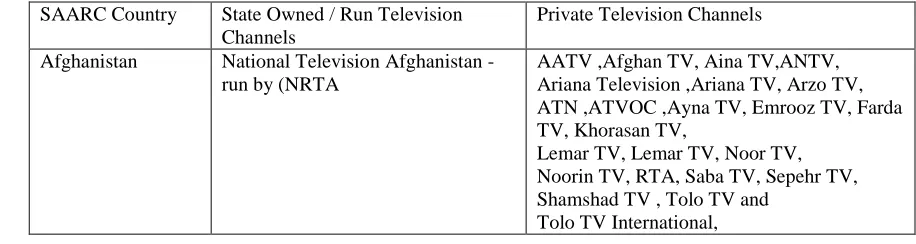
Afghan Television Channels is a popular entertainment medium in Afghanistan.
[image:2.612.152.459.215.291.2] [image:2.612.70.528.366.488.2]The Television Channels details shown in Table 1.0. Foreign Channels are available on DTH and Cable Television platform
Table 1.0
Table Showing Television Channels in Afghanistan
SAARC Country State Owned / Run Television Channels
Private Television Channels Afghanistan National Television Afghanistan -
run by (NRTA
AATV ,Afghan TV, Aina TV,ANTV, Ariana Television ,Ariana TV, Arzo TV, ATN ,ATVOC ,Ayna TV, Emrooz TV, Farda TV, Khorasan TV,
Lemar TV, Lemar TV, Noor TV, Noorin TV, RTA, Saba TV, Sepehr TV, Shamshad TV , Tolo TV and
Tolo TV International,
Bangladesh
East Pakistan seceded from its union with West Pakistan in 1971 and was renamed „The Peoples‟ Republic of Bangladesh‟ emerged as a sovereign state in South Asia on 16 December 1971.
It is bordered by India on all sides except for a small border with Burma (Myanmar) to the far southeast and by the Bay of Bengal to the south. Bangladesh is the seventh most populous country in the world and is among the most densely populated countries in the world..
Country Name People's Republic of Bangladesh Population 161.3 million (UN, 2008) Capital city Dhaka
Area 143,998 sq km Major languages Bengali
Major religion Islam, Hinduism
Bangladesh runs its television service, Covering 80% of the country, with its main stations located in Dhaka. The Television Channels of Bangladesh is shown in Table 1.2.
International Journal of Emerging Technology and Advanced Engineering
Website: www.ijetae.com (ISSN 2250-2459,ISO 9001:2008 Certified Journal, Volume 4, Issue 12, December 2014)
561
[image:3.612.77.528.158.247.2]Table 1.2
Table Showing Television Channels in Afghanistan
SAARC Country State Owned / Run Television Channels
Private Television Channels Bangladesh Bangladesh Television (BTV)
BTV World
ATN Bangla, Bangla Vision, Boishakhi ,Channel One, Desh TV,
Diganta Television, Ekushey TV, ETV ,Islamic TV,NTV, RTV and STAR Bangla
Bhutan
Bhutan is situated at the eastern end of the Himalaya Mountains with borders east, west and south by India and to north by China. Bhutan was inhabited as early as 2000 BC.
Though Bhutan's economy is one of the world‟s smallest, Bhutan's economy is based on agriculture, forestry, tourism and the sale of hydroelectric power to India. One of the main attractions for tourists is the country's culture and traditions. Bhutanese tradition is deeply steeped in its Buddhist heritage
Country Name Kingdom of Bhutan Population 666,900 (UN, 2008) Capital city Thimphu
Area 38,364 sq km Major languages Dzongkha (official)
Major religion Buddhism (official), Hinduism In 2004, after a media impact study, the then Bhutan
communication authority restricted many cable TV channels from being broadcast in the country on the ground that these channels aired excessive violence, glamorized drugs, and showed explicit content. Music channels like MTV, channel V, Zee music, the fashion channel FTV, and a sports channel, Ten sports, were banned.
However, he said that the authority had warned cable operators to refrain from airing channels that broadcast explicit or violent content. the direct-to-home (DTH) technology, popularly known as dish TV
Table 1.3
Table Showing Television Channels in Bhutan
SAARC Country State Owned / Run Television Channels
Private Television Channels
Bhutan BBS (Bhutan Broadcasting Service ) Sigma Cable Service, Zee music, MTV, STC music S1, S2, and Buddhist Channel
India
India is largest among the SAARC countries put together with a largest population.
India shares land borders with four of the SAARC countries and two countries with maritime borders. India is a republic consisting of 28 states and seven union territories with a parliamentary system of democracy.
Country Name Republic of India Population 1.2 billion (UN, 2008) Capital city New Delhi
Area 3.1 million sq km
Major languages Hindi, English and at least 16 other official languages
International Journal of Emerging Technology and Advanced Engineering
Website: www.ijetae.com (ISSN 2250-2459,ISO 9001:2008 Certified Journal, Volume 4, Issue 12, December 2014)
562
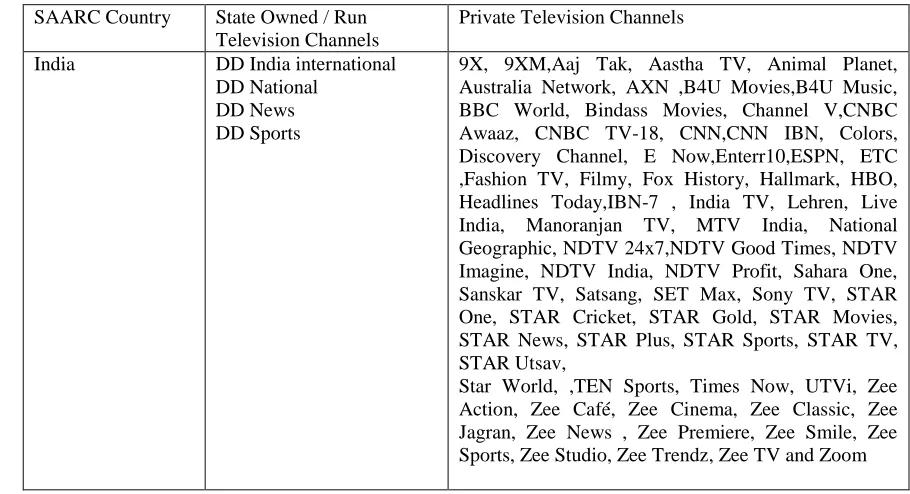
Television came to India in 1959, and today, with over 700 TV transmitters, the estimated audience is over 60% of the country‟s population, with nearly 30 million sets in operation. To facilitate TV viewing in rural and urban slums areas, community sets are provided.
[image:4.612.73.528.221.468.2] [image:4.612.157.455.542.616.2]India has the largest number training schools in the fields of Film, Radio and Television producing the manpower to cater the needs of Television channels as well as manpower provider to neighboring countries.
Table 1.4
Table Showing Television Channels in India
SAARC Country State Owned / Run Television Channels
Private Television Channels India DD India international
DD National DD News DD Sports
9X, 9XM,Aaj Tak, Aastha TV, Animal Planet, Australia Network, AXN ,B4U Movies,B4U Music, BBC World, Bindass Movies, Channel V,CNBC Awaaz, CNBC TV-18, CNN,CNN IBN, Colors, Discovery Channel, E Now,Enterr10,ESPN, ETC ,Fashion TV, Filmy, Fox History, Hallmark, HBO, Headlines Today,IBN-7 , India TV, Lehren, Live India, Manoranjan TV, MTV India, National Geographic, NDTV 24x7,NDTV Good Times, NDTV Imagine, NDTV India, NDTV Profit, Sahara One, Sanskar TV, Satsang, SET Max, Sony TV, STAR One, STAR Cricket, STAR Gold, STAR Movies, STAR News, STAR Plus, STAR Sports, STAR TV, STAR Utsav,
Star World, ,TEN Sports, Times Now, UTVi, Zee Action, Zee Café, Zee Cinema, Zee Classic, Zee Jagran, Zee News , Zee Premiere, Zee Smile, Zee Sports, Zee Studio, Zee Trendz, Zee TV and Zoom
Maldives
The Maldives is a chain of about 1,200 islands. The Maldives is portrayed as a tropical paradise. The economy revolves around tourism, and scores of islands have been developed for the top end of the tourist market.
The country has developed its infrastructure and industries, including the fisheries sector, and has boosted health care, education and literacy.
Country Name Republic of Maldives Population 311,100 (UN, 2008) Capital city Male
Area 298 sq km Major languages Divehi Major religion Islam The popularity and demand for telecasting services has
continued to increase Television stations TVM and Private
International Journal of Emerging Technology and Advanced Engineering
Website: www.ijetae.com (ISSN 2250-2459,ISO 9001:2008 Certified Journal, Volume 4, Issue 12, December 2014)
[image:5.612.77.529.158.268.2]563
Table 1.5
Table Showing Television Channels in Maldives
SAARC Country State Owned / Run Television Channels
Private Television Channels
Maldives TVM (Television Maldives ) Atoll Television, Channel [V] India ,Channel [V] International ,DHI TV, Fox News Channel ,Nat Geo Adventure Maldives ,National Geographic Channel Maldives ,Sky News ,Star Movies, Star News, STAR TV,
Star World ,TVM Maldives and V TV
Nepal
Nepal is a kingdom in the southern slope of the Himalayas. Nepal is a country of amazing mountains, including Mount Everest, elevation 29, 028 feet. It is geographically placed between India and China. The people of Nepal consists of many races and tribes, each wearing traditional costumes, and speaking a different dialect or language.
All these races and tribes coexist peacefully by embracing Hinduism or Buddhism, the country‟s two major religions.One of the major constraints facing Nepal‟s development process is its limitation in productive land, having only a fifth of the land under cultivation.
Country Name Nepal
Population 28.8 million (UN, 2008) Capital city Kathmandu
Area 147,141 sq km Major languages Nepali
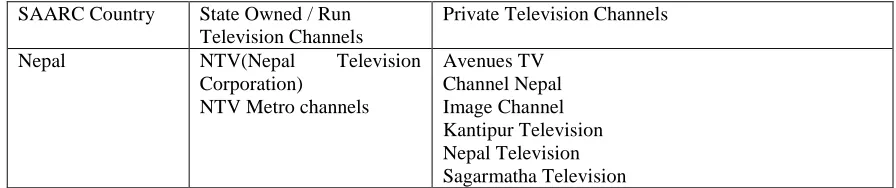
Major religion Hinduism, Buddhism Television was introduced to Nepal in 1985. State run
and private satellite channels and Cable TV available in Nepal.
[image:5.612.154.459.373.448.2]DTH satellite services that give with more than 50 channels.
Table 1.6
Table Showing Television Channels in Nepal
SAARC Country State Owned / Run Television Channels
Private Television Channels Nepal NTV(Nepal Television
Corporation) NTV Metro channels
[image:5.612.81.529.511.605.2]International Journal of Emerging Technology and Advanced Engineering
Website: www.ijetae.com (ISSN 2250-2459,ISO 9001:2008 Certified Journal, Volume 4, Issue 12, December 2014)
564
PakistanPakistan came into existence in 1947. Bordered by China in the North, and towards West and Northwest are
Iran and Afghanistan and towards East and South East its borders are with India China, Afghanistan and Iran.
Country Name Islamic Republic of Pakistan Population 167 million (UN, 2008) Capital city Islamabad
Area 796,095 sq km
Major languages English, Urdu, Punjabi, Sindhi, Pashto, Balochi
Major religion Islam Television, begun in 1964, now has six state-owned TV
stations in the country with 16 re-broadcasting transmitters.
[image:6.612.156.457.192.279.2] [image:6.612.63.531.345.480.2]The Television Network in Pakistan runs on state owned television channels on both terrestrial and satellite, Cable Television and also DTH Platform.
Table 1.7
Table Showing Television Channels in Pakistan
SAARC Country State Owned / Run Television Channels
Private Television Channels Pakistan PTV Bolan
PTV Global PTV Home PTV National PTV News
Aag, AAJ TV,AKS Communication, ARY ARY Digital, ARY Musik, ARY News,
ARY QTV,ARY Zouq, ATV, Dawn News, Dhoom TV, Din News, Dunya News, Express 24x7 (English),Express News (Urdu),Eye Television Network, Geo News, Geo Super, Geo TV, Hum TV, Indus Music, Indus News, Indus TV, Indus Vision, Metro One, MTV Pakistan, News One, Play TV (Pakistan),Style 360,TV One,
Sri Lanka
Sri Lanka is an island 445 km. in length and 225 km in breadth. The population consists Sinhalese , Tamils, Moors, Malyas, Burghers and other small ethnic groups.
Sri Lanka is a multi-religious country with Buddhists constituting the majority rest Hindus, Muslims, and Christians.
Country Name Democratic Socialist Republic of Sri Lanka
Population 19.4 million (UN, 2008) Capital city Colombo
Area 65,610 sq km
Major languages Sinhala, Tamil, English
Major religion Buddhism, Hinduism, Islam, Christianity
Sri Lanka has a long history of mass media, with the oldest newspaper dating back to the 1830s.
International Journal of Emerging Technology and Advanced Engineering
Website: www.ijetae.com (ISSN 2250-2459,ISO 9001:2008 Certified Journal, Volume 4, Issue 12, December 2014)
[image:7.612.81.536.158.278.2]565
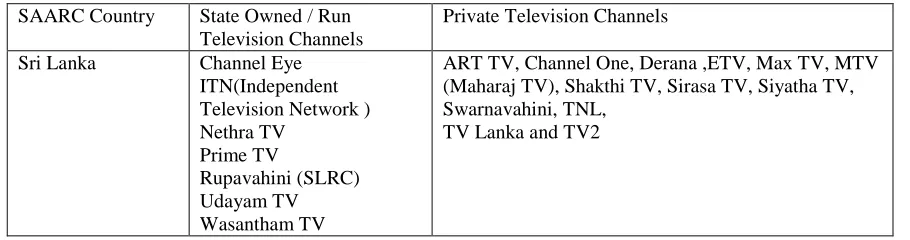
Table 1.8
Table Showing Television Channels in Sri Lanka
SAARC Country State Owned / Run Television Channels
Private Television Channels Sri Lanka Channel Eye
ITN(Independent Television Network ) Nethra TV
Prime TV
Rupavahini (SLRC) Udayam TV Wasantham TV
ART TV, Channel One, Derana ,ETV, Max TV, MTV (Maharaj TV), Shakthi TV, Sirasa TV, Siyatha TV, Swarnavahini, TNL,
TV Lanka and TV2
III. COMMON FACTORS IN SAARCMEMBER COUNTRIES
Poverty and Illiteracy: While poverty is common to all parts in the region, these countries suffer from major disparities in income distribution. A large section of the population lives at or under subsistence level. Illiteracy is a major constraint to development in most of the countries. The high rate of increase in population is another factor to contend with.
Multi-racial Character: Most of the countries are multi-racial in Character and to a certain extent, lack national and cultural cohesion.
Rural Traditions: The total population of the South Asian region is over one billion, and majority of the people in all these countries live in villages. These have had a strong traditions of effective communication, resulting in relatively stable societies of rich and vibrant cultures.
British Influence: South Asian nations also share another commonality resulting from their recent past as subject nations under British rule. All countries within this region have either been under British rule, or subjected to strong British influence.
Rationale for State Control: The “rationale” for state-management of media, as expounded by the then leaders soon after independence, however justifiable it may then been, has in course of time led the media into a different situation, and today, in many countries in the region, electronic media performance, under state-management, has become a subject of much controversy and public criticism.
Political Influence: The tendency on the part of politicians in power to use radio and television to achieve their personal ambitions, and, not infrequently, to deviate from the declared aims and objectives of these organizations, is a phenomenon highly visible in many developing countries in their post-colonial era.
Television Media: Television is gradually gaining ground as the more effective medium with its audio-visual component as its main strength. Advent of Television was delayed in these countries due to lack of capitol. TV broadcasting is a capitol intensive enterprise and most of the equipment needed, including TV receivers, had to be generally imported from developed countries. (It is a salutary sign that a few countries such as India, are now manufacturing some of the equipment needed). Due to high costs, this medium at present can be afforded mostly by the affluent societies. In order to popularize this medium, and bring its benefits to a wider audience at grass-root level, a number of countries in this region have embarked upon a programme of organizing community-viewing facilities.
State Supervision: TV broadcasts are supervised by the State, and in all five countries, owners of television sets are expected to obtain a license for using the set. Large numbers of unlicensed sets, however, are being used in all these countries.TV stations in the five countries are mostly government establishments. During the few years, a few private TV broadcasting services have been establishment in Sri Lanka. Bangladesh and Sri Lanka appear to have the highest land coverage. This is mainly due to the terrain of the lad in the two countries. Bangladesh is a comparatively flat country; while Sri Lanka has a mountain mass in the centre of the island and undulating plains in the coastal areas. Thai main transmitter is fixed on the highest mountain peak in the central hills.
IV. CONCLUSION
International Journal of Emerging Technology and Advanced Engineering
Website: www.ijetae.com (ISSN 2250-2459,ISO 9001:2008 Certified Journal, Volume 4, Issue 12, December 2014)
566
Television is not a passive medium with the participatory programmes by involving larger viewership television can play very dynamic role. The massive expansion of satellite scenario has thrown up several possibilities and issues. There are questions and concerns that need to be addressed including the future of satellite broadcasting and the balance between commercial viability and social desirability. One should acknowledge the power and reach of the television but at the same time one should also never over estimate the potential of television.
REFERENCES
[1] Encyclopedia of SAARC & Member Countries, 9 Volumes, Sharma & Rashmi, Saujanya Books, New Delhi (2007)
[2] Asian Development Outlook 2006
[3] Electronic Media in Bangladesh (ETV, BTV, CHANNEL i, Radio Today & BD Betar), Media Professionals Group: Dhaka. Murdoch, G. (2000)
[4] Localism in broadcasting by Padmaja Shaw (Vidura May- June 1989)
[5] Mass media and cross cultural communications: a Study of television in India by SR Joshi and Trivedi.1994
[6] Millennium Development Goals: South Asia; online: http://ddp-xt.worldbank.org/ ext/GMIS/ gdmis.do?siteId=2&menuId=LNAV01REGSUB5– (2006): [7] Preferential trading in South Asia, Washington, DC: World Bank
(World Bank Policy Research Working Paper 3813) Chandra, R. / R. Kumar (2008):