how work groups cope with understaffing
Shen, W, Chang, K, Cheng, K and Kim, Y
http://dx.doi.org/10.1037/ocp0000129
Title What to do and what works? Exploring how work groups cope with understaffing
Authors Shen, W, Chang, K, Cheng, K and Kim, Y
Type Article
URL This version is available at: http://usir.salford.ac.uk/id/eprint/47180/ Published Date 2018
USIR is a digital collection of the research output of the University of Salford. Where copyright permits, full text material held in the repository is made freely available online and can be read, downloaded and copied for noncommercial private study or research purposes. Please check the manuscript for any further copyright restrictions.
Author Accepted Manuscript
What to do and what works?
Exploring how work groups cope with understaffing.
Winny Shen (University of Waterloo, Canada)
Kirk Chang (University of Salford, United Kingdom)*
KuoTai Cheng (National Tsing Hua University, Taiwan)
Yourie Kim (University of Waterloo, Canada)
*. For further details, please contact Kirk Chang (email: [email protected]).
This manuscript has been accepted for publication in the Journal of Occupational
Health Psychology. Please kindly use the following reference for future citation.
Thank you very much.
Shen, W., Chang, K., Cheng, K.T., & Kim, Y. (in press). What to do and what
works? Exploring how work groups cope with understaffing. Journal of
Occupational Health Psychology.
ABSTRACT
Complaints regarding understaffing are common in the workplace and research has begun
to document some of the potential ill effects that can result from understaffing conditions. Despite evidence that understaffing is a relatively prevalent and consequential stressor, research
has yet to explore how work groups cope with this stressor and the efficacy of their coping strategies in mitigating poor group performance and burnout. The present study examines these questions by exploring both potential mediating and moderating coping effects using a sample of
96 work groups from four technology organizations. Results indicate that work groups react differently to manpower and expertise understaffing conditions, with leaders engaging in more
initiating structure behaviors when faced with manpower understaffing and engaging in more consideration behaviors when faced with expertise understaffing. Further, leaders’ use of consideration in the face of expertise understaffing was negatively associated with group
burnout. We also uncovered evidence that leadership behaviors and work group actions (i.e., team-member exchange) moderate relationships between manpower understaffing and outcomes,
though differently for group performance and burnout. Overall, this study helps to reframe work groups as active in their efforts to cope with understaffing and highlights that some coping strategies are more effective than others. Implications for theory and practice are discussed.
INTRODUCTION
In the face of mounting economic pressures, stiff business competition, and tight margins, many organizations have sought to “do more with less”, including with their human
capital. At the same time, workers’ complaints of understaffing have become common in organizational life (Newport, 2010). For example, in healthcare, nurses and other healthcare professionals have increasingly warned of dangerously understaffed hospitals (e.g., in New
Zealand: Cann, 2017; in California, USA: Newkirk, 2016), and a body of research has emerged linking chronic nurse understaffing to negative patient outcomes, including illness and mortality
(e.g., Clements et al., 2008; Stapleton et al., 2016), as well as negative worker outcomes, such as burnout and dissatisfaction (e.g., Aiken, Clarke, Sloane, Sochalski, & Silber, 2002). Similarly, in the retail industry, research has shown that many stores are understaffed during peak hours to the
detriment of store sales and profitability (e.g., Mani, Kesavan, & Swaminathan, 2015), and retail workers have brought lawsuits against their employers for “intentional understaffing” practices
(e.g., AutoZone, Rubenstein, 2011). Thus, there is growing evidence that chronic understaffing is a prevalent and consequential workplace stressor across countries, industries, and organizations.
Despite the high prevalence of understaffing in organizations, empirical research on
understaffing remains relatively limited, particularly outside of healthcare settings. Additionally, in spite of the tendency of workers and the media to invoke understaffing as the cause of myriad
business problems (e.g., poor morale and performance), the existing empirical research linking understaffing to organizational outcomes has been much less consistent, with evidence of
detrimental, null, and beneficial understaffing effects all being observed in the literature (Hudson
they are active agents who may seek to actively cope with this stressor and whose actions may
ultimately have a strong influence on experienced outcomes. Thus, the overall purpose of this study is to examine how work groups cope with or manage understaffing conditions, focusing on both leader and team actions, as greater insights regarding these reactions may help to explain
prior inconsistent understaffing effects found in the literature as well as facilitate the development of future interventions that can protect workers and work groups against the
potential negative consequences of workplace understaffing. Workplace Understaffing
In the literature, understaffing has typically been defined as a situation where there are
insufficient workers to fulfill the essential tasks and function of a work unit (Greenberg, 1979; Srivastava, 1974). Recently, Hudson and Shen (2015) advocated that workplace understaffing be
re-conceptualized as a multidimensional construct. In support of their arguments, Hudson and Shen (2018) found that workers and work groups differentiated between manpower
understaffing, inability of the work unit to complete its primary tasks and functions due mainly
to lack of needed workers, which has been the focus of almost all prior research on understaffing, and expertise understaffing, inability of the work unit to complete its primary tasks and functions
due to lack of needed knowledge, skills, or other abilities within the unit.
Despite research highlighting that understaffed groups are highly concerned about negative outcomes, with the most prevalent anticipated problems being poor performance and
burnout (Cini, Moreland, & Levine, 1993), prior research examining the actual consequences of understaffing has been equivocal. As an example, some researchers have found that
performance (e.g., when controlling for group size, Perkins, 1982), and yet other scholars have
found understaffing to be unrelated to group performance (e.g., Wicker, Kirmeyer, Hanson, & Alexander, 1976). Similarly inconsistent results can also be observed for other outcomes in this literature (e.g., job attitudes and motivation; for a review, see Hudson & Shen, 2015), though
there appears to be more consistent evidence for negative consequences of understaffing on individual- and group-level burnout (e.g., Dietzel & Coursey, 1998: Rutter & Fielding, 1988).
Coping with Understaffing
Coping is often broadly defined as “conscious volitional efforts to regulate emotion, cognition, behavior, physiology, and the environment in response to stressful events or
circumstances” (Compas Connor-Smith, Saltzman, Thomsen, & Wadsworth, 2001, p. 89). Given that understaffing is a relatively common work stressor, it behooves scholars and practitioners to
better understand how individuals, work groups, and organizations cope with this stressor as well as the effectiveness of different coping strategies on performance and well-being. In spite of this need, there is currently, to our knowledge, no research on typical coping behaviors associated
with understaffing and little research on the factors or actions that can mitigate the possible negative effects of understaffing (for an exception, see Wendsche, Hacker, & Wegge, 2017).
In the current study, we focus on coping (and outcomes) at the work group level-of-analysis given that (under)staffing levels are inherently a property of the work group (Hudson & Shen, 2015). Further, much more research has been conducted on individual- compared to group-
or team-level coping, despite the fact that arguably much of the work in organizations is now organized around and accomplished by work groups and teams (e.g., Devine, Clayton, Philips,
contribute to the literature by uncovering how work groups tend to cope with understaffing
conditions and the efficacy of these choices and actions on group performance and burnout. One key component of understanding how a work group copes with understaffing is how the leader of the work group copes or behaves. Our focus on leader actions is in line with a
substantial body of research that highlights that leaders influence how stressors affect teams and their members (Britt, Davison, Bliese, & Castro, 2004), including by shaping how the stressor is
appraised (e.g., Zhang, LePine, Buckman, & Wei, 2014) and subsequent team member behavioral reactions to stress appraisals (e.g., LePine, Zhang, Crawford, & Rich, 2016). Additionally, focusing on leader behaviors is a promising avenue, particularly when
contemplating future interventions, given evidence that leadership behaviors can be trained or changed (e.g., Barling, Weber, & Kelloway, 1996; Gonzalez-Morales, Kernan, Becker, &
Eisenberger, 2018; Lacerenza, Reyes, Marlow, Joseph, & Salas, 2017) and recent calls to consider leadership development as an occupational health psychology intervention based on robust links between leader behaviors and follower well-being (Kelloway & Barling, 2010).
In the current study, we focus specifically on leaders’ use of initiating structure and consideration behaviors. Initiating structure refers to behaviors that leaders take to define roles
and establish standards in service of goal attainment, whereas consideration refers to leader behaviors centered on demonstrating concern and support for followers (Fleishman, 1973; Judge, Piccolo, & Ilies, 2004). Although a number of different behavioral models of leadership have
been proposed in the literature, across various models, task- and relational-oriented behaviors are represented and recognized as important (Behrendt, Matz, & Göritz, 2017). Further, empirical
appear to be distinct constructs), they do tend to converge substantially and are strongly
correlated (e.g., Piccolo, Bono, Heinitz, Rowold, Duehr, & Judge, 2012).
Given that coping refers to the full gamut of actions that can be taken to deal with stressors in one’s environment, substantial variability exists in the literature regarding the best
way to conceptualize the nature and structure of coping (e.g., Connor-Smith & Flachsbart, 2007; Skinner, Edge, Altman, & Sherwood, 2003). One key distinction often made is between
problem- and emotion-focused coping strategies; the former refers to coping behaviors that directly attempt to change or address the stressor, and the latter refers to coping behaviors that are directed toward managing the emotional reactions that result from the stressor (Folkman &
Lazarus, 1980). Given that initiating structure involves behaviors that serve to clarify pathways to goal accomplishment, it appears to be conceptually aligned with a problem-focused approach
to dealing with understaffing. In contrast, as consideration mainly describes behaviors that reflect care, respect, and appreciation for group members, we reason that it is more in line with an emotion-focused approach to managing affective reactions that may result from understaffing.
Importantly, prior research indicates that both problem- and emotion-focused coping strategies can be adaptive responses to dealing with stressors and are often more effective for adjustment
than disengagement-oriented coping strategies (e.g., avoidance-denial; Compas et al., 2001) Although understanding leader actions in the face of understaffing conditions is
important, there is also value to understanding coping strategies enacted by the other members of
the work group, including the work group as a whole. Specifically, in the current study, we focus on team-member exchange (TMX), the quality of social exchange relationships within the work
of organizational outcomes (Banks, Batchelor, Seers, O’Boyle, Pollack, & Gower, 2014).
Further, recent research indicates that team member behaviors and relationships may be
particularly important resources for teams when other resources, such as leader-based resources, are scarce (Farh, Lanaj, & Ilies, 2017). Thus, to complement our focus on leader initiating
structure and consideration as possible coping behaviors to deal with understaffing, we also consider TMX as another way for the collective or group to cope with this stressor.
Overall, the present research makes three major contributions to the literature. First, we contribute to the literature by providing empirical support for emergent theorizing that
understaffing is a multi-dimensional construct (Hudson & Shen, 2015), highlighting that
reactions to and outcomes of manpower and expertise understaffing may differ in important ways and the need to develop the unique nomological network of each type of understaffing to
advance occupational health psychology research. Second, we contribute to the literature by demonstrating that inconsistent prior relationships between understaffing and outcomes (e.g., performance and well-being) may be due to failure to consider and assess how work groups,
including both the leaders of these groups as well as groups as a whole, actively cope with understaffing. Specifically, we do so by elucidating the complex manner in which coping may
occur (detailed below), whereby some stressors may tend to elicit uniform coping responses whereas other stressors may elicit a variety of reactions, and by re-framing leader initiating structure and consideration as ways of engaging in problem- and emotion-focused coping,
respectively. Finally, we contribute to the literature by examining whether the efficacy of coping responses (i.e., problem- or emotion-focused) depends upon match with the stressor (i.e., type of
Historically, the role of coping in the stressor-strain relationship has been conceptualized
in two ways: as either a (1) mediator or a (2) moderator of this relationship (Frese, 1986; Taylor & Aspinwill, 1996). A mediation model would indicate that there is a tendency for work groups to cope with understaffing in certain ways, which has downstream consequences for experienced
outcomes. As an illustration, greater work group understaffing may mobilize team members to intensify exchange relationships to compensate for the lack of personnel in the group, and greater
TMX is then positively related to group performance. On the other hand, a moderator model would suggest that a range of coping responses is possible or occurs, and how a group responds affects the understaffing-outcome relationship. As an example of this latter type of relationship,
more frequent leader consideration behaviors, such as demonstrating care and compassion for group members, may buffer a team against burnout in the face of understaffing. Thus, in line
with prior coping research (e.g., Calvete, Corral, & Estévez, 2008; Daus & Joplin, 1999; Devereux, Hastings, Noone, Firth, & Totsika, 2009), below we develop hypotheses for both potential mediating and moderating effects of different coping strategies on the relationship
between work group understaffing and group performance and burnout, respectively, the two most common areas of concern for understaffed teams (Cini et al., 1993).
Coping as Mediator.
When Hudson and Shen (2015) proposed that understaffing be conceptualized as a multi-dimensional construct, they argued that manpower and expertise understaffing are likely to be
viewed differently by workers and work groups. Specifically, they reasoned that expertise understaffing may be appraised more negatively and have more damaging effects compared to
work group tasks, and, therefore, view goal accomplishment (including group performance) as
impossible and unreasonable for their organization to expect or demand. In contrast, under manpower understaffing circumstances, work groups lack sufficient personnel resources (i.e., numbers of workers) and may struggle to complete critical work tasks in a timely fashion, but
may largely possess the needed expertise and may therefore still view goal accomplishment (including group performance) as possible and feel some sense of obligation or efficacy to
pursue these goals. Thus, we predict that manpower understaffing should be associated with problem-focused coping behaviors, such as leader initiating structure behaviors, and expertise understaffing should be associated with emotion-focused coping behaviors, such as leader
consideration, as the former situation should be viewed as more rectifiable than the latter. Hypothesis 1: Manpower understaffing is positively related to initiating structure.
Hypothesis 2: Expertise understaffing is positively related to consideration.
Although we argue that the leadership behaviors of interest in the current study, initiating structure and consideration, align with problem- and emotion-focused coping, respectively,
categorization of TMX as a particular type of coping behavior is less straightforward. Prior social exchange theorizing has argued that a key component of social exchange relationships is
benefits, which one partner or party offers to the other that encourages reciprocation (Blau, 1964). Benefits include “assistance, advice, compliance, appreciation, and instrumental services” (Colquitt, Baer, Long, & Halvorsen-Ganepola, 2014, p. 600). Thus, the benefits exchanged
between team members can include both task- and emotion-related resources (Tse &
Dasborough, 2008). Thus, we propose that both types of understaffing, manpower and expertise,
Hypothesis 3: (a) Manpower and (b) expertise understaffing are positively related to
TMX.
These proposed leader and work group coping responses to understaffing should then affect key group outcomes. Links between leader initiating structure and consideration and group
performance are well-established in the literature, including by meta-analytic evidence (Judge et al., 2004). Similarly, a number of studies have documented that TMX is positively correlated
with group performance (e.g., Dierdorff, Bell, & Belohlav, 2011; Jordan, Feild, & Armenakis, 2002), though the extant meta-analysis on TMX only examines and supports its relationship with individual-level performance (Banks et al., 2014).
In the same vein, relational- and task-oriented leadership behaviors, which includes consideration and initiating structure, respectively, are negatively associated with follower poor
mental health, including burnout (for a meta-analytic review, see Montano, Reeske, Franke, & Hüffmeier, 2017). Some research suggests that leadership behaviors affect follower well-being via followers’ job characteristics (e.g., role clarity, meaningful work; Nielsen, Randall, Yarker,
& Brenner, 2008), though research on both the direct and indirect relationships between leadership behaviors and follower burnout has traditionally focused on the individual
level-of-analysis. However, prior research indicates that burnout can be “contagious” and crossover between team members within a work group (Bakker, Schaufeli, Sixma, & Bosveld, 2001; Westman, Bakker, Roziner, & Sonnentag, 2010), suggesting that leader behaviors may be able to
influence group well-being as a whole via its effects on individual follower burnout. Additionally, research has found that group or team-level burnout can further contribute to
research has directly examined relationships between TMX and group burnout, the broader
literature on relationships indicates that high quality social exchanges are critical for health and well-being (e.g., Dutton & Heaphy, 2003). Thus, we hypothesize the following:
Hypothesis 4: Leader initiating structure and consideration are (a) positively related to
group performance and (b) negatively related to group burnout.
Hypothesis 5: TMX is (a) positively related to group performance and (b) negatively
related to group burnout. Coping as Moderator.
Alternatively, perhaps leaders and work groups vary substantially in their typical
responses in the face of understaffing and how they cope or behave may then affect the
subsequent performance or well-being of the group. Given that understaffed groups are highly
concerned about poor performance and burnout (Cini et al., 1993), we anticipate that both manpower and expertise understaffing should be associated with both outcomes. Overall, we predict that groups that cope more effectively (i.e., those whose leaders engage in more initiating
structure or consideration behaviors or those who have high quality exchanges among team members) will demonstrate weaker relationships between understaffing and poor group
outcomes compared to those groups that cope less effectively. However, given prior arguments that expertise understaffing may be appraised more negatively and be perceived as more
insurmountable than manpower understaffing (Hudson & Shen, 2015), we also explore whether a
more emotion-focused approach (i.e., leader consideration) may be more effective in weakening relationships between expertise understaffing and negative group consequences, whereas a more
teams experiencing manpower understaffing against poor team outcomes. Thus, we hypothesize
the following:
Hypothesis 6: Leader initiating structure moderates the negative relationship between (a)
manpower and (b) expertise understaffing, respectively, and group performance and
burnout, such that the relationship is weaker when initiating structure is higher. Hypothesis 7: Leader consideration moderates the negative relationship between (a)
manpower and (b) expertise understaffing, respectively, and group performance and burnout, such that the relationship is weaker when consideration is higher.
Hypothesis 8: TMX moderates the negative relationship between (a) manpower and (b)
expertise understaffing, respectively, and group performance and burnout, such that the relationship is weaker when TMX is higher.
In our hypotheses above, we considered each coping response separately, arguing that any type of more effective coping response may provide the work group with key resources that should buffer the group against the negative consequences of understaffing. However, another
way of considering coping is to examine responses more holistically or in totality. When considered in this manner, it may be the case that the importance or utility of team member
behaviors depends upon the presence or absence of leader behaviors. In other words, perhaps high quality social exchanges between team members are less necessary or beneficial if the leader has already taken steps to address the task- or emotion-related concerns that arise due to
understaffing. In fact, prior research suggests that TMX is most beneficial for individual team member performance when LMX is low, highlighting that these exchanges may be to some
Hypothesis 9: Leader initiating structure, TMX, and understaffing interact to predict
group (a) performance and (b) burnout, such that the buffering effect of TMX on the understaffing-outcome relationship is stronger when initiating structure is low.
Hypothesis 10: Leader consideration, TMX, and understaffing interact to predict group
(a) performance and (b) burnout, such that the buffering effect of TMX on the understaffing-outcome relationship is stronger when consideration is low.
Method
Participants and Procedures
Participants were individuals nested within existing work groups from four technology
organizations in Taiwan that produce various technological products (e.g., semiconductors, electronic chips, and computer wafers). Specifically, we approached organizations that structured
their work teams similarly (i.e., each work group consisted of four team members, including one team leader) to invite them to participate in our study, and each organization allowed us access to 25 work groups. At Time 1, all team members completed measures of work group understaffing,
leader initiating structure and consideration, and TMX. At Time 2, approximately three months later, team leaders rated the performance of their work group and all team members reported on
work group burnout.
In total, 382 individuals at Time 1 (96% response rate) and 400 individuals at Time 2 (100% response rate) from 100 work groups participated in our study. However, to better ensure
representativeness, we only retained groups where the within-group response rate was high (i.e., at least three out of four team members participated) at each time point. Thus, our final sample
Work Group Understaffing. We used Hudson and Shen’s (2018) three-item measures
of manpower understaffing (α = .90; sample item: “There are not enough employees in our work unit to complete all required job tasks”) and expertise understaffing (α = .79; sample item: “Our work unit is missing personnel with key knowledge and skills”). Responses were on a five-point
Likert scale from 1 (strongly disagree) to 5 (strongly agree). [Manpower: ICC(1) = .22, ICC(2) = .52; Expertise: ICC(1) = .70, ICC(2) = .92].
Initiating Structure and Consideration. Initiating structure (α = .95) and consideration
(α = .75) were assessed with 10-items each using the Leader Behavior Description Questionnaire (LBDQ; Stogdill, 1963). Sample item: “Does little things to make it pleasant to be a member of
the group” (consideration); “Assigns group members to particular tasks” (initiating structure). Responses were on a five-point Likert scale from 1 (never) to 5 (always acts as described).1
[Initiating structure: ICC(1) = .26, ICC(2) = .58; Consideration: ICC(1) = .20, ICC(2) = .49]. TMX. TMX was assessed using Seers’ (1989) 10-item measure (α = .74). Sample item:
“Other group members are flexible about switching jobs with me”. Responses were on a
five-point Likert scale from 1 (strongly disagree) to 5 (strongly agree). [ICC(1) = .24, ICC(2) = .56]. Group Performance. Work group performance was rated by the team leader of each
group. Hudson and Shen (2018) suggested that inconsistent relationships between understaffing and group performance may be due to supervisors’ tendencies to use shifting standards when rating the performance of differentially staffed groups (i.e., two groups receive the same
performance rating even though their actual performance is different because the groups are
1 Given that the work groups in the current study are relatively small in size (four members each), we included team
leaders’ ratings of their own leadership behaviors in order to maximize the reliability of the group level scores. This decision was made based on prior meta-analytic evidence that leader and observer ratings of initiating structure (ρ = .32; K = 10) and consideration (ρ = .31; K = 8) demonstrate at least moderate levels of convergence (Lee &
evaluated against different standards—the constraints and resources present). This phenomenon
was first uncovered by Biernat and Manis (1994), who found that stereotypical expectations were not apparent when members of various groups were evaluated using subjective measures due to shifting standards, but emerged when more common-rule measures were used (e.g., men and
women were rated similarly on a Likert-measure of verbal ability from very low to very high, but when participants were asked to assign men and women a letter grade for verbal ability, they
gave women higher grades than men. This suggests that participants were likely comparing women against other women and men against other men, which constitutes different standards, when making subjective evaluations). Subsequent research suggests that shifting standards may
also occur due to environmental factors when evaluating others’ performance; Pindek and
Spector (2016) found that when actual performance was held constant, participants rated workers
who experienced organizational constraints (e.g., equipment constraints, supervisor
micro-management) as higher performers than workers who did not experience the same constraints. Thus, in the current study we employ two different operationalizations of work group
performance to better elucidate whether relationships between work group understaffing and group performance may have been previously obscured in the literature due, in part, to the
dominant use of subjective ratings where shifting standards may be more likely to occur. The first measure is a more “subjective” rating of work group performance using Conger, Kanungo, and Menon’s (2000) five-item measure (α = .90) on a five-point Likert scale from 1 (strongly
disagree) to 5 (strongly agree), where the standard or population of comparison is not made explicit, making the occurrence of shifting standards more likely. Sample item: “The work group
supervisors to rate, “Compared to other work groups in your organization, please list at what
percentile you believe the work group you are supervising would be ranked based on their performance”. Thus, if supervisors are shifting evaluation standards depending upon the staffing conditions faced by or other constraints or resources possessed by the work group, relationships
may be more apparent when common-rule (versus subjective) performance measures are used. Group Burnout. Group burnout was assessed using an adapted version of Wharton’s
(1993) six-item measure of emotional exhaustion (α = .88), where items were modified to reference the work group instead of the individual. Sample item: “Members of the work group feel emotionally drained from work”. Responses were on a five-point Likert scale from 1 (never)
to 5 (feel this way every day). [ICC(1) = .47, ICC(2) = .78].
Scale Translation
All measures were originally written and validated in English, so measures were translated to Mandarin Chinese and back translated to English using standard procedures (Brislin, 1980). The resulting translated measures were then reviewed and verified by three
bilinguals with expertise in organizational research.
Data Aggregation
Given that our hypotheses focus on the work group level-of analysis, we examined within-group agreement statistics prior to aggregation. Kozlowski and Klein (2000) suggested that ICC(1) ≥ .05 and ICC(2) ≥ .50 indicate sufficient agreement to justify aggregation. All of
our variables to be aggregated met these suggested cutoffs, with the exception that the ICC(2) value for consideration was slightly below the guideline at .49. Thus, we aggregated group
Results
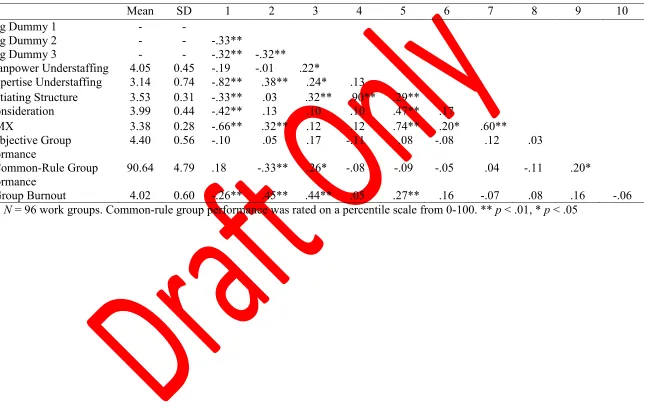
Means, standard deviations, and correlations for study variables can be found in Table 1. This matrix highlights that work groups from the four organizations appears to differ
systematically on some study variables (e.g., average level of expertise understaffing). Thus, we
control for organizational membership using dummy variables in all subsequent analyses.2
Coping as Mediator
Multiple regression analyses examining relationships between the two types of
understaffing and proposed leader and work group coping responses are presented in Table 2. Greater manpower understaffing was associated with greater leader initiating structure (β = .86, p
< .01), supporting Hypothesis 1. Greater expertise understaffing was positively related to leader consideration (β = .43, p < .05) and TMX (β = .60, p < .01), respectively, supporting Hypothesis
2 and providing partial support for Hypothesis 3. Thus, these results indicate that the two types of
understaffing are associated with distinct coping responses by leaders and work groups.3 In regression analyses controlling for organizational membership and both types of
understaffing, initiating structure was found to be unrelated to group performance (subjective: β = -.08, p > .05; common-rule: β = .09, p > .05) and burnout (β = .24, p > .05). In contrast,
although consideration was also unrelated to group performance (subjective: β = .13, p > .05;
2Our use of dummy variables representing organizational membership statistically controls for
between-organization differences on study variables. However, given evidence of mean differences on certain variables of interest between some organizations in our dataset, we also explored whether there was evidence that relationships
between study variables differed by organization. Generally, there was little evidence (one statistically significant interaction across 15 analyses) that relationships between understaffing and proposed coping responses (i.e., initiating structure, consideration, and TMX) as well as relationships between proposed coping responses and group outcomes (i.e., subjective performance, common-rule performance, and burnout) varied by organization.
3Although our hypotheses posit linear relationships between understaffing conditions and leader and work group
common-rule: β = .12, p > .05), it was negatively related to group burnout (β = -.18, p < .05).
The same pattern of results was obtained for TMX, such that TMX was unrelated to group performance (subjective: β = -.05, p > .05; common-rule: β = .01, p > .05), but was negatively related to group burnout (β = -.20, p < .05). Overall, these results provide partial support for
Hypotheses 4 and 5.
We then examined whether there was evidence for significant indirect effects between
expertise understaffing and group burnout via consideration and TMX, respectively, using Hayes’ (2013) PROCESS macro with 5,000 bootstrap resamples. We continued to control for organizational membership and manpower understaffing in these analyses, so that they are
commensurate with our regression analyses above. The indirect effect from expertise
understaffing to group burnout via consideration was significant (estimate: .06, 95% CI: .17,
-.002). However, the indirect effect from expertise understaffing to group burnout via TMX was not (estimate: -.10, 95% CI: -.23, .01). Further, a multiple mediator model that included both consideration and TMX affirmed that only consideration (estimate: -.05, 95% CI: -.14, -.001),
and not TMX (estimate: -.06, 95% CI: -.17, .05), mediated this relationship.
Coping as Moderator
Since prior research has not examined coping behaviors associated with work group understaffing, we initially posited both potential mediating and moderating coping effects. However, given the strong relationships observed linking manpower understaffing with leader
initiating structure and expertise understaffing with TMX, we chose not to examine initiating structure as a moderator of manpower understaffing-outcome relationships or TMX as a
in the face of manpower understaffing and most teams engage in high quality exchanges in the
[image:21.612.72.538.194.589.2]face of expertise understaffing, such that it is unlikely that there is sufficient variation in these behaviors or responses to moderate the corresponding understaffing-outcome relationships.
Table 3 presents the results of our moderator analyses. In examining moderators of the
relationship between manpower understaffing and outcomes, we first examined main effects in Step 1, added two-way interactions representing the moderating effect of consideration and TMX
in Step 2, and added the three-way interaction between understaffing, consideration, and TMX at Step 3. There was no evidence of any moderating effects of consideration or TMX on the
manpower understaffing-subjective group performance relationship.
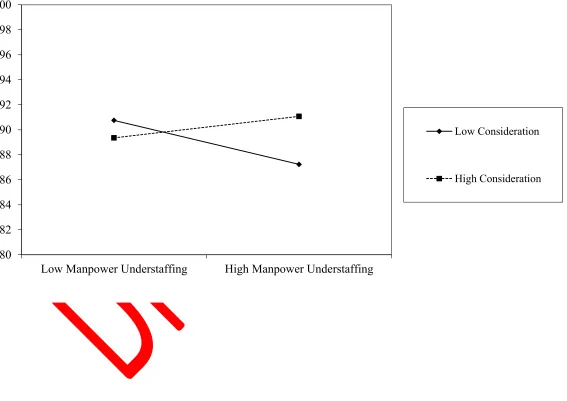
In contrast, there was evidence of a significant two-way interaction between manpower understaffing and consideration in predicting common-rule group performance (β = .21, p < .05;
see Figure 1). Simple slope analyses revealed that the relationship between manpower
understaffing and common-rule group performance was non-significant at high levels (+ 1 SD) of consideration (b = .86, t = 1.15, p > .05), but was significant and negative at low levels (-1
SD) of consideration (b = -1.76, t = -2.00, p < .05). Thus, manpower understaffing was only damaging for group performance when leaders tended not to engage in consideration behaviors,
providing partial support for Hypothesis 7. Additionally, we found no support for Hypothesis 8, regarding the moderating effect of TMX on understaffing-outcome relationships.
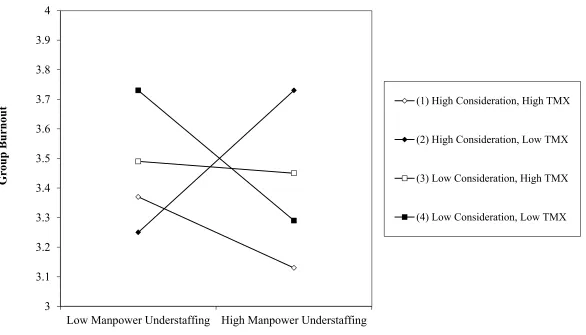
In predicting group burnout, we uncovered a significant three-way interaction between
manpower understaffing, leader consideration, and TMX (β = -.25, p < .05). This interaction is depicted in Figure 2. The form of this interaction is somewhat different from what was posited in
Hypothesis 10. Specifically, supporting the importance of team-based resources, the relationship
regardless of whether leader consideration was high (b = -.12, t = -1.34, p > .05) or low (b = -.02,
t = -0.22, p > .05). However, manpower understaffing was related to group burnout when TMX
was low, though the nature of the relationship depended upon leader consideration. Surprisingly, when both TMX and leader consideration was low, manpower understaffing was negatively
related to group burnout (b = -.22, t = -2.46, p < .05). In contrast, when TMX was low and
consideration was high, manpower understaffing was positively related to group burnout (b = .24,
t = 1.90, p = .06; note that this simple slope becomes significant at p = .05 at +1.10 SD).
We also examined potential moderators of the relationship between expertise
understaffing and group outcomes. In Step 1, we examined main effect relationships, and in Step
2, we added two-way interactions representing the moderating effect of initiating structure and consideration.4 None of the two-way interactions were statistically significant across the three
outcomes examined, failing to support Hypothesis 6. Finally, we were unable to examine Hypothesis 9 (i.e., three-way interactions between understaffing, initiating structure, and TMX)
due to issues of multi-collinearity (i.e., the high correlation between manpower understaffing and
initiating structure and the high correlation between expertise understaffing and TMX).
Discussion
Despite the prevalence of workplace understaffing across organizations, industries, and nations, little is known regarding how work groups cope with this stressor and the effectiveness of various coping strategies. The present study contributes to our knowledge on these issues,
examining naturalistic behavioral reactions of leaders and work groups to understaffing conditions by exploring both potential mediating and moderating coping effects. Our results
4 Although not hypothesized, we also examined whether there was any evidence of three-way interactions between
highlight that leaders and their work groups are active agents whose actions and choices affect
and shape the consequences of workplace staffing conditions.
Our results indicate that manpower and expertise understaffing elicit different responses from leaders and work groups, supporting prior arguments that there is value to distinguishing
between these two types of understaffing (Hudson & Shen, 2015, 2018). Specifically, greater manpower understaffing is associated with greater leader initiating structure behaviors, whereas
greater expertise understaffing is associated with greater leader consideration behaviors and TMX. Further, leader consideration is negatively related to group burnout. Thus, these results suggest that perhaps the reason why expertise understaffing may not be consistently related to
negative group outcomes is because these conditions also tend to elicit some desirable leader behaviors or responses that mitigate against some negative consequences.
In contrast to the indirect effect linking expertise understaffing to group burnout via leader consideration, for manpower understaffing-outcome relationships, we primarily observed moderating coping effects. Further, the pattern of moderation varied depending upon the
outcome under consideration. Although no moderating effects were found for the manpower understaffing-subjective group performance relationship, leader consideration did moderate the
manpower understaffing-common-rule group performance relationship. Specifically, high levels of leader consideration appeared to be protective for common-rule group performance, such that greater levels of manpower understaffing no longer exerted a negative effect. Given that this
relationship was found for common-rule group performance but not for subjective group performance, this suggests that perhaps leaders do tend to evaluate understaffed groups using
the literature. Thus, it may behoove future researchers interested in examining performance
consequences of understaffing to make evaluation standards or comparisons clear and explicit. We also found evidence that manpower understaffing, consideration, and TMX interacted in an unexpected way to predict group burnout. Given the unexpected pattern of this interaction,
it should be viewed as tentative and needs to be replicated in future research to increase confidence in its veracity. Specifically, the pattern is as follows, at high levels of TMX,
manpower understaffing was unrelated to group burnout regardless of leader consideration behaviors. In contrast, at low levels of TMX, the direction of the manpower understaffing-group burnout relationship depended upon leader consideration behaviors. However, this pattern is
likely the opposite of what many people would expect or predict as manpower understaffing was negatively related to burnout (i.e., greater understaffing associated with less burnout) at low
levels of leader consideration, typically considered to be undesirable, whereas manpower
understaffing was positively related to burnout (i.e., greater understaffing associated with greater burnout) at high levels of leader consideration.
We cautiously interpret this pattern of findings as evidence that high TMX appears to be a potent buffer against the potential detrimental effects of manpower understaffing on group
burnout; in contrast, leader consideration alone (without high levels of TMX) appears to be insufficient to mitigate the group burnout that results from manpower understaffing. However, the most puzzling relationship is the negative relationship between manpower understaffing and
group burnout when both consideration and TMX are low. We speculate that perhaps high levels of understaffing are associated with lower group burnout under these conditions because it
actually more exhausting (e.g., why isn’t our leader considerate and my colleagues offering each
other benefits when there’s nothing or no constraint preventing them from doing so?). We encourage future research to examine this possibility and particularly to replicate this effect, given evidence that many interactions in the literature fail to replicate (Murphy & Russell, 2017).
Theoretical Implications
The findings of this study provide important empirical support for recent theorizing that
understaffing should be conceptualized as a multi-dimensional construct (Hudson & Shen, 2015). Although prior empirical research has found that workers and work groups can and do distinguish between manpower and expertise understaffing, it also only resulted in limited
evidence that the two forms of understaffing are differentially related to correlates (Hudson & Shen, 2018). In contrast, the current study produced some strong evidence that the two types of
understaffing exhibit differential relationships with key correlates; work groups naturally cope differently with manpower and expertise understaffing and the most effective actions to reduce the impact of these two forms of understaffing on work group performance and burnout differs.
Thus, these results highlight the need for further theory-building and empirical research regarding the similarities and differences between manpower and expertise understaffing.
The current work may also have theoretical implications for the broader study of work stress beyond understaffing. As an example, common theoretical perspectives invoked in the occupational health psychology literature, such as the Job Demands-Resources model (Bakker &
Demerouti, 2007) and Conservation of Resources theory (Hobfoll, 1989), tend to treat resources as relatively fungible and always desirable. However, our study suggests that the moderating
they are not interchangeable. Further, the three-way interaction between manpower
understaffing, TMX, and leader consideration on group burnout we uncovered indicates that low levels of resources (i.e., low TMX and consideration) may not always be damaging for well-being depending upon context (i.e., high manpower understaffing). Thus, existing theories may
need to be expanded or revised to accommodate these findings (assuming they are replicated in subsequent research).
Finally, our study also has theoretical implications for the integration of leadership theories into occupational health psychology. Although some prior occupational health research has incorporated leadership theories (for a brief review, see Macik-Frey, Quick, & Nelson,
2007), our approach differs and contributes to these efforts in novel and important ways. First, existing efforts to examine relationships between leadership behaviors and employee well-being
has tended to conceptualize these behaviors as resources that followers can draw from (e.g., Inceoglu, Thomas, Chu, Plans, & Gerbasi, 2018), whereas we conceptualize leadership behaviors as coping behaviors. This difference likely stems from the fact that the majority of occupational
health psychology research to date has been at the individual level-of-analysis; therefore, leader behaviors are factors externals to the employee and may be used as resources to facilitate coping
but cannot be considered coping behaviors themselves. However, we argue that this is likely not the case at higher levels-of-analyses where leader behaviors may better reflect direct reactions to managing work stressors facing the collective they are leading. Second, by using a problem- and
emotion-focused coping perspective to understand leader initiating structure and consideration, we highlight that it may be important to differentiate between different types of positive or
contributed to a near exclusive focus on relationally-oriented behaviors (e.g., transformational
leadership and consideration) in occupational health research (e.g., Inceoglu et al., 2018; Kelloway & Barling, 2010). However, our research highlights that future theorizing in
occupational health should also consider task-oriented leadership behaviors as well as the match
between various stressors and leadership behaviors, which may serve as coping strategies.
Practical Implications
One practical implication of our research is that organizations and work group leaders need to be aware that understaffing can occur in different ways. The majority of prior research and media attention has focused on manpower understaffing and has largely neglected expertise
understaffing. However, even if are no job openings to be filled, a work group can still feel understaffed and potentially suffer negative consequences if key abilities, skills, or expertise are
missing within the group that makes it difficult to accomplish important work group tasks. The present study also suggests that although most leaders may automatically engage in consideration behaviors when their work group or team faces expertise understaffing, which
appears to protect the group against burnout, there may be more natural variability across groups when it comes to consideration and TMX behaviors in the face of manpower understaffing.
Thus, a practical implication and possible future intervention may be to teach or train leaders and work groups to recognize and engage in greater consideration and intensify TMX when faced with greater manpower understaffing conditions. Furthermore, the intervention or training could
emphasize enhancing consideration when group performance is most at-risk and improving TMX when group burnout may be imminent.
Although this study has a number of strengths, including temporal separation between
predictors and outcomes and a relatively large sample size for work group/team research in the organizational sciences (cf. Shen, Kiger, Davies, Rasch, Simon, & Ones, 2011), it is not without limitations. First, we assessed understaffing and proposed mediators at the same time, though we
did assess outcomes separately. Thus, these data are cross-sectional and the causal ordering of the variables more ambiguous. However, we are unaware of any rationale for why desirable
leader behaviors (i.e., initiating structure and consideration) would lead to greater perceptions of work group understaffing and believe that our proposed ordering is plausible. Additionally, we acknowledge that despite the fact that we assessed proposed mediators temporally before
expected outcomes, the causal ordering of these variables are still ambiguous given that these variables were ultimately measured and not manipulated (e.g., performance or burnout may
influence leader and team actions or there may be reciprocal relationships between these two domains). Therefore, we encourage future understaffing research to complement observations or surveys in the field with experiments in the lab to enrich our understanding of this phenomenon.
Second, although we found evidence of a significant indirect effect between expertise understaffing and group burnout via consideration, generally there was limited evidence of
mediating coping effects. Further, this was mainly because most of the proposed coping
behaviors were not directly related to group performance and burnout in the current study. This is especially surprising given that links between initiating structure and consideration and group
performance are well-established in the literature (e.g., Judge et al., 2004). We speculate that this may simply be due to sampling error given our relatively modest sample size, though we note
research employing larger samples may find, for example, that there are significant indirect
effects between manpower understaffing and group performance via initiating structure. Third, although we propose that leader consideration and initiating structure and TMX reflect behavioral coping responses to understaffing, the measures we employed do not specify
that these behaviors were undertaken in reaction to (under)staffing conditions. Thus, it may be the case that if understaffing tends to naturally co-vary with other workplace stressors, these
behaviors may reflect general coping strategies or simply typical patterns or habits rather than targeted and unique responses to managing understaffing. Regardless, the present study indicates that such behaviors have important implications for understaffing-outcome relationships.
Finally, in the current study we focus on understaffing at the work group level-of analysis, controlling for differences at the organizational level due to the limited number of
organizations in the present dataset which prevented us from using multi-level modeling to examine the impact of different levels of analysis simultaneously (Maas & Cox, 2005). However, we recognize that understaffing may also vary meaningfully and systematically at the
organizational level. Further, organizational-level understaffing (or other organizational-level variables, such as human resource policies or practices) may influence the relationship between
work group understaffing and outcomes. For example, perhaps greater organizational
understaffing exacerbates the relationship between work group understaffing and negative group outcomes, as work groups within these organizations may be less able to draw upon other work
groups for assistance if everyone is highly stretched for personnel resources. Alternatively, perhaps greater organizational understaffing actually weakens the relationship between work
may seem more normative or necessary in these settings. We encourage future research to
examine these possibilities and, more generally, to explore potential cross-level moderators.
Conclusion
Although a large body of research exists on workplace stressors, research on workplace understaffing is still in its nascence in many ways. The current study contributes to our growing
understanding of this prevalent stressor by highlighting that leaders and work groups tend to react differently to manpower and expertise understaffing conditions, with some behavioral responses appearing to be more effective in promoting group performance and preventing group
References
Aiken, L. H., Clarke, S. P., Sloane, D. M., Sochalski, J., & Silber, J. H. (2002). Hospital nurse
staffing and patient mortality, nurse burnout, and job dissatisfaction. Journal of the American
Medical Association, 288, 1987–1993.
Bakker, A. B., & Demerouti, E. (2007). The Job Demands-Resources model: State of the art.
Journal of Managerial Psychology, 22, 309-328.
Bakker, A. B., Schaufeli, W., Sixma, H. J., & Bosveld, W. (2001). Burnout contagion among
general practitioners. Journal of Social and Clinical Psychology, 20, 82–98.
Bakker, A. B., van Emmerik, H., & Euwema, M. C. (2006). Crossover of burnout and
engagement in work teams. Work & Occupations, 33, 464-489.
Banks, G. C., Batchelor, J. H., Seers, A., O’Boyle Jr., E. H., Pollack, J. M., & Gower, K. (2014).
What does team-member exchange bring to the party? A meta-analytic review of team and leader
social exchange. Journal of Organizational Behavior, 35, 273-295.
Barling, J., Weber, T., & Kelloway, E. K. (1996). Effects of transformational leadership training
on attitudinal and financial outcomes: A field experiment. Journal of Applied Psychology, 81,
827-832.
Behrendt, P., Matz, S., & Göritz, A. S. (2017). An integrative model of leadership behavior. The
Leadership Quarterly, 28, 229-244.
Biernat, M., & Manis, M. (1994). Shifting standards and stereotype-based judgments. Journal of
Personality and Social Psychology, 66, 5-20.
Blau, P. M. (1964). Exchange and power in social life. New York, NY: Wiley.
Brislin, R.W. (1980). Translation and content analysis of oral and written material. In H. C.
Triandis and J. W. Berry (Eds.), Handbook of Cross-Cultural Psychology (Vol. 2, pp. 389-444).
Boston: Allyn & Bacon.
Britt, T. W., Davison, J., Bliese, P. D., & Castro, C. A. (2004). How leaders can influence the
impact that stressors have on soldiers. Military Medicine, 169, 541-545.
Calvete, E., Corral, S., & Estévez, A. (2008). Coping as a mediator and moderator between
intimate partner violence and symptoms of anxiety and depression. Violence Against Women, 14,
886-904.
Cann, G. (2017). Nine in 10 healthcare workers feel understaffed and under-resourced. Retrieved on September 14, 2017 from http://www.stuff.co.nz/national/health/89932971/nine-in-10-healthcare-workers-feel-understaffed-and-underresourced
Cini, M. A., Moreland, R. L., & Levine, J. M. (1993). Group staffing levels and responses to
prospective and new group members. Journal of Personality and Social Psychology, 65, 723–
734.
Clements, A., Halton, K., Graves, N., Pettitt, A., Morton, A., Looke, D., & Whitby, M. (2008).
Overcrowding and understaffing in modern healthcare systems: Key determinants in
meticillin-resistant Staphylococcus aureus transmission. The Lancet Infectious Diseases, 8, 427–434.
Colquitt, J. A., Baer, M. D., Long, D. M., & Halvorsen-Ganepola, M. D. K. (2014). Scale
indicators of social exchange relationships: A comparison of relative content validity. Journal of
Applied Psychology, 99, 599-618.
Compas, B. E., Connor-Smith, J. K., Saltzman, H., Thomsen, A. H., & Wadsworth, M. E.
(2001). Coping with stress during childhood and adolescence: Progress, problems, and potential
in theory and research. Psychological Bulletin, 127, 87–127.
Conger, J. A., Kanungo, R. N., & Menon, S. T. (2000). Charismatic leadership and follower
effects. Journal of Organizational Behavior, 21, 747-767.
Connor-Smith, J. K., & Flachsbart, C. (2007). Relations between personality and coping: A
Daus, C. S., & Joplin, J. R. W. (1999). Survival of the fittest: Implications of self-reliance and
coping for leaders and team performance. Journal of Occupational Health Psychology, 4, 15-28.
Devereux, J. M., Hastings, R. P., Noone, S. J., Firth, A., & Totsika, V. (2009). Social support
and coping as mediators or moderators of the impact of work stressors on burnout in intellectual
disability support staff. Research in Developmental Disabilities, 30, 367-377.
Devine, D. J., Clayton, L. D., Philips, J. L., Dunford, B. B., & Melner, S. B. (1999). Teams in
organizations: Prevalence, characteristics, and effectiveness. Small Group Research, 30, 678-711.
Dierdorff, E. C., Bell, S. T., & Belohlav, J. A. (2011). The power of “we”: Effects of
psychological collectivism on team performance over time. Journal of Applied
Psychology, 96, 247-262.
Dietzel, L., & Coursey, R. (1998). Predictors of emotional exhaustion among nonresidential staff
persons. Psychiatric Rehabilitation Journal, 21, 340–348.
Dutton, J., & Heaphy, E. (2003). The power of high quality connections. In K. Cameron, J.
Dutton, & R. E. Quinn (Eds.), Positive organizational scholarship: Foundations for a new
discipline (pp. 263–278). San Francisco: Berrett Koehler.
Farh, C. I. C., Lanaj, K., & Ilies, R. (2017). Resource-based contingencies of when team-member
exchange helps member performance in teams. Academy of Management Journal.
Fleishman, E. A. (1973). Twenty years of consideration and structure. In E. A. Fleishman & J. G.
Hunt (Eds.), Current developments in the study of leadership (pp. 1–40). Carbondale, IL:
Southern Illinois University Press.
Folkman, S., & Lazarus, R. S. (1980). An analysis of coping in a middle-aged community
sample. Journal of Health and Social Behavior, 21, 219–231.
Frese, M. (1986). Coping as a moderator and mediator between stress at work and
psychosomatic complaints. In M. H. Appleby and R. Trumbull (Eds.), Dynamics of stress (pp.
183-206). New York: Plenum Press.
Frese, M. (1986). `Coping as a moderator and mediator between stress at work and psychosomatic complaints', In: Appley, M. H. and Trumbull, R. (Eds.), Dynamics of Stress pp. 183±206, Plenum Press, New York
Ganster, D., & Dwyer, D. (1995). The effects of understaffing on individual and group
performance in professional trade occupations. Journal of Management, 21, 175–190.
Gonzalez-Morales, M. G., Kernan, M. C., Becker, T. E., & Eisenberger, R. (2018). Defeating
abusive supervision: Training supervisors to support subordinates. Journal of Occupational
Health Psychology, 23, 151-162.
Greenberg, C. (1979). Toward an integration of ecological psychology and industrial
psychology: Undermanning theory, organization size, and job enrichment. Environmental
Psychology and Nonverbal Behavior, 3, 228–242.
Hayes, A. F. (2013). Introduction to mediation, moderation, and conditional process analysis: A
regression-based approach. New York: Guilford Publications.
Hobfoll, S. E. (1989). Conservation of resources: A new attempt at conceptualizing stress.
American Psychologist, 44, 513-524.
Hudson, C. K., & Shen, W. (2015). Understaffing: An under-researched phenomenon.
Organizational Psychology Review, 5, 244-263.
Hudson, C. K., & Shen, W. (2018). Consequences of work group manpower and expertise
understaffing: A multilevel approach. Journal of Occupational Health Psychology, 23, 85-98.
Inceoglu, I., Thomas, G., Chu, C., Plans, D., & Gerbasi, A. (2018). Leadership behavior and
employee well-being: An integrated review and research agenda. The Leadership Quarterly, 29,
179-202.
Jordan, M. H., Feild, H. S., & Armenakis, A. A. (2002). The relationship of group process
variables and team performance: A team-level analysis in a field setting. Small Group Research,
33, 121-150.
and initiating structure in leadership research. Journal of Applied Psychology, 89, 36-51. Kelloway, E. K., & Barling, J. (2010). Leadership development as an intervention in
occupational health psychology. Work & Stress, 24, 260-279.
Kozlowski, S. W. J., & Klein, K. J. (2000). A multilevel approach to theory and research in
organizations: Contextual, temporal, and emergent processes. In K. J. Klein & S. W. J. Kozlowski
(Eds.), Multilevel theory,research and methods in organizations: Foundations, extensions, and
new directions (pp. 3–90). San Francisco, CA: Jossey-Bass.
Lacerenza, C. N., Reyes, D. L., Marlow, S. L., Joseph, D. L., & Salas, E. (2017). Leadership
training design, delivery, and implementation: A meta-analysis. Journal of Applied Psychology,
102, 1686-1718.
Lee, A.., & Carpenter, N. C. (2018). Seeing eye to eye: A meta-analysis of self-other agreement
of leadership. The Leadership Quarterly, 29, 253-275.
LePine, M. A., Zhang, Y., Crawford, E. R., & Rich, B. L. (2016). Turning their pain to gain:
Charismatic leader influence on follower stress appraisal and job performance. Academy of
Management Journal, 59, 1036-1059.
Maas, C. J. M., & Hox, J. J. (2005). Sufficient sample sizes for multilevel modeling.
Methodology, 1, 86-92.
Macik-Frey, M., Quick, J. C., & Nelson, D. L. (2007). Advances in occupational health: From a
stressful beginning to a positive future. Journal of Management, 33, 809-840.
Mani, V., Kesavan, S., & Swaminthan, J. M. (2015). Estimating the impact of understaffing on
sales and profitability in retail stores. Production and Operations Management, 24, 201-218.
DOI: 10.1111/poms.12237
Montano, D., Reeske, A., Franke, F., & Hüffmeier, J. (2017). Leadership, followers’ mental health and job performance in organizations: A comprehensive meta-analysis from an
occupational health perspective. Journal of Organizational Behavior, 38, 327-350.
Murphy, K. R., & Russell, C. J. (2017). Mend it or end it: Redirecting the search for interactions
in the organizational sciences. Organizational Research Methods, 20, 549-573.
Newkirk, B. (2016). Desert Regional dangerously understaffed, nurses say. Retrieved on
September 14, 2017 from http://www.desertsun.com/story/news/health/2016/10/28/desert-regional-hospital-palm-springs-understaffed-nurses/92688460/
Newport, F. (2010). Four in 10 U.S. workers say their company is understaffed.
Retrieved on September 14, 2017 from http://www.gallup.com/poll/143480/Four-Workers-Say-Company-Understaffed.aspx
Nielsen, K., Randall, R., Yarker, J., & Brenner, S.-O. (2008). The effects of transformational leadership on followers’ perceived work characteristics and psychological well-being: A
longitudinal study. Work & Stress, 22, 16-32.
Perkins, D. (1982). Individual differences and task structure in the performance of a behavior
setting: An experimental evaluation of Barker’s manning theory. American Journal of Community
Psychology, 10, 617–634.
Piccolo, R. F., Bono, J. E., Heinitz, K., Rowold, J., Duehr, E., & Judge, T. A. (2012). The
relative impact of complementary leader behaviors: Which matter most? The Leadership
Quarterly, 23, 567-581.
Pindek, S., & Spector, P. E. (2016). Explaining the surprisingly weak relationship between
organizational constraints and job performance. Human Performance, 29, 191-208.
Rubenstein, A. (2011). AutoZone managers win conditional cert in OT suit. Retrieved on
September 14, 2017 from https://www.law360.com/articles/247181/autozone-managers-win-conditional-cert-in-ot-suit
Rutter, D. R., & Fielding, P. J. (1988). Sources of occupational stress: An examination of British
prison officers. Work & Stress, 2, 291-299.
Samples in applied psychology: Over a decade of research in review. Journal of Applied Psychology, 96, 1055-1064.
Seers, A. (1989). Team-member exchange quality: A new construct for role-making research.
Organizational Behavior and Human Decision Processes, 43, 118-135.
Skinner, E. A., Edge, K., Altman, J., & Sherwood, H. (2003). Searching for the structure of
coping: A review and critique of category systems for classifying ways of coping. Psychological
Bulletin, 129, 216-269.
Srivastava, R. K. (1974). Undermanning theory in the context of mental health care
environments. In D. H. Carson (Ed.), Man environment interactions, Part II (pp. 245–258).
Stroudsburg, PA: Dowden, Hutchinson, & Ross.
Stapleton, P. J. M., Murphy, M., McCallion, N., Brennan, M., Cunney, R., & Drew, R. J. (2016). Outbreaks of extended spectrum beta-lactamaseproducing Enterobacteriaceae in neonatal
intensive care units: A systematic review. Archives of Disease in Childhood, Fetal and Neonatal
Edition, 101, F72–F78. http://dx.doi.org/10.1136/archdischild-2015-308707
Stogdill, R. M. (1963). Manual for the Leader Behavior Description Questionnaire. Columbus:
Ohio State University.
Taylor, S. E., & Aspinwall, L. G. (1996). Mediating and moderating processes in psychosocial
stress: Appraisal, coping, resistance, and vulnerability. In H. B. Kaplan (Ed.), Psychosocial
stress: Perspectives on structure, theory, life-course, and methods (pp. 71-110). San Diego, CA: Academic Press.
Tse, H. M., & Dasborough, M. T. (2008). A study of exchange and emotions in team member
relationships. Group & Organization Management, 33, 194-215.
Wendsche, J., Hacker, W., & Wegge, J. (2017). Understaffing and registered nurses’ turnover:
The moderating role of regular rest breaks. German Journal of Human Resource Management:
Zeitschrift für Personalforschung, 31, 238-259.
Westman, M., Bakker, A. B., Roziner, I., & Sonnentag, S. (2010). Crossover of job demands and
emotional exhaustion within teams: A longitudinal multilevel study. Anxiety, Stress, & Coping,
24, 561-577.
Wharton, A. S. (1993). The affective consequences of service work: Managing emotions on the
job. Work and Occupations, 20, 205-232.
Wicker, A. W., Kirmeyer, S. L., Hanson, L., & Alexander, D. (1976). Effects of manning levels
on subjective experiences, performance, and verbal interaction in groups. Organizational
Behavior and Human Performance, 17, 251–274.
Zhang, Y., LePine, J. A., Buckman, B. R., & Wei, F. (2014). It’s not fair…or is it? The role of
justice and leadership in explaining work stressor-job performance relationships. Academy of
Table 1. Descriptive statistics and correlations for study variables
Mean SD 1 2 3 4 5 6 7 8 9 10
1. Org Dummy 1 - -
2. Org Dummy 2 - - -.33**
3. Org Dummy 3 - - -.32** -.32** 4. Manpower Understaffing 4.05 0.45 -.19 -.01 .22*
5. Expertise Understaffing 3.14 0.74 -.82** .38** .24* .13
6. Initiating Structure 3.53 0.31 -.33** .03 .32** .90** .29** 7. Consideration 3.99 0.44 -.42** .13 .10 .10 .47** .17
8. TMX 3.38 0.28 -.66** .32** .12 .12 .74** .20* .60** 9. Subjective Group
Performance
4.40 0.56 -.10 .05 .17 -.11 .08 -.08 .12 .03
10. Common-Rule Group Performance
Table 2. Multiple regression analyses predicting leadership behaviors and team-member exchange from group understaffing
Initiating Structure Consideration TMX
Organizational Dummy 1 -.05 -.11 -.19
Organizational Dummy 2 -.00 -.09 -.01
Organizational Dummy 3 .08 -.08 -.10
Manpower Understaffing .86** .04 .03
Expertise Understaffing .12 .43* .60**
R2 .84 .06 .56
F (5, 90) 98.85** 5.43** 23.19**