Executive Summary
I
The impact of
Libraries
Executive Summary
II
Research Team
Professor Ben Light Dr Kirralie Houghton Professor Jean Burgess Professor Helen Klaebe Dr Roger Osborne
Distinguished Professor Stuart Cunningham Professor Greg Hearn
Contact Information
Digital Media Research Centre Coordinator E [email protected]
T +617 3138 3556 W qut.edu.au/research/dmrc
Digital Media Research Centre Queensland University of Technology Creative Industries Precinct Z1-515 Musk Avenue Kelvin Grove QLD 4059 Australia
AckNowledgments
The authors would like to acknowledge the Libraries as Creative Spaces project’s contributors and facilitators:
• The State Library of Queensland (SLQ) for commissioning this research and facilitating the fieldwork. • The Libraries as Creative Spaces project steering committee members for their helpful feedback - Susan
Coker (Townsville City Council), Ross Duncan (SLQ), Katie Edmiston (Arts Queensland), Andrew Griffiths (Library Board of Queensland) and particularly Deb Miles (SLQ) who has acted as main contact point and invaluable adviser during the project.
• Nicki Hall – Queensland University of Technology (QUT) for her work in supporting the production of the final report and rich media package.
• Saffi Kerezy and Claire Laaja – (QUT) undergraduate students who contributed to the fieldwork and data preparation associated with this project as part of their studies.
Executive Summary
III
Ready access to information through digital media has challenged the perceived societal roles of public libraries. Since
the mid 1990s, libraries have reoriented themselves towards public participation beyond lending and reading. Libraries
now offer an increasing range of community-focused creative activities.
Library spaces are transforming. In addition to housing archival and loan materials, desks and reading spaces, libraries are becoming even more flexible and activity-oriented. Given these transformations, understanding and demonstrating the new contributions public libraries make to their communities is critical. In 2015, the State Library of Queensland (SLQ) commissioned researchers at the Digital Media Research Centre at Queensland University of Technology (QUT) to explore the impact of libraries as creative spaces.
The objectives of the Libraries as Creative Spaces project were to: • Investigate the community impact of creative spaces in public libraries • Provide clear evidence of this impact
• Articulate the opportunities to further embed creative spaces in public libraries or community spaces. The methods used included:
• A contextual review of thinking regarding libraries as creative spaces
• A literature review on the evaluation of creative activity in libraries and creative spaces more generally • Interviews and observational field research at selected Queensland libraries
• The development and refinement of an evidence-based Creative Spaces Impact Framework
• The development of an associated rich media package (including videos, photos and digital stories) showcasing library-based creative activity across Queensland in 2015.
The contextual review highlights the attention being paid to makerspaces as a site of creative activity in public libraries. However, the review also points to the many other ways public libraries are facilitating creative activity. It also demonstrates that while libraries have been formally evaluated for more than a hundred years, only recently has there been a concerted effort to develop frameworks that can qualitatively assess the social impact on individuals and their communities. Moreover, few of these frameworks directly assess libraries as creative spaces.
Following the contextual review, an extended literature review was undertaken for two reasons. Firstly, to develop our understanding of how creative spaces are evaluated (outside the library context). And secondly, to develop our understanding of how libraries are evaluated in more general terms. From this initial evidence base, a preliminary Creative Spaces Impact Framework was developed.
The framework was used to interrogate creative activity at five public library sites across Queensland – Ayr, Cleveland, Helensvale, Roma, and Victoria Point. The framework was revised in conjunction with the fieldwork and further feedback from a range of stakeholders. A summary of the final Creative Spaces Impact Framework can be seen in Table 1.
The Creative Spaces Impact Framework allows for the evaluation of libraries as creative spaces through the creative activities they enable. These activities may be formally organised by the library, informally enacted by library clients, or involve a combination of both approaches. The contents of the framework represent a range of impact potentials, some of which will be relevant to certain library creative space activities more than others, if at all.
The Creative Spaces Impact Framework
allows for the evaluation of libraries
as creative spaces through the creative
activities they enable.
Executive Summary
IV
Using the framework
The components of the Creative Spaces Impact Framework are geared towards demonstrating the value of libraries as creative spaces. A user guide for the framework is available for download at: http://www.plconnect.slq.qld.gov.au/manage/research/libraries-as-creative-spaces and is included in Appendix A. In summary, the framework can be used to:
• Identify and generate creative activity – The framework will help library staff think about and identify creative activity, consider what outcomes flow from creative activity and re-imagine existing activities.
• Identify objectives and outcomes for creative activity – Library staff will be able to use the Creative Spaces Impact Framework criteria and impact indicators to set and monitor objectives and outcomes for creative activity with greater consistency.
• Align creative activity with community needs – By connecting with broader data about the needs of the communities, public libraries can link these with creative activities (existing or new), and align support and service provision accordingly.
• Monitor trends and strategic planning – If used consistently over time, across a range of initiatives, the framework can provide longitudinal and comparative qualitative and quantitative data regarding the impact of libraries as creative spaces.
• Guide exit surveys – By using a common framework to guide exit surveys conducted with the participants of these activities, comparisons can be made over time and across library services, building an overall picture of the impact of libraries as creative spaces.
Recommendations
Further work is needed to communicate and maximise the potential impact and benefits to communities; and the Libraries as Creative Spaces research offers the following recommendations:
1. Refine performance indicators associated with the Library Statistical Bulletin to account for creative activity. The resulting data set will allow for longitudinal analysis that can demonstrate the impact of libraries as creative spaces.
2. Develop resource-friendly and sustainable mechanisms to collect and collate data regarding the impact of libraries as creative spaces.
3. Use the framework to explicitly link community needs with appropriate forms of creative activity that are formally and informally supported by libraries. 4. Investigate further, beyond the five cases in this study, how space is configured and used across libraries where creative activity is concerned. 5. Explore how existing data on publicly-accessible space in libraries, collected for the Library Statistical Bulletin, could be used as a creative activity
performance indicator.
Criterion 1
Accessing Resources
Providing assistance and enabling access to information and materials such as craft supplies,
historical records and digital media.
Criterion 2
Idea Building
Exposing the public to new ideas and facilitating the development of curiosity, experimentation and
risk taking.
Criterion 3
Civic Engagement
Engaging the public in democracy, citizenship, rehabilitation and collaborative work with other public
and private institutions.
Criterion 4
Community Development
Providing a place for community development to happen by encouraging cultural diversity, equality,
equity and social capital where appropriate.
Criterion 5
Cultural Participation
Facilitating public culture by organising and delivering formal and informal events that allow people
to participate in diverse ways.
Criterion 6
Health and Wellbeing
Providing relaxation, entertainment and leisure activities that promote physical and mental
wellbeing.
Criterion 7
Educational Attainment
Making possible, through creative practice, continuous learning and informal approaches to
education that offer an alternative to formal institutions.
Criterion 8
Economic Productivity
Enabling access to mentoring and networking for business and occupational purposes, and
generating income through creative practice.
1
2
3
4
5
6
7
8
Executive Summary
V
Research Team
II
Acknowledgments
II
Executive Summary
III
Table of Contents
VI
1 Introduction
1
1.1 Project Objectives 2 1.2 Definition of Terms: Creativity, Space and Place 2 1.3 Methodology 3 1.4 Governance and Review 3 1.5 Research Ethics 3 1.6 Structure of the Report 4
2 Contextual Review: Evaluating Public
Libraries as Creative Spaces
5
2.1 Dominant Views of Creativity in Libraries: Makerspaces 5 2.2 Creative Practice in Libraries: Beyond Makerspaces 6 2.3 What is the Evidence for the Impact Frameworks? 8
3 An Evidence-Based Creative Spaces
Impact Framework
9
3.1 Developing the Framework 10 3.2 Understanding the Framework 11 3.3 Criterion 1 – Accessing Resources 12 3.4 Criterion 2 – Idea Building 13 3.5 Criterion 3 – Civic Engagement 14 3.6 Criterion 4 – Community Development 15 3.7 Criterion 5 – Cultural Participation 16 3.8 Criterion 6 – Health and Wellbeing 17 3.9 Criterion 7 – Educational Attainment 18 3.10 Criterion 8 – Economic Productivity 19 3.11 Using the Framework 20
4 Demonstrating the Impact of Queensland
Libraries as Creative Spaces
21
4.1 Methodology – Interpreting Creative Activity at State Level 20 4.2 Findings – Creative Activity August to September 2015 22 4.3 Methodology – Case Studies 27 4.4 Case 1: Burdekin – Ayr 29 4.5 Case 2: Gold Coast – Helensvale 32 4.6 Case 3: Maranoa Regional Library Service – Roma Library 39 4.7 Case 4: Cleveland Library and Victoria Point Library – Redlands 44
5 Conclusions and Recommendations
48
6 Bibliography
51
Appendices
Appendix A Reference Copy of the Creative Spaces Impact Framework User Guide 56 Appendix B Table of Contributions of the Literature Review for the Creative Spaces Impact Framework 76 Appendix C Literature – Annotated Preliminary Creative Spaces Impact Framework 79 Appendix D Example of Creative Activity Calendar Activities 81 Appendix E Interview Protocol 82 Appendix F Example of Creative Spaces Impact Framework Coding 84
List of Figures
Figure 1 The Research Process 4 Figure 2 The Creative Spaces Impact Framework for Public Libraries 11 Figure 3 Impact of Creative Activity Across Queensland
August/September 2015 22 Figure 4 Shifts in Impact of Creative Activity Across Queensland
August/September 2015 23 Figure 5 Creative Activity Audiences Across Queensland
August/September 2015 23 Figure 6 Comparison of Creative Activity Impact –
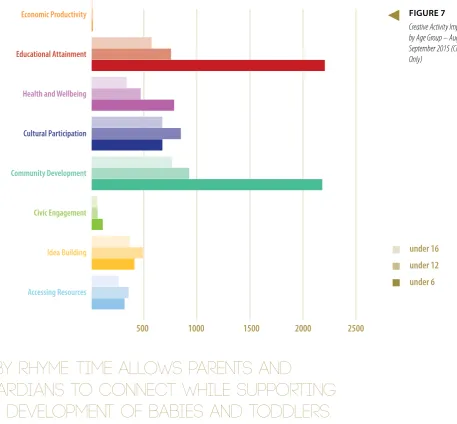
Adults and Children August/September 2015 24 Figure 7 Creative Activity Impact by Age Group –
August/September 2015 (Children Only) 25 Figure 8 Creative Activity Impact by Age Group –
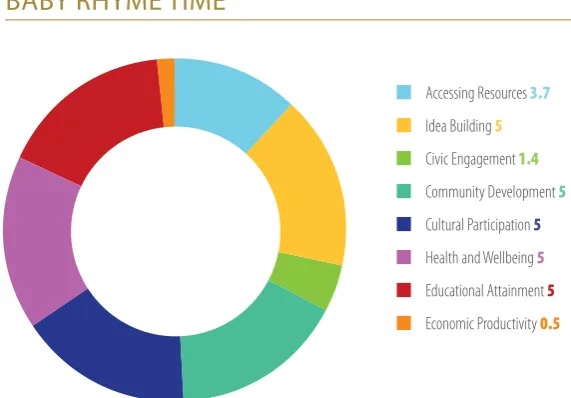
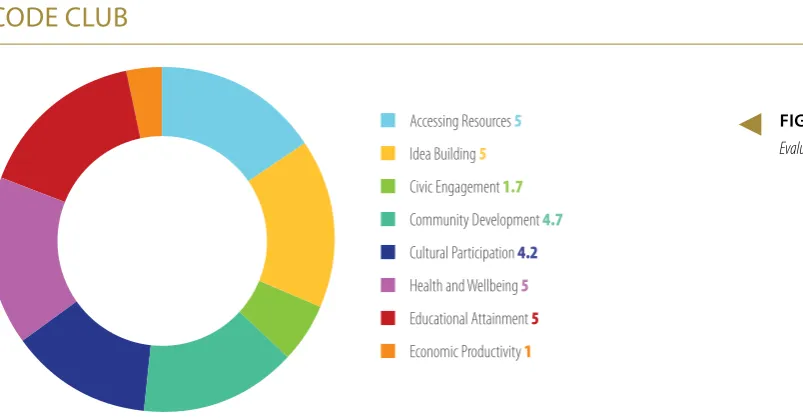
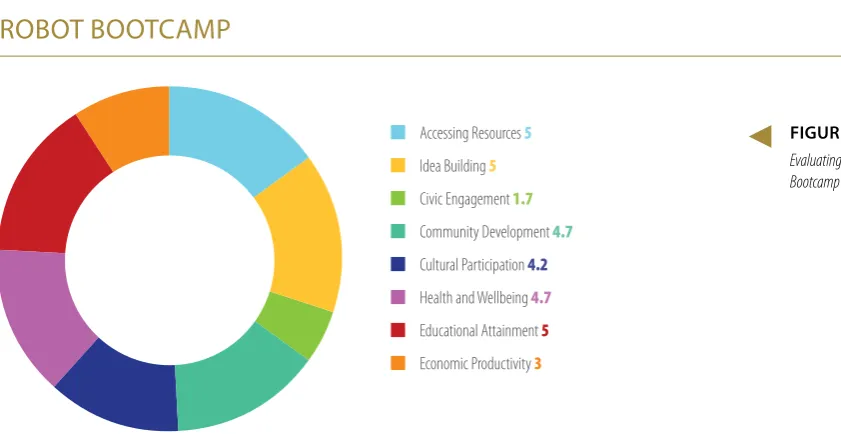
August/September 2015 (Adults Only) 26 Figure 9 Evaluating the Seniors’ Computing Class 31 Figure 10 Evaluating Mikayla’s Use of 3D Printing 34 Figure 11 Evaluating the Garden Club Beekeeping Session 36 Figure 12 Evaluating Baby Rhyme Time 38 Figure 13 Evaluating The Story Bunting Workshop 41 Figure 14 Evaluating the Creative Writers’ Group 43 Figure 15 Evaluating Code Club 45 Figure 16 Evaluating Robot Bootcamp 47
List of Tables
Table 1 Outline of Creative Spaces Impact Framework Criteria V Table 2 SLQ’s Tech Trendsetters Vision 2017 Grants Awarded 7 Table 3 Details of Interviews Undertaken 28
INTRODUCTION
1
INTRODUCTION
1
As more library content goes digital,
and less floor space is required to
store hard copies, there is a trend
towards repurposing library spaces for
creative activity.
Spaces in libraries are transforming. In addition to housing archival and loan materials, desks, reading spaces and
computing equipment, library spaces are becoming more flexible and activity-oriented (Chowdhury et al. 2006;
Houghton et al. 2013; Houghton et al. 2014). Given these transformations, understanding and demonstrating the impact
and contribution public libraries make to communities is critical.
The Library Dividend report (SGS Economics and Planning Pty Ltd 2014) provided an evaluation of libraries across Queensland and looked closely at the value of traditional library activities, demonstrating their significant socio-economic impact. However, the project did not explore the roles and impacts of libraries as creative places, or the benefits these spaces and activities can have on community development and wellbeing.
The State Library of Queensland (SLQ) is keenly aware of the shifting role of public libraries. This is articulated in its Vision 2017 (State Library of Queensland 2013), which sets out a strategic vision for public libraries of the 21st century. The vision has set four priority areas for action, envisioning libraries as: • Creative community spaces – inclusive and welcoming in both their physical and digitally-mediated presence.
• Connectors – bringing diverse groups of individuals and communities together for a variety of social, cultural and economic purposes. • Technology trendsetters – educational, experimental and entrepreneurial spaces where new technologies are concerned.
• Incubators of ideas, learning and innovation – where informal learning outside formal education takes place, generating knowledge and facilitating the exchange of ideas.
INTRODUCTION
2
PROJECT OBJECTIVES
The objectives of the Libraries as Creative Spaces project were to: • Investigate the community impact of creative spaces in public libraries • Provide clear evidence of this impact
• Articulate the opportunities to further embed creative spaces in public libraries or community spaces.
DEFINITION OF TERMS: CREATIVITY, SPACE AND PLACE
The next two sections outline how the Libraries as Creative Spaces project conceptualises three key terms – creativity, space and place. Being clear about what these terms mean in this context is necessary to define what creative spaces in libraries might be, and how they might be evaluated.
CREATIVITY
Creativity is a key driver of the economic and technological development of our society. It underpins our standard of living and educational progress (Robinson 2009). The definition for creativity has been a topic for considerable debate across various academic communities (Robinson 2009; Negus and Pickering 2004). Creativity has been positioned as requiring both originality and usefulness (Runco and Jaeger 2012), formality and informality (Burgess 2006, Light et. al. 2012).
However across these debates, there are a number of common elements that also help clarify what is meant by creativity, which were helpful in evaluating the impact of creative spaces in libraries on their communities. For this purpose, creativity is seen as:
• Relatively Novel (knitting might be new to someone who has not done it)
• Intrinsic in purpose (for example, the process of meeting to knit is the purpose rather than end product) • Extrinsic in purpose (for example, the process of meeting to knit is connected to making things to sell)
• Formal and informal (ranging from a highly structured process with defined outcomes, to a loose unplanned process routed in serendipity – for example, knitting classes as compared with a client organised knitting group)
• Collective and individual (a knitting group or knitting alone).
Any mix of these attributes might occur within a library context. When looking at libraries as creative spaces, the value of creativity can be seen firstly, if it occurs within any of these ways; and secondly, if it moves from one form to another. For instance, where a knitting group inspires someone to take up knitting which in turn inspires knitting for money, which further develops into generating new knitted garments that are sold.
PLACE AND SPACE
Place and space are two different concepts. Space relates to physical dimensions and area, while place is determined by how people become aware of, or are attracted to, a certain piece of space. Place can be understood as a space that people have made meaningful. The most straightforward and common definition of place is ‘a meaningful location’ (Cresswell, 2004). Agnew (1987), a prominent political geographer, contends that for a space to become a place, there needs to be a location (positioning a space somewhere by its relationship to other things), a locale (the specifics of the where of social life) and a sense of place (its identification as a unique community, landscape or moral order). Importantly, this notion of place is not specific to physical space. Digitally-mediated place is also subject to these criteria (Agnew 2011). People’s experiences of spaces determine these connections and emotional relationships (Manzo 2005) taking space from an abstract understanding of physical dimensions into a meaningful place. In particular, feelings of safety, familiarity, personal history and stories are what make a place familiar and help people belong, creating positive relationships with the connection to place (Tuan 1977, Houghton 2014). Public libraries are known as trusted and loved places within communities (Vårheim et al. 2008). This was confirmed for Queensland in the Library Dividend research report (SGS Economics and Planning Pty Ltd 2014). Libraries are public places that can be linked with the capacity and quality of life that an urban or regional centre can offer people who live there (Houghton, 2014). Library places can provide a refuge and a break from the intensity of urban living and work; and connection for the isolated or lonely.
1.1
1.2
1.2.1
1.2.2
INTRODUCTION
3
METHODOLOGY
This research is framed to place weight on meanings of libraries as creative spaces through the views of communities. Any assessment of impact in this context is subjective and this position is at the heart of the Creative Spaces Impact Framework.
Throughout the Libraries as Creative Spaces project, participants have reflected on the value they see in, and gain from, the library as a creative space. The aim has been to better understand the depth of meaning and the lived experience of library staff and clients. This position is in keeping with the public library values around equal access and does not attempt to rate any one perspective over another. The diversity of perspective was valued as part of the research process, in developing the framework and suggesting ways of reporting impact.
The framework developed in this report is built on an evidence framework that includes previous literature and studies, refined through a process of in-depth qualitative interviews, observations and feedback from public library experts and clients.
The methods used are explained throughout the report. These included: • A contextual review of libraries as creative spaces and their evaluation • A literature review of studies evaluating libraries and creative spaces
• The curation and analysis of 5,952 library organised creative activities during August and September 2015 • Fieldwork involving visits to five public libraries
• 20 interviews with staff and the public • 22 hours of on-site observational work
• Developing a rich media package (including videos, photos and digital stories) to explain the findings and support library staff to use the framework.
GOVERNANCE AND REVIEW
A steering committee supported and guided the Libraries as Creative Spaces project with representatives from Arts Queensland, the Library Board of Queensland, Townsville City Council, SLQ and QUT. The QUT research team gave an interim report to the Public Libraries Advisory Group in September 2015. The Public Libraries Advisory Group advises the Library Board of Queensland regarding the development of SLQ’s services and programs across Queensland. Project representatives from QUT and SLQ also presented preliminary findings to the Queensland Public Library Association Conference in October 2015.
RESEARCH ETHICS
Ethical clearance was obtained from the QUT Human Research Ethics Committee (approval number 1500000627) on the 24 August 2015. Participants were fully informed about the nature of the project and their participation in it. Informed consent was obtained from participants or their parent/guardian where they were under 18. A representative at each of the libraries involved reviewed the data compiled for the field research.
1.3
1.4
INTRODUCTION
4
STRUCTURE OF THE REPORT
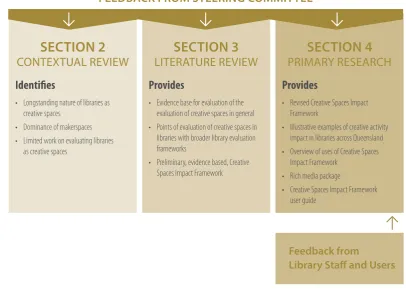
Section 2 is an abridged version of a contextual review of existing practice regarding libraries as creative spaces and their evaluation. It points to the dominance of discussion around makerspaces while acknowledging the longstanding place of libraries as creative spaces and the diversity of practice that currently exists beyond makerspaces. The full version of the contextual review is available online Available at: http://eprints.qut.edu.au/94713/ (see Osborne et. al. 2015).
Section 3 responds to the findings of the contextual review. It draws on a wide-ranging literature review of library evaluations, teasing out elements of these studies that refer to the impacts of creative practice. The review also considers the evaluation of creative spaces more generally. This literature base is used to construct a framework to evaluate libraries as creative spaces. This section details the development process of the Creative Spaces Impact Framework, outlines the finalised framework and documents its potential uses.
In section 4, the results from the desk-based primary research and fieldwork are presented. The desk-based research demonstrates how the framework could be deployed at a macro/state level to highlight the impacts of libraries of creative spaces in communities, and also how this data might facilitate strategic decision making and resource planning. The fieldwork demonstrates the use of the framework in practice; and shows how the framework was refined as further evidence was collected to extend and reshape its detail. A conclusion and recommendations are provided in section 5.
1.6
FEEDBACK FROM STEERING COMMITTEE
SECTION 2
CONTEXTUAL REVIEW
Identifies
• Longstanding nature of libraries as creative spaces
• Dominance of makerspaces • Limited work on evaluating libraries
as creative spaces
SECTION 3
LITERATURE REVIEW
Provides
• Evidence base for evaluation of the evaluation of creative spaces in general • Points of evaluation of creative spaces in
libraries with broader library evaluation frameworks
• Preliminary, evidence based, Creative Spaces Impact Framework
SECTION 4
PRIMARY RESEARCH
Provides
• Revised Creative Spaces Impact Framework
• Illustrative examples of creative activity impact in libraries across Queensland • Overview of uses of Creative Spaces
Impact Framework • Rich media package
• Creative Spaces Impact Framework user guide
[image:10.595.134.541.438.729.2]Feedback from
Library Staff and Users
Public Libraries as Creative Spaces
5
Contextual Review
Evaluating Public Libraries
as Creative Spaces
2
This contextual review provides an overview of thinking and discussion about public libraries as creative spaces. It
includes reference to the types of creative activities that are occurring in the public library context, and an outline of the
rhetoric and reality of the public library as a community space. These are reconsidered in a discussion of the evaluative
frameworks that have been employed by libraries in the past. An extended version of this review is available online
(Osborne et. al. 2015) at http://eprints.qut.edu.au/94713/.
DOMINANT VIEWS OF CREATIVITY IN LIBRARIES: MAKERSPACES
Libraries have a strong history of being creative places. Since the early library in Alexandria in 3rd century BC, libraries have a long association with the development of writing (both fiction and non-fiction) and knowledge (McLeod 2004). As a multidimensional construct where creativity involves persons, processes, products and environment working together to develop successful creative ideas (Runco 2004), libraries provide places that support the development of knowledge. They facilitate the creative incubation of ideas, bringing people together in their traditional roles around book collections through to their more recent evolving role as community hubs (Houghton et al. 2013).
To date, much attention has been paid to the makerspaces as an integral part of creative activity in public libraries. To describe them simply, makerspaces are community centres with tools and materials that allow for creative practice of a variety of purposes to occur. Examples of creative practices in maker spaces include those concerned with arts and crafts, building, computing, engineering, carpentry and design. These spaces can take the form of loosely-organised individuals sharing space and tools, for-profit companies, non-profit corporations, organisations affiliated with or hosted within schools, universities or libraries, and more. All are united in the purpose of providing access to equipment, community, and education, and are variously arranged to fit the purposes of the community they serve. Accordingly, the layout and purpose of a given makerspace may change along with changes in community interest and desire. Nevertheless, it has been argued that the core activities of makerspaces will remain stable over time. As Parham et. al (2014) state, ‘The most significant technology in makerspaces is the ethos of sharing: sharing ideas, sharing skills, sharing materials.’
Boyle et. al. (2014) suggest that the creative activities hosted by public libraries can be as small or as large as funding, sustainability and library space permits. There is not one model of a makerspace that can be held up to scrutiny. The size, content and activity of any creative space is determined by the stakeholders involved, the amount of funding available, the provision of space and tools, and the culture of the community that the library aims to serve. Results from a survey of American libraries reported in Burke (2014) indicate that a wide variety of resources and activities occur in spaces declared to be makerspaces or hacker spaces. Second only to computer workstations as the main technology in libraries, 3D printing is the most popular technology, confirming its role as a prominent symbol of the makerspace movement. Photo and video editing are close behind, followed by computer programming, arts and crafts, photo scanning, website creation and digital music recording. 3D modelling and Arduino/Raspberry Pi electronic circuitry complete the top ten resources available in many makerspaces. Despite this long list of tools, it is accepted that when it comes to makerspaces, bigger is not always best. A trolley of tools and resources in a temporary space can fulfil the aims of the makerspace movement at minimal cost (Boyle et al., 2014).
The presence of makerspaces in public libraries is a recent phenomenon. For instance, The Edge at the State Library of Queensland (SLQ) was established in 2010. The Fayateville Free Library Fab Lab, set up in 2011, was the first of its type in an American public library. The Public Library of Knivsta launched Sweden’s first public library makerspace in 2013; while in the United Kingdom opened St Bodolph’s Waiting Room in 2014. That said, in Australia, a number of makerspaces have been profiled in discussions around libraries as creative spaces:
• Kelly (2013) shows how the Town of Victoria Park Library in Western Australia uses a makerspace to engage the community and improve the Town’s vibrant lifestyle” message.
• Barry (2014) looks at library space, arguing that digital hubs and makerspaces are examples of reinvented library space that facilitates community engagement, knowledge sharing and creative practice.
• Brien and Franks (2012) explore library space and archives more generally, arguing that ‘these institutions function as engine rooms, as well as storehouses, of creativity’.
• Wright (2014) reports on the ongoing development of The Edge at SLQ as an initiative that ‘exemplifies innovation and enterprise and focuses on creation rather than collection, participation instead of preservation and collaboration over curation’.
Public Libraries as Creative Spaces
6
CREATIVE PRACTICE IN LIBRARIES: BEYOND MAKERSPACES
While the State Library of Victoria’s (2014) The Creative Spaces in Public Libraries toolkit directs attention to makerspaces and fab labs, the idea of creative space can, and does, extend well beyond these limits. Public libraries are facilitating creative activity in many ways.
For example, this broader approach to creative activity in libraries is evident in the variety of successful applications for funding in the recent Vision 2017 grant rounds operated by SLQ. To meet the aims of Vision 2017, the grants were designed to position public libraries as places for creative collaboration and learning where ideas can be imagined and new skills acquired through innovative programs and collections. The most recent projects funded through SLQ’s Vision 2017 grant scheme drew applicants from across Queensland and include a steampunk festival for young people, workshops and spaces to encourage small business start-ups, and sensory and new technology play experiences for all ages and abilities. Similar projects were funded in previous rounds, including a digital learning space at Logan (State Library of Queensland 2015). Details of some of the creative practice made possible through this program are detailed in Table 2.
2.2
recent projects funded through SLQ
,
s
Vision 2017 grant scheme drew applicants
from across Queensland and include
a steampunk festival for young people,
workshops and spaces to encourage small
business start ups, and sensory and new
Public Libraries as Creative Spaces
7
ROCKHAMPTON
Steampunk
Rockhampton
An exciting fusion of science, music, fashion, art and invention grounded in history and literature at Rockhampton Regional Libraries. The year-long project targeting young adults (15-25 years) will feature four learning phases to build community capacity in presenting an inaugural Steampunk festival in the Rockhampton region.
BURDEKIN
ideas@108
A centre for growing ideas with a particular focus on small business, start-ups and youth. A multifunctional flexible space for the community as a whole where ideas can grow and take shape.TOOWOOMBA
Finding My Place
This project connects year 10 students to networks, resources and life-long learning through a series of workshops held at local libraries and schools in regional communities. Workshops held during school hours are designed to inform, motivate, foster self-esteem and promote the library as an alternate life-long learning opportunity.MAREEBA
Go Digital
Kuranda
Go Digital Kuranda will establish the enhanced, relocated Kuranda Library as an e-learning hub by providing digital business incubation workshops targeted to Kuranda’s niche tourism and artisan small businesses. By providing expert digital capacity building, Kuranda will be perfectly positioned to support the growth of new start-up digital economies.
COOK
Cooktown
Business
Incubator Hub
Cook Shire Council wants to create a place for start-ups and businesses at the Cooktown Library, delivering workshops to increase business take-ups and business improvement, enhancing small business growth through privacy, education training and business support services.
LOCKYER
Lockyer Valley
Libraries:
make, play and
connect
The make, play and connect project will engage the local community to experience electronics through monthly hands-on workshops using a range of electronic and invention products such as Makey Makey, Ardublock and Boxz Robots. These workshops will provide the community with access to electronic experiences, to which they may not have been previously exposed. These experiences have the capacity to expose residents to the library service through this innovation pathway.
TABLELANDS
Creative Start-ups
Incubator
A program specifically tailored for independent artists and creative entrepreneurs. The program will deliver a series of innovative seminars by successful entrepreneurs and will provide participants with information, essential skills and access to new, online multimedia and print learning materials.
LOGAN
The Sensory
Space: access,
play and learning
for all
The Marsden Library Sensory space will be an inclusive, hands-on environment for children to explore and learn using their senses. A suite of unique programs for families with children with special needs will be provided that utilise the equipment in the sensory space.
GLADSTONE
Library out and
about
A program to extend the library service out to the community where there is no static library building. It will promote literacy, provide learning and technology to the community in interesting ways and use the existing home library vans on the days they are otherwise standing idle.
BARCOO
Library
innovation within
outback isolation
Enhancing the public libraries of the three geographically isolated towns within the Barcoo Shire – Jundah, Windorah and Stonehenge. Enhancing the technological, educational and learning opportunities within the preschool, school, adult community, Indigenous community and tourist population. Creating a learning space to develop the literacy learning development of children within the public library by creating a welcoming space in which to learn, read, research, entertain, relax and enjoy. Celebrating books with free reading sessions. Bridging the gap of technology and geographic isolation to facilitate online learning, encourage upskilling and further education within the local libraries.
TOWNSVILLE
A boot camp for
living
Building a resilient, empowered community through ideas, learning and innovation to overcome high unemployment.
TABLE 2
Public Libraries as Creative Spaces
8
WHAT IS THE EVIDENCE FOR THE IMPACT FRAMEWORKS?
Libraries have been evaluated for more than a hundred years, but only recently have there been concerted efforts to develop frameworks that can qualitatively assess the social impact on individuals and their communities. Few of these approaches concentrate on the benefits of creative spaces. In the creative space toolkit for Victorian librarians, guidance is given on effective evaluation, but the authors concede that it is notoriously difficult to measure benefits and impacts on the community (Boyle et. al. 2014). Berryman (2005) and Rooney-Browne (2011) provide comprehensive summaries of the frameworks used in the evaluation of library services up to 2010, both demonstrating the frequent preference of quantitative over qualitative assessments. Berryman stresses that the ‘indirect and intangible attributes’ of social impact assessment are difficult to assess, are highly contestable, and, therefore, ‘less robustly demonstrated’. Rooney-Browne (2011) concurs, suggesting that the lack of confidence in the measurement of social value results from underdeveloped methodologies in comparison to the economic models that have been around for centuries. Nevertheless, both Berryman (2005) and Rooney-Browne (2011) stress the importance of qualitative data to an understanding of library activities.
Discussion about creative spaces in public libraries has only recently escalated in conjunction with the development of makerspaces, and there are few formal evaluations in the literature that specifically analyse the impact of creative space on library clients and their communities (Sheridan et. al. 2014). The evaluations that exist centre mostly on makerspaces. Whilst there is much value in learning from evaluations of makerspaces, these are ultimately limited by their concentration on specific spaces, activities and demographics within libraries, rather than looking at libraries as a larger architectural and cultural entity within a municipal framework. For example, Bilandzic and Foth (2013) concede that their study of The Edge at SLQ is limited due to ‘the population and potential socio-cultural idiosyncrasies of the case study’.
With this in mind, to obtain the most meaningful data possible for small and large public libraries, the evaluation of creative spaces will need to account for the broader creative activity arrangements that are known to exist beyond those enacted in makerspaces.
2.3
Libraries have been evaluated for more than
a hundred years, but only recently have
Creative Spaces Impact Framework
9
It is important to not only identify libraries
as creative spaces, but to evaluate them
through the diverse range of activities that
are enacted in and with them.
An Evidence Based Creative
Spaces Impact Framework
3
This section describes the development of the Creative Spaces Impact Framework, its contents and a summary of its
suggested uses.
Creative Spaces Impact Framework
10
DEVELOPING THE FRAMEWORK
The Creative Spaces Impact Framework origins lie in an extended literature review. There are two reasons for this. First, the review helped develop an understanding of how creative spaces are evaluated within libraries and beyond. The contextual review and further search of literature identified a lack of library specific frameworks. To better understand what could be included in any framework for libraries, it was necessary to consider broader frameworks and how these might feed into this project. Second, the review sought to interrogate how libraries are currently evaluated in general terms. The initial literature search revealed that elements of evaluating creativity as they relate to libraries were often embedded in more general approaches to library evaluation. In this process, 82 evaluation studies were collated and compared. Of these, 76 of these were library studies, while six provided an analysis of other types of creative spaces. (See Appendix B for the full list studies consulted during this process.) The resulting literature review was then synthesised to produce an initial evidence-based evaluation framework, which was discussed among the steering committee and members of the Libraries as Creative Spaces project team at QUT. The preliminary Creative Spaces Impact Framework incorporated nine criteria:
1. Providing access to information and technology for creative purposes 2. Contributing to idea building
3. Enabling civic engagement 4. Enabling community development 5. Facilitating cultural participation 6. Improving health and wellbeing 7. Improving educational attainment 8. Contributing to economic productivity 9. Generating sustainable practice.
Each criterion had a number of associated impact indicators. For example, enabling civic engagement may have an impact on participation in citizenship, crime reduction/rehabilitation and building trust in government due to the perception of libraries. (See Appendix C for the full list of corresponding impact indicators and literature sources for each.)
This preliminary framework was used to guide the fieldwork and develop the rich media content (including video, photos and digital stories). During this process, the framework was revised further as a result of emerging evidence. The wording of the criteria was changed as a result of the review process to facilitate better understanding. Criterion 1 ‘Providing access to information and technology for creative purposes’ was subject to the most substantive change. This saw a shift in focus from information and technology to accessing resources. It was necessary to go beyond traditional notions of what libraries provide to encompass a broader range of materials such as those for craft and event staging. The impact indicators associated with the criteria were also refined as new impacts were identified. For example, identifying yoga classes as a creative activity provided by libraries extended indicators to include more concrete examples of the possibilities for physical wellbeing.
After a process of review by the project team, project steering committee and participating Queensland libraries, the framework was refined down to eight criteria. A ninth, ‘Generating sustainable practice’, was removed as it was decided that this was more an underlying principle of library practice than a separate criterion. Some elements of this have been incorporated into other criteria such as community development, cultural participation or health and wellbeing. Further impact indicators under each criterion were refined where duplication of concepts had occurred.
Creative Spaces Impact Framework
11
UNDERSTANDING THE FRAMEWORK
3.2
Accessing Re
sources
Idea
Bu
ildin
g
Civ
ic E
nga
gem
ent
Comm
unity
De
velo
pme
nt
Cult
ural
Pa
rtic
ipa
tion
He
alt
h a
nd
W
ell
be
ing
Ed
uc
ati
on
al
At
tai
nm
en
t
Econ
omic
Produ
ctivity
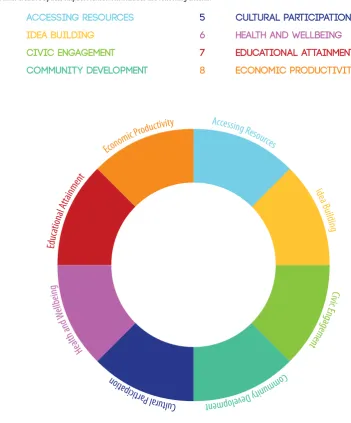
FIGURE 2 The Creative Spaces Impact Framework for Public Libraries
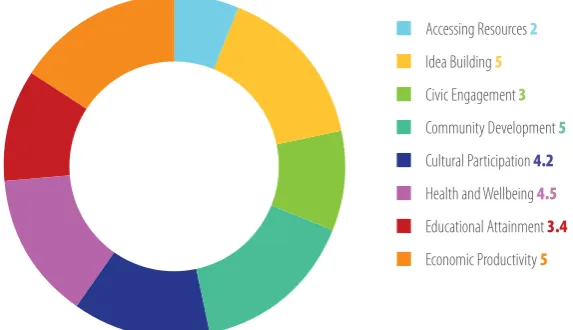
Figure 2 illustrates the eight criteria where communities can benefit from the creative activity associated with libraries. The circle in its continuum supports the nature of the relationship between these elements. Benefits and impacts interrelate and interact. For instance, community development may have a civic engagement flow-on benefit, while educational attainment may have a direct relationship with economic productivity benefits where it leads to new employment or business start-up. The following sections explore each criterion in more detail.
1
Accessing resources
2
Idea building
3
Civic engagement
4
Community development
5
Cultural participation
6
Health and wellbeing
7
Educational attainment
[image:17.595.66.418.248.672.2]1
Libraries have transformed themselves
beyond their traditional roles of
lending and reading to include
activity orientated, flexible spaces.
12
Creative Spaces Impact FrameworkCRITERION 1: ACCESSING RESOURCES
Libraries have transformed themselves beyond their traditional roles of lending and reading to include
activity-orientated, flexible spaces. This criterion considers a range of methods to store, generate and access
resources that might facilitate creativity; arguably a core activity of many libraries today. Impact would be
demonstrated by articulating how these resources enable different forms of creativity and how the library
space facilitates access, enabling it to be thought of as a creative space.
IMPACT INDICATORS
› Affording access to digital technologies - Providing the knowledge of or access to new technologies (e.g. software, services and devices) through courses, onsite access or loans.
› Affording access to creative resources - Providing the knowledge or use of creative resources (e.g. materials and equipment) through courses, onsite access or loans.
› Idea storage/archive - Supporting traditional activity to store and archive information including those generated by and related to creative activity. This includes diverse and evolving range of storage and retrieval including rich digital media.
› Heritage, history and legacy - Accessing local information for heritage, family and local history.
› Access, filter and sort information - Enabling access to information through collections and assistance from library staff. Library clients can access and filter information into what is useful and relevant.
3.3
Example of 3D Printing at Helensvale Library Digital Media Lab (left)
2
Creative Spaces Impact Framework
13
CRITERION 2: IDEA BUILDING
As incubators of ideas, learning and innovation, public libraries offer
places to generate knowledge and exchange ideas outside formal
education. This criterion considers the role of libraries in idea building
as absolutely novel or relatively novel. Impact would be demonstrated
by articulating how different elements of idea building are present in a
given activity, and therefore how a library exists and can be thought of
as a creative space.
IMPACT INDICATORS
› Exposure to ideas - Exposing library clients to previously unknown ideas or concepts through books, computers and a variety of sessions/workshops.
› Development of client curiosity, interests, appreciation - Creating or developing the curiosity of library clients in new ideas or concepts, new ways of doing things or thinking about things, new hobbies and interests.
› Culture of discovery - Developing or encouraging discovery as a way of thinking for library clients and visitors.
› Idea initiation, generation - Supporting creative thinking and development by providing inspiration and initial direction.
› Risk taking and experimenting - Involving both critical thinking and problem solving, and providing a space in which it is safe to ‘have a go’, take a risk and try something new.
› Repertoires of practice - Exposing people to a range of different creative styles, modes, mediums and creative people which increases all participants’ (library clients and creatives) range of methods and repertoires.
3
CRITERION 3: CIVIC ENGAGEMENT
Libraries have long been regarded as places of civic engagement (Burgess 2006; Siddike 2014; Goulding 2009).
Civic engagement implies an interest, knowledge and involvement in civic matters, including but not limited
to discussion and participation. This criterion considers how any given creative practice might afford some
kind of civic engagement.
IMPACT INDICATORS
› Democracy - Providing safe and open access to knowledge and expression, allowing citizens to participate in civic affairs. Providing information and opportunity for intellectual freedom and social justice.
› Participation in citizenship - Enabling involvement or input in local governance activities and participation in civic discussion.
› Crime reduction/rehabilitation - Redirecting negative behaviour or reconnecting potential offenders with their community.
› Institutional trust in government due to perception of libraries - Developing a level of trust within the community for the library and (by extension) the level of government that provide the libraries.
› Development of capacity - Combining groups and sectors (e.g. library and art gallery or library and childcare centre) working together to strengthen each other.
› Societal discussion - Providing a place discuss social issues formally (e.g. through talks and presentations) and informally (e.g. through meetings and conversation).
3.5
Libraries have long
been regarded as
places of civic
engagement. Civic
engagement implies an
interest, knowledge
and involvement in
civic matters.
14
Creative SpaceS Impact Framework4
› Community ownership, strength and identity - Developing a sense of be-longing, connection and involvement with community, social cohesion and collective ownership.
› Cultural diversity and inclusiveness - Facilitating active inclusion for all groups of the community.
› Social capital - Maximising value of who people know, and what can be achieved through these networks (ie when people are more inclined to do things for each other).
› Social interaction and socialising - Providing a place to meet with people (both known and unknown) and an alternative place to hang out and simply ‘be’ – some-where that is not home, work or school – but another place.
› Localised service provision - Meeting specific needs of local community.
› Cooperation, coordination, collaboration, sharing and reciprocity - Working together and interacting, sharing resources, knowledge and time.
› Trust (in community) - Improving the individual’s trust of community.
› Self-organisation - Supporting an activity, group or event that requires minimal or no library staff input.
› Resilience - Developing the ability to cope and regenerate after a setback or change.
Local Art at Roma Library
IMPACT
INDICATORS
Creative Spaces Impact Framework
15
CRITERION 4: COMMUNITY DEVELOPMENT
Creativity in libraries can involve building connections with community, within the community and across
different levels of government. This criterion considers how creative practices associated with libraries might
support community development.
5
CRITERION 5: CULTURAL PARTICIPATION
Cultural participation may include both informal and formal activities within the community, reflecting
quality of life, traditions and beliefs. Cultural participation is inclusive. It includes everyone – from the person
listening to the concert to the person playing music. This criterion considers how libraries as creative places
provide opportunities for many forms of cultural participation.
3.7
Cultural participation is
inclusive. It includes everyone
from the person listening to
the concert to the person
playing music.
IMPACT
INDICATORS
› Audience engagement - Measuring the number of attendees participating in a culturally-based event and their reaction to that event.
› Artist/performer/maker involvement - Assessing the involvement and opportunity of the artist, performer or maker to participate, the value and benefit they receive from the event.
› Sharing of public culture - Providing a means to share and highlight culture that is localised and public.
› Emotional connection and experience - Considering the emotional response or connection to events or activities being conducted.
› Play and leisure - Including a wide range of activities - how time is spent away from business, work, domestic chores and education.
› Celebration - Supporting positive and enjoyable experiences that celebrate local achievement, cultural events and festival.
› Creation and dissemination - Making or producing things and distributing them via a range of means.
6
› Relaxation, entertainment and leisure - Supporting activities that fall outside the context of work or study and provide for relaxation and entertainment.
› Self-expression - Enabling expression of one’s own personality, feelings or ideas through speech, art or other medium.
› Emotional health - Providing access to programs and initiatives with specific benefits around emotional health. The aims of these may target health and wellbeing directly (e.g. art for mindfulness) or indirectly (e.g. a seniors knitting group).
› Physical health - Enabling access to programs and initiatives with specific benefits around physical health. The aims of these may target health and wellbeing directly (e.g. yoga classes) or indirectly (e.g. a local oral history walking tour).
› Access to health information - Sharing health information and resources.
IMPACT
INDICATORS
CRITERION 6: HEALTH AND WELLBEING
Engaging in creative practice contributes positively to how well people feel mentally and physically (Bungay &
Vella-Burrows, 2013; Clift, 2012; Greaves & Farbus, 2006). This criterion considers the impact of library-based
creative practices on health and wellbeing. It is important to note that health and wellbeing does not need to
be the direct aim of the activity.
3.8
7
CRITERION 7: EDUCATIONAL ATTAINMENT
Libraries traditionally support other education institutions and provide means of informal personalised
learning. Creativity as an idea, and creative practices themselves, have educational potential. This criterion
considers what educational opportunities are possible when library clients engage with libraries in creative
activities.
3.9
Creativity as an idea, and
creative practices themselves,
have educational potential.
IMPACT
INDICATORS
• Continuous education, learning opportunities and enrichment - Providing education beyond formalised primary, secondary or tertiary education. Opportunities may be ongoing and life-long; formal and informal; or self-education.
• Literacies - Supporting library clients to be able to interpret and use traditional literature forms and digital technologies.
• Address disadvantage - Providing education and learning opportunities for free or at low cost.
• Provision of alternative education space - Providing a place where people who feel disconnected from formal education can use the library for alternative learning. Allows for play, fun and non-academic outcomes.
• Exposure to different types of jobs and skills - Developing interest in various types of occupations.
Creative Spaces Impact Framework
18
8
› Business innovation - Assisting business in improving their activities or processes.
› Business incubation and mentoring - Supporting business incubation programs and industry talks.
› Employment levels and opportunities/skills - Providing new skills that increase employability through courses, information or practical work experience.
› Networking - Meeting other people for the purpose of business development or some other related economic activity.
› Partnership - Developing partnerships to mutually benefit parties.
› External resource investment (attract visitors) – Including impact on tourism by attracting visitors (local and external) to the area.
› Generate spending - Encouraging or promoting activity which will result in spending.
› Technology equipment support - Offering 3D printing facility, broadband access in rural locations and access to expensive software for small business use.
IMPACT
INDICATORS
CRITERION 8: ECONOMIC PRODUCTIVITY
The
Library Dividend
research report offers detailed evidence for the general economic impacts of libraries
(SGS Economics and Planning Pty Ltd 2014). This criterion considers the contributions that creative activity
in libraries can make to this agenda. This includes direct and indirect economic benefits, bringing people
together or facilitating networks and access to information.
3.10
bringing people
together or
facilitating
networks and
access to
information.
Creative Spaces Impact Framework
20
3.11 USING THE FRAMEWORK
The Creative Spaces Impact Framework is geared towards demonstrating the value of libraries as creative spaces. The
framework also offers potential to generate data for use in advocacy and lobbying for libraries as creative spaces. It will
help library staff to:
1 Identify and generate creative activity by:
• Thinking through what a creative activity might be
• Reconsidering activities currently offered to communities (including those not necessarily thought of as ‘creative’) • Prompting new activities by considering a broader range of creative objectives and outcomes
• Preparing for and delivering creative activities to deliver maximum impact.
2 Identify objectives and outcomes for creative activity by:
• Using the framework to develop objectives and outcomes for creative activity • Articulating the creative impact of an initiative as it is developed, enacted and reported • Securing support and resources (e.g. for grant applications)
• Evaluating activities and planning improvements.
3 Align creative activity with community needs by:
• Building creative library programs that represent the needs of the communities
• Connecting with broader discussions and data about (and help to identify) community needs • Using the framework to identify the kinds of activity that might aid a community with very specific needs • Researching other programs in other areas that have used the framework.
4 Monitor trends and strategic planning by:
• Gathering longitudinal and comparative qualitative and quantitative data regarding the impact of libraries as creative spaces • Helping demonstrate their value as creative spaces
• Assisting in decision making regarding how resources are allocated.
5 Guide exit surveys by:
• Guiding questions for an exit survey of library clients
• Assessing whether they have been involved in creative activity or practice (ranging from formal activity or book borrowing about creative works)
• Drawing comparisons over time and across library services by using common framework questions • Building an overall picture of the impact of libraries as creative spaces.
A staff guide to using the framework can be found at:
Impact of Queensland Libraries
21
It is important to not only identify libraries
as creative spaces, but to evaluate them
through the diverse range of activities that
are enacted in and with them.
4
This section provides an overview of the desk-based primary research and fieldwork data captured across Queensland
libraries during August and September in 2015. It is intended to demonstrate how data can be used to develop an
understanding of creative practice in libraries through the Creative Spaces Impact Framework. This section also includes
case studies from the fieldwork where the initial framework was used to assess creative activities. Evidence gathered in
these cases was used to develop the framework further.
METHODOLOGY:
INTERPRETING CREATIVE ACTIVITY AT STATE LEVEL
A list of activities offered in Queensland libraries throughout August and September 2015 was generated from Council calendars and library webpages. The initial intention was to use library-generated categories to map the creative activity occurring across Queensland during these months. However, our review identified inconsistencies in the categorisation process and the naming of categories (see Appendix D for examples of different descriptive categories applied to library activities in various regions). Therefore, instead, activities were coded according to audience and type of activity in line with the Creative Spaces Impact Framework.
While the Library Statistical Bulletin collects the number of activities occurring in libraries annually, it does not include a breakdown of activities by name or type. The breakdown of activities by type for August and September 2015 offers the first look at this type of data and points to the value of collecting this data over time to benchmark and understand the patterns of Queensland libraries’ creative activity.
Each activity was also coded in terms of its benefits as related to the Creative Spaces Impact Framework. Acknowledging that activities may offer multiple benefits, the data for August and September 2015 was multi-coded to reflect this.
It is necessary to note that the information was sourced online via calendars provided on Council or library websites. If a Council did not enter activities into an online calendar, these will be missing from the data set. Some activities were listed in other ways on the websites and these have been captured and coded as accurately as possible. This data is also based on advertised activities and may not reflect cancelled or rescheduled activities.
4.1
Demonstrating the
Impact of Queensland
Impact of Queensland Libraries
22
FINDINGS - CREATIVE ACTIVITY AUGUST TO SEPTEMBER 2015
The data set comprises 3,214 activities in August and 2,738 in September (5,952 in total). The data was multi-coded
against the framework, with each activity assigned a maximum of four forms of impact. For example, Story Time at
Toowoomba was categorised as educational attainment, community development and cultural participation. The data
set presented here is the complete set of categorised items to give a broad picture across Queensland (rather than
emphasising an activity as primarily being concerned with one form of impact). The data presented here is based on the
sum of all categories.
4.2
DIVERSITY IN IMPACT OF CREATIVE ACTIVITIES ACROSS
QUEENSLAND
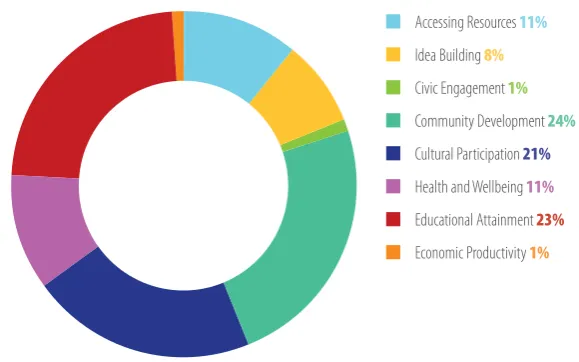
Figure 3: Impact of Creative Activity Across Queensland August/September 2015 shows the proportion of creative activities offered over both August and September based on the framework. Taking our approach to coding, it is possible to show the diversity in creative activity and a general focus around community development, cultural participation and educational attainment. It is also possible to see where impact does not appear to be generated, for example, around economic productivity and civic engagement.
Figure 4: Shifts in Impact of Creative Activity Across Queensland August/September 2015 shows that there is little variation in the proportions of impact between August and September. The largest shift is a drop in educational attainment in September but that is not surprising given this coincides with school holidays in Queensland. Longer term, it would be helpful to note any seasonal shifts in activity; and to establish whether other activities are introduced which bring higher degrees of impact in other areas that seem to be low in our trial. Coding these activities in the future would need to involve the people organising and delivering them to capture the most accurate picture of impact.
4.2.1
Accessing Resources 11% Idea Building 8%
Civic Engagement 1% Community Development 24% Cultural Participation 21%
Health and Wellbeing 11%
Educational Attainment 23%
[image:28.595.176.466.540.721.2]Economic Productivity 1% FIGURE 3
Impact of Queensland Libraries
23
TARGET AUDIENCES OF CREATIVE ACTIVITIES ACROSS
QUEENSLAND
Further coding of the calendar data identified the target audience’s age group. The data on age group was taken from the information provided by libraries in the activity advertising. Of the 5,952 activities, 1,107 did not highlight a target audience and were not included in this data set.
The resulting data was sorted into four categories: programs for participants under 6, under 12, under 16 and those for adults. Again, on the principle of demonstrating the broadest reach of activity, where an activity was advertised as being for groups that crossed categories, then this was multi-coded taking into account the activity description. For example, one activity was targeted at ages 15-25 and therefore it was coded as aimed at those under 16 and adults. Similarly, a Story Time activity was targeted at children, and this was coded as for those under 6 and those under 12.
Taking this broad approach to coding, it can be observed that most creative activity during August/September 2015 was targeted at adults and those under 6 (see Figure 5: Creative Activity Audiences Across Queensland August/September 2015).
4.2.2
27%
40%
18%
15%
Under 6 Under 12 Under 16 Adult
UNDER
6’s UNDER 12’s UNDER 16’s ADULTS
AUGUST
1721
582
561
1366
SEPTEMBER
1065
665
500
526
TOTAL
2786
1247
1061
1892
FIGURE 5 Creative Activity Audiences Across Queensland August/ September 2015 FIGURE 4 Shifts in Impact of Creative Activity Across Queensland August/September 2015 Economic Productivity
Educational Attainment Health and Wellbeing Cultural Participation Community Development
Civic Engagement
Idea Building
Accessing Resources
102
973
1956
2243
103
614
928
69
859
1584
1808
74
721
984
August
September
Impact of Queensland Libraries
24
FIGURE 6 Comparison of Creative Activity Impact – Adults and Children August/September 2015
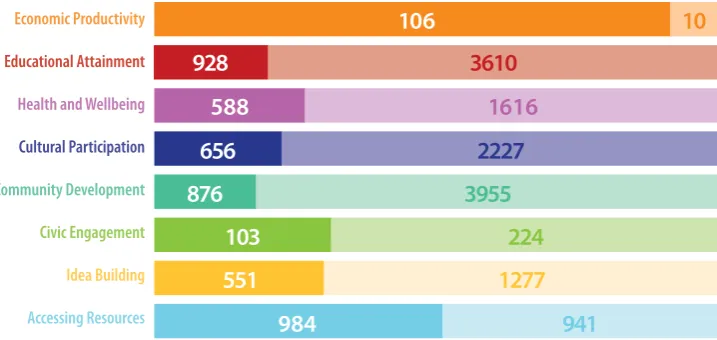
The next step was to combine this audience data with the creative program data for August and September 2015. Figure 6: Comparison of Creative Activity Impact – Adults and Children August/September 2015 shows the relative impacts of creative activity different ages (where children includes all those under 16).
Care is needed when looking at this data as it can be misleading. While adults might be expected to be attached to activities associated with economic productivity (although children are consumers too), this chart must be read as a proportion of activities. While most of the impact in this area is associated with activities targeted at adults, economic productivity was a relatively small feature of impact overall for these two months (as shown in Figure 3).
Furthermore, accessing resources appears to be equally distributed between these two groups, but it is children who are experiencing a higher degree of diversity in their activity.
Economic Productivity
Educational Attainment
Health and Wellbeing Cultural Participation Community Development
Civic Engagement
Idea Building
Accessing Resources