International Journal of Emerging Technology and Advanced Engineering
Website: www.ijetae.com (ISSN 2250-2459, ISO 9001:2008 Certified Journal, Volume 6, Issue 3, March 2016)
220
An Improved Methodology for Power Optimization Using the
Combination of Transparent Interconnection of Lots of Links
and Shortest Path Bridging
M Sivaselvi
1, V Deeban Chakaravarthy
2 1M.Tech Computer Science, Department of Computer Science, SRM University, Chennai, India
2Asst. Professor, Department of Computer Science, SRM University, Chennai, India Abstract---Routing a Sensor device in a wireless sensor
network has become a great challenge in the current technology world. So the upcoming current research is relied on the energy consumption and the lifetime of the Sensor Network. Having these as a base constraints and working further on that part we get an optimized Energy level of the sensor node at the same it gives the better lifetime of that network. Since the network they don’t deal with this in large amount of data, so that the sinking rate would be low and the latency, throughput was not a primary concern that were published work on the sensor networks.so this paper currently dealing with the energy consumption of the sensor network and the lifetime of the sensor node by having as the base of many algorithms. As of many TRILL (Transparent Interconnection of Lots of Links) and SPB (Shortest Path Bridging) are the majorly used algorithm to have an optimized energy level and the life span of the sensor network. The proposed protocol aims to extend the life time of the overall sensor network by avoiding the unbalanced exhaustion of node battery powers as traffic congestion occurs on specific nodes participating in data transfer.
Index Terms – Sensor Networks, TRILL, SPB, Route Request,
Power Optimization.
I. INTRODUCTION
Wireless sensor networks are popularly used to handle critical scenarios where data retrieval time is critical, i.e., delivering an information of each an individual node as fast as possible to the base station. Wireless sensor networks can be always utilized for data gathering and routing tasks due to their dynamic and unique features. The cluster based routing methods are energy efficient focused, scalable and prolong the main feature of network lifetime. So now currently used techniques are particularly explained about the energy consumption and its drawback of the sensor node and how they are balanced in the network without a node failure.
That energy efficient clustering algorithm are based on the TRILL (Transparent Interconnection of Lots of Links) and SPB (Shortest Path Bridging) methodology, this is carried out on the basis of some features they are given below:
TRILL (Transparent Interconnection of Lots of Links)
TRILL has a well-known feature to implement is, it’s a reliable communication.
TRILL is equal-cost when compared to previous protocols or methodologies.
TRILL has a multiple path transmission.
TRILL is mainly used for the tree structures.
TRILL uses the methodology for routing is distribution trees and an Rbridge (forwarding). These are the key features that are seen in TRILL Methodology and that plays a major role in the energy consumption techniques.
SPB (Shortest Path Bridging)
SPB has a key Feature of routing the network in the multiple path in data center.
SPB routes only in the Symmetric way. In Brief way we can say that is it uses a same way to communicate from one point to another point.
SPB has a major feature as loop back as well as route trace.
SPB always creates a shortest distance between the networks based on links among the nodes and then it calculates the traffic (both unicast and multicast) to that concern or relevant path.
These are the key features that are seen in SPB Methodology and that plays a major role in the Shortest path detection in the network.
II. RELATED WORK
2.1 Distributed Clustering in Ad-hoc Sensor Networks:A Hybrid, Energy-efficient Approach
International Journal of Emerging Technology and Advanced Engineering
Website: www.ijetae.com (ISSN 2250-2459, ISO 9001:2008 Certified Journal, Volume 6, Issue 3, March 2016)
This approach can be applied to the design of several types of sensor network protocols that require energy efficiency, scalability, prolonged network lifetime, and load balancing. Only provided a protocol for building a single cluster layer
2.2 Maximizing Networking Lifetime in Wireless Sensor Networks with Regular Topologies
In this paper, author first present how to place SNs by use of a minimal number to maximize the coverage area when the communication radius of the SN is not less than the sensing radius, which results in the application of regular topology to WSNs deployment. Mobile node rotation can extend WSN topology lifetime by more than eight times on average in a is significantly better than existing alternatives. It considers WSNs that are mostly static with a small number of mobile relays not practically declared for Dynamic WSNs.
2.3 Modelling A Three-tier Architecture for Sparse Sensor Networks
This paper deals with mobile data gathering, which employs one or more mobile collectors that are robots or vehicles equipped with powerful transceivers and batteries The performance metrics observed are the data success rate (the fraction of generated data that matches the access points) and the required buffer capacities the sensors and the MULEs. An important issue that is not addressed in this paper i.e. latency.
2.4 Integrated Coverage and Connectivity Configuration for Energy Conservation in Sensor Networks
In this paper author presented the design and analysis of novel protocols that can dynamically configure a network to achieve guaranteed degrees of coverage and connectivity. This work differs from existing connectivity or coverage maintenance protocols in several key ways. Capability of these protocols is to provide guaranteed coverage and connectivity configurations. It is not extending solution to handle more sophisticated coverage models and connectivity configuration and develop adaptive coverage reconfiguration for energy-efficient distributed detection and tracking techniques.
2.5 Call and Response: Experiments in Sampling the Environment
In this paper author have developed an embedded networked sensor architecture that merges sensing and articulation with adaptive algorithms that are responsive to both variabilities in environmental phenomena discovered by the mobile sensors and to discrete events discovered by static sensors.
They also showed relationship among sampling methods, event arrival rate, and sampling performance are presented. Sensing diversity does not introduce which is used to enhance Fidelity Driven Sampling.
III. PROPOSED MODEL
In the proposed model the Rreq is given on the basis of the energy hop by the node element. These are done on the basis of the comparison of the nodes that are present in the network, so the energy level is equally balanced to avoid the node failure in the network, as basic for that we using route discovery using SPB and TRILL on this as a base do discover the shortest path
[image:2.612.328.582.420.609.2]These are the basic algorithm to determine the shortest path route and reach the designation used using the energy as the base node so that it determines the other node energy in the current scenario. In that case TRILL and SPB are the two current algorithm used to determine the shortest path among the network. These are the direct way to explain the proposed method in the model so that it determines the shortest path of the system and that is explained in the diagram on the basis of Rreq method and the receiving system for the proposed model and that is mentioned as the value of the starting node and it follows
Fig 3.1 Block Diagram of Proposed System
IV. MODULE DESCRIPTION Route discovery by RREQ
Energy updating
Calculating hop-by-hop energy
Route selection
International Journal of Emerging Technology and Advanced Engineering
Website: www.ijetae.com (ISSN 2250-2459, ISO 9001:2008 Certified Journal, Volume 6, Issue 3, March 2016)
222
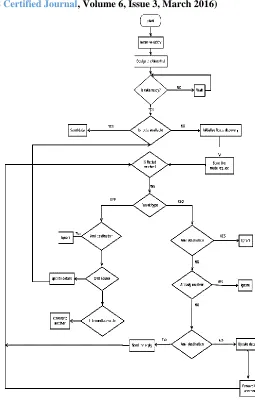
Route Discovery by Rreq
Initially all node will collect the data about neighbor nodes.
The network monitors will always be having the detailed information of neighbor nodes such as routing table. It provides the connection information to Route manager. So this part would give the detailed updating of the routing table
Energy Updating
The mobile devices periodically share their residual energy into all the nodes which are participating in the network. Based on this energy node will select the route in reliable. Having the highest capacity energy level node as the base it starts sharing the resource from one node to another. While sharing them would some of loss energy and that would have tracked with the help of route manager and routing table information.
Calculating Hop-by-hop Energy
When source node sends RREQ, nodes will check the energy of all its one hop neighbor nodes. Then the node selects the next node which one has high energy cost. All the nodes do the same process. Whenever it sees for the energy level it takes only the highest value of the node so that it has more capacity to share the resource from one node top another node.
Route Selection
Finally, Destination node receive the RREQ and also it knows the energy cost of both hop-by-hop also end-to-end communication. After validate these factors destination will send RREP through the high energy path. These are basic transmission of resource that have been taken place between one node and the neighbor node.
Change the Route
[image:3.612.322.577.121.525.2]Nodes will periodically share their energy level continuously. Source will update the energy and compare which route has high residual energy. After comparing residual energy level, source will select different route for data forwarding. It will continue till end of the communication. Whenever a head node is selected it’s all about energy level of the specific node that is going to be a head node.
Fig 4.1 Architecture Diagram of Proposed System
V. SIMULATION RESULT
Simulation is a process of designing a model of a real system and conducting experiments with this model for the purpose of understanding the behavior ofthe system and/or evaluating various strategies for the operation of the system
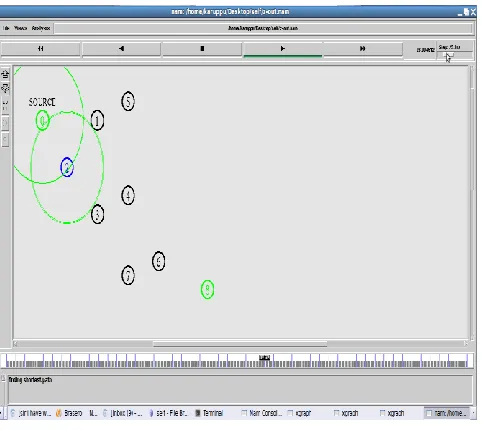
The Simulation output can be showed in two ways
International Journal of Emerging Technology and Advanced Engineering
[image:4.612.50.291.133.348.2]Website: www.ijetae.com (ISSN 2250-2459, ISO 9001:2008 Certified Journal, Volume 6, Issue 3, March 2016)
Fig 5.1 Simulation Result: Network Animator
• Analysis
Trace file: Stores the information of network events (ex., packet sent, received, dropped at the time, node moved from which place to which place…)
[image:4.612.48.302.453.609.2]Xgraph: In this window, we can show the result like as packet delivery radio, packet loss, and delay as graph
Fig 5.2 Simulation Result: Xgraph
VI. CONCULSION
As the expected results of this paper would be the optimized energy optimization of the node and avoid the limitations like node failure and latency in the sensor network, so that it would result in the power efficiency scalability between the networks using the TRILL and SPB methodology.
REFERENCES
[1] F. Boudabdallah, N. Boudabdalah, R. Boutaba, On balancing Energy consumption in Wireless Sensor Networks, IEEE Transactions on Vehicular Technology, vol.58, Issue 6, 2009,2909-2924.
[2] Zhang, Y., Kuhn, L., Fromherz, M., Improvements on Ant Routing for Sensor Networks, Int. Workshop on Ant Colony Optimization and Swarm Intelligence, 2004
[3] M. Dorigo,M. Birattari, and T. Stutzle, Ant Colony optimization,IEEE Computational Intelligence Magazine, vol .1, 2006,28-39.
[4] Rajbhupinder Kaur, Ranjit Singh Dhillon, Harwinder Singh Sohal, Amarpreet Singh Gill, load balancing of ant based algorithm in manet, IEEE,2010
[5] Adeel Akhtar, Abid Ali Minhas, and Sohail Jabbar, ―Energy Aware Intra Cluster Routing for Wireless Sensor Networks‖, International Journal of Hybrid Information Technology Vol.3, No.1, January, 2010
[6] Zijian Wang, Eyuphan Bulut, and Boleslaw K. Szymanski, ―Energy Efficient Collision Aware Multipath Routing for Wireless Sensor Networks‖, International Conference on Communication June 14-18, 2009.
[7] An Energy-Aware Routing Protocol in Wireless Sensor Networks Ming Liu 1, Jiannong Cao 2, Guihai Chen 3 and Xiaomin Wang Sensors 2009.
[8] Lu Su, Changlei Liu, Hui Songand Guohong Cao ―Routing in Intermittently Connected Sensor Networks‖ 2008 IEEE.
[9] K. Akkaya, and M. Younis, "A Survey on Routing Protocols for Wireless Sensor Networks", Elsevier Ad Hoc Network Journal, vol. 3, no. 3, pp 325-349, 2005.
[10] Q. Jiang and D. Manivannan, ―Routing protocols for sensor networks, ‖ Proceedings of CCNC 2004, pp.93-98, Jan. 2004. [11] A.P. Subramanian, A.J. Anto, J. Vasudevan, and P.Narayanasamy,
―Multipath power sensitive routing protocol for mobile ad hoc networks‖, Proc. Conf. Wireless on Demand Network Systems, 2004, LNCS 2928, 2004, pp. 171-183.
[12] Charles E. Perkins, "Ad hoc On-demand Distance Vector (AODV) Routing.", RFC 3561, IETF MANET Working Group, July 2003. [13] T. Senevirathne, A. Banerjee, S. Aldrin, and N. Nimmu, “Multi
Topology Encoding within TRILL Data Frames”, June, 2012. [14] R. Perlman, B. Bhikkaji, B. V. Venkataswami, R. Mahadevan, S.
Sundaram, and N. P. Swamy, “Connecting Disparate TRILL-based Data Center/PBB/Campus sites using BGP”, February, 2013.
[15] H3C 10500 series switches:
http://www.h3c.com/portal/Technical_Support___Documents /Technical_Documents/Switches/H3C_S10500_Series_Switc hes/. 560
[16] STP http://en.wikipedia.org/wiki/Spanning_Tree_Protocol. [17] D. Thaler, and C. Hopps, “Multipath Issues in Unicast and Multicast
Next-Hop Selection”, RFC2991, November 2000.
[18] J. Touch, and R. Perlman, “Transparent Interconnection of Lots of Links (TRILL): Problem and Applicability Statement”, RFC5556, May 2009.
[19] M. Seaman, “Shortest Path Bridging”, 2005.
International Journal of Emerging Technology and Advanced Engineering
Website: www.ijetae.com (ISSN 2250-2459, ISO 9001:2008 Certified Journal, Volume 6, Issue 3, March 2016)
224
[22] VCS: http://www.brocade.com/solutionstechnology/technology/vcs-technology/index.page.
[23] Q-in-Q:
http://www.cisco.com/en/US/docs/ios/lanswitch/configuration /guide/lsw_ieee_802.1q.html.
[24] 802.1ah: http://www.ieee802.org/1/pages/802.1ah.html.