Validity and reliability of 3D marker
based scapular motion analysis : a
systematic review
Lempereur, M, Brochard, S, Leboeuf, FY and RémyNéris, O
http://dx.doi.org/10.1016/j.jbiomech.2014.04.028
Title
Validity and reliability of 3D marker based scapular motion analysis : a
systematic review
Authors
Lempereur, M, Brochard, S, Leboeuf, FY and RémyNéris, O
Type
Article
URL
This version is available at: http://usir.salford.ac.uk/46444/
Published Date
2014
USIR is a digital collection of the research output of the University of Salford. Where copyright
permits, full text material held in the repository is made freely available online and can be read,
downloaded and copied for noncommercial private study or research purposes. Please check the
manuscript for any further copyright restrictions.
Author's Accepted Manuscript
Validity and reliability of 3D marker based
scapular motion analysis: A systematic review
Mathieu Lempereur, Sylvain Brochard, Fabien
Leboeuf, Olivier Rémy-Néris
PII:
S0021-9290(14)00249-8
DOI:
http://dx.doi.org/10.1016/j.jbiomech.2014.04.028
Reference:
BM6629
To appear in:
Journal of Biomechanics
Accepted date: 11 April 2014
Cite this article as: Mathieu Lempereur, Sylvain Brochard, Fabien Leboeuf,
Olivier Rémy-Néris, Validity and reliability of 3D marker based scapular
motion analysis: A systematic review,
Journal of Biomechanics,
http://dx.doi.org/
10.1016/j.jbiomech.2014.04.028
This is a PDF file of an unedited manuscript that has been accepted for
publication. As a service to our customers we are providing this early version of
the manuscript. The manuscript will undergo copyediting, typesetting, and
review of the resulting galley proof before it is published in its final citable form.
Please note that during the production process errors may be discovered which
could affect the content, and all legal disclaimers that apply to the journal
pertain.
Validity and reliability of 3D marker based scapular motion analysis: A systematic
1
review
2 3
Mathieu Lempereura,b,d,*, Sylvain Brocharda,b,d, Fabien Leboeufc, Olivier Rémy-Nérisa,b,d
4 5
a
Laboratoire de Traitement de l’Information Médicale INSERM U1101, Brest, France 6
b
Université de Bretagne Occidentale, Brest, France 7
c
CHU de Nantes, Hôpital St Jacques, service de médecine physique et de réadaptation, 8
Nantes, France 9
d
CHRU de Brest, Hôpital Morvan, service de médecine physique et de réadaptation, Brest, 10
France 11
12 13 14
*
Corresponding author.
15
Address: CHRU de Brest, Hôpital Morvan, service de médecine physique et de réadaptation,
16
5 avenue Foch, 29609 Brest Cedex, France.
17
Telephone number: +33 (0)2-98-22-33-73 extension number 22426
18
Fax number: +33 (0)2-98-22-35-06
19
E-mail address: [email protected]
20
Word count:
21
Abstract
22
Methods based on cutaneous markers are the most popular for the recording of three dimensional 23
scapular motion analysis. Numerous methods have been evaluated, each showing different levels of 24
accuracy and reliability. The aim of this review was to report the metrological properties of 3D 25
scapular kinematic measurements using cutaneous markers and to make recommendations based on 26
metrological evidence. 27
A database search was conducted using relevant keywords and inclusion/exclusion criteria in 5 28
databases. 19 articles were included and assessed using a quality score. Concurrent validity and 29
reliability were analyzed for each method. 30
Six different methods are reported in the literature, each based on different marker locations and post 31
collection computations. The acromion marker cluster (AMC) method coupled with a calibration of 32
the scapula with the arm at rest is the most studied method. Below 90-100° of humeral elevation, this 33
method is accurate to about 5° during arm flexion and 7° during arm abduction compared to palpation 34
(average of the 3 scapular rotation errors). Good to excellent within-session reliability and moderate to 35
excellent between-session reliability have been reported. The AMC method can be improved using 36
Based on current metrological evidence we would recommend (1) the use of an AMC located at the 1
junction of the scapular spine and the acromion, (2) the use of a single calibration at rest if the task 2
does not reach 90° of humeral elevation, (3) the use of a second calibration (at 90° or 120° of humeral 3
elevation), or multiple calibrations above 90° of humeral elevation. 4
5
Keywords
6
Shoulder, accuracy, reliability, validity, scapular kinematics 7
1.Introduction
8
The measurement of shoulder kinematics during movement provides relevant information for the 9
diagnosis and treatment of clinical disorders (Fayad et al., 2008b), rehabilitation techniques (Hanratty 10
et al., 2012), sports performance (Meyer et al., 2008) and injury prevention (Shaheen et al., 2013). 11
Calculation of shoulder joint kinematics using 3D upper-limb motion analysis is usually carried out 12
with the shoulder considered as a virtual thoraco-humeral joint. The scapulo-thoracic (ST) and gleno-13
humeral (GH) joints are not considered individually despite the fact that scapular motion is a vital 14
component of shoulder function. Indeed, during arm elevation in healthy subjects, there is significant 15
motion of the scapula relative to the thorax with a mean 2° decrease in protraction, 39° increase in 16
upward rotation and 21° increase in posterior tilt (Ludewig et al., 2009). Moreover abnormal 3D 17
shoulder kinematic patterns have been found in frozen shoulder (Fayad et al., 2008a), hemiplegia 18
(Meskers et al., 2005), impingement syndrome (McClure et al., 2006), children with cerebral palsy 19
(Brochard et al., 2012) and obstetrical plexus palsy (Duff et al., 2007). This highlights the importance 20
of 3D dynamic analysis to improve understanding of shoulder movement both in the biomechanical 21
field and the clinical environment. Tracking of ST motion allows GH motion to be computed, which 22
provides even more complete information on the dysfunction of the whole shoulder girdle. 23
The main obstacle to performing such a detailed analysis is the difficulty in finding a valid and reliable 24
method to record scapular motion. Among the various techniques available (radiography, magnetic 25
resonance imaging, fluoroscopy, inertial sensor, goniometer, etc.) for the measurement of in vivo 26
Helm and Pronk, 1995; Barnett et al., 1999; Meskers et al., 1999; Karduna et al., 2001; McClure et al., 1
2001; Borstad and Ludewig, 2002; Ebaugh et al., 2005; Ludewig et al., 2009) and optoelectronic 2
methods (Bourne et al., 2007; Lovern et al., 2009; van Andel et al., 2009; Lempereur et al., 2010; Senk 3
and Cheze, 2010; Brochard et al., 2011b; Jaspers et al., 2011a; Shaheen et al., 2011; Lempereur et al., 4
2012) systems) have been the most studied and are the most used techniques for the measurement of 5
scapular motion in the laboratory setting. However, marker based techniques are subject to 6
inaccuracies relating to the placement of markers or soft tissue artefacts (STA) (Leardini et al., 2005). 7
This is particularly true for the tracking of scapular motion: a difference of 87 mm has been found 8
between the position of markers along the medial border of the scapula and the actual position of the 9
scapula with the shoulder in full elevation (Matsui et al., 2006). This may question the validity and 10
reliability of the use of marker based techniques for the recording of scapula motion. In order to 11
standardize the analysis of shoulder kinematics, the International Society of Biomechanics (ISB) has 12
published recommendations for the definition of joint coordinate systems and rotation sequences for 13
the upper limb including the scapula (Wu et al., 2005). Recently, many methods have been described 14
for the estimation of scapular motion such as the acromial method (a sensor is attached directly over 15
the acromion and bony landmarks are digitalized to transform coordinates from the acromial sensor to 16
the scapula coordinate system) (Karduna et al., 2001; van Andel et al., 2009; Brochard et al., 2011b), 17
or the surface mapping approach (estimation of scapular motion using a cluster of markers over the 18
scapula) (Jacq et al., 2008; Mattson et al., 2012). The placement of the sensor over the flat part of the 19
acromion (Shaheen et al., 2011) and the cluster of markers covering the scapula (300 in the study by 20
Mattson et al. (2012) and 120 in the study of Schwartz et al. (2013)) differ according to the methods. 21
The method of computation of scapular motion also varies, such as the Calibrated Anatomical System 22
Technique (CAST) (van Andel et al., 2009), and the double (Brochard et al., 2011a) or multiple 23
(Prinold et al., 2011) calibrations. More complex algorithms can be used to compute scapular motion 24
from marker maps such as the IMCP algorithm (Jacq et al., 2008) which is a robust, simultaneous and 25
multi-object extension of the classic algorithm of registration, Iterative Closest Point (ICP). Moreover, 26
Angulus Inferior (AI)) and the system currently used (AngulusAcromialis (AA) instead of AC) have 1
been found (Ludewig et al., 2010). The current standard interprets the same scapular motion with less 2
internal rotation and upward rotation and more posterior tilt than the original. 3
Despite existing literature on scapular kinematic measurements, a systematic review, pooling existing 4
knowledge in order that a general consensus can be reached, is lacking in literature. 5
Therefore, the aim of this review was to report the existing marker based methods used to estimate 3D 6
scapular movements and their metrological properties (concurrent validity and reliability). Based on 7
this review, recommendations for ST motion analysis tracking and future research are formulated. 8
2.Method
9
A systematic search of the following electronic databases was performed: Pubmed, Web of Science, 10
Cochrane Library, Academic Search Premier and Psych Info. Keywords for the search included (1) 11
Scapula, (2) keywords relative to the concept of accuracy: “accuracy”, “validity”, “agreement”, (3) 12
keywords relative to reliability: “reliability”, “repeatability”, “reproducibility”. Only full papers 13
(original articles, short communications or technical notes) published between 1990 and December 14
2012 were retained. In this paper, validity refers to the general concept of the validity of a measure 15
(including content validity, concurrent/criterion validity and reliability), accuracy refers to the 16
concurrent/criterion validity and reliability refers to the within/between rater/session reliability. 17
The titles and abstracts of articles retrieved from the search were assessed independently by two 18
reviewers (ML and FL). Consensus for inclusion and exclusion was reached by discussion in the case 19
of disagreement. Papers were included if they satisfied the following criteria: (1) the study included 20
human participants, (2) the study evaluated a marker based method for the estimation of 3D scapular 21
motion, (3) concurrent validity and/or reliability were evaluated, (4) full scientific papers. Papers were 22
excluded if they were not published in English or were cadaver studies. The references in the selected 23
articles were screened to complete the review process. 24
All studies included were assessed by two reviewers for their methodological quality. Since no 25
validated quality assessment tool exists for the evaluation of articles in this field, a customized quality 26
of OBservational studies in Epidemiology) (Vandenbroucke et al., 2007) and a systematic review in 1
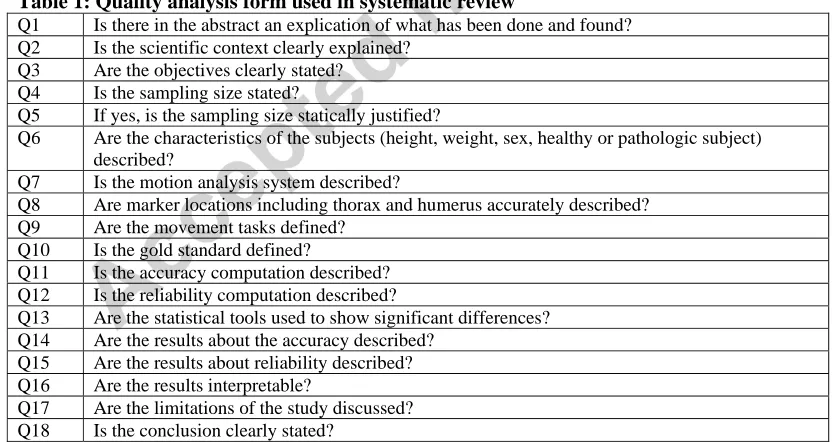
biomechanics (Peters et al., 2010). Table 1 presents the different items. Each item was rated as zero 2
(no description), one (limited description) and two (good description). 3
3.Results
4
3.1.Selection of articles
5
The electronic database search identified a total of 335 papers. 15 articles were included for the title 6
and abstract screening. Screening of references identified another 4 papers. Details of the reviewed 7
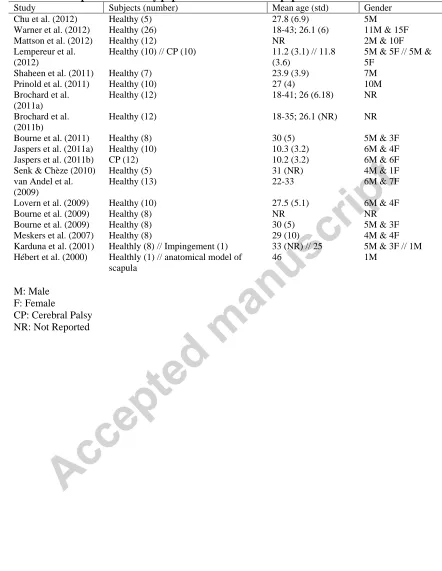
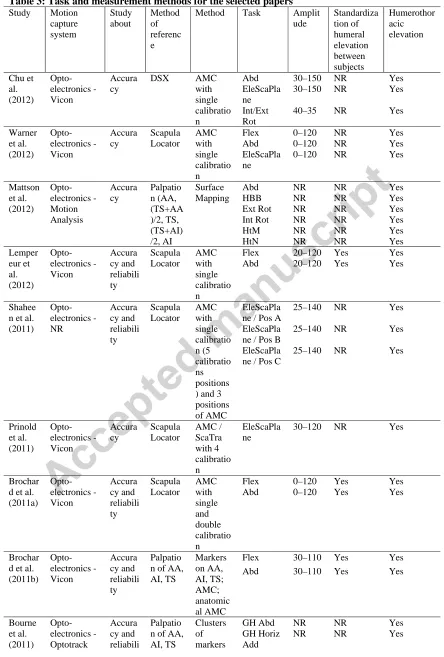
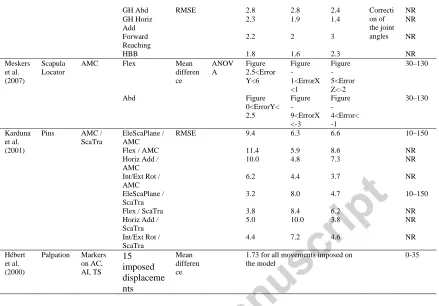
articles are summarized in tables 2, 3, 4 and 5. 8
3.2.Quality of reviewed articles
9
The quality of the reviewed articles is summarized in table 6. 10
Six of the reviewed studies had a quality assessment score above 80% (Hebert et al., 2000; van Andel 11
et al., 2009; Bourne et al., 2011; Brochard et al., 2011a; Lempereur et al., 2012; Warner et al., 2012). 12
Five studies had a quality score between 70% and 80% (Meskers et al., 2007; Bourne et al., 2009; 13
Lempereur et al., 2010; Senk and Cheze, 2010; Chu et al., 2012) and 8 between 60% and 70% 14
(Karduna et al., 2001; Lovern et al., 2009; Brochard et al., 2011b; Prinold et al., 2011; Shaheen et al., 15
2011; Mattson et al., 2012). 16
Most of the articles were of high quality regarding research objectives, the experimental protocol 17
(subject number, motion analysis system, position of markers, movements, definition of a reference 18
method, computation of accuracy), results of concurrent validity, interpretation of the results and the 19
conclusions. Many articles had limited subject characteristic descriptions, evaluation of reliability and 20
results. Limitations of the studies were not always discussed. No study performed sample size 21
calculations. 22
3.3.Population
23
Most of the studies assessed the accuracy of 3D scapular motion in healthy young adult subjects. 24
Lempereur et al. (2012) and Jaspers et al. (2011b; 2011a) also included children with hemiplegic 25
3.4.Motion analysis system
1
The first studies of accuracy used electromagnetic systems which make direct measurements of the 2
orientations and positions of the sensor in 3D space (Karduna et al., 2001; Meskers et al., 2007). 3
Among the selected papers, optoelectronic systems have been the most used systems for the estimation 4
of scapular motion (table 3). 5
3.5.Concurrent validity and reliability
6
3.5.1.Marker placements other than on the acromion 7
Three studies put the markers on the anatomical landmarks of the scapula recommended by the ISB 8
(AA, AI and TS) (Lovern et al., 2009; Lempereur et al., 2010; Brochard et al., 2011b). Bourne et al. 9
(2009) used 6 surface marker configurations on the scapula whereas Mattson et al. (2012) fixed 300 10
markers on the scapula. Lempereur et al. (2010) showed that the use of markers on the scapula 11
produced an error (in comparison with palpation) of up to 15° with increasing humeral elevation 12
Lovern et al. (2009) found an under-estimation of 50° of upward rotation at full arm elevation. 13
However, in both of these studies, a correlation between the skin marker method and palpation 14
(reference method) was performed. Lovern et al. (2009) found a correlation above 0.7 between the 2 15
approaches, suggesting that it may be possible to predict scapula-thoracic upward rotation using skin-16
mounted scapula markers. The model of rotation correction determined by Lempereur et al. (2010) 17
improved the accuracy to less than 4°. However, the proposed models are not valid for all upper limb 18
movements but only for the directions of movement measured in these studies. In the study by Bourne 19
et al. (2011), two surface marker configurations (the six most superior markers and all eight markers 20
of the model) gave the most accurate scapular motion. However, they indicated that the scapular joint 21
angles required correction using a skin correction factor due to the low accuracy of skin markers 22
(Bourne et al., 2009). 23
Two studies assessed the within-session reliability (Lempereur et al., 2010; Brochard et al., 2011b). In 24
both cases, the reliability was excellent (ICC between 0.88 and 0.98 in Lempereur et al. (2010) and 25
ICC between 0.90 and 0.94 in Brochard et al. (2011b)). In the study by Bourne et al. (2011), the 26
between session reliability ranged from 2.6° to 9.1° (RMS differences) showing a good agreement 27
3.5.2.Acromion Marker Cluster and single calibration 1
An alternative method is to position a cluster of markers or an electromagnetic sensor on the flat upper 2
surface of the acromion as first described by Karduna et al. (2001). Table 4 presents the different 3
results of the studies which used an acromion marker cluster. The CAST, with a single calibration and 4
a cluster of markers or an electromagnetic sensor on the acromion, was the most used method to 5
estimate scapular rotations. During upper limb flexion, this method was accurate to 5° (averaged 6
across rotations) except for the studies by Brochard et al. (2011b; 2011a) and Karduna et al. (2001). 7
During upper limb abduction, the accuracy was slightly lower but was above 7°. During elevation in 8
the scapular plane, the method was accurate to 6°, whatever the axis of rotation measured. Despite a 9
low average error in both flexion and abduction, many studies found that accuracy was reduced when 10
the AMC method was used above 90° of arm elevation (Meskers et al., 2007; van Andel et al., 2009; 11
Brochard et al., 2011b; Brochard et al., 2011a; Shaheen et al., 2011). This is a strong limitation when 12
analyzing large amplitude shoulder movements. Above 90° of humeral elevation, the deltoid muscle 13
contraction may create skin movement, increasing soft tissue artifacts although this link has to be 14
proven. The error is generally greater on the Y-axis (protraction) than the other axes. 15
The placement of the AMC on the flat part of the acromion also influences accuracy. Shaheen et al. 16
(2011) showed that Position C (Position A: near the anterior edge, Position B: just above the acromial 17
angle and Position C: the meeting point between the acromion and scapula spine) was the least 18
affected by soft-tissue deformation and therefore the best position for attaching the AMC. 19
The within-session reliability of the AMC method has been more studied than the between-session 20
reliability. A good to excellent within-session reliability has been reported (ICC > 0.90 in Brochard et 21
al. (2011b; 2011a), ICC > 0.80 in Jaspers et al. (2011b; 2011a) and inter-trial mean error < 5.5° in 22
Shaheen et al. (2011) and inter-trial variability < 2.33° in Meskers et al. (2007)). The good level of 23
within-session reliability of ST measurement found in Lempereur et al. (2012) for large ranges of 24
shoulder motion and those found by Jaspers et al. (2011b; 2011a) for within and between-session ST 25
kinematics provides evidence that the level of reliability of the use of an AMC in children with 26
reliability was moderate to excellent (ICC between 0.56 to 0.92) when using the AMC in Brochard et 1
al. (2011a). 2
3.5.3.Acromion Marker Cluster and multiple calibrations 3
The estimation of scapular rotations using the AMC and multiple calibrations was evaluated in 2 4
studies (Brochard et al., 2011a; Prinold et al., 2011). The error between the proposed methods and 5
palpation was estimated between 6.00° and 9.19° with a single calibration versus 2.96° to 4.48° with a 6
double calibration (Brochard et al., 2011a), and between 4° and 7.9° with single calibration versus 1.9° 7
to 2.5° with four calibrations (Prinold et al., 2011). Bourne et al. (2009) also improved the accuracy of 8
scapular tracking using several digitizations of scapula landmarks (Bourne et al., 2011). However, no 9
marker configurations were able to accurately estimate the 3 scapular rotations simultaneously. 10
The between-session reliability of multiple calibrations has been studied only once. It was slightly 11
lower (ICC ranged from 0.49 to 0.78) than for the single calibration, probably because of the two 12
measurements of scapular postures for the double calibration (Brochard et al., 2011a). 13
3.5.4.Scapula Tracker 14
A scapula tracker consists of a base, which is attached to the mid-portion of the scapula spine, and an 15
adjustable arm that positions a footpad onto the meeting point between the acromion process and the 16
scapula spine. Two studies (Karduna et al., 2001; Prinold et al., 2011) used a scapula tracker. They 17
found that it gave an accurate estimation of scapular rotations, particularly in the study by Prinold et 18
al. (2011) (accurate to 3° with a single calibration and to 2° with multiple-calibrations during elevation 19
in the scapular plane). Significant differences were found between the scapula tracker and an acromion 20
marker cluster with a better accuracy with the scapula tracker for upper limb elevation above 100°. 21
Neither within-session nor between-session reliability have currently been assessed for the scapula 22
tracker. 23
3.5.5.Synthesis 24
The AMC or the scapula tracker used with a calibration at rest provides an accurate estimation of ST. 25
Above 90° of thoraco-humeral elevation, the scapula tracker seems to be more accurate, particularly 26
Among the different methods, the AMC is the most used method for the estimation of ST and is a 1
reliable tool to quantify scapular rotations in children and adults (Brochard et al., 2011a; Jaspers et al., 2
2011b; Jaspers et al., 2011a). 3
A single calibration with the arm at rest and the use of an AMC gives a good estimation of scapular 4
rotations with an excellent within-session reliability, as long as thoraco-humeral elevation remains 5
below 90° during the movement (van Andel et al., 2009; Brochard et al., 2011b; Lempereur et al., 6
2012). The association of the AMC with double or multiple calibrations improves accuracy, especially 7
at high degrees of humeral elevation (Brochard et al., 2011a; Prinold et al., 2011). Reliability ranges 8
from good to excellent for within session reliability and from moderate to good for between session 9
reliability (Brochard et al., 2011a). 10
3.5.6.Method of reference 11
The scapula locator was the device most often used to estimate the 'real' position of the scapula. It 12
allows the position of 3 anatomical landmarks (generally AI, AA and TS) to be obtained 13
simultaneously, in contrast with the palpation method (in which the 3 landmarks are palpated one 14
after the other) used in 4 studies. The studies by Karduna et al. (2001) and Bourne et al. (2009) used 15
intra-cortical pins implanted into the scapular spine. More recently, medical imaging such as X-rays 16
combined with a video-based motion analysis have been used to validate data (Chu et al., 2012). 17
3.5.7.Tasks 18
The tasks most used for the estimation of concurrent validity were flexion and abduction of the upper 19
limb, although some studies assessed elevation in the scapular plane (Prinold et al., 2011; Shaheen et 20
al., 2011; Chu et al., 2012; Warner et al., 2012) or shoulder internal/external rotation (Karduna et al., 21
2001; van Andel et al., 2009; Chu et al., 2012; Mattson et al., 2012). To assess reliability, tasks 22
relating to activities of daily living such as hand to mouth, hand to neck or forward reaching were also 23
evaluated (Jaspers et al., 2011b; Jaspers et al., 2011a; Lempereur et al., 2012). 24
3.5.8.Statistical tools and methodology designs 25
The Root Mean Square (RMS) error between the tested method and the method of reference was 26
generally used to quantify errors. In most of the studies, an ANOVA with the independent variables: 27
difference between the method and the reference method. One study used Pearson's correlation 1
coefficient and RMS to evaluate the accuracy. No studies performed sample size calculations. 2
The intra-class coefficient was generally used to assess reliability with the standard error of 3
measurement. 4
4.Discussion
5
Advances in motion analysis systems have made the recording of 3D ST joint motion possible, thus 6
providing a more physiological measurement of shoulder kinematics. This systematic review included 7
19 studies which evaluated the metrological properties of 6 different marker based methods and 8
showed the difficulty of setting one method as a reference for everyday clinical and research practice. 9
The most evaluated method was the AMC with a calibration of the scapula with the arm at rest. Below 10
90-100° of humeral elevation, this method is accurate to 5° for flexion and 7° for abduction compared 11
to palpation and depends highly on the position of the AMC on the acromion process (Shaheen et al., 12
2011), the number of calibrations and the degree of humeral elevation when calibrating (Prinold et al., 13
2011). Other methods using different marker locations or more markers on the scapula blade have 14
been described but they are less accurate than AMC methods and are more relevant for research than 15
clinical use. 16
4.1.Recommendations of the International Society of Biomechanics
17
To facilitate comparison of results between studies of scapular motion, the International Society of 18
Biomechanics recommends the use of AA, AI and TS for the definition of the scapular joint 19
coordinate system and the YXZ Euler sequence for the calculation of joint angles (Wu et al., 2005). 20
This sequence is consistent with both research- and clinical-based two-dimensional representations of 21
scapular motion (Karduna et al., 2000). Indeed, Karduna et al. (2000) found that changing the 22
sequence results in significant alterations in the description of motion, with differences up to 50°. The 23
use of the proposed scapular landmarks (AA, TS and AI) compared to the original ones (AC, TS and 24
AI) reduces the risk of gimbal-lock and results in less internal rotation and upward rotation, and more 25
posterior tilt (Ludewig et al., 2010). The tracking method used is also important when estimating 3D 26
system instead of using skin mounted markers during movement. Lempereur et al. (2010) and Lovern 1
et al. (2009) confirmed that large errors occur when tracking scapular landmarks without a technical 2
coordinate system especially above 90° of humeral elevation. 3
4.2.AMC
4
The association of an AMC and single calibration creates errors of less than 5° for flexion, less than 7° 5
for abduction and less than 6° for elevation in the scapular plane. The AMC has been shown to create 6
small errors up to 90° of humeral elevation in many studies and above this threshold the errors are 7
significantly larger. In specific cases, individual subject differences reach extreme values of 8
approximately 25° (van Andel et al., 2009). Shaheen et al. (2011) advocated the attachment of the 9
AMC at the meeting point between the acromion and the scapular spine since this placement created 10
the smallest errors (below 90° of humeral elevation). 11
No standardized AMC has been developed and therefore, each motion analysis laboratory which 12
carries out measurements of shoulder and scapular motion has created its own. Moreover, there is no 13
consensus regarding the design and dimensions, the diameter of the markers or its weight. We 14
recommend a light AMC with 3 well spaced out markers or electromagnetic receiver, which do not 15
contact the skin during movements, placed at the meeting point between the acromion and the scapular 16
spine. 17
For measurements of upper limb elevation above 90°, the AMC yields good results if the calibration is 18
performed at 90° or 120° (Shaheen et al., 2011). The double or multiple-calibrations reduce errors by 19
at least 50% in comparison to a single calibration and especially, they improve accuracy at high 20
degrees of humeral elevation (Brochard et al., 2011a; Prinold et al., 2011). The limitations of these 21
techniques are the time needed for the calibration and post data processing and the potential errors 22
generated by multiple palpations. Further studies are needed to reach a compromise between the 23
number of calibrations and the level of error. 24
4.3.Validation issues
25
Studies of concurrent validity were generally performed on healthy young adults and on typically 26
athletes with a large muscle mass. The validation is also generally performed during flexion and 1
abduction. However, the validation of the AMC during functional movements such as hand to pocket, 2
hand to head or hand to mouth might generate other results regarding accuracy. 3
The scapula locator is the method generally used to validate the different methods and is considered as 4
'silver standard' (Cutti and Veeger, 2009). Indeed, de Groot (1997) stated that there is a palpation error 5
of about 2° which could increase the risk of validity errors. 6
The gold standard remains intra-cortical pins and has been used, for instance, to evaluate typical 7
scapula-thoracic joint kinematics (Ludewig et al., 2009). Less invasive, the fluoroscopy or dynamic X-8
ray, such as that used in the study of Chu et al. (2012), appears to be an alternative method to evaluate 9
validity. Another limit of the proposed methods is that static positions are compared to dynamic 10
measurements. Cutti and Veeger (2009) suggest that it is important to compare both the quasi-static 11
and the dynamic measurements with a gold standard. However, currently the only invasive technical 12
solution is fluoroscopy which could be a good candidate for a gold standard status. 13
4.4.Reliability
14
Only a few studies performed both validations of accuracy and reliability even though these 15
metrological properties represent different qualities of a measurement (Meskers et al., 2007; van 16
Andel et al., 2009; Lempereur et al., 2010; Bourne et al., 2011; Brochard et al., 2011b; Brochard et al., 17
2011a; Shaheen et al., 2011; Lempereur et al., 2012). Results for reliability show good to excellent 18
within-session reliability whereas the inter-session errors are higher. These differences might be 19
related to palpation inaccuracies, differences in marker placement, lack of control of the plane of arm 20
elevation (Ludewig et al., 2009) or the speed of the movement (Prinold et al., 2013). The knowledge 21
of measurement error magnitude (whatever the accuracy and/or the reliability) is important in clinical 22
decision making. Indeed, clinicians must be able to identify significant deviations from the values of 23
healthy subjects and to differentiate between measurement errors and ‘real’ changes. 24
4.5.Limits and recommendations for future research
25
4 research teams published 10 of the 19 papers included. Since it is known that reliability is very 26
when using the method for the first time. This may also affect the generalization of the results of this 1
review. 2
Only 6 papers had quality scores above 80%. Although we highlighted the main results of the high 3
quality papers we did not exclude low quality papers. One statistical issue which was common to all 4
studies was the lack of sample size calculation. Recommendations exist for power and a priori sample 5
size calculation for reliability studies that could be used in ST measurement validation studies 6
(Eliasziw et al., 1994). Future studies should carry out such calculations in order to produce high 7
quality studies. 8
Most of the validation studies have been carried out in healthy populations and may not be valid in 9
pathological or sports populations. Shoulder bone deformities which occur in some pathologies 10
(arthritis, hemiplegia or obstetrical brachial plexus palsy) or differences in muscle mass may affect the 11
validity of the tracking method. Further validations should be carried out in the specific populations 12
that are targeted by these methods. 13
It is also difficult to compare studies due to the different Euler sequences used for thoraco-humeral 14
elevation (both flexion and abduction), the different levels of maximal humeral elevations and the 15
standardization or not of humeral elevation between subjects, and the placement of the AMC. For 16
validity studies, we recommend the use of the ZXY Euler sequence for the calculation of TH during 17
flexion and the XZY Euler sequence for abduction with a standardization of the humeral elevation 18
angles across subjects by fitting spline functions through the raw data of consecutive trials. 19
Tracking ST joint kinematics based on cutaneous markers remains a challenge and it is highly 20
probable that the most accurate method would be a marker-less approach. However, a 3D dynamic 21
approach has not yet been described. Biplanar fluoroscopy (Zhu et al., 2012) or 3D video cameras 22
(Jacq et al., 2010) may help to produce more accurate recordings. Other static radiological methods 23
(low-dose stereoradiographic imaging (EOS) (EOS imaging, France) (Dubousset et al., 2005), open 24
MRI (Graichen et al., 2000)) might also serve as reference methods to avoid STA or/and to quantify 25
them. Combining static imaging and motion analysis is also a way to explore shoulder motion (Chu et 26
4.6.Recommendations for practice
1
Currently, the marker based approach remains the best compromise for measuring shoulder kinematics 2
based on a two joint model: ST and GH. Based on the results of this review regarding measurement of 3
ST motion we recommend (1): the use of an AMC located at the junction of the spine of the scapula 4
and the acromion, (2) use of a single calibration at rest if the task does not reach 90° of humeral 5
elevation in abduction and flexion, (3) use of a second calibration at 90° or 120° of humeral elevation, 6
multiple calibrations or a scapula tracker for movements above 90° of thoraco-humeral elevation. 7
Others methods may have some research applications such as the estimation of STA. 8
Acknowledgements
9
We sincerely thank Johanna Robertson for her help in revising the English of the article.
10
Conflict of interest
11
None of the authors have any conflicts of interest in conducting the experiment or in
12
preparing this article for publication.
13
References
14
Barnett, N. D., Duncan, R. D. D., Johnson, G. R., 1999. The measurement of three
15
dimensional scapulohumeral kinematics – a study of reliability. Clinical Biomechanics, 14
16
(4), 287-290.
17 18
Borstad, J. D., Ludewig, P. M., 2002. Comparison of scapular kinematics between elevation
19
and lowering of the arm in the scapular plane. Clinical Biomechanics, 17 (9–10), 650-659.
20 21
Bourne, D. A., Choo, A. M. T., Regan, W. D., MacIntyre, D. L., Oxland, T. R., 2007.
Three-22
dimensional rotation of the scapula during functional movements: An in vivo study in healthy
23
volunteers. Journal of Shoulder and Elbow Surgery, 16 (2), 150-162.
24 25
Bourne, D. A., Choo, A. M., Regan, W. D., Macintyre, D. L., Oxland, T. R., 2009. A new
26
subject-specific skin correction factor for three-dimensional kinematic analysis of the scapula.
27
J Biomech Eng, 131 (12), 121009.
28 29
Bourne, D. A., Choo, A. M., Regan, W. D., MacIntyre, D. L., Oxland, T. R., 2011. The
30
Placement of Skin Surface Markers for Non-Invasive Measurement of Scapular Kinematics
31
Affects Accuracy and Reliability. Annals of Biomedical Engineering, 39 (2), 777-785.
Brochard, S., Lempereur, M., Remy-Neris, O., 2011a. Double calibration: an accurate,
1
reliable and easy-to-use method for 3D scapular motion analysis. Journal of Biomechanics, 44
2
(4), 751-754.
3 4
Brochard, S., Lempereur, M., Remy-Neris, O., 2011b. Accuracy and reliability of three
5
methods of recording scapular motion using reflective skin markers. Proc Inst Mech Eng H,
6
225 (1), 100-5.
7 8
Brochard, S., Lempereur, M., Mao, L., Rémy-Néris, O., 2012. The role of the
scapulo-9
thoracic and gleno-humeral joints in upper-limb motion in children with hemiplegic cerebral
10
palsy. Clinical Biomechanics, 27 (7), 652-660.
11 12
Chu, Y., Akins, J., Lovalekar, M., Tashman, S., Lephart, S., Sell, T., 2012. Validation of a
13
video-based motion analysis technique in 3-D dynamic scapular kinematic measurements.
14
Journal of Biomechanics, 45 (14), 2462-2466.
15 16
Cutti, A. G., Veeger, H. E., 2009. Shoulder biomechanics: today's consensus and tomorrow's
17
perspectives. Med Biol Eng Comput, 47 (5), 463-6.
18 19
de Groot, J. H., 1997. The variability of shoulder motions recorded by means of palpation.
20
Clin Biomech (Bristol, Avon), 12 (7-8), 461-472.
21 22
Dubousset, J., Charpak, K., Dorion, I., Skalli, W., Lavaste, F., Deguise, J., Kalifa, G., Ferey,
23
S., 2005. Une nouvelle imagerie ostéo-articulaire basse dose en position debout : le système
24
EOS. Radioprotection, 40 (2), 245-255.
25 26
Duff, S. V., Dayanidhi, S., Kozin, S. H., 2007. Asymmetrical shoulder kinematics in children
27
with brachial plexus birth palsy. Clinical Biomechanics, 22 (6), 630-638.
28 29
Ebaugh, D. D., McClure, P. W., Karduna, A. R., 2005. Three-dimensional scapulothoracic
30
motion during active and passive arm elevation. Clinical Biomechanics, 20 (7), 700-709.
31 32
Eliasziw, M., Young, S. L., Woodbury, M. G., Fryday-Field, K., 1994. Statistical
33
methodology for the concurrent assessment of interrater and intrarater reliability: using
34
goniometric measurements as an example. Phys Ther, 74 (8), 777-88.
35 36
Fayad, F., Roby-Brami, A., Yazbeck, C., Hanneton, S., Lefevre-Colau, M. M., Gautheron, V.,
37
Poiraudeau, S., Revel, M., 2008a. Three-dimensional scapular kinematics and scapulohumeral
38
rhythm in patients with glenohumeral osteoarthritis or frozen shoulder. J Biomech, 41 (2),
39
326-32.
Fayad, F., Roby-Brami, A., Gautheron, V., Lefevre-Colau, M. M., Hanneton, S., Fermanian,
1
J., Poiraudeau, S., Revel, M., 2008b. Relationship of glenohumeral elevation and
3-2
dimensional scapular kinematics with disability in patients with shoulder disorders. Journal of
3
Rehabilitation Medicine, 40 (6), 456-460.
4 5
Graichen, H., Stammberger, T., Bonel, H., Karl-Hans, E., Reiser, M., Eckstein, F., 2000.
6
Glenohumeral translation during active and passive elevation of the shoulder — a 3D
open-7
MRI study. Journal of Biomechanics, 33 (5), 609-613.
8 9
Hanratty, C. E., McVeigh, J. G., Kerr, D. P., Basford, J. R., Finch, M. B., Pendleton, A., Sim,
10
J., 2012. The Effectiveness of Physiotherapy Exercises in Subacromial Impingement
11
Syndrome: A Systematic Review and Meta-Analysis. Seminars in Arthritis and Rheumatism,
12
42 (3), 297-316.
13 14
Hebert, L. J., Moffet, H., McFadyen, B. J., St-Vincent, G., 2000. A method of measuring
15
three-dimensional scapular attitudes using the Optotrak probing system. Clinical
16
Biomechanics, 15 (1), 1-8.
17 18
Jacq, J. J., Cresson, T., Burdin, V., Roux, C., 2008. Performing Accurate Joint Kinematics
19
From 3-D In Vivo Image Sequences Through Consensus-Driven Simultaneous Registration.
20
IEEE Transactions on Biomedical Engineering, 55 (5), 1620-1633.
21 22
Jacq, J. J., Schwartz, C., Burdin, V., Gerard, R., Lefevre, C., Roux, C., Remy-Neris, O., 2010.
23
Building and tracking root shapes. IEEE Trans Biomed Eng, 57 (3), 696-707.
24 25
Jaspers, E., Feys, H., Bruyninckx, H., Harlaar, J., Molenaers, G., Desloovere, K., 2011a.
26
Upper limb kinematics: development and reliability of a clinical protocol for children. Gait &
27
Posture, 33 (2), 279-85.
28 29
Jaspers, E., Feys, H., Bruyninckx, H., Cutti, A., Harlaar, J., Molenaers, G., Desloovere, K.,
30
2011b. The reliability of upper limb kinematics in children with hemiplegic cerebral palsy.
31
Gait & Posture, 33 (4), 568-75.
32 33
Johnson, G. R., Stuart, P. R., Mitchell, S., 1993. A method for the measurement of
three-34
dimensional scapular movement. Clinical Biomechanics, 8 (5), 269-273.
35 36
Karduna, A. R., McClure, P. W., Michener, L. A., 2000. Scapular kinematics: effects of
37
altering the Euler angle sequence of rotations. J Biomech, 33 (9), 1063-8.
38 39
Karduna, A. R., McClure, P. W., Michener, L. A., Sennett, B., 2001. Dynamic measurements
40
of three-dimensional scapular kinematics: a validation study. J Biomech Eng, 123 (2), 184-90.
Leardini, A., Chiari, L., Croce, U. D., Cappozzo, A., 2005. Human movement analysis using
1
stereophotogrammetry: Part 3. Soft tissue artifact assessment and compensation. Gait &
2
Posture, 21 (2), 212-225.
3 4
Lempereur, M., Brochard, S., Burdin, V., Rémy-Néris, O., 2010. Difference between
5
palpation and optoelectronics recording of scapular motion. Computer Methods in
6
Biomechanics and Biomedical Engineering, 13 (1), 49-57.
7 8
Lempereur, M., Brochard, S., Mao, L., Remy-Neris, O., 2012. Validity and reliability of
9
shoulder kinematics in typically developing children and children with hemiplegic cerebral
10
palsy. J Biomech, 45 (11), 2028-34.
11 12
Lovern, B., Stroud, L. A., Evans, R. O., Evans, S. L., Holt, C. A., 2009. Dynamic tracking of
13
the scapula using skin-mounted markers. Proc Inst Mech Eng H, 223 (7), 823-831.
14 15
Ludewig, P. M., Hassett, D. R., Laprade, R. F., Camargo, P. R., Braman, J. P., 2010.
16
Comparison of scapular local coordinate systems. Clin Biomech (Bristol, Avon), 25 (5),
415-17
21.
18 19
Ludewig, P. M., Phadke, V., Braman, J. P., Hassett, D. R., Cieminski, C. J., LaPrade, R. F.,
20
2009. Motion of the shoulder complex during multiplanar humeral elevation. J Bone Joint
21
Surg Am, 91 (2), 378-89.
22 23
Matsui, K., Shimada, K., Andrew, P. D., 2006. Deviation of skin marker from bone target
24
during movement of the scapula. J Orthop Sci, 11 (2), 180-4.
25 26
Mattson, J. M., Russo, S. A., Rose, W. C., Rowley, K. M., Richards, J. G., 2012.
27
Identification of scapular kinematics using surface mapping: A validation study. J Biomech,
28
45 (12), 2176-9.
29 30
McClure, P. W., Michener, L. A., Karduna, A. R., 2006. Shoulder Function and
3-31
Dimensional Scapular Kinematics in People With and Without Shoulder Impingement
32
Syndrome. Physical Therapy, 86 (8), 1075-1090.
33 34
McClure, P. W., Michener, L. A., Sennett, B. J., Karduna, A. R., 2001. Direct 3-dimensional
35
measurement of scapular kinematics during dynamic movements in vivo. J Shoulder Elbow
36
Surg, 10 (3), 269-77.
37 38
Meskers, C. G. M., van de Sande, M. A. J., de Groot, J. H., 2007. Comparison between tripod
39
and skin-fixed recording of scapular motion. Journal of Biomechanics, 40 (4), 941-946.
Meskers, C. G. M., Fraterman, H., van der Helm, F. C. T., Vermeulen, H. M., Rozing, P. M.,
1
1999. Calibration of the “Flock of Birds” electromagnetic tracking device and its application
2
in shoulder motion studies. Journal of Biomechanics, 32 (6), 629-633.
3 4
Meskers, C. G. M., Koppe, P. A., Konijnenbelt, M., Veeger, D. E. J., Janssen, T. W. J., 2005.
5
Kinematic Alterations in the Ipsilateral Shoulder of Patients with Hemiplegia Due to Stroke.
6
American Journal of Physical Medicine & Rehabilitation, 84 (2), 97-105.
7 8
Meyer, K. E., Saether, E. E., Soiney, E. K., Shebeck, M. S., Paddock, K. L., Ludewig, P. M.,
9
2008. Three-dimensional scapular kinematics during the throwing motion. J Appl Biomech,
10
24 (1), 24-34.
11 12
Peters, A., Galna, B., Sangeux, M., Morris, M., Baker, R., 2010. Quantification of soft tissue
13
artifact in lower limb human motion analysis: a systematic review. Gait & Posture, 31 (1),
1-14
8.
15 16
Prinold, J. A., Shaheen, A. F., Bull, A. M., 2011. Skin-fixed scapula trackers: a comparison of
17
two dynamic methods across a range of calibration positions. J Biomech, 44 (10), 2004-2007.
18 19
Prinold, J. A. I., Villette, C. C., Bull, A. M. J., 2013. The influence of extreme speeds on
20
scapula kinematics and the importance of controlling the plane of elevation. Clinical
21
Biomechanics, In press.
22 23
Schwartz, C., Leboeuf, F., Rémy-Néris, O., Brochard, S., Lempereur, M., Burdin, V., 2013.
24
Detection of incoherent joint state due to inaccurate bone motion estimation. Computer
25
Methods in Biomechanics and Biomedical Engineering, 16 (2), 165-174.
26 27
Senk, M., Cheze, L., 2010. A new method for motion capture of the scapula using an
28
optoelectronic tracking device: a feasibility study. Computer Methods in Biomechanics and
29
Biomedical Engineering, 13 (3), 397-401.
30 31
Shaheen, A. F., Alexander, C. M., Bull, A. M. J., 2011. Effects of attachment position and
32
shoulder orientation during calibration on the accuracy of the acromial tracker. Journal of
33
Biomechanics, 44 (7), 1410-1413.
34 35
Shaheen, A. F., Villa, C., Lee, Y.-N., Bull, A. M. J., Alexander, C. M., 2013. Scapular taping
36
alters kinematics in asymptomatic subjects. Journal of Electromyography and Kinesiology, 23
37
(2), 326-333.
38 39
van Andel, C., van Hutten, K., Eversdijk, M., Veeger, D., Harlaar, J., 2009. Recording
40
scapular motion using an acromion marker cluster. Gait & Posture, 29 (1), 123-128.
van der Helm, F. C. T., Pronk, G. M., 1995. Three-dimensional recording and description of
1
motions of shoulder mechanism. Journal of Biomechanical Engineering, 117, 27-40.
2 3
Vandenbroucke, J. P., von Elm, E., Altman, D. G., Gotzsche, P. C., Mulrow, C. D., Pocock,
4
S. J., Poole, C., Schlesselman, J. J., Egger, M., 2007. Strengthening the Reporting of
5
Observational Studies in Epidemiology (STROBE): explanation and elaboration. Ann Intern
6
Med, 147 (8), W163-94.
7 8
Warner, M. B., Chappell, P. H., Stokes, M. J., 2012. Measuring scapular kinematics during
9
arm lowering using the acromion marker cluster. Human Movement Science, 31 (2), 386-396.
10 11
Wu, G., van der Helm, F. C., Veeger, H. E., Makhsous, M., Van Roy, P., Anglin, C., Nagels,
12
J., Karduna, A. R., McQuade, K., Wang, X., Werner, F. W., Buchholz, B., 2005. ISB
13
recommendation on definitions of joint coordinate systems of various joints for the reporting
14
of human joint motion--Part II: shoulder, elbow, wrist and hand. Journal of Biomechanics, 38
15
(5), 981-992.
16 17
Zhu, Z. L., Massimini, D. F., Wang, G. Z., Warner, J. J. P., Li, G. A., 2012. The accuracy and
18
repeatability of an automatic 2D-3D fluoroscopic image-model registration technique for
19
determining shoulder joint kinematics. Medical Engineering & Physics, 34 (9), 1303-1309.
[image:21.612.84.502.403.624.2]20 21 22
Table 1: Quality analysis form used in systematic review 23
Q1 Is there in the abstract an explication of what has been done and found?
Q2 Is the scientific context clearly explained?
Q3 Are the objectives clearly stated?
Q4 Is the sampling size stated?
Q5 If yes, is the sampling size statically justified?
Q6 Are the characteristics of the subjects (height, weight, sex, healthy or pathologic subject)
described?
Q7 Is the motion analysis system described?
Q8 Are marker locations including thorax and humerus accurately described?
Q9 Are the movement tasks defined?
Q10 Is the gold standard defined?
Q11 Is the accuracy computation described?
Q12 Is the reliability computation described?
Q13 Are the statistical tools used to show significant differences?
Q14 Are the results about the accuracy described?
Q15 Are the results about reliability described?
Q16 Are the results interpretable?
Q17 Are the limitations of the study discussed?
Q18 Is the conclusion clearly stated?
24
0 (no description), 1 (limited description) and 2 (good description)
Table 2: Description of the study population for the selected papers 1
Study Subjects (number) Mean age (std) Gender
Chu et al. (2012) Healthy (5) 27.8 (6.9) 5M
Warner et al. (2012) Healthy (26) 18-43; 26.1 (6) 11M & 15F
Mattson et al. (2012) Healthy (12) NR 2M & 10F
Lempereur et al. (2012)
Healthy (10) // CP (10) 11.2 (3.1) // 11.8
(3.6)
5M & 5F // 5M & 5F
Shaheen et al. (2011) Healthy (7) 23.9 (3.9) 7M
Prinold et al. (2011) Healthy (10) 27 (4) 10M
Brochard et al. (2011a)
Healthy (12) 18-41; 26 (6.18) NR
Brochard et al. (2011b)
Healthy (12) 18-35; 26.1 (NR) NR
Bourne et al. (2011) Healthy (8) 30 (5) 5M & 3F
Jaspers et al. (2011a) Healthy (10) 10.3 (3.2) 6M & 4F
Jaspers et al. (2011b) CP (12) 10.2 (3.2) 6M & 6F
Senk & Chèze (2010) Healthy (5) 31 (NR) 4M & 1F
van Andel et al. (2009)
Healthy (13) 22-33 6M & 7F
Lovern et al. (2009) Healthy (10) 27.5 (5.1) 6M & 4F
Bourne et al. (2009) Healthy (8) NR NR
Bourne et al. (2009) Healthy (8) 30 (5) 5M & 3F
Meskers et al. (2007) Healthy (8) 29 (10) 4M & 4F
Karduna et al. (2001) Healthly (8) // Impingement (1) 33 (NR) // 25 5M & 3F // 1M
Hébert et al. (2000) Healthly (1) // anatomical model of
scapula
46 1M
2
M: Male 3
F: Female 4
CP: Cerebral Palsy 5
NR: Not Reported 6
Table 3: Task and measurement methods for the selected papers 1 Study Motion capture system Study about Method of referenc e
Method Task Amplit
ude Standardiza tion of humeral elevation between subjects Humerothor acic elevation Chu et al. (2012) Opto-electronics - Vicon Accura cy DSX AMC with single calibratio n
Abd 30–150 NR Yes
EleScaPla ne
30–150 NR Yes
Int/Ext Rot
40–35 NR Yes
Warner et al. (2012) Opto-electronics - Vicon Accura cy Scapula Locator AMC with single calibratio n
Flex 0–120 NR Yes
Abd 0–120 NR Yes
EleScaPla ne
0–120 NR Yes
Mattson et al. (2012) Opto-electronics - Motion Analysis Accura cy Palpatio n (AA, (TS+AA )/2, TS, (TS+AI) /2, AI Surface Mapping
Abd NR NR Yes
HBB NR NR Yes
Ext Rot NR NR Yes
Int Rot NR NR Yes
HtM NR NR Yes
HtN NR NR Yes
Lemper eur et al. (2012) Opto-electronics - Vicon Accura cy and reliabili ty Scapula Locator AMC with single calibratio n
Flex 20–120 Yes Yes
Abd 20–120 Yes Yes
Shahee n et al. (2011) Opto-electronics - NR Accura cy and reliabili ty Scapula Locator AMC with single calibratio n (5 calibratio ns positions ) and 3 positions of AMC
EleScaPla ne / Pos A
25–140 NR Yes
EleScaPla ne / Pos B
25–140 NR Yes
EleScaPla ne / Pos C
25–140 NR Yes
Prinold et al. (2011) Opto-electronics - Vicon Accura cy Scapula Locator AMC / ScaTra with 4 calibratio n EleScaPla ne
30–120 NR Yes
Brochar d et al. (2011a) Opto-electronics - Vicon Accura cy and reliabili ty Scapula Locator AMC with single and double calibratio n
Flex 0–120 Yes Yes
Abd 0–120 Yes Yes
Brochar d et al. (2011b) Opto-electronics - Vicon Accura cy and reliabili ty Palpatio n of AA, AI, TS Markers on AA, AI, TS; AMC; anatomic al AMC
Flex 30–110 Yes Yes
Abd 30–110 Yes Yes
ty on scapula
Forward Reaching
NR NR Yes
HBB NR NR Yes
Jaspers et al. (2011a) Opto-electronics - Vicon Reliabil ity -- AMC with single calibratio n 3 reach tasks
NR NR NR
2 reach to grasp tasks
NR NR NR
3 gross motor tasks
NR NR NR
Jaspers et al. (2011b) Opto-electronics - Vicon Reliabil ity -- AMC with single calibratio n 3 reach tasks
NR NR NR
2 reach to grasp tasks
NR NR NR
3 gross motor tasks
NR NR NR
Senk & Chèze (2010) Opto-electronics - Motion Analysis Accura cy Palpatio n of AA, AI, TS Local optimisat ion procedur e built from AC, AA and (TS+AA) /2 and recalculat ion of TS and AI
Flex 90–180 NR NR
Abd 90–180 NR NR
Horizontal Flexion
0–90 NR NR
Lemper eur et al. (2010) Opto-electronics - Vicon Accura cy and reliabili ty Palpatio n AA, AI, TS Markers on AA, AI, TS
Flexion 0–160 NR NR
van Andel et al. (2009) Opto-electronics - Optotrack Accura cy and reliabili ty Scapula Locator
AMC Flex 20–100 Yes Yes
Abd 20–100 Yes Yes
Int/Ext Rot
60–90 Yes Yes
Lovern et al. (2009) Opto-electronics - Qualisys Accura cy Scapula Locator Markers on AA, AI, TS
Flex NR NR Yes
Abd NR NR Yes
Bourne et al. (2009) Opto-electronics - Optotrack Accura cy Pins Clusters of markers on scapula and palpation of AA, AI, TS
GH Abd NR NR Yes
GH Horiz Add
NR NR Yes
Forward Reaching
NR NR Yes
HBB NR NR Yes
Mesker s et al. (2007)
Electromagn etics - Flock of birds Accura cy and reliabili ty Scapula Locator
AMC Flex 30–130 Yes Yes
Abd 30–130 Yes Yes
Kardun a et al. (2001) Electromagn etics - Polhemus Accura cy
Pins AMC /
ScaTra
EleScaPla ne
10–150 NR Yes
Flex NR NR Yes
Horiz Add NR NR Yes
Rot Hébert
et al. (2000)
Opto-electronics - Optotrack
Accura cy and reliabili ty
Palpatio n
Markers on AC, AI, TS
15 imposed displacem ents
0-35 No No
1
AMC: Acromion Marker Cluster, SCaTra: Scapula Tracker 2
AA: Angulus Acromialis, AI: Angulus Inferior, TS: Trigonum Spinae, AC: Most dorsal point on the 3
acromioclavicular joint 4
Flex: Flexion, Abd: Abduction, EleScaPlane : Elevation in the Scapular Plane, HBB: Hand Behind 5
Back, Ext Rot: External Rotation, Int Rot: Internal Rotation, HtM: Hand to Mouth, HtN: Hand to 6
Neck, GH Abd: GlenoHumeral Abduction, GH Horiz Add: GlenoHumeral Horizontal Adduction. 7
Table 4: Results of the accuracy for the selected papers 1
Study Method of
reference
Method Movement Accurac y method
Statisti cal tool
Error Remark Amplitu
de
Y X Z
Chu et al. (2012) DSX AMC with single calibratio n
Abd RMSE 3.7 4.6 5.3 30–150
EleScaPlane 6.2 4.5 7.0 30–150
Int/Ext Rot 5.9 14.2 6.7 40–35
Warner et al. (2012) Scapula Locator AMC with single calibratio n Flex RMSE, mean differen ce, limits of agreeme nt ANOV A
3.5 4.3 4.7 RMSE
max
0–120
Abd 4.4 4.8 5.9 0–120
EleScaPlane 4.0 6.1 7.3 0–120
Mattson et al. (2012) Palpation (AA, (TS+AA) /2, TS, (TS+AI)/ 2, AI Surface Mapping Abd RMSE, mean error ANOV A
3.5 4.6* 3.5 p<0.1 NR
HBB 2.3 3.2* *5.0 NR
Ext Rot 5.1* 4.2 4.7* NR
Int Rot 5.3* 3.9 4.1 NR
HtM 5.1* 4.2 3.2 NR
HtN 4.2* 5.9* 2.9 NR
Lemper eur et al. (2012) Scapula Locator AMC with single calibratio n
Flex RMSE ANOV A
3.40 5.23* 4.47 p<0.05 20–120
Abd 7.69* 4.92 6.26 20–120
Shaheen et al. (2011) Scapula Locator AMC with 5 calibratio ns (0°, 30°, 60°, 90° and 120°) and 3 positions of the acromial cluster (Pos A: near the anterior edge, Pos B: just above the acromial angle, Pos C: meeting point between the acromion and scapula spine) EleScaPlane / Pos A / Calibration 1 to 5
RMSE Figure Figure Figure 25–140
EleScaPlane / Pos B / Calibration 1 to 5
Figure Figure Figure 25–140
EleScaPlane / Pos C / Calibration 1 to 5
Figure Figure Figure 25–140
Prinold et al. (2011) Scapula Locator AMC / ScaTra with 4 calibratio n (30°, 60°, 90°, 120°, multi) EleScaPlane / AMC / 30°
RMSE 7.8 4 7 30–120
EleScaPlane / AMC / 60°
6.7 3.7 7 30–120
EleScaPlane / AMC / 90°
5.9 3.2 6 30–120
EleScaPlane / AMC / 120°
6.1 4.8 5.9 30–120
EleScaPlane / AMC / multi
2.2 1.9 2.5 30–120
EleScaPlane / ScaTra / 30°
3.8 4.8 3.8 30–120
EleScaPlane / ScaTra / 60°
3.4 3 3.1 30–120
EleScaPlane / ScaTra / 90°
2.6 2.8 2.5 30–120
EleScaPlane / ScaTra / 120°
EleScaPlane / ScaTra / multi
1.8 1.7 1.6 30–120
Brochar d et al. (2011a) Scapula Locator AMC with single and double calibratio n
Flex / AMC / single calibration
RMSE ANOV A
6.87 6.03* 8.92* 0–120
Abd / AMC / single calibration
6.42* 6.00* 9.19* 0–120
Flex / AMC / double calibration
4.48* 3.59 2.96 0–120
Abd / AMC / double calibration
3.74 3.24 3.43 0–120
Brochar d et al. (2011b) Palpation of AA, AI, TS Markers on AA, AI, TS; AMC; anatomica l AMC Flex / Markers on AA, AI, TS
RMSE ANOV A
4.94* 6.65* 6.06* 30–110
Abd / Markers on AA, AI, TS
1.55 7.85* 6.80*
Flex / AMC 9.33* 4.47 2.14
Abd / AMC 8.87* 3.51 8.79* 30–110
Flex / anatomical AMC
11.05* 3.52 2.4
Abd / anatomical AMC
2.46 8.65* 2.21
Bourne et al. (2011) Palpation of AA, AI, TS 6 clusters of markers on scapula
GH Abd RMSE Figure NR
GH Horiz Add NR Forward Reaching NR
HBB NR
Senk & Chèze (2010) Palpation of AA, AI, TS Local optimisati on procedure built from AC, AA and (TS+AA)/ 2 and recalculat ion of TS and AI
Flex RMSE 9.7 8.3 10.3 Mean of
RMSE from 90° to 150°
90–180
Abd 5.4 7.5 7.8 90–180
Horizontal Flexion
5.0 7.7 7.6 0–90
Lemper eur et al. (2010) Palpation AA, AI, TS Markers on AA, AI, TS Flexion Maxima l differen ce ANOV A
14.86* 14.21* 16.16* 0–160
Flexion 1.74 3.98 2.75 Correcti
on model van Andel et al. (2009) Scapula Locator
AMC Flex Mean
differen ce ANOV A Figure ErrorY<6* Figure ErrorX<3 Figure ErrorZ< 5 Mean differen ce 20–100 Abd Figure ErrorY<4 Figure ErrorX<6 * Figure ErrorZ< 5 20–100
Int/Ext Rot Figure ErrorY<8. 4 Figure ErrorX<4 Figure ErrorZ< 6 60–90 Lovern et al. (2009) Scapula Locator Markers on AA, AI, TS
Flex NR
Abd NR
Bourne et al. (2009) Pins Clusters of markers on scapula and
GH Abd RMSE 9.5 7.5 9.7
Un-correcti on of the joint angles NR GH Horiz Add
7 6.4 4.8 NR
Forward Reaching
6 4.2 5.1 NR
GH Abd RMSE 2.8 2.8 2.4 Correcti on of the joint angles
NR GH Horiz
Add
2.3 1.9 1.4 NR
Forward Reaching
2.2 2 3 NR
HBB 1.8 1.6 2.3 NR
Meskers et al. (2007)
Scapula Locator
AMC Flex Mean
differen ce
[image:28.612.88.527.61.367.2]ANOV A
Figure 2.5<Error Y<6
Figure -1<ErrorX <1
Figure -5<Error Z<-2
30–130
Abd Figure 0<ErrorY<
2.5
Figure -9<ErrorX <-3
Figure -4<Error< -1
30–130
Karduna et al. (2001)
Pins AMC / ScaTra
EleScaPlane / AMC
RMSE 9.4 6.3 6.6 10–150
Flex / AMC 11.4 5.9 8.6 NR
Horiz Add / AMC
10.0 4.8 7.3 NR
Int/Ext Rot / AMC
6.2 4.4 3.7 NR
EleScaPlane / ScaTra
3.2 8.0 4.7 10–150
Flex / ScaTra 3.8 8.4 6.2 NR
Horiz Add / ScaTra
5.0 10.0 3.8 NR
Int/Ext Rot / ScaTra
4.4 7.2 4.6 NR
Hébert et al. (2000)
Palpation Markers on AC, AI, TS
15 imposed displaceme nts
Mean differen ce
1.73 for all movements imposed on the model
0-35
1
AMC: Acromion Marker Cluster, SCaTra: Scapula Tracker 2
AA: Angulus Acromialis, AI: Angulus Inferior, TS: Trigonum Spinae, AC: Most dorsal point on the 3
acromioclavicular joint 4
Flex: Flexion, Abd: Abduction, EleScaPlane : Elevation in the Scapular Plane, HBB: Hand Behind 5
Back, Ext Rot: External Rotation, Int Rot: Internal Rotation, HtM: Hand to Mouth, HtN: Hand to 6
Neck, GH Abd: GlenoHumeral Abduction, GH Horiz Add: GlenoHumeral Horizontal Adduction. 7
RMSE: Root Mean Square Error 8
ANOVA: ANalysis of VAriance 9
Table 5: Results of the reliability for the selected papers 1 Study Method of reference Number of trials Reliability coefficient Within-Session Between-Session Lempereur et al. (2012)
Scapula Locator
3 CMC SEM
Excellent for the TH joint Good for the ST joint
Good to excellent for the GH joint SEM inferior to 7°
Shaheen et al. (2011)
Scapula Locator
3 Inter trial
mean error
Inter-trial error inferior to 5.5° on average, much smaller than the calculated errors using the acromial tracker
Brochard et al. (2011a)
Scapula Locator
3 ICC Simple Calibration: good to excellent
(0.75-0.96)
Double Calibration: good to excellent (0.63-0.92)
SC: moderate to excellent (0.56-0.92)
DC: moderate to good (0.49-0.78) Brochard et
al. (2011b)
Scapula Locator
3 ICC Flex / Markers on AA, AI, TS : Y (0.94),
X (0.93), Z (0.94)
Abd / Markers on AA, AI, TS: Y (0.90), X (0.93), Z (0.92)
Flex / AMC: Y (0.93), X (0.94), Z (0.94) Abd / AMC: Y (0.93), X (0.94), Z (0.91) Flex / anatomical AMC: Y (0.90), X (0.89), Z (0.91)
Abd / anatomical AMC: Y (0.94), X (0.92), Z (0.91)
Bourne et al. (2011) Palpation AA, TS and AI 10 Day1 and Day2 ICC RMS 2.6°<RMS<8.1° Jaspers et al. (2011a)
-- 6 ICC SEM CMC
Moderately high to very high (ICC>0.6) SEM < 5°
ICC > 0.6 SEM < 7°
Jaspers et al. (2011b)
-- 6 ICC SEM CMC
ICC > 0.7 SEM < 5°
ICC > 0.6 SEM < 5°
Lempereur et al. (2010)
Palpation AA, TS and AI
10 ICC Good to excellent reliability 0.88 to 0.98
Van Andel et al. (2009)
Scapula Locator Day 1 and Day2 ICC SEM
Acceptable to good for protraction and external rotation.
ICC low for tilt. Maximal SEM of 8.4°. Meskers et
al. (2007)
Scapula Locator
RMSE 2.33° 5.0°
Hebert et al. (2000)
Palpation 2 Day1
and Day2
Coefficient of
variation
< 10% for most of flexion and abduction task
CMC: coefficient of multiple correlations, SEM: Standard Error of Measurement, ICC: Intraclass 2
Correlation Coefficient, RMSE: Root Mean Square Error 3
4
AMC: Acromion Marker Cluster 5
6
AA: Angulus Acromialis, AI: Angulus Inferior, TS: Trigonum Spinae 7
8
Table 6: Methodological quality of the selected papers
1
Study Q
1 Q
2 Q
3 Q 4
Q 5
Q 6
Q 7
Q 8
Q 9
Q1 0
Q1 1
Q1 2
Q1 3
Q1 4
Q1 5
Q1 6
Q1 7
Q1 8
Total (Max=3
6) Chu et al.
(2012) 2 2 2 2 0 2 2 2 2 2 2 0 2 1 0 2 1 2 28
Warner et
al. (2012) 2 2 2 2 0 2 2 2 2 2 2 0 2 2 0 2 2 2 30
Mattson et al. (2012)
2 0 2 2 0 1 2 2 2 1 2 0 2 1 0 2 2 2 25
Lempere ur et al. (2012)
2 2 2 2 0 2 2 1 2 2 2 2 2 2 0 2 0 2 29
Shaheen et al. (2011)
2 2 2 2 0 1 0 2 2 2 2 0 2 2 0 2 2 0 25
Prinold et
al. (2011) 2 2 2 2 0 1 2 1 2 2 2 0 2 1 0 2 0 2 25
Brochard et al. (2011a)
2 2 2 2 0 2 2 2 2 2 2 2 2 1 2 1 1 2 31
Brochard et al. (2011b)
0 2 2 2 0 2 2 2 2 2 2 0 2 2 0 2 0 0 24
Bourne et
al. (2011) 2 2 2 2 0 2 2 2 2 2 2 2 2 2 2 2 1 2 33
Jaspers et al. (2011a)
2 2 2 2 0 1 2 1 2 0 0 2 0 0 2 2 2 2 24
Jaspers et al. (2011b)
2 2 2 2 0 1 2 1 2 0 0 2 0 0 2 2 2 2 24
Senk & Chèze (2010)
2 2 2 2 0 1 2 2 2 2 2 0 0 2 0 2 1 2 26
Lempere ur et al. (2010)
2 2 2 2 0 2 2 2 2 1 0 0 2 1 1 1 2 2 26
van Andel et al. (2009)
2 2 2 2 0 0 2 2 2 2 0 2 2 2 2 2 2 2 30
Lovern et
al. (2009) 2 2 2 2 0 0 2 2 2 2 0 0 0 2 0 2 1 2 23
Bourne et
al. (2009) 2 2 2 2 0 0 2 2 2 2 2 0 0 2 0 2 2 2 26
Meskers et al. (2007)
2 1 2 2 0 0 2 2 2 2 1 2 2 2 1 2 1 1 27
Karduna et al. (2001)
1 2 2 2 0 0 2 2 2 2 2 0 0 2 0 2 2 1 24
Hébert et
al. (2000) 2 2 2 2 0 1 2 2 2 0 2 2 2 2 2 2 1 2 30