Enhancing Information Quality through Building Information Modelling
Implementation within UK Structural Engineering Organisations
Mehdi Bavafa
School of the Built Environment College of Science and Technology
University of Salford, Salford, UK
Submitted in Partial Fulfilment of the Requirements of the Degree of Doctor of Philosophy, Jun 2015
i
TABLE OF CONTENTS
Table of contents ... i
Abreviations ... ix
Acknowledgement ... x
Dedication ... xi
Declaration ... xii
Abstract ... xiii
CHAPTER 1. Introduction ... 1
1.1 Research Background ... 1
1.2 Problem Statement ... 3
1.3 Research Rational ... 4
1.4 Research Aim and objectives ... 6
1.5 Research Scope ... 7
1.6 Research Approach ... 8
1.7 Report Structure ... 11
CHAPTER 2. Review of Information Management in Structural Engineering Sector ... 13
2.1 Introduction to Structural Engineering Industry ... 13
2.1.1 Structural Engineering Design Process ... 14
2.1.2 Structural Engineering Information System ... 17
2.1.3 Structural Engineering Information Modelling ... 21
2.1.4 Structural Engineering Entities ... 22
2.2 Key Information Management Challenges in Structural Engineering ... 25
2.2.1 Information Quality Management... 32
2.2.2 Information Accuracy ... 36
2.2.3 Information Interoperability... 38
2.2.4 Impacts of Business Workflow and Organisational Culture on Structural Information Management ... 40
2.3 Chapter Summary ... 42
CHAPTER 3. Contribution of BIM to Structural Information Management ... 43
ii
3.2 Technological aspects of BIM... 46
3.2.1 BIM Visualisation Tier ... 47
3.2.2 BIM File Open Standards Tier ... 51
3.2.3 BIM Semantic Tier ... 55
3.2.4 BIM Software Tier ... 61
3.3 BIM-based Workflows ... 64
3.3.1 BS1192 Standard ... 66
3.3.2 PAS1192-2 ... 68
3.3.3 Information Delivery Manual (ISO29481) ... 71
3.4 Human Resource readiness for implementing BIM ... 74
3.5 Initial Conceptual Framework ... 77
3.6 Chapter Summary ... 80
CHAPTER 4. Research Methodology ... 81
4.1 Philosophical Paradigm ... 82
4.1.1 Epistemology ... 82
4.1.2 Ontology ... 82
4.1.3 Axiology ... 83
4.1.4 Philosophical Paradigm Justifications ... 83
4.2 Research Stages ... 84
4.3 Research Method ... 85
4.3.1 Research method justification ... 87
4.4 Research Approach ... 88
4.5 Research Strategy ... 89
4.5.1 Research Strategy Justification ... 91
4.5.2 Case Study Design ... 92
4.6 Qualitative Data Collection and Sampling ... 97
iii
4.7 Quantitative Data Measurement and Analysis ... 99
4.7.1 Sampling Strategy ... 99
4.7.2 Quantitative Data Analysis Techniques ... 101
4.7.3 Descriptive Statistics ... 102
4.7.4 Parametric Techniques ... 103
4.7.5 Reliability and Validity ... 112
4.8 Ethical Consideration ... 113
4.9 Chapter Summary ... 114
CHAPTER 5. Qualitative Data collection and Analysis ... 115
5.1 Case 1- Qualitative Data Analysis ... 115
5.1.1 Case1 Description ... 116
5.1.2 Information Management Challenges in Case 1 ... 117
5.1.3 BIM Adoption in Case 1 ... 123
5.1.4 Human Resource Readiness and BIM Adoption in Case 1 ... 138
5.1.5 Case1- Findings and discussion ... 142
5.2 Case 2- Qualitative Data Analysis ... 144
5.2.1 Case 2 Description ... 145
5.2.2 Information Management Challenges in Case2 ... 146
5.2.3 BIM Adoption in the Case 2 ... 154
5.2.4 Case 2- Findings and discussion ... 172
5.3 Chapter Summary ... 174
CHAPTER 6. Quantitative Data Collection and analysis ... 175
6.1 Demographics of survey sample ... 175
6.2 Information Challenges in the UK Structural Engineering Sector ... 181
6.3 BIM Adoption in Structural Organisation in the UK ... 185
6.4 Factor Analysis ... 191
6.5 Multiple Regression Analysis ... 203
iv
6.5.2 Interpretation of Multiple Regression Output ... 209
6.5.3 Evaluating Multiple Regression Model ... 219
6.5.4 Checking Reliability of the Data... 221
6.6 Chapter Summary ... 222
CHAPTER 7. Conceptual Framework Development and Research Discussions ... 224
7.1 Information Management Challenges in the UK Structural Engineering Sector .... 224
7.2 BIM Adoption in the UK Structural Engineering Sector ... 228
7.2.1 BIM Technology Adoption ... 228
7.2.2 BIM Workflow Adoption ... 235
7.2.3 Human Resources Readiness ... 239
7.3 Proposing Conceptual Framework ... 241
7.4 Conceptual Framework Refinements and Validation ... 247
7.5 Recommendations for Using Proposed Conceptual framework ... 249
7.6 Chapter Summary ... 251
CHAPTER 8. Conclusion ... 253
8.1 Contribution to Knowledge ... 260
8.2 Research Limitations ... 261
8.3 Future Research ... 261
References ... 263
Appendix A – Interview Invitation Letter ... 282
Apendix B – Participant Consent Form ... 283
Appendix C - semi-Structured interview Questions ... 285
Apendix D – Questionnaire Invitation Letter ... 287
Appendix E – Questionnaire Questions ... 289
Apendix F – Ethical Approval ... 301
v
LIST OF FIGURES
Figure 1-1 Research Approach Design ... 10
Figure 2-1 the sub-stages of structural engineering design (Sacks et al., 2000) ... 14
Figure 2-2 Structural Engineering Processes Information System Management (by author) . 18 Figure 2-3 Point-based design b) Set-based design from Bavafa et al (2012)... 19
Figure 2-4 Set-based Structural Engineering information Management System (by author) . 20 Figure 2-5 Stage of the action cycle (Lopez et al., 2010) ... 22
Figure 2-6 Three-tier model for collaborative structural design (Bilek and Hartmann, 2006) 24 Figure 2-7 Information quality impact on information lifecycle in Structural Engineering .... 34
Figure 2-8 Information Access Dimensions ... 35
Figure 2-9 Knowledge availability in structural engineering processes (Caviers et al., 2011)36 Figure 2-10Sheffield building collapse blamed on digger (BBC, 2013) ... 37
Figure 2-11 Information challenges in structural engineering enterprise (by author) ... 41
Figure 3-1 Advantages of BIM (Yan and Damian, 2010) ... 44
Figure 3-2 Structural Zones 3D Visualisation (Tekla, 2014) ... 49
Figure 3-3 Ranking the most important features of a simulation tool (Attia et al., 2012) ... 50
Figure 3-4 Semantic web tower (Berners-Lee et al., 2001) ... 56
Figure 3-5 Example of semantic links of RDF data (Pan, 2006) ... 57
Figure 3-6 Conceptualisation of concept from author ... 58
Figure 3-7 Higher level concepts of taxonomy (El-Diraby et al., 2005) ... 60
Figure 3-8 BIM Maturity Levels (BIS, 2011) ... 65
Figure 3-9 Building Smart’s Standard Protocols (BuildingSmart, 2013) ... 65
Figure 3-10 BS1192 Framework for construction information management ... 67
Figure 3-11 PASS 1192-2 Information Delivery Cycle Framework (BSI, 2013) ... 68
Figure 3-12 Principal Components of IDM (Karlshoj, 2011)... 72
Figure 3-13 Exchange requirements in structural engineering process based on IDM concept ... 73
Figure 3-14 Initial Conceptual Framework... 78
Figure 4-1 the research onion ... 81
Figure 4-2 Philosophical Stance of This Research ... 84
Figure 4-3 Wheel of science ... 88
vi Figure 4-5 Positive and negative correlation between dependent and independent variables
... 104
Figure 4-6 Graphic interpretation of regression line (Fink, 2003) ... 107
Figure 5-1 Themes of Case1 from NVivo ... 115
Figure 5-2 Themes of Case2 from NVivo ... 144
Figure 6-1 Participants Experience Percentage ... 177
Figure 6-2 Participants Roles in Organisations ... 178
Figure 6-3 Participants’ Types of Organsiations ... 179
Figure 6-4 participants’ size of organisations ... 180
Figure 6-5 Most Critical Information management challenges ... 184
Figure 6-6 BIM Technological Tools Utilisation Bar Chart ... 188
Figure 6-7 Information Management Standard Utilisation in the Sample ... 189
Figure 6-8 Scree Plot- Component Number ... 195
Figure 6-9 Components, independents variables and dependent variables ... 205
Figure 6-10 Plot of Information Quality Satisfaction ... 208
Figure 6-11 Histogram of Information Quality Satisfaction... 209
Figure 6-12 Normal P-P Plots Probability and Scatter Plots ... 220
Figure 7-1 Colour Coding in Conceptual Framework ... 243
Figure 7-2Conceptual Framework ... 246
vii
LIST OF TABLES
Table 2-1 RIBA Plan of Work ... 15
Table 2-2 Information management challenges in AEC industry ... 27
Table 3-1 SWOT analysis of BIM for precast concrete engineering (Kaner et al., 2008) ... 45
Table 3-2 Structural IFC entity from (Eastman, 2007) ... 52
Table 3-3 Structural analysis and design applications and their exchange capabilities ... 62
Table 3-4 EIRs contents (BSI, 2013) ... 69
Table 3-5 Desired student learning outcome for college BIM education (Wu and Issa, 2014b) ... 76
Table 4-1 features of qualitative and quantitative methods (Amaratunga et al., 2002) ... 86
Table 4-2 Research questions and Unit of Analysis ... 93
Table 4-3 Demography of interview participants ... 95
Table 4-4 Correlation table in SPSS ... 109
Table 5-1 Information Management Challenges in Case1 ... 122
Table 5-2 Technological BIM adoption in case1 ... 136
Table 5-3 Human Resources readiness BIM adoption in case1 ... 140
Table 5-4 Information management challenges in case 2 ... 154
Table 5-5 Technological BIM adoption in case 2 ... 162
Table 5-6 BIM workflows adoption in case 2 ... 165
Table 5-7 Human resources readiness BIM adoption in case 2 ... 170
Table 6-1 Most Critical Information management challeneges ... 183
Table 6-2 BIM Technologies tools utilisation weighted scores in questionnaire sample... 187
Table 6-3 KMO and Bartlett’s Test ... 191
Table 6-4 Total Variance Explained ... 192
Table 6-5 Component Matrix... 196
Table 6-6 Total Variance Explained- Rotation of Three-factor Solution ... 199
Table 6-7 Pattern Matrix ... 200
Table 6-8 Results of Skewness and Kurtosis parameters ... 206
Table 6-9 Results of Kolmogorov-Smirnov Statistics ... 207
Table 6-10 Correlation Matrix ... 211
Table 6-11 Regression Model for Information Accessibility ... 215
Table 6-12 Regression Model for Information Security ... 216
ix
ABREVIATIONS
AEC Architectural Engineering Construction BIM Building Information Modelling
CIS2 Product Data Standards for Structural Steel
COBie Construction Operations Building Information Exchange
DTD Document Type Definition
FTP File Transfer Protocol
HTML Hyper Text Mark-up Language
HVAC Heating Ventilation and Air Conditioning IAI International Alliance Interoperability ICT Information Communication Technologies
IFC Industry Foundation Classes
IMMC1 Information management map in Case 1 ISO International Standards Organization
MIS Management Information System
RDF Resource Description Framework
RIBA POW Royal Institute of British Architects Plan of Work SGML Standard Generalized Mark-up Language
STPE Standard for the Exchange of Product Model Data
SWR Semantic Web Rule
TPS Transaction Processing System
URIs Uniform Resources Identifier
WOL Web Ontology language
x
ACKNOWLEDGEMENT
First and foremost I would like to thank God. In the process of carrying out this PhD thesis you given me the power to believe in my passion and pursue my dreams. I could never have done this without the faith I have in you, the Almighty.
I would like to express my gratitude to my parents, who supported me to participate in the PhD programme and this thesis could not be complete without their kind help.
I particularly want to thank my supervisor, Dr. Zeeshan Aziz, who provided important guidance over the whole dissertation process.
I would like to acknowledge Professor Arto Kivinimi to support my research in the first year of my PhD programme as my supervisor. I would also like to acknowledge Professor Vian Ahmed, for making helpful suggestions.
Special thanks to the interview participants and questionnaire survey respondents for spending their valuable time. Without their support I would not have completed the PhD as expected.
xi
DEDICATION
“I dedicate this piece of research to my dearest father Hossein and dearest mother Farah for
xii
DECLARATION
This thesis is submitted under the University of Salford rules and regulations for the award of a PhD degree by research. While the research was in progress, some research findings were published in refereed journals and conference papers prior to this submission (refer to Appendix D). The researcher declares that no portion of the work referred to in this thesis has been submitted in support of an application for another degree of qualification of this, or any other university or institution of learning.
xiii
ABSTRACT
Information management has been identified as an essential requirement for the structural engineering sector in a highly competitive AEC marketplace. In the field of structural engineering, information management represents a challenging discipline due to several factors such as a lack of clarity in the adoption of novel technologies, the multitude of different and ambiguous standards available, and the lack of human resources readiness. This research demonstrates that information quality plays a very important role in structural engineering information management as poor quality of structural engineering design information leads to reworks and failures in tendering and construction of projects. 80% to 90% of failures in buildings, bridges and other structures result from errors in design. Novel technologies and workflows have to be adopted by structural engineering organisations, which also need to improve the readiness of their human resources to enhance information management during conceptual, detailed and technical design phases. It is but natural for project teams in structural engineering organisations to expect proper quality of information during the bidding procedure, while providing documents for constructors and also while reporting to clients to make assured accurate decisions. A review of relevant literature revealed that Building Information Modelling has a contributory role in addressing the challenges of information management in various disciplines of the AEC industry. However, to ensure effective contribution of BIM on structural engineering information management, a clear determination is needed to improve information quality. Therefore, the aim of this research is to develop a conceptual framework for the adoption of BIM to enhance the quality of information in structural engineering organisations of the UK.
xiv organisations in the UK. In the context of quantitative data collection, 125 respondents replied to the researcher within two months. Finally, both qualitative and quantitative data were analysed and conceptual framework was developed and validated.
1
CHAPTER 1.
INTRODUCTION
1.1Research Background
Contributing 7% of the Gross Domestic Product (GDP) and incurring an annual expenditure of £11bn per annum (Cabinet Office, 2011), the construction sector is a major player in the UK economy. Interventions in this sector will thus, have a great impact on the national economy. Review of recent literature and construction industry reports suggests that the construction industry is marred by numerous problems including construction projects being over-budgeted and falling behind schedule. This has been attributed to less than adequate quality of information available to project participants (Latham, 1994, Egan, 2002, Tang, 2001, Bassioni, 2004).
AEC (Architectural Engineering Construction) industry is characterised as an information and knowledge intensive industry (Rezgui, 2001). Many researchers like (Anumba et al., 2004, Yeomans et al., 2006, Shen et al., 2013) have stressed that the AEC industry has a multidisciplinary nature which is coupled with the need to provide all relevant stakeholders with an opportunity to efficiently communicate their knowledge and experience with other project participants. It has been pointed out that the productivity of the AEC project management’s decision making process depends to a large extent on the quality of the information (Havelka and Rajkumar, 2006, Lee and Yu, 2012). Information management has also been identified as a significant prerequisite for survival in a competitive AEC marketplace (Construction2025, 2013). The complexity of the industry coupled with the involvement of multidisciplinary teams and heterogeneous information systems have made information management a challenging task in the AEC industry (Chassiakos and Sakellaropoulos, 2008). The AEC industry requires explicit storage and exchange of project information because of the geographically distributed nature of construction work and the involvement of a wide range of multi-disciplinary professionals that creates a variety of communication and co-ordination challenges within a project.
2 of ambiguous standards and boundaries brought on by organisational culture have a negative impact on effective information management in the AEC industry (Arnold and Javemick-Will, 2013). Thus there is a great need and intent to contribute to AEC information management by suggesting a comprehensive strategic approach that would cover all technologies, processes and organisational issues.
Defined as a main part of the construction design process, structural engineering utilises information, knowledge and experiences for analysing force-resistance, designing building or other structures, and document preparation of structures (CASE, 2010). Several researchers from past to present have tried to address collaborative distributed communication between the structural engineering sector and other disciplines of the construction project team. Mostly technological solutions have been suggested by these researchers to address collaboration issues in the structural engineering sector. For example, an intelligent agent system has been suggested by Anumba et al. (2002) for improving asynchronous communication between the structural agent and other project teams. Chen et al. (2005) emphasised on shared open information in a web server that can contribute towards collaboration design between structural engineers and architects. Although, several initiatives have been taken to improve different aspects of information management between structural engineering and other disciplines, there is still a need to find solutions for different aspects of structural engineering information management.
3 resistance to adopt BIM among UK AEC sectors due to a lack of readiness of organisations to implement BIM (Khosrowshahi and Arayici, 2012). This thesis is being presented with an intention to gather a deep understanding of BIM implementation in the structural engineering sector and to address information management challenges faced by this sector by providing clear cut guidelines for the adoption of BIM to manage information and also to enhance the levels of both information and business service quality.
1.2Problem Statement
In this research, it is argued that information management challenges can be considered under the broad context of information quality. Information quality plays a very critical role in determining the outcome in the structural engineering business, as poor information leads to poor drawings and poor reports either in the bidding phase or the construction phase (Westin and Sein, 2013). Several dimensions of information quality in organisations have been identified in the literature review (Marshal, 2004, Gorla et al., 2010) however, the dimensions for benchmarking the quality of information depend on the use of the information in different organisations. Therefore in the context of structural engineering, there is a great need to identify the key dimensions of information quality and key success factors to achieve high quality of information.
The quality of information either fed into the system or generated by the system determines both accuracy and quality of the output product. It can thus be considered that the characteristics of information in organisations are dependent upon the information quality. Thus, information quality is a target that determines the characteristics of information in organisations. In this research, information management strategies are developed so that the target of information quality may be met.
Poor quality of structural design information causes financial costs and structure failure in the construction industry
4 poor reports either in the bidding phase or the construction phase (Westin and Sein, 2013). Therefore, a reduction in rework and failures in the construction process may be achieved through improving the quality of information in the structural engineering discipline, particularly in pre-construction and during construction works.
It has been pointed out that structural engineering organisations are one of the major producers of information in the conceptual and detailed design phase (Institution of Structural Engineers, 2014). In this regard, it is worth mentioning that structural engineers have been recognised as being quick to adopt advanced numerical software solutions for their analysis and design processes, however, their applications and procedures are isolated from multi-disciplinary building information management (Wyatt, 2012). In order to survive in the continually changing and fragile global market competition, structural engineers in the UK need to change their traditional methods of information management. Project teams in structural engineering organisations rely on quality of information during the bidding process, to make accurate decisions
Extensive research related to the challenges associated with information management in the AEC sector in developed countries has contributed to a better understanding of the subject. Most of the literature have emphasised upon the requirement for capable collaboration (Anumba et al., 2004, Peansupap and Walker, 2005a, Yeomans et al., 2006, Shen et al., 2013, Xue et al., 2010), distributed information access (Rezgui et al., 2010, Gorla et al., 2010, Zlatanova et al., 2012, Rob et al., 2012) and inefficient adoption of new information technology,(Peansupap and Walker, 2005a, Peansupap and Walker, 2005b, Sheriff, 2011). However, a review of the existing body of knowledge predicted that deep consideration has not been given to investigating the challenges faced by the structural engineering profession, especially in the UK. The limited literature available on information management in the structural engineering sector recognises inefficient information technology support system, inaccurate features of structural documents (Sacks and Barak, 2007, Mora et al., 2008) and lack of control on design document (Aagaard and Pedersen, 2013) as major challenges.
1.3Research Rational
Impact of BIM on Structural Engineering Professionals needs clear determination:
5 Meng et al., 2014). The main issue facing the structural engineering discipline is the requirement of being able to function closely and in coordination with the client and other disciplines. This entails that the structural engineering discipline stays up to date with information of materials, loads and geometry in order to identify specific solutions for designing durable, stable, sustainable and economic buildings (Arup, 2015). BIM potentially can contribute to the structural engineering profession by improving their technical modelling advantages, enhancing communication with other disciplines, accelerate design changes which are modified by architects or other disciplines and deliver final reports and drawings to the client and contractors. In this context, recent literature abounds with reports of efforts to develop a framework for BIM to achieve maximum benefits from BIM adoption and implementation. It has been pointed out that BIM has the potential to contribute in assisting structural engineers to create consistent information, collaborative design models within integrated applications and achieve more predictable outcomes (Odeh, 2012). There are numbers of frameworks and road maps for BIM implementation in literature review. For instance, Cerovsek (2011) developed a BIM framework which is presented in IDEF diagram and shows procedures from making 3D models towards publishing 5D models by adopting integrated tools. Porwal and Hewage (2013) developed a collaborative BIM framework for Canadian public construction process. All above mentioned BIM frameworks, present multi-disciplinary collaboration during entire building lifecycle and during the part of lifecycle. Recently published BIM frameworks could show stakeholders a general roadmap to generate and retrieve information during each project phases. Therefore, studies for investigating frameworks for BIM adoption in the structural engineering sector detailing the impact of BIM on information quality in the structural engineering domain are very rare.
Lack of awareness of Perceptions of Structural Engineering Professionals in UK:
6 nature of work schedule of structural engineers is significantly different from other AEC enterprises therefore, a study to obtain the perceptions of this industry is necessary.
The UK government is introducing new digital workflows such as Common Data Environment, PAS 1192:2. The impact of these workflows on structural engineering professionals is not evident from existing literature. Although these standards have been adopted by architectural practices, enough attempts have not been made to capture the structural engineering perceptions of existing challenges in managing information and how available BIM dimensions have contributed to address those challenges. This research asserted that there is a serious requirement for a framework to guide decision makers in the field of structural engineering on how to prepare for the adoption of BIM in order to ensure improvement of information quality which is crucial to ensure accurate results in the AEC industry. Formulating a BIM adoption framework by considering literature and current cases in the UK, provides an understanding for decision makers in structural engineering industry to identify specific opportunities among BIM which can be employed to improve their quality of information. Based on the discussions in previous sections, the following aim, objectives and research questions are identified.
1.4Research Aim and objectives
This research aim is to develop a conceptual framework for the adoption of BIM to enhance the quality of information in structural engineering organisations of the UK.
Key research objectives include:
To develop a comprehensive understanding of key challenges in structural engineering information management within UK;
To critically analyse role of BIM to enhance structural engineering information management;
To examine the relationship between identified key challenges within structural information management and BIM technologies, workflows and human readiness dimensions;
7 Key research questions include:
1- What are the key challenges in structural engineering information management within UK?
2- How BIM is implemented in UK-based structural engineering organisations currently? 3- How can BIM contribute to key information management challenges in the UK-based
structural engineering organisations?
1.5 Research Scope
The geographical scope of this research is limited to UK. The UK government announced strong intention to uptake BIM on its projects by 2016. Therefore, structural engineering firms as one of the main partner in design information producing in AEC industry require preparing their selves to work in collaborative BIM-based environment with other disciplines. Additionally there are many structural engineering and construction companies based in the UK, these are leaders in implementing BIM and collaborative design and construction tools and processes. Consequently, it provides this opportunity for this research to investigate their challenges in information management context, requirements and their interpretations of BIM contributions to information management challenges.
The focus of this research is on information management in the UK structural engineering sector with the intent of enhancing the level of information quality. Structural firms conduct force-resistance analysis of structures, design building structure, and do documentation of building design and structure. Analysis, design and technical engineering processes have been excluded from the scope of this research, and the focus is on the key challenges that influence information in the capture, generation, exchange and documentation in structural design organisations. A key emphasis is on integration of structural engineering professions in an integrated design workflow.
8 maturity levels and steps has been elucidated. The scope of this study has been determined into two different domains of research. Firstly, information quality aspects in the context of structural information management have been developed. Secondly, BIM dimensions that which includes technology, workflow and human resource aspects have been considered as solutions that impact upon information quality in the domain of structural information management.
1.6Research Approach
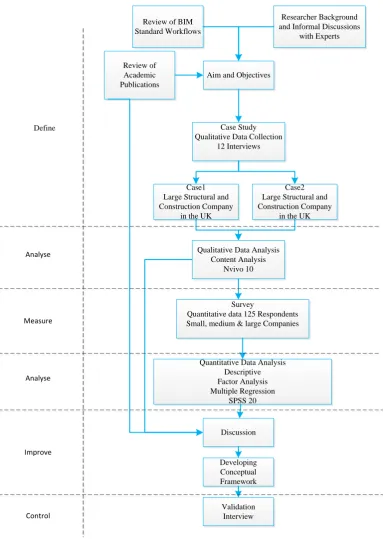
9 comments were applied to modify the conceptual framework and develop guidelines for practice. The adopted research processes are illustrated in Figure 1-1. This research applied the Define, Measure, Analyse, Improve and Control (DMAIC) process (Anbari, 2002, Lawton and Bass, 2006).
1- Define: In this step, literature related to information management characteristics and contribution of BIM has been studied, focussing initially on the AEC and subsequently narrowing down into the structural engineering domain. Semi-structured interviews were used to capture the views of customers sampled from two different construction design organisations in the UK. The qualitative interview was structured into two different levels of questions. In the first part of the interview, questions were designed to cover the general area of information management challenges. In the second part, questions were designed in greater detail to find existing supports of BIM that can solve those challenges. This research describes 12 interviews. The results of the qualitative data seek key existing challenges in construction design in companies that used BIM and work in an integrated design environment.
2- Measure: To make decisions and set priorities, this part of the research required ranking the available alternatives and making the appropriate selection. This study derives such weight by conducting a comparison of challenges and BIM supports with respect to their preferences. In this research an open-ended questionnaire was organised to measure the impact of each identified BIM supports to the dimensions of information quality.
3-Analyse: This research applies descriptive statistical analysis to present the ranking of each key information management challenge. To analyse relationships and interactions between an element with other elements, factor analysis and multiple regression are applied. This process identifies the key factors influencing the dimensions of information quality and scores the influence of each factor in comparison with the others.
10 4- Control: In the final stage of research process, the conceptual framework is validated through interviewing six BIM experts in industry and academia. The comments of these experts are utilised for controlling clarity and applicability within the industry, and for comprehensiveness and novelty.
Review of Academic Publications
Review of BIM Standard Workflows
Aim and Objectives
Case Study Qualitative Data Collection
12 Interviews
Case1 Large Structural and Construction Company
in the UK
Case2 Large Structural and Construction Company
in the UK
Qualitative Data Analysis Content Analysis
Nvivo 10
Survey
Quantitative data 125 Respondents Small, medium & large Companies
Quantitative Data Analysis Descriptive Factor Analysis Multiple Regression SPSS 20 Discussion Developing Conceptual Framework Validation Interview Measure Define Analyse Improve Control Analyse Researcher Background and Informal Discussions
[image:25.595.88.472.147.687.2]with Experts
11
1.7Report Structure
This research aims to propose a conceptual framework for information quality to the UK structural design industry. It seeks study the technological capabilities, workflows and organisational human resource readiness in the existing body of knowledge and the process framework. For the purpose of this report, the structure will contain eight chapters as described below.
Chapter 1- Introduction
This chapter provides an introduction and a brief outline of the structure of this report. The research background, research scope, research justifications, research gap, research questions, aim and objectives and expected contribution to knowledge are outlined.
Chapter 2- Review of Information Management in Structural Engineering
This chapter provides an overview of the literature consideration for this research. A general perspective of the structural engineering profession and outlook of information management challenges in AEC with a particular reference to the structural engineering sector in the UK is provided in this chapter.
Chapter 3- Contribution of Building of Information Modelling to Structural Information Management
This chapter provides literature research in respect of contribution of Building Information Modelling (BIM) in information quality management. BIM is studied from technological, process workflows and organisational human resource points of view. The technological dimensions contain: visualisation, file format and standard, structure of data and semantic technologies. The BIM workflows reported on recent protocols that have been provided for the construction sector in the UK. The importance of training and recruitment in the structural industry is discussed in the context of organisational culture and human resources. In the last stage the initial conceptual framework was proposed.
Chapter 4- Research Methodology
12 strategies and technique. The section on data analysis presents the processes adopted for both qualitative and quantitative data collection for this research.
Chapter 5- Qualitative Data Analysis
This chapter outlines the structure of qualitative interview questions. This chapter discusses the two case studies that involved information management challenges and the contribution of BIM in addressing the challenges faced by the structural engineering sector in the UK.
Chapter 6- Quantitative Data Analysis
This chapter details the quantitative data analysis and results, where the analysis based on the data collected from structural engineers, design managers and BIM experts. The data collection techniques was principally by conducting a questionnaire survey that obtains the perceptions of the participant with respect to to information management challenges, level of BIM implementation and level of satisfaction of information quality in their organisations. Chapter 7- Research Discussion
This chapter discussed the key findings of the research that have been achieved from literature review and qualitative and quantitative data analysis. This chapter also provides a framework for BIM implementation in the structural engineering sector to improve upon key information management challenges. Validation of the framework is done by collecting the opinions of industry experts and guidelines for implementing this framework are presented.
Chapter 8- Conclusion
13
CHAPTER 2.
REVIEW OF INFORMATION MANAGEMENT IN
STRUCTURAL ENGINEERING SECTOR
The main purpose of this chapter is to review the literature to understand the nature of information management in structural engineering information management in order to identify identifying key information management challenges within the AEC sector and particularly, related to management of structural engineering information. This chapter commences with a general overview of the structural engineering profession. The structural design process, interaction between structural engineering and management information systems, structural engineering information modelling and structural entities, are explained in detail. This chapter collects state of the art literature in the context of information management challenges and opportunities in AEC particularly structural engineering industry, to address objective 1 of this research, as set out in Section 1.4.
2.1Introduction to Structural Engineering Industry
14 recent years to understand information requirements and transaction in different stages in details.
2.1.1 Structural Engineering Design Process
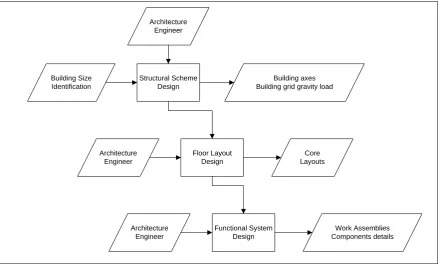
Structural engineering design process comprises various stages. Manning (1995) categorised the process of structural engineering design into three levels: conceptual, intermediate and detailed. Structural design has been divided into three main subdivisions by Sacks et al. (2000). This is depicted in Figure 2-1: structural scheme design, floor layout design, and functional system design. In the structural scheme design phase, the clients’ requirements as acquired by architect are passed on to structural engineers, the site data is clarified and subsequently, the building’s shape, height, position and the number of floors are proposed. The Floor layout design phase covers the layout of all the building spaces and assemblies of their components. Finally, in the functional system design, the details and dimensions of objects are calculated and added into drawings.
Structural Scheme Design Building Size
Identification
Building axes Building grid gravity load
Floor Layout Design Architecture
Engineer
Architecture Engineer
Core Layouts
Functional System Design Architecture
Engineer
[image:29.595.74.515.389.653.2]Work Assemblies Components details
Figure 2-1 the sub-stages of structural engineering design (Sacks et al., 2000)
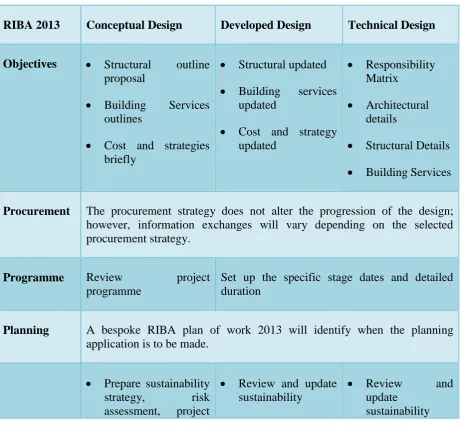
15 structure on design in the AEC industry in UK. It specifies information requirements at different project stages. Collectively, the plan of work and associated guidance and tools provide a good framework for collaboration on construction projects. The scope of the various stages of the process has been described by the RIBA POW (2013). Proposals for structural design and building services system are outlined in the concept design stage. In addition, cost information and project strategies would be specified briefly in accordance with the design programme. The developed design consists of updated and coordinated proposals for structural design, building systems, cost information and project strategies. In technical design phase, the Design Responsibility Matrix and project strategies are prepared for all architectural, structural and building services information. Table 2-1 illustrates tasks required for each stage, which may overlap in some stages, to enable achievement of specific project requirements.
Table 2-1RIBA Plan of Work
RIBA 2013 Conceptual Design Developed Design Technical Design
Objectives Structural outline proposal
Building Services outlines
Cost and strategies briefly
Structural updated
Building services updated
Cost and strategy updated
Responsibility Matrix
Architectural details
Structural Details
Building Services
Procurement The procurement strategy does not alter the progression of the design; however, information exchanges will vary depending on the selected procurement strategy.
Programme Review project
programme
Set up the specific stage dates and detailed duration
Planning A bespoke RIBA plan of work 2013 will identify when the planning application is to be made.
Prepare sustainability strategy, risk assessment, project
Review and update sustainability
Review and
16 Support
Tasks
execution plan and construction strategy.
Develop health & safety plan.
Undertake research and development party.
strategy.
Review and update Project Execution Plan, including Change Control Procedures.
strategy.
Prepare and submit building regulations.
Review and
update project execution.
Review construction strategy and health and safety strategy. Sustainability Checkpoints Sustainability Checkpoint 2 Sustainability Checkpoint 3 Sustainability Checkpoint 4 Information Exchanges
Concept Design
including outline structural and building services design, associated Project Strategies, preliminary Cost Information and Final Project Brief
Developed Design,
including the
coordinated
architectural, structural and building services design and updated Cost Information.
Completed Technical Design of the project.
17 2.1.2 Structural Engineering Information System
Information systems play a crucial role in the administration of day-to-day business. The ability of organisational business services exceedingly depends on the capability of its information systems. An information system consist of data, information and processes to store and distribute information to support decision making in an organisation (Laudon and Laudon, 2012). A typical organisation such as a structural engineering company requires information systems for each of the major engineering and business functions. The engineering functions need systems to support engineering design and analysis, and procedures to document the information concerning structural components. Therefore, it is worth to consider the recent models of information system.
18 Structural
Scheme Design
Floor Layout Design
Transaction Processing
System Management Information System
Processing System
Architectural Details
Structural Details
Building Services
MIS
Reports, Displays and Dashboard
Work Assemblies Components
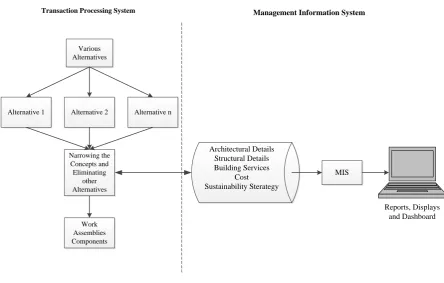
Figure 2-2 Structural Engineering Processes Information System Management (by author)
19
Defining problem
Generate number of alternatives design concept
Analyse on the alternatives
Selected concept further analysing and modyfying
Fail Pass
Production
Stakeholders needed for the
design type
Knowledge and information from
stakeholders to concept of design
Various alternatives meet
all the requirements
Alternative 1 Alternative 2 Alternative n
Narrowing the concepts and eliminating other
alternatives
[image:34.595.110.501.73.414.2]Final solution
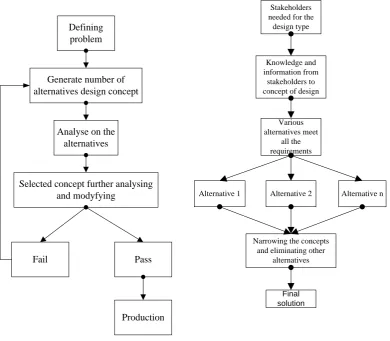
Figure 2-3 Point-based design b) Set-based design from Bavafa et al (2012)
20 Various
Alternatives
Alternative 2 Alternative n Alternative 1
Narrowing the Concepts and Eliminating
other Alternatives
Work Assemblies Components
Management Information System
Architectural Details Structural Details Building Services
Cost Sustainability Sterategy
MIS
Reports, Displays and Dashboard
[image:35.595.72.517.91.374.2]Transaction Processing System
Figure 2-4 Set-based Structural Engineering information Management System (by author)
21 2.1.3 Structural Engineering Information Modelling
22
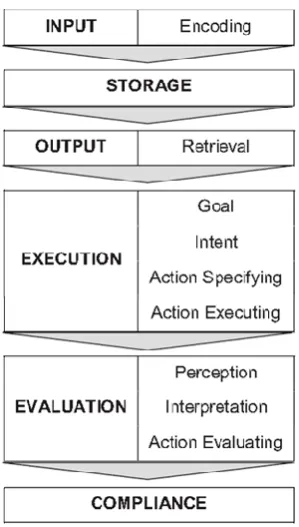
Figure 2-5 Stage of the action cycle (Lopez et al., 2010)
As it is shown in Figure 2-5, all these modelling types involve three main levels of computer system procedures, including input, storage, and output. After outputting models, and before delivering them to contractors, a company is required to evaluate models through project expert disciplines, in order to reduce errors and risks (Lopez et al., 2010). This research considers all three main information modelling procedures as components of information management in structural engineering disciplines. This section sought to obtain more understanding of information modelling procedures before studying challenges among information management context. There is also the intention to understand the main and other entities involved within structural information management in exception of structural engineering discipline. Therefore, the next section explains external entities who are affecting structural information management.
2.1.4 Structural Engineering Entities
23 tangible objects of interest to the construction industry (e.g. legal constraints), and the third entity is called active, which is used to capture and store events that have taken place (e.g. soil analysis entity). Scherer and Schapke (2011) interpret the domain of storing and the co-operation of information in structural designing entities from another point of view; they represented the “multi-model” as a container of data to combine distributed applications and models. The domain of the multi-model categorised by Scherer and Schapke (2011) has four layers:
• Level 1 - Processes for planning, executing and controlling a project
• Level 2 - Functional, geometrical and topological information of building elements • Level 3 - Construction economic and co-ordination model
• Level 4 - Construction uncertainty and risk models
24
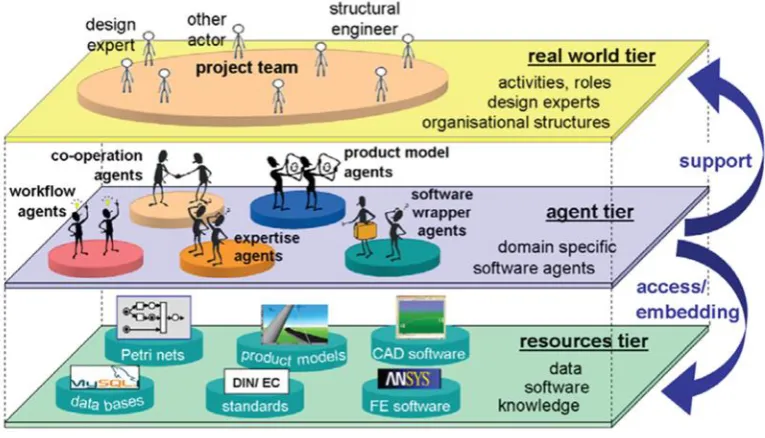
Figure 2-6Three-tier model for collaborative structural design (Bilek and Hartmann, 2006)
25
2.2 Key Information Management Challenges in Structural Engineering
Traditionally, information management among various AEC disciplines was based upon 2D drawings. In the 1960’s dramatic changes in the nature of drawings of buildings and drafting by structural engineers were brought about by computer-based graphic systems (E.Weisberg, 2008). Prior to the introduction of BIM, the detailed design phases in structural engineering were facilitated by CAD (Computer Aided Design) software, but it was felt that the building information was not efficiently documented as it was appreciated by the industry that building information was more than a simple geometric shape (Eastman, 1975). Therefore the demand for information sharing between diverse disciplines of the AEC industry and the need for availability and accuracy of information in the early stages of the design process encouraged the industry to adopt BIM. Recently, structural engineers are facing external pressure to adopt BIM-based software which enables them to exchange information with architects and contractors (Lea, 2013). Detailed literature related to information management challenges right from the broad perspective of the AEC industry, narrowing down to the structural overview have been provided in this section and the following chapter dwells upon the BIM solutions for identified information management challenges.
To be able to comprehend the various aspects of information management, it is imperative to understand the differences between data, information and knowledge. In this regard the literature abounds with definitions of data, information and knowledge. It is commonly accepted that data comprises of raw numbers or facts, information is that data that has been processed and knowledge is information which is authenticated (Vance, 1997), Therefore, data, information and knowledge are parts of a sequential order. Zins (2007) argued that information management science should be excluded from knowledge management as these two aspects are entirely different.
26 however, in computational system its included digital information which can be retrieved in databases (Baskarada and Koronios, 2013).
Information comprises of interpretations of data and the contextual understanding of product. In most instances the decision making process in organisations is based upon the information that individuals can capture, access and communicate with each other (Coakes, 2003). Information management is the process that supports the lifecycle of creation information, representation of information, maintenance of information through to reprocess the information. Many organisations view efficient information management as a competitive advantage. In view of this efficient information management can support technologies with business process improvement in organisations. Therefore a comprehensive method to information management requires strategies, tools and processes to manage information through lifecycle.in this section, this research collected the state of the art literature in the context of information management challenges and opportunities in AEC particularly structural engineering industry.
27
Table 2-2 Information management challenges in AEC industry
Information management Problem in AEC
Author Discussion
Inefficient Collaboration
(Shelbourn et al., 2007)
Good collaboration does not result from the implementation of IT solutions alone. Focus on organisation and process issue is required in parallel with technology consideration.
(Froese et al., 2007)
The most regularly identified problem in Canadian construction refers to collaboration including communications, document management, and interoperability.
(Shen et al., 2010)
Lack of a systematic theoretical framework for communication in construction organisations.
(Gassel et al., 2014) Weak willingness to share information and knowledge with others.
(Fulford and
Standing, 2014)
The problem today is that the building object is a combination of design results, because the collaborative working is not well organized or well managed as a result of a lack of insight into relevant process variables.
28
(Egan, 2002, Jardim-Goncalves et al., 2006, Grilo and Jardim-Goncalves, 2010, Shen et al., 2010, Shen et al., 2013)
Information interoperability
(Li et al., 2015) AEC organisational information efficiency and communication
Distributed
information access
(Rezgui et al., 2010) Information accessibility
(Sheriff, 2011)
Incoherent in the application of metadata and the attributes.
(Rob et al., 2012) The significant value of accessibility, accuracy and currency of the information relating to the project.
(Zlatanova et al., 2012)
validity of objects may not be ensured
(Gorla et al., 2010)
29
(Li and He, 2013)
Exchange and sharing information between different participants and different applications. At present, BIM is considered to be an effective way.
(Corry et al., 2014a) Improving information interoperability and accessible sourcing leads building performances.
Inefficient ICT
technology adoption
(Vidogah and
Moreton, 2003)
Due to cultural and legal reasons, there is no desire to consider collaborative IT tools.
(Peansupap, 2005) Lack of understanding of how to
actually implement ICT into a construction organisation.
(Peansupap and
Walker, 2005a)
Lack of time to learn the new information and communication technologies in organisation.
(Sheriff, 2011) The nuisance in preparing people to change their ways of working and adopt new methods. And lack of professionals with the requisite skills.
(Morlhon et al., 2014)
Maturity and critical success factors of ICT should be evaluated to implementation.
30 industry (Vidogah and Moreton, 2003, Peansupap and Walker, 2005b, Sheriff, 2011, Morlhon et al., 2014).
Increasing complexity in the AEC industry require professional designers and construction experts from multi-disciplinary professions to communicate with each other, understand the communications context ,document the result of the communication and access to document in requested time. The communication may be inter-organisational or external communication with other disciplines. In both type of communication, organisational culture and business strategy have been identified as two critical success factors (Xue et al., 2010). Successful industry information management is yet to be achieved as there are several barriers that prevent widespread adoption of information technology in the AEC industry. This is despite the fact that in addition to organisational and business strategies, in the past few decades the AEC market has seen a proliferation of digital tools that contribute to collaboration in the industry (Azhar and Ahmad, 2015). Although the adoption of technology in construction information management, especially in the design and management processes has the potential for great improvement and change among organisations, there are some challenges that preclude successful adoption and utilisation of recent technologies. A wide range of barriers in the adoption of information and communication technology in the AEC industry have been discussed in the literature.
Robinson et al. (2001) examined information management challenges in United Kingdom engineering and construction organisation as: to share valued tacit knowledge, to rapid reply to customers, to circulate best practices and to reduce rework. Peansupap and Walker (2006) examined the barriers in the Australia construction industry in adoption of information technologies. They argued that barriers could be classified as individual, group and organisation levels. At the individual level there was limited budget for information technology investment; there was issue with information management technology standardisation and security problem. At the group level there was lack of personal contact due to geographical fragmented parties. And At the organisational level there was lack of time to learn the new information technologies applications.
31 enhancing communication performance within AEC industry. The technology has advanced more quickly than the business process model, therefore the productivity improvement of efforts in business strategy are highlighted as important factor rather than development of new technologies (Helin and Lehtonen, 2007).
In the AEC industry, information management can be considered under various themes such as: Organisational culture level, Business process strategy level and Technological level in the market. It has been found from the review of literature that there is a lack of readiness of the AEC industry to adopt technologies to extensively improve information management and communication (Azhar and Ahmad, 2015). Fragmented applications and a heterogeneous information management environment lead to a lack of availability of the information (Eastman et al., 2011). The scholars attention in AEC information management has been turn on by Dossick and Neff (2011) into “messy talk” communication interactions in AEC industry. For the AEC industry to capture the information and then to process it into knowledge by understanding the content, and subsequently to document it for access, or to deliver to other disciplines, however, it is associated with a lack of organised interoperability which has been mentioned in the literature review. Due to time and cost limitations, this research will not cover all disciplines of the AEC industry, and will be limited to the context of the state of the art in information management in the structural engineering sector, an area which has so far been neglected in the existing literature.
Challenges faced by AEC information management have been studied extensively, but requisite attention has not been paid to the challenges associated with information management in the structural engineering sector. Importantly, the distinction between the two has to be made. AEC is an information intensive and fragmented industry, whereas, structural engineering is a part of the engineering design phase of construction stage in the lifecycle of the project. Recent development of computers and information technology has brought about a distinction between the information of physical structures and the information of design process.
32 access to assembly information even at the very early design phase and thus enable structural designers to make more efficient decision. Aagaard and Pedersen (2013) emphasised on lack of control on design information in structural engineering information management system. Goupil (2007) examined from group discussion between several structural engineers that the main challenges for structural information management is reducing errors in design by considering hazardous and implementing BIM to increase their collaboration with other construction and design disciplines. Lee et al. (2012) also focused on high-rise building structures and their research emphasised on optimised structural information to reduce errors and reworks that frequently occur in non-integrated structural information management. From the existing literature review it reveals that the most key challenge for structural engineering discipline are related to achieving minimum hazardous and structure failure by delivering accurate information to fabricators and contractors. And also communication and information exchange which are related to interoperability are structural engineers issue. Access and control on information also emphasized as a key challenge in structural engineering sector. It has been also argued by Chandrasegaran et al. (2013) in recent information management environment in building design sector that raw information is available to designers however, the critical challenge is presenting information and transfer information among design teams.
This research consequently by reviewing most of the concerns in state of the art literature related to AEC information management challenges, construction design information management challenges and structural engineering information management challenges predicted that most key challenges in structural engineering information management challenges are refers to information quality. This research stresses that by enhancing the level of certainty of information in structural engineering organisations, the quality of structural information needs to be considered.
2.2.1 Information Quality Management
33 finance and bank firms and listed its dimensions including; accessibility, appropriate amount of data, believability, completeness, concise representation, consistent representation, ease of manipulation, free of error, interoperability, objectivity, relevancy, reputation, security, timeliness, understand-ability and value-added. The main four dimensions of information has been investigated in model-sound, dependent, useful and usable (Kahn et al., 2002). Further, Kahn et al (2002) provided benchmarking for evaluating method of providing information and delivering dependent and usable information to consumers. Yang et al. (2005) highlighted five dimensions of quality for evaluating web information including; accuracy, accessibility, usability, usefulness and interaction.
34
Information Collecting
Information Organising
Information Exchanging
Information Reusing
Information Quality
Information Accessibility
Information Accuracy
[image:49.595.91.506.67.293.2]Information Interoperability
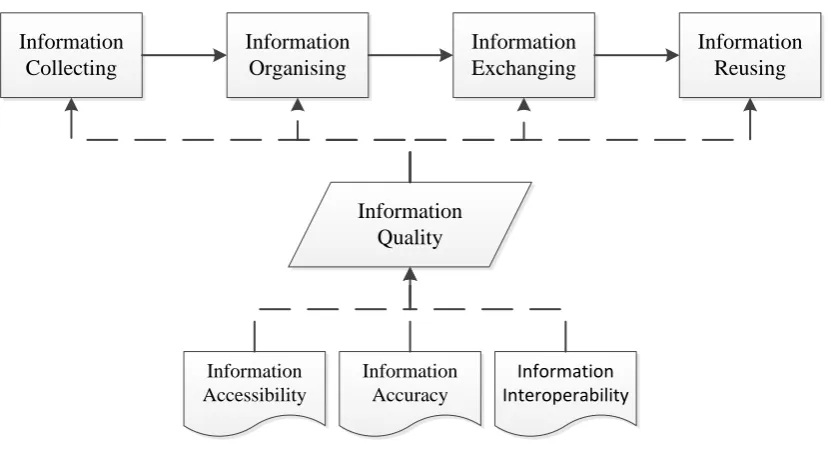
Figure 2-7 Information quality impact on information lifecycle in Structural Engineering
Figure 2-7 shows that information quality has a significant influence in the entire information lifecycle (Information collection, information organising, information exchanging and information reusing) in structural engineering information management. The three main dimensions of information quality consist of: Information accessibility, information accuracy and information interoperability. this research attempts to obtain the expert overview for validation of these dimensions. In the following sub-sections each information quality dimension in the context of structural engineering disciplines is described in details.
2.2.1.1 Information Accessibility
Information retrieval is a well-establish research in engineering information management area. Information access in engineering sector has been surveyed by Liu et al. (2008) essentially to improve information management performance within AEC industry. A number of researches argued that engineers spend two-third of their time due to obtain output results from their work and they spend one-third of their time on searching and accessing to design information (McMahon et al., 2004, Hertzum and Pejtersen, 2000). It is very vital in engineering product design area that information be organised and structured for efficient retrieval (Chandrasegaran et al., 2013).
35 structured data set in relational data warehouse. The availability of information are not efficient in AEC industry due to vast volumes and complex information (Lyman and Varian, 2010). The fundamental function is to select the most useful information in the requested time frame. This underscores the importance of classification of information in information accessibility, especially when the organisation has to handle large volumes of information (Dash and Lin, 2003).
Information Access
Oth er d
isci plin
es in form
atio
n Pr
od uc
t F un
ction
Info
rm
ation
[image:50.595.226.366.217.341.2]Process Information
Figure 2-8 Information Access Dimensions
Reviewing the state of the art literature shows that there are three information categories which are vital to be accessible in structural engineering design sector (See Figure 2-8). The first category is the raw information which may be collected from various sources for example; architect, client, local authorities and building services. Structural engineers can be consumers of some sort of information or producer of other sort of information (Sacks et al., 2000). The second category is related to information of predicting behaviour of product. Chandrasegaran et al. (2013) argued that to design physical engineering structure mapping between function and structure is often a critical challenge. Sometimes behavioural functions of certain structures are not predicted accurately due to lack of sufficient access to product functional information. The information has to be recorded and updated regularly to enable decision making in the analysis and design phases.
36
Figure 2-9 Knowledge availability in structural engineering processes (Caviers et al., 2011)
In future projects structural engineers will access to information related to previous projects in early of stage design while this information can be documented in efficient way. Caviers et al. (2011) called this approach of information management as early integrated approach. The graph in Figure 2-9 presents the relationship between available volumes of knowledge in each phase of structural engineering design in a traditional integration method in contrast with an early integration method. As it can be seen in this graph in traditional information management system the available knowledge in early conceptual design stage is very low and it’s gradually increase towards detailed design. On the other hand, in early integration information management system most of the knowledge can be retrieved at the early conceptual design stage.
2.2.2 Information Accuracy
37 As information stored in databases forms the input to other applications, information accuracy is thus very important for achieving organisational goals. Inaccurate information may result from various causes. For instance, certain information values may be missing as they were not available during the period of recording and transacting. The accuracy of project implementation by the contractor and subcontractor depends upon the information provided by design documentation (Love et al., 2000). Therefore, accuracy of documentation is critical for success of the construction project. 2D and 3D generated drawings specify the physical structure. In addition to this fact, the process of construction and installation may be presented in structural engineering documents. As a result it may improve conflicting, incomplete and erroneous information for passing to contractor’s requirements.
Figure 2-10 Sheffield building collapse blamed on digger (BBC, 2013)
38 1- Incorrect labelling (when names of structural components are ladled wrongly)
2- Drawing omission (when structural elements or some elements of structural components were missed from drawings)
3- Inconsistent labelling (when names of same structural components are not identical among different drawings)
4- Incorrect connection (when connections between structural elements were not design adequately)
5- Incomplete information (when information among drawings and reports are not sufficient for construction purposes or client and local authority’s control)
6- Wrong design (when structural elements were not meant to design on a certain drawing) 7- Missing labels (when structural elements are drawn however are not labelled in drawings) This sub-section described the different views in the context of information accuracy in structural engineering disciplines. This research utilised mixture of those views to describe the meaning of information accuracy in this research. Therefore, information accuracy in this research means the lack of errors (in terms of drawings and calculations), completeness of information (to be sufficient for clients, local authorities and contractors) and constructability of information according to constructors’ capabilities and project’s requirements. The next sub-section describes the information interoperability as third main dimension of information quality.
2.2.3 Information Interoperability