International Journal of Emerging Technology and Advanced Engineering
Website: www.ijetae.com (ISSN 2250-2459,ISO 9001:2008 Certified Journal, Volume 4, Issue 1, January 2014)
547
Design and Analysis of Efficient and Robust DWT based Image
Steganography Technique
Anjali Tiwari1, Seema Rani Yadav2, S.G. Kerhalkar3
1Student, 2 Professor, 3Professor, Department of Electronics and Communication Engineering, OIST , RGPV University,
Bhopal (M.P.)
Abstract-- The image steganography is known as a
technique of hiding information in cover object such that the analysis of stego image doesn’t provides any clue of hidden data. The image steganography is not a new concept but the recent growth in the computer networks makes it live again because of large visual data sharing in computer networks and greater embedding capability than text and with a large number of compression formats which makes image suitable carrier for hidden data. In this paper we are designing and analyzing the Discrete Wavelet Transform (DWT) based technique. The DWT has its own advantage because of its matching with human visual perception which helps in deciding the embedding components that cannot be easily detected by a steganographic analysis or human vision. The paper analyzes this technique for different attacks, different block sizes and for different cover image to hidden image sizes.
Keywords-- Steganography, Data hiding, Discrete Wavelet
Transform (DWT), Security, Steganalysis.
I. INTRODUCTION
The growth in computer networks increase the exchanging speed of multimedia data or information. But this growth also opens up the threat of information theft or leakage because the network contains many components through which the data is transferred and can be used to capture the data if it is not enough than the internet searching provides many software with the ability to access, develop, and modify multimedia objects. Although there are many ways of protecting against these activities like cryptography, secure key based protocol etc. but one of the best way is to send the information in such a way that no one can suspect that the object contains information this is what the steganography perform so if the data is not suspicious no one will try to decode it and the information can be transferred without any risk. The steganography is demanded by governments which often want to be privy to civilians or other government’s activities, and companies who want to save trade secrets from their competitors and thus, methods to do so are increasingly developed, and becoming advanced.
In basic definition the steganography is considered as the art and science of achieving the secret communication by the embedding of information within other information to which only the intended recipient(s) can decode and retrieve the hidden information correctly from the stego media (the cover with embedded information). The rest of the paper is arranged as that the second section provide an over views of some of the most recent and related literatures. The third section explains the basic steganography structure while the fourth section revise the Discrete Wavelet Transform. The fifth section the developed algorithm is presented followed by the performance measuring calculations in sixth section and the seventh section the simulation results for different configurations are shown. The eight section presents the derived conclusion based on the results in the section six.
II. LITERATURE REVIEW
International Journal of Emerging Technology and Advanced Engineering
Website: www.ijetae.com (ISSN 2250-2459,ISO 9001:2008 Certified Journal, Volume 4, Issue 1, January 2014)
548
Edge Adaptive Image Steganography Based on LSB Matching is presented by WeiqiLuo et al [4] their approach expand the LSB matching revisited image steganography and proposed an edge adaptive scheme which can select the embedding regions according to the size of secret message and the difference between two consecutive pixels in the cover image. For lower embedding rates, only sharper edge regions are used while keeping the other smoother regions as they are. When the embedding rate increases, more edge regions can be released adaptively for data hiding by adjusting just a few parameters. A Robust Image Steganography using DWT Difference Modulation (DWTDM) is presented by Souvik Bhattacharyya et al [5] in their work a new transform domain image stenographic technique DWTDM is presented where secret data is embedded in adjacent DWT coefficient differences. The dynamic range of the DWT difference considered while extraction of data which results an efficient and robust stenographic technique which can avoid various image attacks and works perfectly well for both uncompressed and compressed domain. Youssef Bassil et al [9] presented an image steganography technique based on the Canny edge detection algorithm. It is designed to hide secret data into a digital image within the pixels that make up the boundaries of objects detected in the image. More specifically, bits of the secret data replace the three LSBs of every color channel of the pixels detected by the Canny edge detection algorithm as part of the edges in the carrier image. Besides, the algorithm is parameterized by three parameters: The size of the Gaussian filter, a low threshold value, and a high threshold value. These parameters can yield to different outputs for the same input image and secret data. As a result, discovering the inner workings of the algorithm would be considerably ambiguous, misguiding steganalysts from the exact location of the covert data. Dulce R. Herrera-Moro et al [10] present a steganographic algorithm that allows an image process to identify the regions in a cover image where it is less probable to detect a hidden message using visual attacks. The regions selected are those whose texture is not homogeneous. This is because those kind of regions are originally noisy and is too difficult to detect extra information. Since the pixels where a message is hidden depend directly on the features of the cover image the steganographic system becomes adaptive.
III. DISCRETE WAVELET TRANSFORM
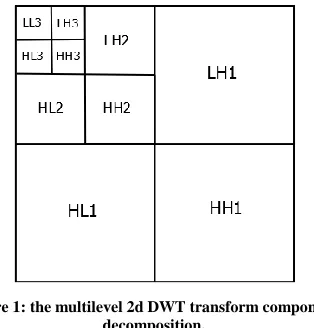
[image:2.612.367.524.440.604.2]The 2D DWT is a modern mathematical tool. It is used in compression (JPEG 2000), denoising and watermarking applications. To exploit all its advantages, it must be carefully studied. The aim of this section is to provide a brief understanding of it for complete study please refer to [11]. In this paper the most commonly used 2D DWT is considered. It is built with separable orthogonal mother wavelets, having a given regularity. At every iteration of the DWT, the lines of the input image (obtained at the end of the previous iteration) are low-pass filtered with a filter having the impulse response and high-pass filtered with the filter . Then the lines of the two images obtained at the output of the two filters are decimated with a factor of 2. Next, the columns of the two images obtained are low-pass filtered with m0 and high-low-pass filtered with m1. The columns of those four images are also decimated with a factor of 2. Four new sub-images (representing the result of the current iteration) are generated. The first one, obtained after two low-pass filtering, is named approximation sub-image (or image). The others three are named detail sub-images, , and .The image represents the input for the next iteration. In the following, the coefficients of the DWT will be noted with , where represents the image who’s DWT is
Figure 1: the multilevel 2d DWT transform components decomposition.
International Journal of Emerging Technology and Advanced Engineering
Website: www.ijetae.com (ISSN 2250-2459,ISO 9001:2008 Certified Journal, Volume 4, Issue 1, January 2014)
549
These coefficients are computed using the following relation:
Where the wavelets can be factorized:
and the two factors can be computed using the scale function ϕ (τ) and the mother wavelets ψ (τ) with the aid of the following relations:
Where:
IV. PROPOSED ALGORITHM
The proposed algorithm works on the basis of DWT decomposition structure which arranges the image information into the four different blocks (Approximation coefficients), (Horizontal detail coefficients), (Vertical detail coefficients) and (Diagonal detail coefficients) according to the properties of coefficients and the properties of image it is concluded that the coefficients contains only the fine information and does not affect the overall image when modified slightly while the coefficients contains the most of the information and the rest of the coefficients (HL and ) contains the information a bit higher than HH but far less than . Utilizing the above information we developed the steganography technique in which can be explained as follows:
Step1: Let the cover image is denoted by and the
secret image in denoted by . Now in first step the and images are decomposed into first level DWT and we get the and coefficients respectively for cover and secret image.
Step2: since it is known that coefficients contains
most of the information hence only the coefficients are selected from the decomposition this reduces the information size to be embedded by approximately four times. This reduction in embedding data facilities to properly hide the data into cover image without producing visual artifacts.
Step3: Now all the four coefficients of
and coefficients of are divided into the blocks of (where n can be 2,3 or any integer less than coefficient matrix size).
Step4: now the embedding procedure can be started for
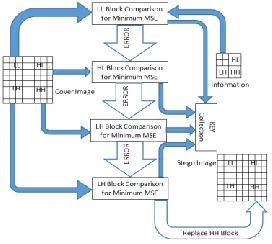
that the first block of is matched with all the blocks of and the index of the block showing the minimum is selected as key while the difference between the block is taken as error block which is then searched on block similarly as done before with and the index is again noted as key the error block coming from this stage is again searched in block in same way finally the error block of this stage is searched in block and the block with minimum is replaced by the error block and index is again noted down.
Step5: the procedure defined in step4 is repeated for all
the blocks of the . This ends the embedding procedure and the image with modified coefficients is retransformed to spatial domain using inverse DWT (IDWT) which is called stegoimage .
Step6: for the retrieval of the image firstly the is
[image:3.612.385.521.583.705.2]decomposed using DWT and the coefficients are divided into the similar block size as used during embedding process. Now the first four digits of key is used to select the blocks from respectively and then the summation of all four block is performed the procedure is repeated for total key digits and the output blocks are arranged in same way it was during embedding.
International Journal of Emerging Technology and Advanced Engineering
Website: www.ijetae.com (ISSN 2250-2459,ISO 9001:2008 Certified Journal, Volume 4, Issue 1, January 2014)
550
V. PERFORMANCE MEASURES
Peak signal-to-noise ratio (PSNR), is an engineering term for the ratio between the maximum possible power of a signal and the power of corrupting noise that affects the fidelity of its representation. Because many signals have a very wide dynamic range, PSNR is usually expressed in terms of the logarithmic decibel scale.
It is most easily defined via the mean squared error (MSE) which for two mXn monochrome images I and K where one of the images is considered a noisy approximation of the other is defined as:
The PSNR is defined as:
Here, MAXI is the maximum possible pixel value of the
image. When the pixels are represented using 8 bits per sample, this is 255.
VI. SIMULATION RESULTS
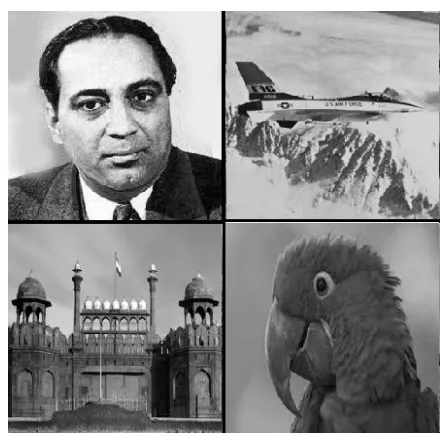
The proposed algorithm has been extensively tested on various standard images as presented in figure 3 and 4 and the results are summarized in the tables from 1 to 8.
[image:4.612.334.553.135.346.2]Figure 3: Test images Pepper, Barbara, Goldhill, and Cameraman.
[image:4.612.66.258.265.411.2]Figure 4: images used as Secret HomiBhabha, Airplane, Redfort and Bird.
Table 1
Experimental results for non-attacked Image: PSNR of Cover Image
Cover Image (256X256)
Secret Image (64X64)
Homi Airplane Redfort Bird
[image:4.612.332.552.365.586.2]International Journal of Emerging Technology and Advanced Engineering
Website: www.ijetae.com (ISSN 2250-2459,ISO 9001:2008 Certified Journal, Volume 4, Issue 1, January 2014)
551
Table 2
Experimental results for non-attacked Image: PSNR of Secret Image
Cover Image (256X256)
Secret Image (64X64)
Homi Airplane Redfort Bird
Technique Previous Proposed Previous Proposed Previous Proposed Previous Proposed Peppers 16.08 16.3353 16.42 18.27 18.83 19.73 18.90 19.94 Goldhill 13.99 16.69 16.40 19.10 18.63 21.33 18.04 20.71 Cameraman 16.20 16.88 16.60 17.50 16.42 19.04 17.43 18.83 Barbara 13.85 16.57 15.15 19.22 17.94 20.28 18.50 19.98
Table 3
Experimental results for Gaussian-Noise(Mean = 0, Variance = 0.001): PSNR of Secret Image
Cover Image (256X256)
Secret Image (64X64)
Homi Airplane Redfort Bird
Technique Previous Proposed Previous Proposed Previous Proposed Previous Proposed Peppers 16.13 16.22 16.42 17.86 18.75 19.35 18.51 19.18 Goldhill 14.04 16.43 16.44 18.51 18.62 20.77 17.69 19.74 Cameraman 16.24 16.75 16.58 17.25 16.51 18.64 17.28 18.17 Barbara 13.92 16.37 15.13 18.67 17.90 19.87 18.33 19.03
Table 4
Experimental results for Gaussian-Filter (Windows Size = 3x3, Variance = 0.5): PSNR of Secret Image
Cover Image (256X256)
Secret Image (64X64)
Homi Airplane Redfort Bird
Technique Previous Proposed Previous Proposed Previous Proposed Previous Proposed Peppers 17.15 14.82 19.25 17.26 21.25 18.91 20.09 18.73 Goldhill 15.49 14.86 20.13 17.12 22.16 19.49 24.16 18.94 Cameraman 15.92 14.27 18.72 16.62 20.15 17.86 22.80 17.18 Barbara 15.63 15.45 18.18 17.51 21.97 19.21 24.50 19.12
Table 5
Experimental results for Average-Filter (Window Size = 3x3): PSNR of Secret Image
Cover Image (256X256)
Secret Image (64X64)
Homi Airplane Redfort Bird
Technique Previous Proposed Previous Proposed Previous Proposed Previous Proposed Peppers 13.90 13.44 16.10 15.51 18.32 17.53 18.67 17.40 Goldhill 13.52 13.31 15.46 15.15 18.28 17.78 18.39 17.37 Cameraman 12.96 12.61 15.58 15.32 17.52 16.76 16.67 15.74 Barbara 14.09 13.99 15.88 15.62 18.31 17.97 18.99 17.91
Table 6
Experimental results for Motion-Bluering(Length = 9, Theta = 0): PSNR of Secret Image
Cover Image (256X256)
Secret Image (64X64)
Homi Airplane Redfort Bird
International Journal of Emerging Technology and Advanced Engineering
Website: www.ijetae.com (ISSN 2250-2459,ISO 9001:2008 Certified Journal, Volume 4, Issue 1, January 2014)
552
Table 7
Experimental results for Histogram-equalization: PSNR of Secret Image
Cover Image (256X256)
Secret Image (64X64)
Homi Airplane Redfort Bird
Technique Previous Proposed Previous Proposed Previous Proposed Previous Proposed Peppers 15.06 15.09 13.48 14.14 16.21 16.88 14.25 15.22 Goldhill 12.72 14.06 11.86 12.36 13.50 14.69 11.75 11.48 Cameraman 14.33 14.79 12.01 12.67 13.99 16.33 12.45 14.88 Barbara 13.27 15.02 12.33 14.00 15.22 17.05 14.06 15.51
Table 8
Experimental results for Sharpness-attack(alpha = 0.2): PSNR of Secret Image
Cover Image (256X256)
Secret Image (64X64)
Homi Airplane Redfort Bird
Technique Previous Proposed Previous Proposed Previous Proposed Previous Proposed Peppers 11.82 12.49 9.77 11.07 10.21 10.68 7.99 11.07 Goldhill 10.70 11.95 9.32 10.52 10.20 12.85 7.19 9.76 Cameraman 11.74 13.27 10.22 11.21 10.83 12.55 7.75 9.51 Barbara 10.21 12.01 8.82 11.37 9.90 12.49 6.87 10.14
VII. CONCLUSION
Our study focused on presenting a DWT based digital image steganography algorithm. Proposed method exploits strength of Wavelet domains transform to obtain further invisibility and robustness. The idea of inserting information in the multiple decomposition component is based on the fact that loss from one band could recovered from other band. Implementation results show that the impact on cover image is greatly reduced as compare to previous method. Presented method is also tested for most of the common image processing attack such as Gaussian filtering, Averaging, histogram equalization etc. and the simulation results show that proposed method is more efficient and robust compare to previous method.
REFERENCES
[1] Tomáš Filler, Jan Judas, and Jessica Fridrich ―Minimizing Additive Distortion in Steganography using Syndrome-Trellis Codes‖, Information Forensics and Security, IEEE Transactions on (Volume:6 , Issue: 3 ),Sept. 2011
[2] Abbas Cheddad, Joan Condell, Kevin Curran and Paul McKevitt‖ Digital Image Steganography: Survey and Analysis of Current Methods‖, Signal Processing, Volume 90, Issue 3, March 2010, Pages 727-752.
[3] Gabriel Hospodar, Ingrid Verbauwhede and Jos´e Gabriel R. C. Gomes ―Algorithms for Digital Image Steganographyvia Statistical Restoration‖ 2nd Joint WIC/IEEE, 2012.
[4] WeiqiLuo, Fangjun Huang and Jiwu Huang ―Edge Adaptive Image Steganography Based on LSB Matching Revisited‖, IEEE TRANSACTIONS ON INFORMATION FORENSICS AND SECURITY, VOL. 5, NO. 2, JUNE 2010.
[5] Souvik Bhattacharyya, GautamSanyal‖ A Robust Image Steganography using DWT Difference Modulation (DWTDM)‖, I. J. Computer Network and Information Security, 2012, 7, 27-40. [6] Bin Li, Junhui He, Jiwu Huang and Yun Qing Shi―A Survey on
Image Steganography and Steganalysis‖ Journal of Information Hiding and Multimedia Signal Processing, Volume 2, Number 2, April 2011.
[7] VojtěchHolub and Jessica Fridrich‖ Random Projections of Residuals for Digital Image Steganalysis‖, Information Forensics and Security, IEEE Transactions on (Volume:8 , Issue: 12 ), Dec. 2013.
[8] TomášPevný and Patrick Bas and Jessica Fridrich‖ Steganalysis by Subtractive Pixel Adjacency Matrix‖, IEEE Transactions on Information Forensics and Security 5, 2 (2010) 215—224.
[9] Youssef Bassil ―Image Steganography based on a Parameterized Canny Edge Detection Algorithm‖, International Journal of Computer Applications (0975 – 8887) Volume 60– No.4, December 2012.
[10] Dulce R. Herrera-Moro, Raúl Rodríguez-Colín, Claudia Feregrino-Uribe ―Adaptive Steganography based on textures‖, 17th International Conference on Electronics, Communications and Computers (CONIELECOMP'07).
[11] AlexandruIsar, SorinMoga, and Xavier Lurton―A Statistical Analysis of the 2D Discrete Wavelet Transform‖, http://www.tc.etc.upt.ro/docs/cercetare/articole/IsaMogLur05.pdf [12] Vijay Kumar and Dinesh Kumar ―Performance evalution of DWT