International Journal of Emerging Technology and Advanced Engineering
Website: www.ijetae.com (ISSN 2250-2459,ISO 9001:2008 Certified Journal, Volume 3, Issue 10, October 2013)
207
Design and Implementation of FFT Processor Using Vedic
Multiplier With High Throughput
Jyoti Agarwal
1,
Vijay Matta
2,
Dwejendra Arya
31,3
Electronics and Communication Engineering, I.E.T Alwar (Rajasthan), INDIA
2Electronics and Communication Engineering, S.R.N.E.C. , Nagpur (Maharashtra) , INDIA
Abstract - In present scenario every process should be rapid, efficient and simple. Fast Fourier transform (FFT) is an efficient algorithm to compute the N point DFT. It has great applications in communication, signal and image processing and instrumentation. But the Implementation of FFT requires large number of complex multiplications, so to make this process rapid and simple it’s necessary for a multiplier to be fast and power efficient. To tackle this problem Urthva Tirvagbhyam in Vedic mathematics is an efficient method of multiplication [4]. Vedic Mathematics is the ancient system of mathematics which has a unique technique of calculations based on 16 Sutras. Employing these techniques in the computation algorithms of the coprocessor will reduce the complexity, execution time, area, power etc. Urdhva Tiryakbhyam one of the sutra of Vedic Mathematics, being a general multiplication formula, is equally applicable to all cases of multiplication. The conventional multiplication method requires more time & area on silicon than Vedic algorithms [8]. More importantly processing speed increases with the bit length. This will help ultimately to speed up the signal processing task. The novelty in this paper is Fast Fourier Transform (FFT) design methodology using Vedic mathematics algorithm. By combining these two approaches proposed design methodology is time-area-power efficient.
Keywords- FFT, Vedic Mathematics, FFT Processor, Vedic Multiplier FFT, Design Vedic multiplier, Vedic Multiplier, FFT Processor design etc.
I. INTRODUCTION
Direct computation of Discrete Fourier Transform
(DFT) requires of the order of N2 complex multiplication
operations where N is the transform size. The FFT algorithm, started a new era in digital signal processing
by reducing the order of complexity of DFT from N2 to
Nlog2N, reduces the number of required complex
multiplications compared to a normal DFT. Since multipliers are very power hungry elements in VLSI designs they result in significant power consumption [7]. So, the complex multiplication operations are realized using Urthva Tirvagbhyam in Ancient Indian Vedic mathematics is an efficient method of multiplication. It literally means “Vertically and crosswise”.
This Sutra shows how to handle multiplication of a larger number (N x N, of N bits each) by breaking it into smaller numbers of size (N/2 = n, say) and these smaller numbers can again be broken into smaller numbers (n/2 each) till we reach multiplicand size of (2 x 2) Thus, simplifying the whole multiplication process [11]. The processing power of this multiplier can easily be increased by increasing the input and output data bus widths since it has a quite regular structure. Due to its regular structure, it can be easily layout in a silicon chip. The Multiplier has the advantage that as the number of bits increases, gate delay and area increases very slowly as compared to other multipliers [2]. In the present scenario high speed digital telecommunication systems such as OFDM and DSL need real-time high-speed computation of the Fast Fourier Transform. Pipeline architecture based on the constant geometry of N point
radix- 2 FFT algorithm, which uses N/2log2N complex
number multipliers and is capable of computing a full N-point FFT in N/2 clock cycles[3], has been proposed. Thus there is a need of innovative algorithms to improve the speed .In this paper, we propose Vedic algorithm for the implementation of multipliers to be used in the FFT. Fast Fourier Transform (FFT) design methodology using Vedic mathematics algorithm provides a fast and a
reliable approach to compute the N point DFT.
II. FAST FOURIER TRANSFORM (FFT)
The computation of the N point DFT by the divide-and conquer approach provides a computationally efficient algorithm. We split the N-point data sequence into two
N/2-point data sequences f1 (n) and f2 (n), corresponding
to the even numbered and odd-numbered samples of x(n),
respectively, that is,
f1(n) = x(2n), (1)
f2(n) = x(2n+1) n = 0,1,…..N/2-1 (2)
Thus f1 (n) and f2 (n) are obtained by decimating x (n)
International Journal of Emerging Technology and Advanced Engineering
Website: www.ijetae.com (ISSN 2250-2459,ISO 9001:2008 Certified Journal, Volume 3, Issue 10, October 2013)
208
FFT of a sequence x(n) of length N is given by X(K)X(K) = ∑ x (n) WNnk ,0 ≤ K ≤ N-1 (3)
N – 1 n =
Where WN =e-j2π/N, is a complex valued phase factor.
FFT take the advantage of the periodicity and
symmetry of the complex number WN. Thus reducing the
complex number multiplications and additions from N2
to N/2log2N and Nlog2N respectively. In FFT, where N is
an integer power of 2, i.e. N=2L, the no of stages of
computation is L (=log2N), then this algorithm is known
as radix-2 F FT algorithm. For N=16, which consist of L
= log216 = 4, f our stages, the first stage computes the
eight 2-point DFTs, the second stage computes the four 4-point DFTs, the third stage computes the two 8-point DFTs and finally the fourth stage computes the desired 16 point DFT. The number of complex multiplications
are N/2log2N = 8log216 = 32 and the number of complex
additions are Nlog2N = 16log216 = 64. The basic
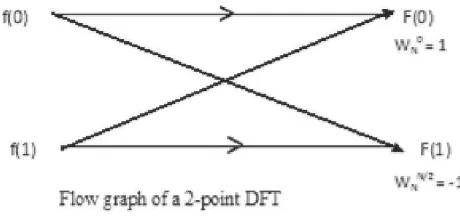
operation of DIT algorithm is the butterfly in which t wo inputs f(0) and f(1) are combined to give the outputs F(0) and F(1)
F(0) = f(0) + f(1)W160 (4)
F(1) = f(0) + f(1)W168 (5)
[image:2.595.54.284.476.587.2]The corresponding flow graph of a 2-point DFT is shown in fig. 1.
Fig. 1 Flow graph of a 2-point DFT.
III. VEDIC MATHEMATICS
Vedic mathematics is an ancient mathematics concept that provides a fast and a reliable approach to perform arithmetic operation using sixteen sutras [5] which was rediscovered from the Vedas between 1911 and 191 8 by Sri Bharati Krishna Tirthaji comprised all this work together and gave its mathematical explanation while discussing it for various applications. Swamiji constructed 16 sutras (formulae) and 16 Upasutras (sub formulae) after extensive research in Atharva Veda. Vedic mathematics is not only a mathematical wonder but also it is logical.
That‟s why it has such a degree of eminence which cannot be disapproved. Due to these phenomenal characteristics, Vedic math has already crossed the boundaries of India and has become an interesting topic of research abroad. Vedic math‟s deals with several basic as well as complex mathematical operations. Especially, methods of basic arithmetic are extremely simple and powerful. The word “Vedic‟ is derived from the word “Veda” which means the store-house of all knowledge. The Vedic mathematics is totally different and considered very close to the way human mind works. A large amount of work has been done in understanding various methodologies. The Sutras apply to cover each and every part of mathematics (including arithmetic, algebra, geometry, trigonometry, astronomy, calculus etc. The beauty of the Vedic mathematic lies in the fact that it reduces the otherwise cumbersome-looking calculations in conventional mathematics to a very simple one. This is so because the Vedic formulae are claimed to be based on the natural principles on which the human mind works. This is a very interesting field and presents some effective algorithms which can be applied to various branches of engineering as computing and digital signal processing.
IV. DESCRIPTION OF URDHVA TIRYAKBHYAM
The multiplier is based on an algorithm Tiryakbhyam of ancient Indian Vedic Mathematics. Urdhva Tiryakbhyam Sutra is a general multiplication formula applicable to all cases of multiplication [3]. It literally means “Vertically and crosswise”. It is based on a novel concept through which the generation of all partial products can be done and then, concurrent addition of these partial products can be done. Thus parallelism in generation of partial products and their summation is obtained using Urdhava Tiryakbhyam. The Multiplier has the advantage that as the number of bits increases, gate delay and area increases very slowly as compared to other multipliers[9]. Therefore it is time, space and power efficient. This Sutra shows how to handle multiplication of a larger numb er (N x N, of N bits each) by breaking it into smaller numbers of size (N/2 = n, say) and these smaller numbers can again be broken into smaller numbers (n/2 each) till we reach multiplicand size of (2 x 2).Thus, simplifying the whole multiplication process. The multiplication algorithm is then illustrated to show its computational efficiency by taking an example of reducing a 4x4 bit multiplication to a 2x2-bit
multiplication operation [12]. To analyze 4x4
International Journal of Emerging Technology and Advanced Engineering
Website: www.ijetae.com (ISSN 2250-2459,ISO 9001:2008 Certified Journal, Volume 3, Issue 10, October 2013)
[image:3.595.57.241.183.313.2]209
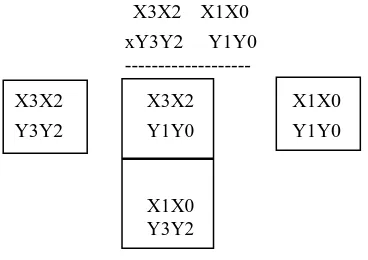
Using the fundamental of Vedic multiplication, taking two bit at a time and using 2 bit multiplier block, we can have the following structure for multiplication.Fig. 2. Block diagram presentation for 4x4 multiplications
Each block as shown above is 2x2 multiplier. First 2x2 multiplier inputs are X1 X0 and Y1 Y0.The last block is 2x2 multiplier with inputs X3 X2 and Y3 Y2. The middle one shows two, 2x2 multiplier with inputs X3X2 & Y1Y0 and X1X0 & Y3Y2. So the final result of multiplication, which is of 8 bit, S7S6S5S4S3S2S1 S0,
X3X2 and Y3Y2 give multiplication result
S33S32S31S30, X3X2 and Y1Y0 give multiplication
result S23S22S21S20, X1X0 and Y3Y2 give
multiplication result S13S12S11S10, X1X0 and Y1Y0 give multiplication result S03S02S0 1S00.
For the final result, add the middle product term along with the term shown below.
The first two outputs S0 and S1 are same as that of S00 and S01. Result of addition of the middle terms by using two, 4 bit full adders will forms output line from S5S4S3S2. One of the full adder will be used to add (S23 S22 S21 S20) and (S13 S12 S11 S10) and then the second full adder is required to add the result of 1st full adder with (S31 S30 S03 S02). The respective sum bit of the 2nd full adder will be S5S4S3S2. Now the carry generated during 1st full adder operation and that during
2nd full adder operation should be added using half adder
so that the final carry and sum to be added with next stage i.e. with S33 S32 to get S7 S6.
A.Combine Approach of FFT with Vedic Mathematics
As FFT reducing the complex number multiplications
and additions from N2 to N/2log2 N and Nlog2N
respectively. For N=16, which consist of four stages, the first stage computes the eight 2-point DFTs, the second stage computes the four 4-point DFTs, the third stage computes the two 8-point DFTs and finally the fourth stage computes the desired 16 point DFT. The number
of complex multiplications are N/2log2N = 8log216 = 32
and the number of complex additions are Nlog2N =
16log216 = 64. The basic operation of DIT algorithm is
the butterfly in which two inputs are combined to give the outputs.
When the word length to be 16 bits. The single simple multiplier implementation needs 16 rows of partial product generation and each row containing 16 partial product bits. To accumulate these 16 partial product rows large hardware will be needed to get the result in sum and carry form. As implementation of 16 pt radix-2 FFT requires large no of multiplication and these all multiplications are done using Vedic mathematics reduces the time, area and power.
e.g. (a+ib) (c+id) = (ac-bd) +i (ad+bc)
Where i2 =-1 and a, b, c, and d are 4 bit
numbers. a and c are real while b and d are imaginary.
Now results of multiplication of ac, bd, ab and bc are obtained using Vedic algorithm. . In the proposed architecture, the 4x4 bit multiplication operation is fragmented reconfigurable FFT modules. The 4x4 multiplication modules are implemented using small 2x2 bit multipliers. The structure of FFT will be designed, optimized and implemented on SPARTAN-3E FPGA (Field Programmable Gate Array). This FFT have the high speed and small area as compared to the conventional FFT. This particular FFT is to be designed by using Vedic adder, Vedic subtractor, and Vedic multiplier. The delay produced by the Vedic FFT is smaller than the delay produced by the conventional FFT.The application of FFT algorithm include Linear filtering, Correlation, Spectrum Analysis which will further add the field of Communication, signal & image processing and instrumentation. Combine approach of FFT with Vedic Mathematics create the new advancement in various fields of engineering.
X3X2 X1X0
xY3Y2 Y1Y0
---
X3X2 X3X2 X1X0
Y3Y2 Y1Y0 Y1Y0
X1X0 Y3Y2
S33 S32 S31 S30 0 0 S01 S00
S23 S22 S21 S20 S13 S12 S11 S10
International Journal of Emerging Technology and Advanced Engineering
Website: www.ijetae.com (ISSN 2250-2459,ISO 9001:2008 Certified Journal, Volume 3, Issue 10, October 2013)
210
V. CONCLUSION AND RESULTIn this paper a novel technique of Fast Fourier Transform (FFT) design methodology using Vedic mathematics algorithm is presented. The design is based on Vedic method of multiplication that is quite different from the conventional method of multiplication like add and shift. This also gives chances for modular design where smaller block can be used to design the bigger one.
This gives method for hierarchical multiplier design. So the design complexity gets reduced for inputs of large no of bits and modularity gets increased. This will help in designing FFT structure, as its give effective utilization of structural method of modelling. An FFT circuit has been described that provides the high performance with
Small area which has great applications in
communication, signal and image processing and instrumentation that can also benefit future needs of wireless communications systems.
[image:4.595.314.567.132.498.2]Fig RTL of 8 point FFT using vedic multiplier
Fig Simulation results
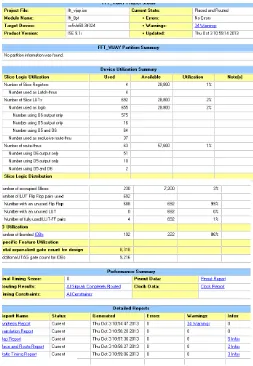
Fig. Synthesis report using virtex5
REFERENCES
[1] Ashish Raman, Anvesh Kumar, R.K.Sarin, „„High Speed Reconfigurable FFT Design by Vedic Mathematics‟‟, journal of Computer Science and Engineering, vol.1, pp 59-63 May 2010. [2] Anvesh Kumar, Ashish Raman, „„Small Area Reconfigurable FFT
Design by Vedic Mathematics”, vol 5, IEEE pp 836-838, 2010. [3] Laxman P. Thakre, Suresh Balpande,Umaeh Akare, Sudhair
Lande, „„Performance evaluation and Synthesis of Multiplier Used in FFT Operation Using conventional and Vedic Algorithm”, International Conference on emerging trends in Engineering and Technology, pp 614-619, 2010.
[4] M.E.Paramasivam, Dr.R.S.Sabeenian, „„An Efficient Bit Reduction Binary Multiplication Algorithm using Vedic Methods”, IEEE pp 25-28, 2010.
[5] Anvesh Kumar, Ashish Raman, „„Low Power ALU Design by Ancient Mathematics”, vol 5, IEEE pp 862-865, 2010.
[image:4.595.47.287.371.569.2]International Journal of Emerging Technology and Advanced Engineering
Website: www.ijetae.com (ISSN 2250-2459,ISO 9001:2008 Certified Journal, Volume 3, Issue 10, October 2013)
211
[7] Leonard Gibson Moses S, Thilagar M, „„VLSI Implementation ofHigh Speed DSP algorithms using Vedic Mathematics‟‟, International Journal of Computer Communication and Information System, Vol.2. pp 119-122 Jul –Dec 2010.
[8] Parth Mehta, Dhanashri Gawelli, “Conventional Versus Vedic Mathematical method for Hardware Implementation of a multiplier”, International Conference on emerging trends in Engineering and Technology, pp 640-642, 2009.