ing
Celle, A and Smith, N
http://dx.doi.org/10.1017/S1360674310000079
Title
Beyond aspect: will be ing and shall be ing
Authors
Celle, A and Smith, N
Type
Article
URL
This version is available at: http://usir.salford.ac.uk/16800/
Published Date
2010
USIR is a digital collection of the research output of the University of Salford. Where copyright
permits, full text material held in the repository is made freely available online and can be read,
downloaded and copied for noncommercial private study or research purposes. Please check the
manuscript for any further copyright restrictions.
Beyond aspect:
will be -ing
and
shall be -ing
11
AG N `E S C E L L E
2
Universit´e Paris-Diderot, CLILLAC-ARP
3
and
4
N I C H O L A S S M I T H
5
University of Salford
6
(Received 25 April 2008;revised 11 February 2010)
7
This article discusses the synchronic status and diachronic development ofwill be -ing andshall be -ing(as inI’ll be leaving at noon).2Although available since at least Middle
English, the constructions did not establish a significant foothold in standard English until the twentieth century. Both types are also more prevalent in British English (BrE) than American English (AmE).
We argue that in present-day usagewill/shall be -ingare aspectually underspecified: instances that clearly construe a situation as future-in-progress are in the minority. Similarly, although volition-neutrality has been identified as a key feature ofwill/shall be -ing, it is important to take account of other, generally richer meanings and associations, notably ‘future-as-matter-of-course’ (Leech 2004), ‘already-decided future’ (Huddleston & Pullum et al. 2002) and non-agentivity. Like volition-neutrality, these characteristics appear to be relevant not only in contemporary use, but also in their historical expansion. We show that the construction has evolved from progressive aspect towards more subjectivised evidential meaning.
8 9 10 11 12 13 14 15 16 17 18 19 20 21
1 Introduction
22
Will be -ingandshall be -ingare among the least discussed expressions in English to
23
refer to the future. The few studies that address these constructions tend to focus on
24
synchronic usage, primarily their alleged status as exceptional uses of the progressive
25
(see e.g. Leech 2004; Huddleston & Pullum et al. 2002; Williams 2002). On their
26
diachronic development, we find a few brief remarks on the timing of the historical
27
emergence ofwill be -ingandshall be -ing. According to Mustanoja (1960: 591) and
28
Strang (1970: 208), both patterns have been attested since at least Middle English,
29
while Visser (1963–73: 2412) dates them even earlier. The only attempt we are aware
30
of to hypothesisehowthese constructions emerged is a short section in Samuels (1972).
31
1 For comments on earlier versions of this article, we would like to thank the two anonymous reviewers, as well
as Cristiano Broccias, Mark Davies, Sebastian Hoffmann, Geoffrey Leech, Patricia Ronan and audiences at the ESSE8 seminar on ‘What future for the future tense in English?’ (30 August 2006) and a research seminar at the University of Manchester (22 April 2008).
2 In the present article,’llis treated as the contraction ofwill. Historically,’llprobably derives from a weakened
We suggest thatwill be -ingandshall be -ingmerit closer scrutiny. Firstly, the variant
32
withwillis in fact encountered in a variety of discourse types in Present-Day English.
33
Following are some typical examples found in contemporary usage:
34
(1) This storewill be closingin 5 minutes.
35
(A standard announcement in UK stores at around 5.25 pm).
36
(2) This trainwill be callingat Preston, Chorley, . . .
37
(automated announcement, Transpennine Express trains, UK, 2005-present).
38
(3) In a few hours’ time President Bushwill be givinghis State of the Union Address.
39
(BBC Newsnight, 20/1/2004).
40
(4) Willyoube needingthe OHP? (asked of a speaker before giving a conference paper)
41
(5) Your carwill be waitingfor you when you arrive.
42
(6) BCNU(=Mobile phone texting abbreviation for ‘Be seeing you’)
43
Corpus data, moreover, confirm that in recent times there have been significant
44
frequency developments in standard English.Will be -ing, especially, has raised its
45
profile among future expressions during the last century.Shall be -ing, too, seems to
46
have grown in use at around the same time, though to a lesser extent.
47
Furthermore, we find that this is one part of the progressive paradigm where there
48
is clear regional divergence between standard BrE and standard AmE.Will be -ingis
49
markedly more popular in BrE. This could be one reason why it has not been commented
50
on much by American linguists.
51
The main area in whichshall be -ingandwill be -inghave been previously discussed –
52
and in which we would like to advance the debate – is that of meaning. It has been
53
argued that certain instances of these constructions are characterised by a meaning that
54
is not aspectual, or at least not progressive. Whereas (5) above is clearly progressive,
55
examples such as (1) and (2) would be deemed ‘progressive in form but non-progressive
56
in meaning’ by Wekker (1976: 116), as not indicating duration by Palmer (1990: 151),
57
as ‘perfective’ by Huddleston & Pullum et al. (2002: 172) and as applying ‘to a single
58
happening viewed in its entirety’ by Leech (2004: 67). In other words, the prototypical
59
features of progressive aspectual meaning, or ‘progressivity’,3 such as ongoingness
60
and duration are alleged to be absent.4A less popular view is that cases such as (1) and
61
(2) can still be construed as in progress, albeit in an extended sense (see Hirtle 1967
62
and Williams 2002).
63
It is sometimes contended thatshall be -ingandwill be -ingimply further meaning,
64
beyond the notion of aspect. According to Hirtle (1967) and Leech (2004), for instance,
65
the realisation of the future situation is construed as ‘a matter of course’, Huddleston &
66
Pullum et al. (2002) speak in terms of the future as ‘already decided’, whereas Samuels
67
(1972) and Gachelin (1997) deem it ‘pure’ or ‘colourless’ future (see also Declerck,
68
this issue). These accounts share a common thread: the idea that the future situation
69
3We borrow this term from Comrie (1976), to distinguish the meaning of the construction from its form. 4For some commentators (e.g. Adamczewski & Delmas 1982) cases such as this provide compelling evidence
‘will come to pass without the interference or the volition of anyone concerned’ (Leech
70
2004: 67). However, the characterisations involve subtle differences, which need to be
71
elucidated and assessed against a body of authentic data.
72
Thus our article is concerned with the following questions:
73
(a) How frequent areshall be -ing and will be -ing in absolute terms, and in
74
comparison to other constructions referring to the future? How frequent are
75
they across different genres or text types? How do BrE and AmE compare in
76
these respects?
77
(b) How can we characterise the synchronic meaning ofshall be -ingandwill
78
be -ing in terms of aspect, and other implied meanings? Can we resolve
79
the apparent anomaly of two aspectual values (namely, progressive and
non-80
progressive) expressed by a single construction?
81
(c) What selectional preferences and constraints are there on the two
82
constructions, in terms of, for example, subject selection, choice of lexical
83
verb, and combinability with the passive?
84
(d) What, if anything, is the connection between the meanings, in synchronic and
85
diachronic terms?
86
(e) What evidence do we have regarding the historical spread in use ofwill/shall
87
be -ing?
88
Our study is corpus-based, embracing a range of corpora and privately collected
89
examples from the twentieth century and earlier. Due to a paucity of examples before
90
1900, our comments on historical developments are necessarily speculative.
91
Although other modal auxiliaries can combine withbe -ingto refer to future situations
92
(e.g.She may be leaving tomorrow), we do not focus on these constructions. Nor, for
93
reasons of space, do we discuss the relatedbe going to+be -ingform. These patterns
94
are, however, implicitly dealt with in some general remarks we make about the effect
95
of combining modals withbe -ing.
96
2 Data and methodology
97
Our analyses are both qualitative and quantitative. Most of the synchronic discussion
98
is based on qualitative analysis of privately collected examples and corpus data. For
99
the historical part, we focus on two primary sets of corpus data:
100
(a) The ARCHER corpus, version 3.1, consisting of 1.7 million words of English
101
from 1650 (the end of the early modern period) to 1990, sampled in fifty-year
102
subperiods (cf. Biber et al. 1994). ARCHER contains a variety of written
103
and spoken (or speech-like) genres: journals, letters, fiction, news reportage,
104
medicine, science, drama and sermons. BrE is included in all subperiods, and
105
AmE for 1750–99, 1850–99 and 1950–90 only.
106
(b) The ‘Brown family’ of corpora: a set of matching one-million-word corpora
107
of written BrE and AmE sampling the years 1961 (the LOB and Brown
corpora) and 1991/92 (the F–LOB and Frown corpora), with a recently
109
added corpus of BrE sampling texts from 1931 (±three years: the B-LOB
110
corpus). Each corpus is modelled on the design of the original Brown corpus
111
(Francis 1965), containing four broad genre categories: Press, General prose,
112
Learned/Academic and Fiction.
113
Evidence of contemporary usage is also drawn from the 100-million-word British
114
National Corpus (BNC), which samples BrE predominantly from the 1980s and early
115
1990s, and a variety of privately collected examples.
116
To retrieve occurrences ofshall be -ingandwill be -ing, we used the CQP software
117
(Christ 1994) on grammatically tagged versions of the corpora.5 With its advanced
118
query syntax, CQP allows the specification of variable patterns between the modal,be
119
and-ing, such as noun phrases, negatives and adverbials:
120
(7) Will the master be havinghis too, m’am? (B-LOB P16)
121
(8) . . . we regret that shewillnotbepersonallyappearingin Richard II.
122
(ARCHER 1952whit.f8b)
123
All the examples retrieved were hand-edited to remove false positives.6
124
In quantifying use of shall be -ingandwill be -ing, our main method has been to
125
normalise their absolute frequencies to a text span of one million words, to facilitate
126
comparisons across genres and corpora of different sizes. In addition, to confirm the
127
growth ofwill be -ingin recent BrE, we have assessed its frequency relative to that of
128
other expressions of future time, notablywill+ bare infinitive,shall+ bare infinitive,
129
be going toand the futurate use of the present progressive. All changes have been
130
measured for statistical significance, using the Log Likelihood test.
131
3 General observations on frequency
132
3.1 Will be -ingin BrE and AmE
133
According to ARCHER, despite being available for several centuries,will be -ingdid
134
not significantly expand in use in BrE and AmE until the twentieth century (table 1).
135
By contrast, overall use of the progressive construction in ARCHER accelerated
136
significantly in each century from 1700 onwards, according to figures in Hundt (2004:
137
69; cf. table A1). Similarly, in a corpus of nineteenth-century BrE, Smitterberg (2005)
138
finds a substantial increase in frequency of the progressive construction as a whole, but
139
a low and declining frequency ofwill be -ing(2005: 136).
140
5Grammatical tagging was carried out automatically with the CLAWS4 software: see Garside & Smith (1997). 6The searches run on ARCHER also took account of variant spellings within the patternsshall be -ingandwill
Table 1. Will be -ingin BrE and AmE, 1650–1990: ARCHER data
BrE AmEa
Period Frequency Pmwb Frequency Pmw
1650–99 4 22 No data
1700–49 1 6 No data
1750–99 0 0 1 6
1800–49 4 22 No data
1850–99 1 6 0 0
1900–49 6 34 No data
1950–90 16 90 10 56
Overall 32 26 11 21
aARCHER currently has AmE data for the periods
1750–99, 1850–99 and 1950–90 only
b‘pmw’ indicates frequency per million words
0 10 20 30 40 50 60 70 80 90 100
1931 1961 1991
BrE AmE
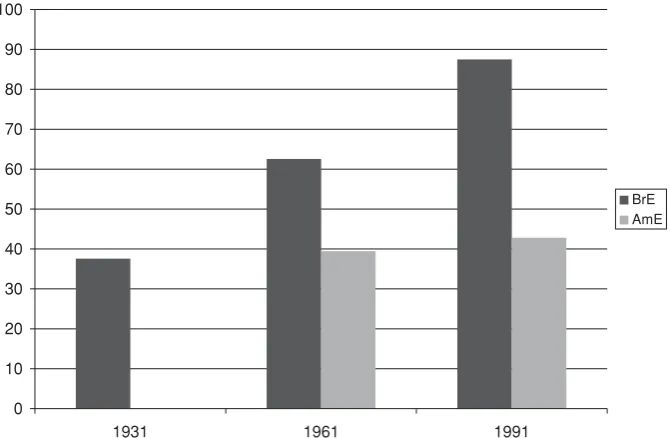
Figure 1.Will be -ingin twentieth-century written BrE and AmE (Brown family corpora): frequencies pmw (raw figures in table A2)7
That the expansion of the construction is a comparatively recent development
141
is further supported by the Brown family corpora of twentieth-century English
142
(figure 1).
143
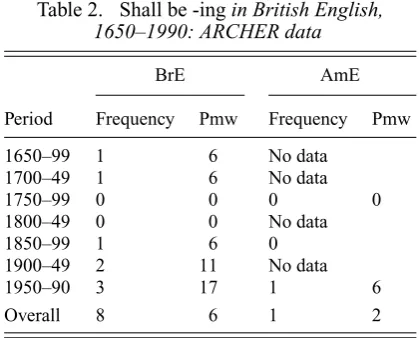
Table 2. Shall be -ingin British English, 1650–1990: ARCHER data
BrE AmE
Period Frequency Pmw Frequency Pmw
1650–99 1 6 No data
1700–49 1 6 No data
1750–99 0 0 0 0
1800–49 0 0 No data
1850–99 1 6 0
1900–49 2 11 No data
1950–90 3 17 1 6
Overall 8 6 1 2
The latter dataset also highlights, more clearly than ARCHER, a significant level
144
of regional divergence between AmE and BrE, which appears to widen as the century
145
progresses. While use of the progressive overall continues to increase in both varieties
146
(cf. Mair and Hundt, 1995; Smith, 2002), the growth ofwill be -ingis significant in
147
BrE only. We discuss the question of contact in the spread ofwill be -ingin 5.2.2.
148
3.2 Shall be -ingin BrE and AmE
149
Shall be -ing, in contrast, never seems to have enjoyed much popularity. From its sparse
150
appearances in ARCHER, it is just about possible to discern a slight growth in BrE: one
151
occurrence per century, until the twentieth century, in which there are five occurrences
152
(table 2). This nevertheless represents a small fraction of the frequency ofwill be -ing.
153
In the AmE portion of ARCHER, a single occurrence ofshall be -ingis found, in the
154
second half of the twentieth century.
155
A similarly sporadic usage rate is found in the Brown family of one-million-word
156
corpora. At just one, seven and five occurrences respectively in 1931, 1961 and 1991,
157
shall be -ingin BrE seems to have reached its peak. In AmE the frequency again trails
158
some way behind:shall be -ingappears once in 1961, and likewise in 1991.
159
3.3 Shall/will be -ingand other future time constructions in BrE: a brief
160
quantitative comparison
161
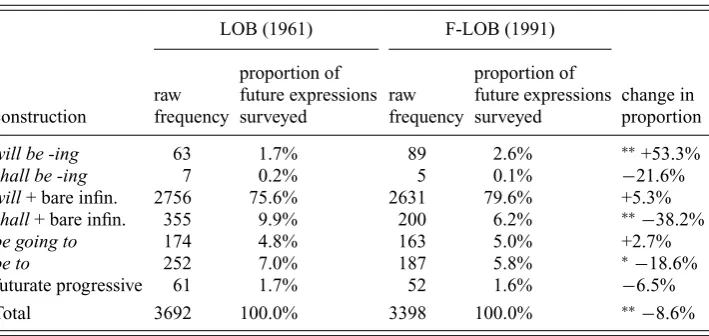
We now consider the frequency ofshall/will be -ing relative to other expressions of
162
future time:will+ bare infinitive,shall+ bare infinitive,be going to(e.g.I’m going to
163
leave),be to(e.g.I am to leave at 4), the futurate use of the present progressive (e.g.
164
I’m leaving at 4).8 The survey here is mainly limited to late twentieth-century BrE
165
(see table 3).
166
8For lack of space we have not analysed the so-called ‘futurate’ use of the simple present (e.g.The train leaves
Table 3. Constructions referring to the future in corpora of recent BrE: raw and proportional frequencies in the LOB and F-LOB corpora
LOB (1961) F-LOB (1991)
construction rawfrequency
proportion of future expressions
surveyed rawfrequency
proportion of future expressions
surveyed change inproportion
will be -ing 63 1.7% 89 2.6% ∗∗+53.3%
shall be -ing 7 0.2% 5 0.1% −21.6%
will+ bare infin. 2756 75.6% 2631 79.6% +5.3%
shall+ bare infin. 355 9.9% 200 6.2% ∗∗−38.2%
be going to 174 4.8% 163 5.0% +2.7%
be to 252 7.0% 187 5.8% ∗−18.6%
futurate progressive 61 1.7% 52 1.6% −6.5%
Total 3692 100.0% 3398 100.0% ∗∗−8.6%
Note: For be going to,be to and the futurate use ofbe -ing, only present tense cases were counted. Counts for the futurate be -ing involve a higher margin of error than the other constructions, due to indeterminate readings – see below.
The only construction significantly increasing in relation to the others iswill be -ing.
167
In fiction, for example,will be -ingis buoyant in comparison to a general decline of the
168
combined set of constructions. Meanwhile, figures for thefuturate useof the present
169
progressiveare somewhat complicated by cases of indeterminate temporal reference
170
(e.g.Timotei . . . is introducinga Facial Scrub to its skin care range,F–LOB E34);
171
see Mair & Hundt (1995: 116) and Leech et al. (2009: 132–3), for discussion. Such
172
cases are fairly evenly balanced at around 60–90 instances in each corpus. Even so,
173
there is no evidence that the futurate use has increased. This is a notable difference
174
from the clear growth of the futurate progressive in BrE across the last two centuries,
175
as reported by Nesselhauf (2007 and this issue), again using ARCHER.
176
Meanwhile two other competitors, shall + bare infinitive and be to, have fared
177
distinctly worse; both have become increasingly confined to formal style (see Leech
178
et al. 2009: 80–1, 108), andshall+ bare infinitive is now almost exclusively used with
179
first-person subjects. It is probable thatshall be -inghas been prevented from sharing
180
in the success ofwill be -ingthrough the demise ofshallin general.
181
Be going tois one construction we might expect to have increased in use (see e.g.
182
Krug 2000; Heine et al. 1991; Hopper & Traugott 2003). However, as noted in Mair
183
(1997) and Leech et al. (2009: 108), as far as written BrE is concerned, its gains are
184
limited to the Press genres in LOB and F-LOB; in the parallel 1960s-90s corpora
185
of AmE (Brown and Frown), be going to has risen dramatically in frequency, and
186
across a wide range of genres. Similarly in two small corpora of spoken British
187
English, Leech (2003) finds that the construction has expanded. No instances of
be going to in construction with be -ing were found in any of the Brown family
189
corpora.9
190
There are some intriguing tendencies, which can be surveyed only briefly here. For
191
example, the spread ofwill be -ingdoes not appear to have had much impact on the
192
frequency ofwill+ bare infinitive.Will+ bare infinitive still dwarfs all other
future-193
referring expressions. Its frequency in the genres where will be -ingis strongest –
194
namely the press, especially news reportage and editorials – has even increased by
195
nearly 10 per cent in BrE (see Smith 2005: 268). In part this can probably be attributed
196
to a fairly consistent propensity in newspaper writing to refer to forthcoming events,
197
not just situations in the present and the recent past: in both LOB and F-LOB the total
198
number of future-referring expressions is around 4,500 pmw, well above each corpus
199
average.
200
In summary, the recent (late twentieth-century) growth ofwill be -ingseems to be
201
confirmed by the fact that most of the future-time constructions it competes with have
202
either declined in use or shown growth in a few registers only.
203
3.4 Will/shall be -ingacross genres in BrE
204
In ARCHER,will be -ing and shall be -ing both mainly occur in speech-based or
205
speech-like genres. In e.g. Drama, Letters and the dialogue parts of Fiction,will be
206
-ing registers 9, 17 and 3 occurrences respectively (51, 55 and 36 pmw). Among
207
information-oriented genres, there is one attestation in News, and none in either Science
208
or Medicine. ARCHER thus gives the impression that the rather restricted register
209
spread is consistent across the periods sampled, and applies to both constructions.10
210
With the twentieth-century Brown family corpora, however,will be -ing presents a
211
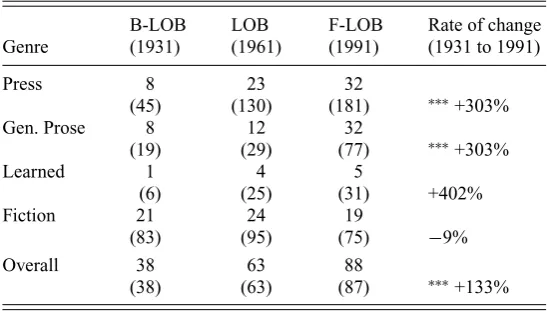
more complex pattern of register variation and change (see figure 2).11In 1931, Fiction
212
ranks highest in frequency. By the 1960s, Fiction has been overtaken by Press, and
213
by the 1990s it is matched by General Prose.12 Not unexpectedly, the construction is
214
consistently infrequent in Learned (i.e. academic) writing: there is rarely call in this
215
text type for predictions and discussion of future situations.
216
The lack of increase of will be -ingin Fiction may seem at odds with the general
217
expansion of the construction. However, part of the explanation for this is that in
218
fictional dialogue, where nearly all cases are found, the frequency of references to the
219
9 This rarity is confirmed in the BNC, with c.3 instances pmw overall, and c.17 pmw in spoken texts. The Corpus
of Contemporary American English (COCA) at www.americancorpus.org, COCA shows consistently higher rates in AmE from 1990–2009, averaging c.76 pmw in spoken texts.
10Smitterberg’s study (2005: 136) of nineteenth-century English finds an even more restricted register spread. In
his corpus, the only genre with significant usage of the constructions is Letters, where the overall rate equates to 100 pmw forwill be -ingand 150 forshall be -ing.
11Instances ofshall be -ingare too few to discuss diachronic genre developments.
12Consistent with ARCHER’s Science and Medicine genres, the Learned writing category of the Brown family
0 20 40 60 80 100 120 140 160 180 200
1931 1961 1991
[image:10.493.71.411.84.306.2]Press Gen Prose Learned Fiction Overall
Figure 2. Genre distribution ofwill be -ingin twentieth-century written BrE: frequencies pmw in B-LOB, LOB and F-LOB
future reduced across the century. In analysing future expressions for table 3, we found
220
that their total frequency in BrE Fiction declined by 26 per cent.
221
We conclude our general frequency overview by considering the distribution of
222
will/shall be -ing in the contemporary genres of the BNC (see tables A3 and A4).
223
Three of the main findings are that:
224
(a) Five of the top ten genres using will be -ing are news-related – including
225
newspapers as well as news broadcast on television and radio.
226
(b) Neither construction can be considered especially conversational, or typically
227
‘oral’, in character: conversation is of only middle-ranking frequency among
228
the genres wherewill be -ingoccurs, and near the bottom of those usingshall
229
be -ing. This is in stark contrast to conversation’s high rank in the overall
230
distribution of the progressive (see e.g. Biber et al. 1999: 462; Leech et al.
231
2009: 125).
232
(c) Shall be -ing is associated most strongly with formal genres, such as
233
parliamentary debates, professional letters and formal meetings.
234
The preponderance in BNC news media supports the findings from the Brown family
235
corpora above. It seems at least partly explainable by the frequent need in news reporting
236
to refer to forthcoming, pre-planned events, as in (9). In broadcast news this frequently
237
extends to scheduling arrangements about the news programme itself, as in (10).
(9) Vickiwill be tryingto repeat her double 1991 success in the junior and senior open
239
women’s 200 m individual medley. (BNC K4T 1327,Northern Echo, sports news)
240
(10) In a moment we’ll be speakingto him about his son’s plight, but first we go over to
241
Switzerland where our reporter, John Marshall, has been following the story.
242
(BNC KRM 884, Broadcast news: Central TV)
243
4 Temporal, aspectual and other implied meanings in Present-Day English
244
We turn now to the meanings ofwill/shall be -ingin contemporary English. We consider
245
aspectual interpretation, and a closely related set of concepts: volition-neutrality,
246
predetermination and matter-of-courseness. Our discussion questions the discreteness
247
of the different uses ofwill/shall be -ing, and argues further that non-agentivity is an
248
additional feature. Where appropriate we comparewill/shall be -ingto other future-time
249
constructions.
250
4.1 Aspect: Type 1 vs Type 2
251
Wherewill/shall be -inghave been commented on previously, the main distinction made
252
is usually between a ‘normal’ use that indicates progressivity (henceforth Type 1), as in
253
(11), and another use, as in (12), that is considered somewhat eccentric in that it does
254
not imply progressivity (henceforth Type 2):
255
(11) When we get there, they’llprobably stillbe havinglunch.
256
(Huddleston & Pullum et al. 2002: 171)
257
(12) Willyou begoingto the shops this afternoon?
258
(Huddleston & Pullum et al. 2002: 171)
259
Either the latter use is regarded as an exception to the principle thatbe -ingconveys
260
progressivity,13or it is accounted for by loosening the notion of progressivity.14Type 1
261
or ‘future progressive’ (Palmer 1979: 153) use does not normally attract further
262
comment.
263
The problem with the first of these approaches is that it makes no attempt to account
264
for the use of thebe -ingform in Type 1 and Type 2 in a unified way. It seems incongruous
265
to have two contrasting aspectual values represented in a single construction. The
266
problem with the second approach is that it extends the notion of progressivity to the
267
arrangement or decision that underlies prediction. Although we fully agree that Type 2
268
is based on some sort of arrangement, we would question whether this arrangement
269
should be considered as being in progress in the future, since it has already been made
270
in the past.
271
Most previous approaches pose two further problems. Firstly, Type 2 is in fact the
272
more frequent in discourse, and our analysis of twentieth-century corpora suggests
273
that it is becoming more common still: see table 4. Type 1 is compatible with
274
13See, for example, Wekker (1976), Palmer (1979: 133, 1990), Declerck et al. (2006: 344), Quirk et al. (1985:
210), Huddleston & Pullum et al. (2002: 171–2) and Leech (2004: 67).
Table 4. Functions of will be -ing:frequencies in twentieth-century BrE (Brown family corpora)
B-LOB (1931) LOB (1961) FLOB (1991)
Type 1: clear 11 7 4
Type 2: clear 15 26 45
Present epistemic: clear 2 3 4
Unclear 10 28 36
Total 38 64 89
progressivity if a temporal adverbial or the contextual environment provides a frame
275
for the ongoingness interpretation.
276
Our analysis of the respective types in twentieth-century corpus data, based on
277
aspectual criteria, shows Type 2 to be the most frequent. In this respect Type 2 is not
278
an eccentric use, which leads us to dispute Samuels’ (1972: 57) claim that Type 1 is
279
the primary function overall. Moreover, the Brown family corpora show that across the
280
twentieth century this use increased. A second problem is that the level of indeterminacy
281
between the two aspectual types is so high that we must question whether they are in
282
fact discrete categories. Consider example (13), where, without any time specifier (such
283
asduring the race), the aspectual value ofI’ll be competingis difficult to determine:
284
(13) If Honda do provide me with a factory machine, I’ll be competingon a par with the
285
top riders in the world. (FLOB A41, reportage)
286
Our corpus analysis indicates that as many as 20–40 per cent of examples cannot be
287
classified discretely according to aspect. We discuss further areas of overlap between
288
the respective types in section 4.3.2.
289
4.2 The role of be -ing
290
How can we explain the frequent absence of progressivity in will/shall be -ing?
291
Before moving on to the specific meaning of will/shall be -ing, we need to clarify
292
the contribution ofbe -ingto the construction.
293
Huddleston & Pullum et al. (2002: 162–71) provide a generally convincing attempt
294
to unify different uses ofbe -ing, but treatwill be -ing(in its Type 2 function) and the
295
futurate use of the present as ‘non-aspectual uses’ ofbe -ing(2002: 171–2). One may
296
wonder why progressive aspectuality should be disallowed by future time reference.
297
Huddleston & Pullum et al. (2002: 171–2) briefly state that these non-aspectual uses
298
both involve future time reference, but do not elaborate. No mention is made either
299
of shalland other modals which similarly may convey non-progressive meaning in
300
combination withbe -ing, or of the epistemic use (see section 4.3.3), which does not
301
involve future time reference. On the other hand, in their general discussion of the
302
meaning ofbe -ing, Huddleston & Pullum et al. (2002: 165) rightly draw attention to
an ‘interpretive’ (or ‘interpretative’; see Ljung 1980) use, i.e. where a clause withbe
304
-ingrefers back to a given situation in order to elucidate its nature. Their example (14)
305
is from a past time context, but it is equally applicable in the future; cf. (15):
306
(14) When I said the ‘boss’, Iwas referringto you.
307
(Huddleston & Pullum et al. 2002: 165)
308
(15) If all goes well there may be more ventures of this kind. Tennis teams perhaps.
309
Athletics in the summer . . . The upshot of this is that you all carry a heavy
310
responsibility. I want you to look on yourselves as ambassadors. You will be
311
representingyour country – Strathdonald School . . . .
312
(W. Boyd,School Ties, p. 95)
313
We would question Huddleston & Pullum et al.’s claim that such examples have
314
progressive aspectuality by virtue of the speaker taking an internal, metaphorically
315
extended, view of the situation. The explanatory function ofwill be representing in
316
(15), for instance, arguably derives from its reidentifying, and implicitly elucidating,
317
the predication <you – carry a heavy responsibility> and the role of ambassador
318
mentioned in the preceding utterance. At the same time,will be -ing identifies the
319
temporal reference point with the future adverbialin the summer.
320
This is one illustration of the dual function ofbe -ing, a fact which can be traced
321
back to its component parts. Thebe -ingform ‘consists of the auxiliarybe+ the-ing
322
participle of a verb’ (Quirk et al. 1985: 151).Beindicates that the situation referred
323
to is identified both temporally and subjectively, because it is always related to some
324
viewpoint (see Larreya 1999). With the-ing participle this situation is presented as
325
already in existence, but with no reference made to the right-hand temporal boundary
326
of the situation (see Bouscaren et al. 1993: 28). As such, be -ing signals that the
327
utterance is connected with some specific situation that is viewed from a subjective
328
perspective. As pointed out by Larreya (1999: 140–3), the concept of identification
329
allows the interpretive use of thebe -ingform to be integrated into the realm of aspect,
330
rather than treated as an exceptional case. The following example, quoted by Larreya
331
(1999: 141), illustrates the interpretive use:
332
(16) When thousands of protestors began a march outside East Berlin’s state television . . .
333
they had no idea theywere startingone of the biggest demonstrations in European
334
history. (Adamczewski & Gabilan 1996: 59)
335
The implication of the situation referred to in the preceding clause is here considered
336
by the speaker. In retrospect, the speaker is able to draw the implication of this event
337
and to interpret its meaning. In this example, as in (15), the event is first referred to
338
and then identified. Referential construction and identification take place in stages. The
339
interpretive meaning arises from the need to re-identify the situation that appears in
340
the preceding clause. However, Larreya (1999: 141) notes that reference to a situation
341
and its identification may coincide:
342
(17) Itwas pouringwith rain, so Tim and Elinor stayed on in Hackney after lunch listening
343
to a hair-raising Otello . . . (quoted by Larreya 1999: 141)
The event is here viewed as in progress at some specific time in the past. In addition,
345
this type of standard use of thebe -ingform is related to the speaker’s point of view.
346
As Mettouchi (1997: 199–200) suggests, the state of affairs referred to by thebe -ing
347
form may well not be in accordance with the subject’s intention. In (17), for instance,
348
Tim and Elinor’s original intention was probably to go out, andbe -ingindicates that
349
the situation runs counter to the subject’s intention.
350
Drawing upon Larreya (1999) and Mettouchi (1997), we propose to consider this
351
subjective dimension as an intrinsic feature of the be -ingaspect and to dissociate it
352
from the concept of progressivity.
353
4.3 Pure future, predetermination and matter-of-courseness
354
4.3.1 Volition-neutrality and non-agentivity
355
One explanation that has been proposed for the emergence ofwill/shall be -ingis that
356
it allows speakers to avoid volitional overtones when referring to the future. Although
357
we consider the meaning to be richer than this (see section 4.3.2), it is undoubtedly a
358
prominent feature.
359
As has been previously observed (e.g. by Coates 1983; Palmer 1979: 119, 133–
360
4, 2003: 16), when modals combine with be -ing, they generally lose the tendency
361
to convey root modality.15 Instead, the function of the modals is either epistemic
362
(conveying judgements about situations in present time), or a predictive future time
363
reference.
364
Likeshall+ bare infinitive,shall+be -ingcannot be used epistemically, and it thus
365
has a narrower range of application than will be -ing. Combined withbe -ing, will
366
andshallexpress neither volition nor obligation respectively. The modals take on a
367
seemingly ‘pure’ predictive meaning, which seems to confirm our view that the relation
368
between the speaker and the predication as a whole takes precedence over the relation
369
between the grammatical subject and the verb. We would argue thatbe -ingcombined
370
withwill/shallalso has an effect on agentivity. Firstly, we comparewill be -ingwith
371
be -ingand then withwill+be+ passive past participle. Contrast the following pair of
372
examples:
373
(18) a. I don’t listen to you when youare being morbid.
374
(T. Williams, quoted by Mettouchi 1997: 192)
375
b. ?? You’ll be being morbid.
376
In (18)a), as pointed out by Mettouchi, the non-progressive present would also be
377
possible, with no implication for the duration of the situation. The temporal clausewhen
378
you are being morbidis just as temporary aswhen you are morbid. Mettouchi correctly
379
states that the main difference between the progressive and the non-progressive form is
380
one of agentivity. With the non-progressive form, the situation is stative and the subject
381
15There are occasional exceptions to this, such as the following with root or deontic interpretation:You should
is characterised by the predication. Withbe -ing, the subject is presented as an agent
382
involved in an activity (actively behaving in a morbid way). In addition, this pattern
383
further implies a negative or reproachful attitude by the speaker. In the case ofwill/shall
384
be -ing, however, such a recategorisation of the stative verb into an activity verb is not
385
possible, as exemplified in (18)b).16 Our hypothesis is that, combined withwilland
386
shall, thebe -ingform loses its potential to be interpreted agentively. The subject cannot
387
be perceived as a volitional agent, which accounts for the unacceptability of (18)b).
388
Moreover, it is questionable whether the verb refers to an activity in (19), since the
389
inanimate subject cannot have a volitional role:
390
(19) With few exceptions, your carwill be waitingfor you at dockside, airport, railroad
391
station or hotel when you arrive . . . (Brown E36)
392
The speaker refers to a typical case, relying on knowledge of car rental companies to
393
make a prediction (it is standard practice for customers to have a car waiting for them
394
where they arrive). With modals, thebe -ingform signals that the predication is based
395
on the speaker’s representation, i.e. on his/her knowledge of a predetermined situation,
396
but not on the agentive role of the grammatical subject, in contrast to modals + bare
397
infinitive. Contrast the following pairs of examples:
398
(20) a. He can’t drive b. He can’t be driving (21) a. He won’t drive b. He won’t be driving
In (20a) and (21a), it is the subject’s ability or volition that is negated. In (20b) and
399
(21b) the speaker’s judgement takes precedence over the subject’s agentive role.
400
It follows from this that the difference between situation types is blurred bywill/shall
401
be -ing, which might explain why this construction may occur with almost any verb
402
type as long as no active role is assigned to the grammatical subject: for example,
403
punctual verbs (see (22)) – with the notable exception ofbe(see (18b)) – and stative
404
verbs:
405
(22) He was speaking in shorthand in a sense and made it very clear that Scottish
406
circumstances would be taken fully into account, and that I (sic)will be reaching
407
a decision in due course. (BNC K5L 1550)
408
(23) Not surprisingly Antrimwill be relyingon the same side that finished that day.
409
(BNC HJ3 2045)
410
(24) In fact I don’t think Iwill be requiringyour services at all. (BNC HTU 2099)
411
However, in the case of the passive,will be -ingis extremely restricted. In the nearly
412
100 million words of the BNC, just five examples were found ofwill be being+ past
413
16As a simple prediction of a future event, (18b) is not acceptable. If this utterance is transformed into an evaluative
participle. That each of the five occurs in a different genre, two in spoken and three
414
in written data, suggests that it is not genre per se, but probably more general stylistic
415
considerations, that restrict the currency of the pattern.
416
(25) This can, in fact, be the most productive teaching time, because the children will be
417
involved in very real problems and their skillswill be beingrigorouslytested.
418
(BNC EV4 1437, academic social science)
419
The be -ing form is taken to introduce a viewpoint specification which overrides
420
the situation type because aspect here is intrinsically linked to the speaker’s mental
421
representation of a future situation.
422
4.3.2 Predetermination and ‘matter-of-course’ use
423
Leech’s (2004: 67) notion ‘future as a matter of course’ and Huddleston & Pullum et al.’s
424
(2002: 172) ‘already decided future’ are closely related, and both relevant towill/shall
425
be -ing. They involve the speaker’s knowledge about the situation that is predicted. As
426
such, the prediction is represented as predetermined, and the label ‘colourless’ future
427
(Samuels 1972) seems inappropriate. The use ofwill/shall be -ingis often said to be
428
more tactful thanwill/shall+ bare infinitive, because it implies that future events will
429
happen as a matter of course – in the natural course of events – and not as a result of
430
the speaker’s, or anyone else’s, involvement (see e.g. Quirk et al. 1985: 217). However,
431
neutrality may be feigned in a subtle way in order for the speaker to better manipulate
432
the addressee: the future event is presented as incontestable, and as having been settled
433
prior to the time of utterance:
434
(26) After they had gone, there was an awkward little silence, then Stephen said gently: ‘I
435
hope everything went as well as you expected, Jo?’
436
‘Oh yes! Better, really. Weshall be goingto London at the end of this month . . .
437
We’ve been offered a very good engagement, you see.’ (LOB P05)
438
The speaker merely reports what has been planned in accordance with the engagement.
439
Onlyshall/will+ bare infinitive unambiguously refers to a decision that is being made
440
at the time of utterance.
441
Our contention is that withwill/shall be -inga predetermined situation is implied
442
in utterances both of Type 1 andType 2 aspect. In (27), we have a situation that is
443
construed as future in progress, but also interpretable as ‘already decided’:
444
(27) He gave the address of the destination to him.
445
‘Axelwill be waitingfor you,’ he said to her in a whisper. ‘He’ll take you to the boat.
446
I’ll be there shortly after six.’ (W. Boyd,The Blue Afternoon, p. 281)
447
In (27), although there is no temporal clause,Axel will be waiting for you implicitly
448
refers towhen you get there. This implicit future reference point provides a temporal
449
frame relative to which the situation is viewed as in progress. And yet, this situation
450
is also part of a schedule that has already been planned at the time of utterance. But
451
the concept of predetermination may also be construed in a more abstract way, since
the effect of adding be -ing is to convey the speaker’s judgement based on his/her
453
knowledge, rather than on some plan:
454
(28) I regret to now inform you that wewill be terminatingall our contracts with you as
455
of Monday 22nd of July 1991. (ICE-GB W1B-028 #46:4)
456
The decision to terminate the contracts is presented as independent of the situation
457
of utterance, i.e. neither the speaker nor the addressee is supposed to be in any way
458
responsible for it. This decision is also assumed to be in accordance with some norm,
459
even if the speaker expresses conventional regret. Ifwill+ bare infinitive had been used,
460
this decision would have been felt to convey the speaker’s intention and might have
461
been considered arbitrary or debatable. Withbe -ing, however, the preconstruction of
462
the predication leaves no room for negotiation, which allows the speaker to impose
463
disputable decisions on the addressee without having to justify them. On the one hand,
464
the addressee is spared the trouble of an unpleasant explanation, which may sound
465
polite. On the other, the addressee may be manipulated into accepting a decision that
466
is not as normal as it is presented to be. The use ofwill be -inghere amounts to an
467
understatement.
468
Most linguists have shown the effect ofbe -ingon modals without paying attention
469
to its effect on the speaker–hearer relationship. Palmer (1979: 133–4) rightly notes that
470
withwill/shall be -ing, ‘the speaker does not want the agreement of his audience’, but
471
the implication of this has not been investigated so far. We propose that thewill/shall be
472
-ingconstruction is not only a volition-disclaimer, but also a responsibility-disclaimer.
473
As a volition-disclaimer, it has an effect on the relation between the grammatical subject
474
and the verb, as stated earlier. As a responsibility-disclaimer, it has an effect on the
475
relation between the speaker and his/her utterance, and consequently on the speaker’s
476
modal attitude towards the hearer.
477
To a certain extent,will be -ingmay be considered to serve an evidential function.
478
There seems to exist typological evidence of a formal parallel between the category
479
of evidentiality and progressive aspect. In many languages, for example Modern
480
Western Armenian, the evidential is derived from the perfect. Donab´edian (2001:
481
436–7) observes that the Western Armenian progressive frequently co-occurs with
482
the evidential, and argues that the progressive functions as ‘the non-completed modal
483
counterpart of the perfect’. In English, the increase in use ofbe going to– especially in
484
AmE – and ofwill be -ing– in BrE – suggests that these constructions are developing
485
along two separate but parallel evidential paths. It is striking that the meaning ofbe
486
going toandwill be -ingencapsulates the three distinguishing features of evidentials –
487
namely inference from situational evidence in the case ofbe going to, and epistemic
488
inference, report or surprise in the case ofwill be -ing.17This may well account for
489
the richness and apparently paradoxical meaning ofwill be -ing: it is used in reaction
490
to directly perceived evidence as well as in pseudo-neutral quotative statements. In
491
17Inference, report and surprise are defined by Guentch´eva (1996: 16) as typical of evidentiality. For a specific
the quotative function, a parallel may be drawn betweenwill be -ingand other modal
492
devices. Modal adverbs (such asreportedly) or passive phrases (such asis reported
493
to, is scheduled to) likewise imply that the speaker is not responsible for what has
494
been scheduled or said. In this way, the speaker may disclaim responsibility for past
495
or present events. Symmetrically, will be -ing signals that the speaker is not taking
496
responsibility for future events:
497
(29) Hewill be taking partin an international conference on the space project which will
498
meet on January 30 in London. (LOB A03, Press reportage)
499
(30) The former White House intern reportedly signed an agreement on Friday with St.
500
Martin’s Press for a book about her affair with President Clinton . . . The book
501
is scheduled to be published in February, the Post said, citing a source familiar with
502
the negotiations. (CNN online)
503
(31) A recent New Scientist article reported that within five years most Western
504
countries will be issuing their citizens with a machine-readable passport that
505
will carry with it the threat of global surveillance of innocent travellers.
506
(www.lextutor.ca/concordancers/concord e.html)
507
In these examples, the speaker dissociates himself/herself from the source of
508
information, which is made explicit in (31) with the introductory clause ‘a recent New
509
Scientist article reported’. This implies that the future situation will actualise as part
510
of some plan arranged independently of the speaker, who disclaims responsibility for
511
this arrangement. In these examples, the speaker aims to construct a future referential
512
situation, even if he/she presents him/herself as not directly involved. However, the
513
speaker may adopt a different stance when faced with a referential situation or a
514
statement that runs counter to his/her norm.
515
(32) ‘A garment, you little thief. Mamzer! I’m sorry for your father. Some heir he’s got!
516
Some Kaddish! Ham and pork you’ll be eating, before his body is in the grave.’
517
(S. Bellow,Herzog, p. 131)
518
(33) ‘So you mean you haven’t read them?’ she says, sticking determinedly to the subject
519
of the documents. ‘You’ll be tellingme in a minute you haven’t had time.’ ‘Of course
520
I’ve read them.’ (J. Le Carr´e,The Constant Gardener, p. 58)
521
The speaker considers the implications of the facts he/she is faced with. The meaning
522
could be glossed as ‘If things carry on this way, I predict that this is what will
523
happen next’ (see Leech 2004: 69). The speaker does not want this situation to
524
actualise and his/her prediction aims at warning the hearer against the negative and
525
inevitable consequences of his/her behaviour, should no change occur. The speaker’s
526
prediction is therefore to be understood as an evaluative judgement about actual
527
surprising or abnormal facts. At the same time, the speaker also intends to influence
528
the hearer’s attitude. In other words, a pragmatic relation is restored in an indirect way,
529
by means of a negative evaluative judgement.
530
Thus the impression of neutrality is in fact created by the stance that the speaker
531
adopts vis-`a-vis the hearer. Because the speaker does not commit himself/herself to
532
the prediction that is made, his/her prediction may, in some cases, sound neutral. But
533
his/her evaluative role may also be marked, as in the last two examples.
Once again, the dual function of the be -ingform gives insight into this apparent
535
paradox. As we have seen, thebe -ingform combined with modals allows the speaker to
536
identify a situation from his/her vantage point. Therefore, it should come as no surprise
537
that the current state of affairs is interpreted in a negative or hyperbolic way. This kind
538
of overstatement is only expressed withwill be -ing, as opposed toshall be -ing.Shall
539
be -ingis found in predictive statements where future actualisation is envisaged by the
540
speaker, but not in epistemic or evaluative judgements.
541
4.3.3 Epistemic use of will be -ing
542
Coates (1983: 180) points out that aspectual marking forces modals to be interpreted
543
epistemically. Tsangalidis (1999: 204-7) pushes further the implications of this
544
observation. He draws upon Blokh’s (1994) analysis, which shows the tendency of the
545
be -ingform and the perfect infinitive to function modally ‘under modal government’.
546
Consequently, the combination will be -ing is ‘underspecified for Tense’, as
547
Tsangalidis (1999: 213) notes. The prevailing meaning is one of prediction about a
548
situation that may be present as well as future. In any case, temporal adverbials or
549
information from the context are needed to assign temporal reference to the verb
550
phrase. In (27), for example, a future temporal locator is inferred from the context,
551
allowingAxel will be waiting for youto be construed as referring to an implicitwhen
552
you get there. Similarly in (19), future time reference is made possible by the temporal
553
clause. However, if a temporal adverbial such asnoworby nowis present, the reference
554
is to the time of utterance:
555
(34) ‘Should we disturb her?’ ‘I think not,’ he replies. ‘Shewill be sleepingby now.’
556
(A. Brookner,Family and Friends, p. 176)
557
(35) He is aware that the inhabitants of the bungalows are watching him curiously out of
558
their windows. He knows that back at Wren House Murielwill be heavingherself to
559
her feet with a loud sigh andaskingif anyone wants anything else before she puts her
560
weary bones to bed. (A. Brookner,Family and Friends, p. 110)
561
Thebe -ingform provides the link between the state of affairs that the speaker intends to
562
explain and his/her mental representation.18In (34), thebe -ingform marks a relation of
563
temporal coincidence between the situation referred to by the verbsleepand the current
564
state of affairs. The situation is viewed as ongoing and is simultaneously identified by
565
the speaker as the reason whysheshould not be disturbed. Similarly in (35),will be
566
heaving herself to her feetmarks temporal coincidence with the time of utterance and
567
with the situationare watching.
568
In (34) and (35), the speaker aims to construct a referential situation but does not
569
have direct access to it, hence it is a case of epistemic modality. This kind of epistemic
570
usage is typically found with third-person subjects. In (34) and (35), the speaker’s
571
18Withshall+ bare infinitive, prediction is guaranteed by the speech-act and expresses future time reference. With
spatial location is different from that of the grammatical subject. The role of thebe -ing
572
form is to establish temporal coincidence with the time of utterance. In the following
573
examples,will be -ingalso conveys epistemic meaning. However, the function ofbe
574
-ingis not only to identify the situations temporally:
575
(36) In the drawing-room, Hal glances unobtrusively at his watch, computing some
576
timetable of his own. ‘Yes,’ says Sofka, who has followed his glance. ‘You will
577
be wantingto get back.’ (A. Brookner,Family and Friends, p. 118)
578
(37) Mrs Batley’s response to this was to say quietly: ‘You’ll be wantinga wash; will you
579
come up?’ (LOB P21)
580
These are second-person utterances directly indexed to the situation of utterance. In
581
combination withwant,will be -ing conveys a modal meaning. In (36),will be -ing
582
signals that Sofka is seeking to interpret Hal’s glancing at his watch in an attempt to
un-583
derstand his current state of mind. Hal’s glance is subjectively identified as meaning ‘you
584
want to get back’.Will be -ingserves a similar function in (37). Mrs Batley is attempting
585
to interpret Linda’s state of mind by conforming to traditional standards of hospitality.
586
In both (36) and (37) the speaker is commenting on a referential situation. It is in this
587
case thatwill be -ingtakes on an interpretive meaning. By contrast, in (34) and (35),
588
the speaker is attempting to establish facts in order to construct a referential situation.
589
Herewill be -ingmarks temporal coincidence and the situation is viewed as in progress
590
at the time of utterance.
591
5 Historical development
592
5.1 Internal factors: possible paths of development
593
Although shall be -ingandwill be -ing have both been in use since at least Middle
594
English (Mustanoja 1960: 591; Strang 1970: 208) and possibly earlier (Visser 1963–
595
73: 2412), we have no dating as to the emergence of the respective uses. Probably, as
596
Samuels (1972: 57) argues, the earliest uses were aspectual, i.e. representing situations
597
as future-in-progress. Most of the seventeenth- and eighteenth-century examples in
598
ARCHER (BrE) are of Type 1 aspectual interpretation, (38), and there are no clear cases
599
of Type 2 until the nineteenth century (39), which is in fact from an Irish dialect speaker:
600
(38) Our Men have brought in several little Prizes, andwill be catching upsome or other
601
daily. (ARCHER 1665inte.n2b)
602
(39) ‘ . . . I want to know from you when you’ll be goin’to your uncle’s, at Mullaghmore.’
603
(1847carl.f5b)
604
Unfortunately, the sampling frame of ARCHER is too recent, and cases ofshall/will
605
be -ingtoo infrequent, to enable a detailed understanding of their functional evolution.19
606
However, in the case ofwill be -ingin BrE, there is enough material to discern possible
607
evolutionary developments.
608
19For example, it is interesting that of the ARCHER cases ofwill be -ingbefore the twentieth century, three of
(a) Contextual reinterpretation of volition-neutrality
609
Samuels (1972) treats future-in-progress (our Type 1) as the original aspectual
610
meaning of shall/will be -ing, and says that volition-neutrality was a feature of
611
meaning incidentally associated with it. Volition-neutrality, he argues, later transferred
612
to an ‘actualising’ function of will/shall be -ing: ‘especially when it is used with
613
non-durative verbs, it focusses more attention on the action of the lexical verb(be)
614
leaving and less on the auxiliaries shall/will’ (1972: 57). The transfer of meaning
615
was motivated by the tendency among other constructions referring to the future (e.g.
616
I shall leave, I will leave, I’ll leave,I’m going to leave) to convey ‘some degree of
617
modal nuance’ (1972: 57). He adds: ‘It [will/shall be -ing] is therefore becoming more
618
and more used as a colourless future without overtones of intention, wish, irritation
619
and the like, and irrespective of whether the context demands a marked aspectual form’
620
(1972: 57).
621
With some qualifications Samuel’s account seems plausible: it integrates the
622
evolution of the aspectual meaning with the volitional-neutral component of meaning.
623
In contemporary terminology we might express the generalisation of volition-neutrality
624
as a case of ‘context-induced reinterpretation’ (Heine et al. 1991; Heine 2003) or
625
‘pragmatic strengthening’ (Hopper & Traugott 2003), i.e. a feature that was originally
626
only conversationally implicated becomes routinised as a feature of the construction as
627
a whole. Together with the partial loss of aspectual specificity (through the emergence
628
of Type 2), this would have resulted in the meaning shift ofshall/will be -ing.
629
The historical data in ARCHER show mixed support for Samuels’ arguments. On
630
the one hand, all occurrences ofwill be -ingin ARCHER up to 1900 are in
second-631
and third-person contexts: according to Aijmer (1985), cited in Traugott & Dasher
632
(2002: 223), it is in such environments that a reported intention is most likely to be
633
reinterpreted as a non-volitional prediction; see (40).20
634
(40) Her cully then desires her to leave it off, and tells her that she might live better and
635
more at ease in her private lodgings, telling her that if she will do so, hewillnotbe
636
wantingto contribute handsomely to her maintenance. (1673kirk.f2b fiction)
637
On the other hand, in most cases it is difficult to say whether the motivation for using
638
will be -ingis to disclaim volition. It is frequently unclear whether the utterance would
639
be interpreted as volitional ifwill+ bare infinitive had been used instead:
640
(41) Our Men have brought in several little Prizes, andwill be catching upsome or other
641
daily. (1665inte.n2b news)
642
(42) If you have a handsome wife, every smooth-faced coxcomb will be combingand
643
cockingat her. (1680otwa.d2b drama)
644
Further, Samuels’ view that the expressive value ofshall/will be -ingis limited to that of
645
colourless future overlooks the notion of predetermination/matter-of-courseness which,
646
as argued in section 4.3.2, is another important characteristic of the constructions. This
647
20Aijmer’s (1985) study is ofwill, and argues that predictive uses spread from second and third person to first
feature is arguably detectable in early cases such as (42) above, where the speaker
648
seems to construe the predicted event as normal and expected.
649
(b) Spread by analogy with the futurate use of the present
650
Another possible factor in the development of the aspectual meaning, as well as
651
the notion of predetermination, is extension by analogy with the futurate use of the
652
progressive (e.g.John is leaving tomorrow.). Numerous synchronic discussions of the
653
progressive have claimed that the notion ‘situation in progress’ can be extended to
654
cover the futurate use (cf. Hirtle 1967; Declerck 1991; Miyahara 1996; and Williams
655
2002). Declerck (1991), for example, claims the ‘temporal perspective is shifted,
656
i.e. . . . the situation is represented as if it were lying in the present rather than in
657
the post-present sector’ (1991: 67).21 In Williams’ (2002) account, the mechanism
658
seems more metonymic: by virtue of a part of the situation (e.g. the planning phase)
659
being under way, the entire situation is represented as in progress.
660
It seems more difficult to extend progressivity to the Type 2 use of will/shall be
661
-ing (although see Williams 2002: 95–8). ‘Situation in progress’ would need to be
662
conceptualised very schematically, since the use ofwill/shallordinarily (as in Type 1)
663
locates the orientation time of the situation in the future, not the present.
664
In several respects the putative developments outlined in (a) and (b) are consistent
665
with grammaticalisation:
666
– That one meaning (progressivity) has been demoted, while others
(volition-667
neutrality, matter-of-courseness, etc.) have been promoted by pragmatic
668
strengthening. To the extent that the future situation cannot literally be in
669
progress, but is based on the speaker’s viewpoint and expectations, the newer
670
meanings can be seen as reflecting increasing subjectification in the sense of
671
Traugott (1989, 1995). That is, over time the function of the construction has
672
become increasingly based in the speaker’s subjective reasoning processes.
673
– There is ‘layering’ (Hopper 1991) in that the original aspectual meaning in
674
Type 1 has survived and co-exists, albeit as a minority use, with Type 2.
675
– The functional generalisation of the construction makes its meaning overall
676
more indeterminate. This is again supported in ARCHER, and also in our
677
twentieth-century corpus data (see Table 1 above).
678
A more problematic question is how to relate the constructions to the
grammaticalisa-679
tion ‘paths’ posited by language typologists. Each construction is a merger of a modal
680
and a progressive construction, whereas typologists’ proposed paths of change typically
681
involve single constructions. According to Dahl (1985: 93, 2000: 10–11) and Bybee
682
et al. (1994: 141), across the world’s languages the normal grammaticalisation path of
683
progressive constructions is to develop into the superordinate category of imperfective;
684
that is, incorporating habitual and stative meaning, in addition to progressivity. If
685
21Cf. also Hirtle (1967: 95): ‘The preparation stage may involve merely an engagement, yet the event may