BIROn - Birkbeck Institutional Research Online
Crawford, Ian and Baldwin, E.C. and Taylor, E.A. and Bailey, J.A. and
Tsembelis, K. (2008) On the survivability and detectability of terrestrial
meteorites on the moon. Astrobiology 8 (2), pp. 242-252. ISSN 1531-1074.
Downloaded from:
Usage Guidelines:
Please refer to usage guidelines at or alternatively
BIROn
-
B
irkbeck
I
nstitutional
R
esearch
On
line
Enabling open access to Birkbeck’s published research output
On the survivability and detectability of terrestrial
meteorites on the moon
Journal Article
http://eprints.bbk.ac.uk/1771
Version: Publisher draft
Citation:
© 2008 Mary Ann Liebert
Publisher version
______________________________________________________________
All articles available through Birkbeck ePrints are protected by intellectual property law, including copyright law. Any use made of the contents should comply with the relevant law.
______________________________________________________________
Deposit Guide
Contact: [email protected]
Birkbeck ePrints
Birkbeck ePrints
242
ASTROBIOLOGY Volume 8, Number 2, 2008 © Mary Ann Liebert, Inc. DOI: 10.1089/ast.2007.0215
Research Paper
On the Survivability and Detectability of Terrestrial
Meteorites on the Moon
IAN A. CRAWFORD,1 EMILY C. BALDWIN,1,2 EMMA A. TAYLOR,2
JEREMY A. BAILEY,3 and KOSTAS TSEMBELIS2,4
ABSTRACT
Materials blasted into space from the surface of early Earth may preserve a unique record of our planet’s early surface environment. Armstrong et al. (2002) pointed out that such materi-als, in the form of terrestrial meteorites, may exist on the Moon and be of considerable as-trobiological interest if biomarkers from early Earth are preserved within them. Here, we re-port results obtained via the AUTODYN hydrocode to calculate the peak pressures within terrestrial meteorites on the lunar surface to assess their likelihood of surviving the impact. Our results confirm the order-of-magnitude estimates of Armstrong et al. (2002) that sub-stantial survivability is to be expected, especially in the case of relatively low velocity (ca.2.5 km/s) or oblique (45°) impacts, or both. We outline possible mechanisms for locating such materials on the Moon and conclude that searching for them would be a scientifically valu-able activity for future lunar exploration. Key Words: Meteorites—Moon—Biomarkers—Im-pacts. Astrobiology 8, 242–252.
INTRODUCTION
T
HE FIRST THOUSAND MILLION YEARSof SolarSys-tem history witnessed many events and processes of importance to astrobiology. These in-clude the period of heavy bombardment and its destructive (i.e., potentially extinction-causing) and constructive (e.g.,delivery of volatiles and or-ganic molecules) aspects, and the origin and early evolution of life on Earth. Unfortunately, owing to its active geological and erosional history, Earth itself has preserved hardly any record of these
early times (see Rollinson, 2007, for a recent re-view). However, Armstrong et al.(2002) suggested that the Moon will have collected materials, in the form of meteorites, blasted off Earth and other ter-restrial planets throughout the history of the So-lar System and that such samples may preserve a unique suite of evidence of the early surface en-vironments of these planets. The recovery of such material would provide an important window into early planetary environments, including pos-sible information on the nature and prevalence of early life, which is unlikely to be obtained in any
1Birkbeck/UCL Research School of Earth Sciences, London, United Kingdom.
2Department of Physics and Astronomy, Centre for Earth, Planetary, Space and Astronomical Research, The Open
University, Milton Keynes, United Kingdom.
3Australian Centre for Astrobiology, Macquarie University, Australia.
other way. Moreover, if found on the Moon, this material, by its very nature, would provide a di-rect record of the rate at which material has been transferred between the terrestrial planets through-out Solar System history and thus help in con-straining models of lithopanspermia (Mileikowsky
et al., 2000; Burchell, 2004).
The greatest influx of terrestrial materials onto the lunar surface likely occurred during the so-called Late Heavy Bombardment (3.8–4.0 Gyr ago). This is a particularly interesting time in the history of life on Earth but one for which the ge-ological record is extremely sparse. As reviewed by Westall and Southam (2006), there is now con-siderable evidence that life was well established on Earth by 3.5 Gyr ago. Microfossils [e.g., Schopf and Walter, 1983; Schopf, 1993 (but see Brasier et al., 2002); Rasmussen, 2000; Furnes et al., 2004] and stromatolites/bacterial mats (Allwood et al., 2006; Westall et al., 2006) have been found to date from this time. Carbon isotope ratios may indi-cate the presence of life back to 3.8 Gyr (Mojzsis
et al., 1996), and though this is more
controver-sial (e.g., Lepland et al., 2005), recent results sup-port this interpretation (McKeegan et al., 2007). Molecular fossils only survive in less altered rocks but can provide information on organism type (Brocks and Summons, 2005). It would thus be of great value to try to push the record of life further back and to test the indications from phy-logenetic analyses that life arose before 4.1 Gyr (Battistuzzi et al., 2004). For these reasons, iden-tifying ancient terrestrial materials on the Moon constitutes a strong astrobiologicalargument for a vigorous robotic and human lunar exploration program (Crawford, 2006).
Armstrong et al.(2002) estimated that between 107 and several times 108 kg/km2 of terrestrial
materials may have landed on the Moon during the Late Heavy Bombardment (corresponding to an equivalent layer several mm to several cm thick; or between roughly 0.05% and 0.5% by mass for a 10 m thick regolith). The correspond-ing quantities for Mars and Venus are lower by approximately 2 and 3 orders of magnitude, re-spectively. To assess the potential value of the lu-nar surface as an archive of ancient terrestrial (and other terrestrial planet) material, it is neces-sary to demonstrate that some fraction of the ma-terial will have survived impact with the lunar surface and to consider how we might identify such exotic materials on the Moon. This is the purpose of the present paper.
SURVIVING THE IMPACT
As the Moon has no atmosphere to decelerate impacting meteorites, it is necessary to consider how much, if any, of this material survives im-pact with the lunar surface in any recognizable form. Armstrong et al. (2002) estimated that the maximum impact velocity of terrestrial mete-orites landing on the Moon 3.9 Gyr ago would have been about 5 km/s (assuming that terres-trial debris was launched into near-Earth helio-centric orbits with which the Moon subsequently interacted). The minimum impact velocity would have been about 2.3 km/s (slightly lower than the Moon’s escape velocity of 2.4 km/s owing to gravitational influence of Earth). In addition to its dependence on the impact velocity, the severity of the shock to which an impacting meteorite is exposed depends on the angle of impact, with oblique impactors being less severely shocked than those which strike the surface at high angles (Pierazzo and Melosh, 2000a, 2000b). In addition, the unconsolidated nature of the lunar regolith may further enhance the survivability of impact-ing meteorites. Based on these considerations, Armstrong et al.(2002) concluded that “the like-lihood of terran ejecta surviving in some large ag-gregate sample is quite high.” Here, we attempt to quantify this conclusion with the AUTODYN hydrocode (Century Dynamics, 2003; Hayhurst and Clegg, 1997), after first reviewing estimates obtained by simpler methods.
Calculating the peak pressures
Peak pressures are strongly dependent on the material densities involved in the impact, as well as the impact velocity and angle of impact (Melosh, 1989; Pierazzo and Melosh, 2000a, 2000b). Armstrong et al. (2002) assumed a basalt projectile impacting into a basalt target; for a ver-tical impact at 5 km/s, they estimated a peak pressure of 48 GPa by approximating the peak pressure to the force per unit area while the pro-jectile decelerated over a distance equal to its own diameter within the target. However, shock-wave physics provides more sophisticated tools with which to calculate the peak pressures experienced within an impacting meteorite.
Shock wave equations of state (Hugoniots) are most often presented as relationships between shock velocity, Us, and particle velocity, Up, in the
UsCSUp
where Cand S are material parameters from the normal linear shock wave speed equation of state [Cis close to the speed of sound in the target and
S, the slope of Us versus Up, is related to the
Grüneisen parameter; see Melosh (1989, p. 39)]. The coefficients Cand Sare specific to the mate-rial involved, and vary according to the pressure regime being considered. Values of Cand S for a range of shock regimes (i.e., elastic shock, low pressure phase, mixed pressure region, and high pressure phase) were tabulated by Ahrens and Johnson (1995). We have combined the values given by Ahrens and Johnson (1995) into effec-tive “low” and “high” pressure phases as de-scribed by Sharp and DeCarli (2006). This in-volves plotting the values tabulated by Ahrens and Johnson in a Upversus Usdiagram and
ob-taining low and high pressure S and C values from the average gradients and intercepts of the best-fitting straight lines in the 2 regions (P. De-Carli, personal communication, 2007). The result-ing values are listed in Table 1 for the basalt and sandstone projectiles considered in this paper.
We first estimated peak pressures in the pro-jectile with the Planar Impact Approximation [PIA; see Melosh (1989, pp 54–57)], a one-dimen-sional technique adequate to assess the initial coupling of energy from the projectile to the tar-get at the initial moment of the impact event. It is based on the shock Hugoniots of both the pro-jectile and the target; the point at which the Hugo-niots intersect represents the peak shock pressure attained in the impact. For the Armstrong et al.
(2002) basalt-into-basalt impact at 5 km/s (and adopting the same basalt density, 2860 kg m3,
for consistency), the PIA yields peak pressure es-timates of 38 and 46 GPa for our low and high pressure choices of Cand S, respectively.
A different approach to estimating the peak pressures, the so-called Late Stage Effective En-ergy (LE) approximation, was described by Mizu-tani et al. (1990). Here, the peak pressure, P0, is
given by
P01/2otCt2
11/2 Swhere Ct and S are the target material
parame-ters described above, ot is the initial density of
the target; v is the impact velocity; and is a pa-rameter related to the shock impedance matching (i.e., the peak pressures which occur in the pro-jectile and the target at the same time) defined by:
2/
1where the subscripts t and p refer to the target and projectile parameters, respectively; if the tar-get and the projectile are the same material, then
is equal to 1. Strictly, as noted by Mizutani et al.
(1990), the LE approximation applies for pres-sures that are less than the bulk incompressibil-ity, K, of the material (where K0C2; 0 is
the density and Cis the sound speed). For some of the highest pressures considered here, this ap-proximation may break down; however, the broad agreement between the peak pressures ob-tained by the LE and the hydrocode simulations (discussed below) gives us confidence that the re-sults have not been seriously affected.
For the choice of parameters given in Table 1, we obtained peak pressures of 38 GPa and 46 GPa for the low and high pressure values of Cand S, identical to those obtained using the PIA. It was on the basis of similar values (i.e.,peak pressures
50 GPa) for basalt-into-basalt lunar impacts that Armstrong et al.(2002) predicted substantial sur-vivability of terrestrial meteorites striking the Moon, as shock melting of basalt is expected to
otCt
opCp
v
Ct
v
Ct
CRAWFORD ET AL. 244
TABLE1. MATERIALPARAMETERSIMPLEMENTED IN THESIMULATIONS FOR THEPROJECTILES
Mechanical
Shock equation-of-state parameters properties
C1 C2 Y
Material (gcm3) (km s1) S
1 Vb Ve (km s1) S2 (GPa) (MPa)
Basalt 2.860 5.22 0.04 0.630 0.610 2.40 1.60 25 135
Sandstone 1.993 2.19 1.08 0.752 0.724 1.67 1.78 10 104
occur in the pressure range 70 to 80 GPa (e.g.,
Melosh, 1988; French, 1998; Stöffler et al., 2006). As shown by Pierazzo and Melosh (2000a, 2000b), lower pressures in the projectile are ex-pected for oblique impacts. Specifically, Pierazzo and Melosh (2000a) found that the peak pressures obtained in oblique impacts scale approximately with the sine of the impact angle (e.g., the peak pressure obtained in a 45° impact is approximately 70% of what it would be in a vertical impact, falling to 34% for a 20° impact, etc.). These lower pres-sures will in turn enhance the survivability of bio-markers in the projectile, as discussed by Pierazzo and Chyba (1999) in the context of amino acids de-livered to planetary surfaces by comet impacts.
We consider now our AUTODYN results for non-vertical impacts and more realistic projectile and target materials than adopted by Armstrong
et al.(2002).
AUTODYN model initialization
AUTODYN-2D and AUTODYN-3D (based at University College London and the Open Uni-versity, respectively) were used to simulate ver-tical and oblique impacts of projectiles into the lunar surface [some background on our use of AUTODYN for impact simulations has been given previously by Baldwin et al. (2005)]. To de-termine the effect of the impact on different pro-jectile materials, we performed separate
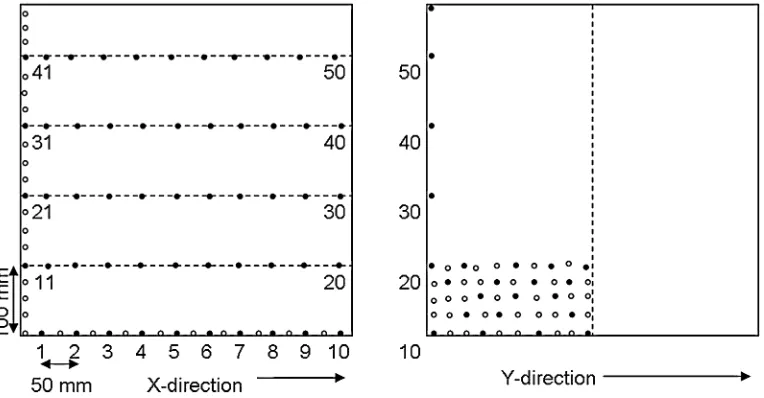
simula-tions for basalt and sandstone projectiles, which represent igneous and sedimentary materials, re-spectively. The projectiles were modeled as cubes, 0.5 m on a side, striking the lunar surface at velocities in the range of 2.5 to 5.0 km/s and impact angles of 90°, 45°, and 20° to the horizon-tal. The Smooth Particle Hydrodynamics (SPH) solver—a gridless Lagrangian formulation—was adopted for the calculations, with a resolution of 20 SPH particles per projectile diameter; this number is a compromise between the require-ments of adequate resolution (see below) and manageable computational time. The projectile was defined with 8000 particles and the target with 360,000 particles. A total of 500 gauge points (the maximum number available in AUTODYN-3D) were spaced at 50 mm intervals in regular ar-rays parallel to the x-axis of the projectile, but ran-domly distributed in the y and z directions to ensure coverage of a representative selection of gauges (Fig. 1); 450 gauge points were placed in the projectile, while 50 were distributed around the impact site in the target. For the 2D (90°, ver-tical) simulations, there were 200 gauge points available, which was sufficient to apply one gauge point to each SPH particle in the projectile. The gauge points were also Lagrangian; that is, they moved with the material location to which they had been assigned, and therefore always mea-sured the state of the same volume of material.
[image:6.612.118.500.471.670.2]To approximate the unconsolidated nature of
FIG. 1. Simplified diagram illustrating the distribution of gauge points (filled circles, with numbers assigned), and SPH particles (open circles), in the projectile.The left-hand plot shows 50 gauge points on the XZ face; the
gauges are spaced every 50 mm in the X direction and spaced every 100 mm in the Z direction. The right-hand
the lunar regolith, we modeled the target as sand (the physical properties of which are incorpo-rated into the AUTODYN material library using a compaction equation of state); in future efforts, we will attempt to refine these values to be more directly applicable to lunar regolith. The adopted shock equation-of-state input values are listed in Table 1. In addition to the equation of state, the materials are defined by various mechanical properties (e.g., shear modulus, yield strength), which describe the way in which the material fails upon impact. We defined our basalt and sand-stone projectiles using values taken from Lama and Vutukuri (1978). The adopted input values for the projectile materials are also presented in Table 1; the target material, sand, is pre-defined in the AUTODYN material library, based on work by Laine and Sandvik (2001).
For the purpose of our study, we were con-cerned with determining the peak pressures gen-erated in the initial stages of impact. Therefore, we ran our models so that the duration of the shock state was included. The duration of the shock state is the time required for the shock wave to propagate through the projectile, reflect at the rear surface, and travel back through the projectile as a rarefaction wave that releases the material from its shocked state. This is approxi-mately the time, t, for the projectile to traverse a depth equal to its own diameter, D, into the tar-get (e.g.,Pierazzo and Melosh, 2000a);
tD / vsin
where vis impact velocity and is the impact an-gle. For our choice of impact angles (90°, 45°, and 20°) and impact velocities (2.5 km/s and 5 km/s), the duration of the shocked state varies from 0.1–0.6 ms. Accordingly, all our models were run for several milliseconds, which represents be-tween 500 and 1000 computational cycles.
Results
As an initial experiment and test of our mod-els, we first used AUTODYN to duplicate the ver-tical 5 km/s impact of basalt into basalt consid-ered by Armstrong et al. (2002). In this case, we obtained a peak pressure of 77 GPa, which is higher than the PIA and LE results. However, this pressure was reported by only one gauge point (located on the impacting face) out of a total of 500 gauge points that sampled the whole
projec-tile; the median peak pressure recorded within the projectile was 22 GPa (with a minimum value of 2 GPa recorded on the trailing edge). Thus, as expected, peak pressures were higher close to the impacting face; if we consider the leading and trailing halves of the projectile separately (see be-low), we obtained median peak pressures of 28 and 14 GPa, respectively. Thus, while the PIA and LE methods described above appear to underes-timate the peak pressures encountered close to the impacting edges of the projectile, they over-estimate the peak pressures encountered within the body of the projectile.
Given that the lunar regolith (here modeled as sand) and terrestrial sedimentary rocks (here modeled as sandstone) have much lower densi-ties than basalt, we would expect even lower peak shock pressures than those estimated by Arm-strong et al. (2002) and, thus, a significantly in-creased probability of impact survival. We would also expect survivability to be further enhanced in the case of oblique impacts for both basalt and sandstone impactors, which also experience lower peak shock pressures (Pierazzo and Melosh, 2000a, 2000b).
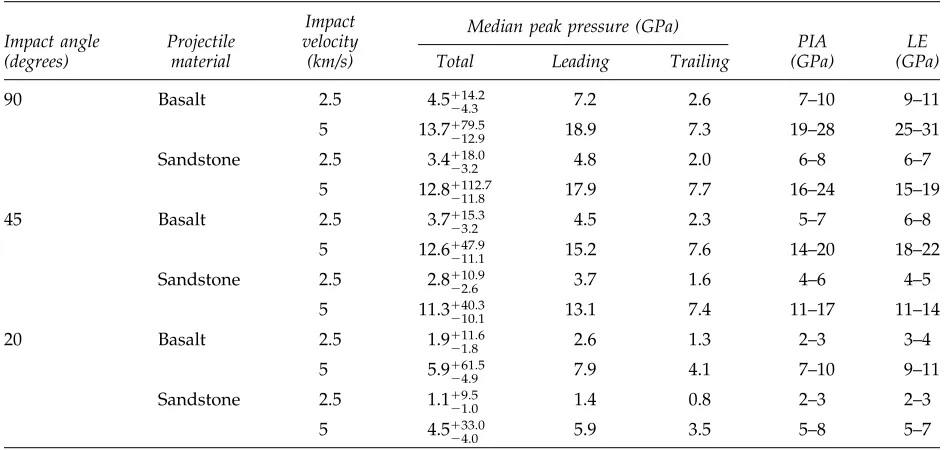
To explore these effects quantitatively, peak pressures were computed for impact velocities of 2.5 and 5.0 km/s into sand and a range of impact angles. The results are given in Table 2. We pre-sent the median value of the peak pressure recorded by all gauge points and the range of peak pressures around this value. We also pre-sent the median peak pressure values for the lead-ing and traillead-ing halves of the projectile (defined in Fig. 2). Median values are listed because the maximum values are generally returned by just 1 or 2 gauge points, whereas the median repre-sents the midpoint of the returned values and thus better represents the typical peak pressure experienced by the bulk of the projectile. Table 2 also lists the predictions made with the PIA and LE techniques for comparison. [For the latter cal-culations, the material parameters adopted for the projectile are those given in Table 1; those for sand are from Ahrens and Johnson (1995): ot
1610 kg m3 (very close to the measured bulk
density of lunar regolith of 1660 kg m3; Carrier
et al., 1991); S10.46; C11.70 km s1; S21.1;
C22.10 km s1, where the subscripts 1 and 2
refer to low and high pressure phases, respec-tively]. As would be expected, and as was con-firmed by the earlier calculations of Pierazzo and Melosh (2000a, 2000b), peak pressures were
higher in the leading halves of the projectile than in the trailing, which leads to an enhanced prob-ability of projectile material surviving from the trailing portion of the projectile.
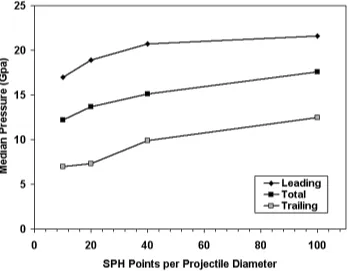
As discussed by Pierazzo et al.(1997), it is nec-essary to ensure that hydrocode calculations are performed at sufficient resolution to ensure that they have converged, and this is a particular con-cern for SPH codes (H.J. Melosh, personal com-munication, 2007). We do not have the computa-tional resources to repeat all our calculations at higher resolution, but we have performed a
res-olution test by repeating the 90° basalt projectile impact with resolutions of 10, 20, 40, and 100 SPH particles across the projectile. The results are shown in Fig. 3, from which it is apparent that the pressures obtained in the 20 SPH particle case
(i.e.,those listed in Table 2) are underestimates of
the true values but probably only by about 30–50% in the case of the whole projectile. It should be noted that in most cases such a cor-rection would bring the median hydrocode nu-merical values into better agreement with those estimated by the PIA and LE methods.
TABLE2. RESULTS OFAUTODYN SIMULATIONS
Impact
Impact angle Projectile velocity PIA LE
(degrees) material (km/s) Total Leading Trailing (GPa) (GPa)
90 Basalt 2.5 4.514.2 7.2 2.6 7–10 9–11
5.0 13.779.5 18.9 7.3 19–28 25–31
Sandstone 2.5 3.418.0 4.8 2.0 6–8 6–7
5.0 12.8112.7 17.9 7.7 16–24 15–19
45 Basalt 2.5 3.715.3 4.5 2.3 5–7 6–8
5.0 12.647.9 15.2 7.6 14–20 18–22
Sandstone 2.5 2.810.9 3.7 1.6 4–6 4–5
5.0 11.340.3 13.1 7.4 11–17 11–14
20 Basalt 2.5 1.911.6 2.6 1.3 2–3 3–4
5.0 5.961.5 7.9 4.1 7–10 9–11
Sandstone 2.5 1.19.5 1.4 0.8 2–3 2–3
5.0 4.533.0 5.9 3.5 5–8 5–7
Results are expressed as the median values of peak pressures recorded by the 500 gauge points sampling the pro-jectile, and for the leading and trailing halves. For the whole propro-jectile, the total range of peak pressures recorded around the median value is indicated. Results for the PIA and LE approximations are given for comparison, where the range corresponds to that obtained for low and high pressure values for the material properties; values for oblique impacts have been obtained by multiplying by the sine of the impact angle (see text for details).
4.3
12.9
3.2
11.8
3.2
11.1
2.6
10.1
1.8
4.9
1.0
4.0
[image:8.612.70.545.72.297.2]Median peak pressure (GPa)
[image:8.612.129.488.553.691.2]SURVIVAL OF BIOMARKERS
The effects of impact-induced shock on geo-logical materials were recently summarized by Stöffler et al. (2006) as follows: the transition be-tween elastic to non-elastic behavior typically oc-curs in the range of 5 to 12 GPa; mechanical deformation and transition to high-pressure min-eral phases occur between about 10 and 60 GPa; and finally, whole-rock melting begins at about 80 GPa for mafic rocks (such as our basalt pro-jectile) and 40 GPa for porous siliceous rocks (such as our sandstone projectile). Post-shock temperatures would be expected to be of the or-der of 100°C at 10 GPa, rising to about 1000°C at 50 GPa (French, 1998).
The results shown in Table 2 indicate that, for the cases of a vertical impact at 5 km/s, some por-tion of the sandstone and basalt projectiles expe-rienced pressures above that at which melting is expected to occur but that the bulk of the projec-tile, and especially the trailing half, was subjected to much lower pressures. Indeed, Table 2 shows that, in all cases (i.e., even for 90° impacts at 5 km/s impacts), the median peak pressures
at-tained in the trailing half of the projectile were all
10 GPa and generally less than 5 GPa. The pro-jectile material should thus be essentially unal-tered by impact-induced shock processes. At 2.5 km/s, no part of the projectile even approached a peak pressure at which melting would be ex-pected. These conclusions are not substantially al-tered by the resolution issues discussed above, and they confirm the general conclusion reached by Armstrong et al. (2002), which was that sub-stantial survivability of terrestrial meteorites on the Moon is to be expected. It should be noted that similar conclusions have recently been re-ported by Bland et al.(2007) in the context of “nor-mal” (i.e., non-terrestrial and therefore higher ve-locity) meteorite impacts on the lunar surface.
As Armstrong et al. (2002) noted with regard to survival in a projectile, biomarkers may range from those that are likely to be preserved in any intact meteorite (e.g., isotope ratios and organic carbon) to those that may only be preserved in the least-shocked and, thus, rarest specimens (e.g., complex molecular fossils or actual micro-fossils, or both). In this context, we note that for most of the impacts (and especially for the
[image:9.612.134.483.58.329.2]trail-CRAWFORD ET AL. 248
ing halves) much of the projectile’s volume was subjected to peak pressures below 5–12 GPa, at which the transition from elastic to plastic be-havior is expected to occur, which led us to ex-pect substantial survival of even quite fragile bio-markers in this type of material. On the other hand, the survival of at least some biomarkers (microfossils, for instance) will presumably de-pend on the extent to which an impacting mete-orite remains physically intact, regardless of the peak pressures to which it is subjected. We might expect relatively weakly cemented sedimentary rocks to fare less well than crystalline igneous materials in this respect. It is important to note, however, that the search for evidence of life need not be restricted to relatively weak sedimentary rocks. Microbial communities are found in the glassy margins of ocean floor basalts (Thorseth et al.,2001), and evidence of life in the form of min-eralized tubes, organic carbon, and carbon iso-tope ratios has been found in Archean pillow lavas (Furnes et al.,2004). It is also true that many rocks likely to contain ancient fossils (e.g.,chert) have a strength between that of sandstones and basalt. We hope to address some of these issues in future work.
METEORITE SURVIVABILITY ON THE MOON
Terrestrial meteorites that survive initial im-pact with the lunar surface will begin to be bro-ken down by the same processes of micromete-orite bombardment responsible for the formation of the lunar regolith. This process is relatively rapid. For example, Hörz et al.(1991) estimated that a typical 1 kg rock is likely to survive for of the order of 10 Myr on the lunar surface. As noted above, the bulk of terrestrial materials on the Moon, and certainly that which is the most as-trobiologically interesting, will have arrived dur-ing the heavy bombardment prior to 3.8 Gyr ago. While, on the one hand, the generation of large-scale basin ejecta blankets during the heavy bom-bardment and the later coverage of large areas by mare basalts would have buried most of this ma-terial to depths where it has been protected from later impact erosion, it is also true that such bur-ial greatly complicates efforts to locate it.
Fortunately, as pointed out by Armstrong et al. (2002), the continual gardening of the lunar re-golith by impacts of all sizes is continuously
bringing buried materials to the surface, and this will presumably include some fraction of the to-tal quantity of terrestrial materials that are se-questered at depth. Following this argument, Armstrong et al.(2002) estimated that at present the average concentration of terrestrial materials exposed at the lunar surface will be of the order of 7 ppm. However, the extent to which bio-markers within buried terrestrial material will survive the impact excavation, gardening, and comminution of the regolith is yet to be assessed, and it may be that the deliberate excavation of terrestrial meteorites preserved at depth [e.g., in buried palaeoregolith deposits (Crawford, 2006; Crawford et al.,2007)] will be required to obtain scientifically useful samples.
DETECTING EARTH ROCKS ON THE MOON
Similarly, carbonates exhibit a characteristic se-ries of sharp, narrow absorption features in the spectral region between 2 and 3 m (Gaffey, 1986; Gaffey et al., 1993), which may also be diagnostic of a terrestrial origin. Other minerals that result from aqueous processes, such as clay minerals and sulfates, also have distinctive spectral fea-tures in this region.
Large meteorites (1 m in size) might be de-tectable from orbit with the use of a hyperspec-tral imaging system based on the “push-broom” imaging approach (Mouroulis et al., 2000). An ex-ample of such a system is the Moon Mineralogy Mapper (M3), which will fly on the Chandrayaan 1 mission. M3 (Green et al., 2007; Pieters et al., 2006) is a compact, low-mass instrument (8 kg) with a resolution of 10 nm over 430–3000 nm and has a spatial resolution of 70 m/pixel. A similar instrument, fed by a much larger telescope and perhaps operating in a lower orbit, could be ca-pable of spatial resolutions of 1 m or less. A rover equipped with a hyperspectral imaging system could search for smaller meteorites ex-posed at the surface. For such a system, an im-ager fed by an acousto-optic tunable filter (e.g.,
Gupta 2005) would be an appropriate compact technology. For both the orbital and surface cases, the spectra of a very large number of image points would be collected. The system could be pro-grammed to search for spectra with a particular spectral feature or to look for unusual spectra—
i.e., anything different from the typical spectra seen from normal lunar materials. We also note that the recent discovery of up to 5 meteorites on the surface of Mars by the Mars Exploration Rovers Spirit and Opportunity (e.g., Rodionov et al., 2005; Ashley et al., 2007) demonstrates that the detection of meteorites on planetary surfaces by
in situ robotic means is achievable (though, of
course, the martian atmosphere would have de-celerated these meteorites during infall, and they survived impact with the surface in a more pris-tine state than would be the case for lunar exam-ples).
A parallel can be drawn with regard to the now-routine collection of meteorites in Antarc-tica: just as there are places in Antarctica where any rock sighted on the surface is likely to be a meteorite, we can imagine scanning the lunar sur-face with infrared instruments sensitive to hy-drated silicates such that every specimen detected stands a good chance of being a terrestrial (or martian) meteorite deserving of more detailed
analysis. It is certainly possible to design a suit-able robotic infrared imaging system that could survey hundreds of square kilometers quite quickly and thus efficiently identify candidates despite their expected rarity. On the other hand, the collection of these candidate materials, their preliminary characterization in situ, and the re-turn to Earth of selected specimens for more de-tailed analysis would be greatly facilitated by a human presence on the Moon (Crawford, 2004). Further, the search for buried materials (e.g., in palaeoregolith deposits) may be impractical with-out a human presence.
CONCLUSIONS
Terrestrial meteorites on the Moon may pre-serve valuable information about Earth’s early surface environment, including evidence for the conditions under which life arose on our planet. Here we have used the AUTODYN hydrody-namics code to calculate the peak pressures within terrestrial meteorites impacting the lunar surface. Our results confirm the order-of-magni-tude estimates of Armstrong et al. (2002) that sub-stantial survivability is to be expected, especially in the case of relatively low velocity (ca.2.5 km/s) or oblique (45°) impacts, or both. We have con-sidered how terrestrial materials might be located on the Moon and have identified a number of pos-sible spectroscopic detection methods. While ro-botic searches for terrestrial (and other terrestrial planet) materials is possible in principle, for rea-sons set out by Crawford (2004) this is the kind of large-scale exploratory activity that would be greatly facilitated by a renewed human presence on the Moon.
ACKNOWLEDGMENTS
We thank Paul DeCarli (SRI International) for helpful discussions on modeling and shock-wave physics. The 3D hydrocode simulations were car-ried out at the Open University and the 2D sim-ulations at University College London. We thank Lidunka Vocadlo (and through her the Royal So-ciety) for facilitating access to AUTODYN 2D at UCL, and Geoff Bradshaw (Manager, OU Science Faculty Impact Computational Cluster) for pro-vision of processing nodes and terabyte data stor-age capabilities. We thank our two referees
fessor H.J. Melosh, the other anonymous) for very helpful comments which have greatly improved the quality of this paper. Emily Baldwin ac-knowledges PPARC/STFC for the award of a post-graduate studentship.
ABBREVIATIONS
LE, Late Stage Effective Energy; PIA, Planar Impact Approximation; SPH, Smooth Particle Hydrodynamics.
REFERENCES
Ahrens, T.J and Johnson, M.L. (1995) Shock wave data for rocks. In AGU Reference Shelf 3: Rock Physics and Phase Relations, A Handbook of Physical Constants, edited by T.J. Ahrens, American Geophysical Union, Washington, DC, pp 35–44.
Allwood, A.C., Walter, M.R., Kamber, B.S., Marshall, C.P., and Burch, J.W. (2006) Stromatolite reef from Early Ar-chaean era of Australia. Nature441, 714–718.
Armstrong, J.C., Wells, L.E., and Gonzales, G. (2002) Rum-maging through Earth’s attic for remains of ancient life.
Icarus160, 183–196.
Ashley, J.W., Ruff, S.W., Christensen, P.R., and Leshin, L.A. (2007) Metallic iron in meteorites as a sensitive tracer of surface-volatile interactions on Mars [abstract 2264]. In 38thLunar and Planetary Science Conference
Ab-stracts, Lunar and Planetary Institute, Houston. Baldwin, E.C., Vocadlo, L., and Crawford, I.A. (2005)
Val-idation of AUTODYN in replicating large-scale plane-tary impact events [abstract 1380]. In 36th Lunar and
Planetary Science Conference Abstracts, Lunar and Plan-etary Institute, Houston.
Battistuzzi, F.U., Feijao, A., and Hedges, S.B. (2004) A ge-nomic timescale of prokaryote evolution: insights into the origin of methanogenesis, phototrophy, and the col-onization of land. BMC Evol. Biol. 4, 44 (doi:10.1186/ 1471-2148-4-44).
Bibring, J.-P., Langevin, Y., Gendrin, A., Gondet, B., Poulet, F., Berthé, M., Soufflot, A., Arvidson, R., Man-gold, N., Mustard, J., Drossart, P., and the OMEGA team. (2005) Mars surface diversity as revealed by the OMEGA/ Mars Express observations. Science307, 1576–1581. Bland, P.A., Artemieva, N.A., Bussey, D.B.J., Collins, G.S.,
and Joy, K.H. (2007) Survival of asteroidal impact ma-terial on the Moon [abstract 5251]. In 70thAnnual
Mete-oritical Society Meeting, Tuscon, AZ, Lunar and Plane-tary Institute, Houston.
Brasier, M.D., Green, O.R., Jephcoat, A.P., Kleppe, A.K., Van Kranendonk, M.J., Lindsay, J.F., Steele, A., and Grassineau, N.V. (2002) Questioning the evidence for Earth’s oldest fossils. Nature416, 76–81.
Brocks, J.J. and Summons, R.E. (2005) Sedimentary hy-drocarbons, biomarkers for early life. In Treatise on
Geo-chemistry, Volume 8: Biogeochemistry, edited by W.H. Schlesinger, Elsevier, Amsterdam, pp 63–115.
Burchell, M.J. (2004) Panspermia today. Int. J. Astrobiology
3, 73–80.
Carrier, W., Olhoeft, G.R., and Mandell, W. (1991) Phys-ical properties of the lunar surface. In The Lunar
Source-book, edited by G.H. Heiken, D.T. Vaniman, and B.M.
French, Cambridge University Press, Cambridge, pp 475–594.
Crawford, I.A. (2004) The scientific case for renewed hu-man activities on the Moon. Space Policy20, 91–98. Crawford, I.A. (2006) The astrobiological case for renewed
robotic and human exploration of the Moon. Int. J. As-trobiology5, 191–197.
Crawford, I.A., Fagents, S.A., and Joy, K.H. (2007) The survival of ancient solar wind, galactic cosmic ray par-ticles, and samples of the early Earth in lunar palaeo-regolith deposits [abstract 1323]. In 38thLunar and
Plan-etary Science Conference Abstracts, Lunar and Planetary Institute, Houston.
Century Dynamics, Inc. (2003) AUTODYN Theory Manual,
Century Dynamics, Suite 1, 3 Horsham Gates, North Street, Horsham, West Sussex, RH13 5PJ, United King-dom.
French, B.M. (1998) Traces of Catastrophe: A Handbook of Shock-Metamorphic Effects in Terrestrial Meteorite Impact Structures, LPI Contribution No. 954, Lunar and Plan-etary Institute, Houston.
Furnes, H., Banerjee, N.R., Muehlenbachs, K., Staudigel, H., and de Wit, M. (2004) Early life recorded in Ar-chaean pillow lavas. Science304, 578–581.
Gaffey, S.J. (1986) Spectral reflectance of carbonate min-erals in the visible and near infrared (0.35–2.55 mi-crons): calcite, aragonite and dolomite. Am. Mineral.71, 151–162.
Gaffey, S.J., McFadden, L.A., Nash, D., and Pieters, C. (1993) Ultraviolet, visible, and near-infrared reflectance spectroscopy. In Remote Geochemical Analysis: Elemental and Mineralogical Composition, edited by C.M. Pieters and P.A. Englert, Cambridge University Press, Cam-bridge, pp 43–77.
Green, R.O., Pieters, C., Moroulis, P., Sellars, G., East-wood, M., Geier, S., and Shea, J. (2007) The Moon Min-eralogy Mapper: characteristics and early laboratory calibration results [abstract 2354]. In 38thLunar and
Plan-etary Science Conference Abstracts, Lunar and Planetary Institute, Houston.
Gupta, N. (2005) Acousto-optic tunable filters for infrared
imaging. Proc. Soc. Photo. Opt. Instrum. Eng. 5953,
190–199.
Hayhurst, C.J. and Clegg, R.A. (1997) Cylindrical sym-metric SPH simulations of hypervelocity impacts on thin plates. Int. J. Impact Eng.20, 337–348.
Hörz, F., Grieve, R., Heiken, G., Spudis, P., and Binder, A. (1991) Lunar surface processes. In The Lunar
Source-book, edited by G.H. Heiken., D.T. Vaniman, and B.M.
French, Cambridge University Press, Cambridge, pp 61–120.
Min-eralogy and Geochemistry, Vol. 60, Mineralogical Society of America, Chantilly, VA.
Laine, L. and Sandvik, A. (2001) Derivation of mechani-cal properties for sand. In Proceedings of the Fourth Asia-Pacific Conference on Shock and Impact Loads on Structures, CI-Premier Pte Ltd., Singapore, pp 361–367.
Lama, R.D. and Vutukuri, V. S. (1978) Handbook on
Me-chanical Properties of Rocks, Volume II. Trans Tech Pub-lications, Stafa-Zurich, Switzerland.
Lepland, A., van Zuilen, M.A., Arrhenius, G., White-house, M.J., and Fedo, C.M. (2005) Questioning the ev-idence for Earth’s earliest life—Akilia revisited. Geology
33, 77–79.
McKeegan, K.D., Kudryavtsev, A.B., and Schopf, J.W. (2007) Geology35, 591–594.
Melosh, H.J. (1988) The rocky road to panspermia. Nature
332, 687–688.
Melosh, H.J. (1989) Impact Cratering: A Geologic Process, Oxford University Press, Oxford.
Mileikowsky, C., Cucinotta, F.A., Wilson, J.W., Gladman, B., Horneck, G., Lindegren, L., Melosh, J., Rickman, H., Valtonen, M., and Zheng, J.Q. (2000) Natural transfer of viable microbes in space: 1. From Mars to Earth and Earth to Mars. Icarus145, 391–427.
Mizutani, H., Takagi, Y., and Kawakami, S.-I. (1990) New
scaling laws on impact fragmentation. Icarus 87,
307–326.
Mojzsis, S.J., Arrhenius, G., McKeegan, K.D., Harrison, T.M., Nutman, A.P., and Friend, C.R.L. (1996) Evidence of life on Earth before 3,800 million years ago. Nature
384, 55–59.
Moroulis, P., Green, R.O., and Chrien, T.G. (2000) Design of push-broom imaging spectrometers for optimum re-covery of spectroscopic and spatial information. Appl. Opt.39, 2210–2220.
Papike J.J., Ryder G., and Shearer, C.K. (1998) Lunar sam-ples. In Planetary Materials, edited by J.J. Papike, Min-eralogical Society of America, Chantilly, VA, pp 5.1–5.234.
Pierazzo, E. and Chyba, C.F. (1999) Amino acid survival in large cometary impacts. Meteorit. Planet. Sci. 34, 909–918.
Pierazzo, E. and Melosh, H. (2000a) Hydrocode modeling of oblique impacts: the fate of the projectile. Meteorit. Planet. Sci. 35, 117–130.
Pierazzo, E. and Melosh, H. (2000b) Understanding oblique impacts from experiments, observations and modelling. Annu. Rev. Earth. Planet. Sci. 28, 141–167. Pierazzo, E., Vickery, A.M., and Melosh, H.J. (1997) A
re-evaluation of impact melt production. Icarus 127,
408–423.
Pieters, C., Boardman, J., Buratti, B., Clark, R., Green, R., Head, J.W., McCord, T.B., Mustard, J., Runyon, C., Staid, M., Sunshine, J., Taylor, L., and Tompkins, S. (2006) Global mineralogy of the Moon [abstract 1630]. In 37thLunar and Planetary Science Conference Abstracts, Lunar and Planetary Institute, Houston.
Rasmussen, B. (2000) Filamentous microfossils in a 3235-million-year-old volcanogenic massive sulphide de-posit. Nature405, 676–679.
Rodionov, D.S., Klingelhöfer, G., Ming, D.W., Morris, R.V., Schröder, C., de Souza, P.A., Squyres, S.W., and Yen, A.S. (2005) An iron-nickel meteorite on Meridiani Planum: observations by MER Opportunity’s Moess-bauer spectrometer. Geophys. Res. Abstr. 7, 10242. Rollinson, H. (2007) Early Earth Systems: A Geochemical
Ap-proach, Blackwell Publishing, Oxford.
Schopf, J.W. (1993) Microfossils of the Early Archaean Apex chert: new evidence for the antiquity of life. Sci-ence260, 640–646.
Schopf, J.W. and Walter, M.R. (1983) Archaean microfos-sils: new evidence of ancient microbes. In Earth’s Earli-est Biosphere, edited by J.W. Schopf, Princeton Univer-sity Press, Princeton, pp 214–239.
Sharp, T.G. and DeCarli, P.S. (2006) Shock effects in me-teorites. In Meteorites and the Early Solar System, edited by D.S. Lauretta and H.Y. McSween, Jr., University of Arizona Press, Tucson, AZ, pp 653–677.
Stöffler, D., Ryder, G., Ivanov, B.A., Artemieva, N.A., Cin-tala, M.J., and Grieve, R.A.F. (2006) Cratering history
and lunar chronology. In New Views of the Moon,
Re-views in Mineralogy and Geochemistry, Vol. 60, edited by B.L. Jolliff, M.A. Wieczorek, C.K. Shearer, and C.R. Neal, Mineralogical Society of America, Chantilly, VA. pp 519–596.
Taylor, S.R. (2001) Solar System Evolution: A New Perspec-tive, Cambridge University Press, Cambridge.
Thorseth, I.H., Torsvik, T., Torsvik, V., Daae, F.L., Peder-sen, R.B., and Keldysh-98 Scientific Party (2001) Diver-sity of life in ocean floor basalt. Earth Planet. Sci. Lett. 194, 31–37.
Watson, E.B. and Harrison, T.M. (2005) Zircon ther-mometer reveals minimum melting conditions on ear-liest Earth. Science308, 841–844.
Westall, F. and Southam, G. (2006) The early record of life. In Archean Geodynamics and Environments, edited by K. Benn, J.-C. Mareschal, and K.C. Condie, AGU Geo-physical Monograph Series, 164, 283–304.
Westall, F., de Ronde, C.E.J., Southam, G., Grassineau, N., Colas, M., Cockell, C., and Lammer, H. (2006) Implic-tions of a 3.472–3.333 Gyr-old subaerial microbial mat from the Barberton greenstone belt, South Africa for the
UV environmental conditions on the early Earth.
Phi-los. Trans. R. Soc. Lond., B, Biol. Sci.361, 1857–1875. Wilde, S.A., Valley, J.W., Peck, W.H., and Graham, C.M.
(2001) Evidence from detrital zircons for the existence of continental crust and oceans on the Earth 4.4 Gyr ago. Nature409, 175–178.
Address reprint requests to:
Dr. I.A. Crawford School of Earth Sciences Birkbeck College London Malet Street London WC1E 7HX United Kingdom
E-mail: [email protected]