Understanding the referential nature of looking: infants’ preference for
object-directed gaze. Cognition 108 (2), pp. 303-319. ISSN 0010-0277.
Downloaded from:
Usage Guidelines:
Please refer to usage guidelines at or alternatively
Enabling open access to Birkbeck’s published research output
Understanding the referential nature of looking: infants’
preference for object-directed gaze
Journal Article
http://eprints.bbk.ac.uk/3911
Version: Accepted (Refereed)
Citation:
© 2008
Elsevier
Publisher version
______________________________________________________________
All articles available through Birkbeck ePrints are protected by intellectual property law, including copyright law. Any use made of the contents should comply with the relevant law.
______________________________________________________________
Deposit Guide
Contact: [email protected]
Senju, A.; Csibra, G.; Johnson, M.H. (2008)
Understanding the referential nature of looking: infants’ preference for
object-directed gaze–
Cognition 108 (2008) 303-319. doi:10.1016/j.cognition.2008.02.009
Understanding the referential nature of looking: Infants’ preference for
object-directed gaze
Atsushi Senju, Gergely Csibra, Mark H. Johnson Birkbeck, University of London
Correspondence concerning this article should be addressed to Atsushi Senju, Centre for Brain and Cognitive Development, School of Psychology, Birkbeck College, Malet Street, London WC1E 7HX. Fax: +44 20 7631 6587; E-mail: [email protected]
Abstract
In four experiments, we investigated whether 9-month-old infants are sensitive to the relationship between gaze direction and object location and whether this sensitivity depends on the presence of communicative cues like eye contact. Infants observed a face, which repeatedly shifted its eyes either toward, or away from, unpredictably appearing objects. We found that they looked longer at the face when the gaze shifts were congruent with the location of the object. A second experiment ruled out that this effect was simply due to spatial congruency, while a third and a fourth experiment revealed that a preceding period of eye contact is required to elicit the gaze-object congruency effect. These results indicate that infants at this age can encode eye direction in referential terms in the presence of communication cues and are biased to attend to scenes with object-directed gaze.
Key Words:
Eye gaze, face, infant, looking time, social cognition
1. Introduction
Eye gaze conveys rich information during human interactions. One important aspect of eye gaze is its referential nature. Eyes point to the subject of someone's attention and intention, provide a reliable signal to infer mental states (Baron-Cohen, 1995), and help us identify and share the topic during communication and social learning (Bloom, 2000; Csibra & Gergely, 2006). Recent neuroimaging studies have revealed that specific brain regions, such as the superior temporal sulcus and the inferior parietal sulcus, encode the relation between others’ eye gaze and the objects being looked at (Bristow, Rees, & Frith, 2006; Pelphrey, Morris, & McCarthy, 2005;Pelphrey, Singerman, Allison, & McCarthy, 2003).
Infants are sensitive to eye gaze from very early on. Even newborns can
Pividori, & Johnson, 2004). However, at least up to 4 months of age, this rudimentary form of ‘gaze following’, or attentional shift to the direction indicated by gaze shifts (Hood, Willen, & Driver, 1998), seems to be based not on the perception of gaze direction but on simpler mechanisms. Farroni, Johnson, Brockbank and Simion (2000) tested 4 to 5-months-old infants with stimuli in which the eyes stayed in the same position relative to the viewer, while the whole face image, except pupils, translated (not rotated) laterally so that the resulting gaze appeared to point to the opposite direction of the face displacement. They found that infants at that age shifted their attention to the direction of face motion rather than of the resulting gaze position. In addition, Farroni, Mansfield, Lai, and Johnson (2003) reported that attentional shifts to the direction of lateral gaze motion were present only when they followed a period of perceived eye contact. These studies suggest that this rudimentary form of attention following in young infants involves (1) detecting eye contact (i.e., direct gaze), and (2) shifting attention in the direction of lateral motion that follows eye contact. However, it is important to note that not all lateral motion following the eye contact may trigger attention shifts in young infants. For example, Hood et al. (1998) reported that lateral motion of the tongue did not have an effect on infants’ spatial attention.
Given that young infants are sensitive to others’ eye direction, a further question is whether they are also sensitive to the relations between eye gaze and objects, i.e., to the referential nature of gaze. Such sensitivity would be highly beneficial for young infants, especially in the context of social learning. Information about object-directed gaze can, for example, disambiguate others' intention when they manipulate novel objects. Referential gaze is perhaps the most important cue for word learning (Baldwin, 1991; Bloom, 2000) and can also contribute to learning other object properties in social referencing situations (e.g., Mumme & Fernald, 2003). Note that understanding referential gaze is most useful in interactive contexts, in which the child is directly addressed by others. The object that the communicator is looking at is likely to be the referent of her message. Thus, understanding the referential nature of gaze provides a powerful mechanism for learning about objects and the meaning of words (Csibra & Gergely, 2006). However, some researchers do not think that infants younger than 1 year encode gaze-object relations. It has been argued that young infants’ gaze-following response is reflexive and does not involve an understanding of the relationship between the gaze of the agent and the object being looked at (e.g., Butterworth & Jarrett, 1991; Moore & Corkum, 1994). Related to this claim, Woodward (2003) reported that 7- and 9-month-old infants’ attention does not recover when an adult’s gaze changes from one object to another, and concluded that infants at those ages fail to understand the relationship between gaze direction and the target object.
gaze at this age. While this finding indicates that infants expect a referent object for a gaze shift, neuroimaging studies demonstrated that adults would also hold the opposite
expectation: that gaze shifts would be directed towards the sole object on the scene (Pelphrey et al., 2003, 2005). Although event-related potential studies suggest that this might also be true for infants (Senju, Johnson, & Csibra, 2006), there has been no behavioural evidence on this issue so far.
We conducted four experiments with 9-month-old infants to address this question. In all four experiments, our participants were presented with a face that occasionally looked right or left after a brief appearance of an object at one or the other side of the computer screen. Crucially, the gaze direction of the face either coincided with the object location or was opposite to it. If infants had no expectation about the referential nature of gaze, they would not be able to detect the difference between these conditions. If, however, they are sensitive to potential gaze-object relations, they should display evidence for discriminating between object-congruent and object-incongruent gaze stimuli.
Additionally, we were also interested in the nature of a potential rudimentary referential understanding in young infants. If infants conceive gaze-object relations in attentional terms (Brooks & Meltzoff, 2002, 2005; Woodward, 2003), they should expect people to look at objects, and when they fail to do so, their expectation would be violated resulting in longer looking times (Baillargeon, Spelke, & Wasserman, 1985; Csibra, Gergely, Bíró, Koós, & Brockbank, 1999; Gergely, Nadasdy, Csibra, & Bíró, 1995). Alternatively, if the initial function of sensitivity to gaze-object relations is to find objects that another person may communicate about (Csibra & Gergely, 2006), they would be more interested in observing a face looking at an object than looking at nothing. Although these two functions might not be mutually exclusive, they give opposite predictions for infants’ looking behaviour in the current experiments. Moreover, the latter theory yields a further prediction: Csibra and Gergely (2006) argue that infants should expect to see referential actions primarily if they immediately follow a communication signal, such as eye contact or infant-directed speech. Thus, we predicted that the removal of communication cues (i.e., the eye contact) from the stimuli would diminish infants’ sensitivity to gaze-object congruency.
Experiments 1 and 2 focused on the first question, i.e., whether 9-months-old infants are sensitive to gaze-object congruency. Experiment 1 tested whether infants’ looking time differs between the stimuli containing congruent gaze shifts and object-incongruent gaze shifts. By contrasting the direction of eye gaze and facial motion,
Experiment 2 further examined which aspect of gaze infants utilize when they detect gaze-object congruency. Experiments 3 and 4 were aimed at our second question, i.e., the role of eye contact in infants' sensitivity to gaze-object relations. These studies tested whether gaze-object congruency, in the absence of communication signals, is detected by infants.
2. Experiment 1
stimulus sequence. Both sequences involved an object appearing either to the right or to the left of the face, followed by a gaze shift toward the object (congruent trials) or away from the object (incongruent trials). Importantly, the object was removed when the gaze shift began in order to avoid a potential confound resulting from occasional gaze-following responses. If we had left the object present after the gaze shift, the congruent trials could have been more interesting to the infants simply because they would be always rewarded with objects whenever they follow the direction of gaze. We predicted that if infants comprehend eye-object relations, they will discriminate between the two sequences, and looking times to the two kinds of trials would differ.
2.1. Method
2.1.1. Participants
Fourteen 9-month-old (6 female and 8 male) infants completed the study. Their mean age in months and days was 9;0 (range 8;20 - 9;11). A further 9 infants were excluded from the analysis because they looked at the test trials for less than five seconds due to fussiness (3), did not look away from the screen for more than 90 seconds (4), or experimenter error (2).
2.1.2. Apparatus
Infants sat on their parent’s lap in a dimmed room approximately 1 m away from a plasma screen, on which the stimuli were presented. A remote-control infrared video camera was mounted above the screen. An experimenter monitored the infants' behaviour through a video monitor and controlled the direction and zooming of the video camera to follow infants’ movement and to keep their face within the frame of the video image. The experimenter pressed a key while infants were watching the stimulus display, and released it when they looked away. This procedure allowed us to record infants’ looking time on-line as well as to control the stimulus presentation delivered by a custom-built program. The whole session was videotaped for off-line analysis.
2.1.3. Stimuli and Procedure
Four test trials, preceded by two familiarization trials, were presented to each infant. Test trials consisted of two congruent trials and two incongruent trials, and were presented in ABBA order. Half of the infants watched a congruent trial first and the other half watched an incongruent trial first. Before every trial, the infants’ attention was drawn to a colour picture of female face (13º wide and 25º high) presented in the centre of the screen, with eyes blinking every 400 ms, by alerting sounds delivered from behind the screen. When the infant was attending to the screen, the experimenter pressed a key and started the trial.
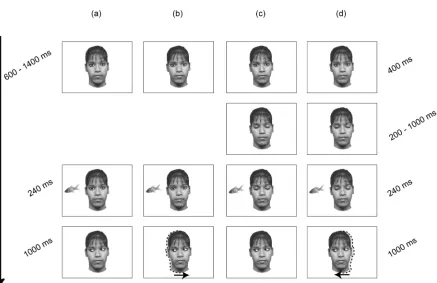
screen) was then presented either to the right or to the left of the face at 17º away from the centre, simultaneously with a brief sound delivered from behind the centre of the screen. The location of the object presentation was randomized within each block. The object disappeared after 240 ms, and at the same time the eyes of the face moved toward the location where the object was presented (congruent trials), or toward the opposite direction (incongruent trials), and remained at that position for 1000 ms (Figure 1a). The sequence of familiarization trials was exactly the same as that of the test trials, except that peripheral objects and the accompanying sounds were not presented. Note that this is not a ‘novelty preference’ type of study. No objects were presented in familiarization trials, and thus both congruent and incongruent trials should be equally novel compared to the familiarization phase.
During each trial, the stimulus sequence was presented in a loop (the end of each sequence being followed by the beginning of next sequence without delay) until the infant looked away from the screen for more than two seconds. Infants who kept watching the trial for more than 90 seconds were excluded from the analysis. If the infant watched the trial for less than 5 seconds, the trial was immediately repeated. An experimenter recorded the infants' looking time on-line with a custom-built computer program, which also
controlled stimulus presentation.
2.1.4. Data Analysis
A second coder, who was naïve to the experimental hypothesis, coded a subset of the data (6 infants) off-line. These secondary measurements were found to correspond well to the on-line coding (r = .95), and thus all data analyses were based on the on-line
Figure 1. Examples of stimulus sequences in Experiment 1 (a), 2 (b), 3 (c) and 4 (d). For illustrative purposes, an arrow has been added to the last frame of (b) and (d) to make it clear that the face translated laterally at this point. In addition, the dotted outlines in the last frame depict the position of the face image in the previous frame. Neither the arrows nor the dotted outlines appeared during the experiments. The depicted sequences represent 'gaze-congruent' trials. In 'gaze-incongruent' trials, the gaze shifted to the opposite direction to the object location. Sequences in familiarization trials were exactly same as in the test trials, except that the fish and the accompanying sounds were not presented.
2.2. Results and Discussion
The average looking times during the two familiarization trials were 14.5 s
(standard deviation [SD]: 7.2 s) and 11.8 s (SD: 4.0 s), respectively. During the test trials, infants looked significantly longer to congruent than to incongruent trials (Figure 2), as the main effect of congruence indicated (F(1,12) = 9.42, p < .01, ηp2 = .440). Average looking
times for congruent and incongruent trials were 19.9 s (SD: 8.6 s) and 15.7 s (SD: 6.2 s). A non-parametric Wilcoxon’s Sign Rank Test also confirmed this effect (Z = -2.47, p < .02). This result shows that infants’ looking time differed between the two types of trials, supporting our hypothesis that infants at this age are sensitive to eye-object relations.
The three-way interaction between congruence, trial repetition and initial trial was also significant (F(1,12) = 10.76, p < .01, ηp2 = .473). This was due to the longer looking
time in the initial test trial. In the first pair of trials, the congruency x initial trial interaction was significant (F(1,12) = 10.45, p < .01, ηp2 = .465) and the main effect of congruency
where the average looking times were 25.1 s (SD: 13.0 s) for congruent trials and 14.6 s (SD: 7.2 s) for incongruent trials, but not in the incongruent-first group (F(1,12) = 1.00, p
> .1, ηp2 = .077), where the average looking times were 16.6 s (SD: 7.1 s) for congruent
trials and 19.5 s (SD: 7.8 s) for incongruent trials. In the second pair of trials, where such initial exposure effect was absent, the congruency x initial trial interaction was not significant (F(1,12) = 0.98, p > .1, ηp2 = .076) and the main effect of congruency was
replicated (F(1,12) = 8.08, p < .02, ηp2 = .402), average looking times were 19.0 s for
[image:9.612.87.507.233.519.2]congruent trials and 14.2 s for incongruent trials, which confirms the main finding above. No other main effect or interaction was significant.
Figure 2. Mean looking time for congruent and incongruent trials in Experiments 1, 2, 3
and 4. Error bars represent standard error. *: p < .05.
The effect of congruence on looking times confirmed that 9-months-old infants are sensitive to gaze-object relations. In addition, infants looked longer to object-congruent gaze shifts than to object-incongruent gaze shifts. This suggests that the differential looking time may have been due to infants’ preference for the potentially informative situation, in which the adult is likely to communicate something about the referred object.
3. Experiment 2
The results of Experiment 1 accord with our hypothesis that infants are sensitive to the gaze-object relationship. However, it is also possible that they simply prefer the spatial congruency between the motion direction of the eyes (right or left) and the object location, rather than evaluating their correspondence. Since both the abrupt onset of peripheral objects (Johnson, Posner, & Rothbart, 1994; Johnson & Tucker, 1996) and lateral motion (Farroni et al., 2000, 2003, 2004) are known to cue infants’ spatial attention, it is possible that the infants in Experiment 1 looked for shorter time at the incongruent trials because they avoided the stimuli that involved an attentional conflict. Previous studies reported that 12-month-old infants would follow the head-turn of adults even when the eyes stay fixated on them and do not follow eye-gaze alone (Corkum & Moore, 1995; Caron, Bulter, & Brooks, 2002; but see Tomasello, Hare, Lehmann, & Call, 2007). In addition, Brooks and Meltzoff (2005) reported that 9-month-old, but not 10- and 11-month-old infants, would follow head turns even when the actor's eyes were closed. These studies may also suggest that 9-month-old infants are sensitive to lateral motion, not gaze direction per se.
Experiment 2 tested this alternative hypothesis. Infants were shown a face and peripheral objects as in Experiment 1. However, rather than the pupils shifting and the rest of the face remaining static, in Experiment 2 the whole face image (except for the pupils) translated laterally while the image of the pupils remained at the same position on the screen. As a result, the eye gaze direction ended up in the opposite direction to the motion cues provided by displacement of the face. Farroni et al. (2000) used the same technique to study gaze cueing and found that 4 to 5-month-old infants were cued by the direction of facial motion, opposite to the perceived shift of gaze direction.
This study offered two possible outcomes. If 9-month-old infants are only sensitive to motion cues, they should look longer to the trials that present face motion congruent with the object’s location. On the other hand, if they encode the ensuing eye gaze direction and its relationship to the object, they should look longer to the trials that present congruent gaze direction (and incongruent motion direction) with regard to the location of the preceding object.
3.1. Method
Twelve 9-month-old (7 female and 5 male) infants completed the study. Their mean age was 9;4 (range 8;29 – 9;9). An additional five infants were excluded from the analysis because they looked at the test trials for less than 5 seconds due to fussiness, (1), did not look away for more than 90 seconds (1), parental interference (1), or experimenter error (2).
The apparatus, stimuli and procedure were the same as those of Experiment 1, except that, simultaneously with the disappearance of the object, the face was displaced laterally to the same extent as pupil motion in Experiment 1 while the pupils remained at the same place (Figure 1b). Familiarization trials were the same as test trials except for the absence of the peripheral objects and the accompanying sounds.
(4 infants) were also coded off-line by a second naïve coder. The correspondence between the two measurements was high (r = .90) and thus all data analyses were performed using the results from on-line timing.
3.2. Results and Discussion
Looking times during the two familiarization trials were 19.0 s (SD: 23.7 s) and 16.2 s (SD: 15.9 s), respectively. Infants looked significantly longer to the gaze-congruent trials than gaze-incongruent trials during the test phase (Figure 2), and this difference reached statistical significance (F(1,10) = 9.94, p < .02, ηp2 = .498). Average looking times
for congruent and incongruent trials were 27.2 s (SD: 11.2 s) and 18.1 s (SD: 10.2 s), respectively. A non-parametric Wilcoxon’s Sign Rank Test also confirmed this effect (Z = -2.12, p < .05). This result shows that gaze direction, and not spatial congruency between motion and object location, contributed to the eye-object congruency effect found in Experiment 1.
A main effect of trial repetition was also significant (F(1,10) = 26.46, p < .01, ηp2
= .726), which was due to infants looking longer to the first test trial pair compared to the second test trial pair. Average looking times for first and second trial pairs were 30.0 s (SD: 17.3 s) and 15.2 s (SD: 8.3 s), respectively. No other main effect or interaction was
significant.
These results showed that infants look longer to congruent gaze (i.e., object-incongruent motion) than to object-object-incongruent gaze (i.e., object-congruent motion). This outcome of Experiment 2 clarifies that 9-month-old infants' preference in Experiment 1 was likely to have been dependent on gaze position rather than on motion direction in relation to a previously appearing object. This result also suggests that, at least by 9 months of age, infants' automatic shifts of attention with motion direction (Farroni et al., 2000) can be overridden by gaze information.
Note that in both Experiment 1 and 2 the gaze shifts were always preceded by a period of perceived eye contact (i.e., direct gaze), which is known to be a precondition for gaze following in young infants (Farroni et al., 2003). In the following experiments we investigated whether this preceding period of eye contact is also required for eliciting infants’ sensitivity to gaze-object congruency.
4. Experiment 3
In Experiments 1 and 2 we found that infants did not only discriminate between object-congruent and object-incongruent gaze, but consistently preferred to look at a face glancing to the location of objects. This suggests that infants' looking time was not driven by violation of expectation, but was based on paying more attention to the scene with object-congruent gaze. One hypothesis that explains this preference is that infants tend to conceive gaze shifts as communicative-referential signals, and pay more attention when the referent of these signals can be identified (Csibra & Gergely, 2006). This hypothesis
least weaken, the congruency effect found in Experiments 1 and 2.
Eye contact signals attention or intention directed toward the observer (Kleinke, 1986), and thus mutual gaze is a reliable cue of initiation of communication and social interaction (Csibra & Gergely, 2006). From 4 months of age, infants' attention follows another person’s gaze direction only when it is preceded by a period of perceived eye contact (Farroni et al., 2003). Further, 4-month-olds encode individual faces better and can discriminate between familiar and novel faces when they are habituated to the faces with direct gaze, but not when faces with averted eyes are used as habituation stimuli (Farroni, Massaccessi, Menon, & Johnson, 2007). These studies demonstrate that direct gaze facilitates subsequent face and gaze processing, and it is required for gaze following and face recognition in young infants. It has also been shown that direct gaze facilitates the detection of subsequent gaze-object relations in adults (Bristow et al., 2006). Thus, it is possible that the eye contact period before the gaze shifts in Experiments 1 and 2 contributed to the detection of eye-object relations, and to the preference for object-congruent gaze, in 9-month-old infants.
Experiment 3 tested this possibility. Infants were shown displays involving a face and peripheral objects as in Experiment 1. However, in Experiment 3 the eyes were closed for a period of time before they opened already directed toward or away from the object. If a preceding period of direct gaze is required in order to facilitate the subsequent detection of gaze-object relations, then removing the opportunity for such eye contact from the stimulus should weaken or eliminate the preference observed in the earlier experiments. Thus, in Experiment 3, we predicted that the lack of direct before lateral gaze would reduce or eliminate the preference for congruent eye-object relations.
4.1. Method
Twelve 9-month-old (7 female and 5 male) infants completed the study. Their mean age was 8;27 (range 8;14 - 9;8). An additional 5 infants were excluded from the analysis because they looked at the test trials for less than 5 seconds due to fussiness, (1), did not look away for more than 90 seconds (3), or experimenter error (1).
The apparatus, stimuli and procedure were the same as those of Experiment 1, except that 400 ms after the onset of the face with direct gaze, the eyes closed, and when they opened again 200 to 1000 ms later, the eyes were already directed toward or away from the object (Figure 1c). Familiarization trials were the same as test trials except for the absence of the peripheral objects and the accompanying sounds.
As in Experiment 1 and 2, looking times were measured on-line, and a subset of the data (4 infants) were also coded off-line by a second naïve coder. The correspondence between the two measurements was high (r = .96) and thus all data analyses were performed using results from on-line timing.
4.2. Results and Discussion
congruency did not have an effect on infants’ looking time in the test trials (Figure 2), as the non-significant main effect of congruency indicated (F(1,10) = 0.01, p > .1, ηp2 = .001).
Average looking times for congruent and incongruent trials were 17.2 s (SD: 8.6 s) and 16.8 s (SD: 10.8 s), respectively. A non-parametric Wilcoxon’s Sign Rank Test did not find a significant effect either (Z = -0.86, p > .1). In fact, in the three-way ANOVA on looking times, none of the main effects or interactions was significant.
This result, when taken together with those in the earlier experiments, shows that a preceding period of direct gaze (i.e., perceived eye contact), plays a crucial role in the detection of eye-object congruency in 9-month-old infants. In particular, in the absence of such a cue, infants seem to fail to appreciate the potentially referential nature of gaze shifts. Nevertheless, there is a further possible interpretation for this result. In this experiment, unlike in the previous ones, there was no lateral motion present. It is therefore possible that such a motion cue is the critical factor for infants’ perception of gaze-object congruency. Thus, we conducted a further experiment to test whether a preceding period of eye contact, or the presence of the lateral motion cue, is the necessary prerequisite for the discrimination of gaze-object congruency.
5. Experiment 4
Experiment 4 tested whether lateral motion is sufficient to recover longer looking times for object-congruent gaze shifts. As in Experiment 3, infants were shown displays involving a face and peripheral objects without a preceding period of eye contact. However, in Experiment 4 the opening of the eyes was accompanied by a lateral face motion in the
same direction as the resulting eye gaze. If a preceding period of eye contact is crucial for facilitating the subsequent detection of gaze-object relations, infants would still fail to discriminate between object-congruent and object-incongruent gaze shifts with these stimuli. If, however, lateral motion provides the crucial cue for them, including the motion cue should recover the preference observed in Experiments 1 and 2.
5.1. Method
Twelve 9-month-old (8 female and 4 male) infants completed the study. Their mean age was 8;30 (range 8;4 – 9;11). An additional 6 infants were excluded from the analysis because they did not look away from the stimuli for more than 90 seconds in a test trial.
The apparatus, stimuli and procedure were the same as those of Experiment 2, with two exceptions. First, 400 ms after the onset of the face with direct gaze, the eyes closed, and when they opened again 200 to 1000 ms later, the eyes were already directed toward or away from the object (Figure 1d). Second, just like in Experiment 2, the image of the face translated laterally toward or away from the disappearing object, but the gaze direction was always the same as, rather than opposite to, the direction of facial translation.
Familiarization trials were the same as test trials except for the absence of the peripheral objects and the accompanying sounds.
of the data (4 infants) were also coded off-line by a second naïve coder. The
correspondence between the two measurements was high (r = .99) and thus all data analyses were performed using results from on-line timing.
5.2. Results and Discussion
The infants looked at the two familiarization trials for 19.5 (SD: 12.6 s) and 12.7 s (SD: 9.4 s), respectively. Unlike Experiments 1 and 2, the eye-object congruency did not have an effect on infants’ looking time during the test trials (Figure 2), as the
non-significant main effect of congruency indicated (F(1,10) = 0.01, p > .1, ηp2 = .001).
Average looking times for congruent and incongruent trials were 23.5 (SD: 11.0 s) and 24.1 s (SD: 14.4 s). A non-parametric Wilcoxon’s Sign Rank Test did not find a significant effect either (Z = -0.08, p > .1). As in the Experiment 3, none of the other main effects or interactions was significant either.
These results rule out the possibility that lateral motion that results in an averted gaze direction is a sufficient cue for 9-months-old infants' sensitivity to gaze-object relations. Note that, unlike in Experiment 2 in which gaze and motion direction were in conflict, infants in the present experiment were provided with multiple directional cues that were congruent with each other. However, despite the presence of multiple cues, our participants were not sensitive to whether these cues corresponded to the object location. Thus, this result corroborates the conclusion of Experiment 3 and suggests that a preceding period of direct gaze (i.e., a perceived eye contact) plays a crucial role in the detection of eye-object congruency in 9-month-old infants.
6. General Discussion
We conducted 4 experiments to examine 9-months-old infants’ understanding of the referential nature of gaze. We asked (1) whether 9-months-old infants encode relations between the direction of eye gaze and the location of an object being looked at, (2) whether they prefer object-directed to non-object-directed gaze, and (3) whether detecting gaze-object relations is dependent on the presence of communicative signals, like eye contact.
The first two experiments demonstrated that 9-month-old infants are sensitive to the relation between eye gaze direction and the location of objects. In Experiments 1 and 2, infants looked longer at a face that gazed toward recurrently appearing objects than they did to a face that always looked in the opposite direction to the object location. The longer looking time in congruent trials cannot be accounted for simply by the ‘gaze-cueing’ effect (Farroni et al., 2000, 2003; Hood et al., 1998), or by reflexive orienting to the direction cued by the eye gaze, which would increase infants’ attention to the peripheral object cued by the gaze shift. This is because the object was removed from the screen at the same time as the gaze shift occurred, and well before the latency of infants’ shift of attention in previous studies (Johnson & Tucker, 1996). In other words, in our paradigm it was
attentional cues, because in Experiment 2 infants looked longer at the trials that contained congruent gaze direction, not congruent facial motion, toward the object. In addition, when the two kinds of spatial cues (gaze direction and face motion) coincided in Experiment 4, no effect of congruency was found in the absence of a preceding period of eye contact. It is thus unlikely that the result of Experiment 1 and 2 could be explained by spatial attentional cues alone.
The results of the following two experiments suggest that sensitivity to gaze-object relations in 9-months-old infants is dependent on their expectations of referential
communication. In Experiments 3 and 4, when direct gaze was replaced with closed eyes before the lateral gaze, infants did not discriminate between congruent and incongruent gaze positions. This finding suggests that a preceding period of eye contact is crucial for the longer looking time for object-congruent gaze stimuli. Furthermore, we ruled out that lateral motion contingent with the gaze shift is sufficient to facilitate infants’ sensitivity to gaze-object relations if the gaze shift does not occur from a direct gaze position. These results extend previous findings that infants can discriminate between different gaze directions (Farroni et al., 2002, 2004; Vecera & Johnson, 1995) and are the first to reveal that infants can encode the direction of eye gaze, in relation to the location of an object, by at least 9 months of age.
It may seem surprising that eye direction, and not facial translation had an effect on 9-month-old infants' looking time because previous research has reported that at this age ‘gaze following’ is based on perceived head- or face-related motion (Brooks & Meltzoff, 2005; Caron et al., 2002; Corkum & Moore, 1995; Farroni et al., 2000, 2003; Moore & Corkum, 1998). One possible problem common to previous studies is that they relied on gaze-following behaviour. These studies are unable to tell us whether infants fail to detect gaze direction, or whether they are simply unable to inhibit attentional orienting elicited by salient facial motion. The looking time measurement adopted in the present study, which is less likely to be affected by the infants’ poor inhibitory control, may thus be a more
sensitive measure of referential gaze understanding.
observed gaze-object relations. For instance, to pass Woodward's (2003) task, infants needed to detect that the actor was looking at a particular object among multiple objects, memorize that object by its visual features, encode that particular object as the target of the actor's looking behaviour, and re-identify the same object in a new location. In contrast, the current experiments presented no more than one object at a time and did not rely on
habituation. As a result, infants in our study only needed to detect the relation between gaze direction and the location of a single object, not a particular object presented among other objects. Thus, our results support other recent studies (Johnson et al., 2007; Csibra & Volein, 2008) that suggest that, when the task is made easier for them, 8- or 9-month-old infants display evidence of conceiving gaze in referential (i.e., object-related) terms.
Another important finding of our study is that 9-month-old infants do not discriminate between congruent and incongruent gaze shift in every context. Longer looking time for the congruent gaze shift was eliminated by the lack of a preceding period of eye contact. This finding adds to an increasing body of evidence that direct gaze
facilitates a range of social-cognitive functions in young infants. For example, infants follow gaze only when it is preceded by a period of eye contact (Farroni et al., 2003), and recognize individual faces better after seeing a face in the context of direct gaze (Farroni et al., 2007). Since eye contact manifests communicative intention and engages observers in a communicative context (Csibra & Gergely, 2006; Kleinke, 1986), it is possible that a clearly defined communicative context is required to activate the cognitive mechanisms that detect the referential nature of observed eye gaze in 9-month-old infants. Alternatively, direct gaze may simply draw infants' attention to the eye region, making it more likely that they detect the pupils' motion and its congruence with the object's location. In addition, one could also argue that a brief period of eye blinking before the gaze shift, which was used in Experiments 3 and 4, may have captured infants' attention causing them to miss the
presentation of the object. Whether these lower level interpretations provide a better explanation for the results than our hypothesis, according to which direct gaze acts as a communication cue, will be the subject of further studies.
Some might question whether the design of the current study could tap into infants’ understanding of the referential nature of gaze, since in our stimuli the gaze shift followed, rather than preceded, the presentation of the object. However, the current results cannot be explained by the detection of mere gaze-object contingency, since the lack of
correspondence between objects and gaze shifts could, in real life, serve to facilitate learning about enduring, rather than transient, objects.
Our results indicate not only that infants are capable of discriminating between congruent and incongruent looking behaviours, but also that they prefer to look at the former one. This pattern of looking cannot be interpreted as reflecting some type of violation of expectation, because infants looked longer at the face that appeared to behave consistently with infants’ normal experience. It would rather seem to suggest that infants pay more attention to the scene that includes referential gaze that follows a clear
communicative cue such as a perceived eye contact. Such a bias would be beneficial for early social learning, assuming that human infants grow up in an environment where other members of the community are willing to communicate useful knowledge to them (Csibra & Gergely, 2006). In such an environment, infants’ bias to attend to communicative-referential behaviours would help them to learn from adults.
Although our experiments demonstrate the presence of this bias in 9-month-old infants, the exact mechanisms underlying this effect will be investigated in further studies. At the lowest level of description, this bias can be described as a sensitivity to the
congruency between the location of an unpredictably appearing peripheral stimulus and the immediately following relative lateral motion of the eyes presented within a central face. This kind of specific sensitivity, in which the only motion that matters is that of the pupils in relation to the encompassing face, could explain the results without referring to a deeper understanding of gaze-object relations. In fact, this mechanistic account could also underlie the functional explanation we have provided, and differs from ours only in that it does not specify the function that this specific perceptual sensitivity could serve. Nevertheless, further studies could test whether infants detect the spatio-temporal congruency between relative motion and object location in non-social contexts, or detect gaze-object relations in the presence of communication cues other than eye contact and in the absence of relative motion. Such future experiments can answer the question of how specific the phenomenon described is to the referential understanding of gaze.
It also remains an open question whether infants younger or older than 9 months are sensitive to gaze-object relations. Since preceding eye contact is not necessary for gaze cueing effects in children older than 3 years of age (Ristic, Friesen & Kingstone, 2002; Senju, Tojo, Dairoku, & Hasegawa, 2004), it is possible that toddlers are also less
dependent on initial eye contact for the detection of gaze-object relations. In addition, the current study could be extended to investigate the atypical development of social cognition in individuals with autism, since atypical gaze processing is one of the symptoms of this disorder (e.g. Pelphrey et al., 2005; Senju et al., 2004).
Acknowledgement
Programme Grant #G9715587 to M.H.J., a Pathfinder grant (CALACEI) from the European Commission to G.C., and A.S. was supported by a Leverhulme Trust Visiting Fellowship and ESRC/MRC Postdoctoral Fellowship.
References
Baillargeon, R., Spelke, E. S. & Wasserman, S. (1985). Object permanence in five-month-old infants. Cognition, 20, 191-208.
Baldwin, D. A. (1991). Infants' contribution to the achievement of joint reference. Child Development, 62, 875-890.
Baron-Cohen, S. (1995). Mindblindness : An essay on autism and theory of mind. Cambridge, MA : MIT Press.
Bloom, P. (2000). How children learn the meaning s of words. Cambridge, MA : MIT Press.
Bristow, D., Rees, G., & Frith, C. D. (2006). Scial interaction modifies neural response to gaze shifts. Social Cognitive and Affective Neuroscience, 2, 52-61.
Brooks, R. & Meltzoff, A. N. (2002). The importance of eyes: How infants interpret adult looking behavior. Developmental Psychology, 38, 958-966.
Brooks, R. & Meltzoff, A. N. (2005). The development of gaze following and its relation to language. Developmental Science, 8, 535-543.
Butterworth, G. & Jarrett, N. (1991). What minds have in common is space - spatial mechanisms serving joint visual-attention in infancy. British Journal of Developmental Psychology, 9, 55-72.
Caron, A. J., Butler, S., & Brooks, R. (2002). Gaze following at 12 and 14 months: Do the eyes matter? British Journal of Developmental Psychology, 20, 225-240.
Corkum, V., & Moore, C. (1995). Development of joint visual attention in infants. In C. Moore & P. Durham (Eds.), Joint attention: Its origins and role in development (pp. 61-85). Hillsdale, NJ: Lawrence Erlbaum Associates.
Csibra, G. & Gergely, G. (2006). Social learning and social cogniton: The case for pedagogy. In Y. Munakata & M. H. Johnson (Eds.), Processes of Change in Brain and Cognitive Development. Attention and Performance XXI (pp. 249-274). Oxford: Oxford University Press.
Csibra, G., Gergely, G., Bíró, S., Koós, O. & Brockbank, M. (1999). Goal attribution without agency cues: the perception of 'pure reason' in infancy. Cognition, 72, 237-267.
Csibra, G. & Volein, A. (2008). Infants can infer the presence of hidden objects from referential gaze information. British Journal of Developmental Psychology, 26, 1-11. Farroni, T., Csibra, G., Simion, F. & Johnson, M. H. (2002). Eye contact detection in
humans from birth. Proceedings of National Academy of Science, 99, 9602-9605. Farroni, T., Johnson, M. H., Brockbank, M. & Simion, F. (2000). Infants' use of gaze
direction to cue attention: The importance of perceived motion. Visual Cognition, 7, 705-718.
Farroni, T., Massaccesi, S., Pividori, D. & Johnson, M. H. (2004). Gaze Following in Newborns. Infancy, 5, 39-60.
Farroni, T., Massaccessi, S., Menon, E. & Johnson, M. H. (2007). Direct gaze modulates face recognition in young infants. Cognition, 102, 396-404.
Gergely, G., Nadasdy, Z., Csibra, G. & Bíró, S. (1995). Taking the intentional stance at 12 months of age. Cognition, 56, 165-193.
Hood, B. M., Willen, J. D. & Driver, J. (1998). Adult's eye trigger shifts of visual attention in human infants. Psychological Science, 9, 131-134.
Johnson, M. H. & Tucker, L. A. (1996). The development and temporal dynamics of spatial orienting in infants. Journal of Experimental Child Psychology, 63, 171-188.
Johnson, M. H., Posner, M. I. & Rothbart, M. K. (1994). Facilitation of saccades toward a covertly attended location in early infancy. Psychological Science, 5, 90-93.Kleinke, C. (1986). Gaze and eye-contact: A research review. Psychological Bulletin, 100, 78-100.
Johnson, S. C., Ok, S., & Luo, Y. (2007). The attribution of attention: Nine-month-olds’
interpretation of gaze as goal-directed action. Developmental Science, 10, 530-537.
Moore, C. & Corkum, V. (1994). Social understanding at the end of first year of life.
Developmental Review, 14, 19-40.
Moore, C. & Corkum, V. (1998). Infant gaze following based on eye direction. British Journal of Developmental Psychology, 16, 495-503.
Mume, D. L. & Fernald, A. (2003). The infant as onlooker: Learning from emotional reactions observed in a television scenario. Child Development, 74, 221-237.
Pelphrey, K. A., Morris, J. P. & McCarthy, G. (2005). Neural basis of eye gaze processing deficits in autism. Brain, 128, 1038-1048.
Pelphrey, K. A., Singerman, J. D., Allison, T. & McCarthy, G. (2003). Brain activation evoked by perception of gaze shifts: the influence of context. Neuropsychologia, 41, 156-170.
Ristic, J., Friesen, C. K., & Kingstone, A. (2002). Are eyes special? It depends on how you look at it. Psychonomic Bulletin and Review, 9, 507-513.
Senju, A., Johnson, M. H., & Csibra, G. (2006). The development and neural basis of referential gaze perception. Social Neuroscience, 1, 220-234.
Senju, A., Tojo, Y., Dairoku, H., & Hasegawa, T. (2004). Reflexive orienting in response to eye gaze and an arrow in children with and without autism. Journal of Child Psychology and Psychiatry, 45, 445-458.
Tomasello, M., Hare, B., Lehmann, H., & Call, J. (2007). Reliance on head versus eyes in the gaze following of great aes and human infants: the cooperative eye hypothesis.
Journal of Human Evolution, 52, 314-320.
Vecera, S. P. & Johnson, M. H. (1995). Gaze direction and the cortical processing of faces; Evidence from infants and adults. Visual Cognition, 2, 59-87.