3643
EFFECT OF GAMIFICATION ON E-LEARNING TO SUPPORT
LEARNING ACHIEVEMENT AND LEARNING MOTIVATION
1TOMMY PRASETYO AJI, 2TOGAR ALAM NAPITUPULU 1Student, Bina Nusantara University, Binus Graduate Program, Indonesia
2Lecturer. Bina Nusantara University, Binus Graduate Program, Indonesia
E-mail: 1[email protected], 2[email protected]
ABSTRACT
Gamification is a use of game elements in contexts other than games to motivate and enhance user activity. With the recent rapid use of gamification for e-learning, an interesting open question for educators is, can it motivate and improve the achievement of students? The purpose of this study is to measure the effect of gamification on e-learning to support learning achievement and learning motivation. This is done by comparing the traditional learning method (class) and the method of e-learning gamification. The researcher will develop a prototype of e-learning gamification to support his research. There are several game mechanics conducted by researchers into e-learning such as, points, levels, challenges, and leaderboards. The data of this research were taken from the questionnaires distribution and the result of study report of 24 students in one of junior high school. Questionnaires were made into two kinds, pre-questionnaire and post-questionnaire respectively for traditional method and e-learning gamification. While the learning reports are obtained from student’s semester report and report during the use of e-learning gamification. The data is processed with the help of software SmartPLS v.3.2.6 and Microsoft Excel 2016 and analyzed using paired t-test. The results obtained are e-learning gamification does not give a positive effect or improvement on student motivation in terms of behavioral, emotional and cognitive. Futhermore, e-learning gamification also does not give a positive effect on improving student's learning achievement. The role of teacher and one time use of e-learning gamification are the causes that e-learning gamification does not give a positive impact. The challenge for further research is, how we substitute the teacher role.
Keywords: Gamification, E-Learning, Learning Motivation, Learning Achievement, Game Mechanics
1. INTRODUCTION
Along with the rapid development of the game industry, many school children spend more time playing games than learning. Elements of the game such as level, score, leaderboard, avatar, achievement, etc., is one factor that can make the game players feel at home. The study results from duniaku.net (2014) states that Indonesia has at least 19.8 million unique user online games. When viewed from the demographics of users, 70% of online game players in Indonesia aged 13-17 years and 18-24 years, ie still the age of students or college students [1].
In addition to the rapidly growing game industry, e-learning is also experiencing rapid development. In 2015, a survey from Ambient Insight stated that the growth of e-learning Indonesia ranked 12th in Asia Pacific [2]. Although there is growth, e-learning itself has a challenge in increasing the motivation of its users (learners). A gamification
approach can be done to improve the motivation of e-learning users [3].
Gamification is a use of design game elements in contexts other than games to motivate and enhance user activity [4]. In recent years, the adoption of gamification has been done in various fields such as business, marketing, corporate management, finance, health, education, etc. Some successful programs that implement gamification are foursquare, nike +, eBay, stackoverflow.com, codecademy.com [5]. For education, there is a successful example of the application of gamification, codecademy.com. In codecademy every time the user successfully completes the material, then the user will get a gift of badge. By using gamification e-learning is expected to be an interesting and fun learning tool.
3644 motivation and learning achievement. Researchers will conduct a survey to one junior high school by comparing the usual learning process with the learning process of e-learning using gamification. In this study, researchers will focus on a single subject area, namely mathematics.
The research question is: will the application of gamification to e-learning can increase learning motivation and achievement?
2. LITERATURE REVIEW 2.1 E-learning
E-learning as a form of technologically supported learning is usually characterized as applying knowledge, information, and educational technology to connect people to each other and or with educational materials, for educational purposes (formal or informal) [6]. The use of technology in e-learning is usually in the form of online learning, virtual learning, distributed learning, network learning, and web based learning. But the term e-learning is more than that, e-e-learning incorporates all educational activities performed by individuals or groups in the form of online or offline, synchronous or asynchronous through computers or other interconnected and standalone electronic devices [7].
2.2 Gamification
The growing number and increasing number of game players (gamers) in the world make the potential of innovative learning methods are also increasing [8]. Researchers have been trying to figure out why games are so attractive. According to them, it can happen because of a combination of fantasies, challenges and curiosities, and the level of interest that makes gamers un-distracted [9]. Jane McGonical argues that the use of games does not have to focus on entertainment alone and the ability created by games can be useful for solving real problems [10]. Zichermann and Cunningham also agree that this process can increase the level of user engagement and interest in order to solve the problem [11].
There are several kinds of notions of gamification. Gamification is a use of design game elements in contexts other than games to motivate and enhance user activity [12]. Gamification can also be interpreted as a concept that uses mechanics, aesthetics, and game thinking to attract people, motivate, increase learning interest, and solve problems [13].
In the game, players are willing to engage in game activity. The game has a beginning, a mid, an end, and of course winning conditions / conditions.
Games also typically contain many elements such as challenges, mechanisms to try again, reward systems, and goals that players must achieve. While in gamification, game elements such as points, badges, freedom to fail, and challenges are used to increase interest and get results to be achieved. Game elements used in gamification can be one element only.
2.3 Game Mechanics and Dynamics
Gamification is a process that integrates game dynamics and game mechanics into a website, business service, online community, portal, or marketing campaign to gain participation and engagement [14]. Game mechanics is a diverse set of mechanisms, actions, behaviors, and controls used to "gamify" activities. Game mechanics will make users have an interesting and motivated experience. While game dynamics is the need and desire generated by game mechanics. These needs and desires are usually sought by people or users as pleasure and self-motivation. There are 6 game mechanics and game dynamics [14]. The game mechanics are points, levels, challenges, virtual goods, leaderboards, gifting & charity. And the game dynamics are reward, status, achievement, self expression, competition, and altruism.
2.4 Learning Motivation
Motivation is a reason to act or act and can be conceptualized as the direction, intensity, quality, and perseverance of a person [15]. Learning motivation can come from internal and external drives. This encouragement will affect behavior to support the learning process [16].
Fredricks dan McColskey (2012) said that there are three types of student engagement to the lesson. These three types of student engagement are Behavioral, Emotional, and Cognitive Engagement [17].
a. Behavioral engagement
Behavior can be seen from the behavior and activities undertaken to achieve a positive learning objectives. Indicators of behavioral attachment are participation in learning, coming on time, execution of duties, obeying rules, concentration.
b. Emotional engagement
Emotional attachment can be seen from reactions or feelings to friends, schools, teachers, or lessons.
c. Cognitive engagement
3645 Voelkl explains that student attachment acts as a link between motivation and achievement [18]. Agreeing with Voelkl, Pekrun and Linnenbrink-Garcia consider student attachment to be a mediator between emotion and achievement [19]. Meanwhile Ainley explains that motivation will produce achievement through student attachment [20].
3. METHODOLOGY 3.1.Theoretical Framework
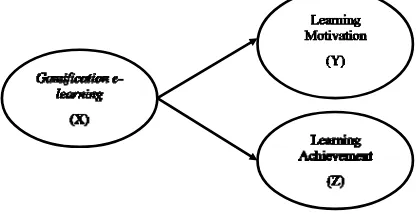
[image:3.612.90.300.353.460.2]Hamari and Koivisto explain that the application of gamification can make users more motivated [21]. In addition, according to Landers and Armstrong gamification can also improve learning outcomes on users who have had experience playing the game [22]. Therefore, this study was conducted to find the effect of gamification on e-learning on e-learning motivation and e-learning achievement of junior high school students. The frame of mind for this study is like the picture below.
Figure 1: Research Framework
3.2.Hypothesis
Based on the formulation of the problem and the frame of mind, the hypothesis to be tested in this study are as follows:
H0: there is no effect of e-learning gamification on improving learning motivation.
H1: there is a positive influence between e-learning gamification to increase learning motivation.
H0: there is no effect of e-learning gamification on improving learning achievement
H1: there is a positive influence between e-learning gamification to the increase of learning achievement.
3.3.Procedure
In this study, researchers will design a method of e-learning based game (gamification). Researchers
will use Bunchball approach to design e-learning gamification. Bunchball uses some game mechanics as the element of gamification [14]. The game mechanics that we use are points, levels, challenges, and leaderboards.
After that researchers will determine a group of students with junior high school level grade 8 or 9. Subjects will be taught through e-learning is the Mathematics. Researchers will examine the motivation and achievement of learning with experimental methods. This method will compare the motivation and learning achievement between the traditional way of learning and the way of e-learning gamification.
[image:3.612.320.530.415.544.2]The procedure to be performed by the researcher is to spread the questionnaire (pre-questionnaire) to the students regarding their motivation during learning mathematics in the traditional way. Furthermore, the students will try to use the application of e-learning gamification to learn math. After completing the application, the students will refill the questionnaire about their experience using e-learning gamification application. Meanwhile, to measure learning achievement, researchers will compare the value of student report cards with the value of exercise questions on e-learning gamification applications.
Figure 2: Procedures
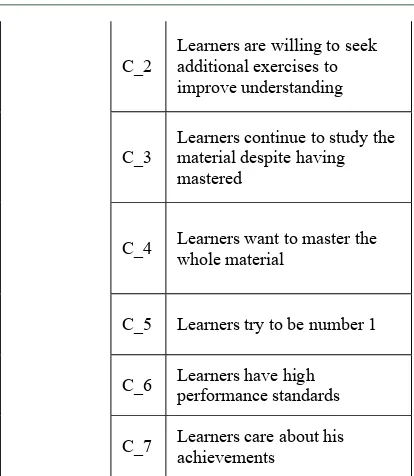
To measure learning motivation, Tillery and Fishbach (2014) say that we need to categorize motivations by type [23]. Fredricks and McColskey (2012) also say that there are three types of attachments of a student to the lesson. This attachment can be classified as a criterion or a measure of the students' motivation in learning. These three types of attachments are Behavioral, Emotional, and Cognitive Engagement [17].
3646 with 3 types of attachment through the indicators in table 1. While for learning achievement, the researcher will measure by comparing student study report which got from written test result with e-learning gamification.
Table 1: Table of Motivation Indicators Against Types of Engagement.
Variable Indicator
Behavioral
(B)
B_1 Learners actively ask or help answer questions
B_2 Learners diligently do the exercises / task / homework
B_3 Learners do the exercises / task / homework on time
B_4 Learners are prepared before the lesson or exam
B_5 Learners concentrate during the lesson
B_6 Learners relearn the material that has been taught
B_7 Learners continue to learn until they can
Emotional
(E)
E_1 Learners feel happy when understood
E_2 Learners feel happy when they get good grades
E_3 Learners feel happy when doing the task / practice / homework
E_4 Learners feel happy when faced with challenges
E_5 Learners feel happy to compete
Cognitive
(C) C_1
Learners continue to learn to really master the material
C_2
Learners are willing to seek additional exercises to improve understanding
C_3
Learners continue to study the material despite having mastered
C_4 Learners want to master the whole material
C_5 Learners try to be number 1
C_6 Learners have high performance standards
C_7 Learners care about his achievements
From the table above, each indicator on the variable of this study will be a reference in making the research questionnaire. The indicators will be measured using a Likert scale. Likert scale form in this study are:
Strongly agree / Always; given a score of 5 Agree / Often; given a score of 4
Neutral / Sometimes; given a score of 3 Disagree / Rarely; given a score of 2 Strongly disagree / Never; given a score of 1
4. ANALYSIS AND DISCUSSION 4.1.Data Description
In research conducted by the author, there are two types of data sources, namely the questionnaire and the results of junior high school students. The questionnaire distributed in this research is in the form of hardcopy. Questionnaires are divided into two types, namely questionnaires for traditional methods (pre-questionnaire) and questionnaires for the method of gamification e-learning (post-questionnaire). Total questionnaires filled were 24 questionnaires for each questionnaire. While for the data result of student study report taken from school mathematic report and mathematics report from gamification e-learning.
4.2.Validity Test
[image:4.612.90.299.200.692.2]3647 latent variable. But in the development stage, values above 0.5 are still acceptable [24]. Testing will use SmartPLS v.3.2.6.
4.3.Validity Test for Traditional Method
[image:5.612.310.524.88.157.2]The table below is the result of the validity test after some invalid indicators are omitted.
Table 2: Table Validity Test for Traditional.
Indicator Traditional Behavioral Traditional Cognitive Traditional Emotional
B_1 0,523
B_2 0,551
B_5 0,786
B_6 0,619
B_7 0,833
C_1 0,592
C_3 0,598
C_4 0,868
C_5 0,673
C_6 0,785
C_7 0,811
E_2 0,649
E_3 0,849
E_4 0,861
E_5 0,855
4.4.Validity Test for Gamification E-learning Method
The table below is the result of the validity test after some invalid indicators are omitted.
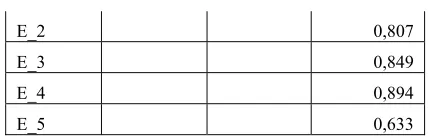
Table 3: Table Validity Test for E-learning.
Indicator Behavioral E-learning E-learning Cognitive E-learning Emotional
B_2 0,758
B_5 0,843
B_6 0,674
B_7 0,776
C_1 0,727
C_2 0,760
C_3 0,811
C_4 0,725
C_5 0,751
C_6 0,800
E_1 0,727
E_2 0,807
E_3 0,849
E_4 0,894
E_5 0,633
4.5.Reliability Test
After the indicators are said to be valid, the reliability test is then performed. Reliability test aims to see the reliability and consistency of the data. To test the reliability of a variable need to see the value of Composite Reliability (CR) and Average Variance Extracted (AVE). The value of the composite reliability should be> 0.7 and the average variance of extracted should be > 0.5 [24].
Table 4: Table Reliability Test for Traditional. Variable Composite
Reliability Variance Average Extracted (AVE)
Description
Behavioral Traditional
0,801 0,454 Reliable
Cognitive
Traditional 0,869 0,531 Reliable
Emotional Traditional
[image:5.612.84.520.481.737.2]0,882 0,653 Reliable
Table 5: Table Reliability Test for E-learning.
Variable Composite Reliability
Average Variance Extracted (AVE)
Description
Behavioral
E-learning 0,849 0,586 Reliable
Cognitive
E-learning 0,893 0,582 Reliable
Emotional
E-learning 0,890 0,620 Reliable
4.6.Latent Variable
3648
Table 6: Table Latent Variable for Traditional.
Traditional
Behavioral_T Cognitive_T Emotional_T
0,531 1,482 1,771
0,402 0,182 0,650
-0,967 -0,104 0,947
-1,107 -0,001 0,354
0,673 0,170 -1,086
0,612 0,389 -0,047
0,365 0,206 -0,047
-0,164 -0,835 0,079
-2,866 -3,114 -3,009
0,401 0,170 -0,111
0,920 0,358 1,073
-0,718 -0,519 -0,809
-0,847 0,076 -0,745
2,038 1,990 1,771
1,226 -0,703 -0,047
-0,051 0,715 0,249
-0,553 0,546 0,249
0,011 -0,835 -0,047
-0,330 -0,439 -0,047 -0,684 -0,346 -0,408
1,226 1,592 0,545
-1,063 -0,827 -0,344
0,059 -0,852 -1,591
0,884 0,699 0,650
Table 7: Table Latent Variable for E-learning.
E-learning Gamification
Behavioral_E Cognitive_E Emotional_E
-0,280 -1,266 0,333
-1,289 -0,614 -0,004
-0,281 0,585 0,460
0,461 0,486 0,953
0,389 -0,015 -1,062
0,875 1,025 0,639
1,362 1,025 0,639
-0,616 0,337 -1,085
-2,587 1,025 -0,669
0,623 0,266 0,917
-0,934 -1,148 0,287
-0,609 -0,818 -1,469
0,551 0,088 0,901
0,775 1,025 1,589
1,110 -0,186 -0,669
1,045 1,025 1,589
-0,765 -1,909 -1,283
1,193 1,025 1,080
1,193 1,025 1,080
-0,195 -1,518 -1,069
-0,764 0,739 0,333
-0,778 -2,155 -1,444
0,875 0,585 -1,469
-1,355 -0,630 -0,576
4.7.Hypothesis Test
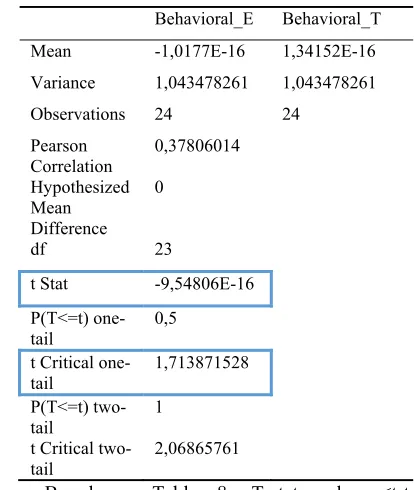
In testing the hypothesis, the researcher will use paired t-test. The sample to be compared is the latent variable of both types of methods. The requirement for the accepted H1 hypothesis is the t-stat> t-table value. The t-table value (df = 23) with the 5% alpha is 1.714.
[image:6.612.298.505.438.683.2]1. Hypothesis 1 (behavioral)
Table 8: Paired t-test for Behavioral.
Behavioral_E Behavioral_T
Mean -1,0177E-16 1,34152E-16 Variance 1,043478261 1,043478261
Observations 24 24
Pearson Correlation
0,37806014
Hypothesized Mean Difference
0
df 23
t Stat -9,54806E-16
P(T<=t)
one-tail 0,5
t Critical one-tail
1,713871528
P(T<=t) two-tail
1
t Critical two-tail
2,06865761
[image:6.612.97.280.542.722.2]e-3649 learning gamification on student behavioral improvement.
This result is contrary to research conducted by Paul Denny. Paul Denny said that gamification on e-learning has a positive influence on the contribution and behavior of a student [25]. However, these results are in line with the research of Li et al in 2014. The results suggest that there is no significant behavioral change between traditional classroom methods and e-learning. One factor that might be causing this is the presence of teachers in the traditional classroom. Teachers in traditional classes have an important role in maintaining and improving behavioral students. For example teachers can provide open questions so that students can engage in discussion and opinion [26]. A student who is behaviorally increased will have better behavior, such as always doing the task, concentrate during learning, and actively ask questions.
[image:7.612.307.504.281.524.2]2. Hypothesis 2 (emotional)
Table 9: Paired t-test for Emotional.
Emotional_E Emotional_T Mean -2,59052E-16 0
Variance 1,043478261 1,043478261
Observations 24 24
Pearson Correlation
0,458342605
Hypothesized Mean Difference
0
df 23
t Stat -1,40679E-15
P(T<=t)
one-tail 0,5
t Critical one-tail
1,713871528
P(T<=t) two-tail
1
t Critical two-tail
2,06865761
Based on Table 9. T-stat value <t-table; 1.40679E-15 <1.713871528. Therefore it can be deduced that H0 is received. There is no positive emotional change between traditional methods and e-learning gamification. This result conflicts with a study by Domínguez et al. Domínguez et al. Said that gamification has a positive effect on students' emotional improvement [27].
This is probably due to several factors. Singh et al. Believes that e-learning is less effective to apply
to younger students and is more suitable for adults as it is considered more independent. E-learning is considered difficult to use because there is no direct interaction with teachers. Interaction between teachers and students is needed to address ambiguity among young learners [28].
Increased emotional students are more likely to feel happy and valuable during the lesson. In the absence of direct interaction with the teacher on learning, the students will emotionally dislike e-learning, because it is considered more difficult in studying the material.
3. Hypothesis 3 (cognitive)
Table 10: Paired t-test for Cognitive.
Cognitive_E Cognitive_T
Mean 6,93889E-17 -6,4763E-17 Variance 1,043478261 1,043478261
Observations 24 24
Pearson Correlation
-0,072939194
Hypothesized Mean Difference
0
df 23
t Stat 3,63473E-16
P(T<=t)
one-tail 0,5
t Critical one-tail
1,713871528
P(T<=t) two-tail
1
t Critical two-tail
2,06865761
Based on Table 10. tstat value <ttable; -3,63473E-16 <1.713871528. Therefore it can be deduced that H0 is received. There is no positive cognitive change between traditional methods and e-learning gamification.
According to Rotgans and Schmidt, students' cognitive motivation did not rise significantly in the first lesson, but in the second and so on [29]. Students who regularly follow the learning and are joined in a discussion group, will have an increase in cognitive motivation. The students can discuss and exchange ideas about what they understand and master. This is what makes the results of this study does not increase cognitive motivation, because this research is only done once and not done continuously.
[image:7.612.84.283.370.618.2]3650 material provided should support real application in everyday life [30]. Materials such as problem solving, case examples, or real projects can make students understand the meaning of the learning objectives. A student whose cognitive is on the rise, has signs like trying to be the best, willing to make more effort to achieve the best results, and wants to have a high achievement.
[image:8.612.132.252.240.647.2]4. Hypothesis 4 (learning achievement)
Table 11: Math Score for Traditional and E-learning.
Math Score Traditional
Math Score E‐learning
94 100
96 100
93 73,33333333
99 73,33333333
97 100
89 86,66666667 94 86,66666667
98 80
86 100
86 80
96 80
92 60
87 100
96 100
94 60
86 86,66666667 98 93,33333333 91 66,66666667 93 73,33333333
98 66,66666667 85 86,66666667
83 40
78 66,66666667
[image:8.612.84.302.680.734.2]99 80
Table 12: Paired t-test for Learning Achievement.
Math Score E‐learning
Math Score Traditional
Mean 80,83333333 92
Variance 252,4154589 33,13043478
Observations 24 24
Pearson Correlation
0,212365598
Hypothesized Mean Difference
0
df 23
t Stat -3,482891305
P(T<=t) one-tail 0,001005061 t Critical one-tail 1,713871528
P(T<=t) two-tail 0,002010122 t Critical two-tail 2,06865761
Based on Table 12. t-stat value< t-table; 3,482891305< 1,713871528. Therefore it can be concluded that H0 received, that there is no positive influence between e-learning gamification to increase student achievement.
Domínguez, et al. argue that the effect of gamification on improving student achievement is limited, so it takes a design and structure that can make these students motivated [27]. In addition Singh et al. argue that e-learning will make students feel difficulty, in the absence of the role of a teacher. Students who feel difficulty in learning the material, would require the guidance of a teacher to answer the ambiguity as well as improve student achievement [28].
5. DISCUSSION
The result of the analysis obtained is e-learning gamification does not give positive impact to the improvement of behavioral, emotional, cognitive motivation and student achievement. Our explanation is self-paced e-learning approach is less suitable to be applied to junior high school students. School students at the age of 13-17 are considered still need the guidance of a teacher.
The role of a teacher is very important in maintaining and improving behavioral motivation students. For example teachers can provide open-ended questions so that students can discuss and share their arguments. Teacher also acts as a parent for students at school. Ethics and morals are also taught to the students so that their behavioral can get better.
3651 lessons that he finds difficult. In addition to impact on emotional students, it also affects student achievement.
Use of e-learning gamification which only one time does not give a significant effect on the improvement of students' cognitive motivation. The use of e-learning gamification needs to be done periodically. Periodic usage can trigger students to exchange opinions, knowledge, and ideas. In addition, materials related to daily life, can trigger aspects of cognitive motivation of students.
6. CONCLUSION AND FUTURE WORK
This work has analyzed the effect of gamification to improve learning achievement and motivation among students of junior high school. The measurements were made by comparing pre-post questionnaires and study reports from both traditional methods and e-learning gamification. The investigation has shown that gamification does not provide a positive influence or improvement on student achievement and motivation. This is evidenced from the results of paired t-test between traditional methods with e-learning gamification method.
We argue that the role of a teacher in junior high school is still very important. A teacher can guide, improve achievement, and motivate students. The instructor-led e-learning approach is thought to accommodate the needs of junior high school students to the role of a teacher.
In addition we also argue that the use of e-learning gamification that only one time has less influence on students. Students need to use e-learning gamification periodically so they can feel the effect of e-learning gamification.
To support further research there are several suggestions that are proposed based on this research, that is:
1. Increasing the number of samples for further research results expected to be more accurate. 2. Suggested use of e-learning gamification is not done at one time only, but on a regular basis, for example for 3-6 months. Regular use has the intention that students can better feel the difference between traditional learning methods and e-learning gamification. In addition, regular use can stimulate students' cognitive motivation for the better [29].
3. It should be investigated more deeply from e-learning gamification design in order to replace the role of teachers that exist in
traditional learning. Because one of the main factors of poorly motivated students is the loss of the teacher's role in the gamification of e-learning [26].
4. Change the e-learning approach model of self-paced e-learning to be an instructor-led and facilitated e-learning. This could be a suggestion in subsequent research so that the role of teachers can remain in the gamification of e-learning.
5. Use of Artificial Intelligence (AI) as a tutor can be one of the proposals and breakthroughs in subsequent research to replace the teacher's role in e-learning gamification.
6. The learning process provided by e-learning gamification in this research is only limited to material explanation along with practice questions. In the next research, can be added a variety of real application of every material in everyday life [30]. This aims to improve student motivation.
7. The additional feature of e-learning gamification is not found in this research such as discussion groups or forums as a means of exchanging opinions and knowledge among students.
8. This research is only done in junior high school and one subject only that is mathematics. For further research is also suggested to be done for other education levels and different subjects.
REFERENCES:
[1] Duniaku Network. (2015, Februari). Game Online Indonesia Tahun 2014 : Ikhtisar dan Infografis. Diambil kembali dari Duniaku Network:
http://www.duniaku.net/2015/02/20/game- online-indonesia-tahun-2014-ikhtisar-dan-infografis/
[2] Ambient Insight. (2015). International eLearning Market Research. Diambil kembali dari
Ambient Insight Research:
http://www.ambientinsight.com/Resources/Doc
uments/AmbientInsight_2015- 2020_AsiaPacific_Self-paced-eLearning_Market_Abstract.pdf
[3] Kuo, M.-S., & Chuang, T.-Y. (2016). How Gamification Motivates Visits and Engagement for Online Academic Dissemination. Computer in Human Behavior 55, 16-27.
3652 Gamefulness: Defining "Gamification". MindTrek.
[5] Dicheva, D., Dichev, C., Agre, G., & Angelova, G. (2014). Gamification in Education: A Systematic Mapping Study. Journal of Educational Technology & Society, 75-88. [6] Ehlers, U., & Hilera, J. (2012). Special Issue on
quality in e-learning. Journal of Computer Assisted Learning, 1-3.
[7] Naidu, S. (2006). E-Learning a Guidebook of Principles, Procedures and Practices. Melbourne: Commonwealth Educational Media Center for Asia.
[8] Simoes, J. R., & Vilas, A. (2012). A social gamification framework for a K-6 learning platform. Computer in Human Behavior, 29 (2013), 345-353.
[9] Kirriemuir, J., & McFarlane, A. (2004). Literature review in games and learning. [10] McGonigal, J. (2011). Reality is broken: Why
games make us better and how they can change the world. New York: Penguin.
[11] Zichermann, G., & Cunningham, C. (2011). Gamification by design: Implementing game mechanics in web and mobile apps. Canada: O'Reilly Media, Inc.
[12] Deterding, S., Dixon, D., Khaled, R., & Nacke, L. (2011). From Game Design Elements to Gamefulness: Defining "Gamification". MindTrek.
[13] Kapp, K. M., Blair, L., & Mesch, R. (2014). The Gamification of Learning and Instruction Fieldbook. San Francisco: Wiley.
[14] Bunchball. (2010). Gamification 101: An Introduction to the Use of Game Dynamics to Influence Behavior. Retrieved from Bunchball: http://www.bunchball.com/sites/default/files/do wnloads/gamification101.pdf
[15] Maehr, M., & Meyer, H. (1997). Understanding motivation and schooling: Where we’ve been, where we are, and where we need to go. Educational Psychology Review, 9, 371-408. [16] Uno, H. B. (2007). Teori Motivasi dan
Pengukuranya. Jakarta: Bumi Aksara.
[17] Fredricks, J. A., & McColskey, W. (2012). The Measurement of Student Engagement: A Comparative Analysis of Various Methods and Student Self-report Instruments. Dalam S. L. Christenson, A. L. Reschly, & C. Wylie, Handbook of Research on Student Engagement (hal. 763-782). New York: Springer US. [18] Voelkl, K. (2012). School Identification. Dalam
S. Christenson, A. Reschly, & C. Wylie,
Handbook of research on student engagement (hal. 193-218). New York: Springer.
[19] Pekrun, R., & Linnenbrink-Garcia, L. (2012). Academic emotions and student engagement. Dalam S. Christenson, A. Reschly, & C. Wylie, Handbook of research on student engagement (hal. 259-282). New York: Springer.
[20] Ainley, M. (2012). Students' interest and engagement in classroom activities. Dalam S. Christenson, A. Reschly, & C. Wylie, Handbook of research on student engagement. New York: Springer.
[21] Hamari, J., & Koivisto, J. (2015). Why do people use gamification services? International Journal of Information Management, 419-431. [22] Landers, R. N., & Armstrong, M. B. (2015).
Enhancing instructional outcomes with gamification: An empirical test of the Technology-Enhanced Training Effectiveness Model. Computers in Human Behavior, 1-9. [23] Tillery, M. T., & Fishbach, A. (2014). How to
Measure Motivation: A Guide for the Experimental Social Psychologist. Social and Personality Compass, 328-341.
[24] Ghozali, I. (2006). Structural Equation Modeling Metode Alternatif dengan Partial Least Squares (PLS). Semarang: Badan Penerbit Universitas Diponegoro.
[25] Denny, P. (2013). The Effect of Virtual Achievements on Student Engagement. In Proceedings of CHI 2013 Changing Perspectives, 763-772.
[26] Li, F., Qi, J., Wang, G., & Wang, X. (2014). Traditional Classroom VS E-learning in Higher Education: Difference between Students’ Behavioral Engagement. International Journal of Emerging Technologies in Learning, 48-51. [27] Domínguez, A., Saenz-Navarrete, J.,
de-Marcos, L., Fernández-Sanz, L., Pagés, C., & Martínez-Herráiz, J.-J. (2013). Gamifying learning experiences: Practical implications and outcomes. Computers & Education 63, 380-392. [28] Singh, A. K., Yusoff, A. M., & oo, N. W. (2009). A Comparative Study between Traditional Learning and E-Learning. Department of ECEC School of Engineering and Science Curtin University of Technology, Miri, Malaysia.
3653 [30] Hashim, R., Ahmad, H., & Ahmad, N. (2011).