3084
THE ADVANCES OF INFORMATION TECHNOLOGY
GOVERNANCE IN UNIVERSITIES: A SYSTEMATIC
REVIEW
ALEJANDRA OÑATE-ANDINO1, 2, DAVID MAURICIO2
1 Faculty of Computing and Electronic, Escuela Superior Politécnica de Chimborazo, Ecuador
2 Faculty of System Engineering and Computing, FISI, National University of San Marcos, Perú
E-mail: [email protected], [email protected]
ABSTRACT
This study analyzes the advances of information technology governance (ITG) in the university context, through a systematic review of the literature. The following research questions are addressed: What progress has been made? What implementation studies have been developed? What factors influence success? What models have been created? And lastly, what are the relevant case studies? In the period from 2006-2017, 17 studies reported advances in the five areas of IT governance, 9 studies referred to aspects related to implementation, zero studies were identified that analyzed critical success factors, 6 studies developed ITG models and 34 studies analyzed implementation initiatives. Our analysis of the relevant studies shows that the advances of ITG in the university context are still incipient.
Keywords: Systematic Literature Review (SLR), IT Governance, Information Technology Government; Universities; Information Technologies Government Systems; Higher Education.
1. INTRODUCTION
During recent years, information technology (IT) has played an important role in the field of education [1]. Its role has been redefined from being a support resource to a strategic factor. However, its incipient role has been tempered by indiscriminate use, underestimated utility and a high share of waste [2]. Universities are increasingly organized and managed through digital data and new and complex IT infrastructures, including human and non-human actors, all framed by new economic and social policies [3]. The functionality of this system requires adopting new forms of resource governance, if one considers the importance and contribution of IT in achieving the strategic objectives of an organization.
The most widely accepted definition of information technology governance (ITG) is the one provided by ISO/IEC 38500 (2008) [4], which states that ITG "is the system through which the use of current and future IT is directed and controlled. It involves the evaluation and management of IT utilization plans that support the organization and monitoring of said use to achieve the objectives
established in the plans. It includes the strategies and policies for the use of IT within the organization."
The implementation of ITG has become a critical element for the success of organizations around the world. There are several contexts in which the strategic importance of ITG has been demonstrated [5]; one of them is the university context, where a positive relationship has been found between the effectiveness of ITG and organizational performance in higher education. The governance of information technology in universities plays a very important role in the fulfillment of strategic objectives and university vision [6], which is why this subject requires a greater investigative effort by the scientific community.
3085 following research question: What progress has been made in IT governance in the university context?
Therefore, this article presents a systematic review of the literature related to the governance of information technologies in the university context through assessing the advances of IT governance in universities. The review demonstrates that there have been few advances in relation to the non-university context. Of the five areas defined by the IT Governance Institute [10], the most widely analyzed area is value delivery, focusing on maximizing costs and demonstrating the value of IT. On the other hand, it is evident that there have been few studies related to the implementation of ITG, which could be a determining factor for universities deciding whether or not to develop implementation initiatives. In addition, no studies have been identified regarding critical factors that influence the success of the ITG in the university context. We also report on studies that have proposed models of IT governance, which have gradually evolved over the last decade and represent a valuable managerial contribution. In relation to the ITG implementation case studies, Australian and European universities predominate in the literature. The results obtained in our review are crucial because they should be taken as a starting point for future studies in this field, since this study aims to provide a holistic view of the advances in IT governance in the university context, which is still incipient in relation to other contexts.
2. METHODOLOGY
Three phases were performed throughout this study: planning, conducting and results. These phases have been reflected in various literature review papers related to ITG, such as Delgado & Velthuis [11] and Noraini et al. [12]. The phases are described below:
a. Planning: this stage consisted of developing research questions, search protocols and keywords, as well as resource assessment and creating inclusion and exclusion criteria.
b. Conducting: the primary studies were selected according to the planning phase.
c. Results: This stage consisted of statistical analysis and assessment of the selected articles, which is presented in section 3.
2.1 Planning
In order to assess the advances of IT governance in universities, we proposed the following research questions:
- Q1: What progress has been made in ITG? - Q2: What efforts have been made in the
implementation of ITG?
- Q3: What factors influence the success of ITG?
- Q4: What governance models of IT have been developed?
- Q5: What are the relevant ITG case studies?
To perform our search for relevant information, we utilized the ACM Digital Library databases, DOAJ (Directory of Open Access Journal), Emerald, IEEE Xplore, Science Direct, Springer, Taylor & Francis, Proquest, EBSCO and Scopus. Our review covers the period between January 2006 and March 2017, since 2006 was the first year that the publications referring to ITG in universities were found.
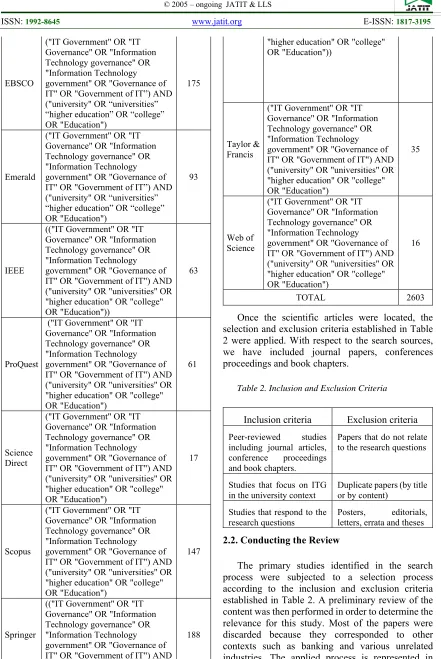
The selected articles were found using the following search string: ("IT Government" OR "IT Governance" OR "Information Technology governance" OR "Information Technology government" OR "Governance of IT" OR "Government of IT") AND ("university" OR "universities" OR "higher education" OR "college" OR "Education"); This search string was applied to the title, abstract and keywords. These terms were adapted to the individual needs of each search engine, as can be seen in Table 1.
Table 1. Query syntax
Source Query syntax Search result count
DOAJ
("IT Government" OR "IT Governance" OR "Information Technology governance" OR "Information Technology government" OR "Governance of IT" OR "Government of IT") AND ("university" OR "universities" OR "higher education" OR "college" OR
"Education")
3086 EBSCO
("IT Government" OR "IT Governance" OR "Information Technology governance" OR "Information Technology government" OR "Governance of IT" OR "Government of IT”) AND ("university" OR “universities” “higher education” OR “college” OR "Education")
175
Emerald
("IT Government" OR "IT Governance" OR "Information Technology governance" OR "Information Technology government" OR "Governance of IT" OR "Government of IT”) AND ("university" OR “universities” “higher education” OR “college” OR "Education")
93
IEEE
(("IT Government" OR "IT Governance" OR "Information Technology governance" OR "Information Technology government" OR "Governance of IT" OR "Government of IT") AND ("university" OR "universities" OR "higher education" OR "college" OR "Education"))
63
ProQuest
("IT Government" OR "IT Governance" OR "Information Technology governance" OR "Information Technology government" OR "Governance of IT" OR "Government of IT") AND ("university" OR "universities" OR "higher education" OR "college" OR "Education")
61
Science Direct
("IT Government" OR "IT Governance" OR "Information Technology governance" OR "Information Technology government" OR "Governance of IT" OR "Government of IT") AND ("university" OR "universities" OR "higher education" OR "college" OR "Education")
17
Scopus
("IT Government" OR "IT Governance" OR "Information Technology governance" OR "Information Technology government" OR "Governance of IT" OR "Government of IT") AND ("university" OR "universities" OR "higher education" OR "college" OR "Education")
147
Springer
(("IT Government" OR "IT Governance" OR "Information Technology governance" OR "Information Technology government" OR "Governance of IT" OR "Government of IT") AND ("university" OR "universities" OR
188
"higher education" OR "college" OR "Education"))
Taylor & Francis
("IT Government" OR "IT Governance" OR "Information Technology governance" OR "Information Technology government" OR "Governance of IT" OR "Government of IT") AND ("university" OR "universities" OR "higher education" OR "college" OR "Education")
35
Web of Science
("IT Government" OR "IT Governance" OR "Information Technology governance" OR "Information Technology government" OR "Governance of IT" OR "Government of IT") AND ("university" OR "universities" OR "higher education" OR "college" OR "Education")
16
TOTAL 2603
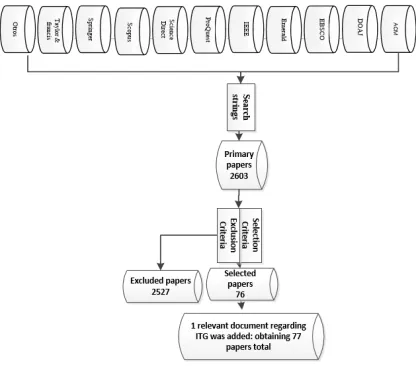
[image:3.612.89.530.57.716.2]Once the scientific articles were located, the selection and exclusion criteria established in Table 2 were applied. With respect to the search sources, we have included journal papers, conferences proceedings and book chapters.
Table 2. Inclusion and Exclusion Criteria
Inclusion criteria Exclusion criteria Peer-reviewed studies
including journal articles, conference proceedings and book chapters.
Papers that do not relate to the research questions
Studies that focus on ITG in the university context
Duplicate papers (by title or by content)
Studies that respond to the research questions
Posters, editorials, letters, errata and theses
2.2. Conducting the Review
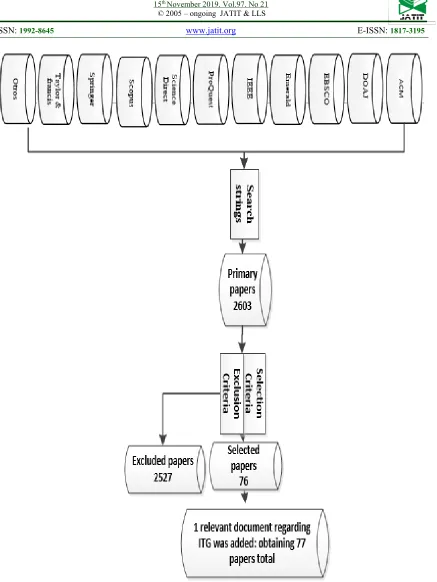
3087 with the search protocol because it contained relevant information that was considered to be essential for a thorough review. We then proceeded to analyze the articles to answer the research questions.
Figure 1. Applied process for conducting the Systematic
Literature Review
3. RESULTS
3.1 Tendencies in the Selected Publications
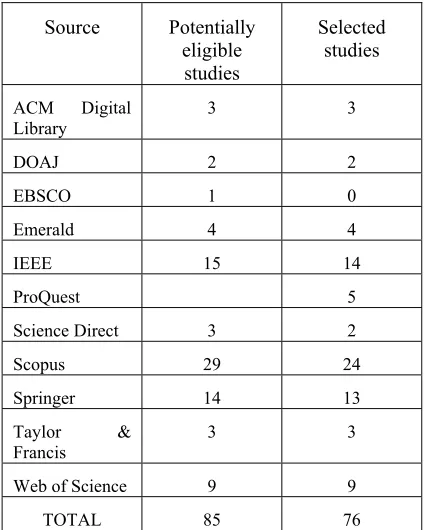
As a result of the systematic review process, 2605 studies were obtained, of which, 76 were selected according to inclusion and exclusion criteria. In Table 3, the studies selected from each resource can be observed.
Table 3. Potentially eligible studies and selected studies
Source Potentially eligible
studies
Selected studies
ACM Digital
Library 3 3
DOAJ 2 2
EBSCO 1 0
Emerald 4 4
IEEE 15 14
ProQuest 5
Science Direct 3 2
Scopus 29 24
Springer 14 13
Taylor &
Francis 3 3
Web of Science 9 9
TOTAL 85 76
3.2 Data Sources
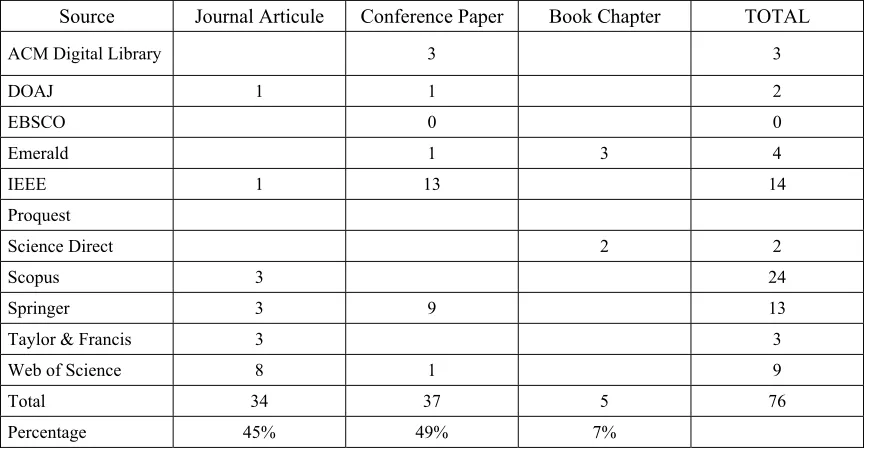
[image:4.612.91.299.165.348.2]Table 4 shows the distribution of the selected articles according to the type of document, journal repository and the number of studies selected for the review according to the type of study. Note that 49% of the selected articles are from conference proceedings, which represents the largest contribution in this work. Articles from journals have the second highest at 45%, and book chapters are in third place at 7%.
Table 4. Distribution of the documents by type and database
Source ArticuleJournal Conference Paper Chapter Book TOTAL ACM
Digital Library
3 3
DOAJ 1 1 2
EBSCO 0 0
Emerald 1 3 4
IEEE 1 13 14
Proquest
Science
Direct 2 2
Scopus 3 24
Springer 3 9 13
Taylor &
Francis 3 3
Web of
Science 8 1 9
Total 34 37 5 76
Percentage 45% 49% 7%
4. FINDINGS
4.1 Q1: What Progress has Been Made in ITG?
3088
Strategic Alignment focuses on maintaining the
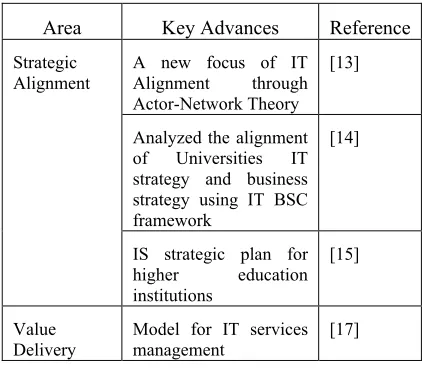
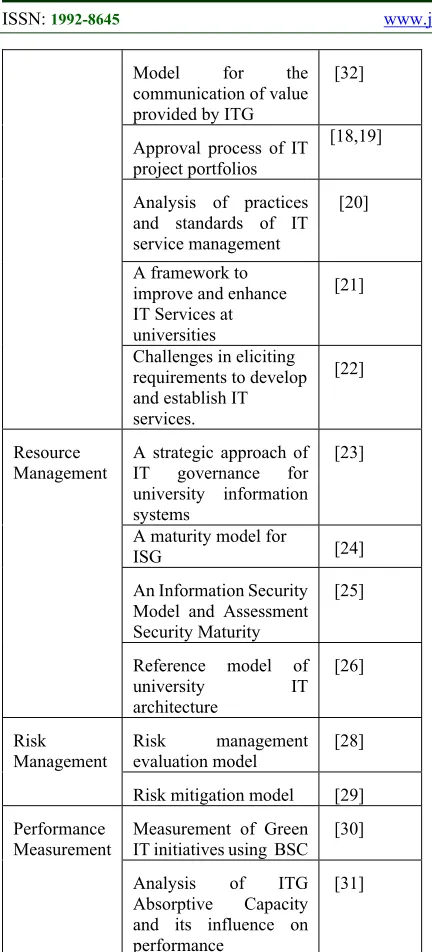
link between the business plan and IT plans by defining, maintaining and validating the IT value proposition, and aligning IT operations with the operations of the organization [10]. In this area, the following advances have been recorded: Martins et al. [13] propose a new approach to IT governance, where the interests of the actors involved in the decisions, implementation and control were considered in strategic alignment. Herdiansyah et al. [14] propose an IT strategy map using IT Balanced Scorecard (BSC) framework in order to evaluate the university’s business strategy and gaps in IT. Sadikin et al. [15] propose an Information System (IS) Strategic Plan.
Value Delivery is based on obtaining specific and
well-cared for processes so that a project avoids difficulties in execution. The purpose is to ensure that IT delivers the promised benefits with respect to the strategy, concentrating on the optimization of costs and the provision of the intrinsic value of IT [10]. The main objectives of IT value management are as follows: to allow organizations to obtain an optimal value of IT-enabled investments at an accessible cost with an acceptable level of risk; to clearly define and communicate their vision of what constitutes value, and for whom; and to select and execute investments [16]. Zhen & Xin-yu [17] propose a service management model based on ITIL theory for Chinese universities. Juiz et al. [18,19] present a model for the communication of value provided by IT Management and Governance. They also propose a process of approval of IT project portfolios. Knahl [20] also performed an analysis of the practices and standards for the management of university IT services. Khther & Othman [21] propose a framework for improving and increasing IT services in universities and applied it in a Malaysian private university. Finally, Erfurth & Erfurth [22] perform an analysis of the general challenges in obtaining requirements to develop and establish IT services.
Resource Management is responsible for optimal
investment, as well as the proper management of critical IT resources: applications, information, infrastructure and people [10]. Some progress has been made in this area: Kwon [23] suggests an IT Governance strategy to improve the performance and security of a university's information system. Hung et al. [24] propose a maturity model of Information Security Governance (ISG) and applied it to technological colleges and universities in Taiwan. Suwito et al. [25] present a model for information security which is based on the standards of COBIT,
ITIL and ISO 27001. Shaoyong et al. [26] propose a model of university IT architecture composed of six layers, including hardware infrastructure, data and information resources, software systems, user services, cyber security and IT governance.
Risk Management is the process of identifying,
analyzing and quantifying the probability of losses and secondary effects that arise from disasters, as well as the corresponding preventive, corrective and reductive actions that must be undertaken [27]. Risk management requires that the top executives of an organization have an awareness and a clear understanding of the risks facing an organization, compliance requirements, transparency of significant risks, and the inclusion of the organization’s risk management responsibilities [10]. Talhi & Al-Ghamdi [28] propose a framework for risk assessment, and Jnr et al. [29] propose an automatic computational system for ITG risk mitigation based on agents whose objective is to measure risk probability and impact.
Performance Measurement is the area that
establishes mechanisms and controls the implementation strategy of each project, including the use of resources, the performance of projects and the delivery of services, using, for example, the BSC [10]. An initiative to measure Green IT using the BSC was conducted by N. K. S. Putri [30]. An analysis of the impact of ITG Absorptive Capacity
[image:5.612.311.522.554.740.2](i.e. organizational competence in recognizing, acquiring or creating valuable new business-IT knowledge) in the performance of ITG, and a conceptual ITG evaluation model has been proposed by Ajayi & Hussin [31].Table 5 demonstrates a summary of the progress made in the different areas of ITG.
Table 5. Advances in ITG
Area Key Advances Reference
Strategic Alignment
A new focus of IT Alignment through Actor-Network Theory
[13]
Analyzed the alignment of Universities IT strategy and business strategy using IT BSC framework
[14]
IS strategic plan for higher education institutions
[15]
Value Delivery
Model for IT services management
3089 Model for the
communication of value provided by ITG
[32]
Approval process of IT project portfolios
[18,19]
Analysis of practices and standards of IT service management
[20]
A framework to improve and enhance IT Services at universities
[21]
Challenges in eliciting requirements to develop and establish IT services.
[22]
Resource
Management A strategic approach of IT governance for university information systems
[23]
A maturity model for
ISG [24]
An Information Security Model and Assessment Security Maturity
[25]
Reference model of
university IT
architecture
[26]
Risk Management
Risk management evaluation model
[28]
Risk mitigation model [29] Performance
Measurement
Measurement of Green IT initiatives using BSC
[30]
Analysis of ITG Absorptive Capacity and its influence on performance
[31]
4.2 Q2: What Efforts Have Been Made in the Implementation of ITG?
According to De Haes & Van Grembergen [33], three aspects must be considered for the implementation of IT Governance: processes, structures, and relational mechanisms.
Processes are closely related to strategic decision
making of IT within the business, the strategic planning of IT systems, the management of the services and the monitoring, control and tools of process definition (COBIT , ITIL, IT BSC, etc.), as well as the management of project and service portfolios, infrastructures, talent and innovation. The
Structures include the organization and assignment
of IT functions to specific people or departments, and the existence of clearly defined roles and responsibilities, including the creation of a series of committees related to IT planning and operation.
Relational Mechanisms facilitate the
communicative relationships between people, between the business units and IT units, and between the business and suppliers. It also refers to the management of organizational change, training, human resources, and the exchange of knowledge regarding mergers and acquisitions.
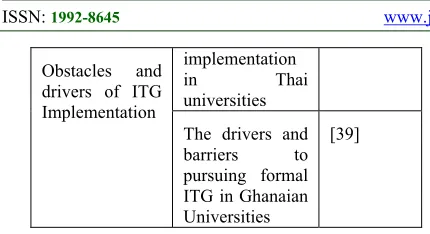
Considering the three aspects of implementation, as well as an additional aspect identified after the review: the obstacles, the efforts to implement ITG
[image:6.612.89.305.69.545.2]have been determined, as shown in Table 6.
Table 6. Studies on the implementation of ITG
Aspect Advances Reference
Structures Perception of Structural Capability of IT
[34]
Processes Perception of Process
Capability of IT [34]
Process Capability Assessment model of IT Governance
[30]
A conceptual model of ITG implementation that includes IT Infrastructure
[35]
Method for IT Governance
Based on
Enterprise Modelling
[36]
Relational
Mechanisms Perception Relational of Capability of IT
[34]
ITG mechanisms that higher education institutions have implemented
[37]
The obstacles of ITG
3090 Obstacles and
drivers of ITG Implementation
implementation
in Thai
universities The drivers and barriers to pursuing formal ITG in Ghanaian Universities
[39]
4.3 Q3: What Factors Influence the Success of ITG?
Critical Success Factors (CSF) are a limited number of areas in which the results, if satisfactory, will ensure successful competitive performance for the individual, department or organization [40]. Leidecker & Bruno [41] defines them as characteristics, conditions or variables that when properly supported, conserved or managed, have a significant impact on the competitive success of a company.
There are no studies in the literature that refer to factors that influence the success of ITG in the context of higher education; however, there are studies in other contexts that may be relevant. Examples include Urbach et al. [42], Buchwald et al. [43] and Nfuka & Rusu [44,45], which demonstrate the importance of this field of study.
4.4 Q4: What Governance Models of IT Have Been Developed?
[image:7.612.89.304.70.187.2] [image:7.612.315.523.124.497.2]In regards to ITG models, it must be noted that according to Fernández & Llorens [46], several universities have implemented ITG via different models and perspectives since 2006. However, Higher Education Institutions (HEIs) have typically been based on experimental models, and it has since been discovered that different institutions have been using distinct models with different norms. Among these are COBIT (Control Objectives for Information and Related Technologies), as well as the case of ISO 38500:2008, which is one of the most widely used and accepted. However, the literature has identified few documents that demonstrate a standard ITG model or framework, as presented in Table 7.
Table 7. ITG Models proposed in the university context
The Joint Information Systems Committee (JISC) designed an ITG model as a reference for the UK’s university system. It is a simple model with easy-to-use support tools and a high level of
adaptation to the environment of higher education institutions [47].
The model of ITG for the Spanish university
system (GTI4U) is a model that pursues the objectives of its university and can be certified without difficulties by the ISO 38500 standard. This model is fundamentally based on the ISO 38500:2008, the model developed by JISC for UK universities and other elements extracted from the main existing frames of reference. In addition, it has the necessary instruments for performing first a local analysis (of each university), and then a global analysis of the actualized situation [46].
Ajami & Al-Qirim [48] developed an ITG framework that helps HEIs govern their IT projects. This framework focuses on evaluating decisions regarding the alignment and compatibility of IT with the overall strategies and goals of the HEI.
Our review also allowed the observation of the emergence of the Green Information Technology Governance Model (GITG), which was applied in private HEIs in Jakarta to help reduce costs by providing affordable tuition fees and reducing losses in daily operating costs [49].
Nugroho [50] proposes an ITG model for higher education that is based on the Cobit 5 framework. This model is essentially built on the principles of governance contained in the ISO 38500 standard: responsibility, strategy, acquisition, performance, conformity and human behavior. The proposal of this model argues that the principles should work well for
Model Reference
Information System Management
and Governance ISMG Model [47]
ITG4U Model [46]
ITG Framework in Education [48] Green information technology
governance model
[49]
Conceptual model of IT governance
[50]
IT governance framework for achieving the development of academic programs in higher education institutions
3091 governance practices and management practices. Governance practices consist of evaluating the process of evaluation, direction and monitoring, whereas management practices consist of the processes of planning, construction, execution and monitoring. This model illustrates how ITG should be aligned with corporate governance, which signifies that ITG is no longer purely the responsibility of the IT unit, but an integral part of the university.
Musa et al. [51] present a conceptual framework by identifying the elements of governance for achieving the development of academia using twelve elements: IS/IT vision, IS/IT management strategy, policy, standards, software, hardware, procedures, communication protocol, people, organizational values, employee values and norms, culture and beliefs. This framework was validated within the Universiti Malaysia Sarawak (UNIMAS).
Within the analysis, we also identified authors who have presented preliminary model proposals. Bianchi & de Sousa [52] highlight the importance of developing an ITG framework specifically for universities. They developed a proposal for the public universities of Brazil and Portugal, which includes adoption guidelines in terms of structures, processes and relational mechanisms. Valverde-Alulema & Llorens-Largo [53] propose an IT Governance framework for Ecuadorian public universities.
4.5 Q5: What are the Relevant ITG Case Studies?
[image:8.612.267.522.56.713.2]After our analysis, it has been determined that the majority of studies related to IT governance in the context of higher education refer to cases in which an IT governance initiative has been implemented, as summarized in Table 8.
Table 8. Cases of ITG in Universities
University Description Reference Higher
Education in Australia
This study analyzed how central IS departments in four institutions of higher education in Australia are transforming organizational attitudes and approaches to governing IT by implementing structural and process
changes and
[54] establishing relational mechanisms. Australian Higher Education
This exploratory study examined and compared how ITG is implemented through a number of structures, processes, and relational mechanisms in two Australian HEIs, and how the adoption of industry best practice frameworks such as COBIT, ITIL and ISO17799 have been utilized in the implementation.
[54]
Australian Higher Education
This study examined
how ITG was
implemented in four Australian HEIs
[55]
Australian Higher Education
This paper analyzed how formal IT governance was implemented in two major Australian institutions of higher education.
[56]
High Public Portuguese Educational Institution
A case
study of the implementation and use of COBIT for IT Governance in an Institution
[57]
Bucharest Academy of Economic Studies
This study presented the main aspects for developing and implementing actual
phase in an
information systems audit, to recognize the risks and establish the necessary measures to eliminate them
[58]
Australian university
This study explored the criteria of effective
ITG processes
employed in
universities and their impact on the
diffusion of
appropriate
technology to base level users
3092 Thai
Universities-Thailand
This study analyzed the status of ITG in Thai universities and ITG performance measures
[38]
Portuguese Private School
This study
implemented ITIL
and COBIT
frameworks with the purpose of IT management and control [60] Satya Wacana Christian University, Salatiga
This study measured IT
performance using COBIT framework version 4.1
[61]
Thai universities
The authors assessed the current situation
and future
improvement for IT governance and controls in a developing country like Thailand.
[62]
Australasian public university
This article examined how public
university IT governance responds to the challenges of operational needs and the IT unit
[63]
Taiwan’s college
This study
investigated the maturity of ISG
[64]
Germany Universities
This author analyzed the current practices and standards in the areas of IT Service Management and IT Governance
[20]
Egypt Higher Education and Research Institutes
These authors reported on the state of ITG in one of the Egyptian research institutes as a case study that shows how ITG is being considered in Egypt Higher Education and Research Institutes.
[65]
Malaysian Public University
This study analyzed the evolution of IT Government and its application in the university context [66] University Malaysia Sarawak (UNIMAS)
These authors validated the IT governance
framework for achieving the
[51]
development of academic programs in higher institutions Higher
Education sector in Sweden
This case study showed that the peer-to-peer principles, such as peer production, can offer more suitable governance over
current EA
frameworks as they are able to better
match the
decentralized components of the university’s organizational structure. [67] Malaysia Public University
This study show how ITG is being implemented in the Malaysia Public University
[68]
Australian universities
This study
determined which elements of decision making processes may be expected to lead to the successful identification and funding of projects that best maximize
the overall
contribution to the university mission. [69] Universitas Bina Darma These authors analyzed the alignment of IT strategy and business strategy at their University
[14]
Universidad de Alicante and
University of Salamanca
This study presented the common core between two subjects in two different universities in order to explain how to organize the service learning approach.
[70]
Thai university
This study developed a formal set of ITG practices based on sufficiency economy philosophy (SEP) to support the generic context for Thai universities.
[71]
Ghanaian Universities
These authors determined the status of IT governance in
3093 universities in a
developing country, Ghana, and determining ITG maturity level Zimbabwe Polytechnics These authors analyzed the state of ITG in Zimbabwe Polytechnics
[72]
Universidad de Ghana
This study analysed maturity levels of ITG in universities in Ghana
[39]
Universidad de Alicante
This study evaluated the situation of Technological ecosystem maps for IT governance
[73]
Brazilian federal universities
This study analyzed of the strategic alignment of the strategic objectives of the universities. [74] Universitas Pendidikan Indonesia (UPI)
These authors
analyzed the
performance of ITG at UPI
Wijayanti, Setiawan, & Sukamto [75] Private High
Education Institutions in Bogota
This study analyzed the current state of ITG in private HEIs in Bogotá, Colombia
Perea Muriel, Díaz-Piraquive, Crespo, & Rozo Rojas [76] Brazilian Higher Education Institutions
This study analyzed how the top managers of Brazilian public sector federal universities perceive risk management.
de Freitas Alves, Neto, Sant’ Ana, & Salgado [77]
Portuguese HEIs
These authors studied the influence of personality traits of Chief Information Officers (CIO) on the type of strategy adopted by Higher Education
Pinho & Franco [78]
Higher education institutions (HEIs) in Brunei Darussalam-Asia These authors evaluated and highlighted the performance of achieving IT Governance using a performance measuring COBIT framework
[79]
Federal Rural University of Pernambuco (UFRPE)-Brazil
These authors studied how to guarantee that planning IT
solutions by federal public organizations legally conformed to IN 04/2014
[80]
5. DISCUSSION & CONCLUSIONS
This study presented a systematic review of the literature related to the governance of information technology in the university context. 77 research papers were selected, allowing an analysis of the advances in each of the five areas defined by the IT Governance Institute [10]. The review demonstrates that there have been few advances in relation to the non-university context. The most widely studied area
is Value Delivery, which focuses on maximizing
costs and obtaining IT value through, for example, the management of IT services.
The studies consulted were consistent in the idea that the implementation of ITG, as an inseparable part of the university management system, requires a framework that considers processes, structure, and relationship mechanisms. However, there are very few studies in this regard that determine whether universities should implement IT governance initiatives.
In addition, no studies have been identified regarding factors that influence the success of ITG in universities. However, there are studies that have analyzed this topic in other contexts, such as Urbach et al. [42], Buchwald et al. [43] and Nfuka & Rusu [44,45]. Identifying critical success factors is a vital practice, which indicates a gap in the literature, and a need to study which factors have effective IT governance. According to ITGI [81], effective ITG generates benefits, such as improving an organization’s reputation, trust, product or service leadership and cost reduction. A study by Weill & Ross [82] indicates that a well-structured ITG can have positive effects on corporate performance. The results of their survey of 256 companies suggests that the companies with the best results show a return on assets (ROA) of more than 40% compared to the values reached by their competitors.
3094 model for any university has not yet been achieved. This could be explained by the existence of diverse governance models, organizational structure, processes, and particularities.
In relation to the case studies on the implementation of ITG initiatives in the university context, the presence of Australian, European and minority universities in Latin America and Africa predominates in the literature. It should be noted that what has been identified does not necessarily reflect the reality of universities, since there are reports of implementation of ITG initiatives that, due to not meeting the inclusion criteria contemplated for this work, were discarded, for example: Velásquez et al. [83], Gómez et al. [84] and Cordero [85].
However, there are essential issues regarding universities that have not been considered. This review demonstrates the lack of studies related to ITG and the essential functions of the university (research, technology transfer, university extension and teaching), which are necessary in improving the competitiveness of universities.
REFERENCES
[1] El Mhouti A, Erradi M, Nasseh A. Using cloud computing services in e-learning process: Benefits and challenges. Education and Information Technologies. 2018 Mar 1;23(2):893-909.
http://doi.org/10.1007/s10639-017-9642-x [2] Van Grembergen W, De Haes S. Enterprise
governance of information technology: achieving strategic alignment and value. Springer Science & Business Media; 2009 Apr
5. Retrieved from
http://books.google.es/books?id=4PmIblBBwt8 C
[3] Williamson B. The hidden architecture of higher education: building a big data infrastructure for the ‘smarter university’. International Journal of Educational Technology in Higher Education.
2018 Dec;15(1):12.
http://doi.org/10.1186/s41239-018-0094-1 [4] ISO/IEC. INTERNATIONAL STANDAR
ISO/IEC 38500: 2008. Switzerland.
[5] ITGI. Global Status Report on the Governance of Enterprise It (GEIt)—2011. Retrieved from
http://www.isaca.org/Knowledge- Center/Research/Documents/Global-Status-Report-GEIT-2011_res_Eng_0111.pdf
[6] Creasey W. The Influences of Information Technology Organizational Performance in Higher Education, 2008. Retrieved from http://thescholarship.ecu.edu/handle/10342/107 7
[7] Periñán IL, Villegas GU. Gobierno de TI– Estado del arte. Sistemas & Telemática. 2011;9(17):23-53. Retrieved from http://www.icesi.edu.co/revistas/index.php/siste mas_telematica/article/view/1052
[8] Almeida R, Pereira R, da Silva MM. IT governance mechanisms: a literature review. InInternational Conference on Exploring Services Science 2013 Feb 7 (pp. 186-199). Springer, Berlin, Heidelberg.
[9] Coertze J, von Solms R. The murky waters of IT governance. In2014 Information Security for South Africa 2014 Aug 13 (pp. 1-8). IEEE. [10] IT Governance Institute. CoBIT 4.1 Executive
Summary Framework, 2007;1–29.
http://doi.org/10.1016/S0167-4048(97)84675-5 [11]Delgado AP, Velthuis MP. Current state of IT
Governance in banking. In2014 9th Iberian Conference on Information Systems and Technologies (CISTI) 2014 Jun 18 (pp. 1-6). IEEE.
http://doi.org/10.1109/CISTI.2014.6876975 [12]Noraini CP, Bokolo AJ, Rozi Nor HN, Masrah
Murad AA. Risk Assessment of It Governance : a Systematic Literature Review. Journal of Theoretical & Applied Information Technology. 2015 Jan 20;71(2). Retrieved from http://www.jatit.org/volumes/Vol71No2/4Vol7 1No2.pdf
[13]Martins L, Cunha P, Figueiredo A, Dias T. IT Alignment through ANT: A case of sustainable decision in the educational sector. In2009 IEEE Toronto International Conference Science and Technology for Humanity (TIC-STH) 2009 Sep 26 (pp. 485-490). IEEE.
[14]Herdiansyah MI, Kunang SO, Akbar M. IT strategy alignment in university using IT balanced scorecard framework. Advanced Science Letters. 2014 Oct 1;20(10-11):2038-41. http://doi.org/10.1166/asl.2014.5685
[15]Sadikin, M, Fitrianah D, Sarinanto MM, Nurhaida I, Arif R. IS Strategic Plan for Higher Education Based on COBIT Assessment : A
Case Study, 2015;5(8).
http://doi.org/10.7763/IJIET.2015.V5.581 [16]Thorp J, Chatterji S, De Haes S, Guldentops E,
Harrison P, Tiernan C. van der Valk R. Enterprise Value: Governance of IT Investments, The Val IT Framework 2.0, 2008.
3095 http://www.isaca.org/Knowledge-Center/Val-IT-IT-Value-Delivery-/Pages/Val-IT1.aspx [17]Zhen W, Xin-yu Z. An ITIL-based IT service
management model for chinese universities. In5th ACIS International Conference on Software Engineering Research, Management & Applications (SERA 2007) 2007 Aug 20 (pp. 493-497). IEEE.
http://doi.org/10.1109/SERA.2007.55
[18]Juiz C, Gómez M, Barceló MI. Business/IT projects alignment through the project portfolio approval process as IT governance instrument. Procedia-Social and Behavioral Sciences. 2012a
Dec 3;65:70-5.
http://doi.org/10.1016/j.sbspro.2012.11.093 [19]Juiz C, Gómez M, Barceló MI. Implementing
business/IT projects alignment through the project portfolio approval process. InInformation Technology Convergence, Secure and Trust Computing, and Data Management 2012b (pp. 1-8). Springer, Dordrecht.
[20]Knahl MH. Application of IT management frameworks in higher education institutions. InInternational Conference on Advanced Information Systems Engineering 2013 Jun 17 (pp. 124-133). Springer, Berlin, Heidelberg. http://doi.org/10.1007/978-3-642-38490-5 [21]Khther RA, Othman M. Developing a
Framework to Improve and Enhance IT Services at One Malaysian Private University. Electronic Journal of Computer Science and Information Technology: eJCIST. 2013;4(1). Retrieved from
http://ejcsit.uniten.edu.my/index.php/ejcsit/artic le/view/31
[22]Erfurth C, Erfurth I. Towards business alignment of IT services in universities: Challenges in elicitations of requirements for IT services. In2014 IEEE 1st International Workshop on the Interrelations Between Requirements Engineering and Business Process Management (REBPM) 2014 Aug 25
(pp. 11-14). IEEE.
http://doi.org/10.1109/REBPM.2014.6890730 [23]Kwon HY. Security engineering in IT
governance for university information system. In2008 International Conference on Information Security and Assurance (ISA 2008) 2008 Apr 24
(pp. 501-504). IEEE.
http://doi.org/10.1109/ISA.2008.93
[24]Hung CN, Hwang MD, Liu YC. Building a maturity model of information security governance for technological colleges and universities in Taiwan. InApplied Mechanics and Materials 2013a (Vol. 284, pp. 3657-3661).
Trans Tech Publications.
http://doi.org/10.4028/www.scientific.net/AM M.284-287.3657
[25]Suwito MH, Matsumoto S, Kawamoto J, Gollmann D, Sakurai K. An analysis of IT assessment security maturity in higher education institution. InInformation Science and Applications (ICISA) 2016 2016 (pp. 701-713).
Springer, Singapore.
http://doi.org/10.1007/978-981-10-0557-2 [26]Shaoyong C, Tang Y, Li Z. UNITA: a reference
model of university IT architecture. InProceedings of the 2016 International Conference on Communication and Information Systems 2016 Dec 16 (pp. 73-77). ACM. http://doi.org/10.1145/3023924.3023949 [27]Fairley R. Risk management for sofware
projects. Software Engineering Management
Assoc., 1994;11.
http://doi.org/10.1109/52.281716
[28]AL-Talhi AH, Abdullah AL. IT governance: performance and risk management evaluation in higher education. International Information Institute (Tokyo). Information. 2014 Dec 1;17(12 (B)):6355.
[29]Jnr BA, Pa NC, Aris TN, Nor RN, Jusoh YY. Autonomic computing systems utilizing agents for risk mitigation of IT governance. Jurnal Teknologi. 2015 Nov 26;77(18).
[30]Putri NK. Modeling Green balanced scorecard for private higher education institutions. In2016 International Conference on Information Management and Technology (ICIMTech) 2016
Nov 16 (pp. 210-214). IEEE.
http://doi.org/10.1109/ICIMTech.2016.793033 1
[31]Ajayi BA, Hussin H. Influence of ITG on Organisation Performance: The Mediating Effect of Absorptive Capacity. In2016 6th International Conference on Information and Communication Technology for The Muslim World (ICT4M) 2017 Nov 22 (pp. 1-6). IEEE. http://doi.org/10.1109/ICT4M.2016.13
[32]Juiz C. New engagement model of IT governance and IT management for the communication of the IT value at enterprises. InInternational Conference on Digital Enterprise and Information Systems 2011 Jul 20 (pp. 129-143). Springer, Berlin, Heidelberg.
3096 [34]Ajayi B, Hussin H. IT governance from
practitioners’ perspective: Sharing the experience of a Malaysian university. Journal of Theoretical and Applied Information Technology, 2016 Jun 20;88(2).
[35]Hsbollah HM, Simon A, Letch N. A network analysis of IT governance practices: a case study of an IT centralisation project. InACIS 2012: Location, location, location: Proceedings of the 23rd Australasian Conference on Information Systems 2012 2012 Jan 1 (pp. 1-11). ACIS. [36]Hontoria E, Fernández A, de-la-Fuente MV.
Method for IT Governance Based on Enterprise Modelling. In Industrial Engineering:
Innovative Networks 2012 (pp. 219-226). Springer, London. http://doi.org/10.1007/978-1-4471-2321-7_25
[37]Bianchi IS, Sousa RD. IT Governance mechanisms in higher education. Procedia Computer Science. 2016 Jan 1;100:941-6. http://doi.org/10.1016/j.procs.2016.09.253 [38]Jairak K, Praneetpolgrang P. A holistic survey
of IT governance in Thai universities through IT executive perspectives. InInternational Conference on Informatics Engineering and Information Science 2011 Nov 14 (pp. 435-447). Springer, Berlin, Heidelberg. http://doi.org/10.1007/978-3-642-25453-6_38 [39]Yaokumah W, Brown S, Adjei PO. Information
technology governance barriers, Drivers, IT/business alignment, and maturity in Ghanaian universities. International Journal of Information Systems in the Service Sector (IJISSS). 2015 Oct 1;7(4):66-83. http://doi.org/10.4018/IJISSS.2015100104 [40]Bullen CV, Rockart JF. A primer on critical
success factors. Retrieved from http://ideas.repec.org/p/mit/sloanp/1988.html [41]Leidecker JK, Bruno AV. Identifying and using
critical success factors. Long range planning.
1984 Feb 1;17(1):23-32.
http://doi.org/10.1016/0024-6301(84)90163-8 [42]Urbach N, Buchwald A, Ahlemann F.
Understanding IT Governance Success And Its Impact: Results From An Interview Study. InECIS 2013 Jun (p. 55). Retrieved from
http://www.horvath-
partners.com/fileadmin/horvath-partners.com/assets/05_Publikationen/PDFs/de utsch/E_European_Conference_2013_Untersta nding_IT_Governance_Buchwald_Urbach_deu .pdf
[43]Buchwald A, Urbach N, Ahlemann F. Business value through controlled IT: Toward an integrated model of IT governance success and its impact. Journal of Information Technology.
2014 Jun;29(2):128-47.
http://doi.org/10.1057/jit.2014.3
[44]Nfuka EN, Rusu L. Critical Success Factors for Effective IT Governance in the Public Sector Organizations in a Developing Country: The Case of Tanzania. InECIS 2010 Jun 7 (p. 128). [45]Nfuka EN, Rusu L. The effect of critical success
factors on IT governance performance. Industrial Management & Data Systems. 2011
Sep 27;111(9):1418-48.
http://doi.org/10.1108/02635571111182773 [46]Fernández Martínez, A., & Llorens Largo, F.
(2011). Gobierno de las TI para universidades. Conferencia de Rectores de las Universidades Españolas (CRUE).
[47]Coen M, Kelly U. Information management and governance in UK higher education institutions: bringing IT in from the cold. Perspectives. 2007 Jan 1;11(1):7-11. Retrieved from http://eric.ed.gov/?id=EJ763777
[48]Ajami R, Al-Qirim N. Governing IT in higher education institutions. Advanced Science and Technology Letters. 2013;36:1-5. http://doi.org/10.14257/astl.2013.36.01
[49]Putri NK, Muljoredjo H. THE USE OF GREEN
INFORMATION TECHNOLOGY
GOVERNANCE MODEL TO DETERMINE CAPABILITY MATURITY LEVEL IN DKI JAKARTA PRIVATE HIGHER EDUCATION INSTITUTIONS. Journal of Theoretical & Applied Information Technology. 2014 Mar
10;61(1). Retrieved from
https://www.scopus.com/inward/record.uri?eid
=2-s2.0-84896883830%7B&%7DpartnerID=40%7B& %7Dmd5=e939e83379bd34126db2b3f11c6b64 db
[50]Nugroho H. CONCEPTUAL MODEL OF IT GOVERNANCE FOR HIGHER EDUCATION BASED ON COBIT 5 FRAMEWORK. Journal of Theoretical & Applied Information Technology. 2014 Feb 20;60(2). Retrieved from http://www.jatit.org/volumes/Vol60No2/4Vol6 0No2.pdf
3097 Technology for The Muslim World (ICT4M) 2014 Nov 17 (pp. 1-6). IEEE. http://doi.org/10.1109/ICT4M.2014.7020673 [52]Bianchi IS, Sousa RD. IT governance for public
universities: Proposal for a framework using Design Science Research. Espacios. 2015;36(21).
[53]Valverde-Alulema F, Llorens-Largo F. Proposal of a framework of IT governance for public universities in Ecuador. InProceedings of the Fourth International Conference on Technological Ecosystems for Enhancing Multiculturality 2016 Nov 2 (pp. 1209-1216). ACM. http://doi.org/10.1145/3012430.3012671 [54]Bhattacharjya J, Chang V. Transforming organizations through the implementation of processes, structures and relational mechanisms for governing IT: A leadership role for IS departments in institutions of higher education in Australia. In Internet and Information Systems in the Digital Age Challenges and Solutions - Proceedings of the 7th International Business Information Management Association Conference, IBIMA 2006 (pp. 219–227). International Business Information Management Association, IBIMA. Retrieved from
http://www.scopus.com/inward/record.url?eid= 2-s2.0-84905085624&partnerID=tZOtx3y1 [55]Bhattacharjya J, Chang V. The role of IT
governance in the evolution of organizations in the digital economy: cases in Australian higher education. In2007 Inaugural IEEE-IES Digital EcoSystems and Technologies Conference 2007
Feb 21 (pp. 428-433). IEEE.
http://doi.org/10.1109/DEST.2007.372012 [56]Bhattacharjya J, Chang V. Adopt and implement
ITG in Australia HE, 2010 (pp. 82–101). [57]Ribeiro J, Gomes R. IT governance using
COBIT implemented in a high public educational institution: a case study. InProceedings of the 3rd international conference on European computing conference 2009 Jun 26 (pp. 41-52). World Scientific and Engineering Academy and Society (WSEAS).
Retrieved from
wseas.us/e-library/conferences/2009/georgia/CCI/CCI04.p df
[58]Rosca IG, Nastase P, Mihai F. Information Systems Audit for University Governance in Bucharest Academy of Economic Studies. Informatica Economica. 2010;14(1):21.
Retrieved from
http://lib-ezproxy.unog.ch/login?url=http://search.proque st.com/docview/1433234203?accountid=28970
%5Cnhttp://pmt-eu.hosted.exlibrisgroup.com/openurl/41UNOG/ 41UNOG_V1?
[59]Hicks M, Pervan G, Perrin B. A case study of improving information technology governance in a university context. InIFIP Working Conference on Human Benefit through the Diffusion of Information Systems Design Science Research 2010 Mar 30 (pp. 89-107).
Springer, Berlin, Heidelberg.
http://doi.org/10.1007/978-3-642-12113-5_6 [60]Alves V, Ribeiro J, Castro P. Information
Technology governance—A case study of the applicability of ITIL and COBIT in a Portuguese Private School. In7th Iberian Conference on Information Systems and Technologies (CISTI 2012) 2012 Jun 20 (pp. 1-6). IEEE.
[61]Evi M, Fibriani C. The Measurement of Information Technology Performance in Indonesian Higher Education Institutions in the Context of Achieving Institution Business Goals Using Cobit Framework Version 4.1 (Case Study: Satya Wacana Christian University, Salatiga). Researchers World. 2012 Jul 1;3(3):9. [62]Jairak K, Praneetpolgrang P. Applying IT
governance balanced scorecard and importance-performance analysis for providing IT governance strategy in university. Information Management & Computer Security. 2013 Oct 7;21(4):228-49. http://doi.org/10.1108/IMCS-08-2012-0036
[63]Olesen K, Narayan AK, Ramachandra S. The challenges of information technology (IT) governance in public universities over time. Corp. Ownersh. Control. 2013;10(2):258-66.
Retrieved from
http://www.scopus.com/inward/record.url?eid= 2-s2.0-84880489862&partnerID=tZOtx3y1 [64]Hung CN, Hwang MD, Liu YC. Show the way
to information security governance for universities in taiwan. InApplied Mechanics and Materials 2013b (Vol. 278, pp. 2199-2203).
Trans Tech Publications.
http://doi.org/10.4028/www.scientific.net/AM M.278-280.2199
3098 [66]Ahlan AR, Arshad Y, Ajayi BA. IT governance
in a Malaysian public Institute of higher learning and intelligent decision making support system solution. InEngineering and Management of IT-based Service Systems 2014 (pp. 19-33).
Springer, Berlin, Heidelberg.
http://doi.org/10.1007/978-3-642-39928-2 [67]Zdravkovic J, Rychkova I, Speckert T. IT
Governance in Organizations Facing Decentralization-Case Study in Higher Education. InCAiSE (Forum/Doctoral Consortium) 2014 (pp. 129-136). Retrieved from
http://www.scopus.com/inward/record.url?eid= 2-s2.0-84924376092&partnerID=tZOtx3y1 [68]Arshad Y, Ahlan AR, Ajayi BA. Intelligent IT
governance decision-making support framework for a developing country's public university. Intelligent Decision Technologies.
2014 Jan 1;8(2):131-46.
http://doi.org/10.3233/IDT-130183
[69]Wilmore A. IT strategy and decision-making: a comparison of four universities. Journal of Higher Education Policy and Management.
2014 May 4;36(3):279-92.
http://doi.org/10.1080/01587919.2014.899056 [70]García-Peñalvo FJ, Llorens-Largo F. Design of
an innovative approach based on Service Learning for Information Technology Governance Teaching. InProceedings of the 3rd International Conference on Technological Ecosystems for Enhancing Multiculturality 2015 Oct 7 (pp. 159-164). ACM. http://doi.org/10.1145/2808580.2808605 [71]Jairak K, Praneetpolgrang P, Subsermsri P.
Information technology governance practices based on sufficiency economy philosophy in the Thai university sector. Information Technology & People. 2015 Mar 2;28(1):195-223.
[72]Mavellas S. The State Of IT Governance In Zimbabwe Polytechnics: Case Of A Polytechnic In Zimbabwe.
[73]Molina-Carmona R, Compañ-Rosique P, Satorre-Cuerda R, Villagrá-Arnedo CJ, Gallego-Durán FJ, Llorens-Largo F. Technological Ecosystem Maps for IT Governance: Application to a Higher Education Institution. InOpen Source Solutions for Knowledge Management and Technological Ecosystems 2017 (pp. 50-80). IGI Global.
[74]Putz RB, Rasoto VI, Ishikawa E. Brazilian federal universities information technology governance: An analysys of the strategic alignment dimension. In2017 12th Iberian Conference on Information Systems and
Technologies (CISTI) 2017 Jun 21 (pp. 1-7). IEEE.
http://doi.org/10.23919/CISTI.2017.7975955 [75]Wijayanti NY, Setiawan W, Sukamto RA.
Performance Assessment of IT Governance with Balanced Score Card and COBIT 4.1 of Universitas Pendidikan Indonesia. InJournal of Physics: Conference Series 2017 Feb (Vol. 812, No. 1, p. 012072). IOP Publishing.
http://doi.org/10.1088/1742-6596/755/1/011001
[76]Perea YD, Díaz-Piraquive FN, Crespo RG, Rojas IR. Non Profit Institutions IT Governance: Private High Education Institutions in Bogota Case. In International Conference on Knowledge Management in Organizations 2017 Aug 21 (pp. 254-269).
Springer, Cham. 254–269.
http://doi.org/10.1007/978-3-319-62698-7 [77]de Freitas Alves G, Neto WL, Coli MC, de
Souza Bermejo PH, Sant’Ana TD, Salgado EG. Perception of Enterprise Risk Management in Brazilian Higher Education Institutions. InEuropean, Mediterranean, and Middle Eastern Conference on Information Systems 2017 Sep 7 (pp. 506-512). Springer, Cham. http://doi.org/10.1007/978-3-319-65930-5 [78]Pinho C, Franco M. The Role of the CIO in
Strategy for Innovative Information Technology in Higher Education Institutions. Higher Education Policy. 2017 Sep 1;30(3):361-80. http://doi.org/10.1057/s41307-016-0028-2 [79]Seyal AH, Poon SH, Tajuddin S. A preliminary
evaluation of ICT centers performance using COBIT framework: Evidence from institutions of higher learning in Brunei Darussalam. InInternational Conference on Computational Intelligence in Information System 2016 Nov 18 (pp. 235-244). Springer, Cham. http://doi.org/10.1007/978-3-319-48517-1 [80]da Silva Barboza L, Gilberto Filho AD, de
Souza RA. Towards legal compliance in IT procurement planning in Brazil’s Federal Public Administration. In2016 IEEE 24th International Requirements Engineering Conference Workshops (REW) 2016 Sep 12 (pp. 229-238). IEEE. http://doi.org/10.1109/REW.2016.62 [81]ITGI, I. G. I. Cobit 4.1: Framework, control
objectives, management guidelines, maturity models,. RollingMeadows: IT Governance Institute, 2007.
[82]Weill P, Ross J, Governance IT. How top performers manage IT decision rights for superior results. Harvard Business School Press,
3099 http://doi.org/10.2139/ssrn.664612
[83]Velásquez Pérez T, Puentes Velásquez AM, Pérez Pérez YM. Model for implementation of IT corporate governance. Tecnura. 2015 Dec;19(SPE):159-69.
http://doi.org/10.14483/udistrital.jour.tecnu-ra.2015.SE1.a14
[84]Gómez R, Pérez DH, Donoso Y, Herrera A. Metodología y gobierno de la gestión de riesgos
de tecnologías de la información. Revista de ingeniería. 2010 Aug 23(31):109-18.
3100
3101
Table 5. Query syntax
Source Query syntax Search result count
DOAJ
("IT Government" OR "IT Governance" OR "Information Technology governance" OR "Information Technology government" OR
"Governance of IT" OR "Government of IT") AND ("university" OR "universities" OR "higher education" OR "college" OR "Education")
82
EBSCO
("IT Government" OR "IT Governance" OR "Information Technology governance" OR "Information Technology government" OR
"Governance of IT" OR "Government of IT”) AND ("university" OR “universities” “higher education” OR “college” OR "Education")
175
Emerald
("IT Government" OR "IT Governance" OR "Information Technology governance" OR "Information Technology government" OR
"Governance of IT" OR "Government of IT”) AND ("university" OR “universities” “higher education” OR “college” OR "Education")
93
IEEE
(("IT Government" OR "IT Governance" OR "Information Technology governance" OR "Information Technology government" OR
"Governance of IT" OR "Government of IT") AND ("university" OR "universities" OR "higher education" OR "college" OR "Education"))
63
ProQuest
("IT Government" OR "IT Governance" OR "Information Technology governance" OR "Information Technology government" OR
"Governance of IT" OR "Government of IT") AND ("university" OR "universities" OR "higher education" OR "college" OR "Education")
61
Science Direct
("IT Government" OR "IT Governance" OR "Information Technology governance" OR "Information Technology government" OR
"Governance of IT" OR "Government of IT") AND ("university" OR "universities" OR "higher education" OR "college" OR "Education")
17
Scopus
("IT Government" OR "IT Governance" OR "Information Technology governance" OR "Information Technology government" OR
"Governance of IT" OR "Government of IT") AND ("university" OR "universities" OR "higher education" OR "college" OR "Education")
147
Springer
(("IT Government" OR "IT Governance" OR "Information Technology governance" OR "Information Technology government" OR
"Governance of IT" OR "Government of IT") AND ("university" OR "universities" OR "higher education" OR "college" OR "Education"))
188
Taylor & Francis
("IT Government" OR "IT Governance" OR "Information Technology governance" OR "Information Technology government" OR
"Governance of IT" OR "Government of IT") AND ("university" OR "universities" OR "higher education" OR "college" OR "Education")
35
Web of Science
("IT Government" OR "IT Governance" OR "Information Technology governance" OR "Information Technology government" OR
"Governance of IT" OR "Government of IT") AND ("university" OR "universities" OR "higher education" OR "college" OR "Education")
16
3102 Table 6. Inclusion and Exclusion Criteria
Inclusion criteria Exclusion criteria Peer-reviewed studies including journal
articles, conference proceedings and book chapters.
Papers that do not relate to the research questions
Studies that focus on ITG in the university context
Duplicate papers (by title or by content)
Studies that respond to the research questions
Posters, editorials, letters, errata and theses
Table 7. Potentially eligible studies and selected studies
Source Potentially eligible studies
Selected studies
ACM Digital Library
3 3
DOAJ 2 2
EBSCO 1 0
Emerald 4 4
IEEE 15 14
ProQuest 5
Science Direct 3 2
Scopus 29 24
Springer 14 13
Taylor & Francis
3 3
Web of Science 9 9
[image:19.612.200.412.282.547.2]3103 Table 8. Distribution of the documents by type and database
Source Journal Articule Conference Paper Book Chapter TOTAL
ACM Digital Library 3 3
DOAJ 1 1 2
EBSCO 0 0
Emerald 1 3 4
IEEE 1 13 14
Proquest
Science Direct 2 2
Scopus 3 24
Springer 3 9 13
Taylor & Francis 3 3
Web of Science 8 1 9
Total 34 37 5 76
3104 Table 5. Advances in ITG
Area Key Advances Reference
Strategic
Alignment A new focus of IT Alignment through Actor-Network Theory [13] Analyzed the alignment of Universities IT strategy and business
strategy using IT BSC framework
[14]
IS strategic plan for higher education institutions [15] Value
Delivery
Model for IT services management [17]
Model for the communication of value provided by ITG [32] Approval process of IT project portfolios [18,19] Analysis of practices and standards of IT service management [20] A framework to improve and enhance IT Services at
universities [21]
Challenges in eliciting requirements to develop and establish IT
services. [22]
Resource
Management A strategic approach of IT governance for university information systems [23] A maturity model for ISG
[24] An Information Security Model and Assessment Security Maturity [25] Reference model of university IT architecture [26] Risk
Management Risk management evaluation model [28]
Risk mitigation model [29]
Performance Measurement
Measurement of Green IT initiatives using BSC [30] Analysis of ITG Absorptive Capacity and its influence on
performance
3105 Table 6. Studies on the implementation of ITG
Aspect Advances Reference
Structures Perception of Structural Capability of IT [34]
Processes Perception of Process Capability of IT [34]
Process Capability Assessment model of IT Governance
[30]
A conceptual model of ITG implementation that includes IT Infrastructure
[35]
Method for IT Governance Based on Enterprise Modelling
[36]
Relational
Mechanisms Perception of Relational Capability of IT [34] ITG mechanisms that higher education institutions
have implemented
[37]
Obstacles and drivers of ITG Implementation
The obstacles of ITG implementation in Thai
universities [38]
The drivers and barriers to pursuing formal ITG in
3106 Table 7. ITG Models proposed in the university context
Model Reference
Information System Management and
Governance ISMG Model [47]
ITG4U Model [46]
ITG Framework in Education [48]
Green information technology governance model
[49]
Conceptual model of IT governance [50] IT governance framework for achieving the
development of academic programs in higher education institutions
3107 Table 8. Cases of ITG in Universities
University Description Reference
Higher
Education in Australia
This study analyzed how central IS departments in four institutions of higher education in Australia are transforming organizational attitudes and approaches to governing IT by implementing structural and process changes and establishing relational mechanisms.
[54]
Australian Higher Education
This exploratory study examined and compared how ITG
is implemented through a number of structures, processes, and relational mechanisms in two
Australian HEIs, and how the adoption of industry best practice frameworks such as
COBIT, ITIL and ISO17799 have been utilized in the implementation.
[54]
Australian Higher Education
This study examined how ITG was implemented
in four Australian HEIs [55]
Australian Higher Education
This paper analyzed how formal IT governance was implemented in two major Australian institutions of higher education. [56]
High Public Portuguese Educational Institution
A case
study of the implementation and use of COBIT for IT Governance in an Institution
[57]
Bucharest Academy of Economic Studies
This study presented the main aspects for developing and implementing actual phase in an information systems audit, to recognize the risks and establish the necessary measures to eliminate them
[58]
Australian university
This study explored the criteria of effective ITG processes employed in universities and
their impact on the diffusion of appropriate technology to base level users
[59]
Thai Universities-Thailand
This study analyzed the status of ITG in Thai universities and
ITG performance measures [38]
Portuguese Private School
This study implemented ITIL and COBIT frameworks with the
purpose of IT management and control [60]
Satya Wacana Christian University, Salatiga
This study measured IT
performance using COBIT framework version 4.1 [61]
Thai universities The authors assessed the current situation and future improvement for IT governance and controls in a developing country like Thailand. [62]
Australasian public university
This article examined how public
university IT governance responds to the challenges of operational needs and the IT unit
[63]
Taiwan’s college
This study investigated the maturity of ISG [64]
Germany Universities