IJPSR (2012), Vol. 3, Issue 06
(Research Article)
Received on 18 February, 2012; received in revised form 24 May, 2012; accepted 29 May, 2012
DEVELOPMENT AND VALIDATION OF DERIVATIVE SPECTROSCOPIC METHOD FOR SIMULTANEOUS ESTIMATION
OF CEFIXIME TRIHYDRATE AND AZITHROMYCIN DIHYDRATE IN COMBINED DOSAGE FORM
Vishal Shah* and Hasumati Raj
Department of Quality Assurance, Shree Dhanvantary Pharmacy College, Kim-Kudsad Road, Kim, Surat,
Gujarat-394110, India
ABSTRACT
A novel, simple, accurate, sensitive, reproducible, economical spectroscopic
method was developed and validated for the determination of Azithromycin
dihydrate and Cefixime trihydrate in combined dosage form. Second order
derivative spectroscopy method is adopted to eliminate spectral
interference. The method obeys Beer’s Law in concentration ranges of 10-40
ppm for Cefixime trihydrate and 25-100 ppm of Azithromycin dihydrate. The
method was validated for linearity, accuracy and precision as per ICH
guidelines. The zero crossing point for Azithromycin dihydrate and Cefixime
trihydrate was 326.4 nm and 226.8 nm, respectively in water. The LOD and
LOQ value were found to be 0.54 and 1.64 ppm for Cefixime trihydrate and
0.77 and 2.34 ppm for Azithromycin dihydrate respectively. The developed
and validated method was successfully used for the quantitative analysis of
commercially available dosage form (ZIMNIC -AZ).
INTRODUCTION:
Azithromycin
[9-de-oxy-9a-aza-9a-methyl-9a-homoerythromycin A dihydrate] is an
Azalide, a subclass of macrolide antibiotics
1. It acts by
inhibiting protein synthesis by binding reversibly to the
‘P’ site of the 50S ribosomal subunit of the bacteria
2, 3.
It is used for Adult and Pediatric
4, 5infections. e.g.,
Respiratory tract infection
1, 6, 7, 8, Skin, Soft tissue
infections, Otitis media
1, 9, 10, Sinusitis, Pharyngitis,
Acute bronchitis, Community-acquired Pneumonia
1,
Cystic fibrosis
11, 12, Tonsilitis
13, Anti-inflammatory in
COPD Patient
14, in
P. Falciparum
Malaria with other
Antimalarial drugs
15, Typhoid fever
16, 17.
Cefixime
(6R,
7R)-7-[2-(2-amino-4-
thiazolyl)
glyoxylamido]- 8-oxo-3-vinyl-5-1 –azabicyclo [4.2.0]
oct-2- ene-2-carboxylicacid,7-9z)-[o
carboxymethyl)-oxime] trihydrate is third generation cephalosporin
antibiotic. It is under the category of β-Lactam
Antibiotics/Cell Wall inhibitor. It Acts by inhibiting an
enzyme Transpeptidase, involved in the building of
Bacterial Cell Walls
18. It is used in Lower Respiratory
Tract Infections
19, 20, 21, Acute Urinary Tract Infections
21, 22, Biliary Tract Infections
23, Sinusitis
24, Acute Otitis
Media
25, Peptic Ulcer
26.
Combination of Cefixime Trihydrate and Azithromycin
Dihydrate has a Synergistic effect. The effect of
Cefixime Trihydrate against
Neissaria gonorrhoeae
can
be significantly enhanced in combination with
Azithromycin Dihydrate
28. This Combination is used in
treatment of Uncomplicated Gonococcal Urethritis
29,
Gonorrhoea
28, Typhoid Fever
31, 32.
Both the drugs are official in Indian pharmacopoeia
2010
33, 34. Literature survey reveals that HPLC
35,
RP-HPLC
36, 37, 38, UV-Visible Spectrophotometry
39, 40, 41, 42,
UPLC
43, methods were reported for the estimation of
Azithromycin Dihydrate alone or in combination with
other drugs except Cefixime Trihydrate and UV-Visible
Spectrophotometry
44, 45, 46, 47, HPLC
48, 49, 50, RP-HPLC
Keywords:Azithromycin dihydrate, Cefixime trihydrate, Derivative Spectroscopy,
Zero crossing point, combined dosage form
Correspondence to Author:
V. N. Shah
51, 52
, HPTLC
58, 53, Voltametry
54, 55, High Performance
Capillary Electrophoresis
56methods were reported for
the estimation of Cefixime Trihydrate alone or in
combination with other drugs except Azithromycin
Dihydrate. As per literature survey, no analytical
method has been reported for simultaneous
estimation of Cefixime Trihydrate and Azithromycin
Dihydrate in pharmaceutical dosage forms.
Therefore the present research work, our aim is to
develop a novel, simple, accurate, sensitive,
reproducible, economical analytical method to
estimate
Cefixime
Trihydrate
&
Azithromycin
Dihydrate in their combined dosage form in routine
analysis.
MATERIALS AND METHODS:
Reagents and Chemicals:
Methanol (AR Grade) and
Distill Water were used as solvent. Pure Standard gift
sample of Cefixime Trihydrate (CEF) and Azithromycin
Dihydrate (AZI) provided by Alicon Pharmaceuticals.
Tablets of ZIMNIC-AZ (Cefixime Trihydrate-200 mg,
Azithromycin Dihydrate- 500 mg) were purchased from
local market.
Instruments:
Shimadzu UV/Vis-2450 and UV/Vis-1800
double beam UV/Vis spectrophotometer with a fixed
slit width of 2 nm, 1 cm quartz cells was used for
recording derivative spectra of standard and test
samples. Sartorius CD2250 balance was used for
weighing the samples. Class ’A’ volumetric glassware
were used.
Preparation of stock solution:
The standard stock
solutions of 100 μg/ml of CEF and 100 μg/ml of AZI
were prepared. 10 mg of both the drugs were
weighed, taken in 100 ml volumetric flask and
dissolved in 25 ml Methanol and then make up to the
mark with Distill Water. Further dilutions were made in
Distill Water to obtain concentrations ranging from
10-40 μg/ml for CEF and 25-100 μg/ml for AZI.
[image:2.612.315.583.46.233.2]Determination of Absorption Maxima:
By appropriate
dilution of two standard drug solutions with Distill
Water, solutions containing 10 μg/mL of CEF and 25
μg/mL of AZI were scanned separately in the range of
200-400 nm to determine the wavelength of maximum
absorption for both the drugs. CEF showed absorbance
maxima at 288 nm and AZI at 217 nm (
Fig. 1
).
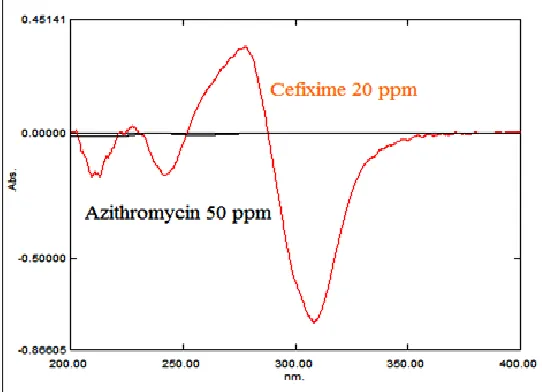
FIG. 1: OVERLAIN ZERO ORDER SPECTRA OF CEF AND AZI
[image:2.612.314.585.386.582.2]Derivative Spectroscopy:
The Overlain spectra in Fig. 1
reveal that no method was possible in zero order. To
overcome this, solutions of CEF (20 μg/mL) and AZI (50
μg/mL), were prepared separately by appropriate
dilution of standard stock solution and scanned in the
spectrum mode from 400 nm to 200 nm. The Zero
order spectra of both the drugs were derivatised to
first order (
Fig. 2
).
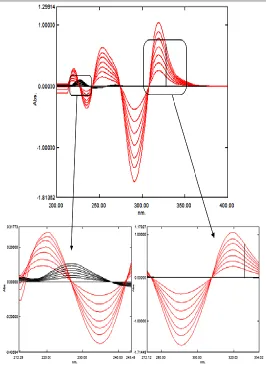
FIG. 2: OVERLAIN 1ST ORDER SPECTRA OF CEF AND AZI
FIG. 3: OVERLAIN 2ND ORDER SPECTRA OF CEF AND AZI
[image:3.612.29.295.355.724.2]The calibration curves for CEF and AZI were plotted in
the concentration range of 10-100 μg/ml at
wavelength 326.4 nm and 226.8 nm, respectively (
Fig.
4
). The concentration of the individual drug present in
the mixture was determined against the calibration
curve in quantitation mode.
FIG. 4: OVERLAIN LINEAR 2ND ORDER SPECTRA OF CEF AND AZI
Validation:
The methods were validated with respect
to linearity, precision, accuracy, robustness, LOD &
LOQ and assay.
Linearity:
Standard stock solutions were prepared by
dissolving 25 mg AZI and 10 mg of CEF in 100 ml
volumetric flasks in 25 ml Methanol and the volume
was made up with Distill Water to get a concentration
of 250 μg/ml of AZI and 100 μg/ml of CEF. From this,
suitable dilutions were made in Distill Water to get the
working standard solutions of 25-100 μg/ml for AZI and
10-40 μg/ml for CEF. The absorbances of the
derivatised spectra were measured at 226.8 nm and
326.4 nm for AZI and CEF, respectively. Five replicate
analysis were carried out.
Precision:
The precision of an analytical procedure
expresses the closeness of agreement between a series
of measurements obtained from multiple sampling of
the same homogeneous sample under the prescribed
conditions. The system precision is a measure of the
method variability that can be expected for a given
analyst performing the analysis and was determined by
performing three replicate analyses of the same
working solution.
The intra-day, inter-day, reproducibility was done to
determine precision of the developed method. The
intra-day precision of the developed UV method was
determined by preparing the samples of the same
batch
in
nine
determinations
with
three
minutes. The solution was then filtered through a
Whatmann filter paper (No. 41). From the filtrate 1.0
ml was transferred to three 10.0 ml volumetric flasks
and add 0.8 ml (Flask 1), 1.0 ml (Flask 2), and 1.2 ml
(Flask 3) of stock solution of API and then made up to
the mark with Distill Water to made them 80%, 100%
and 120% spiking.
Robustness:
The robustness of an analytical procedure
is the measure of its capacity to remain unaffected by
small, but deliberate, variations in method parameters
and provides an indication of its reliability during
normal usage. The parameters were change of
volumetric flasks (10 ml, 50 ml and 100 ml) and Change
in instrument (UV-Vis Spectrophotometer model no.
1800 and 2450). Three replicates were made for the
same conc. (10 μg/ml of CEF and 25 μg/ml of AZI) in 10
ml, 50 ml and 100 ml volumetric flasks and the
recording of absorbances were done on both the
UV-Vis spectrophotometer. The result is expressed in
Percentage RSD.
Limit of detection (LOD) and limit of quantitation
(LOQ):
LOD and LOQ were calculated from the data
obtained from the linearity studies. The slope of the
linearity plot was determined. For each of the ten
replicate determinations of same conc. (10 μg/ml of
CEF and 25 μg/ml of AZI), standard deviation (SD) of
the responses was calculated. From these values, the
parameters Limit of Detection (LOD) and Limit of
Quantitation were determined on the basis of standard
deviation and slope of the regression equation.
LOD = (3.3 x SD) / Slope
LOQ = (10 x SD) / Slope
Assay:
Twenty tablets were weighed and finely
powdered. The average weight of tablets is
determined with the help of weight of 20 tablets. A
portion of powder equivalent to the weight of 10 mg of
CEF was accurately weighed into 100 ml A-grade
volumetric flask and 25 ml Methanol was added. The
volumetric flask was sonicated for 20 min to effect
complete dissolution of the AZI and CEF, the solution
was then made up to volume with Distill Water. The
solution was filtered through Whatman filter paper.
The aliquot portion of the filtrate was further diluted
to get final concentration of 25 μg/ml of AZI and 10
μg/ml of CEF. The % assay of the drugs was calculated.
RESULTS AND DISCUSSION:
The methods discussed in
the present work provide a convenient and accurate
way for simultaneous analysis of CEF and AZI. In
second order derivative spectroscopy, wavelengths
selected for quantitation were 326.4 nm for CEF (zero
cross for AZI) and 226.8 nm for AZI (zero cross for CEF).
Both the drugs obey the Beer‘s law with the
concentration range (CEF: 10 – 40 ppm, AZI: 25 – 100
ppm) with R
2value of 0.9992 and 09990 for CEF and
AZI, respectively (n=5) (
Fig. 5, Table 1
). The Percentage
RSD was found in the range of 0.13 – 0.78 for intra-day
precision (
Table 2
), 0.12 – 0.75 for inter-day precision
(
Table 3
) and 0.11 – 0.24 for reproducibility (
Table 4
)
(n=3).
The mean % assay was found to be 100.37 % and 95.65
% for CEF and AZI, respectively (
Table 5
) (n=3). The
mean % recovery was found to be 100.17 % and 99.81
% for CEF and AZI, respectively (
Table 6
) (n=3). The
mean Limit of Detection (LOD) and Limit of
Quantitation (LOQ) value were found to be 0.54 and
1.64 ppm for CEF and 0.77 and 2.34 ppm for AZI,
respectively (
Table 7
) (n=3). The overall results of
various validation parameters were summarized in
table 8
.
TABLE 1: LINEARITY (n=5)
Concentration (μg/ml)
Absorbance (326.4 nm) Absorbance (226.8 nm)
CEF AZI
10 25 0.183 0.025
15 37.5 0.277 0.037
20 50 0.368 0.052
25 62.5 0.459 0.067
30 75 0.559 0.078
35 87.5 0.634 0.093
40 100 0.743 0.106
TABLE 2: INTRADAY PRECISION (REPEATABILITY) (n=3)
Conc. (μg/ml) Absorbance
(326.4 nm) SD % RSD
Absorbance
(226.8 nm) SD % RSD
CEF AZI
10 25
0.18086
0.001409 0.78
0.02254
0.000144 0.64
0.18330 0.02229
0.18086 0.02254
Avg. 0.18167 0.02245
20 50
0.35699
0.001099 0.31
0.05534
0.000131 0.24
0.35678 0.05509
0.35878 0.05515
Avg. 0.35751 0.05519
40 100
0.74398
0.000931 0.13
0.10536
0.000260 0.25
0.74298 0.10564
0.74212 0.10512
Avg. 0.74302 0.10537
TABLE 3: INTERDAY PRECISION (INTERMEDIATE PRECISION) (n=3)
Conc. (μg/ml) Absorbance
(326.4 nm) SD % RSD
Absorbance
(226.8 nm) SD % RSD
CEF AZI
10 25
0.15560
0.000994 0.64
0.02630
0.000195 0.75
0.15577 0.02594
0.15397 0.02599
Avg. 0.15511 0.02607
20 50
0.36354
0.002316 0.64
0.06155
0.000366 0.60
0.36395 0.06108
0.36975 0.06083
Avg. 0.36241 0.06115
40 100
0.74467
0.000913 0.12
0.10489
0.000668 0.64
0.74356 0.10412
0.74537 0.10545
Avg. 0.74453 0.10482
TABLE 4: REPRODUCIBILITY (n=3)
Conc. (μg/ml) Absorbance
(326.4 nm) SD % RSD
Absorbance
(226.8 nm) SD % RSD
CEF AZI
10 25
0.18295
0.000338 0.19
0.02289
0.000045 0.20
0.18229 0.02298
0.18249 0.02293
Avg. 0.18257 0.02293
20 50
0.35293
0.000376 0.11
0.05420
0.000070 0.13
0.35250 0.05409
0.35325 0.05407
Avg. 0.35289 0.05412
40 100
0.74329
0.000872 0.12
0.10543
0.000250 0.24
0.74376 0.10567
0.74498 0.10517
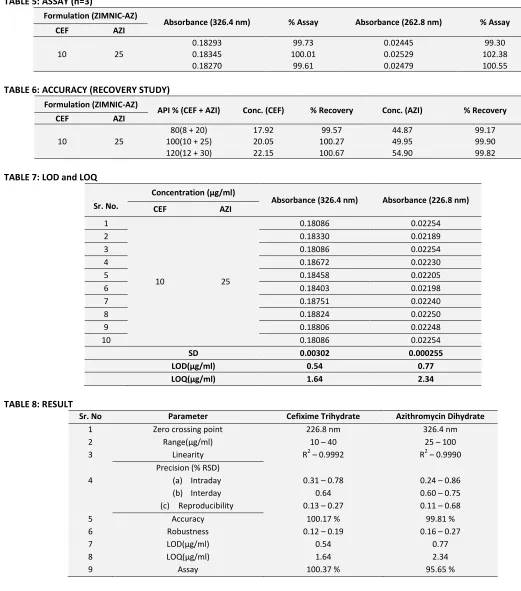
TABLE 5: ASSAY (n=3)
Formulation (ZIMNIC-AZ)
Absorbance (326.4 nm) % Assay Absorbance (262.8 nm) % Assay
CEF AZI
10 25
0.18293 99.73 0.02445 99.30
0.18345 100.01 0.02529 102.38
0.18270 99.61 0.02479 100.55
TABLE 6: ACCURACY (RECOVERY STUDY)
Formulation (ZIMNIC-AZ)
API % (CEF + AZI) Conc. (CEF) % Recovery Conc. (AZI) % Recovery
CEF AZI
10 25
80(8 + 20) 17.92 99.57 44.87 99.17
100(10 + 25) 20.05 100.27 49.95 99.90
[image:6.612.23.544.50.641.2]120(12 + 30) 22.15 100.67 54.90 99.82
TABLE 7: LOD and LOQ
Sr. No.
Concentration (μg/ml)
Absorbance (326.4 nm) Absorbance (226.8 nm)
CEF AZI
1
10 25
0.18086 0.02254
2 0.18330 0.02189
3 0.18086 0.02254
4 0.18672 0.02230
5 0.18458 0.02205
6 0.18403 0.02198
7 0.18751 0.02240
8 0.18824 0.02250
9 0.18806 0.02248
10 0.18086 0.02254
SD 0.00302 0.000255
LOD(μg/ml) 0.54 0.77
LOQ(μg/ml) 1.64 2.34
TABLE 8: RESULT
Sr. No Parameter Cefixime Trihydrate Azithromycin Dihydrate
1 Zero crossing point 226.8 nm 326.4 nm
2 Range(μg/ml) 10 – 40 25 – 100
3 Linearity R2 – 0.9992 R2 – 0.9990
4
Precision (% RSD)
(a) Intraday 0.31 – 0.78 0.24 – 0.86
(b) Interday 0.64 0.60 – 0.75
(c) Reproducibility 0.13 – 0.27 0.11 – 0.68
5 Accuracy 100.17 % 99.81 %
6 Robustness 0.12 – 0.19 0.16 – 0.27
7 LOD(μg/ml) 0.54 0.77
8 LOQ(μg/ml) 1.64 2.34
9 Assay 100.37 % 95.65 %
CONCLUSION:
The developed method was novel,
simple, accurate, precise reproducible, economical,
which would be used to estimate CEF & AZI in their
combined dosage form in routine analysis.
ACKNOWLEDGEMENTS:
Authors are highly thankful to
Alicon Pharmaceuticals, Valsad for providing gift
sample of CEF and AZI.
REFERENCES:
1. Ferrara A, Santos CD, Cimbro M: Comparative antimicrobial activity and post-antibiotic effect of azithromycin, clarithromycin and roxithromycin against some respiratory pathogens. International Journal of Antimicrobial Agents, 1996; 7:181-186.
2. Sharma HL, Sharma KK “principles of pharmacology” edition 2008: 761-762.
3. Goldman RC, Fesik SW, Doran CC: Role of protonated and neutral forms of macrolides in binding to ribosomes from Grampositive and Gram-negarive bacteria. Antimicrobial Agents Chemotherapy, 1990; 34:426-431.
4. Treadway G, Reisman A: Tolerability of 3-day, once-daily Azithromycin Dihydrate suspension versus standard treatments for community-acquired paediatric infectious diseases. International Journal of Antimicrobial Agents, 2001; 18:427-431.
5. Pacifico L, Chiesa C: Azithromycin Dihydrate in Children: A Critical Review of the Evidence. Current Therapeutic Research, 2002; 63:1:54-76.
6. Treadway G, Pontani D, Reisman A: The safety of Azithromycin Dihydrate in the treatment of adults with community-acquired respiratory tract infections. International Journal of Antimicrobial Agents, 2002; 19:189-194.
7. Ferrara A, Santos C, Cimbro M, Grassi G: Comparative antimicrobial activity and post-antibiotic effect of Azithromycin Dihydrate, clarithromycin and roxithromycin against some respiratory pathogens. International Journal of Antimicrobial Agents, 1996; 7:181-186.
8. Hoepelman I, Mollers M, Schied M: A short (3-day) course of Azithromycin Dihydrate tablets versus a 10-day course of amoxycillin–clavulanic acid (co-amoxiclav) in the treatment of adults with lower respiratory tract infections and effects on long-term outcome. International Journal of Antimicrobial Agents, 1998; 9:141-146.
9. Block S, Arrieta A, Seibel M: Single-Dose (30 mg/kg)
Azithromycin Dihydrate Compared with 10-Day
Amoxicillin/Clavulanate for the Treatment of Uncomplicated Acute Otitis Media: A Double-Blind, Placebo-Controlled, Randomized Clinical Trial. Current Therapeutic Research, 2003; 64(A):A30-A42.
10. Rothermel C: Single-Dose Azithromycin Dihydrate for Acute Otitis Media: A Pharmacokinetic/Pharmacodynamic Rationale. Current Therapeutic Research, 2003; 64(A): V.
11. Kabra S, Pawaiya R, Lodha R: Long-term daily high and low doses of Azithromycin Dihydrate in children with cystic fibrosis: A randomized controlled trial. Journal of Cystic Fibrosis, 2010; 9:17-23.
12. Yousef A, Jaffe A: The Role of Azithromycin Dihydrate in Patients with Cystic Fibrosis. Paediatric Respiratory Reviews, 2010; 11:108-114.
13. Baschiera F, Fornai M: Improved Tonsillar Disposition Of Azithromycin Dihydrate Following A 3-Day Oral Treatment With 20 Mg Kg−1 In Paediatric Patients. Pharmacological Research, 2002; 46:1:95-100.
14. Parnham M: Modulation of neutrophil and inflammation markers in chronic obstructive pulmonary disease by short-term Azithromycin Dihydrate treatment. European Journal of Pharmacology, 2005; 517:132-143.
15. Nakornchai S, Konthiang P: Activity of Azithromycin Dihydrate or erythromycin in combination with antimalarial drugs against multidrug-resistant Plasmodium falciparum in vitro. Acta Tropica, 2006; 100:185-191.
16. Ferrera K, Bomasang E: Azithromycin Dihydrate versus First Line Antibiotics in the Therapeutic Management of Documented Cases of Typhoid Fever: A Metaanalysis. Phil Journal Microbiol Infectious Diseases, 2004; 33:4:163-168.
17. Butler T, Sridhar C, Dagac M, Pathak K: Treatment of typhoid fever with Azithromycin Dihydrate versus chloramphenicol in a randomized multicentre trial in India. Journal of Antimicrobial Chemotherapy, 1999; 44:2:243-250.
18. Richard F, Michelle C, Luigi X: Lippincott's Illustrated Reviews: Pharmacology”, 4th Edition: 360-364.
19. Quintiliuni R: Cefixime Trihydrate in the Treatment of Patients with Lower Respiratory Tract Infections: Results of US Clinical Trials. Clinical Therapeutics, 1996; 18:3:373-390.
20. Ani R: Comparative, Multicenter Studies of Cefixime Trihydrate and Amoxicillin in the Treatment of Respiratory Tract Infections. The American Journal of Medicine, 1988; 85(3A):6-13.
21. Genvresse I, Carbon C: Cefixime Trihydrate. International Journal of Antimicrobial Agents, 1993; 3:1-16.
22. Iravani A, Richard G: A Double-Blind, Multicenter, Comparative Study of the Safety and Efficacy of Cefixime Trihydrate versus Amoxicillin in the Treatment of Acute Urinary Tract Infections in Adult Patients. The American Journal of Medicine, 1988; 85(3A):17-23.
23. Westphal J, Jehl F, Schloegel M, Monteil H, Brogardl J: Biliary Excretion of Cefixime Trihydrate: Assessment in Patients Provided with T-Tube Drainage. Antimicrobial Agents and Chemotherapy, 1993; 37:7:1488-1491.
24. Avner S, Buckley J, Pearlman D, Vitanza J: Comparison of Cefixime Trihydrate qd & Amoxicillin tid for acute Sinusitis. Journal of Allergy and Clinical Immunology, 1991; 87:1:143. 25. Johnson C, Susan A, Dennis M: Cefixime Trihydrate compared
with amoxicillin for treatment of acute otitis media. Pediatric Pharmacology and Therapeutics, 1991:117-122.
26. Fera M, Carbone M, Foch A: Activity of Cefixime Trihydrate against Helicobacter pylori. International Journal of Antimicrobial Agents, 1993; 3:105-108.
27. Verhoef J, Gillissen A: Resistant Haemophilus influenzae in community-acquired respiratory tract infections: a role for Cefixime Trihydrate. International Journal of Antimicrobial Agents, 2003; 21:501-509.
28. Furuya R, Nakayama H, Kanayama A: In vitro synergistic effects of double combinations of β-lactams and Azithromycin Dihydrate against clinical isolates of Neisseria gonorrhoeae. Journal of Infection And Chemotherapy, 2006; 12:4:172-176.
29. Rahman M, Hoque M, Mamun S, Rahman Z, Sultan Z:
Comparison of Single-dose Oral Azithromycin Dihydrate with Azithromycin Dihydrate and Cefixime Trihydrate for treatment of uncomplicated gonococcal urethritis. International Conference on AIDS, 2004:11-16.
30. Ryan K: The phs Gene and Hydrogen Sulfide Production by Salmonella typhimurium. Journal of Bacteriology, 1987; 169:6:2391-2397.
31. AHFS Drug information. 2009:139-140. 32. Kucer’s use of Antibiotics, 8th edition: 400,804.
33. Indian Pharmacopoeia Govrnment of India, Ministry of Health & Welfare, 6th edition 2010; 2:857-858.
34. Indian Pharmacopoeia Govrnment of India, Ministry of Health & Welfare, 6th edition 2010; 2:1012-1013.
35. Zubata P, Ceresole R, Rosasco R, Pizzorno M: A new HPLC method for Azithromycin Dihydrate quantitation. Journal of Pharmaceutical and Biomedical Analysis, 2002; 27:833-836. 36. Shaikh K, Patil S, Devkhile A: Development and validation of a
ambroxol hydrochloride and Azithromycin Dihydrate in tablet dosage form. Journal of Pharmaceutical and Biomedical Analysis, 2008; 48:1481-1484.
37. Singh S, Prakash D, Mani T: Development and Validation of Stability indicating RP-HPLC Method for the estimation of Azithromycin Dihydrate Suspension. International Journal of ChemTech Research, 2010; 2:4:1939-1944.
38. Shena Y, Yina C, Sub M, Tua J: Rapid, sensitive and selective liquid chromatography–tandem mass spectrometry (LC– MS/MS) method for the quantification of topically applied Azithromycin Dihydrate in rabbit conjunctiva tissues. Journal of Pharmaceutical and Biomedical Analysis, 2010; 52:99-104. 39. Kulikov A, Verushkin A: Development and Validation of a
Micellar Liquid Chromatographic Method with UV Detection for Determination of Azithromycin Dihydrate in Tablets and Capsules. Chromatographia, 2004; 60:1-2:33-38.
40. Sultana N, Arayne M, Hussain F, Fatima A: Degradation studies of Azithromycin Dihydrate And its Spectrophotometric determination in Pharmaceutical Dosage form. Pakistan Journal of Pharmaceutical Science, 2006; 19:2:94-98.
41. Suhagia B, Shah S, Rathod I, Patel H, Doshi K: Determination of Azithromycin Dihydrate in pharmaceutical dosage forms by Spectrophotometric method. Indian Journal of Pharmaceutical sciences, 2006; 68:2:242-245.
42. Patel C, Chaudahri C, Patel S, Patel N: Visible
spectrophotometric method for estimation of Azithromycin Dihydrate from tablet formulation.
43. Yanamandra R, Chaudhary A, Rao S, Patro B: UPLC Method for Simultaneous Separation and Estimation of Secnidazole, Fluconazole and Azithromycin Dihydrate in Pharmaceutical Dosage Forms. E-Journal of Chemistry, 2010; 7:S1:S363-S371. 44. Sharma R, Pathodiya G, Mishra G, Sharma M: Simultaneous
Estimation and Validation of Cefixime Trihydrate Trihydrate and Ornidazole in Bulk and Tablets using Hydrotropic Solubilizing Agents. Journal of Pharmacy Research, 2010; 3:12:2953-2955. 45. Dhoka M, Gawande V, Joshi P, Gandhi S, Patil N: Simultaneous
estimation of Cefixime Trihydrate and Erdosteine in capsule dosage form by spectrophotometric method. Hindustan Antibiot Bulletin, 2009; 51:1-4:29-32.
46. Rajendran S, Santhi N, Kumar P, Solomon S, Narayanan V: Simultaneous Estimation of Cefixime Trihydrate and Ofloxacin in Bulk and Tablet Dosage Form. Asian Journal Pharmaceutical Analysis, 2011; 1:2:36-38.
47. Gandhi S, Rajput S: Study of Degradation Profile and Development of Stability Indicating Methods for Cefixime
Trihydrate. Indian journal of Pharmaceutical sciences, 2009; 71:4:438-442.
48. Deshpande M, Kasture V, Gosavi S: Application of HPLC and HPTLC for the Simultaneous Determination of Cefixime Trihydrate Trihydrate and Ambroxol Hydrochloride in Pharmaceutical Dosage Form. Eurasian Journal Analytical Chemistry, 2010; 5:3:227-238.
49. Nemutlu E, Kır S, Katlan D, Beksac M: Simultaneous multiresponse optimization of an HPLC method to separate seven cephalosporins in plasma and amniotic fluid: Application to validation and quantification of cefepime, Cefixime Trihydrate and cefoperazone. Talanta, 2009; 80:117-126. 50. Meng F, Chen X, Zeng Y, Zhong D: Sensitive liquid
chromatography–tandem mass spectrometry method for the determination of Cefixime Trihydrate in human plasma: Application to a pharmacokinetic study. Journal of Chromatography B, 2005; 819:277-282.
51. Khan A, Iqbal Z, Khan M, Javed K, Khan A, Ahmad L, Shah Y, Nasir F: Simultaneous determination of cefdinir and Cefixime Trihydrate in human plasma by RP-HPLC/UV detection method: Method development, optimization, validation, and its application to a pharmacokinetic study. Journal of Chromatography B, 2011; 879:2423-2429.
52. Falkowski A, Look Z, Noguchi H, Silber M: Determination of Cefixime Trihydrate in biological samples by Reversed-Phase
High-Performance Liquid Chromatography. Journal of
Chromatography, 1987; 422:145-152.
53. Eric S, Agbaba D, Zivanov D, Vladimirov S: HPTLC determination of ceftriaxone, Cefixime Trihydrate and cefotaxime in dosage forms. Journal of Pharmaceutical and Biomedical Analysis, 1998; 18:893-898.
54. Jain R, Gupta V, Jadon N, Radhapyari K: Voltammetric determination of Cefixime Trihydrate in pharmaceuticals and biological fluids. Analytical Biochemistry, 2010; 407:79-88. 55. Reddy T, Sreedhar M, Reddy S: Voltammetric behavior of
Cefixime Trihydrate and Cefpodoxime Proxetil and
determination in pharmaceutical formulations and urine. Journal of Pharmaceutical and Biomedical Analysis, 2003; 31:811-818.
56. Honda S, Taga A, Kakehi K, Koda S, Okamoto Y: Determination of celfixime and its metabolites by high Performance capillary electrophoresis. Journal of Chromatography, 1992; 590:364-368.