1693
FACTORS INFLUENCING KNOWLEDGE SHARING IN
ENTERPRISE RESOURCE PLANNING SYSTEM USAGE IN
SMALL AND MEDIUM ENTERPRISES
1MOHAMMAD BANY BAKER, 2ZAWIYAH YOUSOF
Faculty of Information Science and Technology, National University of Malaysia, 43600 Bangi Selangor, Malaysia
E-mail: 1[email protected], 2 [email protected]
ABSTRACT
Enterprise resource planning (ERP) system is a comprehensive integrated system, which has been increasingly utilized in many organizations. The system is used by organizations to help manage integrated business processes. The success of such systems depends on how ERP users integrate and share relevant knowledge that is needed to ensure the effective performance of their collective task. Thus, it is evident that knowledge sharing is a key factor for the success of ERP system usage. This study aims to identify the factors affecting knowledge sharing among ERP users in small and medium-sized enterprises (SMEs). By means of a survey of 413 ERP users from 32 Jordanian SMEs was executed. It was found that absorptive capacity; organizational culture, top management support, effective communication and ICT tools factors have impacted significantly on knowledge sharing among ERP users. Such as finding could provide guidelines for the management to enhance knowledge sharing process among ERP users other than achieve business benefits with the use of ERP system.
Keywords: Knowledge sharing, ERP system usage, Small and medium enterprises
1. INTRODUCTION
Enterprise resource planning (ERP) systems are a set of standardized software and organization-wide database in which all business transactions are entered, recorded, processed, monitored, and reported. As a kind of process-based information systems, ERP supports multiple business functions like accounting and finance, human resources, production, and logistics. Therefore, ERP is critical for an organization to meet customer demand as it balances the process of internal production and external information feed [1].The ultimate objective of organizations investing in ERP systems is to gain the opportunities and advantages that they are promised with, once the implementation and routinization of the system is realized in the organization. These advantages have many dimensions, which can be categorized into
1694 and with the system users. All these interactions involve constant knowledge creation, sharing, extraction, preservation, and learning among members [5]. Thus, sharing of knowledge is significant to the success of ERP system. In an enterprise system project, enhanced knowledge sharing throughout various lines of interaction among organizational members is required in different organizational aspects and in different engagement levels within the project [6]. For the ERP success, the formal barriers between the users of functions should share and integrate knowledge between functions and business units for a coordinated work [7]. Further successful usage of ERP in organization requires the getting rid of hindrances to knowledge sharing. However, only little is known concerning the occurrence of knowledge sharing among team members when it comes to ERP systems [10]. For the ERP success, the formal barriers between the users of functions should share and integrate knowledge between functions and business units for a coordinated work [11]. Further successful usage of ERP in organization requires getting rid of hindrances knowledge sharing. Chiu, et al. [12] indicate that “better knowledge sharing occurs through established trust relationships”. Thus, knowledge sharing among ERP end users may be facilitated by their environment.
Organizational factors are crucial factors affecting knowledge sharing. As such, it is important that organizations overcome cultural hurdles and start the fitting culture in order to optimally ease knowledge sharing (Shao et al. 2012). In relation to this, Ha and Ahn (2014) state that knowledge sharing can optimally take place by way of effective communication. Meanwhile, support from top management is integral as to assure the success of ERP and the reinforcement of knowledge sharing by way of making available the conditions that make possible cross-functional interaction (Wang & Noe 2010). Further, by making knowledge sharing easier and more effective, the use of technology can ease the support and encouragement of knowledge sharing (Wangpipatwong 2009)
2. LITERATURE REVIEW
2.1 Small and Medium Size Enterprises and
ERP System
1695
2.2 ERP System Usage
ERP system usage includes automating and informating. Automating refers to using ERP systems to automate business processes, so that these processes can be performed with more continuity, uniformity and control. On the other hand, informating means that ERP systems are used to generate information about the processes by which an organization performs its work [11]. The success of ERP system depends on ERP end-users’ attitudes toward the system and actual use of the system [12] Only when employees are pleased with their direct system interaction can the full potential of the system be exploited [13]. Enterprise systems, such as ERPs, are categorized as collaborative workflow systems, which are complex applications that span a wide set of functionalities, support cross-functional business processes and enforce a high degree of task interdependence [14]. For collaborative applications like ERPs and other enterprise systems, the hierarchy of knowledge is theorized to include three knowledge categories of a) application knowledge, b) business context knowledge, and c) collaborative task knowledge [15].
3. Conceptual Model and Theoretical
Hypotheses
3.1 Knowledge Sharing
van den Hooff and de Leeuw van Weenen [16] defined knowledge sharing as “the fundamental means, through which employees can contribute to knowledge application, innovation, and ultimately, the competitive advantage of the organization.” Knowledge sharing is “the provision of task information and know-how to help others and to collaborate with others to solve problems, develop new ideas, or implement policies or procedures.” According to their definitions, knowledge sharing can occur by direct interaction between individual (face-to-face), communication via online means, documents, handbooks, and expert lecturing. Knowledge sharing after ERP implementation involves more than the connection of how to perform routine tasks; it enables employees to develop and exchange their
underlying opinions, assumptions and the ways of working. Colleagues’ sharing feedback could produce improved success of ERP system [4, 17]. Aside from the above studies, Boudreau [18] research found that employees could quickly update each other with tips on work when one figures out how to perform a useful task - that is, through knowledge sharing, users can exchange what they know to create new knowledge jointly, enable correct operations and, consequently, facilitate system usage. Knowledge sharing is a key factor in successful ERP system usage [19].Thus, this study proposes the first hypothesis as follows:
H1: Knowledge sharing has a positive effect on
ERP usage.
3.2 Absorptive Capacity
According to Roberts, Galluch, Dinger and Grover [20], absorptive capacity is described as the individual’s ability to identify, obtain, modify and employ external knowledge. Absorptive capacity to learn from colleagues at work positively influences a worker’s attitudes towards sharing knowledge. Stated differently, individuals that possess high absorptive capacity are more likely to perceive the advantages of knowledge sharing that stems from their positive attitudes towards it (Wang & Noe 2010). The more the individual is able to value, assimilate and employ the knowledge relayed, the more he is likely to be capable of understanding the way ERP best practices can be employed within firms [11]. In contrast, [21] stated that individuals who lack absorptive capacity prevent knowledge sharing. In other words, individual ERP user’s absorptive capacity plays a key role in the process of knowledge sharing [19]. The second hypothesis is proposed as follows:
H2: Absorptive capacity has a positive effect on ERP knowledge sharing.
4. ORGANIZATIONAL CULTURE
1696 attitudes and behaviors of organizational members. Moreover, culture is a collective mental programming, which distinguishes the members of one category of people to another. As an organization evolves, organizational culture is what holds the firm together. Organizational culture is defined as a system of shared meaning held by members that differentiates the organization from other organizations [22].Organizational culture is one of the top significant factors often addressed in literature. Successful knowledge creation and sharing depends on a culture that contributes to sharing of knowledge and trust among workers. In this regard, Goh [23] stated that an affective culture positively impacts the sharing of knowledge. Thus, in order to change worker’s actions, the more basic underlying layers of culture should be addressed. Therefore, the study proposes the third hypothesis as follows:
H3: Organizational culture has positive effect on ERP knowledge sharing.
4.1 Top Management Support
Top management support refers to the support provided by the top executives in the organization that is expected to contribute to the ERP implementation success [24, 25]. Top management support has been evidenced to influence both knowledge sharing level and knowledge sharing quality via employee’s knowledge management commitment. In addition, perceived supervisor and co-workers’ support and encouragement of knowledge sharing also contribute to the employees’ knowledge sharing and perception of knowledge sharing value [26]. Top management’s support is essential to guarantee ERP implementation success and the encouragement of knowledge sharing and integration through the provision of conditions that enable cross-functional interaction [27]. On the basis of the above discussion, this study proposes the fourth hypothesis as follows:
H4: Top management support has a positive effect on ERP knowledge sharing.
4.2 Communication
Communication is characterized as a two-way, face-to-face discussion that offers an enriching medium for exchange of information by resulting in more chance interactions and by maximizing familiarity – activities which could increase the sharing opportunities [28]. Despite the fact that the generality of current communication occurs via various technological solutions, face-to-face communication appears to be the platform for establishing trusting relationships and should therefore not be completely exchanged with information technology [29]. Communication encapsulates the formal promotion of ERP project initiatives and the feedback of its progress throughout the organization [24]. In fact, effective communication refers to an honest information policy communicated to the users and this can lead to their satisfaction of information requirement [30]. Therefore, the study proposes the following fifth hypothesis for testing;
H5: Communication has a positive effect on ERP knowledge sharing
.
4.3 ICT Tools
1697 H6: ICT tools have a positive effect on ERP knowledge sharing.
5. METHOD
5.1 Sample and Data Collection
[image:5.612.84.299.423.705.2]A self-administered questionnaire method was applied in order to collect the data required to achieve the research objectives and answer the research questions, as well as to test the research hypotheses. A delivery and collection approach of hard copies of the questionnaire was chosen as the most appropriate method for this study to guarantee a high response rate. The questionnaire was distributed in various small and medium enterprises size located in Jordan. The questionnaire was to be completed by ERP users and IT managers, financial and accounting managers and auditing managers working on ERP systems. . 600 questionnaires were distributed within 32 small and medium organizations using ERP systems. A total of 413 completed responses were obtained. The demographics of survey participants as well as the backgrounds of their affiliated organizations are shown in Table 1.
Table 1Profile of respondents (N= 413)
Category N %
Demography
Male 215 52
Female 198 48
Highest education level
Diploma 63 15.3
Bachelor degree 294 71.2
Master degree 48 11.6
PhD 8 1.9
Usage of ERP system experience
< 5 157 38
5 – 10 84 20.3
> 10 172 41.6
Levels of ERP system usage
Operation 279 67.6
Technical support 61 14.8
Decision-making 45 10.9
Management 28 6.8
Type of company
Manufacturing 20 4.8
Transportation 28 6.8
Education 34 8.2
Tourism 36 8.7
IT company 40 9.7
Retail 41 9.9
Construction 46 11.1
Pharmaceutical 50 12.1
Financial service 58 14.0
Health 60 14.5
5.2 Construct Measurement
The survey instrument was developed based on a comprehensive review of the existing literature. The questionnaire was then translated into Arabic, and a few revisions were made to adapt to ERP usage context. All the items were measured on a five-point likert scale, anchored from 1 (strongly disagree) to 5 (strongly agree).
Three items measuring absorptive capacity were adapted from Ebrahimi, Ibrahim and Sedera [35] to evaluate the ability to identify, assimilate, transform, and apply external knowledge research. The items measuring organizational culture were adapted from Raymond, Rivard and Jutras [2] to measure four typologies of organizational culture including development culture, group culture, hierarchical culture and rational culture Quinn and Spreitzer [36]. Four items were used to measure top management support from Svetlik, Stavrou-Costea and Lin [32]. Three items were used to measure effective communication adapted from Ismail Al-Alawi, Yousif Al-Marzooqi and Fraidoon Mohammed [28], which focused on encouraging users to share knowledge. Four items measuring ICT tools were adapted from Chennamaneni [37]. Six items measuring knowledge sharing were adapted from van den Hooff and De Ridder [38]. Those items measured individuals’ attitudes towards and behaviors of knowledge sharing on ERP systems Eleven items measuring ERP system usage were adapted from Doll and Torkzadeh [39], which focused on individual’s ERP system usage with respect to decision support, work integration and customer service.
6. ANALYSIS AND RESULTS
1698 rating of mean score as presented in Table 2, where the table illustrates the mean score, standard deviation and variance for each variable.
Table 2 Descriptive Analysis
Items Mean Std. Deviati
on
Varian ce
Alpha
Absorptive
Capacity AC1 1.23 .634 .402 .705
AC2 1.16 .504 .254
AC3 1.06 .302 .091
Org Culture OC1 1.21 .610 .373 .691
OC2 1.11 .421 .177
OC3 1.04 .238 .057
OC4 1.04 .247 .061
OC5 1.06 .297 .088
OC6 1.08 .340 .115
OC7 1.00 .070 .005
OC8 1.05 .299 .089
OC9 1.89 .981 .963
OC10 1.90 .974 .948
OC11 1.83 .972 .945
OC12 1.47 .702 .493
Top M
Support TMS1 1.40 .736 .541 .726
TMS2 1.42 .719 .517
TMS3 1.73 .717 .515
TMS4 1.21 .626 .391
Communication C1 1.12 .429 .184 .735
C2 1.05 .265 .070
C3 1.05 .260 .068
ICT Tools ICT1 1.08 .321 .103 .831
ICT2 1.11 .378 .143
ICT3 1.04 .187 .035
ICT4 1.07 .323 .104
[image:6.612.96.300.184.520.2]Moreover, regression analysis was conducted in order to provide the researcher with different outcomes so he can answer the study questions and test the research hypothesis postulated, as presented in Tables 3-6.
Table 3 Analysis Of Variance Of Factors And Knowledge Sharing
Model Sum of
Squares
df Mean
Square F
Regression 57.303 4 14.326 415.223
Residual 14.077 408 .035
Total 71.380 412
The model is a summary of the factors (absorptive capacity, organization culture, top
[image:6.612.313.563.242.349.2]management support, communication and ICT tools) and knowledge sharing, the independent variables were observed to have a positive correlation to the knowledge sharing as indicated by the positive R value of .896. A computed R² value of .803 suggests that the variables explain more than 80.1% of the variance in the knowledge sharing (with a standard error estimate of 0.183).
Table 4 Relative Contribution Of Factors
Model
Unstandardized Coefficients
Standardize d Coefficients
t Sig.
B Std.
Error
Beta
Absorptive Capacity .082 .020 .148 4.03 .000
Org Culture .065 .019 .102 3.53 .000
Top M Support .077 .012 .193 6.32 .000
Communication .517 .037 .497 13.88 .000
ICT Tools .333 .021 .300 15.78 .000
*significant is at .05 (p < .05)
The results in Table 4 reveal the relative contribution of each of the predictor variables to the variance in the dependent measure (knowledge sharing). In terms of predicting ERP knowledge sharing attribution, all factors are significantly contributing. This is followed by absorptive capacity (β = .148, t = 4.032, p < .05), communication (β = .497, t = 13.882, p< .05), organization culture (β = .102, t = 3.533, p< .05) and top management (β = .193, t = 6.322, p< .05). ICT tools contributed the highest (β = .300, t = 15.788, p< .05).
Table 5 Analysis Of Variance Knowledge Sharing And ERP System Usage
Model Sum of
Squares
df Mean
Square F
Regression 25.853 1 25.853 142.90
Residual 74.353 411 .181
Total 100.205 412
[image:6.612.315.537.565.623.2]1699 estimate of .425).
Table 6 Relative contribution of knowledge sharing
Model Unstandardized
Coefficients
Standardize d Coefficients
t Sig.
B Std.
Error
Beta
(Constant) .639 .074 8.65 .000
Knowledge
Sharing .602 .050 .508 11.95 .000
*significant is at .05 (p < .05)
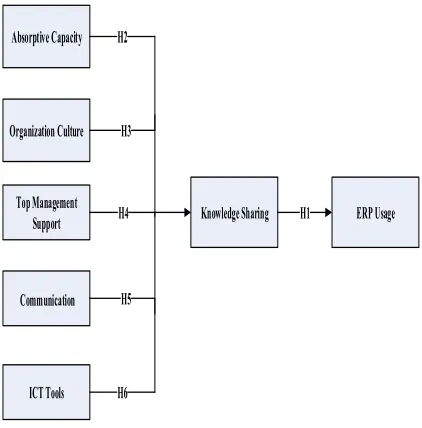
The result in the Table 5 and Table 6 show that the relative contribution of knowledge sharing to the variance in the dependent measure (ERP system usage). In term of predicting ERP system usage attribution, knowledge sharing (β = .508, t = 11.954, p < .05) is contributed significantly. Thus, knowledge sharing positively affect ERP system usage. Thus, hypotheses 1 – 6 are accepted where absorptive capacity, organization culture, top management, communication, and ICT tools all positively affect ERP knowledge sharing. Based on the results this study proposed the knowledge sharing model as shown in figure 1.
Absorptive Capacity
Organization Culture
Top Management Support
Communication
ICT Tools
Knowledge Sharing ERP Usage H2
H3
H5 H4
H6
H1
Figure 1: proposed model
7. DISCUSSION AND CONTRIBUTIONS
7.1 Discussion of Findings
Previous studies evidenced the positive relationship between organizational culture and
knowledge sharing but in this study, group culture, hierarchical culture and rational culture were found to have a direct impact on knowledge sharing. Top management support was found to have continuous significant importance in the post implementation stage influencing communication and collaboration between ERP users. Together with top management support, the effective communication among ERP users has direct impact on knowledge sharing as shown. Due to the large scale and complex nature of an ERP system, ERP users have to acquire new knowledge and skills to perform their jobs, presenting them with more challenges than those presented in legacy systems. As a result, individuals with higher capacity to apply and assimilate new knowledge persist longer and learn better than those with low absorptive capacity. Therefore, as shown in this study, absorptive capacity positively affects knowledge sharing, to conclude this field, the results show that the availability of the ICT tools are of great importance to the knowledge sharing process. Those results are not surprising since the role that the technological tools play in people’s communication with each other is quite known. The availability of the tools does not guarantee well-sharing practice without having the will to do so. The results show that ERP users need to have effective ICT tools to be available for use.
7.2 Research Contributions
[image:7.612.89.300.417.631.2]1700 With regards to organizational factors, top management support was effective for ERP user’s willingness to knowledge sharing with colleagues. The findings indicate that perceptions of top management encouragement of knowledge sharing influence ERP user’s willingness to share knowledge. To promote knowledge sharing activities, top management facilitation of social interaction culture is more important than extrinsically motivating employees. The results reveal that effective communication in an organization is a central condition for successful knowledge sharing, where communication climate exerts a relatively strong direct influence on willingness to share knowledge among ERP users. Moreover, the results show a positive significant relationship between ICT use and knowledge sharing and that ICT tools help ERP users in receiving knowledge.
8. CONCLUSION
The usage of ERP system and information systems is an increasingly popular area of interest to managers in many sectors, especially when the organizational dynamic sustained competitive advantage is emphasized. Knowledge sharing links individual, team and organization by sharing knowledge and expertise from an individual to an organizational level where it is converted to competitive value and advantage for the organization. Moreover, implementing and operating ERP systems involve many people from different backgrounds and with different characteristics, such as different cultures (hierarchical, egalitarian, fatalistic and individualistic), different disciplinary backgrounds (including IT, accounting, management, marketing, manufacturing engineering, etc.) and level of ERP expertise (low or high expertise). On the whole, there is a general lack of awareness about how to enhance knowledge sharing process among ERP users. However, the results of this thesis can help organizations’ top management, IT managers, accounting and financial managers, and other managers to increase their awareness about the factors that could enhance knowledge sharing among ERP users. Understanding these factors and
their effects on the success of ERP systems in organizations could be useful for practitioners and improve their experience.
More importantly, dimensional factors that influence the dynamics of knowledge sharing and ERP system usage have received little empirical attention. The study results suggest that ERP system can succeed by encouraging the appropriate knowledge sharing behavior. This research studied knowledge sharing among ERP system users and the results indicated that the success of ERP is influenced by the complex interplay of knowledge sharing behavior. The results clearly suggest that continued research on these topics has the potential to yield useful practical suggestions for organizations that are implementing the ERP system.
The results show the importance of having helpful working environment to get acceptable knowledge sharing practice. The factors that are studied here are absorptive capacity, organization culture, top management support, communication and ICT tools. These are just a selected group of many other organizational factors that could be studied, but they have the most potential to affect ERP usage. The results also highlighted the importance of having helpful environment to have good knowledge sharing practice within the organization.
1701
REFERENCES
[1] S. Zhang, P. Gao, and Z. Ge, “Factors impacting end-users' usage of ERP in China,” Kybernetes, vol. 42, no. 7, pp. 1029-1043, 2013.
[2] L. Raymond, S. Rivard, and D. Jutras, “Evaluating readiness for ERP adoption in manufacturing SMEs,” International Journal of Enterprise Information Systems
(IJEIS), vol. 2, no. 4, pp. 1-17, 2006.
[3] M. Haddara, and O. Zach, "ERP systems in SMEs: A literature review." pp. 1-10. [4] O. Caya, P.-M. Léger, T. Grebot, and E.
Brunelle, “Integrating, sharing, and sourcing knowledge in an ERP usage context,” Knowledge Management
Research & Practice, 2014.
[5] W.-H. Tsai, M. J. Shaw, Y.-W. Fan, J.-Y. Liu, K.-C. Lee, and H.-C. Chen, “An empirical investigation of the impacts of internal/external facilitators on the project success of ERP: A structural equation model,” Decision Support Systems, vol. 50, no. 2, pp. 480-490, 2011.
[6] R. Vandaie, “The role of organizational knowledge management in successful ERP implementation projects,”
Knowledge-Based Systems, vol. 21, no. 8, pp. 920-926,
2008.
[7] S. Ebrahimi, O. Ibrahim, A. Hussin, R. Che, and D. Sedera, “Efficiency of knowledge integration in enterprise systems implementation,” PACIS 2013
Proceedings, 2013.
[8] E. Shehab, M. Sharp, L. Supramaniam, and T. A. Spedding, “Enterprise resource planning: An integrative review,” Business
Process Management Journal, vol. 10, no.
4, pp. 359-386, 2004.
[9] T. C. Loh, and S. Koh*, “Critical elements for a successful enterprise resource planning implementation in small-and medium-sized enterprises,” International
Journal of Production Research, vol. 42,
no. 17, pp. 3433-3455, 2004.
[10] Y. K. Dwivedi, A. Papazafeiropoulo, and J. Esteves, “A benefits realisation road-map framework for ERP usage in small and medium-sized enterprises,” Journal of
Enterprise Information Management, vol.
22, no. 1/2, pp. 25-35, 2009.
[11] H.-W. Chou, Y.-H. Lin, H.-S. Lu, H.-H. Chang, and S.-B. Chou, “Knowledge sharing and ERP system usage in
post-implementation stage,” Computers in
Human Behavior, vol. 33, pp. 16-22, 2014.
[12] K.-Y. Kwahk, and J.-N. Lee, “The role of readiness for change in ERP implementation: Theoretical bases and empirical validation,” Information &
Management, vol. 45, no. 7, pp. 474-481,
2008.
[13] N. Au, E. W. Ngai, and T. E. Cheng, “Extending the understanding of end user information systems satisfaction formation: An equitable needs fulfillment model approach,” MIS quarterly, pp. 43-66, 2008.
[14] E. B. Swanson, “Information systems innovation among organizations,”
Management Science, vol. 40, no. 9, pp.
1069-1092, 1994.
[15] D. Kang, and R. Santhanam, “A longitudinal field study of training practices in a collaborative application environment,” Journal of Management
Information Systems, vol. 20, no. 3, pp.
257-281, 2003.
[16] B. van den Hooff, and F. de Leeuw van Weenen, “Committed to share: commitment and CMC use as antecedents of knowledge sharing,” Knowledge and
Process Management, vol. 11, no. 1, pp.
13-24, 2004.
[17] H.-W. Chou, H.-H. Chang, Y.-H. Lin, and S.-B. Chou, “Drivers and effects of post-implementation learning on ERP usage,”
Computers in Human Behavior, vol. 35,
pp. 267-277, 2014.
[18] M.-C. Boudreau, "Learning to use ERP technology: A causal model." p. 10 pp. [19] J.-H. Park, H.-J. Suh, and H.-D. Yang,
“Perceived absorptive capacity of individual users in performance of enterprise resource planning (ERP) usage: the case for Korean firms,” Information &
Management, vol. 44, no. 3, pp. 300-312,
2007.
[20] N. Roberts, P. S. Galluch, M. Dinger, and V. Grover, “Absorptive Capacity and Information Systems Research: Review, Synthesis, and Directions for Future Research,” MIS quarterly, vol. 36, no. 2, pp. 625-648, 2012.
[21] H.-H. Chang, and H.-W. Chou, “Drivers and effects of enterprise resource planning post-implementation learning,” Behaviour
& Information Technology, vol. 30, no. 2,
1702 [22] D. J.-F. Jeng, and N. Dunk, “Knowledge
Management Enablers and Knowledge Creation in ERP System Success,”
International Journal of Electronic
Business Management, vol. 11, no. 1,
2013.
[23] S. C. Goh, “Managing effective knowledge transfer: an integrative framework and some practice implications,” Journal of knowledge
management, vol. 6, no. 1, pp. 23-30,
2002.
[24] T. M. Somers, and K. G. Nelson, “A taxonomy of players and activities across the ERP project life cycle,” Information &
Management, vol. 41, no. 3, pp. 257-278,
2004.
[25] P. Ifinedo, “Impacts of business vision, top management support, and external expertise on ERP success,” Business
Process Management Journal, vol. 14, no.
4, pp. 551-568, 2008.
[26] S. Wang, and R. Noe, “Knowledge Sharing: A Review and Directions for Future Research,” Human Resource
Management Review, vol. 20, no. 2, pp.
115-131, 2010.
[27] J. C. Huang, S. Newell, S.-L. Pan, and B. Poulson, “ERP Systems Implementation: a knowledge-focused Perspective,” Journal
of decision systems, vol. 10, no. 1, pp.
99-117, 2001.
[28] A. Ismail Alawi, N. Yousif Al-Marzooqi, and Y. Fraidoon Mohammed, “Organizational culture and knowledge sharing: critical success factors,” Journal
of knowledge management, vol. 11, no. 2,
pp. 22-42, 2007.
[29] E. F. Cabrera, and A. Cabrera, “Fostering knowledge sharing through people management practices,” The International Journal of Human Resource Management, vol. 16, no. 5, pp. 720-735, 2005.
[30] S. Sarker, and A. S. Lee, “Using a case study to test the role of three key social enablers in ERP implementation,”
Information & Management, vol. 40, no.
8, pp. 813-829, 2003.
[31] M. Huysman, and V. Wulf, “IT to support knowledge sharing in communities, towards a social capital analysis,” Journal
of Information Technology, vol. 21, no. 1,
pp. 40-51, 2006.
[32] I. Svetlik, E. Stavrou-Costea, and H.-F. Lin, “Knowledge sharing and firm
innovation capability: an empirical study,”
International Journal of manpower, vol.
28, no. 3/4, pp. 315-332, 2007.
[33] E. Chan, and A. Mills, “Implementation of enterprise resource planning (ERP) software in a major construction contracting organization in Hong Kong,” International journal of managing projects
in business, vol. 4, no. 1, pp. 168-178,
2011.
[34] R. Palanisamy, “Tacit knowledge sharing in geographically distributed enterprise resources planning (ERP) implementation: An exploratory multi-site case study,” Journal of information & knowledge
management, vol. 8, no. 01, pp. 1-12,
2009.
[35] S. Ebrahimi, O. Ibrahim, and D. Sedera, "Efficiency of Knowledge Integration in Enterprise Systems Implementation." [36] R. E. Quinn, and G. M. Spreitzer, The
psychometrics of the competing values culture instrument and an analysis of the impact of organizational culture on quality
of life: Emerald, 1991.
[37] A. Chennamaneni, “Determinants of knowledge sharing behaviors: Developing and testing an integrated theoretical model,” 2007.
[38] B. van den Hooff, and J. A. De Ridder, “Knowledge sharing in context: the influence of organizational commitment, communication climate and CMC use on knowledge sharing,” Journal of knowledge
management, vol. 8, no. 6, pp. 117-130,
2004.