i
and Knowledge-based Systems
in Mineral Processing
byChristiaan Aldrich
Dissertation presented for the Degree
of
DOCTOR OF ENGINEERING
(Extractive Metallurgical Engineering)
in the Faculty of Engineering
at Stellenbosch University
Supervisor
Prof AJ Burger
December 2015
i
Declaration
By submitting this dissertation electronically, I declare that the entirety of the work contained therein is my own, original work, that I am the sole author thereof (save to the extent explicitly otherwise stated), that reproduction and publication thereof by Stellenbosch University will not infringe any third party rights and that I have not previously in its entirety or in part submitted it for obtaining any qualification.
This dissertation includes 181 original papers published in peer reviewed journals or books and 1 unpublished report. The development and writing of the papers (published and unpublished) were the principal responsibility of myself and, for each of the cases where this is not the case, a declaration is included in the dissertation indicating the nature and extent of the contributions of co-authors.
Date: 13 November 2015
Copyright © 2015 Stellenbosch University All rights reserved
ii
Abstract
This dissertation covers research carried out over the past 20 years in the area of knowledge engineering in mineral processing, specifically with regard to process data as a form of knowledge. This focus on data-driven plant automation includes the acquisition, interpretation and application of data in the development of decision support systems in mineral processing, as well as the development of data analytical methodologies required to accomplish this.
The following subthemes have been covered:
o Inferential sensors - predominantly the development of computer vision systems for froth flotation and the analysis of particulate systems, but also acoustic sensors and the interpretation of electrochemical noise. My research into inferential sensors has centred on the development of methodologies and algorithms to interpret image data and not the development of hardware, such as camera systems or other types of sensing devices. A major part of this pioneering research has focused on the interpretation of froth flotation images. Instead of attempting to identify individual objects (bubbles) in these images, we have treated the froth images as statistical patterns. These patterns could be interpreted by suitable feature extraction algorithms and models that could relate these features to meaningful process indicators. The novelty and impact of my research in this area can be inferred not only from the corpus of highly cited papers that associated with the technology, but also from the commercialization of the technology.
o Exploratory data analysis - Focusing on unsupervised learning, such as applied in data visualization, cluster analysis and feature extraction. In exploratory data analysis, the main issue is attempting to make sense of many measurements of large sets of variables. Standard multivariate statistical methods have their limitations when dealing with complex data, and a significant part of my research has concentrated on the extension of linear methods to their nonlinear variants by use of neural networks or other machine learning approaches. Work in this area has formed the basis of a sizeable number of industrial workshops and has significantly influenced the development of commercial process systems software.
o Data-based process modelling - Machine learning approaches to predictive and diagnostic modelling. The construction of process models plays a key role in process systems engineering. This is the case in advanced control systems, where the ability to predict future process states is critical. Models also play an important role in the interpretation of process data and hence the acquisition of insight into process behaviour and mechanisms. Such models can be developed from first principles, but
iii this is costly and with the abundance of process data, often not necessary. The primary impact of this research has been in the development and application of methods to predict process states or key performance indicators for mineral processing systems. o Process monitoring and fault diagnosis - Multivariate statistical process control from
a machine learning perspective. Process monitoring and fault diagnosis has evolved into a key element of process control over the last couple of decades, and is currently experiencing strong growth, with commercial application still lagging significantly behind the advances in academia. My research in this area has centred on the application of neural networks, kernel-based systems, random forests and other machine learning methods to extend current approaches. It has led to the foundation of the Anglo American Platinum Centre for Process Monitoring at Stellenbosch University and the development of algorithms that were adopted by industry on a proprietary basis.
o Intelligent decision support and advanced control - Fuzzy decision support systems and neurocontrol based on the use of reinforcement learning. Apart from data that are generated by instruments, tacit knowledge in the form of plant operator experience and theoretical knowledge is also a valuable resource that can be used in the automation of plant operations. This is the domain of knowledge-based or expert systems and research was undertaken in the development and application of these systems in mineral processing. The novelty of this research has mainly been in the proof-of-concept studies published in academic journals and conference proceedings. It goes without saying that in my research, I have been assisted by many colleagues, industrial collaborators, students and assistants. The contributions of these co-workers were often critical to the investigations indicated in this thesis and are indicated as such, hopefully without omission, where appropriate.
iv
Opsomming
Hierdie proefskrif dek navorsing wat uitgevoer is oor die laaste 20 jaar op kennisgebaseerde ingenieurswese in mineraalprosessering, spesifiek met betrekking tot prosesdata as ‘n vorm van kennis. Hierdie fokus op datagedrewe aanlegoutomatisasie sluit in die verkryging, interpretasie en toepassing van data in die ontwikkeling van besluitnemingsondersteuning-stelsels in mineraalprosessering, sowel as die ontwikkeling van data-analitiese metodologieë wat benodig word daarvoor.
Die volgende subtemas word behandel:
o Inferensiële sensors: Hoofsaaklik die ontwikkeling van rekenaarvisiestelsels vir beide skuimflottasie en die ontleding van partikelstelsels, maar ook akoestiese sensors en die interpretasie van elektrochemiese geraas. My navorsing in inferensiële sensors het gesentreer op die ontwikkeling van metodologieë en algoritmes om beelddata te interpreteer en nie op die ontwikkeling van hardeware, soos kamerastelsels en ander tipe sensortoerusting nie. ‘n Groot deel van die baanbrekende navorsing het gefokus op die interpretasie van flottasieskuimbeelde. In plaas daarvan om individuele voorwerpe (borrels) in die beelde te probeer identifiseer, het ons die beelde as statistiese patrone benader. Hierdie patrone kon geïnterpreteer word deur gebruik te maak van geskikte kenmerkonttrekkingsalgoritmes en modelle wat die kenmerke met betekenisvolle prosesindikatore in verband kon bring. Die innovasie en impak van my navorsing op hierdie gebied kan afgelei word, nie net van die korpus van hoogs-aangehaalde publikasies wat met die metodologie geassosieer word nie, maar ook van die kommersialisering van die tegnologie.
o Verkennende data-ontleding: Gefokus op ongeleide leer, soos toegepas in datavisualisering, trosanalise en kenmerkekstraksie. In verkennende data-ontleding, is die hoofkwessie om sin te maak van baie metings van groot stelle veranderlikes. Standaard meerveranderlike statistiese metodes het hulle beperkings wanneer komplekse data ter sprake is en ‘n beduidende deel my navorsing het gekonsentreer op die uitbreiding van lineêre metodes na hulle nie-lineêre variante deur gebruik te maak van neurale netwerke en ander masjienleertegnieke. Werk op die gebied het die grondslag gevorm van ‘n groot aantal nywerheidswerkwinkels en het die ontwikkeling van kommersiële prosesstelselsagteware betekenisvol beïnvloed.
o Datagebaseerde prosesmodellering: Masjienleerbenaderings tot voorspellende en diagnostiese modelle. Die konstruksie van prosesmodelle speel ‘n sleutelrol in prosesstelselingenieurswese. Dit is die geval in gevorderde prosesbeheerstelsels, waar die vermoë om toekomstige prosestoestande te voorspel van kritieke belang is. Modelle speel ook ‘n belangrike rol in die interpretasie van prosesdata en die
v gevolglike verkryging van insig in prosesgedrag en –meganismes. Sulke modelle kan ontwikkel word vanuit eerste beginsels, maar dis duur en met die geredelike beskikbaarheid van prosesdata, dikwels nie nodig nie. Die primêre impak van my navorsing in die verband was in die beter verstaan van die gedrag van mineraal-prosesstelsels, en as komponente van groter-skaalse aanlegoutomatisasieskemas. o Prosesmonitering en foutdiagnose: Meestal meerveranderlike statistiese
proses-beheer vanuit ‘n masjienleerperspektief. Prosesmonitering en foutdiagnose het ontwikkel tot ‘n sleutelelement van prosesbeheer oor die laaste paar dekades, en ondervind tans sterk groei, alhoewel kommersiële toepassing nog beduidend agter ontwikkeling in die akademie is. My navorsing in die area het gesentreer op toepassings van neurale netwerke, kerngebaseerde stelsels, lukrake woude en ander masjienleermetodes om huidige benaderings uit te brei. Dit het gelei tot die totstandkoming van die Anglo American Platinum Sentrum vir Prosesmonitering by die Universiteit van Stellenbosch en die ontwikkeling en gebruik van algoritmes op ‘n vertroulike basis in die nywerheid.
o Intelligente besluitnemingsondersteuning en gevorderde beheer: Wasige besluit-nemingondersteuning en neurobeheer gebaseer op versterkende leermetodes. Behalwe vir data wat deur instrumente gegenereer word, is stilswyende kennis in die vorm van aanlegoperateurervaring en teoretiese kennis ook ‘n waardevolle hulpbron wat ingespan kan word in die outomatisasie van die bedryf van ‘n aanleg. Dit is die domein van kennisgebaseerde of kundigheidstelsels en navorsing is ook onderneem in die ontwikkeling en toepassing van die stelsels in mineraalprosessering. Die bydrae van hierdie navorsing het hoofsaaklik gelê in bewys-van-konsepstudies gepubliseer in akademiese joernale en konferensieverrigtinge.
Dit is vanselfsprekend dat ek in my navorsing deur baie kollegas, nywerheidsmedewerkers, studente en assistente bygestaan is. Die bydraes van hierdie medewerkers was dikwels van kritieke belang in die ondersoeke wat in die proefskrif bespreek word en word as sulks aangedui, hopelik sonder uitsondering, waar van toepassing.
vi
Acknowledgements
It goes without saying that very little of the work discussed in this thesis could have been completed without extensive support and collaboration with many collaborators over more than two decades. Therefore, I appreciate the opportunity to pay tribute to the following key persons with whom I have had the pleasure to associate with during this period:
Professor Jannie van Deventer, my PhD supervisor and colleague in the early days, who has played a pivotal role in my early career success.
Dr Wayne Stange, then from the University of Witwatersrand.
Dr Mike Slater, then from the Department of Chemical Engineering, University of Bradford,
Bradford, West Yorkshire BD7 IDP, UK.
Drs Derick Moolman, Jacques Ludik and Johan Rademan from Crusader Systems and later CSense Systems.
Colleagues and collaborators from other universities with whom I have worked together one way or another in the past: Prof Henrik Saxén from Åbo Akademi and Andrzej Kraslawski from Lappeenranta University of Technology in Finland, as well as Prof Johan Suykens from ESAT, KU Leuven, Belgium.
Dr JP Barnard, Messrs John Burchell and Keegan Thomas, my team in the Anglo American Platinum Centre for Process Monitoring, together with my research assistant, Ms Corné Yzelle (neè Marais).
Mr Leon Coetzer, Dr De Villiers Groenewald, Gary Humphries, Mike Halhead and Dr Neville Plint from Anglo American Platinum.
Francois du Plessis, from Blue Cube Systems
Dr Marius Gerber, Jan van Vuuren and Prof Ben Herbst from the Department of Applied Mathematics at Stellenbosch University.
Profs Dup Du Plessis, Thomas Jones, Thomas Niesler and Herman Steyn from the Department of Electric and Electronic Engineering at Stellenbosch University.
Prof Niel le Roux and Dr Sugnet Gardner from the Department of Statistics and Actuarial Science at Stellenbosch University.
My colleagues from the Department of Process Engineering, especially Prof Markus Reuter, Prof Jacques Eksteen, A/Prof Guven Akdogan and Dr Lidia Auret.
Prof Ian Craig, from the University of Pretoria.
My colleagues from UCT, Profs Cyril O’Connor, Dee Bradshaw and especially Profs Gerhard de Jager, Chris Schwarz and Francis Petersen.
Prof Jan Cilliers from Imperial College, London.
My postdoctoral researchers, research assistants and students, as detailed in Appendix 9, with special mention to Drs Dingwu Feng, Gorden Jemwa and Ndeke Musee.
vii
o I wish to dedicate this thesis to my wife, Annemarie, in appreciation for her continuous support.
o I also wish to thank my promoter, Professor André Burger, for his support and advice in the submission of this dissertation.
viii
Format of Dissertation
Contents
1. Introduction ... 1
1.1. Research Theme ... 1
1.2. Impact of Research in the Engineering Industry ... 3
1.2.1. Consulting ... 3
1.2.2. Software Development for Industrial Application... 4
1.2.3. Industrial Workshops and Training ... 5
2. Background to Publications ... 6
2.1. Inferential sensors ... 7
2.1.1. Computer Vision ... 7
2.1.2. Acoustic Sensors ... 9
2.1.3. Electrochemical Noise ... 10
2.2. Exploratory Data Analysis ... 10
2.3. Process Modelling, Simulation and Optimization ... 10
2.3.1. Data reconciliation ... 11
2.3.2. Predictive modelling ... 11
2.3.3. Dynamic Modelling and Nonlinear Signal Processing... 12
2.3.4. Diagnostic Modelling of Processes ... 12
2.3.5. Numerical Modelling of Processes ... 12
2.3.6. Process Optimization ... 13
2.4. Process Monitoring and Fault Diagnosis ... 13
2.5. Intelligent Decision Support and Advanced Process Control ... 15
2.5.1. Knowledge-based Systems ... 15
2.5.2. Reinforcement learning control ... 15
3. Summary of Most Significant Research Contributions ... 17
4. List of Publications included in this Submission and referred to in Chapters 1 and 2. ... 19
1
1.
Introduction
1.1. Research Theme
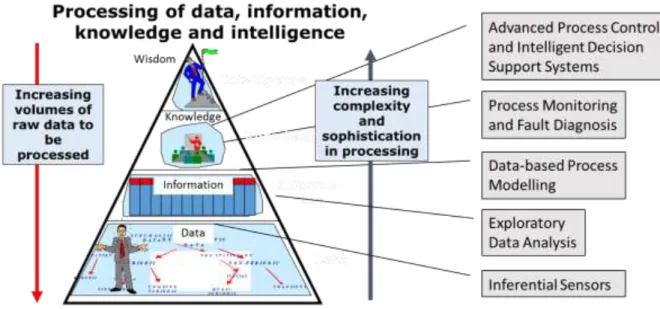
In my research career over the last twenty years, I have focused on the use of data, information and knowledge in all its forms to improve mineral processing systems. It is worthwhile to briefly consider what is meant by these concepts and their interrelatedness. From the classical data mining perspective, the relationship is hierarchical, as embodied by the so-called data-information-knowledge (DIK) pyramid1 shown on the left in Figure 1. The base of the pyramid represents raw or unstructured data, such as process signals, images or process measurements. This is followed by the information layer, where these data are organized into a form where it is amenable to mathematical operations, i.e. typically a matrix with rows (observations or samples) and columns (variables). The layer on top of that is more condensed and represents knowledge, such as useful heuristics or facts or often a model. Knowledge is useful and valuable and identification of knowledge from data (information) is a challenging pursuit in my research career. In the pyramid shown in Figure 1, there is also a fourth layer, referred to as ‘wisdom’. This layer is supposed to be unique to humans and embodies the ability of creative synthesis resulting in music or art, etc., of which machines would supposedly never be capable.
Figure 1. The author’s research activities in relation to a data-information-knowledge-(wisdom) pyramid. My research activities can be broadly classified as the development of analytical methods for smart sensing, the exploratory analysis of process data, data-based process modelling,
1It is interesting to note the number of data analytics consultants with websites such as www.DIK.com, www.D2K.com, etc.
2 process monitoring and fault diagnosis, as well as the development and application of advanced control and intelligent decision support systems.
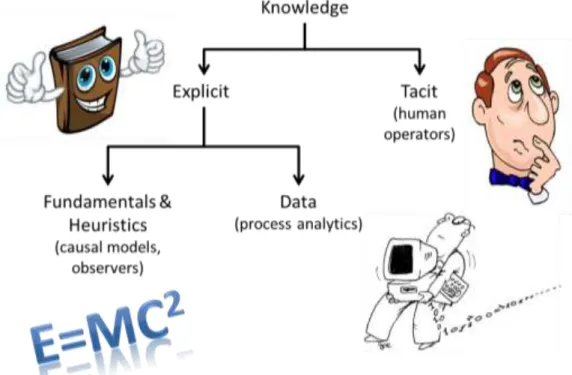
Another perspective on knowledge and data can be gained from the area of knowledge management. From this perspective, knowledge can be explicit or tacit (implicit), as indicated in Figure 2. Explicit knowledge in turn consists of fundamental or heuristic knowledge, such as expressed in textbooks or the form of equations, as well as data. In contrast, tacit knowledge is not expressed, but reside in the minds of process operators and plant managers, based on their experience. Clearly, knowledge can change from one form to another, e.g. equations can be derived from data, while tacit knowledge can be written down in a book. Data can also lead to tacit knowledge, as could textbook knowledge, when it is assimilated by students.
Figure 2. Application of process knowledge.
I shall also refer to the framework in Figure 2 when discussing the broader context of my research. This research includes the interpretation of image data obtained from ore systems, froth flotation, and slurries, construction of data-driven models, knowledge-based systems and fuzzy capturing of tacit data, the visualization of plant data, as well as the use of computational statistics for pattern recognition and the derivation of models and control
3 systems that can be used in various scenarios to improve process operation. A brief outline of this is given below.
1.2. Impact of Research in the Engineering Industry
My consulting practice, my guidance in the development of analytical algorithms for industrial use, as well as the material presented in industrial workshops and training, was developed in tandem with the expertise I have accumulated from my research over the years. These joint insights into industrial practice and cutting edge developments in data analytics allowed me to assume a niche area in my interaction with industry that was virtually immune from competition, as indicated in more detail below.
1.2.1. Consulting
I have applied machine learning methods, such as neural networks, kernel based methods, evolutionary programming, immunocomputing and tree-based modelling approaches to problems in mineral processing, such as data reconciliation, data visualization, system identification, continuous process improvement and advanced process control. This included the development of analytical methodologies that have been used or contributed to the commercial success of companies such as Anglo American Platinum and CSense Systems. My involvement in image processing over the last 20 years, started out with computer vision systems in froth flotation, together with colleague, Jannie van Deventer, and PhD student, Derick Moolman. This has led to Outokumpu acquiring the intellectual property in the mid-1990s to develop the first commercial system in this area. In later years, these approaches have been extended to multivariate image analysis in other areas, such as the spray profile analysis of hydrocyclones, estimation of fines on conveyor belts, sponsored by Sasol, and more recently the characterization of ore systems.
In addition to this, Derick Moolman and I founded Crusader Systems CC, which later became CSense Systems that was eventually acquired by General Electric Intelligent Platforms in April 2010. They have been operating as such since then.
In 2001, I have assisted Blue Cube Systems with the calibration tests of their sensor, now the MQi® series of in-line analyzers used globally in the mineral process industries.
Since 2000, I had started to build a relationship with Anglo Platinum and became their chief consultant with regard to the application of data analytics in their operations. As a consequence, I could successfully negotiate the founding of Stellenbosch University’s Anglo American Platinum Centre for Process Monitoring. This Centre served as a conduit for the implementation of data analytical methods in Anglo Platinum’s operations. This included mill
4 monitoring software, visualization of the thermal profiles of a furnace, and various algorithms for off-line use by their staff.
In the mid-1990s, part of my work had focused on the capture of tacit knowledge via the development of fuzzy logic and knowledge-based systems. I was specifically interested in the derivation of rule-based systems from data and the use of genetic algorithms to derive these rules. At a later stage, Alex Conradie, another one of my capable PhD students, demonstrated the potential of neurocontrol systems in mineral processing.
The above topics are closely related and at their core, they all depend on a data representation of the process, equipment behaviour or physical phenomenon being considered. This representation can often be reduced to a matrix (serving as the basis for multivariate image analysis, machine learning models, or models based on rules or heuristics), or could also represent complex signals, such as reconstructed in phase space, decomposed into multiple scales or modes, etc. Likewise, the analytical algorithms used to interpret the mineral processing data in the form of supervised or unsupervised learning, can be seen as a recurring theme throughout my research.
1.2.2. Software Development for Industrial Application
I have overseen or directed the development of software for industrial application, as follows o In 1996, Dr Otto Strydom, my first postdoctoral researcher, established the computational platform that was first used by Crusader Systems, in the first instance as part of their froth image analysis package, FrothACE, but also for more general application. This platform had the ability to extract data from a variety of data bases and had some basic analytical capability as well.
o In 2000, Mintek has contracted me to develop automated neural network software for their FloatStar® process control platform. This was done with the assistance of one of my Masters students, Ben Bredenkamp, from the Department of Computer Science at Stellenbosch University.
o With the establishment of the Anglo American Platinum Centre for Process Monitoring in 2008, of which I was the Founding Director, a suite of software was developed for exclusive use in the Anglo American group of companies. This included work on Anglo American Platinum’s main processing platform, as well as the development of various suites of analytical components fitting on top of the platform. In this instance, I have directed development by my small team of engineers over a period of four years (2008-2011). Dr JP Barnard deserves special mention in this regard, as specialist programmer, assisted by John Burchell, Corné Yzelle (née Marais), and Keegan Thomas.
5 Apart from the above systems, my students and I have also developed code that could be, and has been used off-line in industry, i.e. mainly the deployment of neural networks in the form of executables or dynamic link libraries.
1.2.3. Industrial Workshops and Training
The workshops and courses below and the presentation materials associated with them where entirely conceptualized, designed, marketed and presented by me. I have also presented several courses on behalf of Statsoft SA for various clients of theirs.
i. Aldrich, C. 1995-1998. Neural Networks for the Process Industries. Course notes for industrial workshop. By agreement, these course notes were also used by Crusader Systems in their workshops for clients.
ii. Aldrich, C. 1996. Introduction to Data Analysis and Empirical Modelling. Class notes for post-graduate course.
iii. Aldrich, C. 1996. An Overview of Neurocontrol Systems in the Process Industries. Course notes for industrial workshop.
iv. Aldrich, C. 1997. Analysis of Variance and Principal Component Analysis. Course notes for industrial workshop at Billiton Process Research.
v. Aldrich, C. 1998-1999. Intelligent Decision Support Systems. Course notes for industrial workshops at Polifin and Mintek.
vi. Aldrich, C. 1998. Data Mining and Knowledge Discovery in Databases. Course notes for in-house industrial workshop at Columbus Stainless.
vii. Aldrich, C. 1998. Introduction to Design of Experiments. Notes for post-graduate course at University of Stellenbosch, also presented at the Cape Technikon.
viii. Aldrich, C. 1998-2000. Exploratory Data Analysis and Empirical Modelling. Course notes for industrial workshop at Mintek.
ix. Aldrich, C. 2000. Nonlinear time series analysis and dynamic modelling. Course notes for an in-house industrial workshop at Sasol Synthetic Fuels in Secunda.
x. Aldrich, C. 2004-2014. Making Sense of Historic Process Data. Course notes used by CSense Systems in international workshops, a workshop for Computational Analysis of Hydrometallurgy in Alberta, Canada, as well as for in-house courses presented at among other Sappi Saiccor, Anglo American Chile, Mittal, and Newcrest Gold in Perth, Australia.
6
2.
Background to Publications
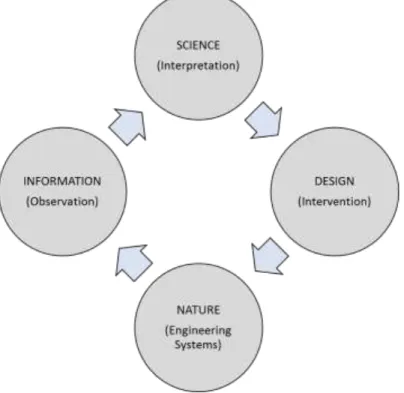
On a philosophical level, technological progress is driven by a virtuous circle containing four elements, as indicated in Figure 3. The first of these is humankind’s ability to observe natural phenomena or systems2. Systematic observation over time leads to an understanding of the phenomenon or system. This understanding leads to intervention to improve the system or change the phenomenon. This new system is then observed again until it is sufficiently well understood to repeat the cycle.
For example, during the Second World War, a number of the so-called Liberty cargo ships in the USA (Engineering System) suffered catastrophic hull failure when crossing the Atlantic ocean (Observation). This was at first attributed to poor manufacturing (welding) practice, but further observation showed that failure resulted from embrittlement of the steel and a transition from ductile to brittle fracture in the cold water of the Atlantic ocean (Interpretation). This could be rectified by appropriate reinforcement of the steel (Intervention). Similar reasoning could be applied to the evolution of the automobile, cell phone technology, medical appliances, drug development, etc.
Figure 3. Cycle of technological progress.
2It is interesting to note that humankind’s ability to observe has grown exponentially with recent improvements in instrumentation and automation, and is a direct driver of the rapidly accelerating growth in technological progress.
7
2.1. Inferential sensors 2.1.1. Computer Vision
a) Froth Flotation
The chief operating variables of flotation processes include reagent addition, ventilation rate and pulp levels, of which the former is perhaps the most important. Control of froth flotation systems have long been dependent on the experience of plant operators, who could judge the state of the flotation cell based on the appearance of the froth. This approach depends completely on the experience of the operator, which may not be extensive. Moreover, even experienced operators can perform inconsistently over time, or may approach control differently from other operators. As a consequence, control of flotation plants based on operator experience may be significantly suboptimal.
In order to address this inefficiency, research began to focus on the automated interpretation of froth surfaces in the late 1980s. The first work in this area was initiated by Prof Gerhard de Jager from UCT, who had focused on direct analysis of bubble size distributions in the froth. However, in 1993, Jannie van Deventer, and I started co-supervision of a PhD student, Derick Moolman, with Wayne Stange from the University of Witwatersrand acting as consultant. We followed a different approach than that of the UCT team. Instead of attempting to measure bubble size distributions in the froth as an indicator of the presence of reagents in the froth, we treated the froth image as a pattern that could be related to the state of the froth system. This approach proved to be highly successful and led to a number of publications related to both the analytical methods and in the study of froth flotation phenomena [5, 7, 9, 10, 11, 19, 23, 26, 39, 53, 95, 98, 99, 1053, 112, 114, 181].
Derick Moolman had completed his PhD in 1995 and joined the department in 1996 as a lecturer. Together we founded a closed corporation, Crusader Systems CC and continued development of the technology under the rubric of FrothACE. Our industrial partner in this was Kenwalt Systems, initially and then Hatch Africa. FrothACE was implemented on a number of plants in the platinum industry (Impala Platinum). Jannie van Deventer was less involved in these commercialization efforts, having left Stellenbosch University in 1995 for a position at Melbourne University in Australia, but retained his intellectual property in the initial discovery.
3This chapter was originally written by Dave Hulbert from Mintek, but contains an example of flotation froth monitoring that I have contributed for the 2nd edition of the book.
8
A few years later, with the concept proven comprehensively via a number of industrial plant trials, Derick Moolman, Jannie van Deventer and I, who had filed a provisional patent for a machine vision system, sold our intellectual rights to Outokumpu. This constituted the first such patent on flotation froth imaging systems and Outokumpu were the first to commercialize the technology, which was sold as a package with their flotation cells.
Research and development in the application of computer vision in flotation has flourished over the last 20 years. With one of my more recent postdoctoral researchers, Dr Anthony Amankwah, we have continued development in the analysis of froth motion [83, 171, 173, 180], but broadly speaking, worldwide the focus has rightly shifted towards flotation control that could exploit these advances. Ideally, this requires direct estimate of grades in the flotation cell. Although it was known to be possible in copper flotation systems, for example, where the colour of the froth would be indicative of the loading of the valuable species, it was not generally considered to be a viable approach in the platinum metal group industries, where colour provide no indication to process operators. However, in her Master studies, Corné Marais has shown that this long held assumption was invalid and the grades could be estimated in PGM systems as well [75, 76, 165].
Two decades after the first development, my collaborators and I reviewed the state of the technology in a paper in the International Mineral Processing Journal [70]. This paper was the most highly cited paper in the journal over the period from 2010-2015 at the time of writing this thesis (July 2015).
b) Hydrocyclone Underflow
The underflow of a hydrocyclone can provide a reliable indication of the state of the operation of the equipment. For example, if the spray angle is excessively large, it is an indication of a very low solids load, while a comparatively small spray angle could presage an excessively high solids loading or the onset of roping. It is this latter condition that should be avoided. Earlier attempts to measure the spray angle of hydrocyclones included the use of a mechanical device (patented by Dave Hulbert at Mintek), but one of my PhD students, Kurt Petersen, has shown that image analysis could be used more efficiently for this purpose [17, 46, 111]. Petersen also completed other work related to the modelling of hydrocyclones [27, 32, 113], while I had recently completed a chapter in hydrocyclones operation, including monitoring of cyclones [104].
Further work on monitoring of the underflow of hydrocyclones was conducted by several of my M.Sc. Eng. students, i.e. Ms Jeanette Janse van Vuuren (née Leeuwner) [79, 150-153, 159, 160] and Foibe Uahengo and Melissa Kistner (née Munnik) [86, 90].
9
c) Ore Characterization and Size Analysis
The ability to distinguish between different ores, based on their appearance or texture has found important application in ore sorting and monitoring of metallurgical feeds on conveyor belts. This can be done by use of multivariate image analysis, and it is a natural extension of my earlier work on the analysis of flotation froths.
In 1998, one of my PhD students, Kurt Petersen, has made use of a simple approach to distinguish between different ores [32]. At a later stage, Dr Gorden Jemwa, whom I had the pleasure to supervise as an M.Sc. Eng. and Ph.D. student, and afterwards as a postdoctoral research fellow, have made use of a considerably more sophisticated approaches to monitor coal particles on conveyor belts [72, 81, 155, 158, 162, 163, 177]. These methods were based on the use of textons and semi-supervised support vector machines. In parallel with this, Dr Amankwah, first as one of my postdoctoral researchers and later as independent collaborator, and I have investigated and published more conventional approaches, based on the identification of individual particles or objects in images [77, 166-168, 174, 175].
More recently, Melissa Kistner conducted a study to compare five different texture based algorithms based on the use of grey level co-ocurrence matrices, wavelets, steerable pyramids, local binary patterns and textons. The last three of these algorithms have received very little attention, if any, in mineral processing, despite their superior performance (as discussed in Kistner’s M.Sc. thesis). I have had these algorithms professionally coded by my erstwhile team in Stellenbosch for further academic and potentially commercial use.
2.1.2. Acoustic Sensors
Like computer vision systems, the signals generated by acoustic sensors require sophisticated processing and models to enable interpretation of the measurements. In essence, this requires the extraction of features from the signal and using these signal variables as predictors of some state or condition of the system being monitored. I have done some work in this area related to the monitoring of mills [38], arc furnaces [67], as well as an acoustic sensing device used in South African mines4.
The hardware for the latter was developed by CSIR in South Africa and my M.Sc. student, Stefan Brink did most of the software development and testing. Since then, the CSIR has licensed Draxin Technology to manufacture and use the device5.
4Brink, S., Dorfling, C. and Aldrich C. 2015. An acoustic sensor for prediction of the structural stability of rock. International Journal of Rock Mechanics and Mining Sciences (Unpublished technical report).
10
2.1.3. Electrochemical Noise
Electrochemical noise is difficult to interpret and with a Postgraduate Diploma and an M.Sc. student of mine, we have shown that by embedding the signal in a phase space and calculating the correlation dimensions of segments of the signal, it is possible to distinguish between different types of corrosion, such as uniform and localized corrosion. Earlier work has been done in this regard, but we have extended the analysis with scaled correlation dimension diagnostics providing potentially more information on the behaviour of these systems [61, 144].
2.2. Exploratory Data Analysis
Most of my work in exploratory data analysis has been in the area of consulting and training for industry. However, I have done some development work in this area as well, with regard to data visualization and clustering.
Data visualization is critically important when dealing with large or complex data sets [18, 31]. Some of these early developments based on the use of self-organizing or Kohonen neural networks and Sammon maps were used to track the state of flotation systems based on their froth features [12, 13, 18, 116]. One of my Master students, Tim Chemaly, has also shown that genetic programming can be used to extract features from data [41]. At a later stage, I had the opportunity to collaborate with my colleagues in the Department of Statistics and Actuarial Science on the application and development of biplot methods, which are equally useful tools for the exploration of multivariate data, but this is covered in more detail in section 2.4.
Like data visualization, cluster analysis is also an essential tool in multivariate data analysis. This is an intensely researched area that has been established for more than 50 years and I have mostly used established methods, such as k-means and hierarchical agglomerative clustering in the vast majority of my consulting work and case studies, as well as a few other approaches based on the use of neural networks (e.g. [36]), but otherwise not published.
2.3. Process Modelling, Simulation and Optimization
The central theme of my Ph.D. that I had completed in 1993 was the use of artificial neural networks in the modelling and simulation of mineral processing circuits. Neural networks had just reemerged as powerful databased approaches to modelling and were embraced by the process industries as a way to rapidly prototype process systems for use in process control applications. Since neural networks are what I would refer to as comprehensive modelling tools (i.e. they are capable of both supervised and unsupervised modelling), I have used these
11 tools in many contexts in the process industries over the last 20 years. This includes both supervised [2, 8, 9, 10] and unsupervised modelling (feature extraction) [11].
Powerful as they are, neural networks are not the only options available to process analyst or engineer, and I have also explored the development and application of other approaches in databased modelling. This includes the use of decision trees [35, 48, 100] and their more advanced derivatives, such as random forests [71, 154, 164], kernel based methods, particularly their use in inferential sensors to relate extracted features from signals to process states or key performance indicators [49, 58, 72, 81, 143, 156] and evolutionary programming6 [28, 30, 37].
2.3.1. Data reconciliation
As part of my Ph.D. in the early 1990s, I have proposed the application of multilayer perceptron neural networks to data reconciliation problems. As is well-known, in practice, mass and energy balances based on measured data, require the data to be reconciled to ensure that conservation constraints are met. Reconciliation of the process measurements can be distorted, sometimes, severely so, when systematic process faults are present. Detection of such faults is therefore important, but difficult without knowledge of the statistical distribution of the data. As I have shown, neural networks can be trained with simulated data to detect such conditions [1, 3, 4, 6, 96], since they do not depend on assumptions regarding the distributions of the data. One of my Masters students, Mr Gerber (co-supervised by Dr Lidia Auret), recently investigated similar approaches, but by using random forests, instead of neural networks [179].
2.3.2. Predictive modelling
Predictive modelling here refers to models that are used to predict a response variable from a given set of factors or input variables, without necessarily attempting to explain the effects or contributions of each input. Such models are often used on plants where outputs cannot be measured online, while inputs can, e.g. as inferential models [2], or where relationships between variables need to be identified. In the early 1990s, linear models were well established in practice, but the dealing with nonlinear systems was more challenging, as it usually required specification of the model structure upfront. Part of the evolving popularity of neural networks in the process industries, was the fact that they could be applied without requiring any advanced knowledge of the behaviour of the system [2, 14, 15, 16, 21, 24, 64, 89, 97, 101, 103, 106, 107, 109, 110, 115, 117, 118, 122].
6One of my research assistants, Mr H. Swart, should also be acknowledged here for his contribution to the development of an evolutionary programming software package in Matlab that we used at the time.
12 Although neural networks were embraced disproportionately by the process systems engineering sector in mineral processing, there are several other classes of models that could also be used, each with their own characteristics. One of these is the use of evolutionary programming models, in which mathematical operators and variables are combined based on the principles of Darwinian evolution. In principle, one of the advantages of these approaches is that the product is an explicit symbolic model or equation that can be deployed very easily and we have shown their potential [29, 30, 33, 120]. However, problems remained with the inefficiency of parameterizing the models and the computational expense of computing in the 1990s and this research was not continued.
2.3.3. Dynamic Modelling and Nonlinear Signal Processing
Although dynamic modelling is in many ways the same as the modelling of steady state processes, preprocessing of the data is critical. My interest in nonlinear time series analysis was boosted very significantly with my PhD student, JP Barnard. Prof. Marius Gerber from the Department of Applied Mathematics at Stellenbosch University acted as co-supervisor and I had learned a lot from that discipline. We were primarily interested in phase space theory and its applications on process systems. This has culminated in a number of papers in various applications, including the development of forecasting models [44, 92, 126, 130], time series analysis based on surrogate data [42, 88, 92], the development and application of singular spectrum analysis [45, 56, 129, 137, 138, 141, 148, 178, 182], and independent component analysis [124, 127, 128, 135].
2.3.4. Diagnostic Modelling of Processes
Models can be used for more than one purpose. While predictive modelling is mostly concerned with predicting certain outputs as accurately as possible, given certain punts, diagnostic modelling is more concerned with the influence of the predictors on the outputs, as a means to gain a better understanding of the system. There are several analytical approaches that can be followed in this respect and this is also an area that my collaborators and I have investigated over time [20, 74, 82, 85, 92, 161, 164].
2.3.5. Numerical Modelling of Processes
Numerical modelling and simulation of processes is growing rapidly in importance, with advances in computational hardware and numerical algorithms. I have also been involved in some related work in the fundamental modelling and simulation of high temperature systems [59, 54, 78, 80, 84, 170, 172], that had mostly been originated by one of my colleagues in the Department of Process Engineering, Guven Akdogan and membrane separation [157], which was part of a Water Research Commission project that I had initiated and managed. The
13
novelty in these projects was generally not related to the numerical algorithms, but to the insights that were gained in the physical behaviour of the systems.
2.3.6. Process Optimization
Models of process systems are often built to assist with optimization of the system, as for example with the identification of the optimal operating conditions of a mill that can be accomplished with an inverse model [88]. However, the problem becomes more difficult when more than one target or objective have to be optimized simultaneously, when these objectives are not independent. A classic example would be the simultaneous optimization of recovery and grade. In this case multi-objective optimization methods are most appropriate. However, these problems are computationally expensive to solve, especially when evolutionary algorithms are used, as is often the case. In collaboration with Dr James Bekker from Stellenbosch University, we have proposed the use of cross-entropy as an alternative, since it converges rapidly in the case of single-objective optimisation problems. Dr Bekker conceptualized most of the work, performed the numerical experiments and co-wrote the paper. This required adaptation of the basic method to multi-objective optimization. The results on dynamic stochastic problems were acceptable, based on relatively few evaluations [73].
2.4. Process Monitoring and Fault Diagnosis
Multivariate statistical process control (MSPC) has seen rapid development over the last 15 years as an area of advanced process control, including in the mineral process industries. This aspect of my research was boosted considerably with my association with Anglo American Platinum, where this was and remains a critical issue in continues process improvement. A number of my papers address several aspects of this topic. The majority of these papers deal with innovations in the technology, such as the change point detection [69, 176], application of artificial immune systems [63, 87], random forests [71, 93, 154, 161, 164], singular spectrum analysis [146], kernel methods [49, 58, 93, 136, 139, 143, 147] and multilayer perceptron neural networks [12, 34, 91, 93], the use of convex hulls [125] and process similarity indices [169].
In addition, the book [93] I have co-authored with my postdoctoral researcher, Dr Lidia Auret, deals extensively with the topic. Chapters in this book have been downloaded more than 10 000 times, since its publication in 2013.
My collaboration with Prof Niel le Roux and Dr Sugnet Gardner from the Department of Statistics and Actuarial Science at Stellenbosch University on the extension and use of biplots to monitor and interpret process data has led to several publications [47, 50, 52, 57, 140].
14 Biplots offer a rich representation of the relationships among multiple variables, as would often be encountered in the analysis of process units. This methodology was adopted by staff in Anglo American Platinum in the routine analysis of their process data, offering vast improvement over the one-variable-at-a-time approach in Excel that is still all too widely used in practice.
Representatives of Anglo American Platinum and Stellenbosch University celebrating the launch of the Centre. From left to right: Dr Neville Plint (Head of Research and Development, AAP), Prof Arnold Schoonwinkel (Dean,
Faculty of Engineering, SU), Mr July Ndlovu (Executive Head of Process, AAP), Mr Leon Coetzer (Head of Process Control and Instrumentation, AAP), Prof Chris Aldrich (Founding director, Consultant, SU), Prof André
Burger (Chairman, Department of Process Engineering & Director of the Centre, SU) and Prof Piet Steyn (Senior Director, Research, SU).
In 2008, Mr Leon Coetzer of Anglo Platinum, then Head of Process Control, for whom I had acted as consultant since 2000, had agreed to fund the establishment of a Centre for Process Monitoring at Stellenbosch University. Some of their chief vendors, including Statsoft, provided in-kind sponsorship. This included funding of the computational infrastructure of the Centre, as well as three engineers and an administrative person. I was successful in recruiting Dr JP Barnard, my erstwhile PhD student, back from the Boston, MA, USA, where he had been working on the development of Matlab software for The Mathworks. Under my guidance, the Centre had developed a number of systems for exclusive use by Anglo Platinum. This included work on their Operational Performance Monitoring (OPM) software, as well as
15 statistical process control software on top of this system, as mentioned in Section 1.2.2. From Anglo American Platinum’s side, one of my former Masters and Ph.D. students, Dr De Villiers Groenewald, likewise played a vital role in the successful deployment of the technology.
2.5. Intelligent Decision Support and Advanced Process Control 2.5.1. Knowledge-based Systems
Around the beginning of the millennium, I was quite interested in the development and application of knowledge-based systems, since these systems are well equipped to deal with the ill-defined nature of mineral processing systems. At the time, knowledge-based or expert systems emerged as a valuable tool in the process industries, but it was widely recognized that the construction of knowledge bases representative of process operations could be a severe constraint.
The reason for this was that process experts whose knowledge was to be captured could be a scarce commodity, and if available, it could still be very expensive to capture and afterwards maintain these knowledge bases. It was also a time when process data in the mineral processing industries became more widely available in plant data bases. It was realized that if expert systems could learn directly from process data, it would make the task of constructing these knowledge-based systems much easier, and it could even be possible to capture knowledge that the human expert may not have possessed in the first place [40]. Inductive learning or decision tree technology developed in the 1970s, was an obvious approach to this problem and I have mostly considered the application of these systems to various processes, with some analytical development. The latter was related to the development of methods to interrogate models, such as artificial neural networks and to represent this knowledge in the form of explicit rules that could be interpreted by human analysts. My Ph.D. students, Gorden Jemwa [142], Francois Gouws and Gregor Schmitz [22, 25, 28, 37, 94, 100, 111, 119, 121, 123] in particular, and later Ndeke Musee, played a pivotal role in these developments [55, 60, 62, 65, 66, 102, 145, 150].
2.5.2. Reinforcement learning control
Reinforcement learning is a powerful machine learning approach, where control or decision policies are automatically developed by providing an agent with a target and a set of possible control actions. This is still an emerging development in the field, but with Alex Conradie, and more recently, one of my Master students, Steven Hunter, we have shown that it has considerable potential in mineral processing and other complex systems [43, 51, 68, 131-134, 149]. Alex had spent some time with Professor Risto Miikkulainen and his group at the
16 University of Texas at Austin, in the USA, who have developed evolutionary algorithms for the construction of neural network topologies with their weights. We then adapted this approach to develop process control policies that could be applied to generic process systems, including a ball mill and batch distillation units.
As stated previously, the developments highlighted in this section are all closely connected via the common theme of data analysis and in the following section, I summarize what I consider to be my most important research contributions.
17
3.
Summary of Most Significant Research Contributions
In summary, the common theme of my research revolves around the exploitation of data and knowledge in various forms towards an improved understanding and automation of mineral and metallurgical processes. These advances have been driven partly by developments in other fields and technology transfer from other disciplines played a pivotal role in my research efforts. This included disciplines such as pattern recognition, data mining, artificial intelligence, modelling of evolutionary systems and artificial life, machine learning, etc. For example, while the use of artificial neural networks in engineering started to become widespread in the late 1980s, they were not established in the mining and metallurgical industries in the early 1990s yet, when I had considered their application in mineral processing. The same goes for other data analytical methods, which the mineral process industries have been slow to adopt, despite their apparent promise as data analytical and process systems tools.
I have contributed significantly in proof-of-concept studies with these systems and related applications in plant automation in the mineral process industries. This often required integration of several technologies (e.g. as in the pre-training of reinforcement learning control systems with partial or full plant models, the incorporation of data visualization with process monitoring or dynamic tracking of plant behaviour, the incorporation of self-diagnostics in plant models for effective maintenance, etc.)
More specifically, the most significant impact of my research in data-driven plant automation can be highlighted as follows:
Flotation froth imaging systems: By a number of measures, this early research constitutes the most significant impact of my research in minerals processing. This includes accounting for approximately 25% of the citations of papers I have (co)authored in the Scopus data base, as well as early commercialization of technology. It was also mostly on the basis of these outputs that I was a recipient of the President’s Award of the Foundation of Research and Development (FRD) in South Africa in 1995.
Process data analytics: Broadly speaking, research activities related to process data analytics include not only process modelling and the exploratory analysis of process data, but also advanced methodologies associated with process diagnostics, advanced control and decision support systems. The impact of these research efforts is reflected in the publication of numerous peer-reviewed papers, including two books, and also a considerable number of confidential reports to industrial sponsors (not referred to
18 in this thesis). In addition, these research efforts have also had a direct or indirect commercial impact via companies such as CSense Systems, now part of General Electric Intelligent Platforms and Anglo American Platinum via the Centre for Process Monitoring at Stellenbosch University. In addition, my research in this area has served as the basis for more than 20 industrial workshops in industry.
19
4.
List of Publications included in this Submission and referred to in
Chapters 1 and 2.
APPENDIX 1: PAPERS IN REFEREED JOURNALS
1. Aldrich, C. and Van Deventer, J.S.J. 1993. The use of neural nets to detect systematic errors in process systems. International Journal of Mineral Processing, 39, 173-197. 2. Aldrich, C., Van Deventer, J.S.J. and Reuter, M.A. 1994. The application of neural nets
in the metallurgical industry. Minerals Engineering, 7(5-6), 793-809.
3. Aldrich, C. and Van Deventer, J.S.J. 1994. Identification of gross errors in material balance measurements by means of neural nets. Chemical Engineering Science, 49(9), 1357-1368.
4. Aldrich, C. and Van Deventer, J.S.J. 1994. The use of connectionist systems to reconcile inconsistent process data. Chemical Engineering Journal Chemical Engineering Journal and the Biochemical Engineering Journal, 54(3), 125-135.
5. Moolman, D.W., Aldrich, C., Van Deventer, J.S.J. and Stange, W.W. 1994. Digital image processing as a tool for on-line monitoring of froth in flotation plants. Minerals Engineering, 7(9), 1149-1164.
6. Aldrich, C. and Van Deventer, J.S.J. 1995. Comparison of different artificial neural nets for the detection and location of gross errors in process systems. Industrial & Engineering Chemistry Research, 34(1), 216-224.
7. Moolman, D.W., Aldrich, C. and Van Deventer, J.S.J. 1995. The monitoring of froth surfaces on industrial flotation plants using connectionist image processing techniques. Minerals Engineering, 8(1-2), 23-30.
8. Aldrich, C. and Van Deventer, J.S.J. 1995. Hybrid connectionist modelling of the kinetics of thermal decomposition processes. Thermochimica Acta, 257, 127-137. 9. Moolman, D.W., Aldrich, C., Van Deventer, J.S.J. and Stange, W.W. 1995. The
classifi-cation of froth structures in a copper flotation plant by means of a neural net. Inter-national Journal of Mineral Processing, 43(3/4), 193-208.
10. Moolman, D.W., Aldrich, C., Van Deventer, J.S.J. and Bradshaw, D.J. 1995. The inter-pretation of flotation froth surfaces by using digital image analysis and neural networks. Chemical Engineering Science, 50(22), 3501-3513.
11. Moolman, D.W., Aldrich, C. and Van Deventer, J.S.J. 1995. The analysis of videographic process data with neural nets. Acta Chimica Slovenica, 42(1), 137-142, 1995.
12. Aldrich, C., Moolman, D.W. and Van Deventer, J.S.J. 1995. Monitoring and control of hydrometallurgical processes with self-organizing and adaptive neural net systems. Computers and Chemical Engineering, 19, Supplement 1, 803-808.
20 13. Aldrich, C., Moolman, D.W.,Eksteen, J.J. and Van Deventer, J.S.J. 1995.
Characteriza-tion of flotaCharacteriza-tion processes with self-organizing neural nets. Chemical Engineering Com-munications, 139, 25-39.
14. Van Deventer, J.S.J., Liebenberg, S.P., Lorenzen, L. and Aldrich, C. 1995. Dynamic mo-delling of competitive elution of activated carbon in columns using neural networks. Minerals Engineering, 8(12), 1489-1501.
15. Aldrich, C. and Van Deventer, J.S.J. 1995. Modelling of induced aeration in turbine aerators by use of radial basis function neural networks. The Canadian Journal of Chemical Engineering, 73(6), 808-816.
16. Annandale, G.J., Lorenzen, L., Van Deventer, J.S.J. and Aldrich, C. 1996. Neural net analysis of the liberation of gold using diagnostic leaching data. Minerals Engineering, 9(2), 195-213.
17. Petersen, K.R.P., Aldrich, C., Van Deventer, J.S.J., McInnes, C. and Stange, W.W. 1996. Hydrocyclone underflow monitoring using image processing methods. Minerals Engineering, 9(3), 301-316.
18. Van Deventer, J.S.J., Aldrich, C. and Moolman, D.W. 1996. Visualisation of plant dis-turbances using self-organising maps. Computers & Chemical Engineering, 20, Supplement, S1095-S1100.
19. Moolman, D.W., Aldrich, C., Schmitz, G.P.J. and Van Deventer, J.S.J. 1996. The inter-relationship between surface froth characteristics and industrial flotation performance. Minerals Engineering, 9(8), 837-854.
20. Rademan, J.A.M., Moolman, D.W., Van Deventer, J.S.J., Lorenzen, L. and Aldrich, C.
1996. Neural net based knowledge extraction from the historical data of an industrial leaching process. Hydrometallurgy, 43(1-3), 95-116.
21. Giles, A.E., Aldrich, C. and Van Deventer, J.S.J. 1996. Modelling of rare earth solvent extraction with artificial neural nets. Hydrometallurgy, 43(1-3), 241-255.
22. Gouws, F.S. and Aldrich, C. 1996. Rule-based characterization of industrial flotation processes with inductive techniques and genetic algorithms. Industrial & Engineering Chemistry Research, 35(11), 4119-4127.
23. Moolman, D.W., Eksteen, J.J., Aldrich, C. and Van Deventer, J.S.J. 1996. The significance of flotation froth appearance for machine vision control. International Journal of Mineral Processing, 48(3-4), 135-158.
24. Reuter, M.A., West, C., Fourie, A.G., Moolman, D.W. and Aldrich, C. 1997. The use of dimensionless numbers to characterise the feed to metallurgical reactors. Minerals Engineering, 10(1), 69-80.
25. Aldrich, C., Moolman, D.W., Gouws, F.S. and Schmitz, G.P.J. 1997. Machine learning strategies for control of flotation plants. Control Engineering Practice, 5(2), 263-269.
21 26. Aldrich, C., Moolman, D.W., Harris, M.C., Bunkell, S.-J. and Theron, D.A. 1997.
Rela-tionship between surface froth features and process conditions in the batch flotation of a sulphide ore. Minerals Engineering, 10(11), 272-281.
27. Petersen, K.R.P. and Aldrich, C. 1998. Prediction of choking in hydrocyclones by use of elementary particle interaction theory. International Journal of Minerals Processing, 53, 201-211.
28. Schmitz, G.P.J. and Aldrich, C. 1998. Neurofuzzy modelling of chemical process systems with ellipsoidal radial basis function neural networks and genetic algorithms. Computers and Chemical Engineering, 22, Supplement, S1001-S1004.
29. Greeff, D.J. and Aldrich, C. 1998. Empirical modelling of chemical process systems with evolutionary programming. Computers and Chemical Engineering, 22(7-8), 995-1005.
30. Greeff, D.J. and Aldrich, C. 1998. Development of an empirical model of a nickeliferous chromite leaching system by means of genetic programming. Transactions of the SAIMM, 98(4), 193-199 {Paper awarded a silver medal by the South African Institute of Mining and Metallurgy, 1999}.
31. Aldrich, C. 1998. Visualization of multivariate data with autoassociative neural networks. Pattern Recognition Letters, 19, 749-764.
32. Petersen, K.R.P., Aldrich, C. and Van Deventer, J.S.J. 1998. Analysis of ore particles based on textural pattern recognition. Minerals Engineering, 11(10), 959-977.
33. Schmitz, G.P.J. and Aldrich, C. 1999. Combinatorial evolution of regression nodes for feedforward neural networks. Neural Networks, 12(1), 175-189.
34. Aldrich, C. and Reuter, M.A. 1999. Monitoring of metallurgical reactors by the use of topographic mapping of process data. Minerals Engineering, 12(11), 1301-1312. 35. Schmitz, G.P.J., Aldrich, C. and Gouws, F.S. 1999. ANN-DT: An algorithm for extraction
of decision trees from artificial neural networks. IEEE Transactions on Neural Networks, 10(6), 1392-1401.
36. Aldrich, C. 2000. Cluster analysis of mineral process data with autoassociative neural networks. Chemical Engineering Communications, 177, 121-137.
37. Aldrich, C., Schmitz, G.P.J. and Gouws, F.S. 2000. Development of fuzzy rule-based systems for industrial flotation plants by use of inductive techniques and genetic algo-rithms. Journal of the South African Institute of Mining and Metallurgy, 100(2), 129-134.
38. Theron, D.A. and Aldrich, C. 2000. Acoustic estimation of the particle size distributions of sulphide ores in a laboratory ball mill. Transactions of the Journal of the South African Institute of Mining and Metallurgy, 100(4), 243-248.
39. Feng, D. and Aldrich, C. 2000. The effect of frothers on bubble size distributions in flotation pulp phases and surface froths. Minerals Engineering, 13(10-11), 1049-1057.
22 40. Aldrich, C. 2000. What is AI and is it better than classical process control? Journal of
the South African Institute of Chemical Engineers, 12(2), 27-49.
41. Chemaly, T.P. and Aldrich, C. 2001. Visualization of process data by use of evolutionary computation. Computers and Chemical Engineering, 25(9-10), 1341-1349.
42. Barnard, J.P., Aldrich, C. and Gerber, M. 2001. Identification of dynamic process systems with surrogate data methods. AIChE Journal, 47(9), 2064-2075.
43. Conradie, A.v.E. and Aldrich, C. 2001. Neurocontrol of a ball mill grinding circuit. Minerals Engineering, 14(9), 1277-1294.
44. Barnard, J.P., Aldrich, C. and M. Gerber. 2001. Embedding of multidimensional time-dependent observations. Physical Review E, 64(4), 046201.
45. Aldrich, C. and Barkhuizen, M. 2003. Process system identification strategies based on the use of singular spectrum analysis. Minerals Engineering, 16(9), 815-826.
46. Van Deventer, J.S.J., Feng, D., Petersen, K.R.P. and Aldrich, C. 2003. Modelling of hydrocyclone performance based on spray profile analysis. International Journal of Mineral Processing, 70, 183-203.
47. Aldrich, C., Gardner, S. and Le Roux, N.J. 2004. Monitoring of metallurgical process plants by use of biplots. AIChE Journal, 50(9),2167-2186.
48. Jemwa, G.T. and Aldrich, C. 2005. Improving process operations using support vector machines and classification decision trees. AIChE Journal, 51(2), 526-543.
49. Jemwa, G.T. and Aldrich, C. 2005. Monitoring of an industrial liquid-liquid extraction system with kernel-based methods. Hydrometallurgy, 78(1-2), 41-51.
50. Gardner, S., Le Roux, N.J. and Aldrich, C. 2005. Process data visualisation with biplots. Minerals Engineering, 18(9), 955-968.
51. Conradie, A.v.E. and Aldrich, C. 2005. Development of neurocontrollers with evolutionary reinforcement learning. Computers and Chemical Engineering, 30(1), 1-17.
52. Le Roux, N.J., Gardner, S. and Aldrich, C. 2005. Biplot analysis of process data. Transactions of the South African Institute of Electrical Engineers, 96(4), 253-258. 53. X. Yang and Aldrich, C. 2005. Relationship between solids flux and froth features in
the batch flotation of a sulphide ore. Transactions of the Nonferrous Metal Society of China, 15(6), 1373-1379, ID: 1003-6326(2005)06-1373-07.
54. Stadler, S.A.C., Eksteen, J.J. and Aldrich, C. 2006. Physical modelling of slag foaming in two-phase and three-phase systems in the churn-flow regime. Minerals Engineering, 19(3), 237-245.
55. Musee, N., Lorenzen, L. and Aldrich, C. 2006. Decision support for waste minimization in wine making. Environmental Progress, 25(1), 56-63.
23 56. Jemwa, G.T. and Aldrich, C. 2006. Classification of process dynamics with nonlinear Monte Carlo singular spectrum analysis. Computers and Chemical Engineering, 30(5), 816-831.
57. Groenewald, J.W. de V., Coetzer, L.P. and Aldrich, C. 2006. Statistical monitoring of a grinding circuit: An industrial case study. Minerals Engineering, 19(11), 1138-1148. 58. Jemwa, G.T. and Aldrich, C. 2006. Kernel-based fault diagnosis on mineral processing
plants. Minerals Engineering, 19(11), 1149-1162.
59. Scheepers, E., Eksteen, J.J. and Aldrich, C. 2006. Optimisation of the lance injection desulphurisation of molten iron using dynamic modelling. Minerals Engineering, 19(11), 1163-1173.
60. Musee, N., Lorenzen. L. and Aldrich, C. 2006. An aggregate fuzzy hazardous index for composite wastes. Journal of Hazardous Materials, A137, 723-733.
61. Aldrich, C., Qi, B.C. and Botha, P.J. 2006.Analysis of electrochemical noise with phase space methods. Minerals Engineering, 19(14), 1402-1409.
62. Musee, N., Lorenzen, L. and Aldrich, C. 2006. Decision support for evaluating energy demand in vinification processes using fuzzy sets theory. Journal of Energy of Southern Africa, 17(4), 4-18.
63. Yang, X., Aldrich, C., Maree, C. 2007. Detecting change in dynamic process systems with immunocomputing. Minerals Engineering, 20(2), 103-112.
64. Van Heerden, B., Aldrich, C. and Du Plessis,A. 2008. Predicting student performance using neural network analysis. Medical Education, 42(5), 516-517.
65. Musee, N., Lorenzen, L., Aldrich, C. and Aoyi, O. 2008. A new methodology for waste classification using fuzzy set theory: Part I. Knowledge acquisition. Journal of Hazardous Materials, 154(1-3), 1040-1051.
66. Musee, N., Lorenzen, L. and Aldrich, C. 2008. A new methodology for waste classification using fuzzy set theory: Part II. Intelligent decision support systems. Journal of Hazardous Materials, 157(1), 94-105.
67. Burchell, J.J, Eksteen, J.J., Niesler, T., Aldrich, C. and Jemwa, G.T. 2009. Acoustic monitoring of plasma arcs in direct current electric arc furnaces. Metallurgical and Materials Transactions B, 40(6), 886-891.
68. Conradie, A.v.E. and Aldrich, C. 2010. A Neurocontrol of a multi-effect batch distillation pilot plant based on evolutionary reinforcement learning. Chemical Engineering Science, 65, 1627-1643.
69. Auret, L. and Aldrich, C. 2010. Change point detection in time series data with random forests. Control Engineering Practice, 18, 990-1002.