
HELP or HELP to: What do corpora have to say?
46
0
0
Full text
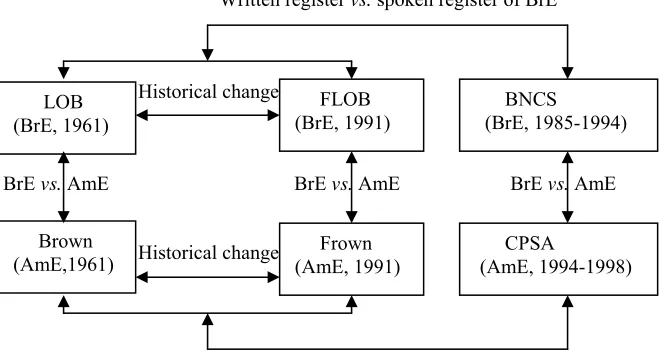
(2) 2. Furthermore, HELP is the only verb that can both control either a full infinitive or a bare infinitive and occur either with or without an intervening noun phrase (NP), 3 as in the following examples cited from the BNC: (1). (a) HELP to V Perhaps the book helped to prevent things from getting even worse. (b) HELP NP to V I thought I could help him to forget. (c) HELP V Savings can help finance other Community projects. (d) HELP NP V We helped him get to his feet and into a chair.. In this paper, we will examine the factors that may potentially influence a language user’s choice of a full infinitive or a bare infinitive as the object or object complement of HELP. 4 Our work is based on the relative frequencies of HELP in six corpora, as shown in Figure 1. All of these corpora are used to explore the potential syntactic and semantic conditions that may be relevant to the choice of a full or bare infinitive with HELP. The four written English corpora were compiled using the same sampling frame, each containing 500 segments sampled from fifteen text categories, each corpus totalling one million words. LOB (The Lancaster-Oslo-Bergen Corpus of British English) and FLOB (The Freiburg-LOB Corpus of British English) represent.
(3) 3. British English (BrE) in 1961 and 1991, while Brown (A Standard Corpus of Present-Day Edited American English) and Frown (The Freiburg-Brown Corpus of American English) represent American English (AmE) in the same periods. 5 The corpus of spoken AmE used in this paper is the Corpus of Professional Spoken American English (CPSA), 6 including over two million words of conversations occurring between 1994 and 1998 in the context of professional activities broadly tied to academics and politics. The corpus of spoken BrE we use is a subcorpus we defined within the spoken component of the British National Corpus (BNCS), totalling around 6.43 million words. To make BNCS more representative of BrE and more comparable to CPSA, the subcorpus only includes language uttered between 1985 and 1994 by speakers whose first language is BrE. 7 Figure 1 Corpus data Written register vs. spoken register of BrE. LOB (BrE, 1961). Historical change. BrE vs. AmE Brown (AmE,1961). FLOB (BrE, 1991) BrE vs. AmE. Historical change. Frown (AmE, 1991). BNCS (BrE, 1985-1994) BrE vs. AmE CPSA (AmE, 1994-1998). Written register vs. spoken register of AmE.
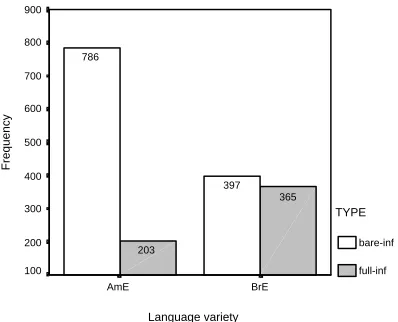
(4) 4. This paper is organized as follows: section 1 contrasts the BrE data and the AmE data to see whether the variety of English has an effect on the language user’s choice; section 2 compares frequencies in LOB/Brown and FLOB/Frown to show the effect of language change over three decades; section 3 is concerned with factors relating to the spoken/written distinction; section 4 examines the effect of the alleged semantic distinction between a full infinitive and a bare infinitive; section 5 discusses the potential influences of syntactic conditions on the use of HELP; and section 6 concludes the paper. 8 1 Language variety To examine the potential effect of the variety of English on HELP, we extracted all of the instances of HELP, including its inflected forms (e.g., helps, helped and helping), from the six corpora and classified each occurrence according to the four-fold classification in (1). The frequencies of the full and bare infinitives in the BrE and AmE corpora are shown in Figure 2. Note that the frequencies in the figure are total counts of the relevant usage of infinitives in both the data of the 1960s and the 1990s, and in both written and spoken corpora. As sample sizes may affect the level of statistical significance, raw frequencies must first be normalized to a common base.9 Of the six corpora used in this paper, four (Brown, Frown, LOB and FLOB) are one million words in size. Therefore, unless otherwise stated, the raw frequencies (RF) of CPSA and BNCS are normalized as frequencies per million words in order to facilitate the comparison.
(5) 5. between the six corpora. Table 1 shows both raw and normalized frequencies of infinitive variants in the AmE and BrE data. 10 The last two columns of the table indicate the LL (log likelihood) ratio calculated on the basis of normalized frequencies and the significance level 11 . Figure 2 Contrasting BrE and AmE 900 800 786 700. Frequency. 600 500 400. 397 365. 300. TYPE. 200. bare-inf. 203. full-inf. 100 AmE. BrE. Language variety. For one degree of freedom (df), the critical value of significance at p<0.001 is 10.83, much less than the calculated log likelihood value (LL) in Table 1. Therefore, we can confidently conclude that the difference in usage of HELP between BrE and AmE is statistically significant with respect to the choice of a full or bare infinitive. Our finding is in line with the observation of Biber et al (1999: 735) that ‘AmE has an especially strong preference for the pattern verb + bare infinitives although the bare infinitive is more common than the to-infinitive in both varieties’. However, a more refined view of the differences between AmE and BrE emerges if we compare the three pairs of comparable corpora separately..
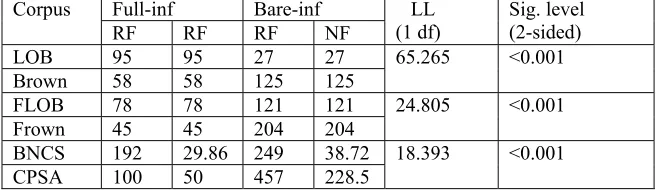
(6) 6. Table 1 Contrast between BrE and AmE Variety BrE AmE. Full-infinitive RF NF 365 43.30 203 50.75. Bare-infinitive RF NF 397 47.04 786 196.50. LL (1 df) 23. Sig. level (2-sided) <0.001. Table 2 shows the results of such a comparison. As can be seen from the table, LOB and Brown (with an LL value of 65.265), which represent written BrE and written AmE in 1961, contrast more strikingly than FLOB and Frown (with an LL value of 24.805). For the moment we will simply note this difference, though we will return to it in section 2. The difference between the two spoken corpora (with an LL value of 18.393) is roughly similar to the FLOB/Frown difference rather than to the LOB/Brown difference. Interestingly, the spoken data is nearly contemporaneous with FLOB and Frown. Table 2 Full infinitives and bare infinitives in BrE and AmE corpora Corpus LOB Brown FLOB Frown BNCS CPSA. Full-inf RF 95 58 78 45 192 100. RF 95 58 78 45 29.86 50. Bare-inf RF NF 27 27 125 125 121 121 204 204 249 38.72 457 228.5. LL (1 df) 65.265. Sig. level (2-sided) <0.001. 24.805. <0.001. 18.393. <0.001. The following example illustrates the British preference for to-infinitives: (2) (BNC). You are going to help me make to make a birthday cake for Jim remember..
(7) 7. The repair in this utterance is telling. The speaker first utters You are going to help me make but immediately changes the utterance to use the full infinitive. By the wording ‘British preference’, we do not mean that full infinitives are more frequent in British English. Rather, the British preference for full infinitives is in relation to the domination of bare infinitives in the AmE data. As Figure 2 shows, bare infinitives account for nearly 80% in the AmE data, whereas they make up only about 52% of the BrE data. Bare infinitives are prevalent in AmE simply because this construction is of American provenance, though it has penetrated rapidly into BrE (cf. Lind 1983: 264; Onions 1965). Zandvoort (1966) classified this construction as an Americanism and claimed that ‘except in American English, however, to help usually takes an infinitive with to’ (cf. Lind 1983: 264). However, if we take language change into account, which we will do in section 3, we find Zandvoort’s claim does not hold any longer – HELP no longer necessarily takes a full infinitive in BrE; rather, the bare infinitive has also become the statistical norm in BrE (cf. also Mair 1995: 264; 2002:124). 3 Language change Language change over time has affected the choice of a full or bare infinitive following HELP. The bare infinitive after HELP was pronounced to be now dialectal or vulgar in the Oxford English Dictionary (1st ed., 1933). The Supplement to the OED (1989) removed this label and judged it as being ‘a common colloq. form’ (cf. Kjellmer 1985: 264). There is evidence that even the.
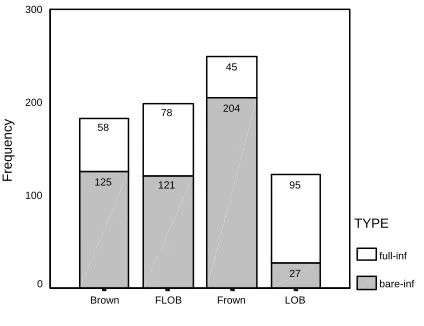
(8) 8. 1933 OED was not reflecting reality, however; Mair (2002: 123), based on the quotation base of the OED, observed a rapid increase in bare infinitives from the mid nineteenth century onwards. As such, Vallins’s (1951: 56) claim that ‘the construction is not seriously questioned now (as it might have been twenty years ago) even in normal literary writing’ is credible. Certainly, by 1991, a bare infinitive after HELP ‘lost the informal ring formerly associated with it’ (Mair 1995: 268). Figure 3 Frequencies in the four written corpora 300. 45. 200. 204. Frequency. 78 58. 125. 121. 95. 100. TYPE full-inf 27 bare-inf. 0 Brown. FLOB. Frown. LOB. Corpus. Given that there is some evidence of language change related to HELP, this section examines recent data to demonstrate the possible effect of language change on the language user’s choice. We will only consider written English because the four written corpora used in this paper are perfect for this purpose. Figure 3 shows the relevant frequency data from the four corpora. 12 It can be seen.
(9) 9. from the figure that the proportion of the bare infinitives in both BrE and AmE data have increased over the period 1961-1991. Table 3 Contrast between written English in 1961 and 1991 Sample Period 1961 1991. Corpus LOB Brown FLOB Frown. Fullinf 95 58 78 45. RF 153 123. Bareinf 27 125 121 204. RF 152. LL (1 df) 40.143. Sig. level (2-sided) <0.001. 325. Table 3 shows the frequencies of the full and bare infinitives in the data for English in 1961 and 1991. As the written AmE and the written BrE data are equal in size, normalization is not needed. The calculated log likelihood value in the table is much greater than the critical value of 10.83 for significance at p<0.001. Therefore, it can be argued confidently that language change over the three decades has indeed exerted influence over the language user’s choice between the two infinitive variants. It is also interesting to note in the table that there is a marked increase in the total occurrence of HELP, in both the BrE and AmE data. For the moment, we will simply note this increase, though we will return to it in section 5. Table 4 Changes in written BrE and AmE Variety BrE AmE. Corpus LOB FLOB Brown Frown. Full-inf 95 78 58 45. Bare-inf 27 121 125 204. % of bare-inf 22.13% 60.80% 68.31% 81.93%. LL (1 df) 47.575. Sig. level <0.001. 10.678. 0.001.
(10) 10. As can be seen in Table 4, in the 1960s, bare infinitives account for only 22% of the BrE data, but this percentage rose to 60% in the 1990s; In the AmE data, there was also an increase, from 68% to 82%, in the proportion of bare infinitives. But the change in AmE is not as marked as that in BrE, as reflected by the lower significance level and smaller LL value for the AmE data. The difference between FLOB and LOB (LL=47.575) is significant at p<0.001, whereas the significance level between Frown and Brown (LL=10.678) is 0.001. The reason for this apparent difference is that by 1961 AmE was already much more tolerant of bare infinitives than BrE (see Figure 2). Consequently a greater shift towards the use of bare infinitives in the period 1961-1991 was possible for BrE, resulting in a more marked change. It is clear that by the 1990s, the bare infinitive has become the statistical norm also in BrE. But even so, the British use full infinitives more frequently than Americans. 4 The spoken/written distinction Written language differs from spoken language in many respects, one of which is that speech is typically less formal than writing and thus more tolerant of variant forms. Earlier studies of HELP show that of the two variants of HELP (NP) to do and HELP (NP) do, the former is the original one and the latter a later development (cf. Kjellmer 1985: 158). As such, bare infinitives are predicted to be more common in spoken English than in written English. This prediction is generally supported by our corpus data. As can be seen in Figure 4, except in.
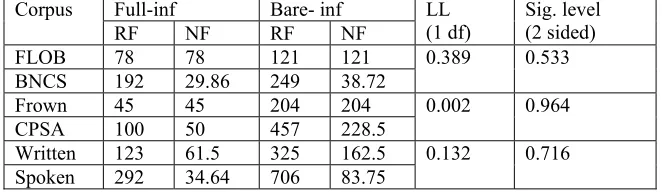
(11) 11. written BrE, 13 bare infinitives occur more frequently in the spoken data than in the written data. In spite of the slightly larger proportion of bare infinitives in spoken English, however, we cannot conclude that the spoken/written distinction actually influences the language user’s choice, as shown by the statistical test conducted below. Figure 4 Full/bare infinitives following HELP in spoken and written English 500 457. Frequency. 400. 329. 300. 249 200 192 173 148 100. 100. TYPE. 103 bare-inf. 0. full-inf AmEspeak. AmEwrite. BrEspeak. BrEwrite. Language variety. To test the statistical significance of this difference, all of the raw frequencies were normalized to one million words, as shown in Table 5. For the difference to be statistically significant, the calculated log likelihood ratio must be greater than 3.84, the critical value for significance at p<0.05 for one df. Table 5 shows that irrespective of whether we consider the written and spoken data in BrE and AmE separately, or ignore the language variety and take the written and spoken data in the two language varieties together, the significance score is greater than 0.05 and hence the difference is not statistically significant. Even if we disregard the effect.
(12) 12. of language change (cf. section 3) and compare the written and spoken data of the matching period (see Table 6), we come to the same conclusion: while bare infinitives occur more frequently in spoken English, the spoken vs. written distinction does not significantly influence a language user’s choice between the two infinitive variants. Table 5 Contrast between spoken and written registers Register BrEwrite BrEspeak AmEwrite AmEspeak Written Spoken. Full-inf RF 173 192 103 100 276 294. NF 86.5 29.86 51.5 50 69 34.88. Bare-inf RF NF 148 74 249 38.72 329 164.5 457 228.5 477 119.25 706 83.75. LL (1 df) 2.159. Sig. level (2-sided) 0.142. 2.711. 0.100. 1.746. 0.186. Table 6 Contrasting the spoken and written data of the matching period Corpus FLOB BNCS Frown CPSA Written Spoken. Full-inf RF 78 192 45 100 123 292. NF 78 29.86 45 50 61.5 34.64. Bare- inf RF NF 121 121 249 38.72 204 204 457 228.5 325 162.5 706 83.75. LL (1 df) 0.389. Sig. level (2 sided) 0.533. 0.002. 0.964. 0.132. 0.716. 4 Semantic distinction The debate over the semantic distinction between the two versions of the infinitive has a long history (see Duffley 1992:1-14). While most researchers content themselves with stating that the omission of to after HELP is optional, a few others see a subtle semantic distinction between the two variant forms. Wood (1962: 107-8) and Lu (1996: 813), for example, argue that to ‘can be omitted only.
(13) 13. when the helper does some of the work, or shares in the activity jointly with the person that is helped’ (Wood, ibid). In other words, when the helper does not take part in the activity with which the help is offered, the infinitive must take to, as in (3a). Thus sentences like (3b) and (3c) are unacceptable according to Lu and Wood. (3). (a) This book helped me to see the truth. (Lu, ibid) (b) These tablets will help you sleep. (Wood, ibid) (c) Writing out a poem will help you learn it. (Wood, ibid). (4). (a) Will you help me clear the table? (Quirk et al 1972: 841) (b) This book will help you to see the truth. (Quirk et al 1972: 841). (5). (a) John helped Mary eat the pudding. (Dixon 1991: 199) (b) John helped Mary to eat the pudding. (Dixon 1991: 199). Similarly to Wood, Quirk et al (1972: 841) argue that the choice of the infinitive variants ‘is conditioned by the subject’s involvement’. For example, in (4a) with a bare infinitive, ‘external help is called in’ whereas in (4b) with a full infinitive, ‘assistance is outside the action proper’. Similar views can also be found in Dixon (1991: 199), who argues that in (5a) John ate part of the pudding as Mary did, whereas in (5b) John presumably fed the pudding to an invalid Mary. Quirk et al (1985: 1206), though, drop the semantic distinction and claim that the only contrast is that the bare infinitive is more American..
(14) 14. Duffley (1992: 14, 18) uses the following minimal pairs to argue for a semantic distinction between the two infinitival variants: (6). (a) I saw him be impolite. (b) I saw him to be impolite.. (7). (a) I had nine people call. (b) I had nine people to call.. Duffley suggests that there is a general difference in the aspectual properties of the bare and full infinitives: the bare infinitive evokes ‘a perfective view of the realization of an event’ (action-like or state-like) while the full infinitive evokes ‘an action situation referred to a point in time prior to its realization’. Thus in (7a) the bare infinitive ‘evokes the actual realization of the action of calling from beginning to end in the past time-stretch referred to by had’ (ibid: 18) whereas in (7b) call is supposed to follow the existence of the obligation to realize this event, denoted by had. On careful examination, however, we find that saw and had have different meanings, and the different readings of these minimal pairs come as a result of a lexical shift rather than the presence or absence of to before the infinitive. In (6a) saw refers to visual perception whereas in (6b) it is related to mental apprehension, or the realization of his being impolite by means of inference (cf. also Bolinger 1974: 66). Likewise, in (7a), had has a causative meaning while in (7b), had simply means ‘possess’, thus the sentence can be interpreted as I will call nine people, and these people are my (real or fictious).
(15) 15. calling list. Hunston (2002: 139) argues, on the basis of collocations, that the three main meanings of maintain (‘do not allow to weaken’, ‘say something strongly’ and ‘keep at a particular level’) might as well be treated as three phraseologies with their own meaning rather than as a single word with three meanings. We believe the same applies to see and have in (6) and (7). As long as we can approach the difference in these sentences from the perspective of the semantic difference encoded in full verbs, rather than aspectual properties of the full and bare infinitives, we need not pursue this issue further here. The semantic difference between the infinitival variants is not reported in more recent corpus-based works such as The Longman Language Activator (1993), The Collins COBUILD English Dictionary (1995), The Longman Dictionary of Contemporary English (1996), and The Longman Grammar of Written and Spoken English (1999). The Collins dictionary, for example, defines HELP thus: If you help someone, you make it easier for them to do something, for example by doing part of the work for them or by giving them advice or money. (Collins, p. 787) The Collins definition does not draw a distinction between whether the helper actually shares or does not share the helping activity. One of their examples is: (8). My mum used to help cook the meals for the children. (Collins, p. 787). Without more contextual information, it is not clear whether the mother did the actual cooking herself or helped the children, perhaps, by means of simply giving.
(16) 16. advice on how to cook or relieving the children from such chores as vacuuming the floor so that they could cook. The most reasonable reading is that the mother did the cooking herself, yet the bare infinitive cook is used. The Activator’s examples, as quoted in (9), are even more illustrating as they certainly seem to counter the semantic distinction: (9). (a) My mother’s death was a very difficult time for me but my boyfriend. helped me get over it. (Activator, p. 604) (b) If I write a list, it helps me remember all the things I have to do in a day. (Activator, p. 606). Yet assessing the claims of Lu, Wood, and Quirk et al on a large scale is made difficult by two factors. Firstly, most of the examples in our corpora do not cover the scenario discussed by these authors. Secondly, where an example may fit the desired scenario, it is in fact hard to make the distinction between whether or not the helper actually takes part in the helping activity. Nevertheless, the following examples provide enough evidence to undermine the semantic distinction as suggested by Lu, Wood and Quirk et al as being an absolute one (cf. also Lind 1983: 271): (10). (a) Good field techniques will not only equip linguists for better work, but. also help them overcome negative attitudes. (Brown) (b) Historical antecedents help us understand the current debate and the absence of a perfect solution to the dilemma of war coverage. (Frown).
(17) 17. (c) Mrs. Clinton, before she came up here today, gave a tour of the White House and the personal residence to one of the physical therapists that will be added to the White House Medical Unit team that will help the President convalesce when he leaves the hospital. (CPSA) (d) And there’s nothing like a poultice to help you get to sleep. (LOB) (e) I help people stop smoking. (FLOB) (f) Well you oh it says if you have a dose last thing at night it helps you sleep. (BNC) In none of these cases, with either an animate or inanimate subject (i.e. the helper) could the helper have actively involved in helping activity, yet the bare infinitive was chosen. As such, Duffley suggests that A better characterization of the bare infinitive structure in these uses is that it evokes ‘helping’ as direct or active involvement in the bringing into being of the action denoted by the infinitive…In contrast, HELP + to evokes help as a condition which enables the helpee to realize the event denoted by the infinitive. (Duffley 1992:28) This characterization, however, does not add much to the argument for the semantic distinction, because there is little difference between direct/active involvement and direct/active participation discussed above. The two are practically equivalent. Duffley uses the examples in (11) to support the distinction he makes:.
(18) 18. (11). (a) Mrs Arthur Goldberg, wife of the Secretary of Labour, paints. professionally and helps sponsor the Associated Artists’ Gallery in the District of Columbia. (Brown) (b) The Bonaventure was quivering and lurching like an old spavined mare. Her stern was down and a sharp list helped us to cut loose the lifeboat, which dropped heavily into the water. (Brown) According to Duffley (ibid: 24), it is not acceptable to use to sponsor in (11a) while to cut in (11b) cannot be replaced with the bare infinitive cut. However, we cannot see any contextual difference between the sentences in (11) and (12): (12). (a) What a thoughtful company are Ford Motors. They don’t only help to. sponsor Sky’s TV Soccer but close down a factory and various assembly lines so that their workers will have time to watch! (BNC) (b) Opportunity 2000 in Kingfisher has helped us unlock rich reserves of talent among our employees […] (BNC) Just as Mrs Arthur Goldberg could be actively involved in sponsoring an art gallery (11a), Ford Motors could similarly sponsor a football match, because ‘the only way to help sponsor something is to sponsor it in part by contributing money oneself’ (Duffley 1992: 138). Yet the full infinitive was used in (12a). 14 Similarly, the subjects in (11b) and (12b) are both inanimate, and HELP in both sentences means to enable or to facilitate. However, one sentence uses the full infinitive whereas the other uses the full infinitive. It would appear that neither.
(19) 19. AmE nor BrE in fact display the distinction claimed by Lu, Wood, Quirk et al and Duffley. Consequently, we claim that the sentences in (3) are perfectly acceptable. Another issue that is related to the semantic distinction is the hypothesis that HELP preceding a bare infinitive is progressively grammaticalized as a modal idiom/catenative or ‘quasi-auxiliary’ (Mair 1995:270; 2002:124). Based on his observation that the use of HELP with infinitives (especially bare infinitives) has started mushrooming since the mid nineteenth century, Mair (ibid) argues that the meaning of HELP has become so general, and abstract (contribute to/provide a favourable environment for) that its meaning ‘approaches those typically associated with grammatical categories’. While Mair is right that the increase of the use of HELP with infinitives in general and bare infinitives in particular is attributable to the extension of the meaning of HELP, we cannot see a link between this increase and the grammaticalization of HELP. In what way has grammaticalization contributed to the increase of the use of HELP with infinitives? Is it that only a grammatical word increases in use over time while a lexically full verb does not? Such issues cannot be addressed fully here, but clearly beg future investigation. Another problematic finding of Mair (2002: 125) is based on his use of the 132 instances of the to help + full verb sequence in the whole BNC corpus to argue that this sequence should be analyzed as an ‘auxiliate’ rather than two separate infinitival clauses arranged in sequence. This argument seems to us to be ill.
(20) 20. founded. If the sequence is to be analysed as a modal idiom, the infinitival verb following HELP must be definite. For example, going in the ‘quasi-modal’ (Biber et al 1999: 484) be going to cannot be replaced with coming. Unfortunately, both in the BNC as used by Mair, and in the other corpora we use, we cannot find a clear pattern in the infinitival verbs following to help. Furthermore, the examples that we found were mainly in the BrE data. The normalized frequencies (per million words) are given as follows: 2 in LOB, 2 in FLOB, 1.24 in BNCS and 0.5 in CPSA. No instances were found in Brown and Frown (see Table 11 in section 5.3). It seems unusual at best, and seems in fact unreasonable that grammaticalization should occur in BrE alone. As Mair (2002:122, 124) observes, bare infinitives have increased considerably in BrE, especially from the 1930s and 1940s onwards. In addition, our discussion in section 2 also shows that, in both BrE and AmE, bare infinitives increased significantly over the period 1961-1991. If HELP is indeed in the process of grammaticalizing as an auxiliary, as Mair claims, there should be, by now, some clear sign of this process. Yet, apart from a considerable increase in the frequency of bare infinitives, we cannot find any evidence showing that sentences like (13a) are becoming acceptable. In contrast, though, need and dare can be used both as a main verb and as a modal auxiliary, and thus (13b) and (13c) are quite felicitous: (13). (a) *Helped Mrs Arthur Goldberg sponsor the art gallery? (b) Do we need/dare to escape? (Duffley 1992: 99).
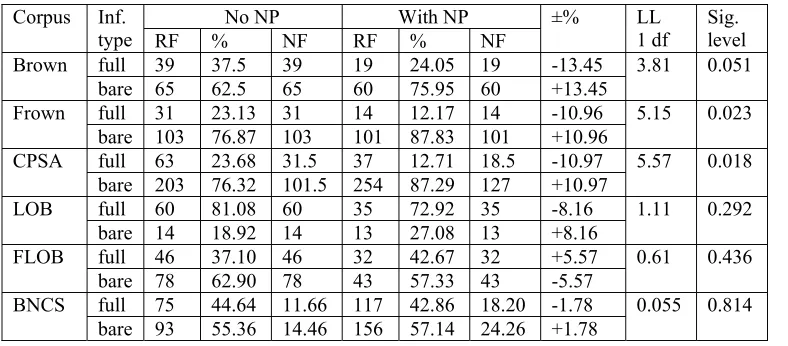
(21) 21. (c) Need we/Dare we escape? (ibid) Biber et al (1999:483-4) observe that ‘the boundary between modals and lexical verbs taking infinitive complementation is in some cases unclear’. Examples include so-called marginal or quasi-modals like need (to), dare (to). It is reasonable to assume that these semi-modals derive from lexical verbs and are undergoing a process of grammaticalizing as full modals. Mair (2002:125) provides the following examples from the quotation base of OED to support his grammaticalization hypothesis: (14). (a) Sir Kingsley Wood … asked the House for another £1,000,000,000, to. help pay for the next three months of war. (b) Nor have they eliminated the unburned hydrocarbons which help produce the smog that blankets such a motor-ridden conurbation as Los Angeles. (c) Negro cabbie John W. Smith, whose arrest for ‘tailgating’ a police car … helped spark five days of rioting …, was found guilty of assaulting a policeman. (d) Part of the fun of the game comes in ‘sooping’. This is when the players sweep the ice with special brooms in front of a moving stone to help it go further. According to Mair, replacing the bare infinitive pay with the full infinitive to pay in (14a) ‘would not only be stylistically clumsy because of the repetition involved; it would also produce a slight shift in perspective, from the instrument (money) to the agent who spends it’. While we agree with the first half of his argument, we cannot accept the second half. Consider the example (15a):.
(22) 22. (15). (a) Money raised from tolls on roads will help to pay for the scheme.. (BNC) (b) The diesel also produces 90% less carbon monoxide, 60% fewer oxides of nitrogen and 90% fewer of unburnt hydrocarbons which help to produce acid rain. (BNC) (c) Where the fund of damage is likely to be substantial, including future nursing costs and the like as well as loss of earnings, an accountant’s evidence can help the court to decide the multiplier, as well as the multiplicand, for example in the case of a one-man business […] (BNC) In (15a) the full infinitive to pay is used, yet no agent is mentioned at all. An infinitive marker clearly does not necessarily produce a shift in perspective. One must also, therefore, doubt the reliability of Mair’s proposed paraphrase test for this feature. Mair (2002:126) argues that adding to before the infinitives in (14b) and (14c) ‘would be slightly incongruous’ because the negative effect featured in the two sentences (i.e., smog and rioting) are ‘incompatible with the core semantics of HELP’. Nevertheless, this argument is poorly postulated, as it is not uncommon for examples featuring negative effects to take infinitives with to, as shown in (15b). 15 Finally, Mair (ibid) argues that as (14d) is ‘a fairly clear case of a purely causative use of HELP, equivalent to make’, ‘adding to before the infinitive is.
(23) 23. problematical’. This statement raises two problems. First, we do not see why the causative use of HELP should be analyzed as a modal idiom, because make is not a modal auxiliary. Second, we cannot find any reason why Mair should claim that the causative use of HELP cannot take a full infinitive, because counter examples are not uncommon, as exemplified in (15c). On the basis of our exploration of AmE and BrE corpus data, we claim that not only is the semantic distinction between the full and bare infinitives following HELP not well grounded, it is also the case that the grammaticalization hypothesis is not justified. 5 Syntactic conditions A number of syntactic conditions have been suggested in the literature that may be related to the choice of a full or bare infinitive following HELP. In this section we will discuss the following factors: •. an intervening NP or adverbial. •. the number of intervening words. •. to preceding help. •. the passive construction. •. inflections of HELP. •. it as the subject. 5.1 The intervening NP or adverbial.
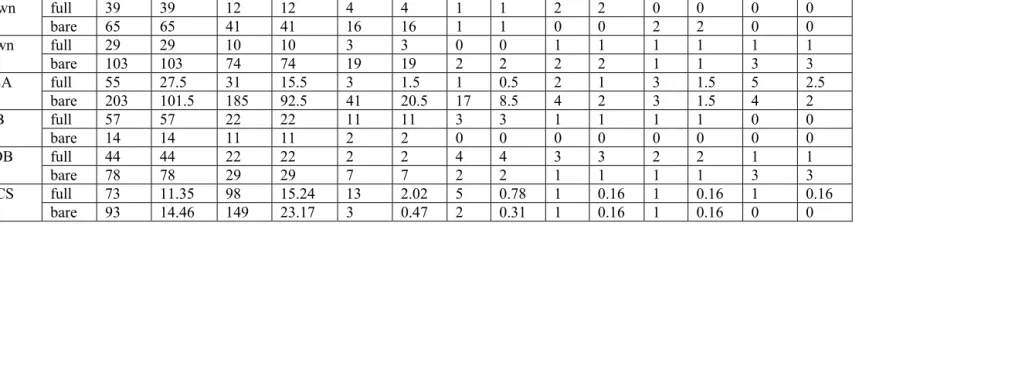
(24) 24. Biber et al (1999: 73), Lind (1983: 269) and Kjellmer (1985: 158) observe that bare infinitives occur more frequently after HELP with an intervening NP than where there is no intervening NP. This observation is partially supported by our data, as shown in Table 7. Table 7 Comparison of HELP and HELP + NP Corpus Brown Frown CPSA LOB FLOB BNCS. Inf. type full bare full bare full bare full bare full bare full bare. RF 39 65 31 103 63 203 60 14 46 78 75 93. No NP % NF 37.5 39 62.5 65 23.13 31 76.87 103 23.68 31.5 76.32 101.5 81.08 60 18.92 14 37.10 46 62.90 78 44.64 11.66 55.36 14.46. RF 19 60 14 101 37 254 35 13 32 43 117 156. With NP % 24.05 75.95 12.17 87.83 12.71 87.29 72.92 27.08 42.67 57.33 42.86 57.14. ±% NF 19 60 14 101 18.5 127 35 13 32 43 18.20 24.26. -13.45 +13.45 -10.96 +10.96 -10.97 +10.97 -8.16 +8.16 +5.57 -5.57 -1.78 +1.78. LL 1 df 3.81. Sig. level 0.051. 5.15. 0.023. 5.57. 0.018. 1.11. 0.292. 0.61. 0.436. 0.055. 0.814. Note that the frequencies in the table do not include the occurrences where an intervening NP and an adverbial co-occur, hence the potential influence of an intervening adverbial is excluded. It can be seen from the table that an intervening NP typically contributes an increase of 10% or more to the proportion of bare infinitives in the AmE data; the increase in the proportion of bare infinitives contributed by an intervening NP is only statistically significant in AmE (marginally significant in Brown). In the BrE data, however, the effect of an intervening NP is unpredictable and not statistically significant. This finding is in line with our conclusion in section 1..
(25) 25. Figure 5 Frequencies of full/bare infinitives preceded by an adverbial 16 5. 14. Frequency. 12. 10. 10. 8. 6 5 4. 0. TYPE. 4 2. 2. 3 full-inf. 1 BNCS. 1 CPSA. FLOB. Frown. bare-inf LOB. Corpus. Lind (ibid: 272) uses the example in (15) to argue that ‘an intervening adverbial will preclude omission of to’. This argument, however, is not supported by our corpus data, as shown in Figure 5. The frequencies in the figure include both instances where an adverbial and an NP co-occur and an adverbial alone intervenes and instances where an adverbial alone intervenes. (16) The whisky helped me not to stagger under this blow. (Lind 1983: 272) It is not hard to find examples like these in our corpora, as shown in (17): 16 (17). (a) So, to help people not jump all over it as soon as they see it and say,. oh, my God, they didn’t say enough about it. (CPSA) (b) Mr. Clinton was an organizer of two London rallies in the fall of 1969 and also helped, to an apparently much lesser degree, organize a huge march on Washington on Oct. 15, 1969. (Frown).
(26) 26. (c) That we extend – in some cases to MSEB and in other cases remind –of a previous extension that they are most welcome to respond in a public hearing and in addition that we will put some questions for those public hearings up that would even help perhaps focus some of those responses. (CPSA) (d) And somebody was following, a colleague was following, saw it happen, stopped and helped him sort of do what you’ve got to do to get the man’s address and this sort of thing, make sure the car was alright, and took him into the office. (BNC) If we exclude the possible influence of an intervening NP and only consider the cases where an adverbial alone intervenes, however, Lind’s argument seems to be viable in BrE, as shown in Figure 6.. Figure 6 Frequencies of full/bare infinitives preceded by an adverbial alone 10. 8. Frequency. 3. 6. 5 4. 3 2 2. 2. TYPE. 1 full-inf 1. 0. bare-inf BNCS. CPSA. FLOB. Frown. LOB. Corpus. 5.2 The number of intervening words.
(27) 27. While an intervening NP is associated with the omission of to, Lind (1983: 269) seems to suggest that the number of intervening words may also influence the choice of a full or bare infinitive. As the first step towards testing this hypothesis, we counted the raw frequencies of the full and bare infinitives in different slots and normalized them to one million words, as shown in Table 8. In this case, we could not use the log-likelihood test, however, because at least one of 4 cells in the 2x2 contingency table for each data set has an expected value less than 5. Consequently we applied Fisher’s exact test to the normalized frequencies to determine the exact significance level so as to avoid the potentially misleading outcomes resulting from log-likelihood test relying on expected values less than 5 (cf. Howitt & Cramer 2001: 121-3). The results are given in Table 9. 17.
(28) Table 8 Frequencies of infinitive variants in different slots Corpus Brown Frown CPSA LOB FLOB BNCS. Inf. type full bare full bare full bare full bare full bare full bare. 0 RF 39 65 29 103 55 203 57 14 44 78 73 93. NF 39 65 29 103 27.5 101.5 57 14 44 78 11.35 14.46. Number of intervening words 1 2 RF NF RF NF 12 12 4 4 41 41 16 16 10 10 3 3 74 74 19 19 31 15.5 3 1.5 185 92.5 41 20.5 22 22 11 11 11 11 2 2 22 22 2 2 29 29 7 7 98 15.24 13 2.02 149 23.17 3 0.47. 3 RF 1 1 0 2 1 17 3 0 4 2 5 2. NF 1 1 0 2 0.5 8.5 3 0 4 2 0.78 0.31. 4 RF 2 0 1 2 2 4 1 0 3 1 1 1. NF 2 0 1 2 1 2 1 0 3 1 0.16 0.16. 5 RF 0 2 1 1 3 3 1 0 2 1 1 1. NF 0 2 1 1 1.5 1.5 1 0 2 1 0.16 0.16. >5 RF 0 0 1 3 5 4 0 0 1 3 1 0. NF 0 0 1 3 2.5 2 0 0 1 3 0.16 0.
(29) Table 9 Number of intervening words and the language user’s choice Corpus Brown Frown CPSA LOB FLOB BNCS. Fisher’s exact test value 9.497 7.157 11.073 3.958 7.048 3.674. Exact sig. level (2-sided) 0.052 0.237 0.056 0.601 0.294 0.236. Df. Critical value. 5 6 6 5 6 6. 11.07 12.59 12.59 11.07 12.59 12.59. As can be seen from the table, the Fisher’s exact test value calculated for each data set is less than the corresponding critical value. Hence, we can safely conclude that the number of intervening words does not significantly influence the language user’s choice of a full or bare infinitive. As such, while infinitives that are spaced more than 5 words apart from HELP are found to take to in our corpora, it is also not infrequent for them to omit to, as shown by the examples in (18). (18). (a) […] the President and I are determined to do all we can to help Israel. and its neighbors in the Middle East stay on the path to peace […] (CPSA) (b) Mrs. Child […] now confided that she had helped one of Henry Palfrey’s slaves escape to Canada some years before […] (Brown) (c) Lo, in the post came an invitation to help the now venerable but astonishingly active trio write a fifth edition. (FLOB) 5.3 TO preceding help A decisive syntactic condition that encourages the omission of to following help, as noted in Biber et al (1999: 737), Lind (1983: 269) and Kjellmer (1985: 159), is.
(30) 30. whether or not the controlling verb itself is preceded by the infinitive marker to, as shown below: (19). (a) They took on an estate manager and wine-maker to help run the. business. (FLOB) This is one device to help him pay those bills. (CPSA) Figure 7 compares the proportions of bare infinitives following HELP and to help. In the figure, the frequency for the label HELP includes counts of full and bare infinitives following HELP (inclusive of its inflected forms). It can be seen that when the controlling verb help is preceded by to, bare infinitives make up 88% of examples, otherwise, they only account for around 60% of examples. Figure 7 Contrast between HELP (including inflected forms) and to help 1400. 1200. 509. Frequency. 1000. 800 752 600. 400. 430. TYPE 200. full-inf. 0. bare-inf help. to help. help/to help. To show the effect of the preceding to more clearly, we also experimented with excluding all of the other factors by comparing the non-inflected form of help and help preceded by to. Table 10 shows the frequencies of the full and bare.
(31) 31. infinitives following the uninflected form of help and help preceded by to in each corpus, their calculated log likelihood values and their significance levels. It can be seen from the table that the difference shown in Figure 6 is statistically significant except in spoken BrE. Table 10 Frequencies of full/bare infinitives after help and to help Corpus Brown Frown CPSA LOB FLOB BNCS. Inf. type full bare full bare full bare full bare full bare full bare. help RF 18 32 12 64 47 150 30 2 26 19 67 108. NF 18 32 12 64 23.5 75 30 2 26 19 10.42 16.8. to help RF NF 1 1 43 43 2 2 58 58 6 3 197 98.5 6 6 15 15 4 4 47 47 40 6.22 71 11.04. LL (1df) 19.740. Sig. level (2-sided) <0.001. 6.333. 0.012. 21.869. <0.001. 26.418. <0.001. 29.917. <0.001. 0.014. 0.907. Table 11 Full and bare infinitives after to help Corpus Brown Frown CPSA LOB FLOB BNCS. Inf. type full bare full bare full bare full bare full bare full bare. RF 0 21 0 24 1 79 2 7 2 30 8 33. No NP % NF 0 0 100 21 0 0 100 24 1.25 0.5 98.75 39.5 22.22 2 77.78 7 6.25 2 93.75 30 19.51 1.24 80.49 5.13. RF 1 22 2 34 5 114 4 8 2 17 32 38. With NP % 4.35 95.65 5.56 94.44 4.20 95.80 33.33 66.67 10.53 89.47 45.71 54.29. Sig. level NF 1 22 2 34 2.5 57 4 8 2 17 4.98 5.91. ±% +4.35 -4.35 +5.56 -5.56 +2.95 -2.95 +11.11 -11.11 +4.28 -4.28 +26.2 -26.2. 1.000 0.512 0.645 0.659 0.623 0.333. While an intervening NP encourages language users to choose a bare infinitive after HELP (cf. section 5.1), intervening NPs after to help may lead to an increase.
(32) 32. in the proportion of full infinitives, as shown in Table 11. A possible reason for this increase is that, in the absence of an intervening NP or adverbial, language users are reluctant, consciously or unconsciously, to repeat to consecutively on the grounds of euphony (cf. Lind 1983: 269). Indeed, the pattern of to help to is non-existent in the written AmE data and only one such instance occurs in the spoken AmE data. We hypothesized that the infinitive marker preceding help enjoys higher priority over an intervening NP in this case. To test this, we used Fisher’s exact test. As can be seen from Table 11, in none of the data sets under consideration is this increase statistically significant (i.e., exact significance level less than 0.05). 5.4 The passive construction Palmer (1969: 169) makes the claim that the ‘passive occurs […] only with to: They were helped to do it’. As such, it is hardly surprising that, of the 9 examples of HELP in a passive construction in our corpora, all are of the be helped to V type without exception. For example: (20). (a) […] but in fact we have never been helped to think about it. (BNC). (b) Are the Arabs to be dominated by men like Saddam Hussein, or can they at last be helped to break out into a freer and more rational future? (FLOB) Beginning with a problem posed by experience, the student must then be helped to gain command of data […] (Frown).
(33) 33. The reason why to cannot be omitted in passive constructions can be explained as follows. The form be helped to V is the passive transformation of HELP NP (to) V. In the HELP NP (to) V type, NP is an object and the infinitive functions as an object complement. In this case the infinitive marker to can be omitted. When it is transformed into the passive, NP becomes the subject and the infinitive becomes a subject complement accordingly, meaning that to can no longer be omitted. An analogy between HELP and verbs such as make/let/see/hear illustrates this point well (cf. Onions 1965). Although verbs of the latter group almost always take a bare infinitive as the object complement, the infinitive marker is not normally omitted when these verbs occur in passive constructions. 18 The passive construction seems to have a greater influence than to preceding help. If HELP is used in the passive construction, the infinitive following HELP must take the infinitive marker irrespective of whether the controlling verb HELP is or is not preceded by to. For example: (21). We needed to be helped to train to sell and so we needed that training to. get us going so to speak, there were no natural salesmen amongst departments. (BNC) 5.5 Inflections of HELP Lind (1983: 268) observes that the omission of to occurs ‘much more frequently after the uninflected form help than after any of the inflected forms’. 19 This observation is partly supported by our corpus data. Figure 8 shows the frequencies.
(34) 34. of the two types of infinitives occurring with the uninflected form of help and its inflected forms. It can be seen from the figure that 66% (i.e., 375/569) of the infinitives occurring after the uninflected form help are bare infinitives. However, the inflected forms of HELP do not demonstrate marked contrasts. Lind (1983) does not make a distinction between the non-infinitive form of help and the infinitive form of help, nor between helped and passive constructions. In Figure 8, however, the frequency of the infinitive variants after the uninflected form does not include the count of infinitives occurring with to help, neither does the frequency of helped include the count of passive constructions. Hence, the influence of these two factors is avoided (cf. sections 5.3 and 5.4), and our method is more reliable than Lind’s. We hypothesize that the inflections of HELP may influence the language user’s choice of a full or bare infinitive. Figure 8 Contrast of inflections of HELP 600 194 500. Frequency. 400 375 300 106 200. 107. 93. 99. 106. helping. helps. 172. TYPE. 100. 0. full-inf bare-inf. help. helped. Inlections of help.
(35) 35. We tested this hypothesis against the corpora used in this paper. The results are given in Table 12. As the expected values in some cells of the contingency table are less than 5, Fisher’s exact test was used (cf. section 5.3). For a difference to be statistically significant, the calculated significance value must be less than 0.05. As can be seen from the table, in the 1960s, neither written AmE nor written BrE was influenced by the inflections of HELP. In the 1990s, however, written AmE changed to become affected by inflections, though neither spoken BrE nor spoken AmE has changed similarly. This finding lends further evidence to support our claim that language change has affected the choice of a full or bare infinitive (cf. section 1). Table 12 Frequencies of full and bare infinitives after inflected HELP Corpus Brown Frown CPSA LOB FLOB BNCS. Inf. type full bare full bare full bare full bare full bare full bare. help RF 18 32 12 64 41 150 30 2 26 19 67 108. NF 18 32 12 64 20.5 75 30 2 26 19 10.4 16.8. helped RF NF 10 10 26 26 12 12 53 53 9 4.5 30 15 28 28 6 6 25 25 30 30 22 3.4 27 4.2. helps RF 9 11 9 19 14 34 12 3 12 15 37 24. NF 9 11 9 19 7 17 12 3 12 15 5.8 3.7. helping RF NF 18 18 13 13 9 9 10 10 29 14.5 46 23 17 17 1 1 10 10 10 10 24 3.7 19 3.0. Fisher’s test value 6.88. Sig. level. 10.05. 0.016. 4.34. 0.223. 3.47. 0.336. 1.892. 0.603. 2.13. 0.583. 0.75. 5.6 It as the subject When it functions as the subject of an infinitive, it is necessary to distinguish between two situations: it as the real subject, anaphoric to something mentioned in the context (e.g., 22a, in which it refers to her spending time in the studios) and.
(36) 36. it as the provisional or logical subject, anticipating the real subject of the infinitive (e.g., 22b, in which it refers for them to have the United States as the mediator). 20 (21). (a) She certainly loved her time at the studios today, even though there. wasn’t anything too exciting going on. I would think it helped her a bit to get over the shock of Elvis’s murder. (FLOB) (b) Sometimes it helps both parties for them to have the United States as the mediator. (CPSA) Figure 9 Frequencies of infinitives after HELP (it as the real subject) 70. 60 58. Frequency. 50 48 40 38 30. TYPE 20 bare-inf. 17 10. full-inf AmE. BrE. Language register. To explore how a language user’s choice relates to it, we extracted all examples of it as the subject of HELP from our corpora. We found 184 examples in total. Of these, 23 had it as the provisional subject of HELP. In all 23 cases, the full infinitive is selected, because the infinitive marker cannot be omitted for syntactic reasons (cf. Lind 1983: 269). This is not the case where it is the real subject of HELP. HELP simply behaves as expected by showing a preference for bare infinitives in AmE and for full infinitives in BrE, as illustrated in Figure 9..
(37) 37. Our finding is contrary to that of Lind (1983: 270), who observes that even when it functions as the real subject the infinitive marker to is not omitted. Lind’s observation is based on nine examples that have it as the real subject. These examples are taken from a corpus composed of 50 English novels, mostly detective stories, published in the decade 1960-1970. While Lind’s conclusion might be accounted for by his skewed corpus, we believe it is more likely to be a result of small dataset: it just happened that to was not omitted in those nine examples. In our data, however, such examples are not uncommon. For example: (22). (a) So it’s a safety feature and it (the tap) helps control the experiment.. (BNC) (b) Like all of our cultural institutions, it (Fernbank) helps us come to terms with a mystifyingly complex world. (Frown) 6 Conclusion In this paper, we used six corpora to study various factors that may influence the choice of a full or bare infinitive when it functions as the object or object complement of HELP. Based on the above discussion, our main findings can be summarized as follows. AmE shows a stronger preference for bare infinitives after HELP than BrE. Language change over the 3 decades from 1961 to 1991 favours bare infinitives after HELP in both AmE and BrE. While the proportion of bare infinitives are slightly higher in spoken English than in written English, the influence of the.
(38) 38. spoken/written distinction is not statistically significant. The alleged semantic distinction between the full and bare infinitives is not supported by our corpus data, nor is the claim justified that HELP is in the process of grammaticalizing as a modal auxiliary. An intervening NP may increase the proportion of bare infinitives after HELP, but an intervening adverbial does not. The number of intervening words is not correlated to the choice of a full or bare infinitive. The infinitive marker preceding help increases the proportion of bare infinitives. When help is preceded by the infinitive marker to, nevertheless, an intervening NP or adverbial may lead to an increase in the proportion of full infinitives. The passive construction exclusively selects bare infinitives. Inflections of the controlling verb HELP are related to the choice of a full or bare infinitive, but their influence is only consistently reliable in spoken English. Finally, while the provisional subject it exclusively selects to-infinitives, the real subject it does not. By taking the corpus-based approach to studying the factors that may influence the language user’s choice between the infinitive variants following HELP, we believe that we have demonstrated the role corpora have to play in generating accurate description of language use, language variation and language change.. Lancaster University. Anthony McEnery & Zhonghua Xiao.
(39) 39. References F. Ball, (2002). Developing wordlists for BEC. Research Notes (8). Available online at http://www.cambridge-efl.org/rs_notes/. Biber, D; S. Johansson; G. Leech; S. Conrad & E. Finegan (1999). Longman grammar of spoken and written English. London: Longman. Bolinger, D. (1974). Concept and percept: two infinitive constructions and their vicissitudes. In Phonetic Society of Japan (ed.) World Papers in Phonetics: Festschrift for Dr Onishi Kijer. Tokyo. 65-91. Bryman, A. & D. Cramer (2001). Quantitative data analysis with SPSS release 10 for Windows. London: Routledge. Chalker, S. (1984). Current English grammar. London: Macmillan. Close, R. (1988). A reference grammar for students of English. London: Longman. Dixon, R. (1991). A new approach to English grammar on semantic principles. London: Oxford University Press. Duffley, P. (1992). The English infinitive. London: Longman. Eastwood, J. (1992). Oxford practical grammar. Oxford: Oxford University Press. Howitt, D & D. Cramer (2001). A guide to computing statistics with SPSS for Windows. Edinburgh: Prentice Hall..
(40) 40. Hunston, S. (2002). Corpora in applied linguistics. Cambridge: Cambridge University Press. Kjellmer, G. (1985). Help to/help θ revisited. English Studies 66 (2): 156-61. Leech, G. (2002). Recent grammatical changes in British English. ICAME 2002. Göteborg, Sweden, 22-6 May, 2002. Lind, A. (1983). The variant forms of help to/help θ. English Studies 64 (3): 26375. Longman Corpus Network (1993). Longman language activator. London: Longman. Lu, G. (1996). The English-Chinese dictionary. Shanghai: Shanghai Translation Press. Mair, C. (1995): Changing patterns of complementation, and concomitant grammaticalisation, of the verb help in present-day British English. In Aarts, B. & Meyer, C. (eds.) The verb in contemporary English. London: Cambridge University Press. 258-72. Mair, C. (2002): Three changing patterns of verb complementation in late modern English. English Language and Linguistics 6:1. 105-31. Murphy, R. (1985): English grammar in use. Cambridge: Cambridge University Press. Onions, C. (1965). An advanced English syntax. London: Routledge. Palmer, F. (1965). A linguistics study of the English verb. London: Longman..
(41) 41. Poutsma, H. (1923). The infinitival, the gerund, and the participle of English verb. Groningen: P. Noordhoff. Quirk, R.; S. Greenbaum; G. Leech & J. Svartvik (1972). A contemporary English grammar. London: Longman. Quirk, R.; S. Greenbaum; G. Leech & J. Svartvik (1985). A comprehensive grammar of the English language. London: Longman. Vallins, G. (1951). Good English: how to write it. London: Andre Deutsch. Wood, F. (1962). Current English usage. London: Macmillan. Zandvoort, R. (1966). A handbook of English grammar. London: Longman..
(42) Notes 1. We would like to thank Susan Hunston and other readers of an earlier. version of this paper for their useful comments. In this paper we use capitals to distinguish the lemma of HELP from the word form help. 2. This paper is based on BNC version 2. (http://escorp.unizh.ch/cgi-. binbnc2/BNCquery.pl). 3. Biber, Johansson, Leech & Finegan (1999: 735) note that dare and help. are the two main clause verbs that can control either a to-clause or a bare infinitive. Only help, however, can take an intervening noun phrase followed by either a full or bare infinitive (cf. also Chalker 1984: 149). Thus, while to in (1d) can be left out, it cannot in Ernest…dared Archie to punch him in the stomach (Frown). 4. As a reader of an earlier version of this paper points out, when an NP. intervenes between help and an infinitive (as in patterns 1b and 1d), the intervening NP can possibly be analyzed as the object of the first clause or the subject of the second clause (biclausal analysis). In our monoclausal analysis, this NP is the object of help while the infinitive functions as the object complement. When there is no intervening NP, the infinitive functions as the object of help. This paper will not include infinitives functioning as adverbials of purpose. 5. See corpus manuals (http://khnt.hit.uib.no/icame/manuals/index.htm)..
(43) 43. 6. A detailed description and a sample of the corpus is available online at. http://www.athel.com/cpsa.html. 7. Considering that a time span of less than ten years is not likely to change. the grammar of a language drastically, we assume that the slight difference in the sampling periods of the two spoken corpora will not affect our results significantly. 8. In addition to the factors discussed in this paper, infinitival verbs and text. categories may also influence the choice of a full or bare infinitive. For example, pay tends to take the bare form as in help pay. However, the discussion of collocation and distribution needs much larger corpora to achieve reliable quantification. In the four written corpora used in this paper, the most frequent verb make only occurs 23 times in the positions of 1st-4th collocates on the right side of help as a verb. We would like to thank Professor Wolfgang Teubert for suggesting this line of inquiry. 9. A normalized frequency (NF) refers to a weighted frequency measure. that allows for easy and reliable comparison of data sets of different sizes (cf. Ball 2002: 11). 10. The counts do not include i) the instances with it as the provisional. subject; ii) infinitives functioning as adverbials of purpose. The same applies to all of the frequencies given in this paper unless otherwise stated..
(44) 44. 11. Unless otherwise specified, the values for significance tests and. significance levels in this paper are calculated using SPSS Release 10.1. 12. While it may be desirable to group the four corpora by the creation date. or language variety in the figure, SPSS automatically arranged them alphabetically. 13. The relatively low frequency of bare infinitives in written BrE is. attributable to the unusually higher frequency of full infinitives in LOB, data of the 1960s (77.87%). 14. In addition to (11a), Duffley (1992:26) provides two other examples in. which ‘only the bare infinitive seems appropriate’. But we cannot see any difference between his examples and (i) and(ii). Duffley appears to have come to this conclusion because the pattern is rare in AmE and is simply absent in Brown, the corpus he used in his study. (i) Table 1.6 helps to provide an overall picture of the content, pattern and distribution of first degree courses (BNC) (ii) […] aid programs that are helping to provide immunization for children around the world […] (CPSA) 15. Here are some more examples, which are all cited from the BNC. corpus: to undermine the Weimar Republic and open the way to Hitler, to.
(45) 45. accelerate global warming, to destroy the market, to destroy the precious rain forest, to disrupt international trade. 16. We have purposefully chosen examples with help without the preceding. infinitive marker to avoid the influence of the preceding to (see section 5.3). 17. Degree of freedom (df) in the cases of Brown and LOB is one less than. others because no instance was in found the two corpora where infinitives are spaced more than 5 words apart from the controlling verb help. 18. Note, however, that verbs of perception like see and hear may take a. full infinitive (e.g., I saw them to be obnoxious, Duffley 1992: 30) when they undergo a lexical shift, i.e., denoting the mental realization by inference. Likewise, while it is the norm for a full infinitive to follow make and let in the passive, bare infinitives are occasionally found, e.g., It wasn’t pleasant to be made feel like a good-for-nothing little brat (cited from Duffley 1992: 78). This usage must be obsolete or dialectal now, if acceptable at all. 19. Lind (1983: 267) also claims that the pattern helping V is rare. This. claim, however, is not supported by our corpus data, as can be seen in Figure 8. We believe Lind’s conclusion is a consequence of skew in his corpus (cf. section 5.6). 20. In the case of provisional subject it is a dummy pronoun (i.e. non-. referential) while the infinitive clauses are sometimes referred to as ‘extraposed.
(46) 46. to-clause’ (e.g. Biber et al 1999: 724). The meaning of example (21b) is equivalent to Sometimes for them to have the United States as the mediator helps both parties, though the two are different stylistically..
(47)
Figure
+7



Related documents
Racks, Cages and Suites – flexible solutions for renting data centre space from a single rack to dedicated secure suites & cages, supported by highly efficient cooling,
To the best of our knowledge, and in accordance with the applicable interim reporting principles, the condensed interim consolidated financial statements give a true and fair view
Second, from the perspective of effort expectancy, in organizational settings, employees assess time and effort in forming views about the overall effort associated Effort Expectancy
Alexander Beard (NZ) Limited is a registered Financial Services Provider governed by the NZ Financial Markets Authority and Financial Advisers Act 2010, and meets and exceeds
Even if they do, however, enough differences remain in mostly unchar- acterized minor antigens to enable immune cells from the donor and the host to recognize the other as “non-
Churchill et al., eds., Frontiers of Entrepreneurship Research (Wellesley, Mass.: Center for Entrepreneurial Studies, Babson College, 1987), pp. House of Representatives, Committee
4: Our face detectors are compared with other asymmetric boosting methods (a) and some state-of-the- art including cascade design methods (b) on MIT+CMU frontal face test data using
