The development of analysis of variance techniques for
angular data.
HARRISON, David.
Available from Sheffield Hallam University Research Archive (SHURA) at:
http://shura.shu.ac.uk/19759/
This document is the author deposited version. You are advised to consult the
publisher's version if you wish to cite from it.
Published version
HARRISON, David. (1987). The development of analysis of variance techniques for
angular data. Doctoral, Sheffield Hallam University (United Kingdom)..
Copyright and re-use policy
See
http://shura.shu.ac.uk/information.html
65 O
ProQuest Number: 10697061
All rights reserved
INFORMATION TO ALL USERS
The quality of this reproduction is dependent upon the quality of the copy submitted.
In the unlikely event that the author did not send a com plete manuscript and there are missing pages, these will be noted. Also, if material had to be removed,
a note will indicate the deletion.
uest
ProQuest 10697061
Published by ProQuest LLC(2017). Copyright of the Dissertation is held by the Author.
All rights reserved.
This work is protected against unauthorized copying under Title 17, United States C ode Microform Edition © ProQuest LLC.
ProQuest LLC.
789 East Eisenhower Parkway P.O. Box 1346
THE DEVELOPMENT OF ANALYSIS OF VARIANCE TECHNIQUES
FOR ANGULAR DATA
DAVID HARRISON
A thesis submitted to the Council for National Academic Awards in partial fulfilment of the requirements for the degree of Doctor of Philosophy
Sponsoring Establishment
Department of Applied Statistics and Operational Research Sheffield City Polytechnic
TH E DEVELOPMENT OF ANALYSIS OF VARIANCE TECHNIQUES FOR
ANGULAR DA TA
D HARRISON
ABSTRACT
In many areas of research, such as within medical statistics, biology and geostatistics, problems arise requiring the analysis of angular (or directional) data. Many possess experimental design problems and require analysis of variance techniques for suitable analysis of the angular data. These techniques have been developed for very limited cases and the sensitivity of such techniques to the violation of assumptions made, and their possible extension to larger experimental models, has yet to be investigated.
The general aim of this project is therefore to develop suitable experimental design models and analysis of variance type techniques for the analysis of directional data.
Initially a generalised linear modelling approach is used to derive parameter estimates for one-way classification designs leading to maximum likelihood methods. This approach however, when applied to larger experimental designs is shown to be intractable due to optimization problems.
The limited analysis of variance techniques presently available for angular data are reviewed and extended to take account of the possible addition of further factors within an experimental design. These are shown to breakdown under varying conditions and question basic underlying assumptions regarding the components within the original approach.
A new analysis of variance approach is developed which possesses many desirable properties held in standard 'linear' statistical analysis of variance.
ACKNOWLEDGEMENTS
I would like to express my gratitude to Dr G K Kanji, acting Head of Department,
and Dr R J Gadsden, Principal Lecturer, for introducing me to this field and under
whose supervision and constant encouragement this work has been carried out. I
would also like to thank the members of the Departments of Mathematics and
Statistics for their assistance on specific points.
My indebtedness to the work of Professor K V Mardia will be evident; I should
here like to thank him, in addition, for his valuable comments and suggestions.
I wish to thank Ms Ann Moon for the excellent typing of this thesis produced from
the demanding material with which she had to work.
Finally, and most of all, I would like to express my love and gratitude to my wife
CONTENTS
Page CHAPTER 1
INTRODUCTION
1.1 Directional Data 1
1.2 A General Thesis Review 3
1.3 Probability Distributions on the Circle 6
1.4 Statistics of a Circular Distribution 10
CHAPTER 2
TH E VON MISES DISTRIBUTION
2.1 Derivation 15
2.2 Properties of the von Mises Distribution and its
Parameters 16
2.3 The Distribution of R for the Uniform and von Mises
Distributions 21
2.3.1 Preliminary Results 21
2.3.2 Distribution of R for the Uniform Distribution 22
2.3.3 Distribution of R for the von Mises Distribution 24
2.4 Combining von Mises Distributions 24
2.5 A Summary of Exact and Approximate Moments of R 27
CHAPTER 3
LIKELIHOOD RATIO TESTS AND APPROXIMATIONS TO TH E
M AXIM UM LIKELIHOOD ESTIMATES
3.1 The Method of Maximum Likelihood and Likelihood Ratio
Tests 30
-3.2 Approximations for the von Mises Concentration Statistic, k,
when k is small 33
3.3 Approximations for the von Mises Concentration Statistic, k,
when k is large 42
3.4 The Best Approximation for the von Mises Concentration
Statistic, k, in the range 1 < k < 2.5 52
3.5 Summary of Approximations 54
3.6 Expansion of [ I0(A )/I0(B)]N 56
CHAPTER 4
THE DEVELOPMENT OF CIRCULAR ANALYSIS OF VARIANCE
TECHNIQUES
4.1 Introduction 58
4.2 Exact and Approximate Tests of Significance from Watson
and Williams 59
4.2.1 An Exact Test 59
4.2.2 Approximate Tests 59
4.3 Hypothesis Testing Concerning the Mean Direction 61
4.4 Multi-sample Tests Concerning the Mean Direction 65
4.4.1 For Small Concentration Parameter, k 66
4.4.2 For Large Concentration Parameter, k 66
4.5 Multi-sample Tests for the Equality of Concentration
Parameters, fcj 69
4.5.1 Rj/Nj < 0.45 70
4.5.2 0.45 < Rj/Nj ^ 0.70 71
4.5.3 Rj/Nj > 0.70 71
-CHAPTER 5
PARAMETER ESTIMATION LEADING TO M A XIM U M LIKELIHOOD
METHODS FOR LARGER EXPERIMENTAL DESIGNS
5.1 Introduction 73
5.2 Constraints for Circular Models 75
Example 5.2.1
5.3 One-way Classification 77
Example 5.3.1
5.4 Randomised Complete Block and Larger Experimental Designs 84
Example 5.4.1
5.5 Summary 90
CHAPTER 6
EXTENDING TO LARGER EXPERIMENTAL DESIGNS
6.1 Introduction 91
6.2 Nested or Hierarchical Design 92
6.3 The Randomised Complete Block Design and Two-way Classification
with Interaction Design 94
6.4 Accuracy of the Associated
x 2
Distributions for theRandomised Block Design and the Two-way Classification
and their Corresponding F Statistics 98
6.5 Summary 114
-CHAPTER 7
THE ROBUSTNESS AND POSSIBLE COLLAPSE OF TH E EXTENDED
TECHNIQUES
7.1 Introduction 115
7.2 Robustness of Assumptions 115
Example 7.2.1
7.3 A Further Approach to Watson and Williams Design Using a
Regression Model 119
7.3.1 Total Measure of Variation 122
7.3.2 Residual or Within Measure of Variation 123
7.3.3 Between Measure of Variation 124
7.3.3.1 Combining Mean Angular Directions and Resultant
Lengths 125
7.4 Cross Product Terms and the Analysis of
Cross-Classification 130
7.5 Summary 134
CHAPTER 8
DEVELOPMENT OF A NEW ANALYSIS OF VARIANCE PROCEDURE
8.1 Introduction 135
8.2 Minimising Chord Distances to Build New Model Components 135
8.2.1 Total Measure of Variation 136
8.2.2 Residual Measure of Variation 138
8.2.3 Between Measure of Variation 139
8.4 Analysis of Cross-Classification and Interaction 143
8.4.1 The Interpretation of Interaction on the Circle 143
8.4.2 The Calculation of Interaction on the Circle 147
8.5 Other Design Models 151
8.5.1 The Randomised Complete Block Design 151
8.5.2 Latin Square Design 152
8.5.3 Nested or Hierarchical Design 154
8.5.4 Three-way Classification 155
8.6 Summary 156
CHAPTER 9
TH E DISTRIBUTION OF THE NEW COMPONENTS A ND TEST
STATISTICS
9.1 Introduction 157
9.2 Small Concentration Parameter, k 158
9.3 Large Concentration Parameter, k 160
9.3.1 Distribution of fc(N-(C2/N)) 161
9.3.2 Distribution of fc((R2/N )-(C 2/N)) 162
9.3.3 Distribution of fc(N-(R2/N)) 162
9.4 The Variance of the Component Chi-Squared Approximations 163
9.4.1 Variance of (N -(R 2/N)) 163
9.4.2 Variance of (N-^(R2j/N 2j)) 166
9.4.3 Variance of ® R 2j/N j)-(R 2/N)) 167
9.5 The Adequacy of the New Procedure, for Large k 168
9.6 Comparing the Power of the Tests, for Large k 184
9.7 The Adequacy of the New Procedure, for Small k 187
9.8 Comparing the Power of the Tests, for Small k 191
9.9 Summary 194
-CHAPTER 10
TH E RANDOMISED COMPLETE BLOCK AND T W O -W A Y DESIGNS
V IA TH E NEW APPROACH
10.1 Introduction 196
10.2 Randomised Complete Block and Two-way Classification with
Interaction Designs, for Large k 196
10.3 Accuracy of the Associated \ 2 Approximations for the Randomised Complete Block and the Two-way Classification
Designs with their Corresponding F Statistics, for
Large k 200
10.3.1 The Randomised Complete Block Design 200
10.3.2 Two-way Classification with Interaction 211
10.4 Randomised Complete Block and Two-way Classification with
Interaction Designs, for Small k 218
10.5 Accuracy of the Associated Chi-squared Approximations for
Small k 219
10.6 Summary 227
CHAPTER 11
ANALYSIS OF VARIANCE EXAMPLES FOR CIRCULAR STATISTICS
11.1 Introduction 228
11.2 One-way Analysis 228
Example 11.2.1 for Large k Example 11.2.2 for Small k
11.3 Randomised Complete Block Design 234
11.4 Two-way Classification with Interaction
Example 11.4.1 for Large k Example 11.4.2 for Small k 11.5 The Latin or Graeco-Latin Square
Example 11.5.1
11.6 Split Plot Design
Example 11.6.1
11.7 Summary
CHAPTER 12
SYNOPSIS OF RESULTS AND CONCLUSIONS
Appendix A
Index of Notation
Appendix B
The Simulation and Accuracy of Numerical Results
CHAPTER 1
INTRODUCTION
1.1 Directional Data
In many scientific fields the experimenter is interested primarily in the direction of a
measured variable. These observations will be bearings from some central point, or
origin, ending on a sphere or circumference of a circle, and may be regarded as
vectors. The radius can be represented as a unit vector, while the length or
magnitude of the vector is not important. Directions may be thought of in any
number of dimensions but in practice they are invariably collected in two or three
dimensional space. The tests and new results presented in this thesis are solely
concerned with directions in two-dimensions. Directions are measured by angles
ranging from 0* to 360*, or, equivalently, from 0 to 2x radians. Circular or
directional data is the name given to data which arise when the observations are
angles.
There are many examples of circular data originating from various disciplines. For
example, geologists study the orientation of fractures in deformed rocks to interpret
structural changes, and the orientation of cross-bedding or particles in undisturbed
sediments to the direction of depositing currents of wind and water. (Pincus (1953),
Curray (1956), Sengupta and Rao (1966), and Sanderson (1976)). The classic example
of directional data is from the study of bird orientation in homing or migration
which involves observing the birds vanishing angles from their release point.
Zoologists use such data to investigate consistency of bird migration under certain
conditions. Many examples from this field of study are well cited and illustrated by
Batschelet (1965, 1981).
-Directional data is not confined to observations directly measured in degrees or
radians, but may also occur in the area of biological rhythms. A period of 24 hours
corresponds to a full turn of 360 degrees. Similarly, a month, a year or any other
period of a cyclic event may be represented by a rotation of 360 degrees. The
number of deaths due to a disease or the number of onsets of a disease in each
month over years fall in this category and can be treated as directional or circular
data. Other examples of this type can be seen in Gumbel (1954).
It is tempting to use the conventional measures of location and spread used in linear
analysis to analyse directional data. For example, suppose our data are the four
values 5, 14, 351 and 10, a simple arithmetic mean would give a value of 95. For
linear analysis this is understandable as the value of 351 has a large influence and
draws the mean away from the other data points. If these values are now regarded
as angles the spread of the whole sample is reduced, since in angular terms the
sample value of 351* is now situated close to the other data points. Similarly the
point of central location will have changed considerably and can now be seen to be
around zero degrees. Then the simple arithmetic mean would not, in general, give a
meaningful mean direction of the sample, similarly, the standard deviation would not
give a good measure of dispersion. If, however, the zero direction was taken at a
different position on the circle such as the y-axis in place of the x-axis then the
linear measure may give a sensible result. For example, if the above sample values
were rotated by 90*, to become 95*, 104*, 81* and 100*, the arithmetic mean would
give a sensible result of 95*. It is therefore not possible to define an arithmetic
mean or standard deviation in such a way that it is invariant under a rotation of the
circle. This heavy dependence on the zero direction shows the inappropriate use of
basic linear methods for circular statistics. Simple examples of such problems are
given by Batschelet (1965, 1981), Mardia (1972) and Watson (1983). Distribution
functions, characteristic functions and moments all suffer from the same draw-back
and must in some way take account of the natural periodicity of the circle.
-1.2 A General Thesis Review
Having introduced the study of directional data, this section gives a brief review of
the work discussed within each of the following chapters, whilst indicating the
structure and progression of the thesis as a whole. The following two sections within
this chapter give further background to the subject of directional data. The first
discusses different types of probability distributions that may exist on the circle, whilst
the second states the elementary statistics of angular data required for further use in
later chapters.
In Chapter 2 the von Mises distribution is discussed from estimation and distributional
view points. The maximum likelihood estimates of the von Mises parameters are
seen to be asymptotically independent so that construction of simple large-sample
tests, for differing hypotheses regarding the parameters, may be carried out. Interest
is focused on the distributional form of the resultant length on the random (Uniform)
distribution, k - 0, and the von Mises distribution. The results from the special case of the random distribution are required since terms in its solution arise again in
the general distribution theory. A summary of exact and approximate moments of
the resultant length, R, are given in preparation for the derivation of further circular
statistical tests.
Chapter 3 is a review of the maximum likelihood results and tests for the von Mises
distribution. Extensive investigation of the many approximations for the von Mises
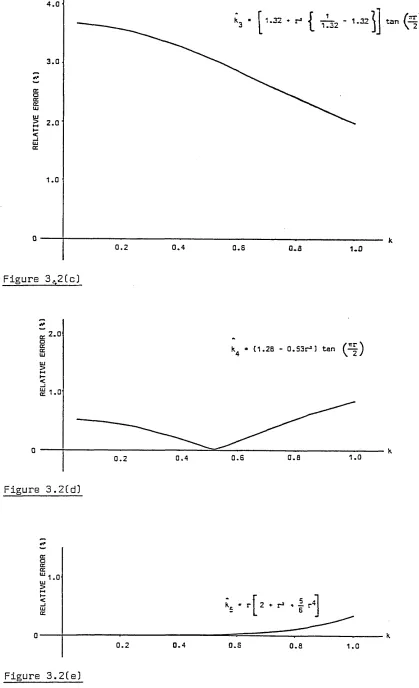
concentration parameter, k, for both small and large k, has been undertaken. Seven approximations for the maximum likelihood estimate of small k, k, which have been cited by various authors are reviewed. Their corresponding values, residuals and
relative residuals are plotted to enable comparison and evaluation of their accuracy.
A
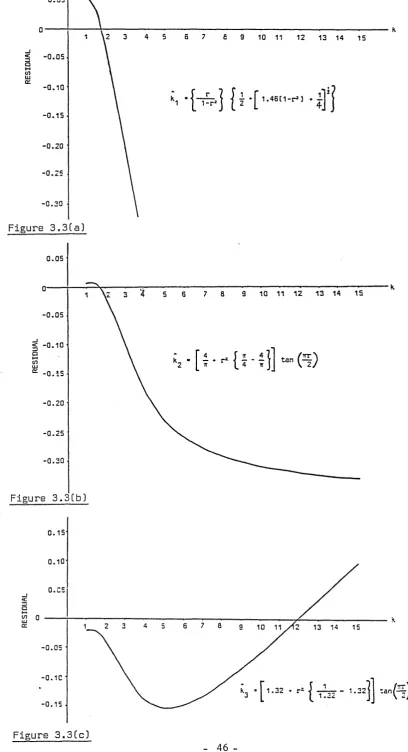
Similar work is carried out for nine approximations to large k, k. A summary of the 'best' and 'best simple1 approximations is given in Section 3.5 against varying
-ranges of the concentration parameter.
Chapter 4 gives an historical review of the development of analysis of variance
techniques. The work covers the exact and approximate tests for differing mean
directions derived by Watson (1956), Watson and Williams (1956) and Stephens
(1962a, b and c), to multi-sample tests for the equality of concentration parameters.
The homogeneity tests for varying ranges of concentration parameter are cited for
later use with new design tests.
Chapter 5 discusses the use of the generalised linear modelling approach for circular
statistics to derive parameter estimates leading to maximum likelihood methods. For
circular statistics it is shown to be desirable to choose the constraint on the angles
specifying the factor parameters so that their sines sum to zero. Section 5.3 shows
how parameter estimates for the one-way classification design may be found and
therefore assist in further understanding of the underlying structure under
investigation. The approach, however, when applied to larger experimental designs is
seen, at this time, to be intractable since the optimization procedures cannot be
solved due to the numerous local maxima found within the constrained equations.
Chapters 6 and 7 examine the possibility of extending the original procedure for the
one-way analysis, derived by Watson and Williams (1956), to larger designs, for large
k. Chapter 6 shows the construction of the nested or hierarchical design, the randomised complete block and two-way classification design with interaction together
with a comparison of their accuracy to the chi-squared and F distributions. Chapter
7, however, shows the possible collapse of these test statistics under particular
circumstances. The problems associated with the combining of circular mean
directions are shown to be influential in this collapse whilst the cross-product terms
are seen to be non-zero and requiring a correction factor to eliminate them.
-Chapter 8 develops a new analysis of variance approach by taking account of the
resultant lengths together with their corresponding mean directions to eliminate the
possible collapse discussed in Chapter 7. The method is still based on maximum
likelihood techniques but requires the user to test for equality of concentration
parameters prior to testing for any difference between mean directions. The
cross-product terms are examined and found to equal their desired combined value of
zero. An investigation of the interpretation and representation of interaction on the
circle is given in Section 8.4 prior to its calculation via the new approach. For the
two-way design the cross-product terms are again shown to equal zero. Further
designs are then constructed in the same manner.
Following the development of the procedures in Chapter 8, Chapter 9 examines the
statistical theory and distributions behind the new design components and test
statistics. The exact theoretical distributions are seen to be intractable, and therefore
distribution approximations are used to examine the theory whilst simulation
techniques reproduce the distributions of the test statistics for comparison with their
assumed expected distributions. The comparisons are carried out for both large and
small k and test statistic improvements are made using the component moments. The power of the new tests are also compared with existing tests for the
multi-sample case and are seen to compare favourably for both large and small k.
Chapter 10 reproduces the components within the new procedure for the randomised
complete block and two-way designs together with their improvement factor derived
in Chapter 9. The component statistics and test statistics are compared to their
respective exact chi-squared and F distributions. These two designs are used to
illustrate the validity of the approach for larger more complex design situations.
-Chapter 11 gives several examples where the new approach is applied to real data
sets with varying sizes of concentration parameter. The examples vary from the
one-way design to the Graeco-Latin square and split plot designs.
Finally Chapter 12 summarises the development of the new analysis of variance
techniques. The adequacy of the new procedures, produced for both large and small
concentration parameter, are discussed together with their respective components and
test statistics.
Appendix A gives a list of notations used throughout the thesis together with the
design notations set out in tabular form. Appendix B reviews the techniques used to
simulate the von Mises distribution and the required experimental designs. The size
and accuracy of the numerical results are also discussed.
1.3 Probability Distributions on the Circle
There is no single distribution on the circle which has all the desirable properties
which the Normal distribution possesses on the line. Most of the distributions on the
circle have been derived either from transformations of the standard univariate (or
bivariate) distributions or as circular analogues of important univariate characteristics.
Linear distributions may have a finite range, range to infinity, or may even extend
over the whole straight line. Circular distributions, however, are always finite
ranging from 0* to 360’ (or, equivalently, 0 to 2ir), or are fractions within this
range.
In general, circular distributions are continuous over the circumference of the circle
and may be specified by a probability density function f(0), which is a periodic
function satisfying
-" 27T
f ( 0 ) d0 - 1 ( 1 . 3 . 1 )
. o
Although no circular distribution holds all the desirable properties seen in the Normal
distribution, the von Mises distribution (originally referred to as the Circular Normal
distribution) is the most generally used distribution in statistical inference on the
circle. The importance of the von Mises distribution on the circle is often compared
to that of the Normal distribution on the line.
The distribution has probability density function
f ( 0 ) = 2ffT (E) exp^ cos( 6 ~ Mo)l 0 < 6 < 2x ( 1 . 3 . 2 )
where I 0(fc) is a modified Bessel function, and A: is a parameter of concentration of
the data about a mean direction nQ. A complete discussion of the von Mises and its properties can be seen in Chapter 2.
There are two limiting cases of circular distributions. The first case occurs when all
the angles are the same i.e. concentrated at one single point 8 = fiQ. The 'point' distribution has little if no practical or theoretical interest here, but has been used
for the analysis of Brownian movement and the paths of beta rays.
The second limiting case is the Uniform distribution, where every angle on the unit
circle has an equal chance of occurring or no sector is preferred to any other sector.
The probability density of 6 is constant over the whole circumference and is defined by
f ( 0 ) = 0 < 8 < 2tt ( 1 . 3 . 3 )
As there is no concentration of points about any given direction on the circle, then
no mean direction exists. Polya (1935) used an analogue of this when he investigated
whether the stars are distributed at random over the celestial sphere.
-As in the linear case an infinite number of circular distributions exist. Among these,
a few, possessing some desirable properties, have received attention. After the von
Mises, probably the most important is the wrapped Normal distribution. This
distribution is a natural conversion of the Normal distribution and is obtained, as its
name suggests, by wrapping the Normal distribution around the circumference of the
circle and adding those probabilities that fall into the same sector of the circle. The
addition of the overlapping tails leads to a rather complicated density function,
though when cr is small the distribution will be approximately Gaussian in (0,2k). Like the Circular Uniform distribution the wrapped Normal distribution possess the
additive property i.e. the sum of two or more wrapped Normal distributions produces
another wrapped Normal distribution with related parameters. The probability density
of a random variable 0, with mean angle /i0 = 0* , from the wrapped Normal
distribution is
f ( 0 ) --- — T exp[~(<> t A m ) 2 ] o < e < 2x ( 1 . 3 . 4 ) O' V 2 7 1 n=-ooL 1 2<r 1
where the mean vector length is
- c r2 exp
As p tends to zero, the wrapped Normal distribution approaches the Uniform
distribution, and as p tends to one it is concentrated at a single point. The
distribution has applications in the study of diffusion processes, and amongst others
has been examined by Stephens (1963) and Bingham (1971).
Another distribution which has been wrapped around the circle in a similar manner
to the Normal is the Cauchy distribution. The result is again a unimodal and
symmetric circular distribution possessing the additive property. With mean angle fiQ and mean vector length p the probability density function for the wrapped Cauchy is
-introduced by Levy (1939) and studied by Wintner (1947).
Other circular distributions of less importance include the cosine distribution, also
called the sine wave distribution, with mean vector length p and mean angle p 0, and
has the density function
f ( 0 ) — 7s— + — cos(0 - p 0) ( 1 . 3 . 6 )
Ztt tt
and the cardioid distribution with the density function
f ( 0 ) - [1 + 2p cos(0 - (iQ)] ( 1 . 3 . 7 )
introduced by Jeffreys (1948).
All the circular distributions discussed so far have been unimodal distributions, with a
single preferred direction of p Q. There are, however, circular distributions with multimodal directions. (1.3.8) gives the density function of a multimodal von Mises
distribution where v denotes the number of modes.
f (0) = 2^1 (k) exP ^ cos v ( 0 " ^o)3 ( 1 . 3 . 8 )
This was suggested by Breitenberger (1963) and further investigated by Stephens
(1965).
Many examples of bimodal data can be found, particularly in scientific fields where
orientation is measurable but direction is not. Batschelet (1965, 1981) gives many
examples of bimodal data from animal orientation and navigation. A similar situation
occurs if we observe the position of undirected straight lines or undirected axes.
removal of their electric charge. These particles do not have a 'head' or 'tail' and
so the observations lie in the range 0 to x radians.
Other unimodal circular distributions were discussed by Mardia (1972 p.48-61).
Batschelet (1981 p.275-90) also reviews skewed, flat-topped and sharply peaked
circular distributions.
The most widely used circular distribution, however, is the von Mises distribution and
it is on this distribution that this thesis is based. The following chapters investigate
and extend the theory and uses of this distribution.
1.4 Statistics of a Circular Distribution
As we noted in Section 1.1 the simple arithmetic mean would not, in general, give a
meaningful mean direction of a sample of angles 0 1> e 2, ...., %• The mean direction in circular statistics is determined by applying trigonometric functions.
Let Pj be one of the N observed angles 0j, i = 1, 2,...,N , with origin 0. Let q
and S[ be the rectangular components of Pj. Then by definition of sine and cosine,
c j = cos 0j sj = s in ( 1 . 4 . 1 )
where
N N
( 1 . 4 . 2 ) i =l
Therefore, if R is the length of the resultant vector with components
mean direction, with components C and S, then
r = (C 2 + S2) 2 ( 1 . 4 . 3 )
N N
R - Nr ( 1 . 4 . 4 )
-Applying basic trigonometry to calculate 6, the mean direction of the sample
arc tan
180 + arc tan
i f C > 0
i f C < 0
with the exceptional cases of
90* i f C = 0 and S > 0
270* i f C = 0 and S < 0
undetermined i f C - 0 and S = 0
Figure 1.4.1 illustrates these circular measures:
( 1 . 4 . 5 )
( 1 . 4 . 6 )
uni
= Sin 0£.
Cc = coS
Oc
Figure 1.4.1 The Circular Statistics
[image:25.612.57.525.46.697.2]-It is clear from Figure 1.4.1 that the length of the resultant cannot exceed N and
similarly, from (1.4.4), that r cannot exceed 1.
Hence,
In the extreme case when all sample points fall onto the same point, the length of
the mean vector, r, equals 1. When points are close together, concentrated over a
small arc, the centre of mass is still very close to the circumference of the unit
circle, and r is close to 1. Less concentration leads to smaller values of r. At the
lower end r = 0, with no concentration around a single direction. Hence, in
unimodal samples, the mean vector length, r, serves as a measure of concentration.
From the above results we may now see that 6 has some desirable properties as a measure of location. One such property is that the mean vector does not depend on
the zero direction of the sample. If a rotation of \p is applied to each angle, then the sample values 6\ turn into 6[ = 6\ - \p. Similarly the new mean angle is
6" = 6 - \p, but the mean vector length, r, remains invariant.
Examining the sine of the difference between the mean angular direction and the
sample angles, it is easily shown that
( 1 . 4 . 7 )
and
( 1 . 4 . 8 )
N
d . 4 . 9 ) i =l
which is analogous to
N
( 1 . 4 . 1 0 )
in linear statistical analysis.
-Similarly, for the cosine of the difference
N
J cos(6{ - 6) = R ( 1 . 4 . 1 1 )
i =l
and therefore
N
i T 2[1 - cos( 9 j - ? ) ] - 2(1 - r ) ( 1 . 4 . 1 2 ) 1=1
For small deviations, 6\ - 6
2[1 - cos( 0 j - 0)] « ( ei - I ) 2 ( 1 . 4 . 1 3 )
hence,
N
1 J (« i - 9 ) 2 * 2(1 - r ) ( 1 . 4 . 1 4 )
i= l
which is analogous to
N
i ^ (X | - x ) 2 = s 2 ( 1 . 4 . 1 5 )
i =l
in linear statistics.
Equation (1.4.12) may be defined as the angular variance and, from (1.4.14), is
asymptotically equivalent to the variance in linear statistics.
Taking the square root of (1.4.12) gives a measure of dispersion, equivalent to the
standard deviation
s = [2(1 - r ) ] i ( 1 . 4 . 1 6 )
called the mean angular deviation.
-The basic results of this section were adapted from Batschelet (1981) where further
discussion of the properties are given. The analogies have been reiterated here so
further use may be made of them in later chapters.
-CHAPTER 2
TH E VON MISES DISTRIBUTION
2.1 Derivation
Gauss showed that the Normal distribution can be derived by the method of
maximum likelihood with the single assumption that the mean is the most probable
value. Von Mises (1918) applied this to a circular variate, and for this reason
Gumbel, Greenwood and Durand (1953) referred to the distribution as the Circular
Normal Distribution. Von Mises procedure was for a distribution f(0| - n 0), such that the direction fiQ upon N observations 0 lt 0 2, ... 0^ is a maximum given by the constraints
where f(0) is the required distribution and f'(0) is the first derivative of f(0) with
respect to n Q. Since the equations (2.1.1) and (2.1.2) are identical for each 0j, therefore
N
(
2.
1.
1)
i= l
and
(
2.
1.
2)
f ' ( * - Mo)
---sin(0 - /t0) f (0 - H0)
( 2 . 1 . 3 )
The equation has the solution
f(0 - ji0) - U exp[/c cos(0 - /i0) ] ( 2 . 1 . 4 )
where the two variables U and k are linked by the condition (1.3.1).
-Hence
U - 1
exp[k cos(6 - nQ) ] d(0 - /tQ) o
1 ( 2 . 1 . 5 )
2x10(k)
where 10(k) is the modified Bessel function of the first kind and order zero. A proof of (2.1.5) can be seen in Mardia (1972, p.58).
The von Mises distribution then, denoted as M (/*0,fc), is given by
The von Mises distribution is unimodal and symmetric with its mode at fiQ and anti-mode at n Q + x. For k=0, the von Mises degenerates into the Uniform distribution, and for large k the distribution concentrates around the mean direction. Therefore, k is called the parameter of concentration. The concentration parameter k is analogous to the inverse of the variance parameter cr2 of the Normal distribution in its effect on the shape of the distribution. For sufficiently large k we may approximate the von Mises by the Normal distribution. Using an approximation
quoted by Bickley (1957), for large k
2x10(k) exP ^ cos(0 “ *o>]
(
2.
1.
6)
2.2 Properties of the von Mises Distribution and its Parameters
1 exp(k) 10c « - — ---(2r k ) i ( c( k ) )
where
2 1
(
2.
2.
1)
-Extending the limits of this approximation would be reasonable since, when k is large, the additional area is negligible. Replacing this into (2.2.2), a von Mises with
mean at zero;
f(»)
2x11n(k)exp(/c cos 0)
(-X < 0 < x)(
2.
2.
2)
gives
f(0) * c(/c)
k_2xexp{k((cos 0) - 1)}
(
—
go< 0 < °°)
( 2 . 2 . 3 )Gumbel, Greenwood and Durand (1953) simplified (2.2.3) to obtain
M(0,
k)
» N ( 0 , / H )alternatively
0 V F « N( 0,1) ( 2 . 2 . 4 )
Upton (1974) considered more accurate approximations by taking further terms in the
power series of ((cos 0) - 1), and produced two new approximations
v / F 0 » N ( 0 ,1) ( 2 . 2 . 5 )
and more accurately,
J T 1
-8k 241 1 + 4k 03 « N ( 0 , 1)
')■
(
2.
2.
6)
A fourth approximation was considered by Upton (1974) given by Mardia (1972,
p.64), without proof;
i
0 « N ( 0 , 1) ( 2 . 2 . 7 )
Upton tested the power of all the approximations, finding that all four consistently
overestimated the upper tail probability. Approximation (2.2.6) was found to be the
best, and this was later confirmed from further work by Hill (1978).
Stephens
-(1962c) gave another approach to the equality of the two distributions using the
moment generating function.
Estimates of the parameters k and /x0 may be obtained by means of the maximum likelihood method.
A sample of N angles •••% are collected from a von Mises distribution with
unknown population parameters k and pL0 which we wish to estimate. The probability density for these angles is
CN exp[/c cos(0 1 - /*0) ] exp[/c cos(0 2 - /*0) ] ...
- CN exp k[cos(6^ - /i0) + cos(0 2 - fiQ) + (2 .2 . 8)
where
1
2x10(k)
The log likelihood function is
N
log L(fi0 ,k) - -N log 10(k ) + k ^ cos(0j - /i0) + const i= l
( 2 . 2 . 9 )
For the maximum likelihood estimate of the parameter (i0
“ k [ s i n ( 6 , - n 0) + s in(02 - fLQ) +
N
(
2.
2.
10)
a
and vanishes for the particular value (nQ) with
N
-From (1.4.yj we Know mat mis equauon is sausriea ior me sampie mean angie a which we calculated in (1.4.5). Hence, the maximum likelihood estimate of the
parameter p Q of a von Mises distribution is the sample mean angle 0. Bingham and Mardia (1975) showed that there exists only one circular distribution for which the
sample mean angle is the maximum likelihood estimate of the population mean angle,
namely the von Mises distribution.
For the maximum likelihood estimate of the parameter k
N
dlog L 1,(10
N
---d(/c) I 0(k) + ^ c o s ( 0 { -
H0)
( 2 . 2 . 1 1 )Therefore dlog Ud{k) is zero if
N
- £ cos( 0 j - IX0) ( 2 . 2 . 1 2 )
I 00 0 N ^
The right hand side is the mean vector length of the sample, r, as indicated by
equation (1.4.11). Hence, the maximum likelihood estimate of k is the solution of
I , < £ ) R
A ( k ) --- r ( 2 . 2 . 1 3 )
I 0<£) N
If the mean direction is known to be p Qt then the maximum likelihood estimate of k, k, is no longer given by equation (2.2.13), but instead by equation (2.2.14)
I , ( * ) X
--- ( 2 . 2 . 1 4 )
I 0W N
where X is the component of R on 6, when /x0 is known.
The solution of (2.2.14) is obtained numerically. Tables are not provided here since
adequate tables have been produced by Upton (1970, Appendix G), Mardia (1972,
-Appendix 2.2) and Batschelet (1981, Table B). For the extreme cases, there are
approximate solutions to (2.2.13) which will be discussed in Chapter 3.
Figure 2.2.1, taken from Upton (1970), illustrates the measures R and X with their
relationship to C and S from (1.4.2). 5 is the angle between R and X.
2
encjfh O Z = ROT
= X
v z = c = 2cos
Q
O V = < 5 = 2 Sin ©£V
O
Figure 2.2.1 Statistics R, X, C and S
Clearly from Figure 2.2.1
C = R cos(0 - 6)
S = R sin(0 - 6)
R2 = C2 + S2
The estimates of /<0 and k by the method of moments are the solutions of
C — A(/c)cos fiQ S = A(/c)sin (iQ ( 2 . 2 . 1 5 )
[image:34.612.74.530.159.510.2]-which give the same results as the maximum likelihood estimates. Hogg and Craig
(1965) have shown that 8 and R are jointly complete sufficient statistics for p0 and k. However, if k is known then Rcos 8 and Rsin 8 are minimal sufficient statistics for p 0 which implies that 8 itself does not contain all the information about fiQ.
This underlines the difficulty in constructing an optimal criterion for estimating the
circular mean direction. Yet if n 0 is known then C is a complete sufficient statistic of k, and C an unbiased estimate of A(k).
2.3 The Distribution of R for the Uniform and von Mises Distributions
The distribution of R for the Uniform and von Mises distributions were derived and
discussed by Stephens (1962a, 62b), Upton (1970) and Mardia (1972) and therefore
will not be fully reiterated here. A brief summary of results, however, will be given
in order that they may be utilised in later chapters.
2.3.1 Preliminary Results
Using the notation of Mardia (1972)
(a) Let i/{p,$) be the characteristic function of a continuous two-dimensional random
variable (x,y) where
x — r cos 8 y — r s in 8 ( 2 . 3 . 1 )
^(p,3>) - E [exp {ip r cos(0 - $ ) } ] ( 2 . 3 . 2 )
The joint density of r and 8 is given by
00 f 27T
e x p [ -ip r c o s(0 - <i>) ] p ^ (p ,<!>) dpd$ ( 2 . 3 . 3 )
-Integrating over 0 gives the density of r
P(r)
<
2t)
2ir ( 2 . 3 . 4 )where Jm(x) is the standard Bessel function of order m and real argument.
Equation (2.3.4) is described as an inversion formula for the distribution of r.
Let 0 j,j= l,2...,N be distributed independently with probability density function fj(0),
j= l,2 ,...,N and of unit length and
N N
C - ^ cos 0j S - J s in 0 j
J - l J -l
The joint characteristic function of (C,S) is given by
N
n
imp
.*>
J -l
where ^j(p,$) is the joint characteristic function of (cos0j,sin0j).
( 2 . 3 . 5 )
Hence, from equation (2.3.5) the probability density function of R is given by
P(R) <2x)
2ir N
J0<PR) (II l h < P .* ) ) P dpd4» j “ l
( 2 . 3 . 6 )
2.3.2 Distribution of R for the Uniform Distribution
To enable the construction of the distribution of R when the observations are taken
from the von Mises we shall initially consider the special case of the von Mises when
k- 0 and the distribution is Uniform.
-The problem of finding the density of R is analogous to the problem of random
walk. Pearson (1905) required the probability that after N steps a man is at a
distance between R and R+5R from his starting point, 0. Here his steps, /, are
regarded as of unit length.
Using (1.3.3), the Uniform distribution, in (2.3.2), the characteristic function of
(cos0j,sin0j) is given by
* & ■ * >
-
< h o exp[ip cos(0 - <£)] d0 ( 2 . 3 . 7 )From (2.3.5) the c.f. of (C,S) is given by
J„N(P) ' ( 2 . 3 . 8 )
Then substituting (2.3.8) into the inversion formula (2.3.6) for R, the probability
density function of R for the Uniform distribution is
pu (R) - R uJ0(Ru) J N(u) du ( 2 . 3 . 9 )
where
pu (R) = 0 fo r R > N
The integral (2.3.9) is often referred to as Kluyver’s integral (1906). The asymptotic
solution of Pearson had been obtained already by Lord Rayleigh (1880). Pearson
(1906) gave another proof of Kluyvers result. Rayleigh (1919) used Kluyvers
technique to obtain the solution to the problem in three dimensions, or random
flights. Tables of pu(R) for differing N are given by Greenwood and Durand (1955)
and updated and extended by Durand and Greenwood (1957). Asymptotic
approximations will be discussed in Chapter 4.
-2.3.3 Distribution of R for the von Mises Distribution
The joint probability density function of C and S is given by
1 Pu<R>
g(C,S) - 7J exp[k#C + /cvS] --- ( 2 . 3 . 1 0 )
2*1 ” (lc) R
where
H — cos fi0 v - s in p0
On transforming C and S to 0 and R by C = R cos 0 and S = R sin 8 in (2.3.10) the joint p.d.f. of 8 and R is seen to be
1
g ( 0 , R ) -rr exp[RR co s(0 - p 0) ] pu (R) ( 2 . 3 . 1 1 )
2xIq(/c)
0 < 0 < 2* 0 < R < N
Integrating with respect to 0, the p.d.f. of R for the von Mises is given by
1
pv ( R ) ---10(RR) PU(R) 0 < R < N ( 2 . 3 . 1 2 ) ( i „ W ] N
where pu(R) denotes the p.d.f. for the Uniform distribution given by (2.3.9).
Equation (2.3.12) is due to Greenwood and Durand (1955). Asymptotic
approximations will be discussed in Chapter 4.
2.4 Combining von Mises Distributions
Let 0 j ,02 be independently distributed as von Mises M M ( v Qtk2) respectively. The probability distribution function of 0 = 8 y + 0 2, using the convolution formula is given by
f 2 7r
exp[r cos($- /3) ] d£ ( 2 . 4 . 1 )
o
47r21 0 (k, ) I 0 (/c2)
-where
r cos (3 - k., + k2cos(0 - a )
r sin /3 - k 2sin(0 - a )
a “ Mo + v 0
Proof of Equation (2.4.1), Outlined by Mardia (1972)
The convolution formula is given by
2*
f1( 0 ) f 2( r - 0) d0
2 *
2x 1 ^ ; - exP[fc.cos<« - /*»)] 2tIq(Ic2) exP[*2cos(f - 0
4 x * I 0 ( k , ) l 0 ( k 2) 2 *
exp[/c1cos(0 - fi0) + k 2cos(T - (0 - v,
Taking the exponential term of the integral
k ,c o s(0 - p 0) + k2cos(f - (0 - v Q) )
Let £ = 0 - p0
Then (2.4.4) becomes
k,cos £ + k2c o s(f - ( £ . + p0 - v Q) )
Expanding and using the sine and cosine rules produces
[k, + k2cos(f - p0 - v 0)]cos £ + [ k2sin ( f - p0 - v 0) ] sin £
Using the equalities (2.4.2)
- [r cos /3]cos £ + [ r sin /3]sin £
r cos(£ - 0)
(2.4.2)
(2.4.3)
- v 0) ) ]
))] d0
(2.4.4)
(2.4.5)
(2.4.6)
(2.4.7)
(2.4.8)
-Replacing (2.4.7) into (2.4.4) gives equation (2.4.1)
As 2xexp[/c cos 0] d0 - 2 x l0(/c) ( 2 . 4 . 9 ) o
(2.4.1) may be reduced i.e.
2 X
exp[/c cos 0] d0 o
2X
exp[r cos(£ - 0 ) ] d£ o
where k=r
r » [ + k 2 cos(0 - a) ] 2 + [ k 2 sin(0 - a ) ] 2 ]^
= k 2 + k 2 + 2k.k? cos1 2 1 (0 - a) ( 2 . 4 . 1 0 )
From (2.4.9), (2.4.4) now becomes
2xl„(fe)
4 x M 0( k , ) I 0(/c2) ‘•“ ‘ 0
~ a ,i B( O l B(ic2) l o K * ? + * i + 2 M 2 o o . ( * - a ) ) i ] ( 2 . 4 . 1 1 )
If k^=k2=k, and using cos20 = 2cos20 -l, (2.4.11) becomes
I0[2k COS j ( e - Of)] ( 2 . 4 . 1 2 ) 0
The expression (2.4.12) is not the density of a von Mises distribution, i.e. the
convolution of von Mises distributions is not a von Mises distribution. However,
expression (2.4.12) may be approximated by a von Mises distribution. Without loss
of generality, let fiQ and v0 equal zero, the distributions M (0,kt) and M(0,fc2) may
now be approximated by the wrapped Normal distribution. The wrapped Normal, as
discussed in Section 1.3, holds the additive property, therefore two wrapped Normals
gives another wrapped Normal with parameter <r| = c f + a\. This distribution can
then be approximated by M(0,fc3) where k 3 is the solution of
A(fc3) - A(/c1 )A(/c2) ( 2 . 4 . 1 3 )
-Hence
( 0 1 + 6 2) mod 2x is approximately M (/i0 + v 0, k 3)
and ( 2 . 4 . 1 4 )
( 0 1 - 6 2) mod 2 t is approximately M(fiQ - v Q, k 3)
Stephens (1963) has shown numerically that this approximation is satisfactory,
although reducing in accuracy as k decreases.
Full details of the exact and approximate moments of R may be found in Upton
(1970) and Mardia (1972). Here only those necessary for the improvement and
examination of tests discussed in later chapters will be given.
The distribution (2.3.12) cannot be used directly to obtain the expected values of R,
however, for large or small values of k (2.3.12) may be replaced by approximation expressions from which the expectation of R for differing k may be calculated.
Stephens (1969) was the first to suggest and undertake the method of repeated
differentiation of the probability density function to obtain the exact even moments of
R. Upton (1970) having defined S and C by
N N
utilised the moment generating functions of S and C to obtain their exact
expectations and in turn produce the expectation of R2 as did Stephens, as
2.5 A Summary of Exact and Approximate Moments of R
i-1 i-1
where R2 - S2 + C2 ( 2 . 5 . 1 )
E(R2) - N + N(N - l ) p 2 ( 2 . 5 . 2 )
As k-*0, then p-»0 and E (R2)-*N, a result expected for the Uniform distribution. As the distribution becomes more concentrated about its angular mean direction (&-*»)
then p-»1 and E (R2)—»N2.
Using both these approaches the exact expectation of R4 has been calculated and
given as
Upton (1970) gives several approximations to the expectation of R by equating
distribution approximations given by Watson and Williams (1956) and Stephens (1969)
to their associated expected chi-squared values for large and small values of k. The expectation of R for the von Mises distribution, as N— is given by
( 2 . 5 . 3 )
where
1 - 2 —(Q. k
E(R) - Np + i - ( l - p ’ ) + 0 -4 p1
IN J
( 2 . 5 . 4 )
From Watson and Williams approximation, for large k
( 2 . 5 . 5 )
From Stephens approximation, for large k
( 2 . 5 . 6 )
-If k and N are large, by substituting the Bessel functions, discussed later in Chapter 3;
E(R) - N - ^ ( 2 . 5 . 7 )
which is in close agreement with the result (2.5.5).
If k is small, without being too small for the approximation to the ratio of Bessel
CHAPTER 3
LIKELIHOOD RATIO TESTS AND APPROXIMATIONS TO TH E M A XIM U M
LIKELIHOOD ESTIMATES
In the early 1920's, R A Fisher proposed a general method of estimation, called the
method of maximum likelihood. Fisher demonstrated the advantage of this method
by showing that (1) it yields sufficient estimates whenever they exist, and (2) it yields
estimates which are asymptotically (when N—*») minimum variance unbiased
estimators. In principle, the method of maximum likelihood consists of selecting that
value of the parameter 0 under consideration for which f(x1,x2,...,xn;^), the
probability of obtaining the sample values, is a maximum.
The joint likelihood of the N observations 0 1, 0 2,...,0 N from a von Mises
distribution with parameters k and fi0 is
as was given and used in Chapter 2.2.
Likelihood ratio tests utilise maximum likelihood estimates to test whether a particular
set of data is consistent with some hypothesis about its underlying distribution. The
likelihood ratio test is a uniformly most powerful test. A detailed discussion of these
tests originally formulated by Neyman and Pearson, can be seen in Kendall and
Stuart (1967).
3.1 The Method of Maximum Likelihood and Likelihood Ratio Tests
N
( 3 . 1 . 1 ) i= l
-The likelihood ratio test provides a means by which a null hypothesis can be tested
against an alternative hypothesis. A null hypothesis k = k Q, fiQ = jtQ may be tested against an alternative hypothesis A: = & ,, /*0 = ? 0 parameters of the population given
by f(0; k, fiQ). Let L0 and L, denote the likelihoods of k Q, /*0 and k , given the population with its parameters k and /t0. Symbolically,
N N
L0 - II f (0iJ k 0, ?0) and L1 — II f (0 j ; k , , £ ,) ( 3 . 1 . 2 )
i- 1 i- 1
These quantities are both values of random variables, they depend on the observed
sample values 0,, 02,... 0N, and their ratio.
max {L 0} under null hypothesis
X ---: --- ( 3 . 1 . 3 )
max { L , } under alternative hypothesis
which is referred to as a value of the likelihood ratio statistic X.
Since max L0 is apt to be small compared to max L , when the null hypothesis is
false, then the null hypothesis should be rejected when X is small.
Usually the natural logarithm of the ratio (3.1.3) is taken since, for large N, the
distribution of -21og X approaches, under very general conditions, the chi-squared
distribution with its degrees of freedom given by the number of parameters which are
constrained by the null hypothesis. Let, under the null hypothesis, the best estimates
a a
of k and /i0 be k Q and /*0 respectively, where these are either given values specified
by the hypothesis or the maximum likelihood estimates of the parameters under the
null hypothesis.
-Similarly, let k y and be the corresponding estimates under the alternative
hypothesis. Then, using (3.1.3) the likelihood ratio statistic is
( 3 . 1 . 4 ) X
-For observations from the von Mises distribution
X
-It is, therefore, not necessary to rely on being able to derive the distribution of our
test statistic theoretically since a good approximation to the distribution, using
-21og X, is available.
Since this, and as we will see later, several other successive approximations to the
likelihood ratio test statistics are used, invariably the tests are biased. However, by
equating the expectation of the test statistic to its associated chi-square expectation
(given by its degrees of freedom), we may attempt to remove this bias, and hence
obtain a more effective test.
Upton (1973, 76) utilizes this method extensively to improve his statistics for
single-sample and multi-sample tests of the von Mises distribution. (These tests will
be discussed and summarised in Chapter 4.) Many of the test statistics resulting
from the likelihood ratio method could be used without simplication. By using the
various approximations, test statistics which are simpler, both in form and use, may
be derived.


![Figure 3.3(f]](https://thumb-us.123doks.com/thumbv2/123dok_us/8014175.764811/61.616.78.470.7.730/figure-f.webp)