Munich Personal RePEc Archive
Switching to a sustainable efficient
extraction path
Bazhanov, Andrei
Queen’s University, Far Eastern National University
20 April 2007
Online at
https://mpra.ub.uni-muenchen.de/2976/
Switching to a Sustainable E
ffi
cient Extraction Path
∗
Andrei V. Bazhanov
†‡§April 20, 2007
∗The paper is prepared for the 41st Annual Meeting of the Canadian Economic Association, Dalhousie University, Halifax, Nova Scotia, June 1-3, 2007.
†Institute of Mathematics and Computer Science, Far Eastern National University, Vladivostok, Russia or
Department of Economics, Queen’s University, Kingston, Canada, e-mail: [email protected]
‡Thanks to the Good Family Visiting Faculty Research Fellowship for
financial support.
Abstract The economy depends on the essential nonrenewable resource and the path of extraction is nondecreasing and inefficient. At some point the government gradually switches to a sustainable (in sense of nondecreasing consumption over time) pattern of the resource use. Technical restrictions do not allow to switch to the efficient extraction instantly. Tran-sition curves calibrated to the current pattern of world oil production are used as the extrac-tion paths in the “intermediate” period. However, there is no soluextrac-tion in finite time for the “smooth” switching from the optimal “transition” to the optimal efficient path, constructed with respect to the same welfare criterion. We analyze numerically two approaches for the approximate solution: “epsilon-smooth” switching and “epsilon-optimal” transition curve with smooth switching. Both cases give the unexpected result: the consumption path along the “inefficient” transition curve is always superior to the constant which we obtain after switching to the “efficient” Hartwick’s curve. The result implies that for the correct switching to the efficient curve in finite time the saving rule must be adjusted. We estimate the importance of following the efficient path by comparing the consumption along the plausible transition path and the efficient pattern of the resource use. For simplicity we use in our examples the constant per capita consumption as a welfare criterion and the Hartwick rule as the benchmark of investment rule.
KeywordsEssential nonrenewable resource·Sustainable extraction·Hartwick rule·
Tran-sition to efficient path
1
Introduction
A sustainable extraction of a nonrenewable resource must be decreasing in the long run if
the resource is limited and essential for the economy even if we do not take into account the
environmental externalities. The requirement of efficient extraction in terms of consumption
(Dasgupta and Heal, 1979) implies the fulfillment of the Hotelling rule which in our case
also trucks ever-declining resource use. Empirical tests of the Hotelling rule have yielded
mixed results and some researchers have examined possible wedges between the theoretical
price behavior (exponentially growing) and historical data (U-shaped or almost constant prices,
see a broad review in Krautkraemer, 1998). For example, Davis and Cairns (1999) introduce
the assumption that the rate of change in the oil prices is less than the rate of interest. This
assumption implies relatively rapid extraction (restricted only by regulations and decreasing
well pressure) and yields a reconciliation between the theoretical and observed time paths of
extraction.
There is also a literature on the design of government interventions for realizing
sustain-able resource use via price changes1 and extraction activity directly (using regulations like in
(Davis and Cairns, 1999) or affecting the households’ demand with environmental policy like
in (Grimaud and Rouge, 2005) and (Pezzey, 2002)).
In this paper we postulate that society must depart from the inefficient and unsustainable
pattern of extraction and we will concentrate on some normative and technical problems which
can arise during the switching infinite time to the path with desirable properties. For example,
it turns out that if we use the mechanisms of influencing the extractive path in a discontinuous
1For example, Karp and Livernois, (1992) examine the efficiency-inducing taxation for a monopolist. A
(“regime-shifting”) way, then it can be possible that the consumption path along the efficient
extraction curve, which we construct, is inferior to the path of the “sustainable” but inefficient
“transition” curve linked to historical path. The pattern of saving must also be adjusted in
order for us to be able to compare the consumption paths along the efficient and the transition
curves. We report on a numerical example based on data of world oil extraction in order to
estimate the gap between the consumption paths along the efficient and the transition curves.
We assume that the economy can not be set in motion initially with current oil extraction
per capita, declining. We focus on the process of switching from the increasing extraction to
the decreasing extraction and efficient path. We assume that technical restrictions prevent the
economy from changing the pattern of extraction instantly from growing to the sustainable and
efficient. We split our problem into two periods. In thefirst (transition) period we construct a
path which is “intermediate” between the nondecreasing and the efficient (in the second period)
patterns of the resource use. Both the transition and the efficient curves are constructed as
optimal with respect to the same welfare criterion. For simplicity we use the constant per
capita consumption over time as a welfare criterion and the Hartwick rule (Hartwick, 1977) as
the saving rule.
We review first the Solow (1974) model with the Cobb-Douglas technology. For simplicity
we consider the case with zero population growth2 and so all the paths of our economy such as
outputq(t),consumptionc(t),capitalk(t)and so on are defined below in per capita units. For
the case with no capital depreciation, no technological progress, and zero extraction cost, we
have output q =f(k, r) =kαrβ wherek is produced capital,r - current resource use, r=−s,˙
2In fact, numerous literature on sustainable development starting T. Malthus work in 1798 and some recent
s - per capita resource stock (s˙ =ds/dt), α, β ∈(0,1)are constants. Prices of capital and the
resource arefk =αq/k andfr =βq/r where fx =∂f /∂x.Per capita consumption isc=q−k˙.
The Hartwick saving rule implies c = q−rfr or, substituting for fr, we have c = q(1−β),
which means that instead ofc˙= 0 we can check q˙= 0.
The efficient path of extraction can be derived from the Hotelling rule f˙r/fr = fk which
impliesαβq/k+r˙(β−1)/r=fk =αq/k or
˙
r/r=−αq/k. (1)
Then
˙
q/q=αk/k˙ +βr/r˙ =β(αq/k+r/r˙ ) = 0, (2)
which means that we really have q˙ = c˙ = 0 or q = const. Then rfr = βq = const and we
have k˙ = βq =const for deriving k(t) and (1) for deriving r(t). We can find two constants of
integrationk0 fork(t) =k0+βqtand the constant of equationr/r˙ =−1/(k0/αq+βt/α)using
initial conditions r(0) =r0 and s(0) =s0, where s0 is the given resource stock which must be
used for production over infinite time: s0 =
U∞
0 r(t)dt. Then we have
r(t) =r0[1 +r0βt/s0(α−β)]−α/β, (3)
where α>β (Solow condition) and
˙
r(t) =−s¨(t) =−αr20/s0(α−β) [1 +r0βt/s0(α−β)]−(α+β)/β. (4)
Since we assume that our economy depends on the resource essentially, we obtain pathr(t)
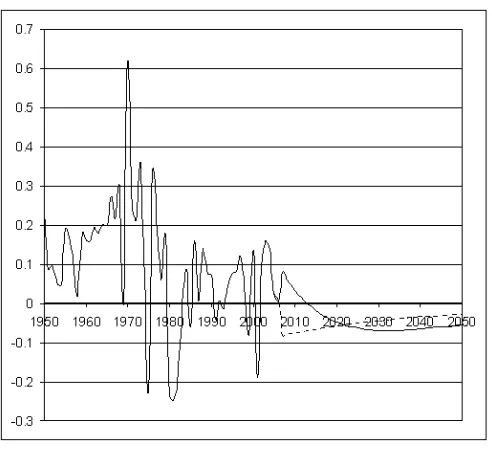
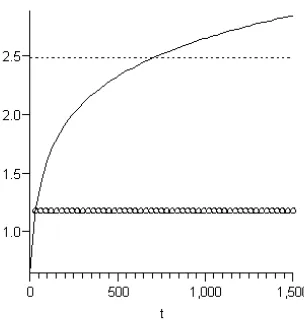
Figure 1: World oil extraction: historical data (before 2006); Hartwick curve (dotted); transi-tion curve (solid)
absolute units) and the path of extraction changes r˙(t) (or negative acceleration of stock s(t)
diminishing, dotted line on Fig. 2) also approaching zero, but starting from negative value
˙
r0 =−
αr2 0 s0(α−β)
. (5)
However, according to our assumptions we are not able to realize technically the efficient
Hartwick curve and we must switch to a sustainable path along some “smooth continuation”
(solid line on Fig. 1 after 2006). Our definitions in the next section reflect these technical
restrictions.
2
Feasibility, e
ffi
ciency, and technical restrictions
The constant per capita consumption over time in our case is the result of
2) fulfillment of the Hotelling rule (f˙r/fr =fk).
We analyze the case when technical restrictions prevent us from starting the extraction
using an efficient path and so we must find the optimal path among inefficient curves. We set
down these assumptions below in the definitions 1 - 4, and the Propositions 1 and 2.
Definition 1 Anintertemporal program f(t), c(t), k(t), r(t) ∞t=0 is a set of paths f(t), c(t),
k(t), r(t), t≥0such that f(t) =f[k(t), r(t)]andc(t) =f(t)−k˙(t).
Definition 2 For positive initial stock of capital and resource (k0, s0) 03 the set of the
programs F ={ f(t), c(t), k(t), r(t) ∞t=0} isa feasible sheaf att= 0 and each of the paths f(t),
c(t), k(t), r(t) is a feasible path if any program f(t), c(t), k(t), r(t) ∞t=0 from F for all t ≥ 0
satisfies the conditions:
1) (f(t), c(t), k(t), r(t)) 0;
2) r(t), k(t), c(t) are continuously differentiable and supt|r˙(t)|≤r˙max<∞;
3) f(t) is twice continuously differentiable;
4) Ut∞r(t)dt ≤s(t);
5) k(0) =k0, c(0) =c0, r(0) =r0,r˙(0) =a0 ≤r˙max.
Definitions 1 and 2 are based on the definition of the interior feasible path in (Asheim et
al., 2007). The differences reflect our assumptions: a) population is constant; b) the speed of
change of the extraction rate r˙ is limited and continuous for all t including t = 0 (technical
restrictions). Henceforth, a “program” and a “path” will refer to a feasible program and a
feasible path.
Definition 3(Dasgupta and Heal, 1979, p. 214) A feasible program f(t), c(t), k(t), r(t) ∞t=0
from F is intertemporally inefficient if there exists a program f(t), c(t), k(t), r(t)∞t=0 fromF
3(x
such thatc(t)≥c(t)for allt ≥0and c(t)> c(t) for some t.
Definition 4(Dasgupta and Heal, 1979, p. 214) A set of feasible programs
E ={ f(t), c(t), k(t), r(t) ∞t=0}is a set of efficient programs if all the programs
f(t), c(t), k(t), r(t) ∞t=0 fromE are not inefficient.
Proposition 1 If fr˙(0)/fr(0) =fk(0) then F ∩E =∅ or all the feasible paths are inefficient.
Proof. Since f(t)is twice continuously differentiable at t= 0, then there existsε>0such
that for any t ∈ [0,ε) and for any feasible program f(t), c(t), k(t), r(t) ∞t=0 ∈ F the Hotelling
rule is not satisfied: fr˙(t)/fr(t) = fk(t). Necessity of the Hotelling rule for the efficiency of a
program (see, e.g., Asheim et al., 2007, Dasgupta and Heal, 1979) follows the assertion of the
Proposition.
Now we will show that in our assumptions (zero extraction cost) all the growing paths of
extraction are inefficient.
Proposition 2 For an economy with technology q = kαrβ where α,β ∈ (0,1); k(t), r(t) > 0
andk˙(t)< q(t) for allt, the path of extraction is inefficient if there is t≥0 such that r˙(t)>0.
Proof. Since the Hotelling rule is a necessary condition for efficiency, it is enough to show
that it does not hold for the growing rate of extraction. Indeed, we can write the Hotelling rule
˙
fr(t)/fr(t) =fk(t) as fr/fr˙ =rβkαk/kr˙ +βqr/r˙ 2l/(βq)−r/r˙ = αk/k˙ −(1−β)r/r˙ = αq/k
(sincefk =αq/k). Then we haveαk/k˙ + (β−1)r/r˙ =αq/k or(β−1)r/r˙ =q−k˙α/k. The
right hand side of the last equation is always positive and the left hand side can be positive
only forr <˙ 0 for any t≥0 (since (β−1)<0 andr >0).
According to our formulation of the problem and the definition of the feasible path of
Figure 2: Per capita extraction accelerations: historical data (before 2006); Hartwick curve (dotted); transition curve (solid)
condition means that the extraction can be reduced without losing consumption only with the
rate not exceeding r˙max which is defined by the rate of introducing the substitute technology.
For our numerical examples we can estimate r˙max from historical data (Fig. 2)4. Note that r˙
oscillated around 0.2 before 1980. As a result of energy crises in 1973 and 1979-80 it was a period
of introducing new technologies. Then after 1980 per capita accelerations oscillate already
around zero. But these energy crises followed by declines in output and consumption. Hence,
since we consider the problem of switching to sustainable path without losing consumption we
4The methodology of estimation of the accelerations for historical extraction data is described in (Bazhanov,
2006b). It is shown in this paper, that there is empirical evidence that the Hamilton variation principle holds in economics of nonrenewable resources. Then the accelerations of the resource extraction can be estimated as follows: ai= 2
si−ri(ti+1−ti)−si+1
(ti+1−ti)2 wheresi, si+1−reserves atti andti+1;ri−rate of extraction atti;[ti, ti+1) -the period when -the sum of all -the reasons influencing the resource extraction can be considered as a constant. The reserve at initial point of extraction was considered as the sum of thefinal historical reserve estimate and the sum of all historical extractions. Since acceleration is proportional to the generalized force (reason of changes), the values of ai can be considered as the indices of the resource market. As a coefficient of proportionality
can take as a reasonable estimate for our numerical examples r˙max = 0.1.
3
Transition curves
The transition path can be constructed in the same class of rational functions as the Hartwick
curve (3). The difference is in the numerator, which in the expression for acceleration a = r˙
must depend ont with a negative coefficient to control “smooth breaking” in the neighborhood
of t= 0.Namely, we will finda(t)in the form of
a(t, b, c, d) =r˙(t) = a0+bt
(1 +ct)d, (6)
where b <0, c > 0, d >1(for convergence a(t)→ −0 with t → ∞). Corresponding to (6) r(t)
has a dependence onb, c, andd in
r(t) ={−[a0+b/[c(d−2)]]/[c(d−1)] +bt/[c(2−d)]}/(1 +ct)d−1.
Note, that a constant of integration for r˙(t) = a(t) must be zero for the convergence of
U∞
0 r(t)dt, and also for the convergence, d actually must be greater than 3. We have r0 =
−[a0+b/[c(d−2)]]/[c(d−1)] to expressb:
b(c, d) =−c(d−2) [r0c(d−1) +a0]. (7)
Then the transition curve has a dependence onc andd in
r(t) = r0(1 +brt)
(1 +ct)d−1 (8)
wherebr =c(d−1) +a0/r0. Coefficientccan be expressed from the condition that resource is
finite s0 =
U∞
0 r(t)dt:
s0/r0 =
] ∞
0
(1 +ct)1−ddt+ [c(d−1) +a0/r0]
] ∞
0
t/(1 +ct)d−1dt
which means that cis a solution of quadratic equation
c2s
0/r0−2c/(d−3)−a0/[r0(d−3)(d−2)] = 0.
The only relevant root (because we are looking forc > 0) is
c(d) =kr0/(d−3) +
r02/(d−3)2+s0a0/[(d−3)(d−2)]
0.5l
/s0. (9)
Hence, we have a single independent parameter d which defines the shape of the curve
(including its peak) and we can use this parameter as a control variable in some selected
optimization problem
F[r(t, d)]→max
d
which can be connected with the short- or long-run policy in output or in consumption. In our
numerical examples we useda0 = 0.08 and as world oil reserves and extraction on January 1,
2007 (Oil & Gas J., 2006, 104, 47: 20-23.): R0 = 72,486.5[1,000 bbl/day] ×365 = 26,457,572
[1,000 bbl/year] (or 3.6243 bln t/year); S0 = 1,317,447,415 [1,000 bbl] (or 180.47 bln t). We
use coefficient 1 ton of crude oil = 7.3 barrel.
4
Consumption along transition curves
Transition path (8) is not efficient in our formulation of the problem (extraction grows in a
neighborhood oft = 0) unlike the Hartwick curve (3) which is derived from the Hotelling rule
and so satisfies it identically. Hence, to examine the consumption behavior in our case along
some path we should check the fulfillment of the Hotelling rule along this curve. For the general
we have fr/fr˙ =rβkαk/kr˙ +βqr/r˙ 2l/(βq)−
˙
r/r = αk/k˙ −(1−β)r/r.˙ Since fk = αq/k we
havefr/fr˙ =fkkk/q˙ −(1−β)kr/˙ (αqr)land substitution fork˙ the saving rulek˙ =βqgives us
˙
fr/fr =fk[β−(1−β)kr/˙ (αqr)]. (10)
Just to check, we can see, that for the Hartwick curve [·] ≡ 1, because the Hotelling rule
impliesr/r˙ =−αq/k.
Hence, if [·] < 1, then q >˙ 0, because fr/fr˙ < fk,5 which follows −
˙
r/r < αq/k or αq/k +
˙
r/r > 0. And the latter, using expression in the left hand side of (2), means q >˙ 0. In the
same way, [·] > 1 follows q <˙ 0 and, in general, sgnq˙ =sgn{1−[·]}. So, to examine long-run
consumptionc= (1−β)q along the LA curve, we can check asymptotic behavior of [·] in (10).
Proposition 3 If an economy with technology q=kαrβ is such thatα,β ∈(0,1); β <α and
1) resource rent is completely invested in capital;
2) there is no time lag between the moment of investment and the corresponding increase in
capital;
3) rate of extraction r(t) is such that
˙
r(t) = (a0+bt)/(1 +ct)d, b <0, c >0, d >3,
then the asymptotic behavior in output q for different β is:
lim
t→∞sgnq˙(t) =
−1, β(d−2)≥1,
sgnL(d,α,β), β(d−2)<1, (11)
where
L(d,α,β) = [α−β(d−2)] [α−αβ(d−2)].
5In our case the nature of inequality f˙
r/fr < fk is stipulated by the Hartwick investment rule and the
Proof of the Proposition is in (Bazhanov, 2006a, Appendix).6
Corollary 1. Under the assumption of the Proposition 3 the consumptionc(t) is
1) asymptotically decreasing if d >α/β+ 2;
2) asymptotically constant if d=α/β+ 2;
3) asymptotically growing if 3< d <α/β+ 2.
Proof. Note that for β(d−2) < 1 or d < 1/β + 2 denominator of L(d,α,β) is positive.
Then the sign of L(d,α,β) is defined by nominator. Since c= (1−β)q and sgnc˙=sgnq˙ then
substituting the expressions fordintoL(d,α,β)in (11) we obtain the assertion of the Corollary.
In the case whend ≥ 1/β+ 2 or β(d−2) ≥1 we define the sign of c˙ by the first line in (11)
which is included in the first case of the Corollary.
5
Switching to an e
ffi
cient path
We define the moment of shifting to the second periodht0 (the period of “efficient extraction”)
as a solution of the “smooth switching” problem. Namely, the economy enters the efficient
path when the acceleration r˙ along the transition curve is equal to the initial acceleration of
the efficient curve which is being constructed at the each current moment. In our case the
efficient curve (3) is being dynamically constructed with the use of “floating” initial conditions
h
r0(t),hr˙0(t),hs0(t) which are being calculated along the transition path. Equations (5) and (6)
for the accelerations imply thatht0 must be a solution of the equation
a0+bht0
(1 +cht0)d
=− αr
2(ht 0)
h
s0(ht0)(α−β)
(12)
where r(ht0) = rh0(ht0) is defined by equation (8) and the rest of resource hs0 at ht0 is hs0(ht0) =
s0−
Uht0
0 r(t)dt.Since our efficient curve (3) with the Hartwick investment rule give us constant
consumption over time, it is natural to construct the transition curve (8) which is consistent with
the same welfare criterion. Namely, according to the Corollary 1, the rational curve (8) with
d=α/β+ 2and with the Hartwick saving rule implies asymptotically constant consumption.7
We will examine the existence of the solution of equation (12) in the following lemma and
proposition.
Lemma 1The rational curve of extraction (8) is such that
a) s0 = c(rd0−p02);
b) the rest of the resource s(t) along this curve at t≥0 is
s(t) =s0−
] t
0
r(t)dt= r0
c(d−2)
p0+p1t
1 +ctd−2 =s0
1 + p1 p0t
1 +ctd−2
where p0 = 1 + c(db−r3), p1 = brd(d−−32) ;
r0 =r(0)− initial rate of extraction, s0− initial stock;
br=br(d), c=c(d), and d are the parameters of the curve (8).
(Proof is in Appendix 1).
Proposition 4 Equation (12) has real roots if and only if parameter d of the rational curve
(8) is such that
d ≤ α
β + 2. (13)
There are two real roots if inequality (13) is strict and one real root if it holds as an equality.
7Rational path withd=α/β+ 2is optimal in the class of rational functions (8), e.g., with respect to the
following criterion, consistent with constant consumption over time: F(d) = mindmaxt|cmax−c(t)|, where
cmax− asymptote for the path with asymptotically constant consumption. For any d1and d3 such that d1 <
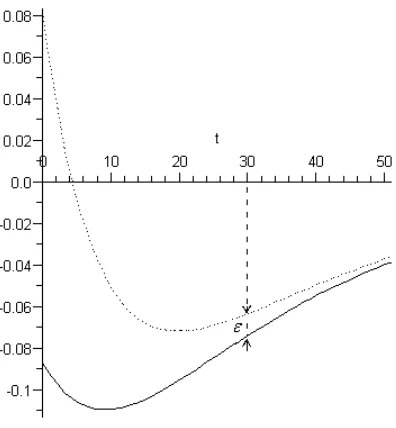
Figure 3: Accelerations for the transition curve with d = α
β + 2 (dotted line) and the initial
accelerations for the Hartwick’s curve (solid line), constructed along the transition curve.
(Proof is in Appendix 2).
Proposition 5 Equation (12) has only one real finite positive root if and only if d < α β + 2.
(Proof is in Appendix 3).
For the example with world oil extraction data, the accelerations of the transition curve (8)
withd= αβ+2(left hand side of equation (12)) and dynamically constructed initial accelerations
of the efficient curve (right hand side of equation (12)) are shown on Fig. 3. It can be seen
that the residual of equation (12) approaches zero only asymptotically which means that our
6
Approximations of the “smooth switching” problem
We will consider two approaches to the approximate solution of the problem (12).
(a) “ε−smooth switching” which means that the economy will enter the efficient curve of
extraction in a “regime shifting” way when the residual of equation (12) is small enough. For
example, using our historical data estimate for r˙max we can define this moment as t0 such that
|rtrans˙ −rHart˙ |=
(1 +a0+ctbt00)d +
αr2(t 0)
h
s0(t0)(α−β)
≤ε= 0.1r˙max= 0.01.
As an approximate solution of this problem we can take t0 = 30 (see Fig. 3).
(b) “ε−optimal transition curve” which means that using the result of Proposition 5 the
economy will follow some ε−optimal (with respect to constant consumption over time)
tran-sition curve with d < α
β + 2 for which equation (12) has a single finite positive root. For the
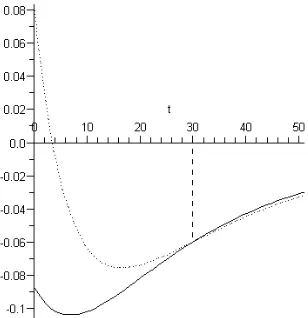
comparison between consumption paths in cases (a) and (b) we will take d = 5.875 (given
α = 0.3 and β = 0.05)8. For this value of d we have the same moment of switching t
0 = 30
(see Fig. 4 and Fig. 13 in the Appendix 3). The difference between two cases is that in case
(a) we must apply some “additional efforts” at the momentt0 to make discontinuous switch to
the efficient path while in case (b) realization of the transition path withd < α
β + 2 needs more
efforts during all transition period (substitute technologies must be introduced faster).
8For α = 0.2 and β = 0.05 estimated in (Nordhaus and Tobin, 1972) the prospects for growth along
the rational paths are less optimistic. The peak of oil extraction for the “borderline”-transition path with
d=α
β+ 2must be closer which implies that the substitute technologies must be introduced faster, and the level
Figure 4: Accelerations for the ε−optimal transition curve with d = 5.875 (dotted line) and the initial accelerations for the Hartwick’s curve (solid line), constructed along the transition curve.
7
Consumption along the “approximate switching”
scenarios of extraction
The Hartwick saving rule which we use in our economy implies that the consumption path
is c = q−k˙ = (1−β)q = (1 −β)kαrβ where r(t) is a known combination of the transition
and efficient paths and k(t) is an unknown path of capital. We can calculate k(t) from the
equation for the saving rule k˙ = βkαrβ assuming that we have estimation of k
0. From (2) we
haveq/q˙ =β(αq/k+r/r˙ ) which implies the expression fork0, givenr0,r˙0,and output percent
change (q/q˙ )0 :
k0 =
˙
q q
0
1
β −
˙
r0 r0
/αrβ0 1 α−1
. (14)
Usingqq˙
construct the consumption path along the Hartwick’s curve (3) we must assume that we manage
not only to change instantly acceleration of the extraction at the moment of switching t0 but
also to stop the growth of our economy. The last requirement connected with condition q˙ = 0
along the Hartwick’s curve including the initial pointt0.9 Substituting for r˙0Hart =− αr 2 0(t0)
h
s0(t0)(α−β)
andq˙= 0 into (14) we have the expression of capital in “different units”: k0 = 30.47656.Since
“physically” capital is the same at this moment,10 we must adjust its value using scale factor
in order to obtain paths of consumption expressed in the “same units”.
For our numerical example the process of switching from the transition path withd=α/β+2
to the efficient curve (case (a)) is depicted on the Fig. 5. Consumption paths are on the Fig.
6. The dash line is the limit (cmax= 2.480) for the growth of consumption along the transition
path. The process of switching from the ε−optimal transition path withd < α/β+ 2 to the
efficient curve (case (b)) is on Fig. 7 and the corresponding consumption paths are on Fig. 8.
Note that according to the Corollary 1 consumption along the rational curve withd <α/β+ 2
grows with no limit. We can see on Fig. 8 that consumption along this path exceeds the limit
for the path with d=α/β+ 2 (dash line).
Hence, in both cases (a) and (b) our attempts to switch to the efficient sustainable path
of extraction gave us unexpected and seemingly paradoxical results. Consumption along the
efficient path of extraction (circled lines on Fig. 6 and Fig. 8) is inferior to the consumption
along the inefficient transition path in all moments of time except the point of switchingt0 = 30
where they are equal. At first glance the example contradicts the definition of inefficient
9At the moment of switching to the Hartwick’s curve (t
0= 30)we have output growth at rate
˙ q q
t0= 0.00886
for the case (a) andq˙ q
t0 = 0.00881for the case (b).
10By the time t
0 = 30 for our example the value of capital along the transition curve with d = 5.875 is
Figure 5: Case (a): “ε−smooth switching” from the transition curve (dotted line) to the efficient curve (solid line).
[image:20.612.228.394.427.603.2]Figure 7: Case (b): switching from the “ε−optimal transition curve” (dotted line) to the efficient curve (solid line).
[image:21.612.232.384.432.592.2]curve (definition 3) according to which everything must be exactly vice versa. However this
definition works only for the feasible paths r(t), k(t), c(t) which according to definition 2 must
be continuously differentiable andf(t) must be twice continuously differentiable. This implies
the continuity of the output percent change q˙
q but in our “approximate solutions” we violated
this requirement assuming that we will manage to stop the growth of economy at the moment of
switching to the efficient path.11 So, if it is really possible to change the economy in a “regime
shifting” manner as a result of some political actions or natural disaster, then we can not be
sure that the continuation of the inefficient program from the “previous life” would be inferior
to our efficient program which we have managed to realize.
For our economy with technology q = kαrβ and the Hartwick investment rule output can
be only growing (q >˙ 0) for all t when r >˙ 0. This implies that for our model consumption
must exhibit an infinite growth12 along the sustainable13 patterns of the resource use (limited
growth as in case (a) along the transition curve or unlimited as in case (b)). Otherwise, if
we discontinuously switch our economy into “different world” which is inferior with respect
to future levels of consumption, the comparison of consumption along the paths from these
“different worlds” will be incorrect.
In order to estimate the amount of consumption which we lose due to the inefficient
extrac-tion, we must compare correctly the consumption behavior along the transition and the efficient
paths. To draw this comparison we will construct a saving rule for the transition path which
impliesq˙(t) = 0 at the moment of switching to the Hartwick’s curve and which also is “close”
11This violation explains also the big differences in consumption along the transition and the efficient paths
(Fig. 6 and Fig. 8) despite very small residual in extractions (Fig. 5 and Fig. 7).
12We assume that our economy has technological progress compensating for the capital depreciation (see
Bazhanov, 2007b) which allows to have an infinite growth.
13We consider the simplest sustainability criterion (in a weak sense) meaning nondecreasing consumption over
asymptotically to the Hartwick rule. We will use this saving rule in the second period only as
an artificial tool for correct comparison of the consumption along our paths. This means that
the efficient Hartwick’s curve will be used in the second period with another saving rule which
will lead to the consumption behavior different from the constant over time. We consider this
case in the following section.
8
Constant output at the moment of switching
Technical restrictions (definition 2) imply, that given q˙(0) > 0, there is no saving rule which
will give us q˙(t) = 0 for all t in the transition period including the moment of switching
t. Then we will construct a saving rule for which q˙(t) = 0 and q˙(t) has arbitrary (feasible)
values at all other moments t in the transition period t ∈ [0, t). Another requirement for
this saving rule is that it must have a feasible continuation for the second period of efficient
extraction (t ∈ [t,∞)) in order to draw the correct comparison of the consumption paths for
this rule. Note that in our formulation we can notfind this saving rule in the class of the rules
with constant saving rates k˙ = δq because we will obtain qualitatively the same behavior of
consumption which will vary only in parameters. For example, for the transition path with
d= α/β+ 2, which implies asymptotically constant consumption we will have different levels
of asymptote cmax for differentδ with monotonically growing consumption cand output q. So
we will construct a feasible function δ(t) which gives us q˙(t) = 0. Since δ(t) has some level of
arbitrariness, we can construct it in such a way thatq(t)is nonmonotonic in transition period
and δ(t) asymptotically approaches β. Then our saving rule asymptotically approaches the
Hartwick rule and the consumption paths will have to be asymptotically constant. Thus, for
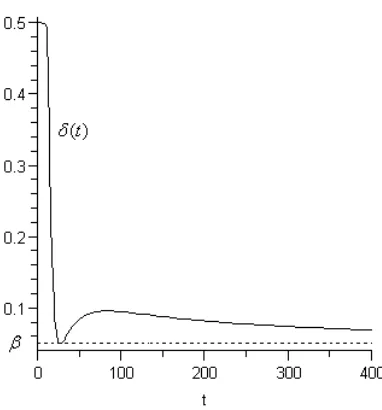
Figure 9: An example of saving rate δ(t) in the transition period (solid line) and the Hartwick saving rate (dotted line).
δ(t) =δ0−(δ0−β)e− ν(t−t∗)2
(1+t)3
with parametersδ0 = 0.5, ν= 20,andt∗ defined from the conditionq˙(t) = 0using an iterative
numerical procedure. The condition q˙(t) = 0 implies that the expressionαkα−1rβk˙+βrβ−1kα
˙
r
or (substituting for k˙ =δq and expressingk)
k(t)−
− β
αδ(t)
˙
r(t)
r(t)β+1
1 α−1
(15)
must be equal to zero. Then for defining t∗ we can use the following procedure:
1) set t∗
0, iterative parameteri= 0,and defineδi(t) =δ0−(δ0−β)e− ν(t−t∗
i)2
(1+t)3 ;
2) calculate (from equation 2)14
k0i =
1
δi(t)αrβ0
˙
q q
0 −βr˙0
r0
1 α−1
;
14Forδi
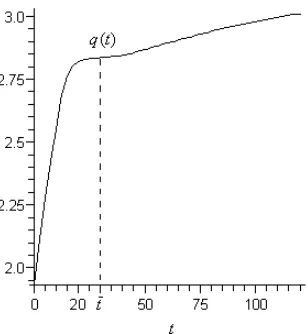
Figure 10: Outputq(t)along the transition curve (ford= α
β+2)with the saving rulek˙ =δ(t)q;
t- the moment of switching to the efficient path.
3) givenki
0 solve differential equation k˙ =δikαrβ for k(t);
4) if the expression in (15) is small enough thent∗ =t∗
i and our saving rule is constructed;
else changet∗
i to reduce the residual in (15), i:=i+ 1, and go to 2).
Since δ(t) can be chosen in such a way that output q is nonmonotonic alongδ(t) (see Fig.
10) and since points withq˙(t) = 0depend on parameter t∗, it can be shown that the procedure
converges. For our numerical example we obtainedt∗ =t−3.48946which gave us the difference
(15) equal to 7.8·10−7.
Now, given the saving rate δ(t) which implies q˙(t) = 0, we can correctly switch at t to
the efficient Hartwick’s curve and compare the levels of consumption (Fig. 11). Note that
when q˙(t) = 0, the estimates for the capital value at the moment of switching coincide for the
transition and the efficient paths and we have no problem of scaling for correct comparison.
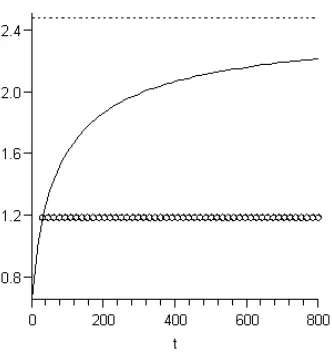
Figure 11: Consumption with the saving rate δ(t) along the Hartwick’s curve (circled) and the transition curve with d= αβ + 2(solid); the line in crosses is the asymptote for the Hartwick’s path, dotted line - asymptote for the transition path.
the consumption along the transition path except the point of switching t where they are the
same. The asymptote for the efficient path (crosses) cmaxHart = 2.6145 is also higher then the
one for the transition path (dotted) cmaxtrans = 2.4802. Hence, we can conclude that it makes
sense to control the efficiency of the extraction path because, as we can see, the economy in
our example is losing more than 5% of consumption at each moment of time in the long run
along the sustainable but inefficient path of extraction.
An interesting source for contemplation is the example for “correct switching” in case (b),
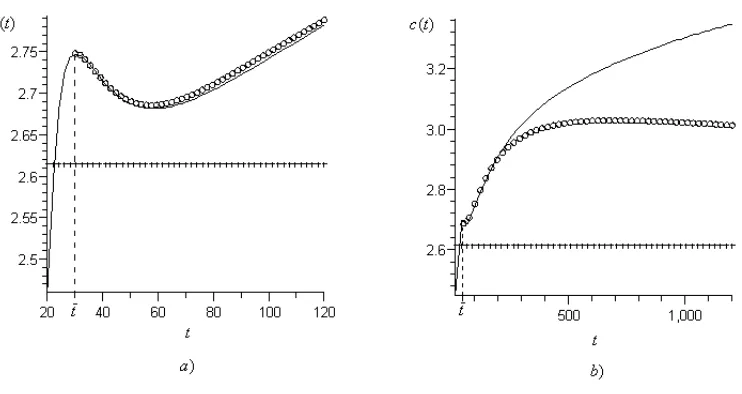
when we use “ε−optimal” transition path withd= 5.875<α/β+ 2.Using the described above
procedure we obtained that in this case the consumption path along the efficient curve is also
superior but only in the short run (Fig. 12 a). Then in accord with Corollary 1 consumption is
Figure 12: Consumption with the saving rate δ(t) along the Hartwick’s curve (circled) and the transition curve withd = 5.875 (solid); the line in crosses is the asymptote for the Hartwick’s path (a - short run; b - long run).
to the same asymptote depicted with crosses (Fig. 12 b).
Of course, our comparison of the satisfactoriness of the extraction paths in this case is
problematic because the transition curve is optimal with respect to a different welfare criterion,
one which implies unlimited growth of consumption. But the example is interesting from the
point of view of selecting a criterion. We can see how small sacrifices of consumption in the
short run yield large future benefits even for the case when an “almost superior” but inefficient
path of consumption is constructed.
9
Concluding remarks
We considered the economy with a restricted rate of substitution between the nonrenewable
man-made capital is represented by new technologies (rather than financial capital in some
fund) which substitute for the resource in production, keeping intact the structure and amount
of output. The new technologies (e.g., solar plants) diminish the demand for resource implying
a declining trajectory of resource extraction. The restriction on the rate of substitution is
expressed by the limiting the rate of change in resource extraction: r˙ ≤r˙max. In our numerical
examples we estimate this bound from historical data.
The restrictions preclude the economy starting resource extraction in an efficient way (i.e.
with a decreasing rate). It also prevents the economy from switching instantly at some moment
to the efficient and sustainable path. Therefore we considered the problem of switching infinite
time as a two-period problem. It turned out that in order to switch “correctly” in finite time
to the desirable path, the economy must “smoothly” adjust during the transition period not
only the path of extraction but also the saving behavior. Violation of this “smooth” process by
discontinuous regime-switching can lead to the seemingly paradoxical result that consumption
along the efficient path, realized by the discontinuous switch, is inferior to the consumption
along the continuation of the sustainable but inefficient path of extraction during the transition
period (Fig. 6 and Fig. 8). In our examples we obtained this interesting result as a consequence
of our “artificial” cessation of the growth of output.
When we stuck with the sustainable saving rule we observed that consumption along the
efficient path is more than 5% higher (Fig. 11) than consumption along the inefficient transition
path which is optimal with respect to the same welfare criterion.
An interesting result was obtained in our comparison of the consumption along the “ε−optimal”
transition path and the efficient curve (Fig. 12). The consumption along the efficient path is
but to a very small extent (less than 0.2% at any moment during this period). But then the
“transition consumption” always exceeds the efficient one and the difference between them goes
to infinity. Of course, for the valid comparison with this transition curve we must construct a sui
generis saving rule and the efficient extraction path consistent with an alternative welfare
crite-rion, one which implies the unlimited growth of consumption. For example, we can use a variant
of the Generalized Rawlsian Criterion (Bazhanov, 2006a) in a form ofcwc˙1−w =γ =constwhich
implies quasi-arithmetic growth c(t) = c0(1 + μt)ϕ where μ = ϕ1
γ
c0
1 ϕ
and ϕ = 1−w. We
think that this problem deserves a separate investigation.
References
[1] Asheim, G.B., Buchholz, W., Hartwick, J.M., Mitra, T. and C. Withagen, 2007.
Con-stant savings rates and quasi-arithmetic population growth under exhaustible resource
constraints. Journal of Environmental Economics and Management, forthcoming.
[2] Bazhanov, A.V., 2006 a. Decreasing of Oil Extraction: Consumption behavior along
transi-tion paths. MPRA Paper No. 469, posted October 16, 2006. Online at
http://mpra.ub.uni-muenchen.de/469/01/MPRA_paper_469.pdf.
[3] Bazhanov, A.V., 2006 b. Variation principles for modeling in resource
economics. Vestnik DVO RAN, 6: 5-13. Online at
http://mpra.ub.uni-muenchen.de/1309/01/MPRA_paper_1309.pdf.
[4] Bazhanov, A.V., 2007 a. The peak of oil extraction and a modified maximin
principle. Proceedings of the International Conference at Waseda University
Em-pirical Analysis”, December 22-23, 2006; 99-128. Online at
http://mpra.ub.uni-muenchen.de/2019/01/MPRA_paper_2019.pdf.
[5] Bazhanov, A.V., 2007 b. The peak of oil extraction and consistency of the government’s
short- and long-run policies. MPRA Paper No. 2507, posted April 02, 2007. Online at
http://mpra.ub.uni-muenchen.de/2507/01/MPRA_paper_2507.pdf
[6] Brander J.A., 2007. Viewpoint: Sustainability: Malthus revisited? Canadian Journal of
Economics. 40: 1-38.
[7] Dasgupta, P. and G. Heal 1979. Economic Theory and Exhaustible Resources. Cambridge
University Press, Cambridge, Eng., 501 pp.
[8] Davis G.A. and R.D. Cairns 1999. Valuing petroleum reserves using current net price.
Economic Inquiry. 37: 295-311.
[9] Grimaud A. and L. Rouge 2005. Polluting non-renewable resources, innovation, and
growth: welfare and environmental policy. Resource and Energy Economics. 27: 109-129.
[10] Hartwick, J.M., 1977. Intergenerational equity and the investing of rents from exhaustible
resources. Amer. Econ. Rev., 67: 972-974.
[11] Karp L. and Livernois J. 1992. On efficiency-inducing taxation for a non-renewable resource
monopolist. Journal of Public Economics, 49: 219-239.
[12] Krautkraemer J.A., 1998. Nonrenewable Resource Scarcity. Journal of Economic
[13] Nordhaus, W.D. and J. Tobin, 1972. Is economic growth obsolete? In: Economic Growth,
5th Anniversary Colloquium, V, National Bureau of Economic Research, New York; 1-80.
[14] Pezzey J.C.V., 2002. Sustainability policy and environmental policy. Australian National
University. Economics and Environment Network Working Paper EEN0211.
[15] Solow, R.M., 1974. Intergenerational equity and exhaustible resources. Rev. Econ. Stud.,
10
Appendix 1
Lemma 1The rational curve of extraction (8) is such that
a) s0 = c(rd0−p02);
b) the rest of the resource s(t) along this curve at t≥0 is
s(t) =s0−
] t
0
r(t)dt= r0
c(d−2)
p0+p1t
1 +ctd−2 =s0
1 + p1 p0t
1 +ctd−2
where p0 = 1 + c(db−r3), p1 = brd(d−−32) ;
r0 =r(0)− initial rate of extraction, s0− initial stock;
br=br(d), c=c(d), and d are the parameters of the curve (8).
Proof. a) By the construction ofr(t) and since d >3we have
s0 r0
=
] ∞
0
(1 +ct)1−ddt+br
] ∞
0
t(1 +ct)1−ddt= 1
c(d−2)
1 + br
c(d−3)
= p0
c(d−2).
b) By direct calculations we have
s(t) =s0−
] t
0
r(t)dt=s(t) =s0−r0
1
c(d−2)
q
1−1 +ct2−dr+brI(t)
(16)
where
I(t) = 1
c2
1
d−3
k
1−1 +ct3−dl− 1 d−2
k
1−1 +ct2−dl
= 1
c2(d−2) (d−3)
q
(d−2)k1−1 +ct 1 +ct2−dl−(d−3)k1−1 +ct2−dlr
= 1
c2(d−2) (d−3)
q
1 +ct2−d(d−3)−(d−2)1 +ct+ (d−2)−(d−3)r
= 1
c2(d−2) (d−3)
+
1− 1 + ( d−2)ct 1 +ctd−2
,
Then the bracket [·]in (16) is
[·] = 1
c(d−2)
+
1 +ctd−2−1
1 +ctd−2
,
+ br
c2(d−2) (d−3)
+
1 +ctd−2−1−(d−2)ct
1 +ctd−2
,
= 1
c(d−2)1 +ctd−2
1 + br
c(d−3)
1 +ctd−2−
1 + br
c(d−3)
− br(d−2)
(d−3) t
= 1
c(d−2)
+
p0−
p0+p1t
1 +ctd−2
,
.
Then (16) can be rewritten as follows
s(t) =s0− r0 c(d−2)
+
p0−
p0+p1t
1 +ctd−2
,
.
Using the result of the case a) we have
s(t) = r0
c(d−2)
p0+p1t
1 +ctd−2 =s0
1 +p1 p0t
1 +ctd−2
11
Appendix 2
Proof of Proposition 4. We will show that the equation defining the momentht0 of “smooth
switching” to the efficient curve
a0+bht0
(1 +cht0)d
=− αr
2(ht 0)
h
s0(ht0)(α−β)
(17)
has real roots if and only if parameterd of the rational curve (8) is such that
d≤ α β + 2
and that there are two real roots if the last inequality is strict and one real root if it holds as
an equality.
Substituting forr(ht0) and multiplying both sides of (17) by
1 +cht0
d
we have
a0+bht0 =−
αr2 0
h
s0(ht0)(α−β)
1 +brht0
2
1 +cht0
d−2.
Applying assertion b) of Lemma 1 it can be written as
a0+bht0 =−
αr2 0 s0(α−β)
1 +brht0
2
1 +p1 p0ht0
which means that the moment of “smooth switching”ht0 is a solution of quadratic equation
a0+bht0
1 +p1
p0
ht0
+ αr
2 0 s0(α−β)
1 +brht0
2
= 0
or
whereλ2 =bpp10 + b
2
rαr02
s0(α−β), λ1 = p1
p0a0+b+
2brαr02
s0(α−β), λ0 =a0+
αr2 0
s0(α−β). This equation has at least
one real root (two if inequality is strict) if and only ifD =λ21−4λ2λ0 ≥0where
λ21 = 1
s2
0(α−β)2
+
p1 p0
a0+b
2
s20(α−β)2+ 4brαr02
p1 p0
a0+b
s0(α−β) + 4b2rα2r40
,
λ2λ0 =
1
s2
0(α−β)2
bp1 p0
a0s20(α−β)2+s0(α−β)
b2rαr02a0+b p1 p0
αr20
+b2rα2r40
Cancelling like terms and multiplying by s0(α−β) >0 we can write our condition as Dh ≥0
where
h
D =s0(α−β)
%
p1 p0
a0+b
2
−4bp1 p0
a0
&
+ 4
brαr20
p1 p0
a0+b
−b2rαr20a0−b p1 p0
αr20
Note that thefirst bracket [·] in this expression is
p1 p0
a0+b
2
−4bp1 p0
a0 =
p1 p0
a0−b
2
and the second bracket is
brαr20
p1 p0
a0+b
−b2rαr02a0−b p1 p0
αr02
= αr20
bra0
p1 p0 −
br
+b
br− p1 p0
= αr20
p1 p0 −
br
(bra0−b).
Then the condition of the root existence is
h
D =s0(α−β)
p1 p0
a0−b
2
+ 4αr20
p1 p0 −
br
(bra0−b)≥0 (19)
where
p1 p0
a0−b = c(d−2)r0br+a0
br(d−2)
d−3
c(d−3)
c(d−3) +br
=brc(d−2)
r0+
a0 c(d−3) +br
= brc(d−2)r0
c(d−3) +br+ a0 r0 c(d−3) +br
=brc(d−2)r0
%
c(d−3) +c(d−1) + a0 r0 +
a0 r0 c(d−3) +c(d−1) + a0
r0
&
= 2brc(d−2)r0
%
c(d−2) + a0 r0
2c(d−2) + a0 r0
&
p1 p0 −
br = br(d−2)
d−3
c(d−3)
c(d−3) +br −br =br
c(d−2)
c(d−3) +br −1
= br
%
c(d−2)−c(d−3)−br
2c(d−2) + a0 r0
&
=−br
%
c(d−2) + a0 r0
2c(d−2) + a0 r0
&
,
bra0−b=bra0 +brc(d−2)r0 =brr0
c(d−2) + a0
r0
.
Substituting for these expressions in (19) we obtain
h
D=s0(α−β)4br2c2(d−2)2r02
%
c(d−2) + a0 r0
2c(d−2) + a0 r0
&2
≥4αr03b2r
%
c(d−2) + a0 r0
2c(d−2) + a0 r0
&
c(d−2) + a0
r0
or
s0(α−β)c2(d−2)2
2c(d−2) + a0 r0
≥αr0.
Substituting fors0 (Lemma 1, a)) into the LHS we have
p0c(d−2)
2c(d−2) + a0 r0
≥ α
α−β
and substituting forp0 we obtain
(d−2) (d−3)
2c(d−2) + a0 r0
2c(d−2) + a0 r0
≥ α α
−β
or
1−β
α ≥1−
1
d−2.
12
Appendix 3
Proof of Proposition 5. We will show that the equation defining the momentht0 of “smooth
switching” to the efficient curve
a0+bht0
(1 +cht0)d
=− αr
2(ht 0)
h
s0(ht0)(α−β)
(20)
has only one real finite positive root if and only ifd < αβ + 2.
It was shown in the Appendix 2 that equation (20) is equivalent to the quadratic equation
(18) which using lemma 1 is equivalent to equation
μ2ht20+μ1ht0+μ0 = 0 (21)
whereμ2 =bp1+ b
2
rr0αc(d−2)
α−β , μ1 =p1a0 +bp0 +2b
rr0αc(d−2)
α−β , μ0 =a0p0+ r0ααc−(dβ−2).
Substituting forb, p0, p1, and reorganizing we have
μ2 = −brc(d−2)r0
br(d−2)
d−3 +
b2
rr0αc(d−2)
α−β =b
2
rr0c(d−2)
α α−β −
d−2
d−3
= b
2
rr0c(d−2)
(α−β)(d−3)[β(d−2)−α].
Note that in our formulation of the problem the multiplier b2rr0c(d−2)
(α−β)(d−3) in the last formula is
always positive since d > 3, α > β, r0 > 0, a0 > 0 and it follows c > 0. Then the sign of μ2
is defined by the sign of β(d−2)−α. Namely, μ2 is negative when d < α
β + 2, positive when
d > α
β + 2,and zero when d = α β + 2.
Coefficient μ1 is
μ1 = br(d−2)
d−3 a0−brc(d−2)r0
1 + br
c(d−3)
+2brr0αc(d−2)
α−β
= br(d−2)
a0 d−3−r0
2c(d−2) + a0 r0
d−3 +
2r0αc
α−β
= br(d−2)
a0−2r0c(d−2) +a0
d−3 +
2r0cα
α−β
Figure 13: The root of equation (12) for d= 5.875.
Finally we have
μ1 = 2brr0c(d−2)
α α−β −
d−2
d−3
.
Note that br is also positive in our formulation (because of the growing rate of extraction in
the neighborhood oft= 0). Then the sign of μ1 like the sign ofμ2 is completely defined by the
same expression β(d−2)−α. It can be shown that μ0 >0 for a0 > 0. The peak of parabola
(21) is defined by equation
t∗ =− μ1 2μ2
=−2brr0c(d−2) [β(d−2)−α] 2b2
rr0c(d−2) [β(d−2)−α]
=−1
br <0.
Hence our parabola is convex for d < α
β + 2 and has only one positive finite root (Fig. 13).
Withd→ α