Developing Web-based Semantic and Fuzzy Expert
Systems using Proposed Tool
Mostafa A. Nofal
Computer Engineering Dept., College of Computers and Information Technology, Taif University, Kingdom
of Saudi Arabia (KSA)
Khaled M. Fouad
Information Systems Dept., Faculty of Computers and Informatics,
Benha University, Egypt
ABSTRACT
Developing the expert system (ES) using conventional programming languages is very tedious task. Therefore, it is not surprising that tools have been developed that can support the knowledge engineer. Separate tools now exist to support the knowledge acquisition and to support the implementation.
Fuzzy set theory is used to capture imprecision in inputs and outputs of models, and fuzzy expert systems are used as a method of reasoning with imprecision. Fuzzy expert system permits handling uncertainties, ambiguities, and contradictions in the knowledge.
In this research, a tool is proposed for development of web-based expert systems and utilizes fuzzy logic and semantic web technology which permits the knowledge engineer and domain expert to define the knowledge without having to know anything about programming languages and AI.
The knowledge can be conceptualized using WordNet. The tool can induce new rules based on the semantic similarity of the concepts using WordNet.
During acquiring the knowledge by a proposed tool using domain expert, the fuzzification process can be performed for values of in the acquired knowledge, then, the fuzzy inference can be initiated that has derivation of the control outputs based on the calculated fire strength and the defined fuzzy sets for each output variable in the consequent part of each rule. Finally, defuzzification is performed that involves weighting and combining a number of fuzzy sets resulting from the fuzzy inference process in a calculation, which gives a single crisp value for each output.
Using a proposed tool, the Web-based fuzzy expert system can be developed simply and takes short time and effort. The proposed tool is evaluated by using the diagnosis domain of air pollution diseases.
Keywords
Fuzzy Expert Systems, XML, Web-based User Interface.
1.
INTRODUCTION
An expert system is a computer program that represents and reasons with knowledge of a specified subject with a view to solving problem directly or giving advice. The existing expert system architecture supports only knowledge base and only on standalone systems. They do not allow defining explicitly the semantics of the underlying knowledge and they are not able to deal with imprecision and vagueness [1]. Expert systems have provided solutions to different problems in companies, from strategic planning of marketing to consulting in process reengineering [2].
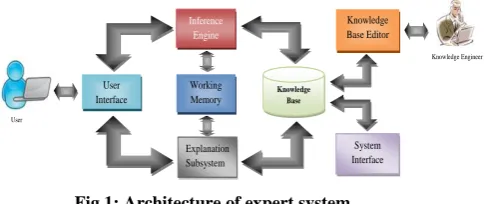
[image:1.595.322.568.221.323.2]The architecture of an expert system [8] is shown in Figure 1.
Fig 1: Architecture of expert system
The Internet offers an ever-expanding set of capabilities and Web-based ES is capable of offering much more than traditional ES [4]. However, the literature appears to offer contradictory pictures on the current status of Web-based ES in practice. Grove (2000) [3] provides some examples of Web-based ES in industry, medicine, science and government and claims that “there are now a large number of ES available on the Internet”. Grove (2000) argued that there are several factors that make the Internet, by contrast to stand-alone platforms, an ideal base for Knowledge Based System (KBS) delivery [4].
Web based expert systems WBES [5] have several factors that make the platforms, by contrast to standalone platforms, an ideal base for KBS (knowledge based system) delivery. These factors include [3]: the Internet is readily accessible, Web-browsers provide a common multimedia interface, several Internet compatible tools for KBS development are available, Internet-based applications are inherently portable, and emerging protocols support co-operation among KBS. The architecture of WBES [6] is based on the traditional expert of system technology with an integration of web technology at various modules of the system. The organic design of traditional expert system architecture has been adapted to Internet use by incorporating client-server architecture and web browser-based interfaces [7].
Lotfi A. Zadeh in [9], proposed a theory of fuzzy sets and an associated logic, namely fuzzy logic. Essentially, a fuzzy set is a set whose members may have degrees of membership between 0 and 1, as opposed to classical sets where each element must have either 0 or 1 as the membership degree; if 0, the element is completely outside the set; if 1, the element is completely in the set.
Fuzzy expert systems (FES) [10] use fuzzy logic instead of classical Boolean logic and collection of membership functions and rules that are used for reasoning about data. They are oriented towards numerical processing and handle uncertain or imprecise information. A fuzzy expert system is an expert system, which consists of fuzzification [11, 31, 32], inference, knowledge base and defuzzification [11, 31, 32] subsystems (as shown in figure 2), and uses fuzzy logic to
Inference Engine
User Interface
Working Memory
Explanation Subsystem
Knowledge Base Editor
System Interface
Knowledge Engineer
User
reason about data in the inference mechanism. While inference module consists of a set of cooperating programs that execute procedural component of expert system, knowledge base and base of facts represents passive data structures. Knowledge engineer collects knowledge from domain expert and transfers it into production rules and creates knowledge base.
Fig 2: The general architecture of FES
During fuzzification [11, 31, 32], the input real values are transformed into linguistic values each with a membership function with a range of [0, 1]. Fuzzy if-then rules and fuzzy reasoning are the backbone of fuzzy expert systems, which are the most important modeling tools based on fuzzy set theory. IF-THEN rules are appSlied to the terms of the linguistic variables where combinations of conditions lead to conclusions. The collection of these fuzzy rules forms the rule base for the fuzzy logic system. Using suitable inference procedure, the conclusion is drawn. This results in one fuzzy subset to be assigned to each output variable for each rule. Again, by using suitable composition procedure, all the fuzzy subsets assigned to each output variable are combined together to form a single fuzzy subset for each output variable. Defuzzification [11, 31, 32] is applied to convert the fuzzy output set to a crisp output that best represents the fuzzy set. The basic fuzzy inference system can take either fuzzy inputs or crisp inputs, but the outputs it produces are always fuzzy sets.
There are powerful tools [12] for the generation of expert systems. However, creating an expert system on the basis of these tools becomes a very difficult task for users without specific training in small and medium-sized companies. A tool that is easy to use but still has enough power to solve problems and can be used by the domain expert makes the technology of expert systems accessible in all types of companies.
Expert system shells are the expert system development tools which are created so that the expert system developers may concentrate more on creating the knowledge base rather than expending effort on the complicated programming for the architectural development. An expert system shell is an expert system with an empty knowledge base. A shell contains the framework with all the specific strategies for inference and knowledge representation incorporated. Most commonly used expert system shells include AQUIRE, CLIPS, JESS, NEXPERT OBJECT, Eclipse, ART, etc. These shells are described in [13]. Tools to develop expert systems can be classified in three categories [14]:
Expert-system shells, Hybrid tools, and
Knowledge-engineering environments.
A major criterion for classifying a tool [14] in any of these categories is the type(s) of knowledge representation [42] supported. Knowledge-representation facilities may cover an entire spectrum, including production rules, special rules, frames, object-oriented facilities, etc. Knowledge-engineering environments usually support most of these facilities.
The proposed tool will facilitates the simple and fast creation and exploitation of web-based expert systems which are accessible via web browsers as well as mobile devices. Additionally, the tool makes it possible to analyze information collected in different sessions. This tool can provide the semantic data to the facts in the knowledge and represent the knowledge in the ontological format [26].
The tool enables the knowledge engineer to insert and update the knowledge simply and in short time. To ensure the knowledge acquired and inferred, it must be verified and validated using domain expert.
The tool creates the fuzzy inference engine and web-based user interface. These components are considered to develop the web-Based expert system. A fuzzy expert system uses pre-defined fuzzy rules to imitate the verbal expression and the think process of human beings to solve the decision-making problems. It has been applied widely in many fields with successful applications.
2.
RELATED WORK
In [2], authors have presented a framework oriented to the development of web-based expert systems by people with no knowledge or experience of AI. Compared with business technologies, the proposed framework is based on a development tool that is simple to use with the objective of allowing domain experts themselves to create expert systems. Furthermore, it allows the created expert systems to be accessible through browsers on conventional PCs as well as through mobile devices.
Kumar and Mishra have discussed and explained the various domains for WBESs in [6]. They summarized and provided observations on few of the representative WBESs in Engineering, Management, Medicine, Education, Agriculture, Finance, and Tourism domains. Observations and comparisons on the different factors like knowledge representation, inference, user interface, use of various web services-related processes, and applications have been tabulated for WBESs of each domain.
In [15], the earthquake disaster management planning in the practical problems used OWL DL to describe the state and characteristics information of the earthquake. On this basis, by introduction of logical reasoning, the authors gave an earthquake rescue planning process on case-based case database and knowledge database. They made full use of existing domain knowledge to support decision-making personnel rescue program for improving the efficiency of case retrieval, and optimize the rescue program has played a positive role.
Prcela, Gamberger, and Jovic described the utilization of OWL in medical expert systems applications in [16]. They presented the descriptive ontology constructed for the heart failure domain and then analyze the possibility to include also procedural knowledge in the same ontological representation. Finally, based on experiments with real application they compared rule based reasoning with onological reasoning for the procedural type of the knowledge.
Inference Engine
Fuzzification Defuzzification
Fuzzy Knowledge Base
Crisp Inputs
Fuzzy Inputs Fuzzy Output
Sahin, Tolun and Hassanpour in [17] have surveyed several recent publications around the intersection of neural networks, expert systems domains and specifically concentrated on recent trends in hybrid expert system development. The review papers were evaluated with respect to Hybrid Expert System structure approaches, algorithms, application categories and building/implementation tools.
Dunstan in [18] has described the method that generates web-based expert systems from XML descriptions of the knowledge domain. The method relies on an XML parser which converts domain knowledge into Prolog code. Web pages dynamically interpret the code to provide expert system responses to the user. A case study was developed which showed that university course rules could be expressed in XML format, and directly converted into Prolog code. The XML parser can also generate course-specific HTML and CGI files as components in a course-specific web-based enrollment guide.
Chitra, Ahmad and Mahsa addressed the TKT-OAV tool for construction of new unique knowledge base in knowledge based systems in [19]. The major objective of this work was to design an user friendly tool to construct a knowledge base which knowledge present in semantic network or frame knowledge representation techniques easily and transform the knowledge of any expert system to the unique knowledge representation technique, Ex-OAV KB. This tool could help the knowledge engineer to validate and verify all knowledge base, based on different knowledge representation techniques in expert systems.
The design and development of a web based expert system shell and its role in developing an Intelligent Fault Diagnosis and Control Paradigm (IFDCP) package for power system equipment is presented in [20]. A brief description of expert system architecture and issues involved in developing a web based expert system shell and the technology used is discussed. The concept of designing a web based expert system with a user friendly GUI is also discussed. The application of the shell to develop the package IFDCP for fault diagnosis and control of general power system equipment which provides online help for diagnosing faults of electrical power equipment and clearing them is discussed in detail in the paper. The package deals with data collected from an electrical factory in Visakhapatnam for Transformers, DC Motors, AC Motors and Street Lamps.
The authors in [21] introduced the definitions and introductory concepts of fuzzy logic and fuzzy decision making and some implemented examples of such systems were presented. A web based student consulting expert system was proposed and its capability in enhancing the consulting process has been shown in [21].
In [22], authors presented a Propositional Dynamic Logic PDL framework for reasoning with fuzzy qualitative movement which entitles us to manage both qualitative and quantitative information, and consequently, to obtain more accurate results. Some of the advantages of PDL have been exploited and explained on the basis of some real examples from the literature, such as the use of programming commands as while...do and repeat...until, which enrich the expressivity or our approach.
The overall goal of the research reported in [23] was to develop a decision support tool to interpret predicted air and dew point temperatures and observed current wind conditions as frost and freeze event warnings related to blueberries and
peaches for the subsequent 12-h period for any of the AEMN locations in Georgia. The specific objectives were: (1) to develop an expert system using fuzzy rules which encompasses the knowledge of expert agrometeorologists’ published literature related to frost and freeze, (2) to verify the performance of the fuzzy expert system using additional weather scenarios not used in model development, and (3) to develop a web-based graphical user interface for disseminating the information to producers across the state of Georgia.
In the study [24], authors presented a Fuzzy Expert System for the diagnosis of having high blood pressure called hypertension. Although there are few methods using artificial intelligence technique for the diagnosis, not many researchers use the Fuzzy Expert System (FES) to diagnose and treat this disease. Authors explored the advantages using FES and it is expected that their system also can be used by medical students for training purposes. As laboratory data, blood pressure, BMI, age, heart rate and life-style of the patient are used. Using this data and help from an expert doctor, the fuzzy rules to determine the risk factor of having high blood pressure are developed. The developed system is expected to give the user the patient possibility ratio of the hypertension.
In [25], a multi-criteria Expert system based on Fuzzy logic for selecting the best supplier was developed. The motive of this work is that if the right supplier was selected, significant save in costs of purchasing processes. Moreover, the competitive advantage of the company would be improved too. When it is not possible to express performance values in numerical formats, using linguistic variables would be very effective and helpful. Expert system (ES) was developed to automate the supplier evaluation and selection processes. The ES replaces the intuitive and non-quantifiable methods employed by human decision makers with a systematic, consistent approach through the use of management science and operations research models.
3.
THE DESIGN OF THE PROPOSED
TOOL
For the creation of the semantic and fuzzy expert systems, an expert system tool can be used, which allow experts and knowledge engineers to create these systems and that users use the same. Questions are suggested for the user, who answers them and the final results are shown on screen.
This work aims at implementing a Web-based tool which allows the construction and development of an expert system based on Web. This tool allows the creation of fuzzy expert system using rule-based representation of knowledge. The knowledge, that is facts and rules, is represented firstly in XML format [5, 27, 30]. The tool uses the ontology; that is WordNet [28, 29], to add semantics to the facts, and then the knowledge is represented in ontological format as XML.
The proposed tool accepts numbers as input, and then translates the input numbers into linguistic terms such as slow, medium, and fast (fuzzification). Rules then map the input linguistic terms onto similar linguistic terms describing the output. Finally, the output linguistic terms are translated into an output number (defuzzification). The syntax of the rules is convenient for control purposes, but much too restrictive for fuzzy reasoning; defuzzification and defuzzification are automatic and inescapable.
1. Building the initial knowledge base.
2. Building the annotated and ontological knowledge base.
3. Building the ontological final knowledge base.
[image:4.595.56.286.174.316.2]Building the Web-Based Fuzzy Expert System is performed by using fuzzy reasoning. The entire architecture of the proposed tool is shown in figure 3.
Fig 3: The entire architecture of the proposed tool
3.1
Build the Initial Knowledge Base
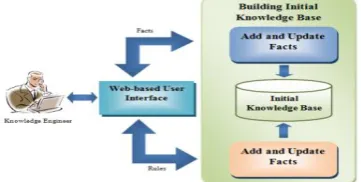
[image:4.595.322.533.280.405.2]That is the first component of the proposed tool; which is elucidated in the previous work [26]. This component aims at entering the facts and the rules; the knowledge, of the initial domain knowledge. This component architecture is shown in figure 4.
Fig 4: The component of building the initial Knowledge Base
This component is considered as the first task of any expert system development, which is the knowledge acquisition. Knowledge acquisition [33] is defined as the process of extracting knowledge from problem domain experts in order to define the required functionality of the knowledge-based expert system. Knowledge acquisition has been referred to as the “bottleneck in the process of building expert systems” [34]. The two key groups of stakeholders during knowledge acquisition are the knowledge engineer and the problem domain experts. The knowledge engineer acts as the conduit for extracting domain specific information from the problem domain experts. The process of knowledge acquisition [35] is difficult especially in case if the knowledge engineer is unfamiliar with the domain. The goal of knowledge acquisition process aims at obtaining the facts and rules from the domain expert.
Developing a knowledge base system has many stages, the following are the knowledge acquisition stages, which described by Buchanan [36]:
Identification stage: in which a definition of the important characteristics of the problem domain is done, e.g. participants, characteristics, resource, and goals.
Conceptualization stage: in this stage the structure protocols are identified (the primary concepts and relationships in the domain).
Formalization stage: in which the knowledge is mapped into representation producing a design.
Implementation stage: the formalization knowledge. Testing stage: in which the knowledge base is
validated.
The proposed tool has a module which aims at building the initial Knowledge Base. Figure 5 shows the Web-based interface of the module which aims at building the initial Knowledge Base.
Fig 5: Interface of building the initial Knowledge Base component
In the proposed tool, the knowledge representation methodology uses XML format [5, 27, 30]. XML is used as ontology language, which aims at specifying a domain theories based on logical representation and XML can be used to provide integrity constraints for information sources [40, 41].
Two elements of knowledge, facts and rules, are represented using XML format. The facts structure of the knowledge is shown in figure 6. The acquired knowledge is for the diagnosis of the air pollution diseases. The facts are found as the main concept which is represented as the value of the attribute “Name” of the element “Parent”. The property of the main concept is always “Name”. The values of the property are represented as the value of the attribute “Name” of the element “child”. For the first node, it means as: Cardialogy diseases=Name.Heart palpitations.
[image:4.595.80.261.423.514.2]The rules structure of the knowledge; Diagnosis of air pollution diseases is shown in figure 7. The rule antecedent is represented as the “Tuple” element and its attribute “Val”. The rule consequent is represented as the value of the attribute “Disorder” of the element “Rule”.
Fig 7: Rules structure of the knowledge
[image:5.595.72.264.424.513.2]3.2
Building the Semantic Knowledge Base
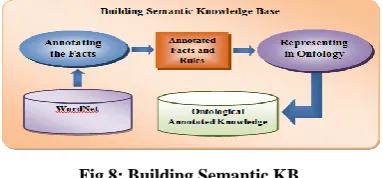
In this phase of the proposed tool, the semantic mapping method based on WordNet [37, 38, 39] is used to acquire the related concepts of the certain concept in the knowledge. WordNet [29] is ontology of cross-lexical references whose design was inspired by the current theories of human linguistic memory. English names, verbs, adjectives and adverbs are organized in sets of synonyms (synsets), representing the underlying lexical concepts. Sets of synonyms are connected by relations. The basic semantic relation between the words in WordNet is synonymy [19]. Synsets are linked by relations such as specific/generic or hypernym /hyponym (is-a), and meronym/holonym (part-whole). The principal semantic relations supported by WordNet is synonymy: the synset (synonym set), represents a set of words which are interchangeable in a specific context. Figure 8 shows the main components of this phase.Fig 8: Building Semantic KB
[image:5.595.318.542.550.618.2]This phase aims at inferring new rules by semantic mapping the values in the knowledge. A sample of the facts after this phase is shown in figure 9.
Fig 9: Sample of mapped values of facts
As shown in figure 9, the mapped concept of the value is added in the value node as “SemVal” attribute. New rules will be inferred after this phase. For example, the original rule which is found in the figure 10 means the rule: IF Cough and respiratory problems AND Shortness of breath AND Feeling of suffocation are found THEN the pollution is affected by increasing oxides of sulfur or hydrogen sulfide.
Fig 10: Sample of rule before semantic mapping of values
After performing semantic mapping of the values the rule becomes as shown in figure 11. The new rule which is found in the figure 11 means the rule: IF Cough and respiratory problems AND (Shortness of breath OR Dyspnea) AND Feeling of suffocation are found THEN the pollution is affected by “increasing oxides of sulfur or hydrogen sulfide”.
Fig 11: Sample of rule after semantic mapping of values
3.3
Building Final and Fuzzy Knowledge
Base
Knowledge base of the proposed tool is developed with the help of the domain expert’s past experience. After multiple rounds of interviews with the air pollution diseases, the knowledge engineers extracted preliminary rules. The preliminary rules from each domain expert were verified by the other experts.
Any confliction was resolved by the consensus. There are many techniques for knowledge representations [42] like predicate calculus, frame, object-oriented technique, production rules, etc. The present module uses fuzzy production rules [43] to build and represent the fuzzy knowledge.
The production rules are written in the format of <IF (antecedent) THEN (consequent)>. In the present fuzzy system condition and conclusion are fuzzy variables. For example of proposed domain; air pollution diseases, a fuzzy rule is: IF Blood pressure=High AND Cholesterol=High AND Cough and respiratory problems THEN the pollution is affected by "Smoking".
This rule is diagnostic and they are selected by the inference engine of developed fuzzy expert system. Figure 12 shows the screen of inserting the range of the linguistic variables by the knowledge engineer.
Fig 12: Screen of inserting the Range of the linguistic variables
Now for example, Blood Pressure; in the proposed domain which is air pollution diseases, is considered as the input variables and it will be described with their membership functions.
[image:5.595.56.274.559.664.2]membership expressions have been defined for blood pressure input field (Eq.(1)). These fuzzy sets will be shown in Table 1. Membership functions of blood pressure field will be shown in figure 13.
Table 1: Classification of Systolic Blood Pressure
INPUT FIELD RANGE FUZZY SETS
Systolic Blood Pressure
<134 Low
127-153 Medium
142-172 High
[image:6.595.49.277.343.539.2]>154 Very high
Fig 13: Membership functions of Systolic Blood Pressure
𝜇𝑙𝑜𝑤 𝑥 =
1 x < 111
134 − 𝑋
23 1 ≤ 𝑥 < 134
𝜇𝑙𝑚𝑒𝑑𝑖𝑢𝑚 𝑥 =
𝑥 −12712 127 ≤ 𝑥 < 139 1 𝑥 = 139 153 −14𝑥 139 ≤ 𝑥 < 153
Eq 1
𝜇ℎ𝑖𝑔ℎ 𝑥 =
𝑥 −142
15 142 ≤ 𝑥 < 157 1 𝑥 = 157
172 − 𝑥
15 157 ≤ 𝑥 < 172
𝜇𝑣𝑒𝑟𝑦 ℎ𝑖𝑔ℎ 𝑥 = x −
154
17 154 ≤ x < 171 1 𝑥 ≥ 171
3.4
Fuzzy Inference Engine
Inference engine component is the heart of expert system. This component gets the input from the user and selects the rules from the rule base. The fuzzy inference engine of the present system selects fuzzy rules and uses Mamdami inference [31, 32] to produce the fuzzy risk output. Mamdami approach is described in short below. The Mamdami (max– min) inference mechanism used in the present work is as follows. Let fuzzy rule base has R production rules like
If x1= Ak1 and x2= Ak2 and …… xn= Akn then y =
Bk where k = 1,2,3, … . , r.
x1, x2, x3, ….., xn are causal factors and y is decision A1k, Ak2,
….. , Akn are fuzzy sets representing the kth rule risk factor and
B(k) is the kth rule fuzzy risk set. For each k, Mamdami rule is described as
μBk (y) = min (μA1k x1 , μA2k x2 , … . , μAnk xn )
Where μBk (y) is the membership value of the kth rule risk.
μAnk xn is the membership value of n the risk factor of the
fuzzy set Akn . Let n1 (n1≤ r) number of rules have been
matched and fired and the fired rule set is denoted by {R}. So aggregation n1rules have the fuzzy risk output as - μB(y) = max (μBki(y)), where μ
B
ki(y) is the k
ith rule risk membership
value and ki∈ R and i= 1,2,3,…. n1. μB(y) is the fuzzy risk output which has to be deuzzified into crisp value by the deffuzzification method [11, 31, 32]. The defuzzifier converts the fuzzy output obtained by inference engine into a non-fuzzy output real number domain and this process is called defuzzification [11, 31, 32]. Centroid method [34] is considered to defuzzify the fuzzy risk output to crisp risk percentage.
3.5
Web-based User Interface
The usefulness of the proposed tool is dependent upon the ease with which users can access its information. A web-based tool offers convenient access for many users, however, it must be user friendly in order to gain acceptance [5]. Most producers do not have time to search through vast amounts of information in order to find relevant warnings.
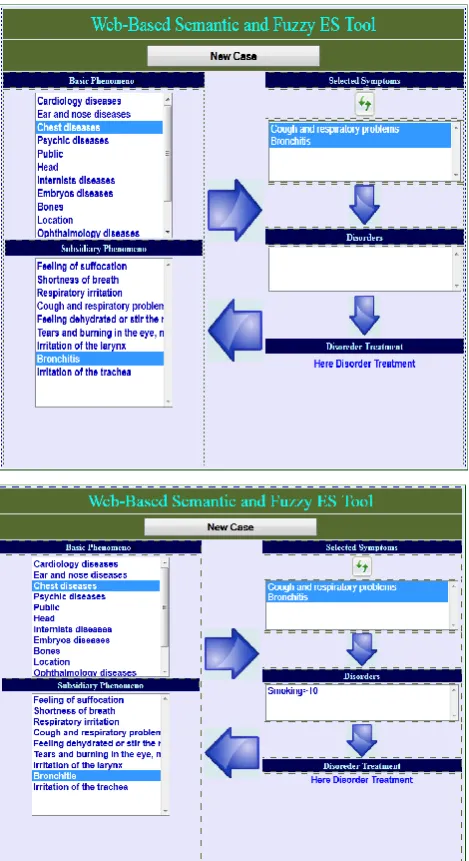
The web interface of the proposed tool was built with this constraint in mind. It was designed to offer a quick graphical warning scheme that is easily accessible yet offers additional detailed information if the user is interested. Figure 14 shows the main screen of the web-based user interface of the proposed tool.
Fig 14: the main screen of the web-based user interface of the proposed tool
3.6 The Results of the Proposed Tool
Tests of the system were carried out by the developers to make sure the tool would work correctly, another validation and evaluation for the tool will be carried out through the using through the web and the feedbacks from the users will be considered for any comments and modifications.
[image:6.595.317.550.358.549.2]Fig 15: User Interface of the case study of the proposed tool
4.
CONCLUSIONS
The proposed tool will facilitates the simple and fast creation and exploitation of web-based fuzzy expert systems which are accessible via web browsers as well as mobile devices. Additionally, the tool makes it possible to analyze information collected in different sessions. This tool can provide the semantic data to the facts in the knowledge and represent the knowledge in the ontological format.
The proposed tool enables the knowledge engineer to insert and update the knowledge simply and in short time. To ensure the knowledge acquired and inferred, it must be verified and validated using domain expert. The finalized knowledge base can now be the main component for the developed web-Based expert system. The tool creates the fuzzy inference engine and web-based user interface. These components are considered to develop the web-Based expert system. A fuzzy expert system uses pre-defined fuzzy rules to imitate the verbal expression and the think process of human beings to solve the decision-making problems. It has been applied widely in many fields with successful applications.
5.
REFERENCES
[1] C.S. Krishnamoorthy; S. Rajeev. (1996). Artificial Intelligence and Expert Systems for Engineers. CRC Press, CRC Press LLC.
[2] B. Ruiz-Mezcua, A. Garcia-Crespo, J.L. Lopez-Cuadrado & I. Gonzalez-Carrasco. (2011). An expert system development tool for non AI experts. Expert Systems with Applications 38 (2011) 597–609.
[3] R. Grove. (2000). Internet-based expert systems, Expert Systems, July 2000, Vol. 17, No. 3, 129-136.
[4] D. Yanqing.(2009). Web-Based Expert Systems. Encyclopedia of Information Science and Technology, Second Edition. IGI Global.
[5] Hogo, M. , Fouad, K. & Mousa, F. (2010). Web-Based Expert System for Civil Service Regulations: RCSES. International Journal of Computer Science and Information Security, IJCSIS, Vol. 6, No. 3, pp. 007-016.
[6] Kumar, S. & Mishra, R. (2010).Expert systems and services. The Knowledge Engineering Review, Vol. 25:2, 167–198, DOI: 10.1017/S0269888910000020. Cambridge University Press.
[7] Grove, F. (2000). Design and development of knowledge-based systems on the web. In Proceedings of ISCA 2000: 9th International Conference on Intelligence Systems: Artificial Intelligence Applications for the New Millennium, Louisville, KY, USA, 147–150.
[8] Shang, Y. (2005). Expert Systems. In: The Electrical Engineering Handbook, 2005, Pages 367-377, Academic Press, Elsevier.
[9] Zadeh, L.A. (1965). Fuzzy sets, Information and Control 8(3):338–353.
[10]Dubey, S., Pandey, R.K. & Gautam, S.S. (2013). Literature Review on Fuzzy Expert System in Agriculture. International Journal of Soft Computing and Engineering (IJSCE), Volume-2, Issue-6.
[11]Siler, W. & Buckley, J. (2005). Fuzzy Expert Systems and Fuzzy Reasoning. John Wiley & Sons, Inc.
[12]Ruiz-Mezcua, B., Garcia-Crespo, A., Lopez-Cuadrado, J. & Gonzalez-Carrasco, I. (2011). An expert system development tool for non AI experts. Expert Systems with Applications 38 (2011) 597–609. Elsevier Ltd.
[13]KOLLU, K. (2011). Prototype of an intelligent tutoring system using the java expert system shell. Master of science engineering. Electrical & Computer Engineering Department, Temple University.
[14]Buydens, L. , Leeuwen, H. & Wehrens, R. (1993). 4: Expert-System-Development Tools. Data Handling in Science and Technology. Volume 13, 1993, Pages 121– 151. Intelligent software for chemical analysis. Elsevier B.V.
[15]Yun, W. & Chan, L. (2009). Semantic Web-based Seismic Disaster management Expert System. 978-1-4244-4507-3/09. IEEE.
[17]Sahin, S., Tolun, M. & Hassanpour, R. (2012). Hybrid expert systems: A survey of current approaches and applications. Expert Systems with Applications 39 (2012) 4609–4617. Elsevier Ltd.
[18]Dunstan, N. (2008). Generating domain-specific web-based expert systems. Expert Systems with Applications 35 (2008) 686–690. Elsevier Ltd.
[19]Chitra, D., Ahmad, A. & Mahsa, A. (2005). Design a Tool for Construction of Unique Knowledge Base For Expert systems. Proceedings of the 18th International Conference on Systems Engineering (ISCEng’05). 0-7695-2359-5/05, IEEE.
[20]Jain, M., Jain, A. & Srinivas, M. (2008). A Web based Expert System Shell for Fault Diagnosis and Control of Power System Equipment. 2008 International Conference on Condition Monitoring and Diagnosis, Beijing, China, April 21-24, 2008. 978-1-4244-1622-6/08, IEEE.
[21]Rafe, V. & Goodarzi, M. (2013) . A Novel Web-based Human Advisor Fuzzy Expert System. Journal of Applied Research and Technology. Vol. 11, February 2013.
[22]Muñoz-Velascoa, E.& Burriezab, A. & Ojeda-Aciegoa , M. (2014). A logic framework for reasoning with movement based on fuzzy qualitative representation. Fuzzy Sets and Systems 242 (2014) 114–131.
[23]Chevalier, R., Hoogenboom, G., McClendon R., Paz, J. (2012). A web-based fuzzy expert system for frost warnings in horticultural crops. Environmental Modelling & Software 35 (2012) 84-91.
[24]Abdullah, A., Zakaria, Z. & Mohammad, N. (2011). Design and Development of Fuzzy Expert System for Diagnosis of Hypertension. Second International Conference on Intelligent Systems, Modelling and Simulation. 978-0-7695-4336-9/11, IEEE.
[25]Pitchipoo. p, Venkumar. P & Rajakarunakaran. S. (2012). Development of Fuzzy Expert System for Supplier Evaluation and Selection. IEEE-International Conference On Advances In Engineering, Science And Management (lCAESM -2012) March 30, 31, ISBN: 978-81-909042-2-3, IEEE.
[26]Nofal. M. & Fouad, K. (2014). Developing Web-Based Semantic Expert Systems. IJCSI International Journal of Computer Science Issues, Vol. 11, Issue 1, No 1, January 2014.
[27]Zeid, I. & Gupta, S. (2000). Disassembly knowledge representation via XML. Paper 39. http://hdl.handle.net/2047/d1000313.
[28]Yan, S., Yun, L., Luan, L. & C. Ling. (2009), A Personalized Search Results Ranking Method Based on WordNet, 2009 Sixth International Conference on Fuzzy Systems and Knowledge Discovery, 978-0-7695-3735-1/09, IEEE.
[29]Fellbaum, C. (2010). WordNet. In: R. Poli et al. (eds.), Theory and Applications of Ontology: Computer Applications, DOI 10.1007/978-90-481-8847-5_10, Springer Science+Business Media B.V.
[30]Deshmukh, P. & Ali, M. (2014). Overview of Xml based Knowledge Representation using Scripts. International Journal of Advance Research in Computer Science and Management Studies. Volume 2, Issue 1, January 2014.
[31]GAINFS, B. (1976). Foundations of fuzzy reasoning. International Journal Man-Machine Studies (1976) 8, 623-668.
[32]Pappis, C. (2005). FUZZY REASONING. In: Introductory Tutorials in Optimization and Decision Support Techniques. pp 437-474. Springer US.
[33]Millette, L. (2012). IMPROVING THE KNOWLEDGE-BASED EXPERT SYSTEM LIFECYCLE. Master of Science in Computer and Information Sciences. UNIVERSITY OF NORTH FLORIDA SCHOOL OF COMPUTING.
[34]Forsythe, D., and B. Buchanan. "Knowledge acquisition for expert systems: some pitfalls and suggestions," Systems, Man and Cybernetics, IEEE Transactions, 19, 3, pp.435-442.
[35]B. F. Leao and A. F. Rocha. (1990). Proposed methodology for knowledge acquisition: a study on congenital heart disease diagnosis. Methods Inform. Medicine 29:3(M-0).
[36]BUCHANAN, "Constructing an expert system." In F. Hayes-Roth, D. Waterman, and D. Lenat, eds. Building Expert Systems, Reading, MA: Addison-Wesley, 1983.
[37]Szyma´nski, J. & Duch, W. (2012). Annotating Words Using WordNet Semantic Glosses. ICONIP 2012, Part IV, LNCS 7666, pp. 180–187, 2012. Springer-Verlag Berlin Heidelberg.
[38]Qasim, I. & Khan, S. (2009). Semantic Mapping between Global and Source Ontology using WordNet. Computer, Control and Communication, 2009. IC4 2009. IEEE.
[39]Amalanathan, A., Shanmugam. S, Senthilnathan. M & Harikumar. S. (2012). Semantic Annotations for Customizing Geographical Maps Based on WordNet. Procedia Technology 4 ( 2012 ) 375 – 383.
[40]M. C.A. Klein, J. Broekstra, D. Fensel, V. Harmelen, and I. Horrocks, "Ontologies and Schema Languages on the Web. Spinning the Semantic Web", 2003, pp: 95-139. MIT Press, IEEE.
[41]Gomez-Perez, A. ; Fac. de Inf., Univ. Politecnica de Madrid, Spain ; Corcho, O. (2002). Ontology languages for the Semantic Web. Intelligent Systems, Page: 54 - 60 , IEEE (Volume:17 , Issue: 1 ).
[42]Liebowitz, J. (1999). The Handbook of APPLIED EXPERT SYSTEMS. VámosChapter, T. Chapter 3: Knowledge Representation. CRC Press LLC.