A Cognitive Linguistic Study of Categorisation and Uncertain
Reasoning in the Representation of Degree Modifiers
by
David Christopher Ringwood
A THESIS SUBMITTED IN PARTIAL FULFILMENT OF
THE REQUIREMENTS FOR THE DEGREE OF
MASTER OF PHILOSOPHY
Department of Linguistics & English Language
University of Lancaster, UK
ProQuest Number: 11003630
All rights reserved
INFORMATION TO ALL USERS
The qu ality of this repro d u ctio n is d e p e n d e n t upon the q u ality of the copy subm itted.
In the unlikely e v e n t that the a u th o r did not send a c o m p le te m anuscript and there are missing pages, these will be note d . Also, if m aterial had to be rem oved,
a n o te will in d ica te the deletion.
uest
ProQuest 11003630
Published by ProQuest LLC(2018). C op yrig ht of the Dissertation is held by the Author.
All rights reserved.
This work is protected against unauthorized copying under Title 17, United States C o d e M icroform Edition © ProQuest LLC.
ProQuest LLC.
789 East Eisenhower Parkway P.O. Box 1346
A Cognitive Linguistic Study of Categorisation and Uncertain
Reasoning in the Representation of Degree Modifiers
Degree modifiers (such as very and really) are common features of written and spoken language. In general, their effect is to moderate the perceived strength of the linguistic form on which they act, making them a useful and versatile tool of expression and emphasis. However, the cognitive mechanisms that underlie the conceptualisation of degree modifiers and the linguistic aspects of their use in combination with other classes of words are extremely complex. The ease and fluency with which they are used and the extent to which their effect is commonly understood is good evidence that, like many aspects of meaning, degree modifiers rely on commonly held beliefs and knowledge about the world around us. For this reason the whole area of linguistic categorisation and prototypes are central to understanding the role of degree modifiers, particularly given that assumptions about prototypical strengths of adjectives are exactly what degree modifiers seek to alter.
ACKNOWLEDGEMENTS
This thesis represents many years of work and its completion is as much a function of persistence as inspiration. The ongoing support of many people contributed significantly over the years, and I am extremely grateful to all those who have helped and encouraged me over the course of this research.
I particularly want to acknowledge the importance of Tamara, Anya and Stacey in providing me with a genuine sense of motivation and direction.
I want to thank my supervisor Jonathan Culpeper for his many years of support, guidance and patience, all of which are truly appreciated. Without this support in particular I would have found it very difficult to keep going.
TABLE OF CONTENTS
Title Page 1
Abstract 2
Acknowledgements 3
Table of Contents 4
Introduction 7
Chapter 1: Current Issues in Cognitive Linguistic Theory
1.1 Introduction 11
1.2 The Development of Cognitive Linguistics 11
1.2.1 The Early Roots of Cognitive Linguistics 13
1.2.2 The Establishment of Cognitive Linguistics from the 1950s 15 1.2.3 Current Developments in Cognitive Linguistics 22
1.2.4 The Cognitive Context of Language 23
1.3 Understanding Uncertainty and Uncertain Reasoning 31
1.3.1 Approaches to Reasoning with Uncertain Knowledge 33
1.3.2 A Typology of Uncertainty in Language 40
1.3.2.1 Linguistic Uncertainty 44
1.3.2.2 Pragmatic Uncertainty 46
1.4 Summary 50
Chapter 2: The Cognitive Linguistic Representation of
Degree Modifiers and Headers
2.1 Introduction 51
2.2 Cognitive Efficiency and Management of Uncertainty 52
2.2.1 Semantic Categorisation and Prototype Theory 54
2.2.2 Prototypes in Lexical Semantics 60
2.3 Degree Modifiers and Headers as part of the Mental Lexicon 75
2.3.1 Conceptually Driven and Data Driven Schemata 78 2.3.2 Schematic Beliefs and the Cognitive Context 81
2.3.3 Mutual and Proprietary Knowledge 86
2.4 Summary 89
Chapter 3: Understanding Degree Modifiers and Headers
3.1 Introduction 90
3.2 What are Degree Modifiers? 91
3.2.1 Exploring Degree Modifiers 94
3.2.2 A Typology of Degree Modifiers 97
3.2.3 Degree Modifiers and their Effects 99
3.3 Collocational Aspects of Degree Modifiers 104
3.3.1 Defining and Classifying Collocations 105
3.3.2 Collocations and Degree Modifiers 109
3.3.3 Degree Modifier Collocations in the BNC 112
3.3.4 Analysing and Interpreting the Corpus Data 116
3.3.5 Integrating Corpus Data with the Thesis Study 124
3.4 Summary 126
Chapter 4: An Experimental Study of the Scalar Representation of
Degree Modifiers under Uncertain Reasoning
4.1 The Research Experiment: Measuring the Influence of 128
Degree Modifiers
4.1.1 Representing Subjective Beliefs under Uncertainty 129
4.1.2 Paradis’ Original Scaling Test (1997) 133
4.1.3 Proposed Methodology and Theoretical Justification 135
4.1.4 Research Study: Methodology 136
4.2 Statistical Analysis Methodology and Findings of the Study 141
4.2.1 Statistical Analysis Methodology and Interpretation of Results 144
4.2.2 Comparing the Collocational and Experimental Analyses 161
4.2.3 Conclusions and Comments 169
4.3 Summary 174
Chapter 5: Overall Research Findings and Conclusions
5.1 Future Work and Directions on Degree Modifiers 175
5.2 Conclusion 180
Bibliography 182
Appendix 1: Test Sentences for Research Study 196
Appendix 2: Scaling Test Questionnaire 198
Appendix 3: Data Tables from Research Study 212
Introduction
The term ‘degree modifiers’ seems at odds with the everyday, commonplace way in which they are used. Indeed, many people would not know what the term itself even means. Degree modifiers such as very, really and fairly fit neatly into the natural flow of sentences and serve their purpose very efficiently. As the name suggests, degree modifiers are intended to influence the perceived strength of the linguistic form on which they act (known as the header).
The view is beautiful. The view is really beautiful.
The addition of the degree modifier really above magnifies the header beautiful and illustrates just how lovely the view is. Examples such as these are very prevalent in everyday language, and their emphatic effect can be particularly strong when combined with intonational stress on the modifier. Degree modifiers then are useful, versatile tools of expression that appear to be very straightforward in nature.
area of uncertain reasoning, which is an aspect of this study that I believe brings an element of added value to our understanding of degree modifiers.
Degree modifiers can also be included in a list of uncertainty markers although their use does not necessarily indicate uncertainty; ironically, it is this potential ambiguity about their role that can increase uncertainty about how the use of degree modifiers should be interpreted. In chapter three I will discuss various classes of adverbs, some of which act as degree modifiers, although it is important to point out, even at this stage, that my interest is in all classes of adverbs that can be associated with the certainty or uncertainty of a belief. For example, the word ‘maybe’ is not classified as a degree adverb, yet it does function as a degree modifier. A typology of degree modifying adverbs is discussed in section 3.2.2. The linguistic manifestation of uncertainty is likely to depend on the particular situation and the amount of relevant information available to the perceiver, but they will also be subject to existing beliefs and prior knowledge about the world, including culturally specific aspects.
With all of these issues in mind my research questions are as follows:
1. What are the key cognitive linguistic elements that contribute to the
communication of the meaning of degree modifiers, and what role does uncertain reasoning play in the conceptualisation and processing of these meanings?
2. What effect do different degree modifiers have on the perceptions of the strength of the header on which they act, and on the certainty of the belief that the degree modifier/header combination represent?
3. Can different headers actually influence the way degree modifiers themselves are perceived and if so how does this manifest itself?
4. What role do collocational or other lexical semantic aspects of language play in moderating the way in which the analysis of degree modifier/adjective
combinations should be approached or interpreted?
The thesis consists of five chapters:
Chapter 1 outlines the historical context of cognitive linguistic research and
introduces basic areas of linguistic theory relevant to this thesis. It establishes an initial understanding of the relationship between thought and language, and sets the scene for some of the work on categorisation and prototypical adjectives in chapter 2. It also raises the core subject of uncertainty and outlines some fundamental areas in which uncertainty influences the way language is represented and processed internally. Through this exploration it will become clear just how prevalent uncertainty is in language and linguistic processing, and how the cognitive linguistic system structures itself to cope with an element that otherwise would cause serious bottlenecks and monopolisation of cognitive resources.
Chapter 2 explores in some detail the key internal constructs that are used to
in the representation of degree modifiers and headers, and their relationship to the manner in which uncertain beliefs are represented and processed.
Chapter 3 focuses on developing the reader’s understanding of degree
modifiers, how and where they are typically used and the grammatical and pragmatic aspects that constrain or moderate their usage. In particular, this chapter deals with collocational aspects of degree modifier/adjective combinations, and explores the role of collocations in the preparation for and analysis of corpus data for the experiment.
Chapter 4 deals with the main experiment in this research. It begins with a
detailed examination of the nature and characteristics of degree modifiers, and describes previous research on degree modifiers that will be used as part of this research. The experimental methodology is proposed and the experimental process and findings are presented. This experiment, based on previous methodologies employed by Paradis, C. (1997), measures the extent to which degree modifiers combine with adjectives to express varying strengths of beliefs. In this thesis I have modified the experiment by adding a second domain of analysis, i.e. where participants score how certain they feel about their score in addition to the primary strength score relating to their perception of the degree modifier. The precise experimental methodology is described in detail as is the method used to evaluate the results. The final results are presented and the chapter concludes with a discussion of the results and their implications.
Chapter 5 looks at the findings of the thesis as a whole and summarises the
Chapter 1
Current Issues in Cognitive Linguistic Theory
1.1 Introduction
The aim of this chapter is to introduce relevant areas of cognitive linguistic theory and to provide an overview of the most recent developments in related theory. The first point of explanation has to be a definition of what cognitive linguistics actually is. Cognitive linguistics is a highly integrated multidisciplinary area of research that brings together many existing area of linguistic and psychological research. It is the study of how mind and language work together in areas such as semantics, syntax, language acquisition and language processing. This integrated approach is critically important in facilitating the inclusion of many differing yet converging areas of study in this thesis, and in this regard it is important to understand more about cognitive linguistics, its origins and the current state of the art. The ultimate foundations of cognitive linguistics can be found in many more traditional areas of linguistics and cognitive science, particularly in topics such as language, thought and conceptualisation.
1.2 The Development of Cognitive Linguistics
semantics, semantic theory was unable to fully account for differences between linguistic meaning and speaker meaning. Philosophers such as Grice, Searle and Austin (e.g. Grice 1975, Searle 1980 and Austin 1962) were at the forefront of the semantics-pragmatics debate, and are generally credited with shaping the foundations of current pragmatic theory. Since then, pragmatics has attracted a great deal of research interest and has diversified into its own areas of specialisation. Although cognitive aspects of language have always been acknowledged, cognitive linguistics did not really emerge as a specialisation until the late 1980’s and the majority of research and publications associated with this new area have been produced from the
1990s onwards.
The aim of cognitive linguistic research is to explore the ways in which language acts as an instrument for organising, processing and communicating information. It deals with issues such as the conceptual interface between syntax and semantics, the relationship between language and thought, and the psychological context of linguistic performance. Like pragmatics, cognitive linguistics has become well established with the founding of the International Cognitive Linguistics Association and the distribution of their quarterly journal Cognitive Linguistics, which has been published since 1990.
Achieving quantifiable results was seen as an objective means of evaluating hypotheses, although the interpretation of results was often highly subjective.
1.2.1 The Early Roots of Cognitive Linguistics
Although cognitive linguistics is a relatively new approach to the study of language and cognition, its precursors were many and the study of language and thought attracted several academics, philosophers and researchers of note. For example, Ludwig Josef Wittgenstein (1889-1951), a British philosopher bom in Austria, rejected the idea that words have definite of fixed meanings, and emphasised the use of language in creating meaning. He used the analogy of language as a game, and suggested that the mere ability to express thought in the forms of words does not give meaning to those words, because no action has yet been performed on them. Wittgenstein summed this idea up in his Philosophical Investigations (Stem 1995: 184):
“Naming is not so far a move in the language game - any more than putting
a piece on the board is a move in chess. We may say: nothing has so far been done, when a thing has been named”.
An individual’s internal representation of concepts, such as objects or sensations, is only meaningful if other people share an understanding of its associated linguistic form (e.g. chair, happiness) and attribute meaning to the performance of its linguistic form within a given context. Wittgenstein therefore largely rejected the notion that mental processes are expressed directly though linguistic form or are constituted in linguistic rules. This is interesting in that it illustrates two points: firstly, that context and shared understanding about that context are critical, and secondly, that language does not contain absolute meanings, rather its meanings have to be constantly negotiated and modified through use and experience. Words can therefore mean different things to different people in different contexts and, by implication, modifiers that shift the emphasis or certainty expressed in those words are also in part a function of the context in which they occur.
J.L. Austin (1911 - 1960), a British philosopher, claimed “the issuing of an utterance is the performing of an action” (Austin 1962: 6). A valuable aspect of Austin’s work is the way in which it created a focus on why people use language, i.e. speech acts, which complimented the research of other philosophers such as H.P. Grice, who was interested in how language communicates meaning between interlocutors. Austin (1960:52) describes a speech act as an utterance and the “total situation in which the utterance is issued”. In essence what this means is how language can be used in a variety of ways to communicate the intention behind the utterance, e.g. (from Thomas 1995: 51) a speech act of requesting someone to close the door could be communicated as:
• Shut the door!
This research marked a shift towards the exploration of the pragmatic use of language, and attracted increasing amounts of research. Pragmatics depends heavily on understanding language in context, and every individual’s definition or perception of context is at least partly dependent on their knowledge of and beliefs about the world around them. This view of language was captured by D. Geeraerts in his Handbook of Pragmatics (Geeraerts 1995: 5): "Language, then, is seen as repository of world knowledge, a structured collection of meaningful categories that help us deal with new experiences and store old ones". However, cognitive linguistics was yet to develop its own identity and in part its development was linked to the emergence of new technologies, particularly from the 1950s onwards.
1.2.2 The Establishment of Cognitive Linguistics from the 1950s
participants, and solidified the general feeling that a new science was emerging. Miller (1979) summed up the thoughts of many afterwards:
“I went away from the symposium with a strong conviction, more intuitive
than rational, that human experimental psychology, theoretical linguistics
and computer simulation o f cognitive processes were all pieces o f a larger
whole, and that the future would see progressive elaboration and co
ordination o f their shared concerns”.
Even Bruner dates the beginning of cognitive psychology from this very symposium (Bruner 1983). One of the most prominent and influential of these speakers was Noam Chomsky (Chomsky 1957, 1980, 1986, 1988), an American linguist whose work on the philosophy and theory of language has contributed greatly to linguistics. In contrast to Wittgenstein, Chomsky asserted that language is “fundamentally a system for expressing thought” (Windisch 1990: 18). In particular Chomsky was interested in the relationship between linguistic meaning, form and structure. This can be seen in his definition of ‘grammatical competence’, which he described as:
“The cognitive state that encompasses all those aspects o f form and meaning
and their relation, including underlying structures that enter into that
relation, which are properly assigned to the specific subsystem o f the human
mind that relates representations o f form and meaning” (Chomsky 1980: 59).
Consequently much of Chomsky’s research was devoted to exploring the relationship between the semantic and syntactic properties of language, and the way in which an apparently infinite combination of words can be used within a finite set of linguistic rules to create meaningful sentences in natural language (a fundamental principle in transformational grammar). Chomsky also asked other interesting questions, some of which went beyond the grammatical aspects of language:
significant empirical questions concerning perceptual categorisation and its
possible special relation to language” (Chomsky 1980: 61).
Here Chomsky makes several important points, particularly if applied to the pragmatic use of language. Using Chomsky’s approach to thought and language, we can think of speech as a process that involves translating thought into linguistic form, and then transforming that language into meaningful sound. But Chomsky also raises another important issue, i.e. the ‘possible’ relationship between perceptual categorisation and language. Does language somehow contain encoded representations of perceptions, and what in what linguistic forms might these perceptions manifest themselves?
Chomsky’s questions are critically important in exploring the relationship between language and perception, and this ultimately applies to the way in which degree modifiers are used, particularly given the categorisational aspect of their headers. However, it is essential to bear in mind that language must serve a range of functions (such as those proposed by Austin), and that they are used within a social context. Windisch (1990: 23) illustrates the point that speech is more than just a collection of sounds:
“Verbal behaviour is actually never purely verbal, it is always verbal,
cognitive and social at the same time. Linguistic practice is indissociable
from cognitive and social practice. A linguistic practice is a social practice”.
There are several areas where the relationship between thought, language and speech is critical. One of the most important in the context of the stated goals of this research is the way in which people organise objects, events and people into natural categories, and the relationship between these categorisational representations and their application in language, and ultimately in the representation of categories, prototypes and scalar relationships between degree modifiers and headers. Fraser (1992: 102) illustrates the point well:
“Perception is closely bound up with language and culture. Our most common
way o f perceiving is in terms o f the categories our language gives us”.
Cognitive structures such as categories are important and I will discuss them in more detail at a later stage. However, a core philosophical issue remains: are categories merely internal cognitive structures that can be expressed in speech, or does speech actually shape and activate categories? This was one of the primary interests of Edward Sapir and Benjamin Lee Whorf, two American linguists who together proposed the Sapir-Whorf Hypothesis. In 1929 Edward Sapir, suggested that:
“Human beings do not live in the objective world alone, nor alone in the
world o f social activity as ordinarily understood, but are very much at the
mercy o f the particular language which has become the medium o f expression
for their society. It is quite an illusion to imagine that one adjusts to reality
essentially without the use o f language and that language is merely an
incidental means o f solving specific problems o f communication or reflection.
The fact o f the matter is that the 'real world' is to a large extent unconsciously
built upon the language habits o f the group. N o two languages are ever
sufficiently similar to be considered as representing the same social reality.
The worlds in which different societies live are distinct worlds, not merely the
experience veiy largely as we do because the language habits of our community predispose certain choices of interpretation” (1958: 69).
The writings of Whorf have created more debate about the extent to which these ideas hold true more than the credibility of the notions themselves, although Whorf was not without his critics. For example, one famous example associated with the Sapir-Whorf hypothesis is the Inuit Indian’s use of many different terms of different varieties of snow. One major criticism of their hypothesis is its lack of empirical support. Schlesinger points out that
“the mere existence of such linguistic diversities is insufficient evidence for the parallelist claims of a correspondence between language on the one hand and cognition and culture, on the other, and for the determinist claim of the latter being determined by the former” (1991:18)
and that
“Whorf occasionally supplies the translations from a foreign language into English, and leaves it to the good faith of the reader to accept the conclusion that here must have been a corresponding cognitive or cultural phenomenon” (1991:27).
There remains a variety of opinions about the extent to which the systemic structures of a language (what de Saussure referred to as la langue, Koemer 1973) constitutes a linguistic influence as opposed to those associated with social and cultural norms and individual use (de Saussure’s la parol: ibid). Benjamin Whorf reinforced Sapir’s thoughts by proposing that:
organized by our minds - and this means largely by the linguistic systems in
our minds” (Whorf 1940: 213-14)
The Sapir Whorf hypothesis contains two main proposals (from Kit-Fong Au 1996: 194):
(i) Linguistic Relativity: Structural differences between two languages
will generally be paralleled by non-linguistic cognitive differences in the native speakers of the two languages.
(ii) Linguistic Determinism: The structure of a language strongly influences or fully determines the way its speakers perceive and reason about the world.
The notion of linguistic relativity is less problematic as it avoids the suggestion that there is a direct causal relationship between language and thought, whereas linguistic relativity suggests no more than a parallel between the two. The more extreme notion however that using a particular language somehow traps the speaker in the same cognitive environment as other speakers of the same language does seem difficult to accept; but there must also be some consistency in the cognitive environments of speakers of a given language to the extent that scalar representation operates in a reasonably consistent way across a population. Furthermore, the notion of prototypes depend heavily on culturally specific references and experiences, and the idea that languages can be translated effectively on a word-for-word basis in a way that captured the exact notion and example of prototypes in each language and culture seems very unlikely (see Nida's work on equivalence 1964, 1969 and 1982).
of what is being expressed, but this remains to be seen. When we add other important elements such as the subjectivity and variability of the beliefs on which many perceptions are based, then uncertainty becomes an issue that cannot be ignored. Fortunately, the expertise vested in cognitive linguistics is particularly well suited to exploring the relationship between cognition and language.
Some of the most recognisable work in cognitive linguistics came from researchers such as Ronald Langacker (1987, 1991), Charles Fillmore (2003) and George Lakoff (1980, 1987), both of whom were instrumental in bringing cognitive linguistics to the fore in the 1970s. Langacker and Fillmore produced copious amounts of research and publications on the topic of cognitive grammar. Lakoff wrote widely on a range of cognitive linguistic topics, most often in areas of semantics and language and conceptualisation. His 1987 publication ‘Women, fire and dangerous things’ in one of the better known books on semantic conceptualisation and categorisation, a core element in this thesis. The 1980s in particular saw greater numbers of researchers devoting their time and attention to many areas of cognitive research, and linguistics enjoyed renewed attention and a fresh perspective as a consequence. The scene was now well and truly set for the expansion of cognitive linguistics to the heights it has reached today, and for the manner in which the cognitive aspect of language has become an increasingly established element of many specialist sub-fields within linguistics.
share developments in cognitive linguistics. Presidents of the ICLA since its inception have included George Lakoff and Ron Langacker, two of the most recognised names in cognitive linguistics.
1.2.3 Current Developments in Cognitive Linguistics
As Croft and Cruse (2004: 328) point out, cognitive linguistics began largely as an approach to the analysis of linguistic meaning and grammatical form in response to truth-conditional semantics and generative grammar. The evolution of cognitive linguistics has seen its application beyond the boundaries of linguistics, and the extent to which one area of academic specialisation influences another is always a good indication of how far it has progressed. Cognitive linguistics in 2005 is a highly developed and extensive field of academic research. Research in cognitive linguistics has been applied to literary analysis (e.g. Turner 1987), to the stylistic analysis of poetry, narrative fiction and lyrics (e.g. Semino & Culpeper 2002), and even philosophy and ethics (e.g. Johnson 1993). Furthermore, the findings of cognitive linguistic research, in particular the assertion that language is not an autonomous cognitive facility, has increasingly held sway with researchers in non-linguistic cognition, who recognise the value that cognitive linguistics has added to our understanding of conceptual structures.
Differing views remain about the critical question of the relationship between language and cognition. Sperber and Wilson argue that the essential function of language is information processing and that this function can be separated completely from language as a communicative device:
cognitive. Language is an essential tool for the processing and memorising of information” (Sperber and Wilson 1995: 173).
One criticism of cognitive linguistics is that it tends to focus on the internal cognitive processes of the individual, and not enough on the linguistic discourse between people. While I am not convinced that this is a particularly strong argument, I would agree that it is useful to be able to link cognitive linguistic theory to observable linguistic behaviour. In this regard I aim to include both the internal constructs associated with degree modifiers with their usage in everyday language, particularly with regard to their relationship to other linguistic forms and the linguistic choices people make when dealing with uncertain concepts. Another criticism is that cognitive science assumes that the mind has mental representations analogous to computer data structures, and computational procedures similar to computational algorithms. This is the compromise between an approach to cognitive science that is computationally tractable (i.e. it can be computed mathematically) and cognitively plausible (i.e. it accurately reflects how the human mind actually works). Debate continues in other key areas, and answers are likely to be slow in emerging. Topics remain such as the nature versus nurture debate, the role of the social, physical and emotional world, and the ultimate challenge of creating a mathermatical model of human reasoning, given that human thinking cannot be computational in the standard sense, so the brain must operate differently, perhaps as a quantum computer, an issue that Thagard (1996) suggests can be best explored by expanding the computational-representational approach to researching this area of cognitive science.
1.2.4 The Cognitive Context of Language
behaviour. The amount of information that people have to process even to engage in the most basic linguistic exchange is almost overwhelming. This is especially the case when we consider that all of this information and the utterances produced as a consequence have to be managed in real time, i.e. as it actually occurs. This might not be so difficult if what people said was literally true and expressed their intentions directly and explicitly, as this would limit the work required to the simple understanding of words and sentences. However, in order to balance the need to achieve various goals while adhering to social expectations, people need to employ various linguistic strategies. The constant need for interlocutors to ‘think on their feet’ is not limited to their linguistic behaviour, although the pragmatic use of language is an excellent example of this ability.
The role of context in determining meaning and word sense will ultimately become very apparent over the course of this thesis. I would first like to look at the nature of context itself, and to develop at least an initial understanding of how it can be defined. The notion of context applies across a multitude of disciplines including linguistics, psychology, computer science, and artificial intelligence. Across such disciplines, two broad categories or approaches to context have evolved; a theory of objective context, exemplified by the works of Kaplan (1978, 1989) and Lewis (1969, 1993, 1998), and a theory of subjective context, exemplified by the works of McCarthy (1958) and Giunchiglia (1993). These two categories of context can be summarised as follows:
• Context is an objective or metaphysical (ontological) state that represents a set of features of the world that can be expressed in ways such as time, place, speaker, etc.
Perry (1997) also proposes three different levels of context; pre-semantic, semantic
and post-semantic. The pre-semantic context is required to initiate a syntactic
evaluation of an utterance, which otherwise would contain potential ambiguities. For example, a sentence such as “I saw her duck under the table” contains potential ambiguities. It could refer to a woman’s duck (the bird) underneath a table or a scenario where a woman is seeking cover beneath a table, depending on whether ‘her’ is an indexical or a possessive pronoun, and whether ‘duck’ is a noun or a verb. Once it has been determined which syntactic structures and meanings are being used, we then need to resolve the semantic context. For example, assuming that the word ‘her’ in the sentence above is an indexical, we then need contextual information about the person, place, time, etc. to decide which individual the sentence refers to. Interestingly, Penco (1999: 3) defines post-semantic context as what is assumed or taken for granted during a linguistic exchange between people. This notion is an element in various parts of this thesis, such as the discussion of prototypes, schematic beliefs and categorisational processes, many of which are reflective of the culture and society in which the interlocutors live.
• the analysis of each word into its root and affixes, that is, its morphology;
• the contextually appropriate part or parts of speech of each word, that is, its
syntactic tag or tags;
• for each sense of the word, whether the sense is preferred or deprecated, either in general, because of its frequency, or in the context, because it is the expected one for a domain;
• whether a word is part of a common expression, or collocation, such as a nominal compound (e.g., soda cracker) or a predicative relation (e.g., take action);
• whether a word sense is supported by the semantic context - for example, by its association with other senses in the context sharing a semantic category, a situation, or a topic;
• whether the input satisfies the expectations created by syntactic cues (e.g., some senses only take arguments of a particular syntactic type);
• whether it satisfies role-related expectations (i.e., expectations regarding the semantic relations that link syntactically attached objects);
• whether the input refers to something already active in the discourse focus.
To take this discussion to a deeper level would require a detailed look at areas such as semantic networks and clusters, and this would distract from what is intended, at least at this stage, to be a higher level exploration of the notion of context. What is relevant to now consider is how the limitations of the human mind contribute to the construction of context.
structures possible (Ungerer & Schmid 1996: 68, Sperber & Wilson 1995: vii). This also affects perceptual and attentional biases both in our surrounding world and the language we use. For example, when chatting in a room full of people, we are surrounded by an astonishing amount of information that we could possibly focus on and consider. We could focus on the light bulb that illuminates the room, the physical and dimensional properties of its filament and the mechanical and electrical processes that creates this source of light. If we were to allow ourselves to be wide open to that level of unfiltered detail about every item in the room, then mentally we would implode as the human mind is simply incapable of processing such vast quantities of data.
This is a rather superficial example of a process that has a significant influence on the way we process language and thought, and the extent of this influence will become apparent as the thesis progresses. In order to concentrate on the conversation itself, an interlocutor cannot afford to attend to environmental details other than those that are immediately relevant to current mental or behavioural activities. The human mind, despite its impressive capabilities, is limited in the amount of information it can process at one time. It is generally accepted that approximately seven items (known as units) of information can be held in short term memory (technically known as Short Term Storage, or STS) at any given time (Miller 1956). One cognitive process that seeks to address this difficulty is known as chunking, whereby individual units are linked together to form one single more complex unit. Ashcraft (1994: 147) uses the following example to illustrate the point:
BYGROUPINGITEMSTOGETHERINTOUNITSWEREMEMBERBETTER
therefore ‘chunks’ chosen letters together into words that can be more easily held in STS, more quickly processed and more readily stored in Long Term Storage (LTS) if necessary. The process of remembering these new ‘chunked’ units is known as re coding; the individual units such as letters are therefore automatically ignored. Obviously there has to be some basis for how information is re-coded, i.e. units are chunked on the basis of some relationship between them, and not arbitrarily.
I have already borrowed the term cognitive economy to describe the way in which people need to be ‘cognitive misers’; i.e. people use their cognitive resources only to support necessary information-processing tasks. Fiske & Taylor (1991: 14) described people as cognitive misers in that they are burdened with processing demands that far exceed their timeframes and mental capacities. The propensity of the human mind to take cognitive ‘short-cuts’ such as chunking and re-coding has a number of important implications. It indicates that information can be stored into meaningful collections in an organised and efficient manner, and that the storage of information in the human mind is based upon some associative relationship rather than purely arbitrarily (Srull & Wyer 1989). One of the most fundamental mental processes that is shaped by the requirements of cognitive economy is categorisation, a process which ensures that “the perceived world comes as structured information rather than as arbitrary and unpredictable attributes” (Rosch 1978: 274). Categorisation involves the classification of people, objects and events into groups which have perceivable similarities with each other, and which are distinguishable from other categorical groups.
i.e. words are categorised according to associations between their meanings. Individual words or phrases therefore take on added significance in that they can create expectations about what is about to occur in the conversation, and create a ‘background’ against which subsequent hypotheses can be tested. Beliefs therefore are generated and modified dynamically in real time and the amount and quality of information available to the perceiver is critical in determining the strength or certainty of beliefs. This obviously is an important consideration in examining the use of degree modifiers, which themselves can be used to enhance or weaken the strength of beliefs expressed through linguistic forms such as adjectives or verbs. I have discussed the process of categorisation in detail in chapter 2.
In order to maintain a fluent stream of meaningful and appropriate speech, an interlocutor utilises a process known as back-propagation (Altmann & Shillcock 1993), which involves the constant backward reference to existing beliefs or associations that have been generated already in the conversation. This is essential in order to maintain cognitive economy; uncertain meanings or beliefs cannot be maintained indefinitely and therefore new information needs to be compared against existing information using this back-propagation system.
Online speech processing is not an entirely backward-looking function. As I have already mentioned, language usage also creates expectations about what may be about what might lie ahead (a process known as priming (Brooks 1987)), which can influence the interpretation of the speech being processed at a particular point in time. An example of the effect of priming can be seen in the following sentence:
Example: The astronomer married the star.
Example 1: The old man’s glasses were filled with sherry. Example 2: The crane on the building site had laid three eggs.
Clearly the interpretation of the words ‘glasses’ and ‘crane’ is critical. The initial strong belief (generated by ‘old man’ and ‘building site’ respectively) becomes highly uncertain as new information is added. By the time this new information becomes available, the perceiver has already travelled ‘down the garden path’, and is forced to re-test the initial belief in order to retrieve the correct meaning of the sentence.
The linear and potentially ambiguous nature of language and the ways in which people use language can create uncertainty about how to interpret and react to different potential meanings. The extent to which this is manifest in the use of degree modifiers is an interesting question and the research study in chapter four will explore this in some detail. In particular, I am interested in exploring how more ambiguous (or less certain) forms of degree modifiers influence the perceived certainty of their header, which might suggest that the perceiver would increasingly have to attend to or search for alternative evidence in the utterance to ascertain the intended meaning of the speaker.
1.3 Understanding Uncertainty and Uncertain Reasoning
perception, interpretation and beliefs, which are usually quite subjective. Resulting from these, a third and very fundamental phenomenon occurs, that of uncertain reasoning, which is the process of reasoning with uncertain knowledge or beliefs. Uncertain reasoning is significant in that it competes heavily for very limited cognitive resources; ordinarily online processing involves the efficient management of a great deal of information, but when uncertain knowledge is introduced this process become increasingly difficult to sustain, particularly given the demands of real-time speech events.
Uncertain reasoning at any level should not necessarily be thought of as a part of an individual’s deep cognitive machinery. While I have already pointed out that speech is often typified by the way it is produced and comprehended without much conscious effort, the conscious awareness and use of uncertainty in language can have a disproportionately large impact on the pragmatic use of language. The essential condition here is awareness, that an individual can consciously use uncertainty strategically in their pragmatic use of language, or the idea that an awareness of uncertainty can also adversely influence an individual’s ability to process language effectively. The link between cognition, context and the behaviour of social interactants is a widely accepted notion; Potter (1998: 40) stresses:
“the importance o f treating cognition in much the same way as other
features o f context - as something that is formulated, worked up, constituted
and oriented to by participants”.
Uncertainty is an inherent part not only of language itself, but also of the way in which people participate in social communication. This is an important aspect of the context in which the specific use of forms such as degree modifiers should be interpreted, i.e. that uncertainty is not limited merely to linguistic uncertainty, but is also part of a much broader continuum of uncertainty which encompasses social communication, ambiguities about the intended meaning of the speaker, etc (see additional reference to pragmatic uncertainty in section 1.3.2.2 below). All of these factors (and many more) are potential sources of uncertainty, and are all part of the perceptual context in which language is processed and interpreted.
1.3.1 Approaches to Reasoning with Uncertain Knowledge
Uncertainty is such an inherent part of language that it is impossible to ignore. I also believe that this study of uncertainty and uncertain reason reflects how language is actually used in practice:
“Speakers rarely mean what they say. The direct meaning o f their utterances is
only a clue to what they mean, and listeners have to combine such clues with
other information and infer the intended interpretations” (Clark 1978: 319).
This reiterates two points that I have already made: that language is a form of social human behaviour and that combinations of propositions often need to be considered. Language is a perfect tool for those with questionable motives or those who need to be maximally polite or evasive:
“Natural language is notorious for its vagueness, ambiguity, nonspecificity
and indexicality. Those very properties make it relatively easy to lie,
dissemble, obscure and confuse so that even those who are fluent in a natural
language are easily deceived” (Smithson 1989: 227).
ignorance, the premise for which is that ignorance, like knowledge, is socially constructed and negotiated. Smithson (1989: 227) suggests a loose definition of ignorance:
“A is ignorant from B ’s viewpoint if A fails to agree with or show
awareness o f ideas which B defines as actually or potentially valid”
Smithson does acknowledge that this definition is somewhat inadequate given the highly generalised nature of the term, from which many other more specific forms of ignorance are derived. From a linguistic point of view it is also lacking, specifically in the way that Smithson’s definition emphasises the elements of ‘agreement with’ and ‘showing awareness’. I will qualify this criticism in section 1.5.4 below. He also makes two important points regarding ignorance. The first is that ignorance occurs at a number of levels, i.e. that people vary in the extent to which they are aware of their own ignorance; I have already mentioned the role of second-order logic and uncertainty. The second point is that ignorance can occur at either an informational or epistemological level. Informational ignorance occurs when an individual (who Smithson rather unkindly refers to as an ‘ignoramus’) is in error about factual matters, whereas epistemological ignorance occurs when that individual, having the correct facts available, does not process them appropriately. Beyond this Smithson illustrates his taxonomy of ignorance as follows (Smithson 1989: 9):
Figure 1.1: Smithson’s Taxonomy of Ignorance
i ranee
Error Irrelevance
Untopicality Taboo ^ UndecidatJility
Distortion Incompleteness
a
Confusion Inaccuracy Uncertainty Absence
[image:35.498.47.436.562.720.2]Traditional approaches to the cognitive management of uncertainty have taken a probabilistic view of uncertainty, i.e. uncertainty is seen either as a frequentistic measure of randomness or in terms of a subjective measure of confidence satisfying well circumscribed propositions (Krause and Clark 1993: 3). A classic example of this approach can be found in Bayesian probability, which is a subjective view of probability measured by the degree of belief of a person in a given hypothesis. This is often combined with the Bayesian rule of conditioning, which essentially is a subjective system of belief revision based on the observation and consideration of new evidence. The Bayesian approach however has been criticised (Krause and Clark 1993: 16) for being normative but not descriptive, i.e. it prescribes an ideal method of establishing degrees of belief rather than describes how people actually evaluate beliefs. Give that people are poor estimators of numerical values and do not assign percentage probability values to each proposition, Bayesian probability therefore, while computationally tractable, lacks cognitive plausibility in that it does not reflect how people actually reason with uncertain knowledge. I have borrowed an example from Croft and Cruse (2004: 185) to illustrate this point:
Person A: How was the earthquake?
Person B: Quite good - better than the last one.
quite good actually meant. However, person A is unlikely to have assigned a percentage belief in their hypothesis of what speaker B meant, or to have mathematically adjusted this figure upwards when the second clause was uttered.
This thorny issue of how to ascribe measures to degrees of belief remains a point of debate in areas such as cognitive science and logic. However, the notion that beliefs can be adjusted (conditional probability) depending on what evidence presents itself is important, and this point will be revisited throughout the thesis. Cheeseman (1985: 29) summed this point up as follows:
“The conditional probability of a proposition given particular evidence is a real number between zero and one, that is an entity’s belief in that proposition, gives the evidence”.
This approach uses a non-monotonic logic, i.e. a formal framework devised to capture and represent defeasible inference, i.e., that kind of inference of everyday life in which reasoners draw conclusions tentatively, reserving the right to retract them in the light of further information. Such inferences are called "non-monotonic" because the set of conclusions warranted on the basis of a given knowledge base does not increase (in fact, it can shrink) with the size of the knowledge base itself. This is in contrast to classical (first order) logic, whose inferences, being deductively valid, can never be "undone" by new information.
take the header large. How large is large? Is it a physical or conceptual measurement? Across how many dimensions does it apply? Both the degree modifier and the header are potentially uncertain (and possibly highly so), and the perceiver will be aware of this. This metacognitive awareness of uncertainty is an important aspect of second
order reasoning, particularly when people are required to evaluate what the degree
modifier represents in terms of other people’s beliefs.
Taking a first order approach, a measure of uncertainty could be calculated as 1 minus the amount of certainty. However, to ‘calculate’ uncertainty in this way is to ignore the effect of metacognition, specifically the degree of uncertainty about uncertainty. I have already emphasised the role and effect of metacognition on people’s behaviour and language usage, and this is equally applicable to uncertainty, and therefore second-order reasoning has to be taken into consideration. Uncertainty cannot easily be assigned fixed values, and this is especially true when people have their own perceptions about degrees of uncertainty, and for this reason uncertainty has to be assigned a subjective value. Therefore a more appropriate proposal is:
“That the uncertainty o f a belief is 1 minus its subjective probability, and
that the degree o f uncertainty o f a conclusion validly inferred from uncertain
beliefs should not exceed the value o f their uncertainties” (Evans, Over &
Manktelow 1993: 182).
uncertain propositions. Clearly people need an efficient mechanism with which to resolve uncertainty, and it is important therefore that the nature of the uncertainty can be identified and addressed appropriately.
Up to this point I have referred variously to ‘knowledge’ and ‘beliefs’, and as yet I have not suggested any distinction between the two. The definition of what constitutes knowledge or belief is the subject of some debate. One apparent distinction between the two is that beliefs are likely to be more subjective then knowledge. Such a well-defined distinction is hard to justify without entering into a lengthy philosophical debate, which is unlikely to be either conclusive or productive. Furthermore, it would not necessarily shed any light on the issue of uncertainty in knowledge or beliefs, which is one of my areas of interest.
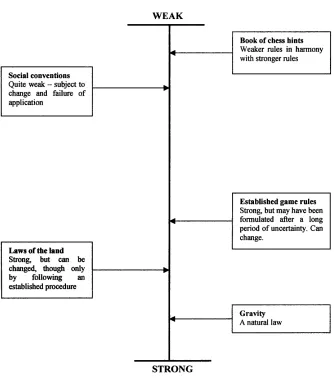
either. The essential reason that they qualified as knowledge is that they were very strongly commonly held beliefs, and thus treated as factual knowledge. McEnery (1996: 30) proposes a hypothetical continuum of weak/strong knowledge as below: Figure 1.2: McEnerv’s Continuum of weak/strong knowledge
WEAK
Gravity A natural law Book of chess hints Weaker rules in harmony with stronger rules Social conventions
Quite weak - subject to change and failure o f application
Laws of the land
Strong, but can be changed, though only an established procedure
following
Established game rules Strong, but may have been formulated after a long period o f uncertainty. Can change.
STRONG
[image:40.497.71.405.141.519.2]stronger modifying effect than fairly. Does this mean then that people’s belief of the strength of really exceeds that of fairly ? This interesting question will be examined further during the experiment in chapter 4. For the moment however I want to concentrate on deepening our understanding of uncertain reasoning, particularly in relation to language and linguistic processing.
1.3.2 A Typology of Uncertainty in Language
knowledge). An interlocutor, being both speaker and hearer, can be affected by uncertainty in many ways. For example, a speaker’s awareness of the grammatical or pragmatic ‘rules’1 of language means that they can detect when these ‘rules’ are being infringed or broken in some way. This is the basis of one of the leading figures in pragmatic theory, H.P. Grice, whose Co-operative Principles were based on people’s knowledge about language usage (Grice 1975). Metaknowledge is also one of the basic components of any Artificial Intelligence (AI) system, as the ability of a computer to reason about the way it thinks is the essence of its own intelligence.
There is unquestionably a direct relationship between metacognition and language, particularly cognition involving subjective beliefs. In order to express a belief, e.g. “he’s a nice guy”, it is first necessary to hold a metabelief about this belief, i.e. ‘I believe that he’s a nice guy’. Moreover, according to Langford (1994: 20), this relationship is not compromised where the speaker is mistaken or insincere about what is said. This is extremely important for the pragmatic use of language. Language can be used to disguise intentions and to mislead in the same way that it can be used to convey clear and unambiguous meanings. If a speaker mistakenly but sincerely expresses a belief, then the fact that the belief is mistaken does not alter the fact that the speaker still genuinely holds that belief. Conversely, a speaker who insincerely expresses a belief does so knowing that he/she does not actually hold this belief. The same principles can be applied to people’s beliefs about other people, and about the way that the pragmatic use of language can alter other people’s perception of them. While many beliefs are not expressed through language (as they often need to be disguised), beliefs or perceptions about other people’s beliefs are significant in
shaping the motivation and linguistic choices of interlocutors. As Maslow, A. (in Lowry (Ed.) 1979) points out:
“Behaviour in the human being is sometimes a defence, a way o f concealing
motives and thoughts, as language can be a way o f hiding your thoughts and
preventing communication”.
Metacognitive and metalinguistic beliefs therefore are by no means purely internalised functions, as they both relate to the perception of other people, and in particular to people’s conceptions of communicative strategies. A classic example of the overlap of metacognitive and metalinguistic knowledge can be seen in the way people utilise their beliefs about the recursive nature of language. One of the fundamental principles in pragmatic theory is that the communication and interpretation of meanings depends on interlocutors’ recognition of each other’s intentions, i.e.:
“The speaker’s intention in the making o f an utterance to produce an effect
in the hearer by means o f the hearer’s recognition o f the intention to produce
that effect” (Verschueren 1999:47).
“Oral communication, for instance, is a modification by the speaker o f the
hearer’s acoustic environment, as a result o f which the hearer entertains
thoughts similar to the speaker’s own” (Sperber and Wilson 1986: 1).
Relevance theory depends on metacognitive and metalinguistic awareness, particularly in the interpretation of utterances. Interlocutors’ knowledge about both knowledge and language means that they can understand what is being said in its given context, and therefore they can resolve and utilise the linguistic and contextual elements that are relevant to the speech event.
An interlocutor’s knowledge about the uncertain nature of language can also play a significant role in the pragmatic use of language. Ordinarily people may elect to make linguistic choices that minimise the amount of uncertainty in their utterances; alternatively they may choose to deliberately employ linguistic strategies to increase uncertainty. However, in order to appreciate how uncertainty functions in language usage it is useful to firstly gain an understanding of what uncertainty actually is, and the forms in which it may present itself.
Relevance theory has attracted strong interest among researchers and academics because of the way it captures important aspects of cognition and communication within its two main principles. The first principle (known as the Cognitive Principle of Relevance) proposes that people constantly understand their environment by:
“paying attention to the newly accessible information that seems most
relevant to them, and.... having thoughts inferentially derived by combining
this information with the most relevant contextual information available”
(Sperber & Wilson 1997: 3).
“Every act o f ostensive communication communicates the presumption o f its
own optimal relevance” (Sperber and Wilson 1986: 158).
However, there are elements in social communication that rely heavily on non- ostensive communicative methods. Furthermore, relevance as a notion is somewhat intangible, as it combines general notions of what is relevant in given situations (such as schematic beliefs) as well as more specific situational-dependant perceptions of relevance. It would be very unreasonable to suggest that people work on the basis of identical beliefs or perceptions, or that their knowledge about situations or other people is complete. Relevance theory provides a convenient explanation of how certain communicative goals are achieved but places less (and arguably too little) emphasis on communicative failure or the management of difficulties (such as uncertainty) in communication. I have explored Relevance Theory in more detail in section 2.2.3 below.
1.3.2.1 Linguistic Uncertainty
(aroma of cooking) or taste (good food). In this sense ‘pretty’ can be thought of as being part of the possible range of meanings of ‘beautiful’, but not vice versa.
Uncertainty is also an inherent part of nouns. Some nouns are used to label categories that are very broad, and the noun therefore can be very imprecise. For example, the nouns ‘vehicle’ and ‘precipitation’ can be used to encompass many different sub-types of vehicles (cars, buses, motorbikes) and precipitation (rain, sleet, drizzle, hail, snow). As with adjectives, some nouns have different potential meanings. Although it was many years ago, I distinctly remember my mother telling me to put some clothes into the ‘bin’. I was very young at the time and I proceeded to empty the clothes into the dustbin instead of the clothes bin. My inability to distinguish between the different potential meanings of this noun was not at all appreciated by my mother.
Verbs can also contain uncertainties. For example, what is the exact difference between the verbs ‘to agree’ and ‘to concur’? Furthermore, the verb ‘to concur’ can also mean to occur simultaneously, to combine, to co-operate or to coincide. Even some of these alternative meanings are uncertain in that while they have different syntactic forms, they have extremely similar meanings (e.g. to occur simultaneously and to coincide). Verbs such as ‘to like’ suffer the same uncertainty as adjectives such as ‘nice’ in that they are very vague and imprecise; to like something expresses approval but fails to quantify it effectively, hence the potential value of degree modifiers such as really.
linguistic device that can be used to reduce uncertainty is itself uncertain, although this adds to the intrigue in exploring the relationship between uncertainty and the use of degree modifiers such as quantifiers and intensifies. In this regard it is important to have an appreciation of the various classifications of degree modifiers and the way they can be used to influence other linguistic forms. This is particularly true as there are also issues such as grammatical constraints and collocations that need to be borne in mind when evaluating the role of degree modifiers. I have explored these issues in greater detail in section 3.2 below.
Other syntactic categories such as pronouns can create uncertainties because they rely on clarity of reference to function effectively. Take the following example:
“John likes Paul because he shares his interests”.
The confusion in this case over who exactly is being referred to in the first pronoun (he) and the possessive pronoun (his) is not critical because the meaning of the sentence is the same whatever pronoun reference is used. However, the frequent use of large numbers of uncertain references such as pronouns and deictics are often more problematic that the simple example above. The uncertainty of these and other syntactic categories is also moderated by the ways in which they are used in everyday language. The way in which language is used can itself create another class of uncertainty, i.e. pragmatic uncertainty.
1.3.2.2 Pragmatic Uncertainty
Example 1: This coffee is wonderful. Example 2: Is the window open?
Example 1 contains linguistic uncertainty because the adjective ‘wonderful’ is vague (it lacks clarity of definition and differentiation between other adjectives such as ‘brilliant’), and it is also fuzzy (it lacks clear boundaries that define its upper and lower limits). It is however reasonably precise because its polarity is clear (i.e. it is a positive description) and it is towards the upper end of a possible scale of positive adjectives (good, great, brilliant, wonderful). Despite these areas of linguistic uncertainty, example 1 lacks pragmatic uncertainty in that the language is used in a straightforward, unambiguous way and it is obviously a positive comment about the coffee (excluding a possible scenario where intonation might indicate sarcasm).
Example 2 does not contain similar linguistic uncertainty. The only possible linguistic uncertainty is in the definite article ‘the’ (we assume that there is only one window, or that there is more than one but that the interlocutors understand which window is being referred to). The adjective ‘open’ has a direct binary opposite, i.e. ‘closed’ and while there are other possible options (e.g. ajar, half-open), any possible uncertainty is minimal. Despite this lack of linguistic uncertainty, example 2 is clearly uncertain in that the intended meaning of the speaker is unclear. A hearer might infer a number of different intended meanings, such as:
1. Is the window open? (i.e. the question was intended to be literally true). 2. Don’t you think it’s too hot/cold/draughty/noisy in here? (requesting an
opinion).
3. Can you open/close the window? (requesting or ordering an action). 4. You always leave the bloody window open/closed! (criticism).