http://dx.doi.org/10.4236/wjm.2014.42007
Methodology for Comparing Coupling Algorithms for
Fluid-Structure Interaction Problems
Jason P. Sheldon*, Scott T. Miller, Jonathan S. Pitt
Applied Research Laboratory, The Pennsylvania State University, State College, USA Email: *[email protected], [email protected], [email protected]
Received November 23,2013; revised December 18, 2013; accepted January 17, 2014
Copyright © 2014 Jason P. Sheldon et al. This is an open access article distributed under the Creative Commons Attribution License, which permits unrestricted use, distribution, and reproduction in any medium, provided the original work is properly cited. In accor- dance of the Creative Commons Attribution License all Copyrights © 2014 are reserved for SCIRP and the owner of the intellectual property Jason P. Sheldon et al. All Copyright © 2014 are guarded by law and by SCIRP as a guardian.
ABSTRACT
The multi-physics simulation of coupled fluid-structure interaction problems, with disjoint fluid and solid do- mains, requires one to choose a method for enforcing the fluid-structure coupling at the interface between solid and fluid. While it is common knowledge that the choice of coupling technique can be very problem dependent, there exists no satisfactory coupling comparison methodology that allows for conclusions to be drawn with re-spect to the comparison of computational cost and solution accuracy for a given scenario. In this work, we de- velop a computational framework where all aspects of the computation can be held constant, save for the method in which the coupled nature of the fluid-structure equations is enforced. To enable a fair comparison of coupling methods, all simulations presented in this work are implemented within a single numerical framework within the deal.ii [1] finite element library. We have chosen the two-dimensional benchmark test problem of Turek and Hron [2] as an example to examine the relative accuracy of the coupling methods studied; however, the compar- ison technique is equally applicable to more complex problems. We show that for the specific case considered herein the monolithic approach outperforms partitioned and quasi-direct methods; however, this result is prob- lem dependent and we discuss computational and modeling aspects which may affect other comparison studies.
KEYWORDS
Fluid-Structure Interaction; FSI; Finite Element Method; Monolithic Coupling; Partitioned Coupling; Dirichlet-Neumann Coupling; Multi-Physics
1. Introduction
In this work, we focus on constructing a numerical framework in which algorithms for solving the class of engineering problems commonly referred to as Fluid- Structure Interaction (FSI) problems can be benchmarked and compared in a consistent and quantitative manner. The primary challenge in finding a numerical solution to a FSI problem is not in solving the field equations over either the solid of fluid components of the domain, but rather handling the compatibility conditions that must be enforced on the interface between these components.1 Recently, two primary strategies for enforcing this coupl-
ing in the Arbitrary Lagrangian-Eulerian (ALE) frame- work have emerged: solving the solid and fluid compo- nents of the domain separately, while iteratively passing information between them, and a simultaneous solution of all field equations at once. The former method is re-ferred to in this work as “partitioned”, and the latter as “monolithic”.
The choice of coupling strategy is an important deci- sion to make from the start of any endeavor to implement a numerical ALE framework for the simulation of fluid- structure interaction, as it places inherent constraints on the entire effort moving forward. On one hand, an author must be sure to choose an approach that allows for all of the relevant physics to be captured, but must also con- sider the performance of the resulting computer code, the ease of implementation, and its ability to address prob- lems of interest. If one turns to the work of other authors *
Corresponding author.
for guidance, conflicting statements can be found re- garding the performance of various coupling approaches. In addition to this, there is seemingly conventional wis- dom in the community today that partitioned approaches are faster than their monolithic counterparts due to the optimized nature of the individual component solvers and smaller systems inverted by the linear solvers [4-7]; however, these notions have been challenged in [8]. There is agreement within the FSI community that, in general, the choice of coupling type is problem depen- dent, although no specific guidance exists on exactly when a coupling strategy should be preferred.
Michler et al. [9] state that in a simple one dimension-al FSI problem “the computationdimension-al cost of the monolithic procedure is three to four times the one of the partitioned procedure;” however, he does not hold each approach to the same convergence tolerance. In fact, he requires more strict convergence of the monolithic solver, which con- tributes to its longer run time. In contrast, he later hypo- thesizes that for more complex problems the monolithic approach would be superior in a comparison of computa- tional cost for a desired accuracy against his partitioned method.
Degroote et al. [6] utilize ADINA [10], a commercial finite element software package, to compare partitioned and monolithic FSI. They claim that ADINA converges both methods to the same tolerances, for the norms of displacement and force on the interface; however, it is unclear exactly what convergence criterion is used as no equations or methods are presented. They find that for certain cases their partitioned method requires half the computational time of their monolithic method, while for other cases it requires as much as four times the compu- tational time of the monolithic method, and in some cas- es, the partitioned method does not converge at all.
On the other hand, Heil et al. [8] use the open source finite element library OOMPH-LIB [11] to compare par- titioned and monolithic methods. In their tests, they found that, in terms of computation time required, mono- lithic methods outperform partitioned methods when FSI effects were significant and that this behavior was ampli- fied with proper pre-conditioners. Again, it is unclear exactly what parameters they use to signify convergence. They claim that the convergence criterion is either the maximum global residual, or the maximum change in position of nodes between iterations; however, in all of their cases they do not require the partitioned method to converge to the same tolerances as the monolithic me- thod.
As can be seen by these examples, although there has been past work in comparing coupling techniques, there is no clear agreement on which method is optimal for a given problem. To aid in providing clarity to this situa- tion, we have developed an ALE-based framework that
can hold constant many of the confounding factors and can focus solely on the fluid-structure coupling metho- dology. This includes performing all calculations on the same mesh, using the same discretization scheme for all approaches, and using the same benchmark problem for all approaches. Most importantly, we use the same con- vergence criterion and linear solvers for all coupling me- thods, ensuring that we are eliminating as many con- founding factors as possible. We believe that this type of framework is necessary in order to provide a fair com- parison between FSI coupling types, and has clearly been lacking in prior work.
We note that we are interested in algorithms appropri- ate for fully-coupled FSI problems, i.e., where the struc- tural and fluid responses are tightly intertwined and re- quire a truly simultaneous solution. Problems requiring only one-way or weak coupling are outside the scope of this study. We begin this presentation by deriving the governing equations necessary for FSI in Sections 2 - 3. The discretization procedure is presented in Section 4, the three coupling strategies we are comparing are dis- cussed in Section 5, and formal verification of the im- plemented algorithm is demonstrated in Section 6. Final- ly, results of the study and our conclusions are discussed in Sections 7 - 8.
2. Kinematics
Fluid-structure interactions are modeled as initial boun- dary value problems (IBVPs). This section presents an overview of the mathematical background necessary to describe these problems. This material is presented from a continuum mechanics perspective, see Gurtin [12], Bowen [13], Chadwick [14], or Spencer [15] for a more detailed discussion.
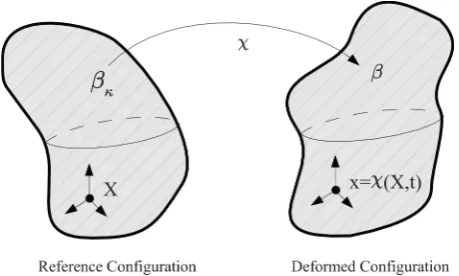
Kinematics is the geometrical description of motion. It provides descriptions for the movement of bodies (a collection of material points) and changes of reference frames. We denote a body β ∈3 in the reference configuration κ3 as βκ , where the reference confi- guration is chosen to be the configuration of the body initially before deformation. The same body β can be defined in subsequent configurations through a defor- mation function χ. The position of a material point in
κ is X X
(
,t)
, while the position of a material point in the deformed configuration, known as the spatial point, isx. The deformation function χ
(
X,t)
maps a material point X to the spatial point x at the instant of timet, as shown in Figure 1.
Considering a smooth sequence of configurations or- dered in time, a motion is defined as
(
,t)
(
,t)
,Figure 1. Configurations of a body before and after defor- mation.
(
,t)
.= −
[image:3.595.59.289.86.224.2]u x X X (2) The domain Ω of an FSI problem, as shown in
Figure 2, is defined as the union of the disjoint solid and fluid subdomains:
S F
Ω = Ω Ω ,
where ΩS is the solid subdomain and ΩF is the fluid
subdomain. Similarly, the domains’s boundary ∂Ω is split into four parts: the Dirichlet boundaries for the fluid and solid subdomain ΓDF and ΓDS and the Neumann boundaries for the fluid and solid subdomain ΓNF and
S
N
Γ , where ∂Ω = ΓDSΓDF ΓNS ΓNF. These boun-
daries can be subdivided further to suit a given problem. The interface between the solid and fluid subdomains is
FS S F
Γ = Ω Ω .
Furthermore, we find it useful to think of this boundary as Γ = ΓFS FSDΓFSN, denoting the Dirichlet
and Neumann parts with the subscripts. The usefulness of this arises when defining proper finite-dimensional function spaces and setting boundary conditions for our discrete problems.
The displacement vector is piecewise defined over the solid and fluid subregions as
s S
m F
, ∀ ∈ Ω
= ∀ ∈ Ω
u X u
u X (3)
where us is the solid displacement and um is the
(arbitrary) displacement of the fluid subdomain. Continuity of displacement on the fluid-solid interface requires
s− m = ∀ ∈ΓFS.
u u 0 X (4) The deformation gradient is the spatial gradient of the motion, defined as
(
,t)
=Gradχ= +Grad ,F X I u (5)
where I is the identity tensor. In the next section, we will use F for push-forward and pull-back operations in the Arbitrary-Lagrangian-Eulerian (ALE) description
Figure 2. Domain Ω of an arbitrary two-dimensional
fluid-structure interaction problem. The solid and fluid subdo-mains, Dirichlet and Neumann boundaries, and the fluidso-lid interface are labeled.
of the fluid region. Operators with capitalized first letters (e.g. Grad) denote differential operators with respect to
X, while those with lower-case first letters (e.g. grad) denote differential operators with respect to x. The determinant of F is
( )
det .
J= F (6)
3. Governing Equations
Governing equations are generated by complementing balance laws with constitutive relations for specific ma- terials and kinematic relations. We consider solid mate- rials that are modeled as St. Venant-Kirchhoff hyperelas- tic isotropic solids. Fluids considered are all incompress- ible and linearly viscous (Newtonian). We choose to use the ALE description for the fluid to address the disparity on the fluid-solid interface between the reference frames naturally used for the fluid (Eulerian) and solid (Lagran- gian). Other approaches, such as space-time techniques [16,17], or immersed boundary/body methods [18,19], could also have been implemented, but we chose to use the ALE description for the purposes of our study. The ALE fluid deformation is described with the equations of linearized elasticity.
3.1. Elasticity
The governing differential equations for an elastic solid are cast in the Lagrangian (referential) frame. The bal- ance of linear momentum is
s
s Div R s s S,
t
ρ ∂ − =ρ ∀ ∈Ω
∂
v
T b X (7)
where vs is the solid's velocity field, ρs=ρs
( )
X isthe referential mass density, bs =b Xs
(
,t)
is the bodyforce per unit mass, and TR
(
X,t)
is the first Piola-Kirchhoff stress. The first Piola-Kirchhoff stress is related to the second Piola-Kirchhoff stress S X
(
,t)
viaR = .
( )
str 2 s ,
λ µ
= +
S E I E (9) where λ and µ are Lamé’s first and second parame- ters and the strain tensor E X
(
,t)
=1 2(
F FT −I)
. Lamé’s parameters relate to Poisson’s ratio ν and Young’s modulus E as ν λ=(
2(
λ µ+)
)
and(
3 2) (
)
E=µ λ+ µ λ µ+ . The strain tensor expressed as a function of displacement is
(
) (
)
(
T T)
s s s s
1 Grad Grad Grad Grad .
2
= + +
E u u u u (10)
The separate displacement and velocity fields necessi- tate the use of the kinematic compatibility condition
s
s S.
t
∂ − = ∀ ∈Ω
∂
u
v 0 X (11) Strong enforcement of (11) yields the familiar governing differential equation for elastic solids solely in terms of us:
2 s
s 2 Div R s s S.
t
ρ ∂ − =ρ ∀ ∈Ω
∂
u
T b X (12)
In this work, (7) and (11) are referred to as the two- field
(
u vs, s)
formulation of elastodynamics, while (12)is referred to as the one-field
( )
us formulation ofelastodynamics. We choose to use the two-field formu- lation in our FSI formulation, as it is very convenient to have the velocity as a primitive variable on the fluid- solid interface (see Section 3.4).
3.2. Incompressible Navier-Stokes
The Eulerian frame is the natural setting for the mathe- matical description of fluid behavior. In the context of FSI descriptions, however, we need to unify the mathe- matical description of the fluid and solid domains (on the interface, at least). The ALE description of fluid behavior utilizes a smooth map between the referential and spatial domains. We begin by providing the incompressible Navier-Stokes equations in the Eulerian frame, and then transform those equations into the ALE description.
3.2.1. Eulerian Description
The balance of linear momentum in the Eulerian frame is
( )
f F
div div t ,
t
ρ∂ + ⊗ = +ρ ∀ ∈Ω ∂
v
v v T b x (13)
where ΩF
( )
t is the current deformed fluid domain, ρis the mass density, and T is the Cauchy stress tensor. We denote the velocity field in the fluid domain as
f
=
v v . Mass balance for an incompressible flow reduces to the divergence free velocity condition
( )
Fdivv=0 ∀ ∈Ωx t . (14) The Cauchy stress for a linearly viscous, incompre- ssible fluid, is given as
(
)
(
T)
grad grad , p µ
= − + +
T I v v (15)
where p is the fluid pressure and µ is the fluid dynamic viscosity. Equations (13), (14), and (15) are collectively known as the Navier-Stokes equations for an incompressible flow.
3.2.2. Arbitrary Lagrangian-Eulerian Description
The ALE formulation is used to provide a unified refer- ence frame for fluid-structure interaction problems. This requires transforming the fluid governing differential Equations (13), (14), and (15), into a form defined on the reference configuration ΩF
( )
0 . The resulting equa- tions are termed the ‘incompressible Navier-Stokes equa- tions in ALE form.’The following relations are necessary to construct the transformation:
1
gradv=Gradv Fκ −, (16) and
(
1)
[ ]
m
Grad ,
t t κ
κ − ∂
∂ = −
∂ ∂
v v
v F v (17)
where vm is the fluid domain velocity, defined as
m= ∂ ∂χ t
v . The κ subscript is used to denote quan- tities transformed from spatial coordinates into the ALE reference frame. Using these relations, the ALE form of the incompressible Navier-Stokes equations2 are
(
)
[
]
(
)
( )
1
m
T
F
Grad
Div 0 ,
t κ
κ κ
κ κ
ρ ρ
ρ
− −
∂ + −
∂
+ = ∀ ∈Ω
v
v F v v
T F b X
(18)
( )
1 T
F
: Grad κ 0 0 ,
− = ∀ ∈Ω
F v X (19)
and
(
)
(
1 T T)
Grad Grad .
p
κ = − κ +µκ κ − + − κ
T I v F F v (20)
3.3. Mesh Motion
The computational mesh is a non-physical object which can be constructed in any manner we see as beneficial; this is the “arbitrary” component of the ALE formulation. We choose to treat the mesh as a linearly elastic material governed by an elastostatic equation (derived from the balance of linear momentum (7)):
( )
R F
DivT =0 ∀ ∈ΩX 0 . (21) For linearly elastic (infinitesimal deformation) mate- rials, which require that Gradum 1, the first Piola- 2
Kirchhoff stress, when linearized with respect to Gradum,
is given as
( )
R =λmtr +2µm ,
T e I e (22) where λm and µm are arbitrarily defined mesh
material properties and e is the infinitesimal strain tensor. The infinitesimal strain tensor
(
)
(
T)
m m
1 Grad Grad .
2
= +
e u u (23)
results from linearizing E with respect to Gradum.
3.4. Boundary and Initial Conditions
In addition to the governing differential equations, there are also boundary conditions, fluid-structure interfacial conditions, and initial conditions necessary to fully de- fine a FSI problem. A boundary condition that prescribes a value for a field variable is a Dirichlet boundary condi- tion, while a boundary condition involving spatial deriv- atives of a field variable is a Neumann boundary condi- tion. Initial conditions prescribe a value for a field varia- ble over the entire domain (or a subdomain) at the initial time. Specific boundary and initial conditions are prob- lem dependent, but the general form can be defined.
The primitive variables can be can be prescribed on the Dirichlet boundaries as
(
)
DS
s Γ = s , ,t
u u X (24)
(
)
DS
sΓ = s , ,t
v u X (25)
(
)
DF
, ,t κ Γ = κ
v v X (26) where time differentiation is denoted with a superposed dot as θ= ∂ ∂θ t. The tractions can be prescribed on the Neumann boundaries as
[ ]
( )
NS
s s Γ = s ,t ,
T n t x (27)
[ ]
( )
NF
, .t κ κ Γ = κ
T n t x (28) For the mesh, a constraint is placed on the entire boundary that there be no normal mesh displacement, to maintain a conforming geometry:
(
)
DF NF
m⋅ f Γ Γ =0.
u n (29)
The initial conditions for the primitive variables can be prescribed over their respective domains at t=0 as
(
)
s( )
s ,t=0 = 0 ,
u X u X (30)
(
)
s( )
s ,t= =0 0 ,
v X v X (31)
(
)
( )
f ,t=0 = 0κ .
v X v X (32) FSI coupling imposes three additional conditions on
the fluid-solid interface. The solid displacement governs the mesh displacement on the interface:
(
)
FSD
m− s Γ = ,
u u 0 (33) the velocity fields are continuous across the interface:
(
)
FSD
s ,
κ − Γ =
v v 0 (34) and the tractions are continuous across the interface:
[ ]
[ ]
(
)
(
)
[ ]
FS
FSN N
s s + κ κ Γ = s− κ s Γ = ,
T n T n T T n 0 (35)
where the orientation of the interface requires ns= −nκ.
4. Discretization via Finite Elements
The finite element method (FEM) is used to solve an IBVP by transforming its governing partial differential equations (PDEs) into a system of algebraic equations that approximately solve the original problem. The PDEs are weighted by an arbitrary function, and integrated over their respective domains. Integration by parts yields the weak form of the equations. In this work, the notation is used that
( )
a b, Ω≡∫
Ωa b⋅ Ωd . The ALE form of the fluid equations requires us to compute the spatial integrals over a reference configuration; as such, the following transformation from the Eulerian to the ALE frame is necessary:( )
( )
( )( )
F F0
d d .
t f x fκ J X
Ω = Ω
∫
x∫
X (36)In all future equations Ω ≡ ΩF F
( )
0 for brevity. Asufficiently regular computational mesh is used to discretize the domain Ω, and we ensure that the fluid- structure interface ΓFS is coincident with element edges.
The approximate solutions are denoted by the super- script h. We define the following standard finite-dimen- sional trial solution spaces on our mesh:
( )
{
DS}
1
s : s s S , s s ,
h h h h
H Γ
= u u ∈ Ω u =u
U (37)
( )
{
DS}
2
s : s s S , s s ,
h h h h
L
Γ = v v ∈ Ω v =u
V (38)
( )
{
Df}
1 F
: , ,
h h h h
H
κ = v vκ κ∈ Ω vκ Γ =vκ
V (39)
( )
{
2}
F
: ,
h h h
p p L
κ = κ κ∈ Ω
P (40)
( )
(
)
Df Nf 1
m : m m F , m 0 .
h h h h
H κ
Γ Γ
= ∈ Ω ⋅ =
u u u n
U (41)
Our weighting function spaces are
( )
{
DS}
1
s:= u uˆ ˆs s∈H ΩS ,uˆsΓ =0 ,
U (42)
( )
{
DS}
2
s:= v vˆ ˆs s∈L ΩS ,vˆsΓ =0 ,
( )
{
Df}
1 F
ˆ ˆ ˆ
: H , ,
κ = v vκ κ∈ Ω vκ Γ =0
V (44)
( )
{
2}
F
ˆ ˆ
: p p L ,
κ = κ κ∈ Ω
P (45)
( )
{
Df Nf}
1
m:= u uˆm ˆm∈H ΩF ,uˆmΓ Γ =0 .
U (46)
With these definitions, it is clear that our finite ele- ment method is of the standard (Bubnov-) Galerkin weak formulation, in which weighting function spaces and trial solution spaces are taken to be the same except on the Dirichlet boundaries [22].
The temporal discretization is handled with the impli- cit, second-order accurate Crank-Nicolson method. The choice of time integration, while important for accuracy and efficiency of a method, is not the focus of our current work. We are interested in investigating different strate- gies for solving the fully-coupled FSI system. As such, in the remaining mathematical formulation of the FSI prob- lem, we shall omit the time discretization aspect of the problem for the sake of brevity. The weak formulation of the problem is understood to be integrated over a time step with a suitable approximation of the time deriva- tives.
Weak Formulation
An FSI problem consists of three distinct sub-problems which are coupled through boundary conditions on the fluid-structure interface ΓFS. We introduce the Galerkin
formulation for each sub-problem separately, followed by the statement of the global FSI problem.
Problem 1 (Solid sub-problem) Find
{
u vsh, sh}
∈Ush×Vsh such that(
) (
)
(
)
(
)
(
)
(
(
)
)
(
)
(
)
{
}
S S S S S
S S FSD
FSN NS
s s s s s s s
R s s s s s s
s s s s s s s s
ˆ ˆ ˆ
, , ,
ˆ ˆ ˆ
, Grad , ,
ˆ ˆ ˆ ˆ
, , 0 , .
k k
κ ρ ρ
Ω Ω Ω Ω Ω
Ω Ω Γ
Γ Γ
− +
+ − + −
− − = ∀ ∈ ×
u u v u v v
T v b v v v v
t v t v u v
U V
(47)
where S
kΩ is a constant over the solid domain with dimensions of mass per length cubed per time cubed to give our equations dimensional consistency. For the solids considered in this work, the first Piola-Kirchhoff stress
R
T uses the St. Venant-Kirchhoff strain tensor given in (10). Problem 2 (Fluid sub-problem)
Find
{
h, h}
h hp
κ κ ∈ κ × κ
v V P such that
(
)
[ ]
(
)
(
)
(
)
[ ]
(
)
(
)
(
) (
)
(
)
(
)
(
(
)
)
{
}
F F F F F FSNF N FSD
1 m
1
T 1 T
s
ˆ
Grad ,
ˆ ˆ
Grad , ,
ˆ ˆ
, Grad : Grad ,
ˆ ˆ ˆ
, , ,
ˆ ˆ
0 ,
J
J
J J p
p
κ κ κ κ
κ κ κ κ κ κ
κ κ κ κ
κ κ κ κ κ κ
κ κ κ κ
ρ ρ ρ − Ω − Ω Ω − − Ω Ω Γ Γ Γ − + − + + − − + − = ∀ ∈ ×
v v F v v
v F v v b v
T F v F v
t v t v v v v v
V P
(48)
where F and J are as given in (5) and (6), and, for the linearly viscous, incompressible fluids considered in this work, the Cauchy stress Tκ is as given in (20).
Problem 3 (Mesh sub-problem) Find m m
h∈ h
u U such that
(
)
(
(
)
)
(
)
(
)
F FSDm m m m s m
F
T
m m m m
m m
ˆ ˆ
Div , Div ,
ˆ Grad Grad , Grad
ˆ 0 . λ µ Ω Γ Ω + − + + = ∀ ∈
u u u u u
u u u
u U
(49)
Solving (49) using spatially constant material proper- ties λm and µm can can result in poor quality meshes
if the solid displacement is large enough3. To prevent this, an artificial stiffness is imposed on the mesh, using
( )
m m
λ =λ X and µm=µm
( )
X , in a manner such thatit is stiffer near the interface and less stiff away from the interface. This propagates the distortion caused by the solid displacement throughout the entire mesh, instead of it being localized at the interface.
The global FSI problem is a direct sum of Problems 1, 2, and 3.
Problem 4 (Global FSI problem)
F i n d
{
sh, sh, h, h, mh}
sh sh h h mhp
κ κ ∈ × × κ × κ ×
u v v u U V V P U
such that (47), (48), and (49) are simultaneously satis- fied.
The individual sub-problems are coupled solely via the boundary conditions on the FSI interface ΓFS. The glo-
bally defined system in Problem 4 is a fully coupled non- linear system of equations. We have employed the New- ton-Raphson method to solve these equations, including all non-linear sub-problems that arise. We present some of the details in Appendix 9 since the calculations can be daunting, especially for the monolithic method.
5. FSI Algorithms
The numerical solution of Problem 4 is the focus of our study. We examine three different types of solution pro- cedures: partitioned, monolithic, and quasi-direct. These are often referred to as FSI coupling methods, although they can also be thought of as a family of algebraic solution methods to solve the fully coupled Problem 4.
One of the key features of our study is that all three solution algorithms are implemented within the same software package (deal.ii). This feature allows us to use the same finite element assembly routines for all FSI coupling types, ensuring that computational cost differ- ences between the methods studied is not due to different implementations. Furthermore, the convergence criterion chosen are applied in exactly the same manner for each FSI algorithm, as described in Section 7.2.
The global solution procedure of the three coupling types is the same. After a setup procedure and applica- tion of initial conditions, a time loop advances the solu- tion with a prescribed time step size until the final simu- lation time is reached. For each time step, the three FSI coupling algorithms solve Problem 4 in different man- ners. We refer to the non-linear solution procedure within a single time step as FSI iterations.
5.1. Partitioned Coupling
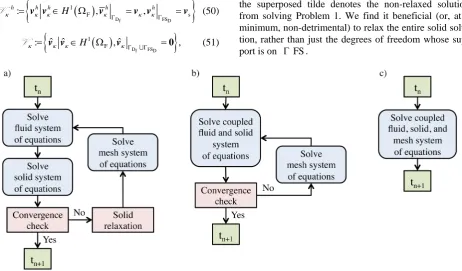
The partitioned coupling method couples Problems 1, 2, and 3 in a sequential fashion to solve the global FSI problem. This coupling method is also referred to as Di- richlet-Neumann coupling, due to the way constraints are imposed on the FSI interface. There are other types of partitioned coupling, but we choose Dirchilet-Neumann coupling as it is by far the most common type used in practice: used by Turek et al. [2], Degroote et al. [6], Küttler et al. [23], and Campbell et al. [24], amongst many others. The FSI iterations for the partitioned me- thod involve solving the fluid, solving the solid, and solving the mesh; this process is iterated until conver- gence is attained. The partitioned algorithm is detailed in
Figure 3(a).
We solve (48) with prescribed velocities on ΓFSD. As
such, we enforce Dirichlet conditions on D
FS
Γ and define
N FS
Γ = ∅. The corresponding change to our finite dimensional vector spaces requires us to replace (39) and (44) with
( )
{
Df FSD}
1
F s
: , ,
h h h h h
H
κ = v vκ κ∈ Ω vκ Γ =v vκ κ Γ =v
V (50)
( )
{
Df FSD}
1F
ˆ ˆ ˆ
: H , ,
κ = v vκ κ∈ Ω vκ Γ Γ =0
V (51)
respectively. The strong enforcement of the velocity coupling is achieved in our implementation through the use of deal.ii’s constraint tools [1]. Newton-Raphson iterations are used to solve the non-linear fluid sub- problem.
Once a fluid solution is obtained, Problem 1 is solved over the solid domain using the fluid traction as the driving force on the FSI interface. That is, ΓFSD = ∅
and the applied traction on ΓFSN is computed as
[ ]
(
)
(
)
s
1 T T T
f
= p Grad Grad J ,
κ κ κ
κ µκ κ − − κ −
= − = −
− +
t t T n
I v F F v F n
(52) which comes from (35) and (20). The function space definitions on ΩS do not need modification for the
partitioned method. Due to the geometric non-linearities in Problem 1, a Newton-Raphson method is used to solve for the solid displacements and velocities.
If the change in position of ΓFS is non-trivial (see Section 7.2 for discussion of this criterion), we deem it necessary to update the mesh position by solving Prob- lem 3. Before solving for the mesh displacement, it is well known [23] that the interfacial displacements should be under-relaxed to ensure convergence. The solid dis- placements and velocities are relaxed as
(
)
s, 1 s, 1 s, 1 s, ,
h h h h
i+ = i +ωi+ i+ − i
u u u u (53)
(
)
s, 1 s, 1 s, 1 s, ,
h h h h
i+ = i+ωi+ i+ − i
[image:7.595.68.531.449.720.2]v v v v (54) where the subscript i denotes the iteration count and the superposed tilde denotes the non-relaxed solution from solving Problem 1. We find it beneficial (or, at a minimum, non-detrimental) to relax the entire solid solu- tion, rather than just the degrees of freedom whose sup- port is on Γ FS.
The scalar relaxation parameter ωi+1 can be chosen
to be constant, but it has been shown [23] that allowing it to change between iterations can accelerate convergence. Aitken’s δ2 convergence acceleration method seems to be the most popular algorithm for choosing ω, and we have used it in this work. The position of the fluid-solid interface is viewed as a set of fixed points for the partitioned FSI iterations, and the secant method is used to extrapolate the expected position of the interface. The result is the recursive formula for computing the relaxa- tion factor
(
1)
1 2 1 , 1 ,
1
, ,
i i i
i i i s i s i
i i
ω ω +
+ + +
+
⋅ −
= − = −
−
r r r
r d d r r
(55)
and the discrete vector ds consists of the nodal values
from FS
s
h
Γ
u . The Euclidean inner product and norm are used for the discrete vector. For the first FSI iteration of each timestep a relaxation factor of 0.75 is used.
Once the solid solution has been relaxed, we update the mesh displacements by solving Problem 3. The function space definitions (41) and (46) are augmented as
( )
(
)
{
Df Nf FS FS}
1
m : m m F , m 0, m s ,
h h h h h h
H κ Γ Γ
Γ Γ
= u u ∈ Ω u ⋅n = u =u
U (56)
( )
{
Df Nf FS}
1m:= u uˆm ˆm∈H ΩF ,uˆmΓ Γ Γ =0 ,
U (57)
respectively, to account for enforcing a Dirichlet condi- tion on the fluid-structure interface. Unlike the fluid and solid sub-problems, the mesh motion is governed by a linear system of equations and only requires a single algebraic solve.
5.2. Quasi-Direct Coupling
The second algorithm of our study for quasi-direct coupling, as first performed by Tezduyar [25], is detailed
in Figure 3(b). The algorithm solves Problems 1 and 2 monolithically, and an iterative procedure is used to couple with Problem 3 to fully solve the complete FSI Problem 4. For each time step, we solve the coupled flu- id-solid system, update the mesh displacements, and ite- rate on these two solves until convergence is reached. The quasi-direct algorithm does not use the Dirichlet- Neumann coupling scheme that the partitioned method uses. Rather, we construct a conforming velocity field over the entire reference domain Ω as
( )
{
D S F}
1
s
: , , , ,
h h h h h h h h
H Γ Ω Ω κ
= v v ∈ Ω v =v v =v v =v
V (58)
( )
{
D S F}
1
s
ˆ ˆ ˆ ˆ ˆ ˆ ˆ
:= v v∈H Ω ,vΓ =0,vΩ =v v, Ω =vκ .
V (59)
The consequence of this choice is that (34) is strongly satisfied, which implies that
(
)
(
)
(
)
FS
FSN N FSN
s,ˆs Γ κ,ˆκ Γ R,ˆκ ˆs Γ 0,
− t v − t v = t v −v = (60)
after enforcing (35) and recognizing that the velocity weighting functions are chosen from the same function space. Another way to recognize that the tractions on
FS
Γ do not contribute to the weak form is that ΓFSD = ΓFS
and N FS
Γ = ∅ by construction of a conforming (conti- nuous) velocity space. Therefore, the traction continuity is implicitly satisfied and does not enter the quasi-direct (or monolithic) equations [26].
The solution from the fluid-solid does not need to be relaxed as it was for the partitioned algorithm. The relax- ation procedure is only used for iterative Dirichlet- Neumann coupling schemes for stability. Our only re- quirements on the mesh motion are the same as for the partitioned case. Namely, m
h
u is computed using the function spaces given in (56) and (57).
5.3. Monolithic Coupling
The full monolithically coupled solution procedure is the third algorithm of our study and is detailed in Figure 3(c). Problem 4 is solved as a single non-linear system, with no FSI iterations necessary. We use the conforming velocity space given in (58) and (59) to strongly couple the fluid and solid domains.
The displacement fields s
h
u and m
h
We have used a simple and efficient method to strongly enforce (33) while avoiding the artificial stiff- ness phenomena. We solve Problem 4 using function spaces defined by (37), (40), (41), (42), (45), (46), (58), (59). The Newton-Raphson method is used to compute the solution, and we provide details of the linearization in the Appendix. Within each Newton-Raphson iteration, we weakly enforce the displacement continuity constraint within Problem 3. At the end of the iteration, the nodal mesh displacements on the interface are set to be equal to the solid displacement. In our numerical computations, we have found that weakly enforcing continuity yields mesh values that are relatively close to those computed for the solid. Also, modifying the mesh solution at the end of each Newton-Raphson iteration does not seem to affect the convergence characteristics of the method.
6. Code Verification
Verification of the discretized equations of motion, and the software in which it is implemented, is performed via the method of manufactured solutions (see, e.g., [27,28]). We perform the following sequence of analysis for the solid and fluid solvers separately: 1) choose an exact solution for the governing equations, 2) substitute this solution in the equations to obtain analytical expressions for the corresponding forcing functions and boundary conditions, 3) implement these into the code, and 4) compute an approximate solution. The error between the exact and approximate solutions is then computed according to some norm, and the process is repeated for a sequence of uniformly refined meshes.
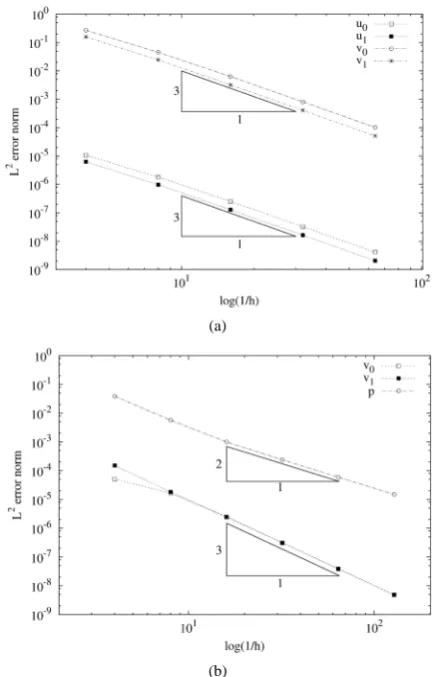
Figure 4 shows the results of this process for several iterations of mesh refinement. The Figure 4(a) shows the individual components of the elastic displacement and velocity error declining as mesh size decreases, with a linear rate of p+ =1 3 under the L2 norm when using bi-quadratic 2
Q tensor-product elements for all fields. The Figure 4(b) shows the analogous situation for the velocity and pressure fields in the fluid solver, where the difference in convergence rate is due to the Taylor-Hood
2
Q − Q1 tensor product elements used for the velocity and pressure, respectively.
Overall, this simple verification exercise demonstrates that the individual components of the FSI solver are functioning correctly. We will evaluate the correctness of the coupling implementation in the next section; more details regarding verification of the solvers can be found in Sheldon [29].
7. Model Validation
An FSI benchmark was proposed by Turek and Hron [2] for the purpose of facilitating comparison between dif- ferent FSI modeling approaches and algorithms, regard- less of coupling types or discretization schemes. This
(a)
[image:9.595.314.532.83.422.2](b)
Figure 4. Error convergence plots for the two-field elasticity formulation (a) and Navier-Stokes formulation (b). In each case, the expected rates of error convergence are achieved, with respect to the L2-norm. This demonstrates that each component of the FSI solver is functioning correctly.
benchmark consists of a numerical experiment involving laminar incompressible channel flow around a bluff body, which subsequently sheds vortical structures that excite a flexible tail until it reaches a state-state flow induced oscillation. Data were provided by Turek and Hron for the tip displacement of the elastic structure, hereafter called the flag (see Figure 5), and the drag and lift about the combined boundary of the flag and the cylinder to which the flag is attached. We used this benchmark as a means to validate the FSI model developed in this work, via direct comparison of our model’s predictions to that of Turek and Hron, and as a baseline for comparing the coupling strategies to one another.
7.1. Numerical Experiment Definition
Figure 5. Turek and Hron [2] FSI benchmark domain with expanded view of cylinder and flag.
Table 1. Turek and Hron [2] FSI benchmark domain di-mensions and material properties.
Parameter Symbol Value [m] Property Value
Channel length L 2.5 3
kg m
s
ρ
10,000
Channel height H 0.41 νs 0.4
Cylinder center C (0.2, 0.2) Es [e6 2 kg
ms ] 5.6
Cylinder radius r 0.05 3
kg m
κ
ρ
1000
Flag length l 0.35 kg
ms
κ
µ
1
Flag height h 0.02 m
s
U
1
Reference point A (0.6, 0.2) Reference point B (0.15, 0.2)
[image:10.595.335.538.514.571.2]ducing the “FSI2” case of Turek and Hron, as it involves the largest structural deformations, and is therefore the most intense test for our solver. The material properties for this simulation are also reproduced for the reader in
Table 1, where ρ is the density, ν is the Possion’s ratio, µ is the viscosity, E is the Young’s modulus, and U is the mean inflow velocity. As before, the s
and f subscripts indicate solid and fluid properties, respectively. Figure 6 shows an example of the flow field and solid deformation, using results from FSI2 after 16.5 simulation seconds, to help in visualizing the benchmark.
The boundaries of the computational domain are labeled in Figure 7, which also shows the mesh we used for our calculations. The boundary conditions are as follows: a parabolic fluid velocity inflow on Γ1:
( )
(
(
)
)
1
2
* 1.5 ,
2
0 v
y H y U
y Γ H
−
=
(61)
a no-slip fluid velocity on Γ2, Γ4, and Γ6:
Figure 6. Visualization of the velocity magnitude and flag deformation at t = 16:5 [s]. Solid displacement and fluid velocity are shown with their own color scales. The flag is shown as a wireframe to distinguish it from the fluid and the rigid cylinder.
Figure 7. Turek and Hron [2] FSI benchmark mesh with labeled boundaries and domains.
2,4,6 0, κΓ =
v (62) a constant fluid pressure on Γ3, which is prescribed to
be zero:
3 0,
pκ Γ = (63) a fixed solid displacement and velocity on Γ5:
5 5
sΓ = sΓ =0,
u v (64)
the interface conditions given in (33) and (34) on ΓFS,
and the mesh displacement condition given in (29) on
1
Γ , Γ2, Γ3, Γ4, and Γ6.
All fields are initially zero. For the first two seconds the fluid inlet velocity is subject to a smooth increase defined by
( )
1 11 *
*
1 Cos 2
2.0
, 2 .
2.0 t
t y t
t
κ Γ Γ
Γ
− π
<
=
≥
v v
v
(65)
A timestep size ∆ =t 0.0025 s
[ ]
was used in all cases to satisfy the Courant-Friedrichs-Lewy (CFL) condition [30], computed from a maximum flow velocity and minimum cell diameter of approximately[ ]
max 2.2 m s
v = and ∆xmin =0.011 m
[ ]
, respectively.As in Section 6, all subsequent results in the section were computed with Q2 elements for the solid dis- placement and velocity, Taylor-Hood 2
Q − 1 Q ele- ments for the fluid velocity/pressure, 2
with the sparse direct solver UMFPACK [31].
7.2. Convergence Criterion
The FSI coupling strategies that we have employed in this work all require some sort of sub-iteration at each time step in the simulation process. For the partitioned schemes, we make fixed-point iterations between the solver components to converge the solution, while for the monolithic approaches we use Newton-Raphson itera- tions. Consistency in defining convergence criteria for the global coupled FSI solution, that is applicable to both the partitioned and monolithic approaches, is a key point of this work. If this metric is not chosen consistently, we will not be able to say that the solutions are similarly converged to the same level of error, and therefore be unable to make comparisons regarding the wall clock time.
For the global FSI solution, the convergence criterion [23,32] is given by
( ) ( )
2 FS
2 FS 1
s s
FSI,
1
i i
L L
ε
+
Γ Γ −
<
u u
(66)
where s1
i+
u and s
i
u refer to the solid displacement at the current and previous FSI iteration, whether that iteration is fixed-point (partitioned) or Newton-Raphson (monolithic). Here, 2( )
FS
L Γ
⋅ is the standard L2 norm over the fluid-solid interface, and εFSI is some
convergence tolerance, which we typically defined to be
1E−10, for all coupling methods. For the partitioned
method, we perform this solution check after every instance where the solid displacement is solved, while for the monolithic approaches, we perform this check after each Newton Iteration. In all coupling approaches, once this criterion is satisfied, we exit the sub-iteration loop and move on to the next time step.
7.3. Computations
In Turek and Hron’s FSI2 simulation benchmark, the system starts at rest and the speed of the inflow grows until it levels off to some steady value. After this initial transient period, which is approximately the first twelve seconds of simulation time, the solution reaches a steady state of oscillation. All results over a given periodic interval after this time are interchangeable, and as such we have normalized the comparison time interval on all forthcoming images.
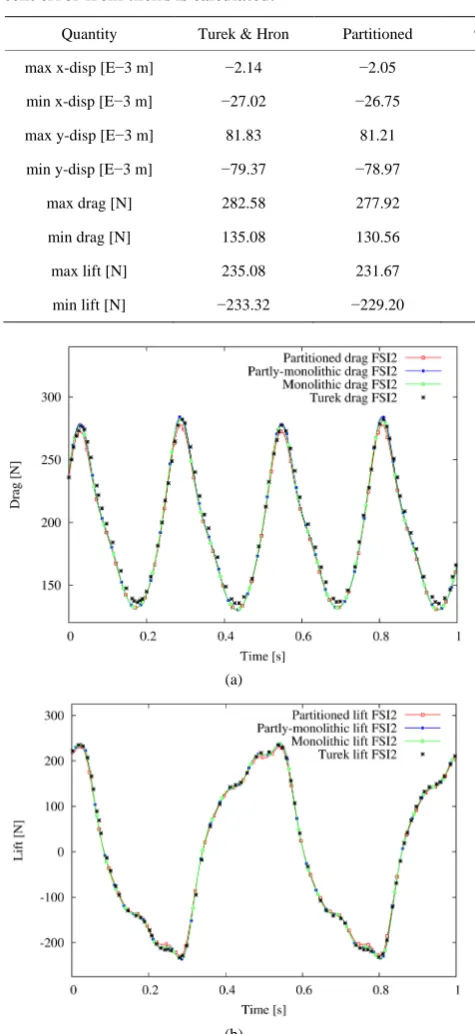
We were able to reproduce the results given by Turek and Hron, for the x- and y-displacement of point A, at the mid-point of the tip of the tail, and the lift and drag gen- erated about the combined surface of the flag and cylind- er. Our calculations are nearly indistinguishable whether
using the partitioned, quasi-direct, or monolithic coupl- ing, as seen in Figures 8 and 9. Table 2 provides nu- merical values for the maximum and minimum of the displacement, drag, and lift from both Turek and Hron’s work and our own, along with the percent error between our solutions and the validation data. The maximum deviation from the validation data for any quantity is 4%, with the three coupling methods each being the most accurate for some quantities and the least for others. Overall, the visual and numerical results demonstrate the coupling methods are all within an acceptable deviation from the validation data, and can be confirmed to func- tioning correctly. Even more so, we have demonstrated that using the same convergence criterion for the global FSI problem has resulted in three solutions that are quite similar to each other.
Finally, Figure 10 plots the wall clock runtime of the three coupling techniques over 20 seconds of simulation time. The noticeable change in slopes at approximately 7 simulation seconds aligns with the time at which the flag
(a)
[image:11.595.309.540.336.686.2](b)
Table 2. Maximum and minimum values for the x- and y-displacements of point A, and the lift and drag generated about the combined surface of the flag and cylinder. The results from Turek and Hron [2] are presented alongside ours, and our per- cent error from theirs is calculated.
Quantity Turek & Hron Partitioned % error Quasi-Direct % error Monolithic % error
max x-disp [E−3 m] −2.14 −2.05 4.00% −2.12 1.05% −2.05 2.23%
min x-disp [E−3 m] −27.02 −26.75 0.99% −27.40 1.41% −27.26 0.89%
max y-disp [E−3 m] 81.83 81.21 0.76% 82.40 0.69% 82.18 0.43%
min y-disp [E−3 m] −79.37 −78.97 0.50% −80.15 0.98% −79.93 0.71%
max drag [N] 282.58 277.92 1.65% 284.58 0.71% 282.71 0.05%
min drag [N] 135.08 130.56 3.35% 130.25 3.58% 130.25 3.58%
max lift [N] 235.08 231.67 1.45% 239.43 1.85% 231.81 1.59%
min lift [N] −233.32 −229.20 1.77% −237.39 1.74% −236.75 1.39%
(a)
(b)
Figure 9. The drag and lift generated about the combined surface of the flag and cylinder. All three of our schemes show larger minimum values than Turek and Hron [2] do when calculating the drag, with otherwise good agreement. Our monolithic and quasi-direct schemes capture the com- plex shape of of Turek and Hron’s lift results [2], while our partitioned scheme matches the global maximum and minimum values but not all local the minimums and max- imums in-between.
Figure 10. Time study for partitioned, quasi-direct, and monolithic coupling over 20 simulation seconds (8000 time-steps). Our partitioned coupling scheme required over twice the amount of CPU time per time step compared to our quasi-direct coupling scheme, which in turn required ap-proximately twice that of our monolithic coupling scheme.
oscillations began to be significant, thus requiring more sub-iterations of the FSI algorithm. As can be seen, for this benchmark case the partitioned scheme requires over twice the amount of CPU time to solve any given time- step compared to the quasi-direct scheme, and the mono- lithic scheme requires even less CPU time than that. Given that we have held each solver to the same conver- gence criterion, and given that all other aspects of the simulation are held constant, we can state that for this problem, the monolithic scheme is certainly more effi- cient.
8. Summary and Conclusions
rithms to be evaluated for accuracy and efficiency in a quantitative manner. By holding constant many of the usually confounding factors, such as the grid, mesh mo- tion, discretization approach, and solver tolerances, we were able to compare three different coupling strategies. These include a Dirichlet-Neumann partitioned coupling method, a monolithic coupling method, and quasi-direct coupling method. Each of these is tightly-coupled and uses the same convergence criterion to define when the global FSI solution is converged during a given time step. All three coupling methods use the same software infra-structure, system of equations assembly code, algebraic solver, and parameters. Other than their inherent differ-ences in methodology, they are identical.
The benchmark proposed by Turek and Hron [2] was used to test the FSI coupling strategies developed in this work. We were able to achieve results which accurately reproduce those provided by Turek and Hron to within four percent at worst, generally within two percent. For this case, our results show that monolithic coupling and quasi-direct coupling are slightly more accurate, with respect to the validation data, than partitioned coupling and slightly better at capturing fine details along the in- terface. We also found that monolithic coupling and qua- si-direct coupling are significantly faster than partitioned coupling when held to tight coupling tolerances. This substantiates Michler’s hypothesis discussed earlier, that monolithic schemes can outperform partitioned schemes when held to the same tolerances [9], at least for the spe- cific problem consider herein.
While this work aims to present a methodology for proper comparison between ALE FSI coupling algo- rithms, we acknowledge that the benchmark example considered is neither exhaustive nor addresses many of the other practical simulation issues. In the weak-coupl- ing limit, we might expect that a partitioned or quasi- direct approach would be more efficient than a mono- lithic approach. Large three-dimensional problems may also change the comparison results: as the number of degrees of freedom grows quickly, the cost of solving a large linear system becomes the main computational cost and scalability needs to be addressed. The choice of li- near algebraic solvers could also greatly sway the study, as extremely efficient methods for solving each subprob- lem exist, but cannot be applied to the monolithic system of equations. The governing equations and the choice of discretization scheme will also undoubtedly affect any sort of computational cost comparisons. Finally, there exist numerous other ALE partitioned coupling methods (e.g. Robin-Robin coupling rather than Dirichlet-Neu- mann) that may be more accurate and efficient than the methods we investigated. These aspects of the ALE FSI solution can be studied within our numerical framework, and we leave them as future research efforts.
Acknsowledgements
J. Sheldon gratefully acknowledges financial support from Naval Sea Systems Command, Advanced Subma- rine Systems Development Office (SEA 073R) with Ms. Diane Segelhorst and Mr. Patrick Tyler as program ma- nagers. S. Miller and J. Pitt acknowledge internal support for this research from the Applied Research La- boratory at The Pennsylvania State University.
REFERENCES
[1] W. Bangerth, T. Heister and G. Kanschat, “Deal. II Dif-ferential Equations Analysis Library,” Technical Refer-ence. http://www.dealii.org
[2] S. Turek and J. Hron, “Proposal for Numerical Ben-chmarking of Fluid-Structure Interaction between an Elastic Object and Laminar Incompressible Flow,” Fluid- Structure Interaction, 2006, pp. 371-385.
[3] T. Wick, “Fluid-Structure Interactions Using Different Mesh Motion Techniques,” Computers & Structures, Vol. 89, No. 13, 2011, pp. 1456-1467.
http://dx.doi.org/10.1016/j.compstruc.2011.02.019 [4] H. G. Matthies and J. Steindorf, “Partitioned but Strongly
Coupled Iteration Schemes for Nonlinear Fluid-Structure Interaction,” Computers & Structures, Vol. 80, No. 27, 2002, pp. 1991-1999.
http://dx.doi.org/10.1016/S0045-7949(02)00259-6
[5] C. F¨orster, W. A. Wall and E. Ramm, “Artificial Added Mass Instabilities in Sequential Staggered Coupling of Nonlinear Structures and Incompressible Viscous Flows,”
Computer Methods in Applied Mechanics and Engineer-ing, Vol. 196, No. 7, 2007, pp. 1278-1293.
http://dx.doi.org/10.1016/j.cma.2006.09.002
[6] J. Degroote, K. Bathe and J. Vierendeels, “Performance of a New Partitioned Procedure versus a Monolithic Pro-cedure in Fluid-Structure Interaction,” Computers & Structures, Vol. 87, No. 11, 2009, pp. 793-801.
http://dx.doi.org/10.1016/j.compstruc.2008.11.013
[7] G. Hou, J. Wang and A. Layton, “Numerical Methods for Fluid-Structure Interaction—A Review,” Communica-tions in Computational Physics, Vol. 12, No. 2, 2012, pp. 337-377.
[8] M. Heil, “An Efficient Solver for the Fully Coupled Solu-tion of Large-Displacement Fluid-Structure InteracSolu-tion Problems,” Computer Methods in Applied Mechanics and Engineering, Vol. 193, No.1-2, 2004, pp. 1-23.
http://dx.doi.org/10.1016/j.cma.2003.09.006
[9] C. Michler, “A Monolithic Approach to Fluid-Structure Interaction,” Computers & Fluids, Vol. 33, No. 5-6, 2004, pp. 839-848.
http://dx.doi.org/10.1016/j.compfluid.2003.06.006
[10] ADINA, “Adina fsi,” Cited 08-23-2012.
[11] M. Heil and A. Hazel, “Oomph-lib,” Cited 09-12-2012. [12] M. Gurtin, E. Fried and L. Anand, “The mechanics and
Thermodynamics of Continua,” Cambridge University Press, 2009.
Engineers,” Plenum Press, New York, 1989.
http://dx.doi.org/10.1007/978-1-4684-7761-0
[14] P. Chadwick, Continuum Mechanics: Concise Theory and problems. Dover Publications, 1999.
[15] A. Spencer, “Continuum mechanics,” Dover Publications, 2004.
[16] T. Tezduyar, K. Takizawa, C. Moorman, S. Wright, and J. Christopher, “Space-Time Finite Element Computation of Complex Fluid-Structure Interactions,” International Journal for Numerical Methods in Fluids, Vol. 64, No. 10-12, 2010, pp. 1201-1218.
http://dx.doi.org/10.1002/fld.2221
[17] Y. Bazilevs, K. Takizawa and T. E. Tezduyar, “Computa-tional Fluid-Structure Interaction: Methods and Applica-tions,” Wiley, New York, 2012.
[18] C. Peskin, “The Immersed Boundary Method,” Acta Nu-merica, Vol. 11, 2002, pp. 479-517.
[19] M. Uhlmann, “An Immersed Boundary Method with Direct Forcing for the Simulation of Particulate Flows,”
Journal of Computational Physics, Vol. 209, No. 2, 2005, pp. 448-476.http://dx.doi.org/10.1016/j.jcp.2005.03.017 [20] J. Hron and S. Turek, “A Monolithic Fem/Multigrid
Solver for an Ale Formulation of Fluid-Structure Interac-tion with ApplicaInterac-tions in Biomechanics,” Fluid-Structure Interaction, Vol. 53, 2006, pp. 146-170.
[21] T. Richter and T. Wick, “Finite Elements for Fluid- Structure Interaction in Ale and Fully Eulerian Coordi- nates,” Computer Methods in Applied Mechanics and En- gineering, Vol. 199, No. 41, 2010, pp. 2633-2642.
http://dx.doi.org/10.1016/j.cma.2010.04.016
[22] M. P. Robert Cook, David Malkus and R. Witt, “Con-cepts and Applications of Finite Element Analysis,” JohnWiley & Sons, 4 Edition, 2001.
[23] U. Kuttler and W. A. Wall, “Fixed-Point Fluid-Structure Interaction Solvers with Dynamic Relaxation,” Computa-tional Mechanics, Vol. 43, No. 1, 2008, pp. 61-72.
http://dx.doi.org/10.1007/s00466-008-0255-5
[24] R. Campbell and E. Paterson, “Fluid-Structure Interaction
Analysis of Flexible Turbomachinery,” Ph.D. Thesis, The Pennsylvania State University, 2011.
[25] T. E. Tezduyar, S. Sathe, R. Keedy and K. Stein, “Space- Time Finite Element Techniques for Computation of Fluid-Structure Interactions,” Computer Methods in Ap-plied Mechanics and Engineering, Vol. 195, No. 17, 2006, pp. 2002-2027.
http://dx.doi.org/10.1016/j.cma.2004.09.014
[26] S. Kang, H. Choi and J. Yoo, “Investigation of Fluid- Structure Interactions Using a Velocity-Linked p2/p1 Fi-nite Element Method and the Generalized-A Method,” International Journal for Numerical Methods in Engi-neering, Vol. 90, No. 12, 2012, p. 1529.
[27] C. Roy, C. Nelson, T. Smith and C. Ober, “Verification of Euler/Navier-Stokes Codes Using the Method of Manu- factured Solutions,” International Journal for Numerical Methods in Fluids, Vol. 44, No. 6, 2004, pp. 599-620.
http://dx.doi.org/10.1002/fld.660
[28] P. J. Roach, “Code Verification by the Method of Manu- factured Solutions,” Journal of Fluids Engineering- Transactions of the ASME, Vol. 124, No. 1, 2002, pp. 4-10.
[29] J. Sheldon, “A Comparison of Fluid-Structure Interaction Coupling Algorithms Using the Finite Element Method,” Master’s Thesis, The Pennsylvania State University, 2012.
[30] S. Osher and R. Fedkiw, “Level Set Methods and Dy-namic Implicit Surfaces,” Springer, New York, 2003. [31] T. Davis, “Algorithm 832: Umfpack v4. 3-An
unsymme-tric-pattern multifrontal method,” ACM Transactions on Mathematical Software (TOMS), Vol. 30, No. 2, 2004, pp. 196-199.http://dx.doi.org/10.1145/992200.992206 [32] S. Deparis, M. A. Fern´andez and L. Formaggia,
“Acce-leration of a Fixed Point Algorithm for Fluid-Structure Interaction Using Transpiration Conditions,” ESAIM: Mathematical Modelling and Numerical Analysis, Vol. 37, No. 4, 2003, pp. 601-616.
![Table 1. Turek and Hron [2] FSI benchmark domain di-mensions and material properties.](https://thumb-us.123doks.com/thumbv2/123dok_us/7995869.760269/10.595.59.285.249.460/table-turek-hron-benchmark-domain-mensions-material-properties.webp)
![Figure 8. The x- and y-displacement of point A on the flag tip. Our monolithic and quasi-direct schemes show nearly identical results to Turek and Hron [2], while our parti-tioned scheme is slightly different](https://thumb-us.123doks.com/thumbv2/123dok_us/7995869.760269/11.595.309.540.336.686/figure-displacement-monolithic-schemes-identical-results-slightly-different.webp)