
Oblivious Parallel RAM and Applications
Elette Boyle∗ Technion Israel [email protected]
Kai-Min Chung Academica Sinica [email protected]
Rafael Pass† Cornell University [email protected]
August 31, 2015
Abstract
We initiate the study of cryptography for parallel RAM (PRAM) programs. The PRAM model captures modern multi-core architectures and cluster computing models, where several processors execute in parallel and make accesses to shared memory, and provides the “best of both” circuit and RAM models, supporting both cheap random access and parallelism.
We propose and attain the notion of Oblivious PRAM. We present a compiler taking any PRAM into one whose distribution of memory accesses is statistically independent of the data (with negligible error), while only incurring a polylogarithmic slowdown (in both total and parallelcomplexity). We discuss applications of such a compiler, building upon recent advances relying on Oblivious (sequential) RAM (Goldreich Ostrovsky JACM’12). In particular, we demonstrate the construction of agarbled PRAMcompiler based on an OPRAM compiler and secure identity-based encryption.
∗The research of the first author has received funding from the European Union’s Tenth Framework Programme (FP10/ 2010-2016) under grant agreement no. 259426 ERC-CaC, and ISF grant 1709/14.
†
Pass is supported in part by a Google Faculty Award, Alfred P. Sloan Fellowship, Microsoft New Faculty Fel-lowship, NSF Award CNS-1217821, NSF CAREER Award CCF-0746990, NSF Award CCF-1214844, AFOSR YIP Award FA9550-10-1-0093, and DARPA and AFRL under contract FA8750-11-2- 0211. The views and conclusions contained in this document are those of the authors and should not be interpreted as representing the official policies, either expressed or implied, of the Defense Advanced Research Projects Agency or the US Government.
1
Introduction
Completeness results in cryptography provide general transformations from arbitrary functionalities described in a particular computational model, to solutions for executing the functionality securely within a desired adversarial model. Classic results, stemming from [Yao82, GMW87], modeled computation as boolean circuits, and showed how to emulate the circuit securely gate by gate.
As the complexity of modern computing tasks scales at tremendous rates, it has become clear that the circuit model is not appropriate: Converting “lightweight,” optimized programs first into a circuit in order to obtain security is not a viable option. Large effort has recently been fo-cused on enabling direct support of functionalities modeled as Turing machines or random-access machines (RAM) (e.g., [OS97, GKK+12, LO13a, GKP+13, GHRW14, GHL+14, GLOS15, CHJV15,
BGL+15,KLW15]). This approach avoids several sources of expensive overhead in converting
mod-ern programs into circuit representations. However, it actually introduces a different dimension of inefficiency. RAM (and single-tape Turing) machines do not support parallelism: thus, even if an insecure program can be heavily parallelized, its secure version will be inherently sequential.
Modern computing architectures are better captured by the notion of aParallel RAM (PRAM). In the PRAM model of computation, several (polynomially many) CPUs are simultaneously run-ning, accessing the same shared “external” memory. Note that PRAM CPUs can model physical processors within a single multicore system, as well as distinct computing entities within a dis-tributed computing environment. We consider an expressive model where the number of active CPUs may vary over time (as long as the pattern of activation is fixed a priori). In this sense, PRAMs capture the “best of both” RAM and the circuit models: A RAM program handles ran-dom access but is entirely sequential, circuits handle parallelism with variable number of parallel resources (i.e., the circuit width), but not random access; variable CPU PRAMs capture both random access and variable parallel resources. We thus put forth the challenge of designing cryp-tographic primitives that directly support PRAM computations, while preserving computational resources (total computational complexity and parallel time) up to poly logarithmic, while using the same number of parallel processors.
Oblivious Parallel RAM (OPRAM). A core step toward this goal is to ensure that secret
information is not leaked via thememory access patterns of the resulting program execution. A machine is said to be memory oblivious, or simply oblivious, if the sequences of memory accesses made by the machine on two inputs with the same running time are identically (or close to identically) distributed. In the late 1970s, Pippenger and Fischer [PF79] showed that any Turing Machine Π can be compiled into an oblivious one Π0 (where “memory accesses” correspond to the movement of the head on the tape) with only a logarithmic slowdown in running-time. Roughly ten years later, Goldreich and Ostrovsky [Gol87, GO96] proposed the notion of Oblivious RAM (ORAM), and showed a similar transformation result with polylogarithmic slowdown. In recent years, ORAM compilers have become a central tool in developing cryptography for RAM programs, and a great deal of research has gone toward improving both the asymptotic and concrete efficiency of ORAM compilers (e.g., [Ajt10, DMN11, GMOT11, KLO12, CP13, CLP14, GGH+13, SvDS+13,
CLP14, WHC+14, RFK+14, WCS14]). However, for all such compilers, the resulting program is
inherently sequential.
In this work, we propose the notion of Oblivious Parallel RAM (OPRAM). We present the first OPRAM compiler, converting any PRAM into an oblivious PRAM, while only inducing a
polylogarithmic slowdown to both the total and parallelcomplexities of the program.
Theorem 1.1(OPRAM – Informally stated). There exists an OPRAM compiler withO(log(m) log3(n))
worst-case overhead in total and parallel computation, andf(n)memory overhead for any f ∈ω(1), where n is the memory size and m is an upper-bound on the number of CPUs in the PRAM.
We emphasize that applying even the most highly optimized ORAM compiler to an m-processor PRAM program inherently inflicts Ω(mlog(n)) overhead in the parallel runtime, in comparison to ourO(log(m)polylog(n)). When restricted to single-CPU programs, our construction incurs slightly greater logarithmic overhead than the best optimized ORAM compilers (achieving O(logn) over-head for optimal block sizes); we leave as an interesting open question how to optimize parameters. (As we will elaborate on shortly, some very interesting results towards addressing this has been obtained in the follow-up work of [CLT15].)
1.1 Applications of OPRAM
ORAM lies at the base of a wide range of applications. In many cases, we can directly replace the underlying ORAM with an OPRAM to enable parallelism within the corresponding secure application. For others, simply replacing ORAM with OPRAM does not suffice; nevertheless, in this paper, we demontrate one application (garbling of PRAM programs) where they can be overcome; follow-up works show further applications (secure computation and obfuscation).
Direct Applications of OPRAM We briefly describe some direct applications of OPRAM.
Improved/Parallelized Outsourced Data. Standard ORAM has been shown to yield effective, prac-tical solutions for securely outsourcing data storage to an untrusted server (e.g., the Oblivi-Store system of [SS13]). Efficient OPRAM compilers will enable these systems to support secure efficient parallel accesses to outsourced data. For example, OPRAM procedures se-curely aggregate parallel data requests and resolve conflicts client-side, minimizing expensive client-server communications (as was explored in [WST12], at a smaller scale). As network latency is a major bottleneck in ORAM implementations, such parallelization may yield sig-nificant improvements in efficiency.
Multi-Client Outsourced Data. In a similar vein, use of OPRAM further enables secure access and manipulation of outsourced shared data by multiple (mutually trusting) clients. Here, each client can simply act as an independent CPU, and will execute the OPRAM-compiled program corresponding to the parallel concatenation of their independent tasks.
Secure Multi-Processor Architecture. Much recent work has gone toward implementing secure hardware architectures by using ORAM to prevent information leakage via access patterns of the secure processor to the potentially insecure memory (e.g., the Ascend project of [FDD12]). Relying instead on OPRAM opens the door to achieving secure hardware in the multi-processor setting.
Garbled PRAM (GPRAM) Garbled circuits [Yao82] allow a user to convert a circuit C and
programs [GHL+14, GLOS15], where the cost of evaluating a garbled program ˜P scales with its
RAM (and not circuit) complexity.
In this paper, we show how to employ any OPRAM compiler to attain a garbled PRAM (GPRAM), where the time to generate and evaluate the garbled PRAM program ˜P scales with the
parallel time complexity of P. Our construction is based on one of the construction of [GHL+14]
and extends it using some of the techniques developed for our OPRAM. Plugging in our (uncondi-tional) OPRAM construction, we obtain:
Theorem 1.2 (Garbled PRAM – Informally stated). Assuming identity-based encryption, there exists a secure garbled PRAM scheme with totaland parallel overhead poly(κ)·polylog(n), where κ
is the security parameter of the IBE and nis the size of the garbled data.
Secure Two-Party and Multi-Party Computation of PRAMs. Secure multi-party
com-putation (MPC) enables mutually distrusting parties to jointly evaluate functions on their secret inputs, without revealing information on the inputs beyond the desired function output. ORAM has become a central tool in achieving efficient MPC protocols for securely evaluating RAM pro-grams. By instead relying on OPRAM, these protocols can leverage parallelizability of the evaluated programs.
Our garbled PRAM construction mentioned above yields constant-round secure protocols where the time to execute the protocol scales with the parallel time of the program being evaluated. In a companion paper [BCP15], we further demonstrates how to use OPRAM to obtain efficient protocols for securely evaluating PRAMs in the multi-party setting; see [BCP15] for further details.
Obfuscation for PRAMs. In a follow-up work, Chung et al [CCC+15] rely on our specific
OPRAM construction (and show that it satisfies an additional “puncturability” property) to achieve obfuscation for PRAMs.
1.2 Technical Overview
Begin by considering the simplest idea toward memory obliviousness: Suppose data is stored in random(-looking) shuffled order, and for each data queryi, the lookup is performed to itspermuted
location,σ(i). One can see this provides some level of hiding, but clearly does not suffice for general programs. The problem with the simple solution is incorrelated lookupsover time—as soon as item i is queried again, this collision will be directly revealed. Indeed, hiding correlated lookups while maintaining efficiency is perhaps the core challenge in building oblivious RAMs. In order to bypass this problem, ORAM compilers heavily depend on the ability of the CPU to move data around, and to update its secret stateafter each memory access.
However, in the parallel setting, we find ourselves back at square one. Suppose in some time step, a group of processors all wish to access data itemi. Having all processors attempt to perform the lookup directly within a standard ORAM construction corresponds to running the ORAM several times without moving data or updating state. This immediately breaks security in all existing ORAM compiler constructions. On the other hand, we cannot afford for the CPUs to “take turns,” accessing and updating the data sequentially.
In this overview, we discuss our techniques for overcoming this and further challenges. We describe our solution somewhat abstractly, building on a sequential ORAM compiler with a tree-based structure as introduced by Shi et al.[SCSL11]. In our formal construction and analysis, we
rely on the specific tree-based ORAM compiler of Chung and Pass [CP13] that enjoys a particularly clean description and analysis.
Tree-Based ORAM Compilers. We begin by roughly describing the structure of tree-based
ORAMs, originating in the work of [SCSL11]. At a high level, data is stored in the structure of a binary tree, where each node of the tree corresponds to a fixed-size bucket that may hold a collection of data items. Each memory cell addr in the original database is associated with a random path
(equivalently, leaf) within a binary tree, as specified by a position mappathaddr=P os(addr). The schemes maintain three invariants: (1) The content of memory cell addr will be found in one of the buckets along the path pathaddr. (2) Given the view of the adversary (i.e., memory accesses) up to any point in time, the current mapping P os appears uniformly random. And, (3) with overwhelming probability, no node in the binary tree will ever “overflow,” in the sense that its corresponding memory bucket is instructed to store more items than its fixed capacity.
These invariants are maintained by the following general steps:
1. Lookup: To access a memory itemaddr, the CPU accesses all buckets down the pathpathaddr, and removes it where found.
2. Data “put-back”: At the conclusion of the access, the memory item addr is assigned afreshly randompathP os(addr)←path0addr, and is returned to the root nodeof the tree.
3. Data flush: To ensure the root (and any other bucket) does not overflow, data is “flushed” down the tree via some procedure. For example, in [SCSL11], the flush takes place by selecting and emptying two random buckets from each level into their appropriate children; in [CP13], it takes place by choosing an independent path in the tree and pushing data items down this path as far as they will go (see Figure 1 in Section 2.2).
Extending to Parallel RAMs. We must address the following problems with attempting to
access a tree-based ORAM in parallel.
• Parallel memory lookups: As discussed, a core challenge is in hiding correlations in parallel CPU accesses. In tree-based ORAMs, if CPUs access different data items in a time step, they will access different paths in the tree, whereas if they attempt to simultaneously access the same data item, they will each access the same path in the tree, blatantly revealing a collision. To solve this problem, before each lookup we insert a CPU-coordination phase. We observe that in tree-based ORAM schemes, this problem only manifests when CPUs access exactly
the same item, otherwise items are associated with independent leaf nodes, and there are no bad correlations. We thus resolve this issue by letting the CPUs check—through anoblivious
aggregationoperation—whether two (or more) of them wish to access the same data item; if
so, a representative is selected (the CPU with the smallest id) to actually perform the memory access, and all the others merely perform “dummy” lookups. Finally, the representative CPU needs to communicate the read value back to all the other CPUs that wanted to access the same data item; this is done using anoblivious multi-cast operation.
The challenge is in doing so without introducing too much overhead—namely, allowing only (per-CPU) memory, computation, and parallel time polylogarithmicin both the database size and the number of CPUs—and that itself retains memory obliviousness.
invariants, the item must be inserted somewhere along its new path, without revealing any information about the path. In tree-based ORAMs, this is done by reinserting at the root node of the tree. However, this single node can hold only a small bounded number of elements (corresponding to the fixed bucket size), whereas the number of processorsm—each with an item to reinsert—may be significantly larger.
To overcome this problem, instead of returning data items to the root, we directly insert them into level logm of the tree, while ensuring that they are placed into the correct bucket along their assigned path. Note that level logmcontainsmbuckets, and since them items are each assigned to random leaves, each bucket will in expectation be assigned exactly 1 item. The challenge in this step is specifying how the m CPUs can insert elements into the tree while maintaining memory obliviousness. For example, if each CPU simply inserts their own item into its assigned node, we immediately leak information about its destination leaf node. To resolve this issue, we have the CPUs obliviously route items between each other, so that eventually the ith CPU holds the items to be insert to the ith node, and all CPUs finally perform either a real or a dummy write to their corresponding node.
• Preventing overflows: To ensure that no new overflows are introduced after inserting m items, we now flush m times instead of once, and all these m flushes are done in parallel: each CPU simply performs an independent flush. These parallel flushes may lead to conflicts in nodes accessed (e.g., each flush operation will likely access the root node). As before, we resolve this issue by having the CPUs elect some representative to perform the appropriate operations for each accessed node; note, however, that this step is required only for correctness, and not for security.
Our construction takes a modular approach. We first specify and analyze our compiler within a simplified setting, where oblivious communication between CPUs is “for free.” We then show how to efficiently instantiate the required CPU communication proceduresoblivious routing,oblivious
aggregation, andoblivious multi-cast, and describe the final compiler making use of these procedures.
In this extended abstract, we defer the first step to Appendix 3.1, and focus on the remaining steps.
1.3 Related Work
Restricted cases of parallelism in Oblivious RAM have appeared in a handful of prior works. It was observed by Williams, Sion, and Tomescu [WST12] in their PrivateFS work that existing ORAM compilers can support parallelization across data accesses up to the “size of the top level,”1 (in
particular, at most logn), when coordinated through a central trusted entity. We remark that central coordination is not available in the PRAM model. Goodrich and Mitzenmacher [GM11] showed that parallel programs in MapReduce format can be made oblivious by simply replacing the “shuffle” phase (in which data items with a given key are routed to the corresponding CPU) with a fixed-topology sorting network. The goal of improving the parallel overhead of ORAM was studied by Lorch et al.[LPM+13], but does not support compilation of PRAMs without first
sequentializing.
Follow-up work. As mentioned above, our OPRAM compiler has been used in the recent works of Boyle, Chung, and Pass [BCP15] and Chenet al.[CCC+15] to obtain secure multi-party
computa-tion for PRAM, and indistinguishability obfuscacomputa-tion for PRAM, respectively. A different follow-up
1E.g., for tree-based ORAMs, the size of the root bucket.
work by Nayaket al. [NWI+15] provides targeted optimizations and an implementation for secure
computation of specific parallel tasks.
Very recently, an exciting follow-up work of Chen, Lin, and Tessaro [CLT15] builds upon our techniques to obtain two new construction: an OPRAM compiler whose overhead in expectation matches that of the best current sequential ORAM [SvDS+13]; and, a general transformation taking
any generic ORAM compiler to an OPRAM compiler with logn overhead in expectation. Their OPRAM constructions, however, only apply to the special case of PRAM with a fixed number of processors being activated at every step (whereas our notion of a PRAM requires handling also a variable number of processors2); for the case of variable CPU PRAMs, the results of [CLT15]
incurr an additional multlicative overhead ofmin terms of computational complexity, and thus the bounds obtained are incomparable.
2
Preliminaries
2.1 Parallel RAM (PRAM) Programs
We consider the most general case of Concurrent Read Concurrent Write (CRCW) PRAMs. An m-processor CRCWparallel random-access machine (PRAM)with memory sizenconsists of num-bered processors CP U1, . . . , CP Um, each with local memory registers of size logn, which operate
synchronously in parallel and can make access to shared “external” memory of size n.
A PRAM program Π (given m, n, and some inputx stored in shared memory) provides CPU-specific execution instructions, which can access the shared data via commandsAccess(r, v), where r ∈[n] is an index to a memory location, and v is a word (of size logn) or ⊥. Each Access(r, v) instruction is executed as:
1. Read from shared memory cell address r; denote value by vold.
2. Write valuev6=⊥to address r (if v=⊥, then take no action). 3. Return vold.
In the case that two or more processors simultaneously initiateAccess(r, vi) with the same address
r, then all requesting processors receive the previously existing memory valuevold, and the memory
is rewritten with the valuevi corresponding to the lowest-numbered CPUifor which vi6=⊥.
We more generally support PRAM programs with a dynamic number of processors (i.e., mi
processors required for each time step iof the computation), as long as this sequence of processor numbersm1, m2, . . . is public information. The complexity of our OPRAM solution will scale with
the number of required processors in each round, instead of the maximum number of required processors.
The (parallel) time complexity of a PRAM program Π is the maximum number of time steps taken by any processor to evaluate Π, where eachAccessexecution is charged as a single step. The PRAM complexity of a functionf is defined as the minimal parallel time complexity of any PRAM program which evaluates f. We remark that the PRAM complexity of any function f is bounded above by its circuit depth complexity.
Remark 2.1 (CPU-to-CPU Communication). It will be sometimes convenient notationally to as-sume that CPUs may communicate directly amongst themselves. When the identities of sending
2As previously mentioned, dealing with a variable number of processors is needed to capture standard circuit
and receiving CPUs is known a priori (which will always be the case in our constructions), such communication can be emulated in the standard PRAM model with constant overhead by commu-nicatingthrough memory. That is, each action “CPU1 sends messagemto CPU2” is implemented in two time steps: First, CPU1 writesm into a special designated memory locationaddrCP U1; in
the following time step, CPU2 performs a read access toaddrCP U1 to learn the value m.
2.2 Tree-Based ORAM
Concretely, our solution relies on the ORAM due to Chung and Pass [CP13], which in turn closely follows the tree-based ORAM construction of Shi et al. [SCSL11]. We now recall the [CP13] construction in greater detail, in order to introduce notation for the remainder of the paper.
The [CP13] construction (as with [SCSL11]) proceeds by first presenting an intermediate so-lution achieving obliviousness, but in which the CPU must maintain a large number of registers (specifically, providing a means for securely storingndata items requiring CPU state size ˜Θ(n/α), where α >1 is any constant). Then, this solution is recursively applied logαn times to store the resulting CPU state, until finally reaching a CPU state size polylog(n), while only blowing up the computational overhead by a factor logαn. The overall compiler is fully specified by describing one level of this recursion.
Step 1: Basic ORAM with O(n) registers. The compiler ORAM on input n ∈ N and a
program Π with memory size n outputs a program Π0 that is identical to Π but each Read(r)
or Write(r, val) is replaced by corresponding commands ORead(r), OWrite(r, val) to be specified
shortly. Π0 has the same registers as Π and additionally has n/α registers used to store aposition
map Pos plus a polylogarithmic number of additional work registers used by ORead and OWrite. In its external memory, Π0 will maintain a complete binary tree Γ of depth`= log(n/α); we index nodes in the tree by a binary string of length at most `, where the root is indexed by the empty string λ, and each node indexed by γ has left and right children indexed γ0 and γ1, respectively. Each memory cellr will be associated with a random leafposin the tree, specified by the position mapPos; as we shall see shortly, the memory cellr will be stored at one of the nodes on the path from the rootλto the leaf pos. To ensure that the position map is smaller than the memory size, we assign ablock ofαconsecutive memory cells to the same leaf; thus memory cell rcorresponding to blockb=br/αc will be associated with leafpos=Pos(b).
Each node in the tree is associated with a bucket which stores (at most) K tuples (b, pos, v), wherevis the content of blockbandposis the leaf associated with the blockb, andK∈ω(logn)∩
polylog(n) is a parameter that will determine the security of the ORAM (thus each bucket stores
K(α + 2) words). We assume that all registers and memory cells are initialized with a special symbol⊥.
The following is a specification of the ORead(r) procedure:
Fetch: Let b = br/αc be the block containing memory cell r (in the original database), and let i=r mod α ber’s component within the blockb. We first look up the position of the block b using the position map: pos = Pos(b); if Pos(b) =⊥, set pos ← [n/α] to be a uniformly random leaf.
Next, traverse the data tree from the root to the leaf pos, making exactly one read and one write operation for the memory bucket associated with each of the nodes along the path. More precisely, we read the content once, and then we either write it back (unchanged), or we
λ
0 1
00 01 10 11
000 001 010 011 100 101 110 111
value of memory cellris found somewhere on path fromλtopos= 011
flush along random path fromλtopos∗= 110
1 2 3 b=brαc
n α n α−1
· · ·
· · · ·
· · ·
pos= 011
Position MapP os
ORAM Tree Γ position of memory cellris found here
Figure 1: Illustration of the basic [CP13] ORAM construction.
simply “erase it” (writing⊥) so as to implement the following task: search for a tuple of the form (b, pos, v) for the desired b, pos in any of the nodes during the traversal; if such a tuple is found, remove it from its place in the tree and set v to the found value, and otherwise take v=⊥. Finally, return theith component ofv as the output of the ORead(r) operation.
Update Position Map: Pick a uniformly random leak pos0 ←[n/α] and letPos(b) =pos0.
Put Back: Add the tuple (b, pos0, v) to the root λof the tree. If there is not enough space left in the bucket, abort outputtingoverflow.
Flush: Pick a uniformly random leaf pos∗ ← [n/α] and traverse the tree from the roof to the leaf pos∗, making exactly one read and one write operation for every memory cell associated with the nodes along the path so as to implement the following task: “push down” each tuple (b00, pos00, v00) read in the nodes traversed so far as possible along the path topos∗ while ensuring that the tuple is still on the path to its associated leaf pos00 (that is, the tuple ends up in the nodeγ = longest common prefix of pos00 andpos∗.) Note that this operation can be performed trivially as long as the CPU has sufficiently many work registers to load two whole buckets into memory; since the bucket size is polylogarithmic, this is possible. If at any point some bucket is about to overflow, abort outputting overflow.
OWrite(r, v) proceeds identically in the same steps asORead(r), except that in the “Put Back”
steps, we add the tuple (b, pos0, v0), wherev0 is the stringvbut theith component is set tov(instead of adding the tuple (b, pos0, v) as in ORead). (Note that, just as ORead, OWrite also outputs the ordinal memory content of the memory cell r; this feature will be useful in the “full-fledged” construction.)
memory cells, but still using buckets that store K tuples). Recall that each invocation of ORead
and OWrite requires reading one position in the position map and updating its value to a random
leaf; that is, we need to perform asinglerecursiveOWritecall (recall thatOWriteupdates the value in a memory cell, and returns the old value) to emulate the position map.
At the base of the recursion, when the position map is of constant size, we use the trivial ORAM construction which simply stores the position map in the CPU registers.
Theorem 2.2( [CP13]). The compilerORAM described above is a secure Oblivious RAM compiler
with polylog(n) worst-case computation overhead and ω(logn) memory overhead, where n is the
database memory size.
2.3 Sorting Networks
Our protocol will employ an n-wire sorting network, which can be used to sort values on n wires via a fixed topology of comparisons. A sorting network consists of a sequence oflayers, each layer in turn consisting of one or more comparator gates, which take two wires as input, and swap the values when in unsorted order. Formally, given input values ~x = (x1, . . . , xn) (which we assume
to be integers wlog), a comparator operation compare(i, j, ~x) for i < j returns ~x0 where ~x= x~0 if xi ≤xj, and otherwise, swaps these values asx0i=xj andxj0 =xi(whereasx0k=xkfor allk6=i, j).
Formally, a layer in the sorting network is a setL={(i1, j1), . . . ,(ik, jk)}of pairwise-disjoint pairs
of distinct indices of [n]. Ad-depth sorting network is a list SN = (L1, . . . , Ld) of layers, with the
property that for any input vector~x, the final output will be in sorted order xi ≤xi+1 ∀i < n.
Ajtai, Koml´os, and Szemer´edi demonstrated a sorting network with depth logarithmic inn.
Theorem 2.3 ( [AKS83]). There exists an n-wire sorting network of depth O(logn) and size
O(nlogn).
While the AKS sorting network is asymptotically optimal, in practical scenarios one may wish to use the simpler alternative construction due to Batcher [Bat68] which achieves significantly smaller linear constants.
3
Oblivious PRAM
The definition of an Oblivious PRAM (OPRAM) compiler mirrors that of standard ORAM, with the exception that the compiler takes as input and produces as output a parallel RAM program. Namely, denote the sequence of shared memory cell accesses made during an execution of a PRAM program Π on input (m, n, x) as ˜Π(m, n, x). And, denote by ActivationPatterns(Π, m, n., x) the (public) CPU activation patterns (i.e., number of active CPUs per timestep) of program Π on input (m, n, x). We present a definition of an OPRAM compiler following Chung and Pass [CP13], which in turn follows Goldreich [Gol87].
Definition 3.1(Oblivious Parallel RAM). A polynomial-time algorithmOis anOblivious Parallel RAM (OPRAM)compiler with computational overheadcomp(·,·) and memory overheadmem(·,·), if O given m, n ∈ N and a deterministic m-processor PRAM program Π with memory size n,
outputs anm-processor program Π0 with memory sizemem(m, n)·nsuch that for any inputx, the parallel running time of Π0(m, n, x) is bounded by comp(m, n)·T, whereT is the parallel runtime of Π(m, n, x), and there exists a negligible function µsuch that the following properties hold:
• Correctness: For anym, n ∈Nand any stringx∈ {0,1}∗, with probability at least 1−µ(n),
it holds that Π(m, n, x) = Π0(m, n, x).
• Obliviousness: For any two PRAM programs Π1,Π2, any m, n ∈ N, and any two inputs
x1, x2 ∈ {0,1}∗, if |Π1(m, n, x1)| = |Π2(m, n, x2)| and ActivationPatterns(Π1, m, n, x1)) =
ActivationPatterns(Π2, m, n, x2), then ˜Π01(m, n, x1) is µ-close to ˜Π02(m, n, x2) in statistical
dis-tance, where Π0i←O(m, n,Πi) for i∈ {1,2}.
We remark that not all m processors may be active in every time step of a PRAM program Π, and thus its total computation cost may be significantly less than m ·T. We wish to consider OPRAM compilers that also preserve the processor activation structure (and thus total computation complexity) of the original program up to polylogarithmic overhead. Of course, we cannot hope to do so if the processor activation patterns themselves reveal information about the secret data. We thus consider PRAMs Π whose activation schedules (m1, . . . , mT) are a-priori fixed and public.
Definition 3.2 (Activation-Preserving). An OPRAM compiler O with computation overhead
comp(·,·) is said to beactivation preserving if givenm, n∈Nand a deterministic PRAM program
Π with memory sizenand fixed (public) activation schedule (m1, . . . , mT) formi≤m, the program
Π0 output byO has activation schedule (m1)ti=1,(m2)ti=1, . . . ,(mT)ti=1
,wheret=comp(m, n).
It will additionally be useful in applications (e.g., our construction of garbled PRAMs in Sec-tion 4, and the MPC for PRAMs of [BCP15]) that the resulting oblivious PRAM iscollision free.
Definition 3.3(Collision-Free). An OPRAM compilerO is said to becollision freeif givenm, n∈
N and a deterministic PRAM program Π with memory size n, the program Π0 output by O has
the property that no two processors ever access the same data address in the same timestep.
We now present our main result, which we construct and prove in the following subsections.
Theorem 3.4 (Main Theorem: OPRAM). There exists an activation-preserving, collision-free OPRAM compiler with O(log(m) log3(n)) worst-case computational overhead and f(n) memory overhead, for anyf ∈ω(1), where n is the memory size andm is the number of CPUs.
3.1 Rudimentary Solution: Requiring Large Bandwidth
We first provide a solution for a simplified case, where we are not concerned with minimizing communication between CPUs or the size of required CPU local memory. In such setting, commu-nicating and aggregating information between all CPUs is “for free.”
Our compiler Heavy-O, on input m, n ∈ N, fixed integer constant α > 1, and m-processor
PRAM program Π with memory size n, outputs a program Π0 identical to Π, but with each
Access(r, v) operation replaced by the modified procedure Heavy-OPAccess as defined in Figure 2.
(Here, “broadcast” means to send the specified message to all other processors).
Note that Heavy-OPAccessoperates recursively fort= 0, . . . ,dlogαne. This corresponds analo-gously to the recursion in the [SCSL11, CP13] ORAM, where in each step the size of the required “secure database memory” drops by a constant factorα. We additionally utilize a space optimiza-tion due to Gentryet al.[GGH+13] that applies to [CP13], where the ORAM tree used for storing
Heavy-OPAccess(t,(ri, vi)): The Large Bandwidth Case
To be executed by CP U1, . . . , CP Um w.r.t. (recursive) database sizent:=n/(αt), bucket size K.
Input: EachCP Uiholds: recursion levelt, instruction pair (ri, vi) withri ∈[nt], global parameterα.
Each CP Ui performs the following steps, in parallel
0. Exit Case: Ift≥logαn,return 0.
This corresponds to requesting the (trivial) position map for a block within a single-leaf tree. 1. Conflict Resolution
(a) Broadcast the instruction pair (ri, vi) to all CPUs.
(b) Letbi=bri/αc. Locally aggregate incoming instructions to blockbi as ¯vi = ¯vi[1]· · ·¯vi[α],
resolving write conflicts (i.e.,∀s∈[α], take ¯vi[s]←vj for minimaljsuch thatrj =biα+s).
Denote byrep(bi) := min{j:brj/αc=bi} the smallest indexj ofanyCPU whoserj is in
this blockbi. (CPUrep(bi) will actually accessbi, while others perform dummy accesses).
2. Recursive Access to Position Map (DefineLt:= 2nt/K, number of leaves int’th tree).
If i=rep(bi): Sample fresh leaf id `0i ← [Lt]. Recurse as `i ←Heavy-OPAccess(t+ 1,(bi, `0i))
to read the current value `i of Pos(bi) and rewrite it with`0i.
Else: Recursively initiatedummyaccessx←Heavy-OPAccess(t+1,(1,⊥)) at arbitrary address (say 1); ignore the read valuex. Sample fresh random leaf id`i←[Lt] for a dummy lookup.
3. Look Up Current Memory Values
Read the memory contents of all buckets down the path to leaf node`i defined in the previous
step, copying all buckets into local memory.
If i = rep(bi): locate and store target block triple (bi, voldi , `i). Update ¯v from Step 1 with
existing data: ∀s ∈[α], replace any non-written cell values ¯vi[s] = ∅ with ¯vi[s]← viold[s]. ¯vi
now stores the entire data block to be rewritten for block bi.
4. Remove Old Data from ORAM Database
(a) Ifi=rep(bi): Broadcast (bi, `i) to all CPUs. Otherwise: broadcast (⊥, `i).
(b) InitiateUpdateBuckets nt,(remove-bi, `i),{(remove-bj, `j)}j∈[m]\{i}
, as in Figure 3. 5. Insert New Data into Databasein Parallel
(a) Ifi=rep(bi): Broadcast (bi,v¯i, `0i), with updated value ¯vi and target leaf`0i.
(b) Letlev∗ := blog(min{m, Lt})c be the ORAM tree level with number of buckets equal to number of CPUs (the level where data will be inserted). Locally aggregate all incoming instructions whose path`0j haslev∗-bit prefix i: Inserti:={(bj,¯vj, `0j) : (`0j)(lev
∗)
=i}. (c) Access memory bucket i(at level lev∗) and rewrite contents, inserting data items Inserti.
If bucketiexceeds its capacity, abort with overflow. 6. Flush the ORAM Database
(a) Sample a random leaf node`flush
i ←[Lt] along which to flush. Broadcast `flushi .
(b) Ifi≤Lt: InitiateUpdateBuckets
nt,(flush, `flushi ),{(flush, `flushj )}j∈[m]\{i}
, in Figure 3. Recall thatflushmeans to “push” each encountered triple (b, `, v) down to the lowest point at which his chosen flush path and `agree.
7. Update CPUs
Ifi=rep(bi): broadcast theoldvalueviold of blockbi to all CPUs.
Figure 2: Pseudocode for oblivious parallel data access procedureHeavy-OPAccess (where we are temporarily not concerned with per-round bandwidth/memory).
UpdateBuckets nt,(mycommand,mypath),{(commandj,pathj)}j∈[m]\{i}
Letpath(0), . . . ,path(logLt) denote the bit prefixes of length 0 (i.e., ∅) to log(L
t) ofpath.
For each tree levellev= 0 to logLt, each CPUi does the following at bucketmypath(lev):
1. DefineCPUs(mypath(lev)) :={i}∪{j :path(jlev)=mypath(lev)}to be the set of CPUs requesting changes to bucketmypath(lev). Letbucket-rep(mypath(lev)) denote theminimalindex in the set.
2. Ifi6=bucket-rep(mypath(lev)), do nothing. Otherwise:
Case 1: mycommand=remove-bi.
Interpret each commandj = remove-bj as a target block id bj to be removed. Access
memory bucket mypath(lev) and rewrite contents, removing any block bj for which j ∈ CPUs(mypath(lev)).
Case 2: mycommand=flush.
Define Flush ⊂ {L, R} as {v : ∃ pathj s.t. pathj(lev+1) = mypath(lev)||v}, associating L ≡ 0, R≡1. This determines whether data will be flushed left and/or right from this bucket. Access memory bucket mypath(lev); denote its collection of stored data blocks b by
ThisBucket. Partition ThisBucket=ThisBucket-L∪ThisBucket-Rinto those blocks whose
associated leaves continue to the left or right (i.e., ThisBucket-L := {bj ∈ ThisBucket :
¯
`(jlev+1) =mypath(lev)||0}, and similar for 1).
• IfL∈Flush, then setThisBucket←ThisBucket\ThisBucket-L, access memory bucket
mypath(lev)||0, and insert data items ThisBucket-L into it.
• IfR∈Flush, then setThisBucket←ThisBucket\ThisBucket-R, access memory bucket
mypath(lev)||1, and insert data items ThisBucket-R into it.
Rewrite the contents of bucketmypath(lev)with updated value ofThisBucket. If any bucket exceeds its capacity, abort withoverflow.
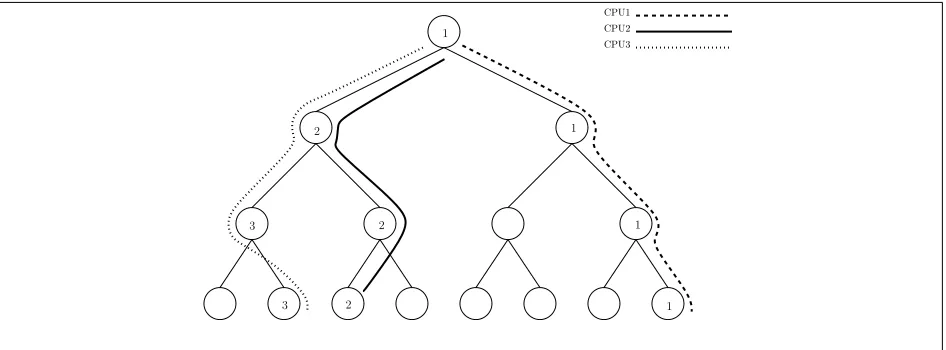
Figure 3: Procedure for combining CPUs’ instructions for buckets and implementing them by a single representative CPU. (Used for correctness, not security). See Figure 4 for a sample illustra-tion.
Lemma 3.5. For any n, m∈N, The compilerHeavy-O is a secure Oblivious PRAM compiler with
parallel time overhead O(log3n) and memory overhead ω(1), assuming each CPU has Ω(m)˜ local memory.
We will address the desired claims of correctness, security, and complexity of the Heavy-O compiler by induction on the number of levels of recursion. Namely, for t∗ ∈ [logαn], denote by
Heavy-Ot∗ the compiler that acts on memory size n/(αt
∗
) by executing Heavy-O only on recursion levels t=t∗,(t∗+ 1), . . . ,dlog
αne. For each such t∗, we define the following property.
Level-t∗ Heavy OPRAM: We say thatHeavy-O
t∗ is avalid level-t∗ heavy OPRAMif the
partial-recursion compilerHeavy-Ot∗ is a secure Oblivious PRAM compiler for memory size n/(αt ∗
) with parallel time overheadO(log2n·log(n/αt∗)) and memory overhead ω(1), assuming each
CPU has ˜Ω(m) local memory.
Then Lemma 3.5 follows directly from the following two claims.
CPU1 CPU2 CPU3 1
2
3
3
2
2
1
1
1
Figure 4: UpdateBuckets sample illustration. Here, CPUs 1-3 each wish to modify nodes along their paths as drawn; for each overlapping node, the CPU with lowest id receives and implements the aggregated commands for the node.
Proof. Note thatHeavy-Ologαn, acting on trivial size-1 memory, corresponds directly to the exit case (Step 0) of Heavy-OPAccess in Figure 2. Namely, correctness, security, and the required efficiency trivially hold, since there is a single data item in a fixed location to access.
Claim 3.7. Suppose Heavy-Ot is a valid level-t heavy OPRAM for t > 0. Then Heavy-Ot−1 is a
valid level-(t−1) heavy OPRAM.
Proof. We first analyze the correctness, security, and complexity overhead of Heavy-Ot−1
condi-tioned on never reaching the event overflow (which may occur in Step 5(c), or within the call to
UpdateBuckets). Then, we prove that the probability of overflow is negligible inn.
Correctness (w/o overflow). Consider the state of the memory (of the CPUs and server) in each step of Heavy-OPAccess, assuming no overflow. In Step 1, each CPU learns the instruction pairs of all other CPUs; thus all CPUs agree on single representative rep(bi) for each requested
block bi, and a correct aggregation of all instructions to be performed on this block. Step 2 is a
recursive execution ofHeavy-OPAccess. By the inductive hypothesis, this access successfully returns the correct value `i of Pos(bi) for each bi queried, and rewrites it with the freshly sampled value
`0
i when specified (i.e., for each rep(bi) access; the dummy accesses are read-only). We are thus
guaranteed that each rep(bi) will find the desired block bi in Step 3 when accessing the memory
buckets in the path down the tree to leaf `i (as we assume no overflow was encountered), and so
will learn the current stored data value vold.
In Step 4, each CPU learns the target block bi and associated leaf `i of every representative
CPU rep(bi). By construction, each requested blockbi appears in some bucketB in the tree along
his path, and there there will necessarily be some CPU assigned asbucket-rep(B) inUpdateBuckets, who will then successfully remove the blockbi fromB. At this point, none of the requested blocks
bi appear in the tree.
In Step 5, the CPUs insert each blockbi (with updated data valuevi) into the ORAM data tree
at level min{logαn/αt,blog
2(m)c} along the path to its (new) leaf `0i.
Finally, the flushing procedure in Step 6 maintains the necessary property that each block bi
appears along the path to Pos(bi), and in Step 7 all CPUs learn the collection of all queried values
vold (in particular, including the value they initially requested).
Thus, assuming no overflow, correctness holds.
Obliviousness (w/o overflow). Consider the access patterns to server-side memory in each step
of Heavy-OPAccess, assuming no overflow. Step 1 is performed locally without communication to
the server. Step 2 is a recursive execution of Heavy-OPAccess, which thus yields access patterns independent of the vector of queried data locations (up to statistical distance negligible in n), by the induction hypothesis. In Step 3, each CPU accesses the buckets along a single path down the tree, where representative CPUsrep(bi) access along the path given byPos(bi) (fordistinctbi), and
non-representative CPUs each access down an independent, random path. Since the adversarial view so far has been independent of the values ofPos(bi), conditioned on this view all CPU’s paths
are independent and random.
In Step 4, all data access patterns are publicly determinable based on the accesses in the previous step (that is, the complication in Step 4 is to ensure correctness without access collisions, but is not needed for security). In Step 5, each CPU iaccesses his corresponding bucketiin the tree. In the flushing procedure of Step 6, each CPU selects an independent, random path down the tree, and the communication patterns to the server reveal no information beyond the identities of these paths. Finally, Step 7 is performed locally without communication to the server.
Thus, assuming no overflow, obliviousness holds.
Protocol Complexity (w/o overflow). First note that the server-side memory storage require-ment is simply that of the [CP13] ORAM construction, together with the log(2nt/K) tree-depth
memory optimization of [GHL+14]; namely, f(n) memory overhead suffices for anyf ∈ω(1).
Consider the local memory required per CPU. Each CPU must be able to store: O(logn)-size requests from each CPU (due to the broadcasts in Steps 1(a), 4(a), 5(a), and 7); and the data contents of at most 3 memory buckets (due to the flushing procedure inUpdateBuckets). Overall, this yields a per-CPU local memory requirement of ˜Ω(m) (where ˜Ω notation hides lognfactors).
Consider the parallel complexity of the OPRAM-compiled program Π0 ←Heavy-O(m, n,Π). For each parallel memory access in the underlying program Π, the processors perform: Conflict resolu-tion (1 local communicaresolu-tion round), Read/writing the posiresolu-tion map (which has parallel complexity O(log2n·log(n/αt)) by the inductive hypothesis), Looking up current memory values (sequential
steps = depth of level-(t−1) ORAM tree ∈O(log(n/αt−1))), Removing old data from the ORAM
tree (1 local communication round, plus depth of the ORAM tree ∈ O(log(n/αt−1)) sequential
steps), Inserting the new data in parallel (1 local communication round, plus 1 communication round to the server), Flushing the ORAM database (1 local communication round, and 2× the depth of the ORAM tree rounds of communication with the server, since each bucket along a flush path is accessed once to receive new data items and once to flush its own data items down), and Up-dating CPUs with the read values (1 local communication round). Altogether, this yields parallel complexity overhead O(log2n·log(n/αt−1)).
It remains to address the probability of encountering overflow.
Π0(m, n, x) outputs overflow is bounded by µ(n).
Proof. We consider separately the probability of overflow in each of the level-t recursive ORAM trees. Since there aredlogne of them, the claim follows by a straightforward union bound.
Taking inspiration from [CP13], we analyze the ORAM-compiled execution via an abstract dart game. The game consists of black and white darts. In each round of the game, m black darts are thrown, followed by m white darts. Each dart independently hits the bullseye with probability p = 1/m. The game continues until exactly K darts have hit the bullseye (recall K ∈ω(logn) is the bucket size), or after the end of the Tth round for some fixed polynomial bound T = T(n), whichever comes first. The game is “won” (which will correspond tooverflowin a particular bucket) ifK darts hit the bullseye, and all of them are black.
Let us analyze the probability of winning in the above dart game.
Subclaim 1: With overwhelming probability in n, no more than K/2 darts hit the bullseye in any round. In any single round, associate with each of the 2·m darts thrown an indicator variable Xi for whether the dart strikes the target. TheXi are independent random variables each equal to
1 with probability p= 1/m. Thus, the probability that more than K/2 of the darts hit the target is bounded (via a Chernoff tail bound3) by
Pr "2m
X
i=1
Xi > K/2
#
≤e2(K/4
−1)2
2+(K/4−1) ≤e−Ω(K)≤e−ω(logn).
Since there are at mostT =poly(n) distinct rounds of the game, the subclaim follows by a union bound.
Subclaim 2: Conditioned on no round having more thanK/2bullseyes, the probability of winning the game is negligible in d. Fix an arbitrary such winning sequence s, which terminates sometime during some round r of the game. By assumption, the final partial roundr contains no more than K/2 bullseyes. For the remaining K/2 bullseyes in rounds 1 through r−1, we are in a situation mirroring that of [CP13]: for each such winning sequence s, there exist 2K/2−1 distinct other
“losing” sequences s0 that each occur with the same probability, where any non-empty subset of black darts hitting the bullseye are replaced with their corresponding white darts. Further, every two distinct winning sequencess1, s2yield disjoint sets of losing sequences, and all such constructed
sequences have the property that no round has more thanK/2 bullseyes (since this number of total bullseyes per round is preserved). Thus, conditioned on having no round with more than K/2 bullseyes, the probability of winning the game is bounded above by 2−K/2∈e−ω(logn).
We now relate the dart game to the analysis of our OPRAM compiler.
We analyze the memory buckets at the nodes in the t-th recursive ORAM tree, via three sub-cases.
Case 1: Nodes in level lev<logm. Since data items are inserted to the tree in parallel directly at level logm, these nodes do not receive data, and thus will not overflow.
Case 2: Consider any internal node (i.e., a node that is not a leaf) γ in the tree at level logm≤lev<log(Lt). (RecallLt:= 2nt/K is the number of leaves in the t’th tree when applying
the [GHL+14] optimization). Note that whenm > L
t, this case is vacuous. For purposes of analysis,
consider the contents of γ as split into two parts: γL containing the data blocks whose leaf path
3Explicit Chernoff bound used: for
X =X1+· · ·X2m(Xi independent) and meanµ, then for anyδ >0, it holds that Pr[X >(1 +δ)µ]≤e−δ2µ/(2+δ).
continues to the left from γ (i.e., leaf γ||0||·), and γR containing the data blocks whose leaf path
continues right (i.e.,γ||1||·). For the bucket of nodeγ to overflow, there must beK tuples in it. In particular, eitherγL orγR must haveK/2 tuples.
For each parallel memory access in Π(m, n, x), in the t-th recursive ORAM tree for which nt ≥ m/K, (at most) m data items are inserted, and then m independent paths in the tree are
flushed. By definition, an inserted data item will enter our bucket γL (respectively, γR) only if
its associated leaf has the prefix γ||0 (resp., γ||1); we will assume the worst case in whichall such data items arrive directly to the bucket. On the other hand, the bucket γL (resp., γR) will be
completely emptied after any flush whose path contains this same prefixγ||0 (resp.,γ||1). Since all leaves for inserted data items and data flushes are chosen randomly and independently, these events correspond directly to the black and white darts in the game above. Namely, the probability that a randomly chosen path will have the specific prefixγ||0 of lengthlevis 2−lev≤1/m(since we consider
lev≥logm); this corresponds to the probability of a dart hitting the bullseye. The bucket can only overflow if K/2 “black darts” (inserts) hit the bullseye without any “white dart” (flush) hitting the bullseye in between. By the analysis above, we proved that for any sequence of K/2 bullseye hits, the probability that allK/2 of them are black is bounded above by 2−K/4, which is negligible
inn. However, since there is a fixed polynomial number T =poly(n) of parallel memory accesses in the execution of Π(m, n, x) (corresponding to the number of “rounds” in the dart game), and in particular, T(2m) ∈ poly(n) total darts thrown, the probability that the sequence of bullseyes contains K/2 sequential blacks anywherein the sequence is bounded via a direct union bound by (T2m)2−K/4 ∈e−ω(logn), as desired.
Case 3: Consider any leaf node γ. This analysis follows the same argument as in [CP13] (with slightly tweaked parameters from the [GHL+14] tree-depth optimization). For there to be an
overflow in γ at time t, there must be K+ 1 out ofnt/αelements in the position map that map
to the leafγ. Since all positions are sampled uniformly and independently among theLt:= 2nt/K
different leaves, the expected number of elements mapping to γ is µ =K/2α, and by a standard multiplicative Chernoff bound,4 the probability that K + 1 elements are mapped to γ is upper
bounded by
e1
(1 + 1)(1+1)
µ
≤(21/3)−K/2α∈2−ω(logn).
Thus, the total probability of overflow is negligible inn, and the theorem follows.
3.2 Oblivious Distributed Insertion, Aggregation, and Multi-Cast
3.2.1 Oblivious Parallel Insertion (Oblivious Routing)
Recall during the memory “put-back” phase, each CPU must insert its data item into the bucket at level logm of the tree lying along a freshly sampled random path, whilehiding the path.
We solve this problem by delivering data items to their target locations via a fixed-topology routing network. Namely, the m processorsCP U1, . . . , CP Um will first write the relevant m data
items msgi (and their corresponding destination addresses addri) to memory in fixed order, and
4We use the following version of the Chernoff bound: LetX1, . . . , L
nbe independent [0,1]-valued random variables. LetX=P
iXiandµ=E[X]. For everyδ >0, Pr[X≥(1 +δ)µ]≤
eδ
(1+δ)(1+δ) µ
Parallel Insertion Routing Protocol Route(m,(msgi,addri))
Input: CP Ui holds: messagemsgi with target destinationaddri, and global thresholdK.
Output: CP Ui holds {msgj :addrj =i}.
Letlev∗ = logm (assumed∈N for simplicity). EachCP Ui performs the following.
Initialize Mi,0 ←msgi. Fort= 1, . . . ,lev∗:
1. Perform the following symmetric message exchange withCP Ui⊕2t:
Mi,t+1 ← {msgj ∈Mi,t∪Mi⊕2t,t: (addrj)t= (i)t}.
2. If|Mi,t+1|> K (i.e., memory overflow), thenCP Ui aborts.
Figure 5: Fixed-topology routing network for delivering mmessages originally held by m proces-sors to their corresponding destination addresses within [m].
then rearrange them in logmsequential rounds to the proper locations via the routing network. At the conclusion of the routing procedure, each nodejwill hold all messagesmsgi for whichaddri =j.
For simplicity, assume m = 2` for some ` ∈
N. The routing network has depth `; in each
level t= 1, . . . , `, each node communicates with the corresponding node whose id agrees in all bit locations except for the tth (corresponding to his tth neighbor in the logm-dimensional boolean hypercube). These nodes exchange messages according to thetth bit of their destination addresses
addri. This is formally described in Figure 5. After the tth round, each message msgi is held by a
party whose id agrees with the destination address addri in the firsttbits. Thus, at the conclusion
of `rounds, all messages are properly delivered.
We demonstrate the case m = 8 = 23 below: first, CPUs exchange information along the
depicted communication network in 3 sequential rounds (left); then, each CPUiinserts his resulting collection of items directly into nodei of level 3 of the data tree (right).
CPUs
1 2 3 4 5 6 7 8
1 2 3 4 5 6 7 8
We show that if the destination addressesaddri are uniformly sampled, then with overwhelming
probability no node will ever need to hold too many (the threshold K will be set to ω(logn)) messages at any point during the routing network execution:
Lemma 3.9 (Routing Network). If L messages begin with target destination addresses addri
dis-tributed independently and uniformly over [L]in theL-to-L node routing network in Figure 5, then with probability bounded by 1−(LlogL)2−K, no intermediate node will ever hold greater than K
messages at any point during the course of the protocol execution.
Proof. Consider an arbitrary node a∈ {0,1}`, at some levelt of execution of the protocol. There
are precisely 2t possible messages m
i that could be held by node a at this step, corresponding to
those originating in locations b ∈ {0,1}` whose final `−t bits agree with those of a. Node a will
hold message mb at the conclusion of round t precisely if the first t bits of addrb agree with those
of a. For each such message mb, the associated destination address addrb is a random element of
[L], which agrees with aon the firstt bits with probability 2t.
For eachb∈ {0,1}` agreeing withaon the final`−tbits, defineX
b to be the indicator variable
that is equal to 1 ifaddrbagrees withaon the firsttbits. Then the collection of 2trandom variables {Xb :bi =ai ∀i=t+ 1, . . . , `} are independent, and X =PXb has mean µ= 2t·2−t = 1. Note
thatX corresponds to the number of messages held by node aat levelt. By a Chernoff bound,5 it
holds that
Pr[X≥K] = Pr[X≥(1 + (K−1))µ]<
eK−1
KK
<2−K.
Then, taking a union bound over the total number of nodes L and levels`= logL, we have that the probability of any node experiencing an overflow at any round is bounded by (LlogL)2−K.
3.2.2 Oblivious Aggregation
To perform the “CPU-coordination” phase, the CPUs efficiently identify a single representative and
aggregaterelevant CPU instructions; then, at the conclusion, the representative CPU must be able to multi-cast the resulting information to all relevant requesting CPUs. Most importantly, these procedures must be donein an oblivious fashion. In this section, we address oblivious aggregation; we treat the dual multi-cast problem in Section 3.2.3.
Formally, we want to achieve the following aggregation goal, with communication patterns independent of the inputs, using only O(log(m)polylog(n)) local memory and communication per CPU, in only O(log(m)) sequential time steps. An illustrative example to keep in mind is where
keyi = bi, datai = vi, and Agg is the process that combines instructions to data items within the
same data block, resolving conflicts as necessary.
Oblivious aggregation:
Input: Each CPU i ∈ [m] holds (keyi,datai). Let K = S{keyi} denote the set of distinct keys.
We assume that any (subset of) data associated with the same key can be aggregated by an aggregation functionAgg to a short digest of size at most poly(`,logm), where `=|datai|.
Goal: Each CPUioutputs outi such that the following holds.
– For every key ∈K, there exists unique agent iwith keyi =key s.t. outi = (rep,key,aggkey),
whereaggkey =Agg({dataj :keyj =key}).
– For every remaining agent i,outi = (dummy,⊥,⊥).
At a high level, we achieve this via the following steps. (1) First, the CPUs sort their data list with respect to the corresponding key values. This can be achieved via an implementation of a log(m)-depth sorting network, and provides the useful guarantee that all data pertaining to the same key are necessarily held by an block of adjacent CPUs. (2) Second, we pass data among CPUs in a sequence of log(m) steps such that at the conclusion the “left-most” (i.e., lowest indexed) CPU in each key-block will learn the aggregation of all data pertaining to this key. Explicitly, in each stepi, each CPU sends all held information to the CPU 2i to the “left” of him, and simultaneously
accepts any received information pertaining to his key. (3) Third, each CPU will learn whether he is the “left-most” representative in each key-block, by simply checking whether his left-hand
5Exact Chernoff bound used: Pr[X >(1 +δ)µ]< eδ
(1+δ)1+δ µ
neighbor holds the same key. From here, the CPUs have succeeded in aggregating information for each key at a single representative CPU; (4) in the fourth step, they now reverse the original sorting procedure to return this aggregated information to one of the CPUs who originally requested it.
Lemma 3.10 (Space-Efficient Oblivious Aggregation). Suppose m processors initiate protocol OblivAgg w.r.t. aggregator Agg, on respective inputs {(keyi,datai)}i∈[m], each of size `. Then at
the conclusion of execution, each processor i∈[m] outputs a triple (rep0i,key0i,data0i) such that the following properties hold (where asymptotics are w.r.t. m):
1. The protocol terminates in O(logm) rounds.
2. The local memory and computation required per processor is O(logm+`).
3. (Correctness). For every key key ∈ S
{keyi}, there exists a unique processor i with output key0i=key. For each such processor, it further holds thatkey0i =keyi,rep0i= “rep”, anddata0i=
Agg({dataj :keyj =keyi}). For every remaining processor, the output tuple is(dummy,⊥,⊥).
4. (Obliviousness). The inter-CPU communication patterns are independent of the inputs(keyi,datai).
A full description of our Oblivious Aggregation procedure OblivAgg is given in Figure 6.
Proof of Lemma 3.10. Property (1): Steps 1 and 4 ofOblivAggeach execute a sorting network, and require communication rounds equal to the depthd∈O(logm) of the sorting network implemented. Step 2 takes place in logm sequential steps. Step 3 requires a single round. And Step 5 (output) takes place locally. Thus, the combined round complexity ofOblivAgg isO(logm).
Property (2): We first address the size the individual items stored, and then ensure the number of stored items is never too large.
• Keys (e.g.,keyi,tempkeyi): Each key is bounded in size by the initial input size`.
• Data (e.g., datai,datatempi,aggdatai): Similarly, by the property of the aggregation function Agg, we are guaranteed that each data item is bounded in size by the original data size, which is in turn bounded by size`.
• CPU identifiers (e.g., sourceidi,idtempi): Each processor can be identified by bit string of
length logm.
• Representative flag (repi): The rep/dummy flag can be stored as a single bit.
Each processor begins with input size`. In each round of executing the first sorting network (Step
1 of OblivAgg), a processor must hold two sets of data (sourceid,keytemp,datatemp),
correspond-ing to at most 2(logm+ 2`) storage. Note that no more than 2 tuples are required to be held at any time within this step, as the processors exchange tuples but need not maintain both val-ues. In each round of the Aggregation phase (Step 2), processors may need to store two pairs
(keytemp,datatemp) in addition to the information held from the conclusion of the previous step
(namely, a single valuesourceidi), which totals to logm+2(2`) memory. Note that by the properties
of the aggregation schemeAgg, the size of the aggregated data does not grow beyond`(and recall that parties do not maintain data associated with any different key). In the Representative Iden-tification phase (Step 3), each processor receives one additional key value keyi−1, which requires
memory logm, and is then translated to a single-bit flagrepi and then deleted. In the Reverse Sort phase (Step 4), processors within each round must again store two tuples, this time of the form
(idtemp,rep,keytemp,datatemp), which corresponds to 2(logm+ 1 +`+`) memory. Thus, the total
local memory requirement per processor is bounded byO(logm+`).
Oblivious Aggregation Procedure OblivAgg (w.r.t. Agg)
Input: Each CPU i∈[m] holds a pair (keyi,datai).
Output: Each CPU i ∈ [m] outputs a triple (repi,keyi,aggdatai) corresponding to either
(dummy,⊥,⊥) or withaggdatai=Agg({dataj :keyj =keyi}), as further specified in Section 3.2.
1. Sort on keyi. EachCP Uiinitializes a triple (sourceidi,keytempi,datatempi)←(i,keyi,datai).
For each layer L1, . . . , Ldin the sorting network:
• LetL` = ((i1, j1), . . . ,(im/2, jm/2)) be the comparators in the current layer `.
• In parallel, for each t∈ [m/2], the corresponding pair of CPUs (CP Uit, CP Ujt) perform the following pairwise sort w.r.t.key:
Ifkeytempjt <keytempit, then
swap (sourceidit,keytempit,datatempit)↔(sourceidjt,keytempjt,datatempjt). 2. Aggregate to left. Fort= 0,1, . . . ,logm:
• (Pass to left). Each CP Ui for i > 2t sends his current pair (keytempi,datatempi) to
CP Ui−2t.
• (Aggregate). Each CP Ui for i < m−2t receiving a pair (keytempj,datatempj) will
aggregate it into own pair if the keys match. That is, if keytempi = keytempj, then set
datatempi ←Agg(datatempi,datatempj). In both cases, the received pair is then erased.
The left-mostCP Ui withkeytempi =key now hasAgg({datatempj :keytempj =key})).
3. Identify representatives. For each value keyj, the left-most CPU i currently holding
keytempi =keyj will identify himself as (temporary) representative.
• EachCP Ui fori < m: send keytempi to right-hand neighbor, CP Ui+1.
• Each CP Ui for i > 1: If the received value keytempi−1 matches his own keytempi, then
setrepi ← “dummy” and zero out keytempi ← ⊥,datatempi ← ⊥. Otherwise, set repi ←
“rep”. (CP U1 always setsrep1←“rep”).
4. Reverse sort (i.e., sort on sourceidi). Return aggregated data to a requesting CPU.
For each layer L1, . . . , Ldin the sorting network:
• LetL` = ((i1, j1), . . . ,(im/2, jm/2)) be the comparators in the current layer `.
• EachCP Ui initializes idtemp←sourceidi. Inparallel, for each t∈[m/2], the
correspond-ing pair of CPUs (CP Uit, CP Ujt) perform the following pairwise sort w.r.t.sourceid: Ifidtempjt <idtempit, then
swap (idtempit,repit,keytempit,datatempit)↔(idtempjt,repjt,keytempjt,datatempjt). At the conclusion, eachCP Uiholds a tuple (idtempi,repi,keytempi,datatempi) withidtempi=
iand keytempi =keyi.
5. Output. EachCP Ui outputs the triple (repi,keyi,datatempi).
Property (3): We now prove that the protocol results in the desired output. Consider the values stored by each processor at the conclusion of each phase of the protocol.
After the completion of Step 1, by the correctness of the utilized sorting network, it holds that eachCP Ui holds a tuple (sourceidi,keytempi,datatempi) such that the list (sourceid1, . . . ,sourceidm)
is some permutation of [m], andkeytempi ≤keytempj for everyi < j. Note that for eachiit always the case that the pair (keytempi,datatempi) currently held byCP Ui is precisely the original input
pair ofCP Uj forj=sourceidi.
For the Aggregation phase in Step 2, we make the following claim.
Claim 3.11. At the conclusion of Aggregate Left (Step 2), the CPU of lowest index i for which keytempi =key holdsdatatempi =Agg({dataj :keyj =key}) (for each value key).
Proof. Fix an arbitrary value key, and let Skey ⊂ [m] denote the subset of processors for which
keytempi =key. From the previous sorting step, we are guaranteed thatSkey consists of an interval
of consecutive processorsistart, . . . , istop. Now, consider anyj∈Skey (whose data CPUistart wishes
to learn).
For any pair of indices i < j ∈ Skey, denote by ti,j := max{t ∈ [logm] : (j⊕istart)t = 1} ∈ {0,1, . . . ,logm−1}the highest index in which the bit representations of j and istart disagree. We
now prove that for each such pair i, j,CP Ui will learnCP Uj’s data after roundti,j ≤logm. The
claim will follow, by applying this statement to each pair (istart, j) withj∈Skey.
Induct on ti,j. Base caseti,j = 0: follows immediately from the protocol construction; namely,
in the 0-th round, each CPUj sends his data to CPU (j−1), which in this case is precisely CPU i. Now, suppose the inductive hypothesis holds for alli < j withti,j =t, and consider a pairi < j
withti,j =t+ 1. In roundt+ 1 of the protocol, processorireceives from processor (i+ 2t+1) the
collection of all information it has aggregated up to round t. By the definition of ti,j, we know
that i < (i+ 2t+1) ≤j, and that t
(i+2t+1),j ≤ t. Indeed, we know that iand j differ in bit index
(t+ 1), and no higher; thus, (i+ 2t) must agree with j in index (t+ 1) in addition to all higher
indices. But, this means by the inductive hypothesis that CPU (i+ 2t) has learned CPU j’s data
in a previous round. Thus, CPUiwill learn CPU j’s data in roundt+ 1, as desired.
In Step 3, each processor learns whether his left-hand neighbor holds the same temporary key as he does; that is, he learns whether or not he is the left-most CPU holding tempkeyi (and, in turn, holds the complete aggregation of all data relating to this key). Each processor for whom this is not the case sets his tuple to (dummy,⊥,⊥).
At this point in the protocol, the processors have successfully reached the state where a single self-identified representative for each queried key holds the desired data aggregation. The final step is to return these information tuples to some CPU who originally requested this key. This is achieved in the final reverse sort (Step 4). Namely, by the correctness of the implemented sorting network, at the conclusion of Step 4 each CP Ui holds a tuple (idtempi,repi,keytempi,datatempi)
such that the ordered list (idtemp1, . . . ,idtempm) is precisely the ordered list 1, . . . , m. Since the tuples (idtempi,repi,keytempi,datatempi) are never modified (only swapped between processors), it remains to show that each non-dummy (repi,keytempi,datatempi) tuple is received by an appropri-ate requesting CPU. But, that is precisely the information held byidtempi: the identity of the CPU who made the original request with respect to key keytempi. Thus, the reverse sort successfully routes the aggregated tuples back to a CPU making the correct key request.
![Figure 1: Illustration of the basic [CP13] ORAM construction.](https://thumb-us.123doks.com/thumbv2/123dok_us/7911047.1313540/9.612.71.546.70.295/figure-illustration-basic-cp-oram-construction.webp)
![Figure 5: Fixed-topology routing network for deliveringsors to their corresponding destination addresses within [ m messages originally held by m proces-m].](https://thumb-us.123doks.com/thumbv2/123dok_us/7911047.1313540/18.612.160.452.437.526/figure-topology-deliveringsors-corresponding-destination-addresses-messages-originally.webp)
